
I went to Poland to find some of my roots. I’m not Polish but my maternal great grandparents immigrated from Glatz, Germany which now lies within Poland. Poland has morphed over hundreds of years and for over 100 years (1795 to 1918) it didn’t even exist. My great grandparents left in the 1880’s for the United States and Olean, New York. Krakow is the largest Polish city close to Glatz and it’s one of the main reasons I took a Road Scholar tour to Poland which started in Warsaw. The contrast with Warsaw is dramatic. Warsaw had 85% of it’s structures destroyed and was rebuilt by the Soviets, most of it is a cold, dull gray; Krakow on the other hand is vibrant and historic.
We took a train from Warsaw and easily walked from the train station in Krakow to the main square of Krakow. We entered via St. Florian’s Gate which was built in the 14th century. As you enter the historic square there is a relief of St. Florian who was the patron saint of firefighters and he is depicted pouring water on a fire. Old Town Krakow was originally established in 1257 and the sheer size of what was once a walled city is staggering. At the center of the market square is the stand the Renaissance cloth hall,Sukiennice,, which was completed in 1358. It still has advertisements on the wall for the inks and dyes used in the making of cloth. Within the “Cloth Hall” are gift shops with handmade crafts. It’s easy to imagine that you are a traveling merchant in the 15th century coming for imports from the east like spices and silk or selling the local textiles or salt from the local salt mine. We arrived on a Sunday and there were hundreds of tourists in the Market Square even though this was late October.
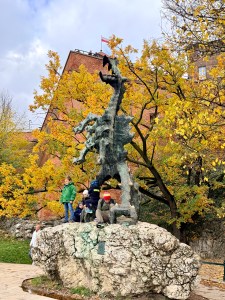
The statue of the Wawel Dragon in Krakow Poland
In a lecture later in our visit, we found out that the walls around Old Town Krakow were demolished around 1814 and were replaced with extensive park land around the city. So, when walking out of the old town you have this feeling that you are leaving it entirely. It’s quite the beautiful transition.
We toured the area of Wawel Hill which overlooks that entire city. At the base stands the Wawel Dragon which legend says a shoemaker defeated the dragon that lived in a cave beneath Wawel Hill. This accounts for the dragon being a symbol of Krakow. On top of the hill is a palace and cathedral. John Paul II was the archbishop of Krakow and his statue stands outside the cathedral. The kings of Poland were elected (very unusual) and received the crown at Wawel Cathedral. In fact, there were two female kings in Poland’s rich history. Krakow was the capital for most of Poland’s history. Wawel Palace originated in 970 A.D. and has served as the primary residence for Polish monarchs for over five centuries. It’s all quite impressive as it imposingly stands over the city and the Vistula River.
We left Krakow and drove 90 minutes to the Auschwitz and Birkenau museums. Auschwitz is largely brick buildings and in relation to Birkenau is quite small. Originally, it was built as army barracks. The Nazi’s took it over and created a concentration camp. It’s quite emotional to walk in via the gate with the sign above that says in German “Work Shall Set You Free”. In reality most did not survive or given the opportunity to work. We were led by a guide throughout the camp and the shear magnitude of the horrors unfold as you walk into various block numbers. There is a map on the wall of all the various European cities that deported Jews and political criminals to the gates of Auschwitz. Between 1940-1945 at least 1.3 million people were deported to Auschwitz. 1 million of them were Jews and about half those were Hungarian Jews. We walked past piles of shoes, glasses and suitcases and the most devastating of which was the room full of human hair. They have been sitting here for 80 years left behind by terrified souls. There is an energy here that is residual, abject fear. I felt it.
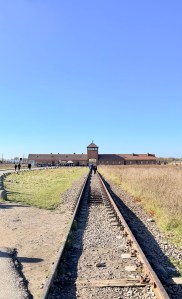
The Birkenau portion is two miles away which has the infamous train tracks through the Death Gate. Birkenau is enormous. It was 10 times the size of Auschwitz. It and was a death camp with its 4 massive crematoriums. This is where the wooden barracks were and box cars with upwards of 100 prisoners per car. This is where selections were made in a matter of seconds as to whether someone would live or die. This is where 5-7 people laid together on the same bunk. Most residents were sent out daily as slave labor, walking in wooden clogs and numbered striped uniforms. They were brought back at the end of the day if they were allowed to live. Most were not.
Before I left on this trip, I knew that it involved going to Auschwitz-Birkenau. I briefly thought about skipping it. It’s a heavy, exhausting day but I felt that I needed to witness the struggles of these people. Perhaps for a few hours carrying their pain. It’s an acknowledgment of humanity at its darkest hour. There were reams of young adults (you have to be 14 years old to visit) funneling through the rooms. I can only hope that this informs our next generations to keep this from happening again. Never forget.
Written by a human.


Poland has been on my list of potential travel destinations for a while, and Krakow is definitely one of the cities I’d visit if I go. I’ve been agonizing over whether I’d go to Auschwitz if and when I’m there. I fear it might be too emotionally overwhelming. Plus, while I think it’s important to bear witness, I worry about it being just a tourist attraction for people to check off their list.
Thanks for your post.
LikeLiked by 1 person
Auschwitz is never taken lightly by anyone entering. I can assure you.
LikeLiked by 1 person