
I came to Warsaw in October of 2026. I was part of a tour with Road Scholar Tours (which is a play on Rhode Scholar) and my main reason to come to Poland was to investigate part of my maternal family heritage. My maternal great grandfather and mother as well as his father left Lower Silesia in the 1880’s when it was part of Germany, their hometown region, Glatz, now sits within Poland right on the Czech Republic border. I can read about an area or watch a YouTube on its history but actually setting foot in a place that has had so much turbulence over the last 200 years is enlightening.
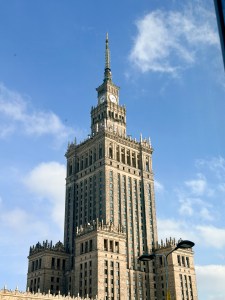
I usually arrive at least a day early for a tour in order to recover from jet lag. My hotel was right across from Swietokrzyski Park. In the center of the park is the Palace of Culture and Science which is a 778-foot skyscraper that was a “gift” from the Soviets under Joseph Stalin. I explored two museums within this immense complex. The National Museum of Technology in Warsaw is an interesting look at innovation over the last 100 years from a Polish perspective including what a teenage bedroom looked like in the 60’s and 80’s with Rolling Stone and Backstreet Boys posters on the wall. The Neon Museum was very interesting because neon was used for both capitalism and propaganda as Warsaw cycled through being a Polish Republic to Nazi occupation to Soviet control and then finally a return to private enterprise with the fall of communism. They showed a 50-minute film in English and Polish that educated me on the turbulence I already mentioned, that occurred over a 100-year period from the 1920’s to present day.
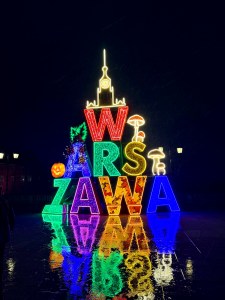
When I joined the group, our guide, Krys, took us on a walking tour of Warsaw to point out the communist propaganda that is still present throughout Warsaw. From plaques and statues and enormous avenues for marching armies, there are many reminders of the Soviet occupation. What was most educational were the stories that Krys, who is in his 50’s, told of growing up under Soviet controlled Poland. When he was a teenager, he and his friend got up at 3 AM to head to a shoe store where he was the 110th person in a line to get shoes at a store that opened at 10 AM. He said that when he finally got his turn, he grabbed two pairs of shoes of unknown size. No trying on, no choice of color, just grab and go. One pair he gave to his father and he traded the other on the black market to get a correct fitting pair of shoes.
In another story, he told of his family driving to another Soviet block country. They had to request their passports from the authorities and then his father took a shortcut through part of Russia. When they wanted to cross the border, he was issued a fine for taking the short cut (it saved several hundred miles) and they had to go back to the starting point to pay the fine. Needless to say, they didn’t take the shortcut again. It’s one thing to read dates on the start and end of Soviet control, it’s quite another to hear a first-hand account of the impact of that Soviet control.
Poland was at the crossroads of three empires that wanted to control it. The Russians, the Prussians (later Germany) and the Hapsburgs (later Austria). These three empires divided up Poland in 1795, and independent Poland did not exist from 1795 to 1918. This for me, accounts for the fact that my great grandparents spoke German even though their hometown is now in Poland. There was a second Polish republic in 1918 at the end of World War I. Herbert Hoover is revered in Poland for his humanitarian aid. In 1939, both the Soviets and Germans invaded which ushered in a brutal occupation and the Holocaust.
Warsaw was demolished during World War II, with 85% of the buildings being leveled. The entire Old Town section with the exception of one church was gone. We took a tour of Old Town Warsaw and the entire place has been painstakingly rebuilt, so much so, that it is now a UNESCO World Heritage site. It’s quite amazing to walk cobblestone streets with colorful facades that look 300 years old but were completed in the 1960’s. This is in stark contrast to the dull gray slabs of Soviet occupation. We ate in a restaurant that was several hundred years old, it was a basement and untouched by destruction.
The Jewish ghettos that were built by the Nazi’s are gone. I highly recommend watching the movie “The Pianist” if you want to understand the painful history of the Nazi created ghettos to “house” what was the largest Jewish population (30%) in Europe. When the Nazi’s arrived there were 375,000 Jews that were rehoused into two ghettos. Outside of monuments for uprisings and the eventual deportation of Jews to Treblinka death camp, nothing remains but street names.
On our final day in Warsaw, we went to the POLIN museum which shows the 1,000-year history of Jews. It is one of the best museum experiences I’ve had because it’s self guided but the headset seamlessly narrates as you enter each room.
Perhaps the most astounding fact for me is that Hitler succeeded in practically eliminated the race he so vehemently hated. Warsaw went from 375,000 Jews in 1939 to 17,156 Jews in 2021. Where once they enjoyed a free existence to worship and gather, there are few. What artists, writers, brilliant minds and creators did we lose in that massacre? We must always remember. We must never forget.

