Intriguing Krakow 🐉

I went to Poland to find some of my roots. I’m not Polish but my maternal great grandparents immigrated from Glatz, Germany which now lies within Poland. Poland has morphed over hundreds of years and for over 100 years (1795 to 1918) it didn’t even exist. My great grandparents left in the 1880’s for the United States and Olean, New York. Krakow is the largest Polish city close to Glatz and it’s one of the main reasons I took a Road Scholar tour to Poland which started in Warsaw. The contrast with Warsaw is dramatic. Warsaw had 85% of it’s structures destroyed and was rebuilt by the Soviets, most of it is a cold, dull gray; Krakow on the other hand is vibrant and historic.

We took a train from Warsaw and easily walked from the train station in Krakow to the main square of Krakow. We entered via St. Florian’s Gate which was built in the 14th century. As you enter the historic square there is a relief of St. Florian who was the patron saint of firefighters and he is depicted pouring water on a fire. Old Town Krakow was originally established in 1257 and the sheer size of what was once a walled city is staggering. At the center of the market square is the stand the Renaissance cloth hall,Sukiennice,, which was completed in 1358.  It still has advertisements on the wall for the inks and dyes used in the making of cloth. Within the “Cloth Hall” are gift shops with handmade crafts. It’s easy to imagine that you are a traveling merchant in the 15th century coming for imports from the east like spices and silk or selling the local textiles or salt from the local salt mine. We arrived on a Sunday and there were hundreds of tourists in the Market Square even though this was late October.
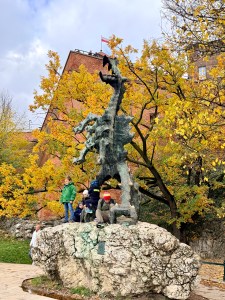
The statue of the Wawel Dragon in Krakow Poland

In a lecture later in our visit, we found out that the walls around Old Town Krakow were demolished around 1814 and were replaced with extensive park land around the city. So, when walking out of the old town you have this feeling that you are leaving it entirely. It’s quite the beautiful transition.

We toured the area of Wawel Hill which overlooks that entire city.  At the base stands the Wawel Dragon which legend says a shoemaker defeated the dragon that lived in a cave beneath Wawel Hill. This accounts for the dragon being a symbol of Krakow. On top of the hill is a palace and cathedral. John Paul II was the archbishop of Krakow and his statue stands outside the cathedral. The kings of Poland were elected (very unusual) and received the crown at Wawel Cathedral. In fact, there were two female kings in Poland’s rich history. Krakow was the capital for most of Poland’s history.  Wawel Palace originated in 970 A.D. and has served as the primary residence for Polish monarchs for over five centuries. It’s all quite impressive as it imposingly stands over the city and the Vistula River.

We left Krakow and drove 90 minutes to the Auschwitz and Birkenau museums. Auschwitz is largely brick buildings and in relation to Birkenau is quite small. Originally, it was built as army barracks. The Nazi’s took it over and created a concentration camp. It’s quite emotional to walk in via the gate with the sign above that says in German “Work Shall Set You Free”. In reality most did not survive or given the opportunity to work. We were led by a guide throughout the camp and the shear magnitude of the horrors unfold as you walk into various block numbers. There is a map on the wall of all the various European cities that deported Jews and political criminals to the gates of Auschwitz. Between 1940-1945 at least 1.3 million people were deported to Auschwitz. 1 million of them were Jews and about half those were Hungarian Jews. We walked past piles of shoes, glasses and suitcases and the most devastating of which was the room full of human hair. They have been sitting here for 80 years left behind by terrified souls. There is an energy here that is residual, abject fear. I felt it.
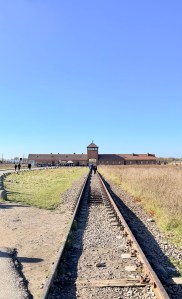
The Death Gate in Birkenau

The Birkenau portion is two miles away which has the infamous train tracks through the Death Gate. Birkenau is enormous. It was 10 times the size of Auschwitz. It and was a death camp with its 4 massive crematoriums. This is where the wooden barracks were and box cars with upwards of 100 prisoners per car. This is where selections were made in a matter of seconds as to whether someone would live or die. This is where 5-7 people laid together on the same bunk. Most residents were sent out daily as slave labor, walking in wooden clogs and numbered striped uniforms. They were brought back at the end of the day if they were allowed to live. Most were not.

Before I left on this trip, I knew that it involved going to Auschwitz-Birkenau. I briefly thought about skipping it. It’s a heavy, exhausting day but I felt that I needed to witness the struggles of these people. Perhaps for a few hours carrying their pain. It’s an acknowledgment of humanity at its darkest hour. There were reams of young adults (you have to be 14 years old to visit) funneling through the rooms. I can only hope that this informs our next generations to keep this from happening again. Never forget.

Written by a human.
Complex Warsaw🇵🇱

I came to Warsaw in October of 2026. I was part of a tour with Road Scholar Tours (which is a play on Rhode Scholar) and my main reason to come to Poland was to investigate part of my maternal family heritage.  My maternal great grandfather and mother as well as his father left Lower Silesia in the 1880’s when it was part of Germany, their hometown region, Glatz, now sits within Poland right on the Czech Republic border. I can read about an area or watch a YouTube on its history but actually setting foot in a place that has had so much turbulence over the last 200 years is enlightening.

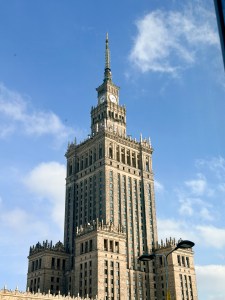
I usually arrive at least a day early for a tour in order to recover from jet lag. My hotel was right across from Swietokrzyski Park. In the center of the park is the Palace of Culture and Science which is a 778-foot skyscraper that was a “gift” from the Soviets under Joseph Stalin. I explored two museums within this immense complex. The National Museum of Technology in Warsaw is an interesting look at innovation over the last 100 years from a Polish perspective including what a teenage bedroom looked like in the 60’s and 80’s with Rolling Stone and Backstreet Boys posters on the wall. The Neon Museum was very interesting because neon was used for both capitalism and propaganda as Warsaw cycled through being a Polish Republic to Nazi occupation to Soviet control and then finally a return to private enterprise with the fall of communism. They showed a 50-minute film in English and Polish that educated me on the turbulence I already mentioned, that occurred over a 100-year period from the 1920’s to present day.

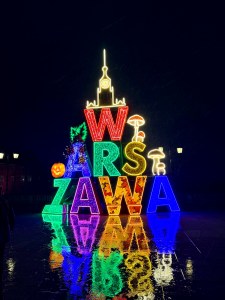
Warsaw sign in Old Town Warsaw

When I joined the group, our guide, Krys, took us on a walking tour of Warsaw to point out the communist propaganda that is still present throughout Warsaw. From plaques and statues and enormous avenues for marching armies, there are many reminders of the Soviet occupation. What was most educational were the stories that Krys, who is in his 50’s, told of growing up under Soviet controlled Poland. When he was a teenager, he and his friend got up at 3 AM to head to a shoe store where he was the 110th person in a line to get shoes at a store that opened at 10 AM. He said that when he finally got his turn, he grabbed two pairs of shoes of unknown size. No trying on, no choice of color, just grab and go. One pair he gave to his father and he traded the other on the black market to get a correct fitting pair of shoes.

In another story, he told of his family driving to another Soviet block country. They had to request their passports from the authorities and then his father took a shortcut through part of Russia. When they wanted to cross the border, he was issued a fine for taking the short cut (it saved several hundred miles) and they had to go back to the starting point to pay the fine. Needless to say, they didn’t take the shortcut again. It’s one thing to read dates on the start and end of Soviet control, it’s quite another to hear a first-hand account of the impact of that Soviet control.

Poland was at the crossroads of three empires that wanted to control it. The Russians, the Prussians (later Germany) and the Hapsburgs (later Austria). These three empires divided up Poland in 1795, and independent Poland did not exist from 1795 to 1918. This for me, accounts for the fact that my great grandparents spoke German even though their hometown is now in Poland. There was a second Polish republic in 1918 at the end of World War I.  Herbert Hoover is revered in Poland for his humanitarian aid. In 1939, both the Soviets and Germans invaded which ushered in a brutal occupation and the Holocaust.

The Palace of Culture and Science built as a gift from the Soviet’s to Warsaw

Warsaw was demolished during World War II, with 85% of the buildings being leveled. The entire Old Town section with the exception of one church was gone. We took a tour of Old Town Warsaw and the entire place has been painstakingly rebuilt, so much so, that it is now a UNESCO World Heritage site. It’s quite amazing to walk cobblestone streets with colorful facades that look 300 years old but were completed in the 1960’s. This is in stark contrast to the dull gray slabs of Soviet occupation. We ate in a restaurant that was several hundred years old, it was a basement and untouched by destruction.

The Jewish ghettos that were built by the Nazi’s are gone. I highly recommend watching the movie “The Pianist” if you want to understand the painful history of the Nazi created ghettos to “house” what was the largest Jewish population (30%) in Europe. When the Nazi’s arrived there were 375,000 Jews that were rehoused into two ghettos. Outside of monuments for uprisings and the eventual deportation of Jews to Treblinka death camp, nothing remains but street names.

On our final day in Warsaw, we went to the POLIN museum which shows the 1,000-year history of Jews. It is one of the best museum experiences I’ve had because it’s self guided but the headset seamlessly narrates as you enter each room.

Perhaps the most astounding fact for me is that Hitler succeeded in practically eliminated the race he so vehemently hated. Warsaw went from 375,000 Jews in 1939 to 17,156 Jews in 2021. Where once they enjoyed a free existence to worship and gather, there are few. What artists, writers, brilliant minds and creators did we lose in that massacre? We must always remember. We must never forget.