
I’ve been on a trek over the last few years to visit all 63 U.S. National Parks. So, in the Spring of 2026, I found my way to Great Sand Dunes National Park in my motorhome, Abeona. On this same road trip, I went to Mammoth Cave NP and Hot Springs NP, they are vastly different from Great Sand Dunes National Park. I arrived at Great Sand Dunes from New Mexico heading north toward central southern Colorado. As with Big Bend NP and Death Valley NP, Great Sand Dunes NP is in the middle of nowhere. You see a sign on the road that says “Great Sand Dunes NP” and then proceed to drive over 100 miles to get to the entrance.
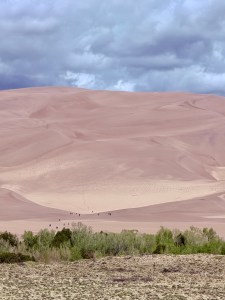
Most of the drive from Santa Fe is flat and dry with tumbleweeds rolling across the landscape. As I drove up route 150 toward the park I was suddenly taken aback as I saw this enormous desert that was at the bottom of the Sangre de Cristo Mountains. It looked like a mirage; as if Africa dumped a sandbox off at the base of these 14,000-foot mountains. It’s probably because of the height of the mountains behind them but the dunes don’t look that big until you get much closer. They look like brown hills until you realize that they are all sand; constantly shifting sand that is abutted to the base of the mountains with nowhere to go.
I always try to watch the National Park film at the visitor center. It was really interesting because they show that there is a seasonal creek called Medano Creek which flows by the sand dunes in the summer after the snow melt in the Sangre de Cristo. What is unusual about this creek is that it has “surge flow” waves. In the video you could see that the creek actually pulses like ocean waves. It’s such an unusual phenomenon that occurs only in Great Sand Dunes NP. Unfortunately, I was in the park too early in the spring to see the creek which was dry at the time I arrived in early May.
There is a trail to hike around near the visitor’s center and as I stared at the dune field which covers 30 square miles and is as high at 750 feet which is about half as tall as the Empire State Building. I didn’t realize until later that there were small black dots at the base of the dunes and those black dots were people hiking up the dunes. It was stunning how large the dunes were.
I drove from the visitor center to the dunes parking lot and sure enough there were about 50 people in various stages of climbing or returning from the massive dunes. As you can imagine, hiking in dunes is no easy task I was glad that it was 50 degrees because I can image that the dunes really heat up in the summer time. They rent sand boards and sand sleds along with wax. I walked out to the dunes and that is when you get the shear expanse and height of the dunes.
The altitude at Great Sand Dunes NP is 8,200 feet. It’s not something I was really conscious of because the drive from Santa Fe (altitude 7,000 feet) was relatively flat. I had booked a campsite close by at Zapata Falls Campground. Unconsciously, I figured that a campground at the base of a waterfall would be in the lowlands. I was taken aback as I dove up 1,000 feet to arrive at my campsite at 9,200 feet. So not only was it cold overnight but there was snow on the ground when I woke up the next morning. This was a happy accident as I was able to see the sand dunes in the distance covered with a light dusting of snow which melted within minutes of sunrise.
Great Sand Dunes National Park was a surprising stop for me as I think I was expecting something more similar to White Sands National Park. White Sand’s dunes are 60 feet high and are cool to the touch because they are from gypsum. You can drive through the dunes (although terrifying in that the road is constantly morphing from the wind) at White Sands NP. Great Sand Dunes is much more immense and since they are reddish brown they retain the heat. It was a fascinating stop on my trip.

