Stunning Capitol Reef National Park 🏜️

I’ve been on a quest to see all 63 U.S. National Parks.  I had seen ten of some of the western National Parks on a road trip when my children were in Elementary School and we went to 4 of the Utah Mighty Five.  My first four was Bryce Canyon, Zion, Canyonlands and Arches NPs.  Capitol Reef has been on my list for about twenty years so that I could complete the Mighty Five.  It did not disappoint.

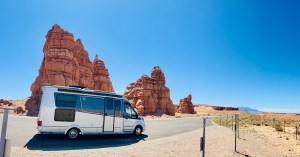
As I look at a map of Utah, I can see why Capitol Reef did not make that original road trip. It’s farther north than the other four and, as with most National Parks, you can’t get there from here. The drive to Capitol Reef reminded me of the endless drive to Big Bend NP in lower western Texas. It’s a lot of driving on a narrow two-lane highway with absolutely no services. Utah state route 24 has no vegetation and winds through the high desert. As you get within 20 miles of the visitor center suddenly the rocks turn from sand and gray to red. Formations stand like sentinels along the roadside. There are several turn outs along the road so that you can really appreciate  formations with names like Navajo Knobs, Petroglyph Panels and Pectols Pyramid. This part of route 24 follows the Fremont River and there are cottonwoods and vegetation along the river bank.

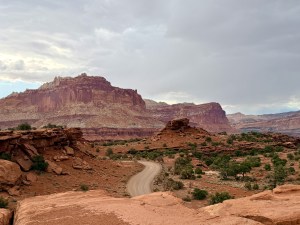
The stunning scenic drive through Capitol Reef National Park

Once I arrived at the visitor’s center, I watched the film, “Watermark” which details the history and geology of the “Waterpocket Fold” that is Capitol Reef NP. The Waterpocket Fold is an enormous 100-mile geologic wrinkle in the Earth’s crust which creates a rugged landscape of colorful knobs, cliffs, towers and bridges along its length. It was a hot, sunny afternoon when I arrived so I decided to head out along the scenic drive that goes into the heart of the national park the next day.  When driving a large vehicle (25 feetI) like my RV, Abeona, I love to head out early to explore when there are less crowds. 

The next morning, I headed out at 8 AM to explore several viewpoints and the scenic drive. Panoramic Point had been recommended by the ranger at the visitor center and was close to my campground. It was a magnificent overlook of the Waterpocket Fold as it carves through the valley. It was raining a little and then as it stopped there was a huge rainbow that came out. It was all quite stunning. 

I went up the scenic drive and I was glad I got out there early as the road was quite narrow and at times I was driving through a narrow slot canyon. I kept thinking “thank goodness I am the only one out here”. Since no one else was on the road and there were very few pull outs, sometimes I just stopped the RV and got out to take pictures. It’s hard to describe all the formations. When you go to Bryce Canyon, it’s all hoodoos, when you go to the Grand Canyon, it’s sheer drop offs and in Arches, it’s…all arches. In Capitol Reef there are all those things but in small quantities and in an ever changing landscape. 

I hiked the Chimney Rock trail and it did not disappoint. There was plenty of parking and it was raining when I arrived but it cleared as I headed up the trail. Chimney Rock is a flat tall red formation. Like someone built a large red four-story free-standing wall jutting out from a cliff. 

The entire National Park is quite stunning; both the drive in and drive out. It’s hard to decide if and when the beauty stops because it’s all so varied and stark.  While it’s off the beaten path, I highly recommend heading there if you want to see some unique formations. I also recommend heading out early in the morning to beat the crowds as the roads are narrow. 

Imposing Great Sand Dunes National Park⛰️

I’ve been on a trek over the last few years to visit all 63 U.S. National Parks.  So, in the Spring of 2026, I found my way to Great Sand Dunes National Park in my motorhome, Abeona. On this same road trip, I went to Mammoth Cave NP and Hot Springs NP, they are vastly different from Great Sand Dunes National Park. I arrived at Great Sand Dunes from New Mexico heading north toward central southern Colorado. As with Big Bend NP and Death Valley NP, Great Sand Dunes NP is in the middle of nowhere. You see a sign on the road that says “Great Sand Dunes NP” and then proceed to drive over 100 miles to get to the entrance. 

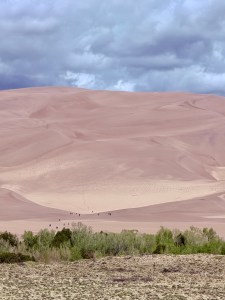
Most of the drive from Santa Fe is flat and dry with tumbleweeds rolling across the landscape. As I drove up route 150 toward the park I was suddenly taken aback as I saw this enormous desert that was at the bottom of the Sangre de Cristo Mountains. It looked like a mirage; as if Africa dumped a sandbox off at the base of these 14,000-foot mountains. It’s probably because of the height of the mountains behind them but the dunes don’t look that big until you get much closer. They look like brown hills until you realize that they are all sand; constantly shifting sand that is abutted to the base of the mountains with nowhere to go.

The Great Sand Dunes with people climbing (the small black dots).

I always try to watch the National Park film at the visitor center. It was really interesting because they show that there is a seasonal creek called Medano Creek which flows by the sand dunes in the summer after the snow melt in the Sangre de Cristo. What is unusual about this creek is that it has “surge flow” waves. In the video you could see that the creek actually pulses like ocean waves. It’s such an unusual phenomenon that occurs only in Great Sand Dunes NP. Unfortunately, I was in the park too early in the spring to see the creek which was dry at the time I arrived in early May. 

There is a trail to hike around near the visitor’s center and as I stared at the dune field which covers 30 square miles and is as high at 750 feet which is about half as tall as the Empire State Building. I didn’t realize until later that there were small black dots at the base of the dunes and those black dots were people hiking up the dunes. It was stunning how large the dunes were.

I drove from the visitor center to the dunes parking lot and sure enough there were about 50 people in various stages of climbing or returning from the massive dunes.  As you can imagine, hiking in dunes is no easy task I was glad that it was 50 degrees because I can image that the dunes really heat up in the summer time. They rent sand boards and sand sleds along with wax.  I walked out to the dunes and that is when you get the shear expanse and height of the dunes. 

The altitude at Great Sand Dunes NP is 8,200 feet. It’s not something I was really conscious of because the drive from Santa Fe (altitude 7,000 feet) was relatively flat. I had booked a campsite close by at Zapata Falls Campground. Unconsciously, I figured that a campground at the base of a waterfall would be in the lowlands. I was taken aback as I dove up 1,000 feet to arrive at my campsite at 9,200 feet.  So not only was it cold overnight but there was snow on the ground when I woke up the next morning.  This was a happy accident as I was able to see the sand dunes in the distance covered with a light dusting of snow which melted within minutes of sunrise. 

Great Sand Dunes National Park was a surprising stop for me as I think I was expecting something more similar to White Sands National Park. White Sand’s dunes are 60 feet high and are cool to the touch because they are from gypsum. You can drive through the dunes (although terrifying in that the road is constantly morphing from the wind) at White Sands NP. Great Sand Dunes is much more immense and since they are reddish brown they retain the heat. It was a fascinating stop on my trip.

Route 66 from Amarillo to Santa Fe 🏜️

I’ve been traveling across the United States in my motorhome, Abeona, for the last few weeks; and have been following a zig zag route. The intent is to check off some more of the National Parks in an effort to see all 63. There are no National Parks between Amarillo and Santa Fe but there are some fun Easter eggs if you go looking. An easter egg is a surprise where you aren’t expecting it. A friend of mine turned me onto an app called Atlas Obscura which has a handy map feature to show you some offbeat locations to stop by.  I was really glad I had the app because it helped me locate a few interesting stops along what would be a boring stretch of highway. 

Route 66 was established in 1926 and connected Chicago to Santa Monica. It became a migrant route and then a post war tourist mainstay. I lived in Albuquerque NM for several years and “the Mother Road” cuts down from Santa Fe right through Albuquerque. A lot of what is currently Interstate 40 from Oklahoma to Tucumcari NM is the old Route 66. It’s interesting to think of all the folks who have traveled this road in search of a better life or simply  seeking the sun of southern California. 

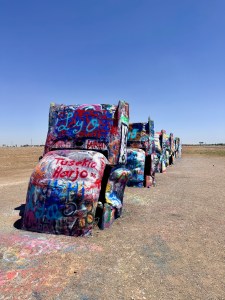
Cadillac Ranch on Route 66

When I arrived in Amarillo, I first ventured to Slug Bug Ranch.  I had expected it to be just 5 VW bugs face down in the ground (similar to Cadillac Ranch) but was surprised to find 10 VW bugs and several stretch limousines face planted in the ground and covered in graffiti. It was expanded in 2024. Unfortunately, parking (ironic) was not easy in a motorhome so I just looked at it from Abeona. It’s definitely a quirky free stop but fun.

Cadillac Ranch is about three miles down the road along I-40 (route 66). The ten Cadillacs that make up Cadillac Ranch have been around since 1974 but they were moved in 1997. They are now visible form I-40. There is a ton of parking along the frontage road and there are dumpsters full of spent spray paint cans. The ten Cadillacs are in the middle of a barren field and there had to be upwards of 40 folks mingling and painting the structures. It’s remarkable to watch different families and groups making their art on these huge metal objects. It’s wild to watch graffiti in action.  The entrance to the park as well as parking are free and sometimes there are leftover spray cans for use. 

The trip from Amarillo to Tucumcari was a white-knuckle trip that I had not anticipated. I had wanted to get out of Oklahoma and the threat of tornados. High winds in west Texas and New Mexico are a whole other animal. Driving a high-profile vehicle along a large stretch of road in the high desert is like holding onto a sailboat in high swells. The winds were 25 miles an hour with gusts to 50 miles an hour. I could see off into the distance (because it’s such a huge flat expanse) and there were red dust clouds looming and tumble weeds careening across the roadway..  By the time I got to my campground in Tucumcari, both of my hands were numb from holding the steering wheel so tightly. 

The next day, I headed up a long-lost road from Tucumcari to Santa Fe.  This was a bit of a crazy experience. It was fortunate that I filled up with gas before heading out because there were no services along the road. I remember seeing a roadrunner cross the road and I felt like it was a lucky sign that I was on the right road. They are such beautiful birds and its namesake cartoon really doesn’t illustrate the delicate beauty of this tenacious bird. On my three-hour trip to Santa Fe there on this barren road, I saw two trees(some 40 miles apart) decorated with Christmas decorations for no apparent reason. 

My last stop on my trip to Santa Fe was the Pecos National Historical Park in Pecos, NM. I lived in Albuquerque for several years and I spent a lot of time traveling the state to check out different landmarks; this was a new place for me. It was a major 14th-century community that thrived as a trade hub between the Puebloan and Plains Apache tribes. At its peak it was a 2,000-person community with 5 story buildings and they have done a great job recreating some of the ruins and kivas.  The Spanish first visited in 1541. I think it’s always so mind blowing to see how successful indigenous folks were and how early and so far inland the Spanish were in the United States. It’s truly a remarkable exhibit. 

I enjoyed my return to the Mother Road and outside of some hairy driving during high winds, there were lots of interesting stopping points to take along the way. It really pays to plan to seek them out before heading out so that you can take in these remarkable places. It’s all part of the journey. 

Exploring Hot Springs National Park: A Unique Experience 🔥

I am on a journey to see each National Park in the United States. Due to my extensive travel as a child with my family and living on the west coast for many years, I’ve made quite a dent into the 63 National Parks currently designated by the United States. This Spring I decided to zig zag across the country to visit some of those I had previously missed which brought me to Hot Springs Arkansas in April of 2026. I traveled there in my motorhome named, Abeona, and although the weather wasn’t great, I still had a lovely time exploring this historic park.

Anytime I’m visiting a small town in Abeona, I am apprehensive about parking in the downtown area. I once parked Abeona (she is 25 feet long) in Key West and it was quite nerve racking to try and park in a town with narrow streets and overrun with tourists.  I’m still not sure how I ended up street parking her and not getting a scratch but if I can avoid trying to park on city streets, I do avoid it. I was camped at Gupha Gorge Campground which is part of the National Park but it was still several miles from the center of the National Park.  I decided to take a ride share so that I wouldn’t have to maneuver Abeona around unknown narrow streets.

The stained glass ceiling of the Fordyce Bathhouse

Hot Springs was known as the “Valley of Vapors” and for good reason.  Every fountain on the street had springs gurgling out of the steaming rocks. .  It’s quite wild and, of course, I had to touch it to make sure it really was hot (143 degrees). Native American Tribes were the first to take in the waters.  Federal protection started in 1832 (predating Yellowstone by 40 years) by President Andrew Jackson for its 47 thermal springs. The area was developed in the late 1800’s and hit its peak in the 1940’s inclusive of gangsters and baseball spring training. 

The main attraction at Hot Springs National Park is the main thoroughfare called Bathhouse Row. This is in downtown Hot Springs and there are 8 bathhouses that are still proudly standing on Central Avenue.  One of these bathhouses is called Fordyce Bathhouse and is the Visitor Center for the National Park.  It is free to tour three floors of this structure which was originally opened in 1915 and closed its doors as a bathhouse in 1962.  The National Park has restored the bathhouse to its original glory including lovely mahogany paneled  men’s and women’s locker rooms, beauty salons, steam showers, and state rooms. There is a gymnasium on the third floor which has early 20th century gym equipment including a pommel horse for some bizarre reason and ropes to climb. The piece de rescue de resistance is the stain glass ceiling of the Men’s Bath Hall.  You can truly imagine how opulent it was to visit these establishments in the early 1900’s.

The other bathhouses on Bathhouse Row have been developed into other uses like a brewery, a restaurant, a gift shop and two of the bathhouses continue to operate.  I actually went to the Quapaw Bathhouse where it’s $30 to go ahead and take in four different temperature baths. They provide a towel and locker and all you need is a bathing suit and sandals. There is no need for a reservation and the day I went there about 10 people in the baths.  It’s interesting to test the different water temperatures and relax either in the baths or on a chaise lounge.  They also provide cold water to drink. The Buckstaff Bathhouse also has baths although I didn’t try that one. 

In addition to Bathhouse Row, there is the Promenade that is a wide path that goes behind Central Avenue and its historic buildings.  Along this Promenade they have several historical markers and you can actually see some of the springs gurgling out of the rocks. There is also the park land which has trails and Hot Springs Mountain Tower which provides a 360 view of the park and town below. 

It’s interesting to go to a National Park that is not about rock formations, caves or tall trees but more about the thermal waters and the history and infrastructure that was built around it. I’m really glad I got to experience the waters that created this natural wonder. 

Mammoth Cave National Park🧐

I’ve been on a quest to visit all of the United States National Parks for the last several years. There are 63 National Parks and that might sound like too little, but it does not include National Historic Parks or National Monuments. I traveled to Florida last year to visit the 3 parks in southern Florida including, Dry Tortugas, Biscayne and the Everglades. I’m in my RV, Abeona, zigzagging across the US to hit some of the more obscure National Parks. The majority are in the West and Alaska. Mammoth Cave is in southern Kentucky and is quite an impressive National Park.  As the name suggests, most of the National Park is underground and they have upwards of 20 different tours you can take to experience this enormous cave.

Mammoth Cave is the largest cave in the world. Is that not crazy? Over 426 miles of the cave have been discovered thus far. They have a representation of the caves and it’s kind of like a big wad of spaghetti that is all interconnected. My first tour was the Mammoth Passage tour. I have previously toured Carlsbad Caverns which is a completely different experience because it’s a 2 mile walk down to the bottom of the cavern. On the Mammoth Passage tour we went into the historic entrance of the cave which was 125 steps to the main passage of the cave. It’s much more accessible than Carlsbad.  It’s also called a dry cave so in that section of the cave there are no stalagmites or stalactites although there are plenty of bats. The ranger explained that indigenous people started using the caves between 5,000 and 2,000 BC and were able to mine them for minerals like gypsum, mirabilite and selenite crystals. 

The 75 foot high Frozen Niagara in Mammoth Cave National Park

In 1790 John Houchin settled near the cave. It was used extensively to mine for saltpeter which was used for gunpowder.  In fact, we saw remnants of early settlers who mined the saltpeter on the tour which was used during the War of 1812.  Early tourism started in the 1830’s and many enslaved African Americans played a critical role in exploring the caves due to the dangerous nature of the job so they were left risking their lives to explore the extensive caves. It became a National Park in 1941 as the federal government stepped in to take over the land of competing cave owners during the “Kentucky Cave Wars”. 

I took a second tour call Frozen Niagara Tour.  This entrance was several miles away from the visitor’s center and we took a bus to get there.  This is a wet cave so we got to see the amazing formations caused by thousands of years of dripping water. It’s a very short set of stairs down into the cave and some rather tight passage ways where you have to hunch over.  I had a tall guy in front  of me to use a barometer of how far I would have to hunch.  They ask you not to touch the walls but I have to say that one passage way was so tight I had no way to avoid it. At one point you could see down some three stories to a small “lake” called Crystal Lake. Looking at stalagmites that extend some two to three stories down from the ceiling was really amazing. The actual Frozen Niagara is 75 feet high and 50 feet wide. It’s interesting that it took hundreds of thousands of years for it to form. There is also the drapery room which had huge formations that look, of course, like drapes. We also saw several hundred Kentucky cave crickets. Of course, I didn’t notice them overhead until the ranger pointed them out by flashing a light on them. They are silent, so it’s a bit unnerving to look up and see a hundred or so crickets hanging out over your head. 

I camped at Mammoth Cave Campground which was walking distance to the Visitor’s Center and is where all the cave tours depart. The day I arrived it was raining but it didn’t put a damper on touring the national park since so much of what there is to see is below ground. I will say that there are two rivers and tons of hiking trails above ground as well. I highly recommend visiting this natural wonder in south central Kentucky and be sure to explore both the dry and wet caves on a tour. To think that there are 426 miles that have been discovered so far and they believe there could be anywhere from another 200 to 600 miles that are still undiscovered is rather astounding. 

😎 PEI – Tiny and Unique

Prince Edward Island (PEI) is the smallest province in Canada but if it was a US state, it would be the second smallest right after Rhode Island. Yes, my Delaware friends, there is a Canadian province that is smaller than the state of Delaware. I traveled here on my Atlantic Maritimes Road trip in my RV, Abeona in the summer of 2025. I will say that getting to PEI is not for the faint of heart. My knuckles were white as I drove across the only bridge to the island called Confederation Bridge. First, I’d like to thank the travel gods because it wasn’t windy that day as I traversed the 8-mile bridge. I was dumbfounded as to why there weren’t any west bound cars as I came across the bridge until we were stopped for about 5 minutes due to construction on the bridge. It was nerve wracking to be about two thirds of the way across the bridge only to be stuck high above the Gulf of the St. Lawrence for what seemed like an eternity and to feel the roadway undulate from the weight of the cars (this takes me back to walking across the Golden Gate Bridge many years ago and feeling the ground constantly move). There is no toll on the east bound side of the bridge but on the way back it was 50.25 CAD ($36.70). That is definitely the most I have ever paid for a bridge toll. 

The red cliffs and beaches of Prince Edward Island

I headed immediately to the most western lighthouse on the island called West Point Lighthouse which is in Cedar Dunes Provincial Park. Here I got to see the tallest lighthouse on PEI at 68 feet tall. It’s situated right next to the red sand beaches of Cedar Dunes Provincial Park which is quite stunning as it was a clear sunny day and the dark blue ocean waves crashing next to the vast red sandy beach is impressive. It turns out that this tiny island province has over 55 lighthouses which is a lot compared to at the very least North Carolina which only has seven active lighthouses. Once I arrived at West Point Lighthouse I wanted to continue on to my next destination and there was no cell coverage. It wasn’t until later that I learned that driving on the island is more like navigating a maze. I definitely would have invested in a paper map if I had to do it again. I was able to start up my satellite dish to get my directions to my next destination but I have to say I was caught off guard. I think I had better cell coverage in the Yukon

When traveling on to The Bottle Houses and Garden, there was never a straight shot on a road for say 20 kilometers. It was more like 1.5 KM then right for 2 KM and then left for 1 KM. And so on. There are vast amounts of fields and farmland which is pastural but I felt like my GPS must be wrong that that there must be a more straight- forward way to get from point A to point B. I needed to let go and let faith take over. Later in the day I ended up on a gravel road for at least 5 KM which really rattled me both physically and mentally. 

The Bottle Houses and Gardens is a lovely spot; it has a chapel and two house built by Edouard Arsenault in 1980.  His first house was built with 12,000 bottles which he collected and carefully cleaned and then built using cement between the bottles. The second building is called the tavern and is built using 8,000 bottles and the last creation is a chapel which was completed posthumously with 10,000 bottles. The gardens around the site are picturesque and there are many bottle trees (metal tree shaped frames with bottles on the “branches”) in the gardens as well. It’s definitely worth the visit.

I visited the Green Gables Heritage Place along with Lucy Maud Montgomery’s birthplace. I’m not sure anyone would be interested to visit these places unless you have read Anne of Green Gables or watched one of the series or movies associated with the place. I have read the book and watched the series and it was neat to see where Montgomery got her inspiration. The Green Gables house was actually Montgomery’s grandparents’ house and she spent a lot of time there since her mother passed away when she was two and her father moved out to western Canada. You could feel that the book was very autobiographical as Montgomery like her main character, Anne Shirley, was also a teacher. As an aspiring writer it was really neat to see her first handwritten draft of Anne of Green Gables and the old typewriter she also used.  It’s an interesting walk back in time to see the farmhouse and its thatched beds and Victorian furnishings.

An interesting stop in PEI is The Dunes Studio Gallery and Cafe which is a great place to look at local art, buy some locally made crafts, eat seafood and wander the lovely gardens. There are also art studios for the artists who actually work here that you can see into. If it weren’t for the drizzle that morning, I could have wandered for hours. 

There is a laid-back pace to PEI with endless red sand beaches, striking red cliffs near the placid waves breaking on shore. I’m pretty sure I passed more farm equipment on the road than anywhere back home in North Carolina. This island is all about the farming and raising of world-famous PEI mussels which can be seen throughout the bays and inlets around the islands.  I’m glad I ventured here and now I’ve been to every province in Canada. 

🧐25 Peculiarities of Newfoundland

I’m finishing up a month-long solo RV tour of Newfoundland.  This is truly a beguiling place with vast amounts of seascapes, cliffs, and wilderness as well as tiny fishing villages and busier hubs like St. John. The vast Great Northern Peninsula is as desolate in areas as the Yukon Territory with nary a Tim Horton (Canada’s answer to Dunkin); while St. John’s is a major shipping port with countless restaurants and museums. I began my trip at Port aux Basques where I could travel for hours without seeing any facilities and I am finishing up my trip outside of St. John’s which has 40% of the province’s population complete with parking garages and pedestrian thoroughfares. There is a lot of contrast here and I’ve loved every moment.

An iceberg near St. Lunaire-Griquet

Here are the 25 peculiarities of Newfoundland:

  1. Pronouncing it. I have been corrected on the pronunciation of Newfoundland by several Newfies. From the best I can figure it is pronounced: New-FUN-lAnd. I tend to say NEW-fin-lund. 
  2. No Newfoundland dogs.  Outside of statue of a Newfoundland and Labrador dog in downtown St. John’s, I have yet to see a Newfoundland dog here.  I had a client ask if there were herds of them here. There are not.
  3. Only Dairy.  Especially in the remote northern end of Newfoundland, I could not find any non-dairy milk or yogurt.  It’s all dairy, dairy here.
  4. Moose. I went to a nature park called Salmonair and traveled over 1,000 miles in Newfoundland. I have yet to see a live moose although they claim that there is one moose for every 4 people or 125,000 moose. That’s an amazing number considering they were introduced here in 1904.
  5. Icebergs. I saw eight icebergs on my trip here and if you come in June and are willing to travel to St. Lunaire or Twillingate, I can pretty much guarantee you will see an iceberg and it’s an awe-inspiring sight.
  6. RDF. A Newfie clued me in that this is the general term for weather which stands for Rain, Drizzle and Fog (St. John is known as Fog town). There is no telling when it will rain and when it will be sunny and, in general, the forecast is wrong. This can make planning difficult and you just have to be adaptable. 
  7. National Parks. There are two National Parks (Gros Morne and Terra Nova) on Newfoundland and they are beautiful and super inexpensive compared to the US. It’s only $11.00 to enter these parks for the day.
  8. Provincial Parks. I saw several Provincial Parks and all of them have been free. The most stunning was the Dungeon Provincial Park which is a collapsed sea cave.  It was a gravel road out to it, but when there is a clear, blue sky and pounding waves below in “the dungeon”, it’s a spectacular sight. 
  9. Potholes. When I drove the Alaska Canada highway last year there were always signs to indicate that potholes were coming and they were accurate. While the Trans-Canada Highway here is terrific, there are several secondary roads that were riddled with potholes and/or frost heaves (undulating roadway from temperature changes). Sometime I had to drive 20 miles an hour to make sure Abeona held together.
  10. Brogue. Many of the locals sound like they are from Ireland or Scotland. A server or customer service person would approach me and I must have had a deer in the headlights look because I have no earthly idea what they just said. Expressions like “Whaddayat” or “How ya gettin’on” at times made me think I was across the pond. 
  11. Chatty. I was mentioning to a Newfie I met in St. Pierre that people were so nice in Newfoundland and she said, “Well, they are really just chatty.” She is right. People would talk to me about just anything but most likely the weather (see #6).  I had an older man come up to me while I was gassing up Abeona and said, “Whaddayat” and “Come from away” (are you visiting).  He thought I had a really nice rig and asked “Do you have a man in there?” The folks here are chatty.
  12. Time zones. I think it’s bizarre but Newfoundland and Labrador are a half hour ahead of the Atlantic Time zone (Nova Scotia, etc.). So, they have their very own time zone.
  13. Gas. A lot of the gas stations only have regular gas and you pump and then pay inside. Similar to my trip through the Yukon, I gassed up at almost each gas station I found open (some are closed on Sunday).
  14. Potable water. I was prepared for this before I came but several campgrounds had boil warnings on the water. I had to be sure I filled up at the campgrounds with safe drinking water.
  15. Cover shopping carts return. I found it strange that grocery stores had covered places for the carts to be returned. Gas stations were not normally covered (like they are in the US). 
  16. Cod. Cod is the center of the universe here and when there was a moratorium on cod fishing starting in 1992 it devastated the region.  As they say here, fish is cod and cod is God. The fishing just restarted in 2024 but only partially. It’s why the area was settled 400 years ago.
  17. Jigg’s Dinner.  This is a classic Sunday dinner in Newfoundland and is only served on Sunday.  It’s a boiled dinner that included salted beef, turkey, potatoes, turnips, mashed peas, carrots and greens. The whole thing is covered in gravy (similar to Poutine which is fries covered in gravy). I was finally able to be at an open restaurant on Sunday that was serving it and it was delicious.
  18. Lupin. Besides thousands of dandelions that almost look like they are cultivated along the highways and byways, swaths of lupin in blue, pink and white are along hiking trails and highways.
  19. Balsam Fir. Most of the landscape on the Great Northern Peninsula is barren and grassy but along the Avalon and Bonavista peninsula’s there are miles of balsam fir conifer forests and the smell is breathtaking. 
  20. Moose burgers. Besides fish and chips (see #16), another staple at roadside restaurants on the Great Northern Peninsula  is moose burgers. It’s more prevalent than regular hamburgers. 
  21. Painted Rocks. I found painted rocks on random hiking trails where school children from a particular class room painted rocks to line the trail at its apex. There are large boulders painted as well. It’s like finding Easter eggs while driving or hiking.
  22. Partridge Berries.  These are small red berries that are tart like a cranberry and many restaurants made tarts from them.
  23. Gift shops.  There are tiny gift shops next to lighthouses and on the road next to restaurants. These shops are filled with handknit gloves, homemade partridge berry jam (see #22) and painted rocks. They are all locally made and quite homespun. 
  24. Wood piles. I saw this the most on the Great Northern Peninsula but there would be random piles of wood along the Viking Trail on my way to St. Lunaire. Apparently, locals have a place to keep their wood for the winter.  It seems random but it’s not.  The same goes for piles of lobster traps.
  25. Names. I find it funny that there is an island called Random Island and two lakes right next to each other, one called 3 Corner Pond next to Triangle Pond. I wondered how they knew the difference since isn’t a three-corner pond a triangle? There is also the town of Dildo which Jimmy Kimmel featured on his show. There is the inappropriately named Western Brook Pond which is a fresh water fjord that is 10 miles long and 250 feet. Not really a pond. 

I love that Newfies and Newfoundland are so quirky and friendly. Regardless of whether I was walking down a trail, doing laundry or paying for gas, these people are so welcoming to those that come from away.  I can’t wait to return. 

🐳 Puffins, Whales and Lighthouses: Newfoundland

My original purpose in traveling to Newfoundland was to see icebergs and the Norse settlement, L’Anse aux Meadow. But in addition, I was secretly hoping for puffins and whales as well. I scheduled my trip at the height of iceberg season (May and June) so if I was able to see puffins and whales, all the better. I knew, of course, there had to be lighthouses because with 6,000 miles of coast line, there will be lighthouses. 

While I camped outside of St. John’s on the Avalon peninsula, I took a tour of the area surrounding St. John. I could have driven it but with a 24-foot motor home to park and St. John being full of narrow streets and hills, I figured I’d leave the parking and maneuvering to someone more knowledgeable. We headed to Cape Spear and the most easterly point of North America. We arrived there on a windy day and saw the two lighthouses that sit atop the craggy cliffs. The current lighthouse was built in 1955 and is completely white and stands 45 ft. tall. It’s quite picturesque above the rocky coastline. Behind it about 50 yards away is the original lighthouse which was built in 1836 and is a squat single story white building with a red and white light on top. This older lighthouse is the oldest surviving lighthouse in Newfoundland. They apparently used to use whale oil to light the original lighthouse. It doesn’t feel like it but Cape Spear is within the city limits of St. John, the heart of which is 7 miles away. Cape Spear is a windswept place on its isolated crag. The Portuguese named this place Cabo da Esperance meaning “cape of hope”, which became Cap d’Espoir in French and finally Cape Spear.  It feels like every European nation had hands in the naming of the towns and headlands of Newfoundland. If they were fishing for cod, they were here at some point.

The Bonavista Lighthouse in Newfoundland

My next conquest was puffins. Before coming to Newfoundland, I made sure I joined a few Facebook groups.  There are several iceberg, whale and puffin Facebook groups and you can find out in real time if there is any activity.  This proved invaluable. I was camped in Chance Cove and almost a three-hour drive to the best puffin viewing area.  When I come back to Newfoundland, and I know I will, I will definitely plan to camp closer to Elliston which is out on the Bonavista peninsula. Puffins are most active in June and July while they are nesting. The best time of day to see puffins is in the early morning and late evening.  Even though I headed out at 7:30 AM, I wasn’t able to park and see the puffins until around 10 AM so most of the activity had subsided by the time I trekked out around a very narrow isthmus to get to the Puffin Viewing Area. There were about twenty people out there. There were several hundred puffins out on the cliff walking and flying about in addition to seagulls. It was really interesting but I should have brought binoculars or a high zoom camera lens. They are such unusual looking birds that I wanted to see them up close. There was another puffin viewing area off the coast of the Bonavista lighthouse but by the time I got there around noon, I didn’t see any puffins. The Bonavista lighthouse built in 1843 is another squat lighthouse although it is painted with bold red and white stripes. So, no puffins but another lighthouse bagged.

Next up, the Whales Playground in St. Vincent, Newfoundland. I traveled there on the Sunday of the major holiday weekend of Canada Day (July 1st). It was sunny and I wanted to beat the crowds. I figured it would be busy since by all accounts on Facebook, the humpbacks were definitely there. I headed out at 7 AM and arrived just before 9 AM. There was plenty of parking and the crowds were already gathered to see this awe-inspiring site. Apparently, the small fish called Capelin migrate in June and July off the shores of Newfoundland and the humpbacks migrate as well to feast on the abundance of fish. The beach off of St. Vincent has a sharp drop-off so that the whales are just 25 feet away.  I parked and headed out to the beach where there were 30 or so spectators, many with enormous zoom lenses. I absolutely gasped and tears came to my eyes as I saw the shiny black back of a humpback whale right off the beach. There was one single whale at one end of the beach and a mother and her calf about 30 feet away. When they are feeding, they are super active with tails, blow holes and pectoral fins flying. They are such majestic animals and they seem like they are just barely out of reach from the stone covered beach. Many people set up and camp in a chair for the day. As I headed out around noon, I passed hundreds of cars on their way to see the whales. I was glad I got there early before the crowds descended. The Whales Playground on a sunny day in June is not to be missed.

Newfoundland has been a treasure trove of UNESCO world heritage sites, lighthouses, spectacular rocky cliffs, icebergs and encounters with beautiful wildlife. I had a short Wishlist before I arrived and it’s been completely fulfilled in my month here on the island referred to as The Rock.  It truly has been an adventure and I’m so glad I made the effort. 

🇫🇷 Enchanting St. Pierre and Miquelon

St. Pierre and Miquelon (SPM) are two tiny islands off the south west coast of Newfoundland that are part of France. It recently came into the public eye when the current U.S. administration levied the highest tariff on SPM tied with the African county of Lesotho. SPM makes up .01 of the GDP of France.  SPM was visited by indigenous people for over 5,000 years but in 1536 it was claimed by Jacques Cartier for France. Over the ensuing years there were battles between Great Britain and France, changing hands multiple times before being definitively restored to French control in 1816. Its allure was the vast abundance of Cod fishing in the North Atlantic and the ability to dry the cod and send it back to Europe. I became aware of this French archipelago almost 7 years ago when Anthony Bourdain came here in 2018 on his show Parts Unknown. It was also featured in Peaky Blinders final season in 2022. I knew I had to investigate this French gem off the coast of Newfoundland. 

There is a lot involved in planning a trip here as there is not a daily ferry from Newfoundland and I couldn’t find a flight from St. John’s that was available.  First, I secured an RV spot that was walking distance to the ferry at Fortune, NL. Next, I found a hotel room that matched the ferry availability. This involved making several international calls (calling Canada is free on my Verizon plan, not so SPM) and making sure my lodging was walking distance to the center of the town of St. Pierre. I could not understand the ferry booking site since it’s mostly in French although parts are translated so here again, I made an international call. So once all the parts of the journey were set up, I was set to travel by ferry to St. Pierre and back for a weekend stay. 

The lovely austere countryside of L’Ile aux Marins (Island of the Sailors) off the coast of St. Pierre et Miquelon

When we set sail from Fortune it was foggy.  The ferry was very nice with only a small deck towards the back of the deck to be outside.  It was 50 degrees and foggy so why be outside, right? When we arrived in SPM at the main wharf in St. Pierre (both the town and name of the island), we disembarked and went through customs where I happily received a stamp on my passport from France. St. Pierre is not exactly pedestrian friendly since the sidewalks (if there are any) are narrow and cut up and the streets are narrow as well. I stood in a marked crosswalk and the traffic continued (this I can assure you would never happen in Spain or Italy). There is a lawless feel to those behind the wheel.  I was glad I didn’t have far to walk to get to my bed and breakfast, Nuit Saint Pierre. Michel, my host, was there at the bottom of the stairs to greet me and shake my hand.  I would guess the B and B had about 7 guest rooms and a kitchen to share where Michel or his son would put out delicious French pastries, juice and coffee each morning. It was nice to have a private bath and a place to flop. Reservations are compulsory in SPM and Michel immediately reviewed everyone’s dinner reservations.  I did not have one because I don’t normally eat dinner. Michel took it upon himself to take me to a local market in his car.  That was a trip. I’m not sure if it was a one-way street but he squeezed through two cars facing opposite directions with maybe an inch on each side of the car. Michel knew everyone in the market and immediately took me to a refrigerator case that had cooked lobster in a container. I have to say that the lobster was one of the best I’ve ever had and I couldn’t believe I bought it at a market. 

One of the big highlights of my trip to SPM was going to the tiny island of lle aux Marins (Island of the Sailors). I went to the tourist information center to get ferry times. I planned it for the one morning when it wasn’t too windy and there would be sun.  SPM reminds me of San Francisco in the summer, cool and foggy most of the time. I traveled by boat on the ten-minute ride that I paid for in 7 Euros cash only. The island was settled in 1604 and once had a population of 700 which was almost all fishermen and their families.  There is a church and school.  It was largely abandoned in the 1960’s with only 20 inhabitants in the summer.  There is no electricity or running water or cars.  There are communal wheel barrels and wagons available for visitors and inhabitants to use. I immediately made a beeline to see the Transpacific wreckage which is a German Cargo ship that wrecked in 1972.  It’s a ghostly sight with its bow face-up on the beach. The island itself is stark with nary a tree or bush.  There are plots full of rocks which is where children were used to put out the cod to dry. There was an Andrew Wyeth vibe to the place with windswept austerity.  After exploring the island for an hour and a half,  I was picked up by the ferry and headed back to St. Pierre. 

Michel let me know that there was the blessing of the boats at the main church that morning which was a block from the B and B. Another guest and I walked over when the service headed outside.  It was an emotional experience as the priest and parishioners marched out to the wharf with models of boats that had been lost at sea. They sang beautiful hymns in French as they walked through the streets in their blue and white striped shirts. It was particularly poignant as a boat that was lost in 1962 call the Ravenel had just been found the month before. 15 St. Pierre fishermen had lost their lives and many of the family member were in the procession to leave flowers by the statue commemorating “our lost sailors”. We watched as the priest went to the wharf to bless the boats as dories with rowers, small crafts and fishing vessels honked their horns. It was a brilliant blue sky for all the pageantry. 

I headed back to Newfoundland on Sunday afternoon after spending three enchanting days on SPM. Anyone passing me on the street said “Bon jour” even the children getting out of school. I’m not sure any place could be more welcoming and I found myself here at the optimum time to truly experience a piece of France in North America. 

🧐Iceberg Hunting

When I took the ferry to Newfoundland in June of 2025 one of my main goals was to see an iceberg. The eastern waters off the coast of Newfoundland are referred to as Iceberg Alley and the best time of the year to view them is in May and June. When I started planning my trip, I found the most places to camp didn’t open until June 1st.  So, I planned for the ferry ride as early as possible in June to take advantage of prime iceberg season. I had watched a few YouTube videos on the topic and apparently 2024 was a “bad” year for icebergs. I planned my trip to head to the most northern tip of Newfoundland first and then, heading to the more populated areas of St. John towards the end of my trip to leverage my iceberg viewing potential.   

I traveled up the Viking Trail or route 430 to the Great Northern Peninsula.  As I drove up the highway the Gulf of the St. Lawrence was on the left-hand side almost the entire way. With gusting winds of up to 30 miles an hour, there were a lot of white caps on the ocean. I tried in vain to spot an iceberg but white caps on the ocean and the white of an iceberg are identical. I never saw an iceberg in the Gulf of the St. Lawrence but I knew that the eastern side of “The Rock”, Newfoundland, is where icebergs are most prevalent.

In front of the largest iceberg I saw with a piece of glacier in my hand of the coast of St. Lunaire-Griquet

I arrived in St. Lunaire-Griquet on June 14th and, after some hunting, I found a place to park Abeona, I went to the dock where my zodiac tour was to launch and there in front of me was my first iceberg (which I later learned was a growler due to its small size). I was so excited. When we met our captain, Molly, she explained that she had two icebergs to take us to as we suited up in what was essentially an all-body life preserver. There were nine of us and Molly as we headed out into the Labrador Sea. It was raining but it was relatively calm waters (hardly any white caps). I think in retrospect I was glad for rain instead of choppy waters. After about 30 minutes we came upon an enormous iceberg that was 80 feet by 150 feet. It was absolutely amazing because there was a cove of sorts on the end of the iceberg that waves were crashing into. You could see the striations of dark blue ribbons which are the purest portions of the iceberg. We kept a fair distance from the iceberg and Molly could tell from her depth detection that it was 120 feet below the surface and it was “stuck” at the moment on the sea floor.  The greatest danger in an iceberg is a piece breaking off and possibly toppling the boat. 

Molly reached into the ocean and grabbed a piece of floating ice and broke it up for us to each have a piece. There I licked my tiny piece of a 10,000-year-old glacier from the purest water on Earth.  It was surreal. After circumnavigating the biggest iceberg, we traveled another 20 minutes to see a mid-size iceberg that almost seemed to be turning over in the water. The waves were rocking the iceberg topsy turvy. It was the size of a ranch house and was see-sawing in the water. When I realized that the icebergs have no ballast, it makes sense that this one was rocking so much. 

The last iceberg we saw was pretty small and was more of the classic cone shape. It’s interesting to see how the water forms ripples in the surface as the iceberg slowly dissolves into the sea. On our way back to the dock we went by my first “iceberg” which was really a growler because it’s more the size of a car.  From the time we left and came back, it had dissolved almost a third of its size. 

The icebergs of “Iceberg Alley” are the pieces of glaciers mostly from western Greenland but also from Canada’s Arctic. Each year there are upwards of 40,000 medium to large size icebergs that break off, or calve, off glaciers in Greenland. They float their way down Iceberg Alley with about 800 making it as far south at St. John’s. I drove down to Twillingate a few days later and was able to see two, off in the far distance from Long Point Lighthouse.  There were two that were the size of a two-story house floating in Bayview which is near Twillingate. I really wanted to get a closer look but with a 24-foot RV, I was loathe to head down unfamiliar roads and possibly get stuck with no way out. I found that there are several iceberg alley resources on Facebook where you can see real time photos of icebergs up and down iceberg alley. It’s truly amazing to see one floating in a bay taller than the houses that sit by the water’s edge.

So far, I’ve seen eight icebergs and growlers on my visit to Newfoundland. Each one is unique and beautiful. They are silent sentinels marching south to slowly melt into the sea. It’s a once in a lifetime experience that took over a year of planning but it was worth it. They believe that icebergs have been off the coast of Newfoundland for over 10,000 years and I was able to bear witness to them.