🚐 The Viking Trail – Newfoundland

Route 430 is the 257-mile road that goes from Corner Brook to L’Anse aux Meadow on the Great Northern Peninsula of Newfoundland. I traveled the entire route in my RV, Abeona, while exploring Newfoundland for a month in the summer of 2025. The route is called the Viking Trail for the Norse folks who came here in approximately 1000 AD (well before any other Europeans). There is an immense amount of beauty along this road which takes you from Deer Lake all the way to the tip of the peninsula at L’Anse aux Meadow and along the way there are two UNESCO world heritage sites. UNESCO sites are known for their universal value and protected for future generations. 

Gros Morne National Park is stunning and enormous. It’s the second largest National Park in Atlantic Canada with 697 square miles. It’s part of the Long Range Mountain range which is an extension of the Appalachian Mountains. It became a UNESCO world heritage site in 1987 because “The park provides a rare example of the process of continental drift, where deep ocean crust and the rocks of the earth’s mantle lie exposed.” Geologists discovered the ancient North American trilobite fossils matched those in Spain and North Africa. I took a hike at Green Point and sure enough you can see the Earth’s mantle there on the side of a cliff. There is also a long shelf which causes the north Labrador Sea to crash sideways. It’s quite remarkable to stand in a place that was formed over 1.2 billion years ago.

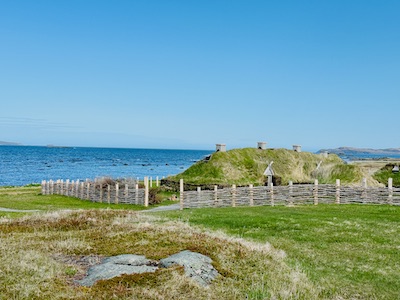
The rebuilt Norse encampment in L’Anse aux Meadows, Newfoundland

I scored a boat ride on Western Brook Pond (quite an understatement) on a clear day.  This was a two-hour tour which was simply awe inspiring. I felt transported as we traveled on a fresh water lake that once was attached to the sea.  Here a 2,000-foot glacier carved fjords that loomed over us as we traveled the length of the lake. Impossibly high water falls and jagged cliffs with formations like the “tin man” and “the old man on the mountain” are here. Some of the waterfalls are so high that they evaporate into mist before reaching the lake below. At one point I felt like I was in Yosemite and looking at El Capitan as the rock face was so gigantic; even though El Capitan is a thousand feet higher. Perhaps it’s the stunning lake at the base but the fjords rise majestically above. It’s a 2 miles hike to get to the boat ride and back but it’s worth the effort to see this incredible site. 

I camped overnight in Port aux Choix.  It was pretty cool because the campsites were next to the Gulf of the Saint Lawrence.  I ventured over to the Port aux Choix lighthouse and saw the lobster boats that go out at sunrise pulling in traps. This area has deep historical significance because there is evidence of over 5000 years of Archaic, Groswater and Dorset-Palaeo Eskimos in the area.  Burial sites in the area discovered in the 1960’s are unusually well preserved due to the raised shoreline and alkaline soil. It makes sense that this area has been inhabited for so long because Port aux Choix has a large protected port which now has fishing vessels. 

From Port aux Choix, I continued on to Flower’s Cove which is famous for thrombolites. Thrombolites are very rare fossils from 650 million years ago with remnants of bacteria and algae. The only other place in the world to find them are in Australia. They look dome shaped and dot the coast line. 

I had two purposes in coming to Newfoundland, one was to see an iceberg; I am happy to report I saw many. And the other was to see the first place that Europeans landed in North America. I am the daughter of a history teacher and when I was eight years old, we traveled to Minnesota to investigate the Kensington Stone and look for evidence of Viking explorers. This was all to help my father teach investigative history to his students. The Kensington stone has since been debunked as a hoax, so coming to L’Anse aux Meadows, I was excited to find evidence of the discovery of the Americas by Europeans. 

L’Anse aux Meadow was just a fishing village on the tip of Newfoundland when Helge and Anne Stine Ingstad were shown what was thought to be an Indigenous campsite by a local fisherman. It was an indigenous campsite and, as they discovered, also an 11th century Viking settlement. There were a few significant artifacts found including a forge and metal objects which were likely used in ship repair.  It also corresponds with the stories told in the Vinland Sagas which document the voyages of Leif Erikson and other Norse explorers who came from Greenland and Iceland. They have rebuilt several of the dwellings based on Norse traditions.  It’s quite remarkable to tour the area.  This is seen as the end of the circle of exploration since crossing the Atlantic was the last piece of migration across the globe. 

I was so excited to visit this remote area of the world and explore something that I know my father would have loved. I left some of my father’s ashes there so that he too could be a part of history, the subject he loved so much. 

🛳️ The Ferry to Newfoundland

I just recently traveled from North Sydney, Nova Scotia to Port aux Basques, Newfoundland in June of 2025. This is not my first ferry ride in my intrepid RV named Abeona. My first ferry ride with Abeona was from Bellingham, WA to Skagway AK in the summer of 2024. This was my first trip to Newfoundland and, hopefully, not my last. The Alaska ferry ride is 3 days and the trip to Port aux Basques is 8 hours.  That’s a big difference. I had purchased my tickets for my early June 2025 ride in May of 2024. Over a year in advance.  I had watched a few RV YouTubers and found out that getting space for a larger vehicle AND a berth to sleep in can be difficult, so I planned well in advance. I took the 11:15 PM trip which arrived in Newfoundland at 7:30 AM. There are two ferries a day between North Sydney and Port aux Basques but only one is at night.  I choose the night ferry so that I would have plenty of time to arrive at my next campground. I’m not a fan of setting up camp at night.  Although I had not factored in that the sun wouldn’t be setting until 9:15 PM so maybe that’s not as much an issue as I had anticipated.

As I departed my campsite in Little Bras d’Or, NS, I had twelve hours to kill before the ferry departed at 11:15 PM. I took the opportunity to head to the Cabot Trail of Nova Scotia and to the Cape Breton Highlands National Park. The scenic drive has sheer cliffs, artisan shops and sandy coves. It’s named for explorer John Cabot who was Italian but was commissioned by Henry VII of England to explore North America. He made his voyage in 1497. Every road sign in Cape Breton is written in both English and Gaelic. Cape Breton is quite the melting pot with French, Scottish, English, Mi’kmaq and Irish. Apparently Acadian French, Mi’kmaq, and Scottish Gaelic are spoken here in addition to English. Quite the mélange with a stunning backdrop.

Loading the ferry in North Sydney, Nova Scotia

I arrived back to North Sydney and made sure I filled up with gas before getting in line for the ferry some 4 hours before departure. When I had made the reservation last year, I had given the length of Abeona at 25 feet since I was warned not to be under on the length lest they decide we couldn’t fit. A man came out to measure Abeona and we were actually 24 feet so they gave me a 1.24 CAD refund. The agent at the entry booth was very nice and reminded me to shut off my propane before boarding. I was also given my card for my berth by the same agent. 

Abeona and I sat for 3 hours waiting to board. I sat on my bed in the back relaxing and preparing my overnight bag. There were some facilities with a sitting area and bathrooms but I was perfectly happy hanging out waiting for instructions from over the load speaker. They started loading cars and trucks about 2 and a half hours before departure. I have no idea about the masterplan for loading but apparently there are three decks for vehicles. I’m pretty sure I saw at least 25 eighteen wheelers travel up the roadway to the 5th deck which is where all the commercial vehicles are loaded. It’s quite the undertaking.  Abeona and I were loaded about an hour before departure onto deck 3. It’s a back to front loading ferry which is different than the ferry to Alaska which is side loaded and much more complex to get on and off of. It was a relief that loading was so straightforward. 

I tucked Abeona in and grabbed my backpack to travel to my berth on deck 8. I was anxious to get to bed since it was an overnight trip. It was a very nice berth with twin beds, a full bathroom and a porthole! This was an upgrade from my bunk bed with a sink and no window to Alaska. The ship had a gift shop, restaurant and coffee bar and they were all open for the length of the trip. There were also movies being shown throughout the ship.

Once we set sail and the various boarding announcements stopped, I slept really well.  It was also super nice to have a shower right in my room. They refer to these trips as “crossings”. My crossing was very calm and I didn’t see many white caps on the Cabot Strait.  I grabbed a relatively cheap cup of coffee in the morning which was $2.50. Loading for Deck 3 and 5 were the first to be let off the ship once we were docked.  I saw some folks with a dog in the back of the car when I was walking back to Abeona. I can’t imagine leaving a dog for over 7 hours in my vehicle. Unfortunately, you are not allowed access to your vehicle until the ship is docked and the crossing is complete.

Abeona and I easily disembarked and I headed to a grocery store in Port aux Basques, parked and waited until it opened at 8:30 AM. I find it crazy that Newfoundland and Labrador (one province) are a half hour ahead of Atlantic time. So, if it’s 7:00 AM in North Sydney it’s 7:30 in Port aux Basques and my watch and phone automatically updated to the new time. It feels strange to be 30 minutes off from the rest of the world. It’s a small price to pay for this enormous island that is referred to as “The Rock”. I’m looking forward to exploring it for the next month. 

😎 Surprising SoFlo

I have visited Southern Florida several times.  My son attended the University of Miami and then lived in Miami for about eight years.  I just returned from five weeks on the road in my RV, Abeona.  I wanted to check off the three National Parks in Florida and the historic town of St. Augustine. I found SoFlo to be a totally different vibe from other areas of Florida and certainly from North Carolina where I normally live. There is a Latin, family welcoming vibe and most people assume that you can speak Spanish which I have never found before in the United States. 

Flying over the vast expanse of Dry Tortugas National Park

Here is what I found surprising in SoFlo:

Farms. I always realized that a lot of citrus is grown in Florida but south of Miami in the towns of Homestead and Florida City, there are miles and miles of farms. And what seems like hundreds of fruit stands.  Two famous one’s which are not to be missed is one called, Robert is Here and Knaus Berry Farm. One is very different from the other. Robert is Here is a few miles from the entrance to Everglades National Park and is part fruit stand, food stand, milk shake stand and aviary. There is a small farm and aviary with everything from Goats to Cockatiels. They have tons of fruits you will only find in the Caribbean and South America like Mamey Sapote, Sapodilla, Cocao Pods, and Guanabana. They make the most delicious milkshakes I’ve ever had (I highly recommend coconut key lime). Knaus Berry Farm is in Homestead and they sell a terrific selection of baked goods in addition to being a farm stand.  The sticky buns are sold by the dozen and they are delectable. I’d like to thank my friend Sue (who lives in SoFlo) for recommending both places. Both are worth the journey to get to.

Animals.  The array of animals that happily exists in the wild is pretty amazing. If you have ever been to Key West then you know that Roosters are ubiquitous.  You can’t turn a corner downtown without seeing Roosters, Hens and chicks walking aimlessly. I was taken aback by the amount of Anhinga that were on the appropriately named Anhinga Trail in Everglades National Park. I could have stood two feet from one and it wouldn’t budge from sunning itself. Manatees, Ospreys, Crocodiles, Green Herons, Great Blue Herons, Egrets, Night Herons and Alligators.  They are all there coexisting in the vast region of wetlands that is south of Tamiami Trail. As I drove to Naples from Flamingo on Tamiami Trail, I stopped at several state and national preserves and saw upwards of 30 alligators hanging out sunning themselves. I was practically desensitized to being afraid of them because they were so plentiful but languid. 

Spanish. I went to a restaurant with my friend Sue and practically everyone that greeted us from the restaurant staff greeted us in Spanish. If you answer in English, they respond in Spanish.  It was wild.  The real test for me was going to a grocery store before heading to Key West. Both associates and customers were speaking Spanish throughout the store. I asked someone in the produce department for “Mushrooms” and he said “Don’t speakee English”. So, I asked for “Hongos” and he immediately took me to where the mushrooms were stored and he asked me how to say it in English. This was so wild for me. I think there were places in Spain that spoke more English than this enormous grocery store in Homestead. I had an issue checking out and the customers behind me were asking “Que pasa?” which I responded to in Spanish.  If you have ever tried to speak another language, most folks default to speaking English. I really enjoyed immersing myself back into Spanish.  It was an unexpected delight. 

Water. There are vast expanses of water everywhere.  Even if it looks like solid ground, it’s most likely a swamp. It’s humbling to drive Route 1 all the way down to Key West. It’s almost a hundred miles from Key Largo to Key West down the only connecting road, Route 1 or Overseas Highway.  It’s called Overseas for the reason most of the time all you can see on either side of the road is water.  Crystal clear water dotted with tiny keys covered in mangroves or grass. It’s quite the adventure.  Then there is the massive Biscayne Bay which is mostly National Park and water. Within the Everglades there is another gigantic body of water called Whitewater Bay. I realize there have been jokes about buying swamp land in Florida but there is a ton of it. It’s important to get out on it or over it by boat or seaplane or kayak.  There is so much to explore.

I admit that my expectations for SoFlo have mostly been driving around Miami and enjoying the restaurants, the beaches and the murals of the Wynwood Art District. There is so much more there than giant mojitos in South Beach and trending murals.  There is a ton of nature and culture to be explored. I hope you get a chance to do so. 

✈️ Secluded and Intriguing Dry Tortugas National Park

I decided to check off three more National Parks from my bucket list in the Spring of 2025. Dry Tortugas was the one I was most intrigued by. Dry Tortugas was discovered in 1513 by Ponce de Leon and it was initially called Las Tortugas (Spanish for turtles) and later called Dry Tortugas since it doesn’t have fresh water.  It’s very inaccessible because you can only get there by boat or seaplane and it’s one of the least visited National Parks with about 70,000 folks visiting annually.  It encompasses seven tiny islands (keys) 68 miles southwest of Key West and most of the National Park, like Biscayne National Park, is water. Just getting to Key West is an adventure as there is only one way in and one way out by road. Factor in construction, traffic and, in my case, a few fires, I was quite relieved to successfully finish the drive to Key West. 

This goes down as one of the most amazing adventures I’ve ever embarked on. In fact, outside of visiting historic Saint Augustine, this was the main point of venturing to the bottom of the continental United States. Traveling by motorhome in Florida in March is something that must be planned at least six months in advance and finding a campsite took several weeks to finally obtain.  After that, I booked my seat on Key West Seaplane Adventures. Yes, it’s expensive, but it’s oh so worth it.

The Seaplane to Dry Tortugas National Park

I had a 10 AM flight out of the Key West airport. First of all, a seaplane can take off on a regular runway, which I did not know.  There were two other groups on my plane which were families with kids and then me for a total of 10 adventurous souls all with window seats.  We donned our headsets and listened to our pilot as we took off in the middle of the airstrip (because the whole airstrip wasn’t necessary). It’s not a pressurized cabin so the wind, disconcertingly, is blowing in. But the view? Mesmerizing. The seaplane flies at 500 feet above the crystal-clear water and all of the coral and sand are visible from above. Much of the trip the water is only 3-7 feet deep and the water is a bright aqua blue. Our pilot described the various shipwrecks, pointed out dolphins and sharks and told stories of Spanish treasure. The seaplane ride alone was worth the effort. 

We landed a 100-yards from the edge of the Garden Key which is home to Fort Jefferson and the area of Dry Tortugas that you can visit. The airplane backed up to the beach and we all came down the ladder and stepped safely onto the beach. It feels like about 90 percent of the island is taken up by Fort Jefferson. It is the largest brick masonry structure in the Western Hemisphere with more than 16 million bricks.  Construction started in 1847 although it was never completed. At the time it was being constructed there were upwards of 400 people living on the island which seems crazy since there is no fresh water source. It also was never used as a fort although it was a prison during and after the Civil War.   Dr. Samuel Mudd who aided John Wilkes Booth and three other conspirators were held in the fort. 

It was interesting to explore the fort which doesn’t have electricity or running water.  If you head up the spiral staircase, don’t expect lighting or a handrail. Apparently, they abandoned finishing the fort which was designed to house 7,500 men. It became obsolete due to the invention of rifled cannons; the weight of the bricks caused the fort to sink and there were several yellow fever outbreaks. There is a lighthouse on the fort itself and another lighthouse on Loggerhead Key which is visible from the fort. It’s disconcerting to hike around a fort with absolutely no safety features and realize that the whole thing is sinking. 

There is also Bush Key which is connected to Garden Key that is closed while there are nesting bird colonies of Sooty Tern and Brown Noddies.  It’s open in the fall once the birds have finished breeding. All the birds fly high above the fort along with Magnificent Frigatebirds which are quite stunning. 

The seaplane ride back was just as terrific as we went over shipwrecks from the last 400 years. One famous one is the Nuestra Señora Atocha which was a Spanish treasure galleon which sank in 1622 and was famously discovered by Mel Fisher in 1985 with almost a half billion dollars in treasure. From the seaplane I could see one ship with its mast from my seat on the plane. 

It was such an adventure all wrapped up in one spot.  The beauty of the scenic plane ride practically gliding over the crystal-clear water, the ecosystem of nesting birds, the massive coral reef and visible fish from the seawall as well as the deep history of an immense fortress that was never complete. Go see it for yourself!

🏝️ Discovering Biscayne National Park

 set out to check off three more national parks from my list this Spring by heading to the south of Florida. The National Parks in Florida don’t have mountains or canyons or glaciers or tall ancient trees.  What they have a lot of is water. What they have in common with most of the other National Parks is remoteness. For the most part, it takes preparation and planning to set out to truly discover these national parks. Traveling by motorhome in Florida takes at least 6 months of planning as most RV parks are frequently booked 6 months to a year in advance during high season. Many of the tours that are available in Biscayne National Park need to be booked over 6 months in advance or you have to be very flexible with your dates.  The closest RV park was a Miami-Dade Park called Larry and Penny Thompson Memorial Park and Campground. This is a nice jumping off point for everything south of Miami.

Biscayne National Park sits off the coast of Miami south of Key Biscayne. The only way to see it, outside of stopping by the visitor’s center near Homestead, FL is to get on a boat.  There are a slew of boat tours available out of the Dante Fascell Visitor Center whether it be via kayaking, snorkeling, canoeing or stand up paddle board.  I elected to take a 3-hour cruise out to Boca Chita Key.  I was shocked to find out that 95% of the park is under water. Beneath the waters are manatees, coral reefs and countless abandoned mangrove covered keys.  The water was crystal clear.  We learned about the history of the area that was once inhabited by the Tequesta people. Later in the 19th century, pineapples, tomatoes and key limes were cultivated on these teeny tiny islands.  This became obsolete with several hurricanes destroying the crops.  In the 60’s and 70’s two power plants and two nuclear power plants were built on the shores.  This caused a backlash against development so the Biscayne National Park was born to preserve the delicate ecosystems of coral reefs, sea turtle nesting grounds and mangroves. 

Visiting Boca Chita Key in Biscayne National Park

The highlight of my boat tour was on Boca Chita Key which was originally developed to be a private club with a small lighthouse and barn.  Now the only way to arrive is by boat and many folks dock overnight.  I could see the coral reefs and schools of fish 

from the edge of the island. I really enjoyed walking on the perimeter of the key to see the birds and mangroves and very small beaches and the fact that no one was out there. I felt a million miles away from the towering Miami skyline; it was just me and the sand and the mangroves.  It was quite the boat ride back although most of bay is only seven to ten feet deep, when the wind picks up the waves come splashing over the boat. I don’t think any of the 30 of us on the boat escaped getting soaked on the trip which made it more of an adventure.

The park is a juxtaposition with the enormous metropolitan center just minutes away and the vast expanse of crystal clear water and mangrove covered keys dotting the water. I had been to Key Biscayne and its lighthouse guarding the bay some years ago.  To travel from the visitor’s center for Biscayne NP to the Key Biscayne lighthouse would take 2 hours and I still would not have circumnavigated the entire park. I’m just so glad I was able to have this experience and I was grateful for the forethought of those who sought to protect it. 

🇪🇸 Historic Saint Augustine

I traveled to St. Augustine in March of 2025. I have wanted to go to one of the most historic cities in the United States for the last decade or so. I tried last year but as with most winter/spring plans involving an RV, St. Augustine was fully booked.  This time I was well prepared in advance and booked 9 months in advance. St. Augustine did not disappoint. 

I grew up in Wilmington, Delaware and most of my historic lens is built around the thirteen original colonies, the Mayflower and Delaware being the first state (Dover is closer to Philadelphia than Harrisburg; so Cesar Rodney arrived first to sign the Declaration of Independence). Florida and the history of the Americas has never really been in my knowledge base. It’s quite surprising to realize that St. Augustine is the oldest European inhabited city in the United States and that it wasn’t part of the United States until 1819. In fact, it was occupied for 300 years before it became part of the United States.  

In front of the Castillo de San Marco

Ponce de Leon ventured onto what he thought was an island in 1513. He aptly named the island “La Florida” which means the place of flowers and claimed it for the Spanish crown. It was founded in 1565 by Menendez de Aviles. In contrast, the Mayflower sails to the United States in 1620.  The Spanish were here a century before the English. In St. Augustine most of the oldest homes in the United States are here as well as the oldest wooden school house which was built in 1702 and it still exists on St. George St. in the heart of old town St. Augustine.

Castillo de San Marcos was originally built by the Spanish in 1695 and is the oldest masonry fortification in the United States. A wooden fort was built after Sir Francis Drake attached St. Augustine in 1565. The masonry fort was built after an English privateer Robert Searles attacked and destroyed much of St. Augustine and the existing wooden fort. Most of the fortress was completed in 1672.  The Spanish Crown wanted to protect the shipping routes from Central and South America. Touring the fort is easy and it’s located right next to the water in central St. Augustine. It’s complete with a moat and drawbridge. It’s an unusual shape with pointed corners so that any intruder can be fired upon. The mortar is made from coquina or seashells which makes it extremely impregnable. The fortress itself was never breached or taken by force and was only exchanged through treaty or agreement. 

The Spanish held the fort from 1565 until 1763 when the British took over the fort in exchange for the British giving up control of occupied Havana. When this happened, many freedmen left for Cuba since they could not be assured of their rights under the English. In 1783, the Treaty of Paris ceded Florida back to Spain in recognition for their efforts on behalf of the American colonies during the Revolutionary War. Florida and the fort came under American rule when Spain ceded Florida in the 1819 Adams-Onis Treaty.  Quite the amazing history for an impenetrable fort. 

I was able to tour Flagler College which is on the site of the Hotel Ponce de Leon which was built by Standard Oil co-founder Henry Flagler.  It was built between 1885-1887 and it’s a terrific example of the Spanish Colonial Revival style. There are hundreds of homages to Spain inside and outside the hotel with the coats of armor for many Spanish cities. It has an incredible collection of Tiffany windows and many nautical themes throughout what once was a hotel that was only open for four months of the year for wealthy snow birds. It really is stepping back in time to tour the inside of the buildings which now house students for Flagler College.

Right across the street is the Lightner Museum of St. Augustine which is on the location for Flagler’s Hotel Alcazar. There is now a cafe in what once was an indoor pool.  I had lunch in the Cafe Alcazar and it’s wild to see pictures of this pool full of water and folks diving off of what is now a terrace. The museum if full of photos of the hotel from the late 1800’s. 

I was surprised by the beautiful architecture, the swaying palm tree lined avenues, the tiny shops in the historic district, and the mighty fortress that still sits perched on the Matanzas (which mean massacre in Spanish) River. Here the many folks that called this home and then had to either voluntarily or involuntarily move on as one ruler came on and another exited. So much history in an idyllic town which at one point was the north end of the entire Spanish kingdom. 

😳 Do It Scared: Overseas


I just got back from an eight city, seven-week escapade to Southern Europe. I’m moderately fluent in Spanish but besides that and a structured tour in Rome, I was on my own with my carry-on bag, backpack and my single pair of sneakers. The genesis of the trip was wanting to be in Rome on Christmas. Once I started booking things, it ended up that I was in Athens for Christmas and on a “Road Scholar” tour of Rome the week before. After talking to my world traveling friend Janine, I decided that Lisbon was the best place to start my trip as I recovered from jet lag. So, there it started, Lisbon, Rome, Athens and then on to Venice, Florence, Seville, Tenerife and finally Madrid. My route was set. Leading up to my departure, I started getting pangs in my stomach and started to wonder if I had an appendicitis or a burst gall bladder. I started to get nervous that I would land in Lisbon and then get rushed to a hospital.  It was all for naught. I think it was just like getting nervous before a speech or running a marathon; it was all in my head. I decided it was psychosomatic and pushed through anyway.  I’m so glad I did. 

Doing it scared at the Acropolis

Here are the ways I did it scared:

Carry on only. I had to pack light.  I had a trip a few weeks before to Seattle after my mother passed away and it was a test trip for packing extremely light.  One pair (yes ONE) of shoes, three pairs of pants, one rain jacket, one puffy jacket with hood and 6 long sleeve shirts, 1 t-shirt and 10 pairs of underwear. I had booked apartments with washers except for the hotel in Rome. I purchased a carry-on suitcase that is both the lightest and fits in all European airlines and had two sturdy wheels (no spinners) so that I could drag it for miles on cobblestone streets. I always purchased early boarding so that I wouldn’t have issues with getting my bag on board. I have heard enough nightmare stories of lost luggage that I wanted to make sure I had what I needed once I got my feet on the ground. I could easily pick up my bag and put it in the overhead bin and my backpack was a lower profile so it could easily fit in under the seat in front of me. One snafu to carry on is that many of the airports I traveled to had a bus to the airplane which meant maneuvering the bags on the bus and up a set of stairs to the plane. All of this gave the assurance that I wouldn’t be stuck without my luggage.

Embrace the unknown. Each time I was going from one city to the next city I almost always ran into a cab or public transit dropping me off some half mile from my destination due to pedestrian only streets. I had not factored this in the first time it happened in Lisbon. By the time I got to Athens, I would set up the directions to the apartment by getting the walking directions from the airport in my map app. That way, when the cab dropped me off, I would start following the directions of my phone/watch. There were still snafus like the closed park in Venice that I had to circumnavigate and the sheer confusion of massive amounts of shoppers in Athens. I was always my most vulnerable when I had my luggage with me and just finding a space off to the side of a major thoroughfare full of people to get my bearings was intimidating. There is also the fact that elevators start on level 0. I went up and down elevators several times looking for what I though was the second floor on floor 1 instead of going all the way to floor 2. I really had to embrace just being lost and to be OK with circling the block several times to figure out where I was. 

Figure out shopping. My first order of business once I found my apartment was figuring out what I was going to do for breakfast for the next day. I scoped out the coffee situation whether it was a Moka, electric kettle, Nespresso or Dolce Gusto machine. Off to the nearest Carrefour or Conad market I go with empty foldable backpack in hand. Most markets in Europe have self-checkout which is always interesting in a foreign language although sometimes you can select the British flag to get English. I never found oatmeal (Avena) until I arrived in Spain. In Portugal, Italy and Greece, I ended up buying Muesli (like granola) and milk. Fruits and vegetables almost always have a self-service station to weigh it.  You can imagine how intimidating finding a fruit or vegetable is on a foreign scale system. I’m not sure I was accurate but I survived getting a scanner code and was able to check out.  In addition, you scan or pay for each bag you use. I know some states have adopted this but taking along an empty backpack was handy. Every market payment system in Europe had a tap option so I didn’t have to figure out using what little Euros I had. Each time it was a new adventure. When I try to eat mostly vegetarian google translates by taking a picture of a product and was invaluable.

Travel on foot if possible. I ended up walking at least 5 miles a day during my travels. I never wore a headset. I try to be absolutely present and pay attention to the sounds and sights. It’s similar to walking a trail, I have to pay attention to each foot fall especially on narrow cobblestone streets. If something was wet, I’d walk slower. In retrospect the only place I saw folks with walkers and wheelchairs was in Madrid.  The rest of the cities I traveled to had stairs, cobblestones and rarely an elevator. Complete handrails (from top to bottom of a set of stairs) was a rarity. When I solo travel, I really slow down and carefully move forward. I also got to experience each city from the graffiti to the smells of roasting chestnuts to the sound of church bells. Each time I was in a precarious situation I would think about how it could be worse, like climbing up to the Acropolis, well at least it’s not raining and it’s only 60 degrees. Amongst the throngs the week before Christmas at the base of the Spanish Steps in Rome, I thought, at least I’m not shopping or trying to get a cab. Being on foot makes me be present and appreciate each moment.

Each time I plan my travel adventures; it feels like some long-lost dream until it’s behind me. I put a plan together and hope it all works out and figure if it doesn’t, I’ll just stay home. Fear is a fickle thing cropping up at inopportune times and I try to remember to bring curiosity and optimism. Mostly, I’m just grateful to have the opportunity to work remotely, see the world and do it scared.

🤪 Mad about Madrid

It’s ironic that the abbreviation for Madrid is Mad. Mad is the airport call letters and it’s used in the name of lots of things like restaurant names, “Mad Grill”, “Mad Mad Vegan”, and “Mad Cafe”. In American English, you wouldn’t normally call something mad but in British English it has a primary connotation to be crazy about something. Well, I decided that I’m mad about Madrid. Madrid was in the unfortunate position of being the last stop on my 8 city European tour in the winter of 2024-2025. I didn’t arrive with high expectations.  I had just been seduced by Seville with its flamenco, oranges and history. I had previously been to Barcelona and stayed in the romantic, intriguing Gothic Quarter. I really expected it to be like a Spanish New York City with tapas. Yes, it’s more cosmopolitan than Barcelona or Seville but it’s not the concrete jungle with canyons of tall buildings like New York City.

Taking a cooking class in Madrid and showing that the paella is ready because it is adhered to the pan.

This is why I’m mad about Madrid:

There will be art. I was able to go to three art museums while I was in Madrid and they were all less than a mile walking distance from my apartment. Museo del Prado is the main Spanish national art museum. It has art dating back to the 12th century with works from Goya, Bosch, Rubens, Titian, Velazquez and El Greco. There are countless paintings of the crucifixion of Christ and it’s remarkable to see the interpretation of various artists on this one subject. The Prado is an emotional experience with its mostly dark themes from either the crucifixion to enormous 40-foot paintings of battles and executions. You can also see the advancement of art through the centuries from painting on wood to frescos to canvases with immaculate perspective. I also went to the Museo Reina Sofia which is on the other end of the perspective from the Prado with all its works being from the 20th century.  It’s surprising to be in a museum in Madrid and to see painting from Hopper, Pollack and Wyeth. This is alongside an extensive collection of Picasso, Dali and Mora.  There was a temporary exhibit by Portuguese artist, Grada Kilomba in which she uses words and music in video or dancers representing her words.  It was quite unique. The Museo Thyssen-Bornemisza is another great museum in Madrid which fills the gap between the medieval Prado and the very modern Sofia. The Thyssen has many of the classic impressionists like Monet, Degas and Renoir which are some of my favorites so I really enjoyed it. Madrid has art for every taste.

There will be food. Madrid is a food lovers Mecca with everything from tapas to brunch to Michelin star restaurants. I was really glad I signed up for a tapas and paella class for the first day I arrived. There were only five of us in the class and the other four folks were from Mexico. When the instructor realized I spoke Spanish, she decided to teach the class in Spanish which was a confidence builder for me. I learned some amazing tricks like grating Roma tomatoes instead of chopping which seems crazy but the method effortlessly eliminates the skin of the tomato. We also cleaned cuttlefish which was something new for me. I really appreciate that was very hands on, similar to a class I took with my college roommates (Those Girls and the Blonde) in Paris some ten years ago. I have also found that throughout Spain if the name of the restaurant is in English then the restaurant is an easy place for English speakers like myself to go as the entire experience from greeting to menu is in English.  I also found that most restaurants serve tapas and that the portions are enormous. I received a plate of blistered peppers that were simple yet delicious and that alone could have been a meal. I did not venture into any fine dining places as most places don’t open until 7 PM and I’m not a big fan of walking at. Night. There were also tons of butcher shops and produce stands throughout the city. Grocery stores are amazing places throughout Europe. I would walk up to a Carrefour market and it would look like a simple convenience store until you walk inside the labyrinth which is almost always at least two floors with an elevator. I found that sparkling water is almost always at the far end of the second floor much like milk is always in the back row of Safeway. In Madrid, there are always full Jamons (legs of cured ham) hanging in the store where families will have one parked on a kitchen counter to take a slice whenever needed. There were also plenty of vegan restaurants to choose from as well. I really enjoyed eating my way through Madrid.

There will be walkways and parks. In a city the size of Madrid, I did not expect to see so many pedestrian walkways and parks. I have to say that even if there are cars on the road, the minute you step within a foot a crosswalk, the vehicle stops in its tracks. I found this to be amazing. I also took an amazing tour of Toledo (the cathedral is the second largest in Spain after Seville and is simply breathtaking) and the bus picked us up two stories below the Royal Palace. We then drove some ten miles underground (similar to Boston’s downtown). I didn’t realize until that moment but you don’t see large trucks or many cars in downtown Madrid. If there are vehicles, they are only taxis and delivery vans. This makes walking around very easy. In addition, they have a metro system as well, although I didn’t need it since everything for me was in walking distance. There are also enormous parks throughout the city with countless statues venerating various kings and conquerors. One of the main streets by the Sofia and Prado is closed to traffic on Sundays (similar to Central Park in NYC). This makes for terrific space for runners, skaters and sightseers like me. 

I found Madrid to be friendly and inviting. Folks sitting next to me at a table on the Plaza Mayor wished me a pleasant meal (buen provecho), and folks walking down the street would say hello (buenos dias or hola). One funny thing happened at the Thyssen.  The man behind the ticket counter asked if I wanted a discount and I said (in Spanish) well, I’m not a student but I am old. The couple in the next cue laughed and said, “Woman, you’re not old”. Probably the greatest gift in life is making someone laugh in another language. I got the discount by the way:). I am mad about Madrid and hope to return.

🧐Exploring Tenerife

I have always wanted to travel to Tenerife because my children have relatives that lived there and it was a reprieve from the colder temperatures of Southern Europe. Tenerife is the largest island of the seven Canary Islands which is a Spanish province 62 miles off the coast of Morocco. The indigenous people of the Canaries are called Guanches and have been around for 2 to 3 thousand years.  The Romans were there in 100 BC and countless others came through including the Phoenicians, Greeks, and Carthaginians. In 1402, the Castilian colonized the islands, there was genocide and enslavement of the native Guanches, a dispute with Portugal on this advantageous jumping off point for exploration and finally it was incorporated under the Kingdom of Castile in 1496. The Canaries then became wealthy as they were a major trade stop for Conquistadors on their way to the New World and the riches they brought back with them. Sugar cane was the main crop for many years until the New World could produce it more cheaply.  After sugar cane bananas became the new cash crop of choice. Tenerife in current times has almost 1 million inhabitants and the largest industry is tourism with over 4 million visitors a year. I was one of those tourists for a week and really enjoyed it’s topography, history and friendly people.

Mesa del Mar in Tenerife, Canary Islands, Spain

The only way around the island is by car and most rental cars are manual transmission.  I was fortunate that when I booked my car rental that I requested an automatic. This proved to be invaluable when I was descending the ten hairpin turns down the side of the cliff into Mesa del Mar which is where my apartment was for the week. My right foot ached from riding the brake all the way down the roadway and I prayed for no cars (or God forbid, busses) in the opposite direction. Once I arrived at the bottom, I was rewarded with a magnificent vista of crashing waves, an Olympic size natural pool right on the ocean and a black sand beach. It truly was mesmerizing to watch the waves crash relentlessly against black volcanic rocks and it was a view I didn’t tire of for the rest of the week. 

My apartment was in a 12-story tower right on the water with a view of Mount Teide, deep blue rolling waves and black volcanic rock outcroppings off shore. Truly amazing. The price of this view was a drive up and down a cliff in order to get groceries or see other sights of the island. I was on the 5th floor with an elevator that did a little dip when it arrived at each floor which was a bit unnerving. The walkway to the parking lot where my car was, was frequently hit by errant waves. As beautiful as it was it also felt a bit precarious with netting to guard the road from rockslides, ferocious wind gusts and the natural pool being inundated each high tide. The weather was terrific for my entire visit with sun and highs in the low 70’s and lows in the 60’s. 

I drove to the largest town on the island, Santa Cruz de Tenerife, which was about 25 minutes away and visited the Palmetum which is a botanical garden overlooking the ocean. It has an amazing array of palm trees and some pretty views of the ocean. I was really surprised to find Monarch butterflies because they are native to Central and North America. Apparently, they first appeared in the Canaries in 1880. Quite the feat from across the globe. 

I took a tour to Tiede National Park. I had initially thought that I would drive around the island but my cliffside road to my apartment, my ability to constantly take the wrong turn and have to be redirected by my GPS, told me otherwise. I cannot tell you how relieved I was to be in a tour up to Tiede National Park. The road to and from is not for the faint of heart. One of the first stops on the tour was to see a 700-year-old Dragon Tree in the town of Icod de los Vinos. It’s the largest and longest-lived tree of its kind in the world with a trunk that’s wider than its height. It looks like it belongs in a fairy tale with its vine like trunk and brush shaped branches.

The next stop was the town of Garachico. This town was founded in 1496 and was a major port on the island until a volcanic eruption in 1706 wiped out most of the town. This caused the port to be closed and operations moved to Santa Cruz de Tenerife. Throughout the western side of the island of Tenerife is evidence of all the volcanic activity on Tenerife with black sand beaches and long dormant lava flows. From Garachico, we headed inland to the small town of Masca. It’s a tiny town with 90 inhabitants at 2,000 feet above sea level that our guide told us was comparable to Machu Picchu. The view from town was magnificent with the sharp drop offs and views of the Atlantic Ocean out in the distance. 

We left Masca on what our guide referred to as “Ah Ya Ya” road. Being in a full-size tour bus on a narrow winding road with what felt like hundreds of tourists in rental cars seems like a recipe for disaster. There were times the driver motioned drivers to back up, uphill some 100 yards, so that we could navigate the hairpin turns and narrow road. We all clapped when we finally arrived in the Tiede National Park. The park itself is basically a Calderon of the volcano which is Mount Tiede. Apparently, it’s a unique volcano in that it’s located on top of a shield volcano and the second tallest (from the base under the ocean) in the world. Only Hawaii’s Mauna Kea is taller. It’s considered an active volcano since it last erupted in 1909. The landscape is truly amazing with large tower like rock formations, colorful striations and only Canarian pine trees that seem to be able to survive the volcanic eruptions. My Spanish seat mate described the pine trees as “Terrorists” because they burn quickly but have an astounding ability to regenerate. I think of the lava flows I saw near Bend Oregon which was desolate in comparison to Tiede National Park with its Canarian Pine groves. At lunch outside of the National Park I was finally able to snap a picture of a canary, throughout my stay on the island I could hear the birds but they were pretty elusive. 

I spent most of my time in Tenerife just staring out the window at the Atlantic Ocean. There were no screens on the windows and no central heat or air conditioning. Just the natural breeze blowing through the apartment and the sound of the ceaseless ocean. It truly was a nice pause with idyllic weather, a tremendous view and a topography that cannot be matched. 

🍊Seville: Oranges, Passion and History

I arrived in Seville on the afternoon of January 4th which happened to be the Cabalgata de Reyes or the Three Kings Parade.  Three Kings Day is celebrated on January 6th but the parade is scheduled depending on the day of the week.  I had no idea that this was going on until I couldn’t get an Uber from the airport due to incredible price increases.  I decided to find a cab instead and my driver told be about the parade. It’s a long parade that travels in a big loop through the city dropping candy for children and a spectacle for the adults. Had I known the route, I would have attended but I really wanted to get my bearings in a new city. It seems that being lost with luggage in tow is a norm for me at this point, I was dropped off by the cab about a quarter mile from my apartment because, as is the case in a lot of European cities, my apartment was on a pedestrian only street. I have found in my travels that being on a pedestrian street is advantageous in the ease of getting around on foot and they tend to be quieter at night. The main snafu is that it’s easy for me to get disoriented in a narrow alley trying to find the entrance. I did. The location was great. The cost is 15 minutes of figuring things out.

I absolutely love Seville. The weather in January is highs in the 60’s. I was able to walk safely to every sight of interest. The people are very warm and friendly. There are bitter orange trees everywhere. In January, that means that each tree will be full of ripe bitter oranges. I found this to be amazing and unexpected. In fact, there are over 14,000 bitter orange trees throughout the city. The oranges themselves are the property of the government and are harvested by temporary staff annually to make the famous Seville marmalade. So basically, I was walking through a bitter orange orchard for the week I spent in Seville. What’s not to love about that?

One of the magnificent rooms in the Real Alcazar in Seville

I am moderately conversant in Spanish and I found that practically everyone I met locally defaulted to speaking Spanish with me. I really appreciate this as it makes me feel more self-reliant to be able to converse in basic questions like “does this have onion?” or “is it very far?” In the previous weeks I muddled through with the basics of Italian “Grazie” and “Por Favore” and Portuguese “Obrigado”. It was a relief to be able to understand what people were talking about and for locals to be willing to engage with me in my mediocre Spanish. I compare this to a trip I took with my kids to Barcelona where the language is Catalan and practically everyone started speaking to us in English regardless of whether we tried to engage in Spanish (not Catalan). It’s not that they don’t speak Spanish, the locals default to Catalan or English.

There are probably a 100 flamenco shows within the Seville city limits. It is the birthplace of this passionate dance with Moorish and Roman roots. Most of the songs and dance are that of lament; the wailing and intensity sucks you in. I was in the second row crammed into a tiny tableau with maybe 50 seats. The singers, the guitarist and dancers are just feet away. Each performance is loosely planned and the songs and dance are improvised. There was one woman performer who could snap her fingers so delicately and eloquently, I was mesmerized. The clothing, the music, the wail and pain of the singer, and the incredible speed of the guitar; it is not to be missed.

When I traveled to Lisbon the month before I finally understood that Portugal and Spain were under Muslim rule from 711 to 1492. 800 years has an enormous impact on architecture and culture. “Ojala” in Spanish translates to “hopefully” but that root is actually from an Arabic word “Inshalla” or “If God wills.” The name for the main castle in Seville is Real Alcazar.  Alcazar is Arabic for castle and Real means Royal. This place is not to be missed. It was started as a citadel in the 10th century during the Abbasid dynasty. It had palaces (nine in total) added and enlarged over the next 4 centuries by both Arabs and Spaniards under different regimes. The Alcazar represents the melting pot of cultures with extensive tile from floor to ceiling with Moorish arches and floor fountains in many rooms. It’s surrounded by an extensive garden including the omnipresent bitter orange trees. Ferdinand III conquered Seville in 1248 and it was taken over by Castilian monarchs. Seville is about 60 miles from the coast along the Guadalquivir River. Many explorers including Christopher Columbus, Ponce de Leon and Nunez Balboa passed through the Real Alcazar to either bring back the spoils of the journey or ask for sponsorship on the next voyage. This was the hub for all things American. It’s remarkable to stand in a place so steeped in history.

I also visited the Seville Cathedral which is the largest gothic cathedral in the world. It opened as a Catholic Cathedral in 1507 (it originally was a mosque in 1172) and is an example of Gothic, Moorish and Renaissance styles.  There are countless chapels (there are 80 contained in the cathedral) in this enormous church. The stunning feature of the cathedral is the enormous gold altar piece that is called the Retablo Mayor which is the largest altar in the world with thirty-six relief panels depicting scenes from the Old Testament and the lives of saints. It stands 76 feet high is and is breathtaking to behold. 

There are many places to visit in Seville including the Gold Tower, the Plaza de Espana, and the very modern Setas de Seville (which look like giant mushrooms). I most enjoyed just walking the countless pedestrian streets through old historic neighborhoods with empanada shops, tapas bars and plenty of stores selling Flamenco dresses. I also enjoyed a paella class on a rooftop near the Gold Tower. It was mostly a demonstration instead of cooking but it was interesting none the less. 

I could have spent another week or two in Seville it had such a relaxed friendly vibe and I felt like I was immersed in the history of both Spain and the Americas. I know I will return.