
I traveled to St. Augustine in March of 2025. I have wanted to go to one of the most historic cities in the United States for the last decade or so. I tried last year but as with most winter/spring plans involving an RV, St. Augustine was fully booked. This time I was well prepared in advance and booked 9 months in advance. St. Augustine did not disappoint.
I grew up in Wilmington, Delaware and most of my historic lens is built around the thirteen original colonies, the Mayflower and Delaware being the first state (Dover is closer to Philadelphia than Harrisburg; so Cesar Rodney arrived first to sign the Declaration of Independence). Florida and the history of the Americas has never really been in my knowledge base. It’s quite surprising to realize that St. Augustine is the oldest European inhabited city in the United States and that it wasn’t part of the United States until 1819. In fact, it was occupied for 300 years before it became part of the United States.
Ponce de Leon ventured onto what he thought was an island in 1513. He aptly named the island “La Florida” which means the place of flowers and claimed it for the Spanish crown. It was founded in 1565 by Menendez de Aviles. In contrast, the Mayflower sails to the United States in 1620. The Spanish were here a century before the English. In St. Augustine most of the oldest homes in the United States are here as well as the oldest wooden school house which was built in 1702 and it still exists on St. George St. in the heart of old town St. Augustine.
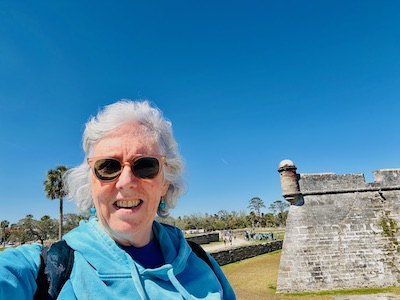
Castillo de San Marcos was originally built by the Spanish in 1695 and is the oldest masonry fortification in the United States. A wooden fort was built after Sir Francis Drake attached St. Augustine in 1565. The masonry fort was built after an English privateer Robert Searles attacked and destroyed much of St. Augustine and the existing wooden fort. Most of the fortress was completed in 1672. The Spanish Crown wanted to protect the shipping routes from Central and South America. Touring the fort is easy and it’s located right next to the water in central St. Augustine. It’s complete with a moat and drawbridge. It’s an unusual shape with pointed corners so that any intruder can be fired upon. The mortar is made from coquina or seashells which makes it extremely impregnable. The fortress itself was never breached or taken by force and was only exchanged through treaty or agreement.
The Spanish held the fort from 1565 until 1763 when the British took over the fort in exchange for the British giving up control of occupied Havana. When this happened, many freedmen left for Cuba since they could not be assured of their rights under the English. In 1783, the Treaty of Paris ceded Florida back to Spain in recognition for their efforts on behalf of the American colonies during the Revolutionary War. Florida and the fort came under American rule when Spain ceded Florida in the 1819 Adams-Onis Treaty. Quite the amazing history for an impenetrable fort.
I was able to tour Flagler College which is on the site of the Hotel Ponce de Leon which was built by Standard Oil co-founder Henry Flagler. It was built between 1885-1887 and it’s a terrific example of the Spanish Colonial Revival style. There are hundreds of homages to Spain inside and outside the hotel with the coats of armor for many Spanish cities. It has an incredible collection of Tiffany windows and many nautical themes throughout what once was a hotel that was only open for four months of the year for wealthy snow birds. It really is stepping back in time to tour the inside of the buildings which now house students for Flagler College.
Right across the street is the Lightner Museum of St. Augustine which is on the location for Flagler’s Hotel Alcazar. There is now a cafe in what once was an indoor pool. I had lunch in the Cafe Alcazar and it’s wild to see pictures of this pool full of water and folks diving off of what is now a terrace. The museum if full of photos of the hotel from the late 1800’s.
I was surprised by the beautiful architecture, the swaying palm tree lined avenues, the tiny shops in the historic district, and the mighty fortress that still sits perched on the Matanzas (which mean massacre in Spanish) River. Here the many folks that called this home and then had to either voluntarily or involuntarily move on as one ruler came on and another exited. So much history in an idyllic town which at one point was the north end of the entire Spanish kingdom.






 Workplace Navigator