😎 PEI – Tiny and Unique

Prince Edward Island (PEI) is the smallest province in Canada but if it was a US state, it would be the second smallest right after Rhode Island. Yes, my Delaware friends, there is a Canadian province that is smaller than the state of Delaware. I traveled here on my Atlantic Maritimes Road trip in my RV, Abeona in the summer of 2025. I will say that getting to PEI is not for the faint of heart. My knuckles were white as I drove across the only bridge to the island called Confederation Bridge. First, I’d like to thank the travel gods because it wasn’t windy that day as I traversed the 8-mile bridge. I was dumbfounded as to why there weren’t any west bound cars as I came across the bridge until we were stopped for about 5 minutes due to construction on the bridge. It was nerve wracking to be about two thirds of the way across the bridge only to be stuck high above the Gulf of the St. Lawrence for what seemed like an eternity and to feel the roadway undulate from the weight of the cars (this takes me back to walking across the Golden Gate Bridge many years ago and feeling the ground constantly move). There is no toll on the east bound side of the bridge but on the way back it was 50.25 CAD ($36.70). That is definitely the most I have ever paid for a bridge toll. 

The red cliffs and beaches of Prince Edward Island

I headed immediately to the most western lighthouse on the island called West Point Lighthouse which is in Cedar Dunes Provincial Park. Here I got to see the tallest lighthouse on PEI at 68 feet tall. It’s situated right next to the red sand beaches of Cedar Dunes Provincial Park which is quite stunning as it was a clear sunny day and the dark blue ocean waves crashing next to the vast red sandy beach is impressive. It turns out that this tiny island province has over 55 lighthouses which is a lot compared to at the very least North Carolina which only has seven active lighthouses. Once I arrived at West Point Lighthouse I wanted to continue on to my next destination and there was no cell coverage. It wasn’t until later that I learned that driving on the island is more like navigating a maze. I definitely would have invested in a paper map if I had to do it again. I was able to start up my satellite dish to get my directions to my next destination but I have to say I was caught off guard. I think I had better cell coverage in the Yukon

When traveling on to The Bottle Houses and Garden, there was never a straight shot on a road for say 20 kilometers. It was more like 1.5 KM then right for 2 KM and then left for 1 KM. And so on. There are vast amounts of fields and farmland which is pastural but I felt like my GPS must be wrong that that there must be a more straight- forward way to get from point A to point B. I needed to let go and let faith take over. Later in the day I ended up on a gravel road for at least 5 KM which really rattled me both physically and mentally. 

The Bottle Houses and Gardens is a lovely spot; it has a chapel and two house built by Edouard Arsenault in 1980.  His first house was built with 12,000 bottles which he collected and carefully cleaned and then built using cement between the bottles. The second building is called the tavern and is built using 8,000 bottles and the last creation is a chapel which was completed posthumously with 10,000 bottles. The gardens around the site are picturesque and there are many bottle trees (metal tree shaped frames with bottles on the “branches”) in the gardens as well. It’s definitely worth the visit.

I visited the Green Gables Heritage Place along with Lucy Maud Montgomery’s birthplace. I’m not sure anyone would be interested to visit these places unless you have read Anne of Green Gables or watched one of the series or movies associated with the place. I have read the book and watched the series and it was neat to see where Montgomery got her inspiration. The Green Gables house was actually Montgomery’s grandparents’ house and she spent a lot of time there since her mother passed away when she was two and her father moved out to western Canada. You could feel that the book was very autobiographical as Montgomery like her main character, Anne Shirley, was also a teacher. As an aspiring writer it was really neat to see her first handwritten draft of Anne of Green Gables and the old typewriter she also used.  It’s an interesting walk back in time to see the farmhouse and its thatched beds and Victorian furnishings.

An interesting stop in PEI is The Dunes Studio Gallery and Cafe which is a great place to look at local art, buy some locally made crafts, eat seafood and wander the lovely gardens. There are also art studios for the artists who actually work here that you can see into. If it weren’t for the drizzle that morning, I could have wandered for hours. 

There is a laid-back pace to PEI with endless red sand beaches, striking red cliffs near the placid waves breaking on shore. I’m pretty sure I passed more farm equipment on the road than anywhere back home in North Carolina. This island is all about the farming and raising of world-famous PEI mussels which can be seen throughout the bays and inlets around the islands.  I’m glad I ventured here and now I’ve been to every province in Canada. 

🧐25 Peculiarities of Newfoundland

I’m finishing up a month-long solo RV tour of Newfoundland.  This is truly a beguiling place with vast amounts of seascapes, cliffs, and wilderness as well as tiny fishing villages and busier hubs like St. John. The vast Great Northern Peninsula is as desolate in areas as the Yukon Territory with nary a Tim Horton (Canada’s answer to Dunkin); while St. John’s is a major shipping port with countless restaurants and museums. I began my trip at Port aux Basques where I could travel for hours without seeing any facilities and I am finishing up my trip outside of St. John’s which has 40% of the province’s population complete with parking garages and pedestrian thoroughfares. There is a lot of contrast here and I’ve loved every moment.

An iceberg near St. Lunaire-Griquet

Here are the 25 peculiarities of Newfoundland:

  1. Pronouncing it. I have been corrected on the pronunciation of Newfoundland by several Newfies. From the best I can figure it is pronounced: New-FUN-lAnd. I tend to say NEW-fin-lund. 
  2. No Newfoundland dogs.  Outside of statue of a Newfoundland and Labrador dog in downtown St. John’s, I have yet to see a Newfoundland dog here.  I had a client ask if there were herds of them here. There are not.
  3. Only Dairy.  Especially in the remote northern end of Newfoundland, I could not find any non-dairy milk or yogurt.  It’s all dairy, dairy here.
  4. Moose. I went to a nature park called Salmonair and traveled over 1,000 miles in Newfoundland. I have yet to see a live moose although they claim that there is one moose for every 4 people or 125,000 moose. That’s an amazing number considering they were introduced here in 1904.
  5. Icebergs. I saw eight icebergs on my trip here and if you come in June and are willing to travel to St. Lunaire or Twillingate, I can pretty much guarantee you will see an iceberg and it’s an awe-inspiring sight.
  6. RDF. A Newfie clued me in that this is the general term for weather which stands for Rain, Drizzle and Fog (St. John is known as Fog town). There is no telling when it will rain and when it will be sunny and, in general, the forecast is wrong. This can make planning difficult and you just have to be adaptable. 
  7. National Parks. There are two National Parks (Gros Morne and Terra Nova) on Newfoundland and they are beautiful and super inexpensive compared to the US. It’s only $11.00 to enter these parks for the day.
  8. Provincial Parks. I saw several Provincial Parks and all of them have been free. The most stunning was the Dungeon Provincial Park which is a collapsed sea cave.  It was a gravel road out to it, but when there is a clear, blue sky and pounding waves below in “the dungeon”, it’s a spectacular sight. 
  9. Potholes. When I drove the Alaska Canada highway last year there were always signs to indicate that potholes were coming and they were accurate. While the Trans-Canada Highway here is terrific, there are several secondary roads that were riddled with potholes and/or frost heaves (undulating roadway from temperature changes). Sometime I had to drive 20 miles an hour to make sure Abeona held together.
  10. Brogue. Many of the locals sound like they are from Ireland or Scotland. A server or customer service person would approach me and I must have had a deer in the headlights look because I have no earthly idea what they just said. Expressions like “Whaddayat” or “How ya gettin’on” at times made me think I was across the pond. 
  11. Chatty. I was mentioning to a Newfie I met in St. Pierre that people were so nice in Newfoundland and she said, “Well, they are really just chatty.” She is right. People would talk to me about just anything but most likely the weather (see #6).  I had an older man come up to me while I was gassing up Abeona and said, “Whaddayat” and “Come from away” (are you visiting).  He thought I had a really nice rig and asked “Do you have a man in there?” The folks here are chatty.
  12. Time zones. I think it’s bizarre but Newfoundland and Labrador are a half hour ahead of the Atlantic Time zone (Nova Scotia, etc.). So, they have their very own time zone.
  13. Gas. A lot of the gas stations only have regular gas and you pump and then pay inside. Similar to my trip through the Yukon, I gassed up at almost each gas station I found open (some are closed on Sunday).
  14. Potable water. I was prepared for this before I came but several campgrounds had boil warnings on the water. I had to be sure I filled up at the campgrounds with safe drinking water.
  15. Cover shopping carts return. I found it strange that grocery stores had covered places for the carts to be returned. Gas stations were not normally covered (like they are in the US). 
  16. Cod. Cod is the center of the universe here and when there was a moratorium on cod fishing starting in 1992 it devastated the region.  As they say here, fish is cod and cod is God. The fishing just restarted in 2024 but only partially. It’s why the area was settled 400 years ago.
  17. Jigg’s Dinner.  This is a classic Sunday dinner in Newfoundland and is only served on Sunday.  It’s a boiled dinner that included salted beef, turkey, potatoes, turnips, mashed peas, carrots and greens. The whole thing is covered in gravy (similar to Poutine which is fries covered in gravy). I was finally able to be at an open restaurant on Sunday that was serving it and it was delicious.
  18. Lupin. Besides thousands of dandelions that almost look like they are cultivated along the highways and byways, swaths of lupin in blue, pink and white are along hiking trails and highways.
  19. Balsam Fir. Most of the landscape on the Great Northern Peninsula is barren and grassy but along the Avalon and Bonavista peninsula’s there are miles of balsam fir conifer forests and the smell is breathtaking. 
  20. Moose burgers. Besides fish and chips (see #16), another staple at roadside restaurants on the Great Northern Peninsula  is moose burgers. It’s more prevalent than regular hamburgers. 
  21. Painted Rocks. I found painted rocks on random hiking trails where school children from a particular class room painted rocks to line the trail at its apex. There are large boulders painted as well. It’s like finding Easter eggs while driving or hiking.
  22. Partridge Berries.  These are small red berries that are tart like a cranberry and many restaurants made tarts from them.
  23. Gift shops.  There are tiny gift shops next to lighthouses and on the road next to restaurants. These shops are filled with handknit gloves, homemade partridge berry jam (see #22) and painted rocks. They are all locally made and quite homespun. 
  24. Wood piles. I saw this the most on the Great Northern Peninsula but there would be random piles of wood along the Viking Trail on my way to St. Lunaire. Apparently, locals have a place to keep their wood for the winter.  It seems random but it’s not.  The same goes for piles of lobster traps.
  25. Names. I find it funny that there is an island called Random Island and two lakes right next to each other, one called 3 Corner Pond next to Triangle Pond. I wondered how they knew the difference since isn’t a three-corner pond a triangle? There is also the town of Dildo which Jimmy Kimmel featured on his show. There is the inappropriately named Western Brook Pond which is a fresh water fjord that is 10 miles long and 250 feet. Not really a pond. 

I love that Newfies and Newfoundland are so quirky and friendly. Regardless of whether I was walking down a trail, doing laundry or paying for gas, these people are so welcoming to those that come from away.  I can’t wait to return. 

🐳 Puffins, Whales and Lighthouses: Newfoundland

My original purpose in traveling to Newfoundland was to see icebergs and the Norse settlement, L’Anse aux Meadow. But in addition, I was secretly hoping for puffins and whales as well. I scheduled my trip at the height of iceberg season (May and June) so if I was able to see puffins and whales, all the better. I knew, of course, there had to be lighthouses because with 6,000 miles of coast line, there will be lighthouses. 

While I camped outside of St. John’s on the Avalon peninsula, I took a tour of the area surrounding St. John. I could have driven it but with a 24-foot motor home to park and St. John being full of narrow streets and hills, I figured I’d leave the parking and maneuvering to someone more knowledgeable. We headed to Cape Spear and the most easterly point of North America. We arrived there on a windy day and saw the two lighthouses that sit atop the craggy cliffs. The current lighthouse was built in 1955 and is completely white and stands 45 ft. tall. It’s quite picturesque above the rocky coastline. Behind it about 50 yards away is the original lighthouse which was built in 1836 and is a squat single story white building with a red and white light on top. This older lighthouse is the oldest surviving lighthouse in Newfoundland. They apparently used to use whale oil to light the original lighthouse. It doesn’t feel like it but Cape Spear is within the city limits of St. John, the heart of which is 7 miles away. Cape Spear is a windswept place on its isolated crag. The Portuguese named this place Cabo da Esperance meaning “cape of hope”, which became Cap d’Espoir in French and finally Cape Spear.  It feels like every European nation had hands in the naming of the towns and headlands of Newfoundland. If they were fishing for cod, they were here at some point.

The Bonavista Lighthouse in Newfoundland

My next conquest was puffins. Before coming to Newfoundland, I made sure I joined a few Facebook groups.  There are several iceberg, whale and puffin Facebook groups and you can find out in real time if there is any activity.  This proved invaluable. I was camped in Chance Cove and almost a three-hour drive to the best puffin viewing area.  When I come back to Newfoundland, and I know I will, I will definitely plan to camp closer to Elliston which is out on the Bonavista peninsula. Puffins are most active in June and July while they are nesting. The best time of day to see puffins is in the early morning and late evening.  Even though I headed out at 7:30 AM, I wasn’t able to park and see the puffins until around 10 AM so most of the activity had subsided by the time I trekked out around a very narrow isthmus to get to the Puffin Viewing Area. There were about twenty people out there. There were several hundred puffins out on the cliff walking and flying about in addition to seagulls. It was really interesting but I should have brought binoculars or a high zoom camera lens. They are such unusual looking birds that I wanted to see them up close. There was another puffin viewing area off the coast of the Bonavista lighthouse but by the time I got there around noon, I didn’t see any puffins. The Bonavista lighthouse built in 1843 is another squat lighthouse although it is painted with bold red and white stripes. So, no puffins but another lighthouse bagged.

Next up, the Whales Playground in St. Vincent, Newfoundland. I traveled there on the Sunday of the major holiday weekend of Canada Day (July 1st). It was sunny and I wanted to beat the crowds. I figured it would be busy since by all accounts on Facebook, the humpbacks were definitely there. I headed out at 7 AM and arrived just before 9 AM. There was plenty of parking and the crowds were already gathered to see this awe-inspiring site. Apparently, the small fish called Capelin migrate in June and July off the shores of Newfoundland and the humpbacks migrate as well to feast on the abundance of fish. The beach off of St. Vincent has a sharp drop-off so that the whales are just 25 feet away.  I parked and headed out to the beach where there were 30 or so spectators, many with enormous zoom lenses. I absolutely gasped and tears came to my eyes as I saw the shiny black back of a humpback whale right off the beach. There was one single whale at one end of the beach and a mother and her calf about 30 feet away. When they are feeding, they are super active with tails, blow holes and pectoral fins flying. They are such majestic animals and they seem like they are just barely out of reach from the stone covered beach. Many people set up and camp in a chair for the day. As I headed out around noon, I passed hundreds of cars on their way to see the whales. I was glad I got there early before the crowds descended. The Whales Playground on a sunny day in June is not to be missed.

Newfoundland has been a treasure trove of UNESCO world heritage sites, lighthouses, spectacular rocky cliffs, icebergs and encounters with beautiful wildlife. I had a short Wishlist before I arrived and it’s been completely fulfilled in my month here on the island referred to as The Rock.  It truly has been an adventure and I’m so glad I made the effort. 

🇫🇷 Enchanting St. Pierre and Miquelon

St. Pierre and Miquelon (SPM) are two tiny islands off the south west coast of Newfoundland that are part of France. It recently came into the public eye when the current U.S. administration levied the highest tariff on SPM tied with the African county of Lesotho. SPM makes up .01 of the GDP of France.  SPM was visited by indigenous people for over 5,000 years but in 1536 it was claimed by Jacques Cartier for France. Over the ensuing years there were battles between Great Britain and France, changing hands multiple times before being definitively restored to French control in 1816. Its allure was the vast abundance of Cod fishing in the North Atlantic and the ability to dry the cod and send it back to Europe. I became aware of this French archipelago almost 7 years ago when Anthony Bourdain came here in 2018 on his show Parts Unknown. It was also featured in Peaky Blinders final season in 2022. I knew I had to investigate this French gem off the coast of Newfoundland. 

There is a lot involved in planning a trip here as there is not a daily ferry from Newfoundland and I couldn’t find a flight from St. John’s that was available.  First, I secured an RV spot that was walking distance to the ferry at Fortune, NL. Next, I found a hotel room that matched the ferry availability. This involved making several international calls (calling Canada is free on my Verizon plan, not so SPM) and making sure my lodging was walking distance to the center of the town of St. Pierre. I could not understand the ferry booking site since it’s mostly in French although parts are translated so here again, I made an international call. So once all the parts of the journey were set up, I was set to travel by ferry to St. Pierre and back for a weekend stay. 

The lovely austere countryside of L’Ile aux Marins (Island of the Sailors) off the coast of St. Pierre et Miquelon

When we set sail from Fortune it was foggy.  The ferry was very nice with only a small deck towards the back of the deck to be outside.  It was 50 degrees and foggy so why be outside, right? When we arrived in SPM at the main wharf in St. Pierre (both the town and name of the island), we disembarked and went through customs where I happily received a stamp on my passport from France. St. Pierre is not exactly pedestrian friendly since the sidewalks (if there are any) are narrow and cut up and the streets are narrow as well. I stood in a marked crosswalk and the traffic continued (this I can assure you would never happen in Spain or Italy). There is a lawless feel to those behind the wheel.  I was glad I didn’t have far to walk to get to my bed and breakfast, Nuit Saint Pierre. Michel, my host, was there at the bottom of the stairs to greet me and shake my hand.  I would guess the B and B had about 7 guest rooms and a kitchen to share where Michel or his son would put out delicious French pastries, juice and coffee each morning. It was nice to have a private bath and a place to flop. Reservations are compulsory in SPM and Michel immediately reviewed everyone’s dinner reservations.  I did not have one because I don’t normally eat dinner. Michel took it upon himself to take me to a local market in his car.  That was a trip. I’m not sure if it was a one-way street but he squeezed through two cars facing opposite directions with maybe an inch on each side of the car. Michel knew everyone in the market and immediately took me to a refrigerator case that had cooked lobster in a container. I have to say that the lobster was one of the best I’ve ever had and I couldn’t believe I bought it at a market. 

One of the big highlights of my trip to SPM was going to the tiny island of lle aux Marins (Island of the Sailors). I went to the tourist information center to get ferry times. I planned it for the one morning when it wasn’t too windy and there would be sun.  SPM reminds me of San Francisco in the summer, cool and foggy most of the time. I traveled by boat on the ten-minute ride that I paid for in 7 Euros cash only. The island was settled in 1604 and once had a population of 700 which was almost all fishermen and their families.  There is a church and school.  It was largely abandoned in the 1960’s with only 20 inhabitants in the summer.  There is no electricity or running water or cars.  There are communal wheel barrels and wagons available for visitors and inhabitants to use. I immediately made a beeline to see the Transpacific wreckage which is a German Cargo ship that wrecked in 1972.  It’s a ghostly sight with its bow face-up on the beach. The island itself is stark with nary a tree or bush.  There are plots full of rocks which is where children were used to put out the cod to dry. There was an Andrew Wyeth vibe to the place with windswept austerity.  After exploring the island for an hour and a half,  I was picked up by the ferry and headed back to St. Pierre. 

Michel let me know that there was the blessing of the boats at the main church that morning which was a block from the B and B. Another guest and I walked over when the service headed outside.  It was an emotional experience as the priest and parishioners marched out to the wharf with models of boats that had been lost at sea. They sang beautiful hymns in French as they walked through the streets in their blue and white striped shirts. It was particularly poignant as a boat that was lost in 1962 call the Ravenel had just been found the month before. 15 St. Pierre fishermen had lost their lives and many of the family member were in the procession to leave flowers by the statue commemorating “our lost sailors”. We watched as the priest went to the wharf to bless the boats as dories with rowers, small crafts and fishing vessels honked their horns. It was a brilliant blue sky for all the pageantry. 

I headed back to Newfoundland on Sunday afternoon after spending three enchanting days on SPM. Anyone passing me on the street said “Bon jour” even the children getting out of school. I’m not sure any place could be more welcoming and I found myself here at the optimum time to truly experience a piece of France in North America. 

🧐Iceberg Hunting

When I took the ferry to Newfoundland in June of 2025 one of my main goals was to see an iceberg. The eastern waters off the coast of Newfoundland are referred to as Iceberg Alley and the best time of the year to view them is in May and June. When I started planning my trip, I found the most places to camp didn’t open until June 1st.  So, I planned for the ferry ride as early as possible in June to take advantage of prime iceberg season. I had watched a few YouTube videos on the topic and apparently 2024 was a “bad” year for icebergs. I planned my trip to head to the most northern tip of Newfoundland first and then, heading to the more populated areas of St. John towards the end of my trip to leverage my iceberg viewing potential.   

I traveled up the Viking Trail or route 430 to the Great Northern Peninsula.  As I drove up the highway the Gulf of the St. Lawrence was on the left-hand side almost the entire way. With gusting winds of up to 30 miles an hour, there were a lot of white caps on the ocean. I tried in vain to spot an iceberg but white caps on the ocean and the white of an iceberg are identical. I never saw an iceberg in the Gulf of the St. Lawrence but I knew that the eastern side of “The Rock”, Newfoundland, is where icebergs are most prevalent.

In front of the largest iceberg I saw with a piece of glacier in my hand of the coast of St. Lunaire-Griquet

I arrived in St. Lunaire-Griquet on June 14th and, after some hunting, I found a place to park Abeona, I went to the dock where my zodiac tour was to launch and there in front of me was my first iceberg (which I later learned was a growler due to its small size). I was so excited. When we met our captain, Molly, she explained that she had two icebergs to take us to as we suited up in what was essentially an all-body life preserver. There were nine of us and Molly as we headed out into the Labrador Sea. It was raining but it was relatively calm waters (hardly any white caps). I think in retrospect I was glad for rain instead of choppy waters. After about 30 minutes we came upon an enormous iceberg that was 80 feet by 150 feet. It was absolutely amazing because there was a cove of sorts on the end of the iceberg that waves were crashing into. You could see the striations of dark blue ribbons which are the purest portions of the iceberg. We kept a fair distance from the iceberg and Molly could tell from her depth detection that it was 120 feet below the surface and it was “stuck” at the moment on the sea floor.  The greatest danger in an iceberg is a piece breaking off and possibly toppling the boat. 

Molly reached into the ocean and grabbed a piece of floating ice and broke it up for us to each have a piece. There I licked my tiny piece of a 10,000-year-old glacier from the purest water on Earth.  It was surreal. After circumnavigating the biggest iceberg, we traveled another 20 minutes to see a mid-size iceberg that almost seemed to be turning over in the water. The waves were rocking the iceberg topsy turvy. It was the size of a ranch house and was see-sawing in the water. When I realized that the icebergs have no ballast, it makes sense that this one was rocking so much. 

The last iceberg we saw was pretty small and was more of the classic cone shape. It’s interesting to see how the water forms ripples in the surface as the iceberg slowly dissolves into the sea. On our way back to the dock we went by my first “iceberg” which was really a growler because it’s more the size of a car.  From the time we left and came back, it had dissolved almost a third of its size. 

The icebergs of “Iceberg Alley” are the pieces of glaciers mostly from western Greenland but also from Canada’s Arctic. Each year there are upwards of 40,000 medium to large size icebergs that break off, or calve, off glaciers in Greenland. They float their way down Iceberg Alley with about 800 making it as far south at St. John’s. I drove down to Twillingate a few days later and was able to see two, off in the far distance from Long Point Lighthouse.  There were two that were the size of a two-story house floating in Bayview which is near Twillingate. I really wanted to get a closer look but with a 24-foot RV, I was loathe to head down unfamiliar roads and possibly get stuck with no way out. I found that there are several iceberg alley resources on Facebook where you can see real time photos of icebergs up and down iceberg alley. It’s truly amazing to see one floating in a bay taller than the houses that sit by the water’s edge.

So far, I’ve seen eight icebergs and growlers on my visit to Newfoundland. Each one is unique and beautiful. They are silent sentinels marching south to slowly melt into the sea. It’s a once in a lifetime experience that took over a year of planning but it was worth it. They believe that icebergs have been off the coast of Newfoundland for over 10,000 years and I was able to bear witness to them.

🚐 The Viking Trail – Newfoundland

Route 430 is the 257-mile road that goes from Corner Brook to L’Anse aux Meadow on the Great Northern Peninsula of Newfoundland. I traveled the entire route in my RV, Abeona, while exploring Newfoundland for a month in the summer of 2025. The route is called the Viking Trail for the Norse folks who came here in approximately 1000 AD (well before any other Europeans). There is an immense amount of beauty along this road which takes you from Deer Lake all the way to the tip of the peninsula at L’Anse aux Meadow and along the way there are two UNESCO world heritage sites. UNESCO sites are known for their universal value and protected for future generations. 

Gros Morne National Park is stunning and enormous. It’s the second largest National Park in Atlantic Canada with 697 square miles. It’s part of the Long Range Mountain range which is an extension of the Appalachian Mountains. It became a UNESCO world heritage site in 1987 because “The park provides a rare example of the process of continental drift, where deep ocean crust and the rocks of the earth’s mantle lie exposed.” Geologists discovered the ancient North American trilobite fossils matched those in Spain and North Africa. I took a hike at Green Point and sure enough you can see the Earth’s mantle there on the side of a cliff. There is also a long shelf which causes the north Labrador Sea to crash sideways. It’s quite remarkable to stand in a place that was formed over 1.2 billion years ago.

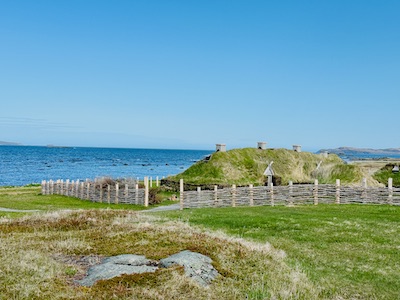
The rebuilt Norse encampment in L’Anse aux Meadows, Newfoundland

I scored a boat ride on Western Brook Pond (quite an understatement) on a clear day.  This was a two-hour tour which was simply awe inspiring. I felt transported as we traveled on a fresh water lake that once was attached to the sea.  Here a 2,000-foot glacier carved fjords that loomed over us as we traveled the length of the lake. Impossibly high water falls and jagged cliffs with formations like the “tin man” and “the old man on the mountain” are here. Some of the waterfalls are so high that they evaporate into mist before reaching the lake below. At one point I felt like I was in Yosemite and looking at El Capitan as the rock face was so gigantic; even though El Capitan is a thousand feet higher. Perhaps it’s the stunning lake at the base but the fjords rise majestically above. It’s a 2 miles hike to get to the boat ride and back but it’s worth the effort to see this incredible site. 

I camped overnight in Port aux Choix.  It was pretty cool because the campsites were next to the Gulf of the Saint Lawrence.  I ventured over to the Port aux Choix lighthouse and saw the lobster boats that go out at sunrise pulling in traps. This area has deep historical significance because there is evidence of over 5000 years of Archaic, Groswater and Dorset-Palaeo Eskimos in the area.  Burial sites in the area discovered in the 1960’s are unusually well preserved due to the raised shoreline and alkaline soil. It makes sense that this area has been inhabited for so long because Port aux Choix has a large protected port which now has fishing vessels. 

From Port aux Choix, I continued on to Flower’s Cove which is famous for thrombolites. Thrombolites are very rare fossils from 650 million years ago with remnants of bacteria and algae. The only other place in the world to find them are in Australia. They look dome shaped and dot the coast line. 

I had two purposes in coming to Newfoundland, one was to see an iceberg; I am happy to report I saw many. And the other was to see the first place that Europeans landed in North America. I am the daughter of a history teacher and when I was eight years old, we traveled to Minnesota to investigate the Kensington Stone and look for evidence of Viking explorers. This was all to help my father teach investigative history to his students. The Kensington stone has since been debunked as a hoax, so coming to L’Anse aux Meadows, I was excited to find evidence of the discovery of the Americas by Europeans. 

L’Anse aux Meadow was just a fishing village on the tip of Newfoundland when Helge and Anne Stine Ingstad were shown what was thought to be an Indigenous campsite by a local fisherman. It was an indigenous campsite and, as they discovered, also an 11th century Viking settlement. There were a few significant artifacts found including a forge and metal objects which were likely used in ship repair.  It also corresponds with the stories told in the Vinland Sagas which document the voyages of Leif Erikson and other Norse explorers who came from Greenland and Iceland. They have rebuilt several of the dwellings based on Norse traditions.  It’s quite remarkable to tour the area.  This is seen as the end of the circle of exploration since crossing the Atlantic was the last piece of migration across the globe. 

I was so excited to visit this remote area of the world and explore something that I know my father would have loved. I left some of my father’s ashes there so that he too could be a part of history, the subject he loved so much. 

🛳️ The Ferry to Newfoundland

I just recently traveled from North Sydney, Nova Scotia to Port aux Basques, Newfoundland in June of 2025. This is not my first ferry ride in my intrepid RV named Abeona. My first ferry ride with Abeona was from Bellingham, WA to Skagway AK in the summer of 2024. This was my first trip to Newfoundland and, hopefully, not my last. The Alaska ferry ride is 3 days and the trip to Port aux Basques is 8 hours.  That’s a big difference. I had purchased my tickets for my early June 2025 ride in May of 2024. Over a year in advance.  I had watched a few RV YouTubers and found out that getting space for a larger vehicle AND a berth to sleep in can be difficult, so I planned well in advance. I took the 11:15 PM trip which arrived in Newfoundland at 7:30 AM. There are two ferries a day between North Sydney and Port aux Basques but only one is at night.  I choose the night ferry so that I would have plenty of time to arrive at my next campground. I’m not a fan of setting up camp at night.  Although I had not factored in that the sun wouldn’t be setting until 9:15 PM so maybe that’s not as much an issue as I had anticipated.

As I departed my campsite in Little Bras d’Or, NS, I had twelve hours to kill before the ferry departed at 11:15 PM. I took the opportunity to head to the Cabot Trail of Nova Scotia and to the Cape Breton Highlands National Park. The scenic drive has sheer cliffs, artisan shops and sandy coves. It’s named for explorer John Cabot who was Italian but was commissioned by Henry VII of England to explore North America. He made his voyage in 1497. Every road sign in Cape Breton is written in both English and Gaelic. Cape Breton is quite the melting pot with French, Scottish, English, Mi’kmaq and Irish. Apparently Acadian French, Mi’kmaq, and Scottish Gaelic are spoken here in addition to English. Quite the mélange with a stunning backdrop.

Loading the ferry in North Sydney, Nova Scotia

I arrived back to North Sydney and made sure I filled up with gas before getting in line for the ferry some 4 hours before departure. When I had made the reservation last year, I had given the length of Abeona at 25 feet since I was warned not to be under on the length lest they decide we couldn’t fit. A man came out to measure Abeona and we were actually 24 feet so they gave me a 1.24 CAD refund. The agent at the entry booth was very nice and reminded me to shut off my propane before boarding. I was also given my card for my berth by the same agent. 

Abeona and I sat for 3 hours waiting to board. I sat on my bed in the back relaxing and preparing my overnight bag. There were some facilities with a sitting area and bathrooms but I was perfectly happy hanging out waiting for instructions from over the load speaker. They started loading cars and trucks about 2 and a half hours before departure. I have no idea about the masterplan for loading but apparently there are three decks for vehicles. I’m pretty sure I saw at least 25 eighteen wheelers travel up the roadway to the 5th deck which is where all the commercial vehicles are loaded. It’s quite the undertaking.  Abeona and I were loaded about an hour before departure onto deck 3. It’s a back to front loading ferry which is different than the ferry to Alaska which is side loaded and much more complex to get on and off of. It was a relief that loading was so straightforward. 

I tucked Abeona in and grabbed my backpack to travel to my berth on deck 8. I was anxious to get to bed since it was an overnight trip. It was a very nice berth with twin beds, a full bathroom and a porthole! This was an upgrade from my bunk bed with a sink and no window to Alaska. The ship had a gift shop, restaurant and coffee bar and they were all open for the length of the trip. There were also movies being shown throughout the ship.

Once we set sail and the various boarding announcements stopped, I slept really well.  It was also super nice to have a shower right in my room. They refer to these trips as “crossings”. My crossing was very calm and I didn’t see many white caps on the Cabot Strait.  I grabbed a relatively cheap cup of coffee in the morning which was $2.50. Loading for Deck 3 and 5 were the first to be let off the ship once we were docked.  I saw some folks with a dog in the back of the car when I was walking back to Abeona. I can’t imagine leaving a dog for over 7 hours in my vehicle. Unfortunately, you are not allowed access to your vehicle until the ship is docked and the crossing is complete.

Abeona and I easily disembarked and I headed to a grocery store in Port aux Basques, parked and waited until it opened at 8:30 AM. I find it crazy that Newfoundland and Labrador (one province) are a half hour ahead of Atlantic time. So, if it’s 7:00 AM in North Sydney it’s 7:30 in Port aux Basques and my watch and phone automatically updated to the new time. It feels strange to be 30 minutes off from the rest of the world. It’s a small price to pay for this enormous island that is referred to as “The Rock”. I’m looking forward to exploring it for the next month. 

😎 Surprising SoFlo

I have visited Southern Florida several times.  My son attended the University of Miami and then lived in Miami for about eight years.  I just returned from five weeks on the road in my RV, Abeona.  I wanted to check off the three National Parks in Florida and the historic town of St. Augustine. I found SoFlo to be a totally different vibe from other areas of Florida and certainly from North Carolina where I normally live. There is a Latin, family welcoming vibe and most people assume that you can speak Spanish which I have never found before in the United States. 

Flying over the vast expanse of Dry Tortugas National Park

Here is what I found surprising in SoFlo:

Farms. I always realized that a lot of citrus is grown in Florida but south of Miami in the towns of Homestead and Florida City, there are miles and miles of farms. And what seems like hundreds of fruit stands.  Two famous one’s which are not to be missed is one called, Robert is Here and Knaus Berry Farm. One is very different from the other. Robert is Here is a few miles from the entrance to Everglades National Park and is part fruit stand, food stand, milk shake stand and aviary. There is a small farm and aviary with everything from Goats to Cockatiels. They have tons of fruits you will only find in the Caribbean and South America like Mamey Sapote, Sapodilla, Cocao Pods, and Guanabana. They make the most delicious milkshakes I’ve ever had (I highly recommend coconut key lime). Knaus Berry Farm is in Homestead and they sell a terrific selection of baked goods in addition to being a farm stand.  The sticky buns are sold by the dozen and they are delectable. I’d like to thank my friend Sue (who lives in SoFlo) for recommending both places. Both are worth the journey to get to.

Animals.  The array of animals that happily exists in the wild is pretty amazing. If you have ever been to Key West then you know that Roosters are ubiquitous.  You can’t turn a corner downtown without seeing Roosters, Hens and chicks walking aimlessly. I was taken aback by the amount of Anhinga that were on the appropriately named Anhinga Trail in Everglades National Park. I could have stood two feet from one and it wouldn’t budge from sunning itself. Manatees, Ospreys, Crocodiles, Green Herons, Great Blue Herons, Egrets, Night Herons and Alligators.  They are all there coexisting in the vast region of wetlands that is south of Tamiami Trail. As I drove to Naples from Flamingo on Tamiami Trail, I stopped at several state and national preserves and saw upwards of 30 alligators hanging out sunning themselves. I was practically desensitized to being afraid of them because they were so plentiful but languid. 

Spanish. I went to a restaurant with my friend Sue and practically everyone that greeted us from the restaurant staff greeted us in Spanish. If you answer in English, they respond in Spanish.  It was wild.  The real test for me was going to a grocery store before heading to Key West. Both associates and customers were speaking Spanish throughout the store. I asked someone in the produce department for “Mushrooms” and he said “Don’t speakee English”. So, I asked for “Hongos” and he immediately took me to where the mushrooms were stored and he asked me how to say it in English. This was so wild for me. I think there were places in Spain that spoke more English than this enormous grocery store in Homestead. I had an issue checking out and the customers behind me were asking “Que pasa?” which I responded to in Spanish.  If you have ever tried to speak another language, most folks default to speaking English. I really enjoyed immersing myself back into Spanish.  It was an unexpected delight. 

Water. There are vast expanses of water everywhere.  Even if it looks like solid ground, it’s most likely a swamp. It’s humbling to drive Route 1 all the way down to Key West. It’s almost a hundred miles from Key Largo to Key West down the only connecting road, Route 1 or Overseas Highway.  It’s called Overseas for the reason most of the time all you can see on either side of the road is water.  Crystal clear water dotted with tiny keys covered in mangroves or grass. It’s quite the adventure.  Then there is the massive Biscayne Bay which is mostly National Park and water. Within the Everglades there is another gigantic body of water called Whitewater Bay. I realize there have been jokes about buying swamp land in Florida but there is a ton of it. It’s important to get out on it or over it by boat or seaplane or kayak.  There is so much to explore.

I admit that my expectations for SoFlo have mostly been driving around Miami and enjoying the restaurants, the beaches and the murals of the Wynwood Art District. There is so much more there than giant mojitos in South Beach and trending murals.  There is a ton of nature and culture to be explored. I hope you get a chance to do so. 

✈️ Secluded and Intriguing Dry Tortugas National Park

I decided to check off three more National Parks from my bucket list in the Spring of 2025. Dry Tortugas was the one I was most intrigued by. Dry Tortugas was discovered in 1513 by Ponce de Leon and it was initially called Las Tortugas (Spanish for turtles) and later called Dry Tortugas since it doesn’t have fresh water.  It’s very inaccessible because you can only get there by boat or seaplane and it’s one of the least visited National Parks with about 70,000 folks visiting annually.  It encompasses seven tiny islands (keys) 68 miles southwest of Key West and most of the National Park, like Biscayne National Park, is water. Just getting to Key West is an adventure as there is only one way in and one way out by road. Factor in construction, traffic and, in my case, a few fires, I was quite relieved to successfully finish the drive to Key West. 

This goes down as one of the most amazing adventures I’ve ever embarked on. In fact, outside of visiting historic Saint Augustine, this was the main point of venturing to the bottom of the continental United States. Traveling by motorhome in Florida in March is something that must be planned at least six months in advance and finding a campsite took several weeks to finally obtain.  After that, I booked my seat on Key West Seaplane Adventures. Yes, it’s expensive, but it’s oh so worth it.

The Seaplane to Dry Tortugas National Park

I had a 10 AM flight out of the Key West airport. First of all, a seaplane can take off on a regular runway, which I did not know.  There were two other groups on my plane which were families with kids and then me for a total of 10 adventurous souls all with window seats.  We donned our headsets and listened to our pilot as we took off in the middle of the airstrip (because the whole airstrip wasn’t necessary). It’s not a pressurized cabin so the wind, disconcertingly, is blowing in. But the view? Mesmerizing. The seaplane flies at 500 feet above the crystal-clear water and all of the coral and sand are visible from above. Much of the trip the water is only 3-7 feet deep and the water is a bright aqua blue. Our pilot described the various shipwrecks, pointed out dolphins and sharks and told stories of Spanish treasure. The seaplane ride alone was worth the effort. 

We landed a 100-yards from the edge of the Garden Key which is home to Fort Jefferson and the area of Dry Tortugas that you can visit. The airplane backed up to the beach and we all came down the ladder and stepped safely onto the beach. It feels like about 90 percent of the island is taken up by Fort Jefferson. It is the largest brick masonry structure in the Western Hemisphere with more than 16 million bricks.  Construction started in 1847 although it was never completed. At the time it was being constructed there were upwards of 400 people living on the island which seems crazy since there is no fresh water source. It also was never used as a fort although it was a prison during and after the Civil War.   Dr. Samuel Mudd who aided John Wilkes Booth and three other conspirators were held in the fort. 

It was interesting to explore the fort which doesn’t have electricity or running water.  If you head up the spiral staircase, don’t expect lighting or a handrail. Apparently, they abandoned finishing the fort which was designed to house 7,500 men. It became obsolete due to the invention of rifled cannons; the weight of the bricks caused the fort to sink and there were several yellow fever outbreaks. There is a lighthouse on the fort itself and another lighthouse on Loggerhead Key which is visible from the fort. It’s disconcerting to hike around a fort with absolutely no safety features and realize that the whole thing is sinking. 

There is also Bush Key which is connected to Garden Key that is closed while there are nesting bird colonies of Sooty Tern and Brown Noddies.  It’s open in the fall once the birds have finished breeding. All the birds fly high above the fort along with Magnificent Frigatebirds which are quite stunning. 

The seaplane ride back was just as terrific as we went over shipwrecks from the last 400 years. One famous one is the Nuestra Señora Atocha which was a Spanish treasure galleon which sank in 1622 and was famously discovered by Mel Fisher in 1985 with almost a half billion dollars in treasure. From the seaplane I could see one ship with its mast from my seat on the plane. 

It was such an adventure all wrapped up in one spot.  The beauty of the scenic plane ride practically gliding over the crystal-clear water, the ecosystem of nesting birds, the massive coral reef and visible fish from the seawall as well as the deep history of an immense fortress that was never complete. Go see it for yourself!

🏝️ Discovering Biscayne National Park

 set out to check off three more national parks from my list this Spring by heading to the south of Florida. The National Parks in Florida don’t have mountains or canyons or glaciers or tall ancient trees.  What they have a lot of is water. What they have in common with most of the other National Parks is remoteness. For the most part, it takes preparation and planning to set out to truly discover these national parks. Traveling by motorhome in Florida takes at least 6 months of planning as most RV parks are frequently booked 6 months to a year in advance during high season. Many of the tours that are available in Biscayne National Park need to be booked over 6 months in advance or you have to be very flexible with your dates.  The closest RV park was a Miami-Dade Park called Larry and Penny Thompson Memorial Park and Campground. This is a nice jumping off point for everything south of Miami.

Biscayne National Park sits off the coast of Miami south of Key Biscayne. The only way to see it, outside of stopping by the visitor’s center near Homestead, FL is to get on a boat.  There are a slew of boat tours available out of the Dante Fascell Visitor Center whether it be via kayaking, snorkeling, canoeing or stand up paddle board.  I elected to take a 3-hour cruise out to Boca Chita Key.  I was shocked to find out that 95% of the park is under water. Beneath the waters are manatees, coral reefs and countless abandoned mangrove covered keys.  The water was crystal clear.  We learned about the history of the area that was once inhabited by the Tequesta people. Later in the 19th century, pineapples, tomatoes and key limes were cultivated on these teeny tiny islands.  This became obsolete with several hurricanes destroying the crops.  In the 60’s and 70’s two power plants and two nuclear power plants were built on the shores.  This caused a backlash against development so the Biscayne National Park was born to preserve the delicate ecosystems of coral reefs, sea turtle nesting grounds and mangroves. 

Visiting Boca Chita Key in Biscayne National Park

The highlight of my boat tour was on Boca Chita Key which was originally developed to be a private club with a small lighthouse and barn.  Now the only way to arrive is by boat and many folks dock overnight.  I could see the coral reefs and schools of fish 

from the edge of the island. I really enjoyed walking on the perimeter of the key to see the birds and mangroves and very small beaches and the fact that no one was out there. I felt a million miles away from the towering Miami skyline; it was just me and the sand and the mangroves.  It was quite the boat ride back although most of bay is only seven to ten feet deep, when the wind picks up the waves come splashing over the boat. I don’t think any of the 30 of us on the boat escaped getting soaked on the trip which made it more of an adventure.

The park is a juxtaposition with the enormous metropolitan center just minutes away and the vast expanse of crystal clear water and mangrove covered keys dotting the water. I had been to Key Biscayne and its lighthouse guarding the bay some years ago.  To travel from the visitor’s center for Biscayne NP to the Key Biscayne lighthouse would take 2 hours and I still would not have circumnavigated the entire park. I’m just so glad I was able to have this experience and I was grateful for the forethought of those who sought to protect it.