🧐Narcissistic Boss? Here are 7 Secrets.

You made a big mistake. You criticized your boss for the way they delegated the project. Now you are in her sights. You’ve pulled the pin on the grenade and now you are holding it. No one critiques the narcissistic boss because the collateral damage is huge. Your next performance review will be toast and your next assignment will be unattainable and sure to fail with heroic deadlines not met. Hell hath no fury as a narcissistic boss who is criticized.

I haven’t had a narcissistic boss in decades but I sure see them around me. In fact, since I first wrote about narcissism, I’ve suddenly started to see them everywhere. Speaking engagements, workshops and parties, they are ubiquitous. How can you tell them? They do all the talking and very little listening. They are always right as well.

So here are the secrets to dealing with your narcissistic boss:

1. Do not complain to others. I know misery loves company but a narcissist is paranoid. Really paranoid. She is on the hunt for any detractors. And detractors will not be tolerated. Whether it’s texting or email or hushed voices by the water cooler, assume that the narcissist boss is omniscient. If there is a way to find out gossip about their carefully crafted image, they will find a way and there will be consequences.

2. Do not be friends. As Susan Price wrote for IvyExec, “Narcissists lack empathy, so they are not capable of true friendships. You might feel betrayed if you think you are becoming friends with one only to find they act without your interests in mind. If they are friendly to you, it is because they want something, whether your attention, your ideas, or anything else.” I have been personally burned by this several times in my career. I’ve had narcissists promise me the moon in my career only to find them to be completely empty. There is only one person they care about and that is themselves.

3. Keep your guard up. I know this can be exhausting. Constantly being vigilant for any sign of backstabbing or manipulation can take a lot of energy. Set boundaries and do not cross them. As Jacquelyn Smith wrote for Business Insider, “Understand that winds change quickly, and you may get undercut at any time. You can record and document every conversation and keep every email trail, but the narcissist has the ability to think quickly and act differently. And you will never see it coming.” Don’t get blindsided. Stay vigilant.

4. Give them praise. I know this seems like brown nosing, and it is, but the narcissist’s image of themselves is paramount in their mind. As Price writes, “Always remember that everything is about her/him. So if your words and actions make her/him feel good, she/he will be far more tolerable than if she/he feels that you are doing something that attacks her/him such as undermining her/him authority or criticizing her/him. Narcissists want praise and acknowledgement, so be prepared to give it to them.” A little sugar goes a long way.

5. Protect their image by taking the blame. Another bitter pill which is why you probably need to look at #7. Falling on the sword or keeping facts under wraps so that the narcissist’s image is maintained can be soul crushing. As Price posits, “Narcissists don’t take responsibility for anything negative, whether it is a bad culture in the office or declining revenues. It has to be someone else’s fault.” Scan the office for any detrimental indicators and proactively put them to bed.

6. Don’t compete with them. Narcissists are winners. They never lose. So don’t try and grab the limelight even if you worked 80 hours last week to get the project out the door. As Price writes, “Your boss will assume that you are doing good work because of what he taught you. Your award should be his; after all, you work for him, don’t you? You can’t win. Ever. So don’t play.” You are not opponents in a game, you are the support that helps them win.

7. Have an exit plan. I have a dear friend who was under the thumb of a narcissistic boss for upwards of three years. After empty promises and grueling months of 80 plus hour thankless work weeks, he started searching for his next job. So have a financial plan, keep your life in balance (don’t take this out on your family) and update your resume. There may be other opportunities in the organization. If you are not up to #1 through #6? Exiting gracefully is the best option. And don’t hesitate to use a professional coach or a friend help you with the plan and the process. You need someone on your side.

I think it’s like marriage. I was married to a narcissist and thought I could change him. It’s not possible. You can’t expect to change a narcissist boss. You can have all the staff development days in an organization but narcissists just point the fingers at everyone else. All they see in the mirror is their own carefully crafted image.

🤩You Are Enough

Have you been waiting to hear those words since say…kindergarten? I have. I generally have stayed uber-focused on my penmanship (sketchy), my height (too tall) and my value as a human being (a work-in-progress). This happens to the distraction from my more valuable traits like writing, coaching and being present. I am more worried about the illusive atta-boy (-girl) from my sixth-grade math teacher or my parents finally being happy with the career I have chosen.

Unfortunately, if you go looking for someone to say: “Cathy, you are good enough,” you will be waiting a long time. Your value is not determined by those outside of yourself. It’s an inside job. It’s between your ears. You need to decide you are good enough. No one is going to do it for you. Decide today. You are worthy. You are good enough. Go ahead. I’ll wait right here.

These might be the reasons holding you back from being enough:

The yardstick of perfectionAnne Lamott wrote brilliantly in Bird by Bird, “Perfectionism is the voice of the oppressor, the enemy of the people. It will keep you cramped and insane your whole life… I think perfectionism is based on the obsessive belief that if you run carefully enough, hitting each stepping-stone just right, you won’t have to die. The truth is that you will die anyway and that a lot of people who aren’t even looking at their feet are going to do a whole lot better than you and have a lot more fun while they’re doing it.” It’s OK if my handwriting isn’t that legible. It’s OK if I am taller than the rest. It’s OK if I have honestly wasted half a Saturday getting over vertigo and not writing. I just spent part of the morning criticizing myself for not going to the gym first thing or writing a post. Really? Like the exercise and blog gods are sitting around judging me for recovering from half a day spent getting to the bottom of my vertigo? So what? As Lamott says, you will die anyway. Spending time trying to be perfect is empty and completely unrewarding. You are good enough right now.

A gold medal won’t change a thing. Lamott famously quotes a 400 pound has-been coach, “If you’re not enough before the gold medal, you won’t be enough with it.” Interesting. If you are not enough before you lose 30 pounds, you won’t be enough after. If you are not enough before the big promotion, you won’t be after. If you are not enough before the divorce, you won’t be after. Worthiness is not a line in the sand. It’s not a point in time. It’s not after the big achievement or disappointment. You are worthy right now. And now. And now. Sit in that. Let it sink in. A gold medal will not make a difference.

You are uniquely you. The mold is busted and there is only one of you and your individual view on life. As Dr. Seuss famously said, “Today you are You, that is truer than true. There is no one alive who is Youer than You.” Even you and your identical twin would have different shortcuts on your desktop. One of you was picked last or first on the soccer team. It has made all the difference. You now fight for the downtrodden or represent soccer player’s rights. Neither is better or worse. Just unique. Be you. Own it. Embody it. Be the unique you that you are.

Comparison is futile. Lamott said, “Never compare your insides to everyone else’s outsides.” You have no idea what your neighbor is going through or your coworker or your dog for that matter. You may be jealous of that new car but don’t realize they had to take over payments for their daughter. Your coworker is battling stage 4 colon cancer. Your dog has been barking at that neighbor dog for the last ten years and has yet to get the last word. We really have no idea what is going on for someone else and comparing it to your current situation is a recipe for disaster. Comparing does not make you feel worthy or enough. So stop comparing.

What other people think of me is none of my business. This is a Wayne Dyer quote that stops me cold. You have absolutely no control over what other people think of you. Let it go. I’m not saying it’s easy. It’s not. We’ve spent so much time on worrying about what others think. I remember having 11 different pairs of colored corduroy Levis in high school. It did not increase the number of friends I had. AND I was probably the only one who noticed. If you cannot move the needle on it, don’t bother worrying about it. Besides, you are perfectly good enough right now.

I was the last pick a lot in elementary school. My mother was upset with how I held a pencil in my hand. I didn’t have a ton of friends in high school. It’s OK. Let the past go and move on. It has no impact on my worthiness right now. Let go of the judgments from the past and be enough. You are good enough. And so am I.

😳 Do It Scared: Overseas


I just got back from an eight city, seven-week escapade to Southern Europe. I’m moderately fluent in Spanish but besides that and a structured tour in Rome, I was on my own with my carry-on bag, backpack and my single pair of sneakers. The genesis of the trip was wanting to be in Rome on Christmas. Once I started booking things, it ended up that I was in Athens for Christmas and on a “Road Scholar” tour of Rome the week before. After talking to my world traveling friend Janine, I decided that Lisbon was the best place to start my trip as I recovered from jet lag. So, there it started, Lisbon, Rome, Athens and then on to Venice, Florence, Seville, Tenerife and finally Madrid. My route was set. Leading up to my departure, I started getting pangs in my stomach and started to wonder if I had an appendicitis or a burst gall bladder. I started to get nervous that I would land in Lisbon and then get rushed to a hospital.  It was all for naught. I think it was just like getting nervous before a speech or running a marathon; it was all in my head. I decided it was psychosomatic and pushed through anyway.  I’m so glad I did. 

Doing it scared at the Acropolis

Here are the ways I did it scared:

Carry on only. I had to pack light.  I had a trip a few weeks before to Seattle after my mother passed away and it was a test trip for packing extremely light.  One pair (yes ONE) of shoes, three pairs of pants, one rain jacket, one puffy jacket with hood and 6 long sleeve shirts, 1 t-shirt and 10 pairs of underwear. I had booked apartments with washers except for the hotel in Rome. I purchased a carry-on suitcase that is both the lightest and fits in all European airlines and had two sturdy wheels (no spinners) so that I could drag it for miles on cobblestone streets. I always purchased early boarding so that I wouldn’t have issues with getting my bag on board. I have heard enough nightmare stories of lost luggage that I wanted to make sure I had what I needed once I got my feet on the ground. I could easily pick up my bag and put it in the overhead bin and my backpack was a lower profile so it could easily fit in under the seat in front of me. One snafu to carry on is that many of the airports I traveled to had a bus to the airplane which meant maneuvering the bags on the bus and up a set of stairs to the plane. All of this gave the assurance that I wouldn’t be stuck without my luggage.

Embrace the unknown. Each time I was going from one city to the next city I almost always ran into a cab or public transit dropping me off some half mile from my destination due to pedestrian only streets. I had not factored this in the first time it happened in Lisbon. By the time I got to Athens, I would set up the directions to the apartment by getting the walking directions from the airport in my map app. That way, when the cab dropped me off, I would start following the directions of my phone/watch. There were still snafus like the closed park in Venice that I had to circumnavigate and the sheer confusion of massive amounts of shoppers in Athens. I was always my most vulnerable when I had my luggage with me and just finding a space off to the side of a major thoroughfare full of people to get my bearings was intimidating. There is also the fact that elevators start on level 0. I went up and down elevators several times looking for what I though was the second floor on floor 1 instead of going all the way to floor 2. I really had to embrace just being lost and to be OK with circling the block several times to figure out where I was. 

Figure out shopping. My first order of business once I found my apartment was figuring out what I was going to do for breakfast for the next day. I scoped out the coffee situation whether it was a Moka, electric kettle, Nespresso or Dolce Gusto machine. Off to the nearest Carrefour or Conad market I go with empty foldable backpack in hand. Most markets in Europe have self-checkout which is always interesting in a foreign language although sometimes you can select the British flag to get English. I never found oatmeal (Avena) until I arrived in Spain. In Portugal, Italy and Greece, I ended up buying Muesli (like granola) and milk. Fruits and vegetables almost always have a self-service station to weigh it.  You can imagine how intimidating finding a fruit or vegetable is on a foreign scale system. I’m not sure I was accurate but I survived getting a scanner code and was able to check out.  In addition, you scan or pay for each bag you use. I know some states have adopted this but taking along an empty backpack was handy. Every market payment system in Europe had a tap option so I didn’t have to figure out using what little Euros I had. Each time it was a new adventure. When I try to eat mostly vegetarian google translates by taking a picture of a product and was invaluable.

Travel on foot if possible. I ended up walking at least 5 miles a day during my travels. I never wore a headset. I try to be absolutely present and pay attention to the sounds and sights. It’s similar to walking a trail, I have to pay attention to each foot fall especially on narrow cobblestone streets. If something was wet, I’d walk slower. In retrospect the only place I saw folks with walkers and wheelchairs was in Madrid.  The rest of the cities I traveled to had stairs, cobblestones and rarely an elevator. Complete handrails (from top to bottom of a set of stairs) was a rarity. When I solo travel, I really slow down and carefully move forward. I also got to experience each city from the graffiti to the smells of roasting chestnuts to the sound of church bells. Each time I was in a precarious situation I would think about how it could be worse, like climbing up to the Acropolis, well at least it’s not raining and it’s only 60 degrees. Amongst the throngs the week before Christmas at the base of the Spanish Steps in Rome, I thought, at least I’m not shopping or trying to get a cab. Being on foot makes me be present and appreciate each moment.

Each time I plan my travel adventures; it feels like some long-lost dream until it’s behind me. I put a plan together and hope it all works out and figure if it doesn’t, I’ll just stay home. Fear is a fickle thing cropping up at inopportune times and I try to remember to bring curiosity and optimism. Mostly, I’m just grateful to have the opportunity to work remotely, see the world and do it scared.

🧐Curiosity: the Antidote for Fear

I’ve been taking several team coaching courses through CRR Global. Our facilitator said something really thought provoking. Curiosity is the antidote for fear. She posited that you can’t hold fear and curiosity at the same time. I guess this is why Curious George seemed to escape dire consequences because he wasn’t holding onto fear and examining all the “what if’s”. Rather liberating isn’t it? Just be curious and fear will melt away.

As I look back, I think the period of my life where I was consumed with fear and struggled with worrying about all that could go wrong was when my son was two. He was a toddler capable of dragging a tricycle onto a kitchen table and then sitting on it. He lacked any sense of fear. I was tethered to my son’s hand in every parking lot, store, amusement park, Movie Theater….for about three years. He had no sense of danger. No limits. I remember sitting several rows back at a Cirque du Soleil performance and he ran down the aisle to try and go on stage. We caught him just shy of the first step. Crisis averted. His curiosity struck fear in me. Thank goodness they grow up. Thank goodness he and I both survived.

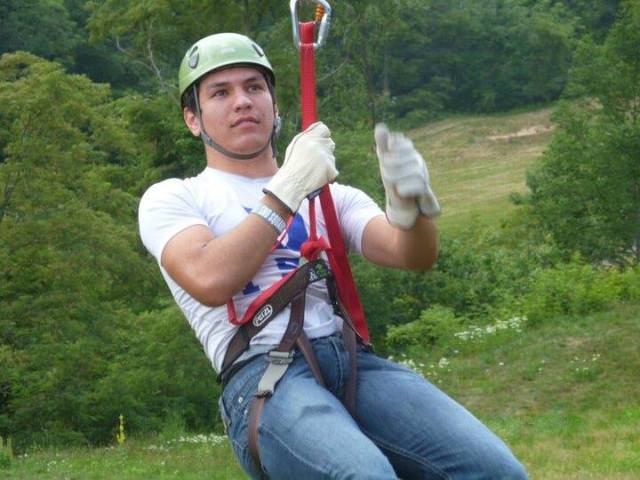
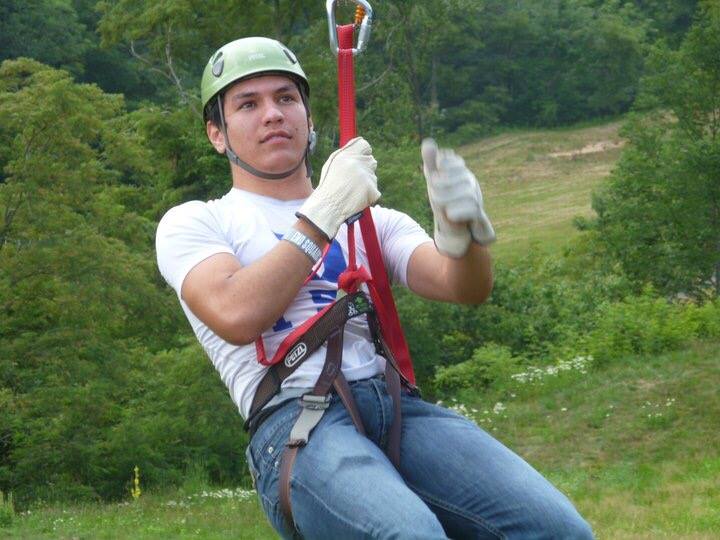
My son, Benson, zip lining.

I’m not saying we shouldn’t watch out for our toddlers and let them go play in traffic; but there is a lot to be learned from having an open curiosity about the world. I personally am game for any antidote for fear. So here are some ideas for embracing curiosity.

1. Open. To be able to embrace curiosity, you need to be open. Be available for the experience. I remember going for a zip line experience with my son a few years ago. I initially asked him if he wanted to go try it out and he was game (no surprise there). To be honest when I asked him I hadn’t really thought through that this meant I would be flying through a forest several hundred feet above the ground. I am not a dare devil but I was open. I didn’t come up with a laundry list of why I shouldn’t do it. It was more about seizing the opportunity to do something fun with my son before he headed off to college. When they strapped us into our gear and the helmet was on, well…it was too late to worry about fear. We had a blast and suffered no injuries. Be open.

2. Scientist. Put on your scientist hat…or a lab coat. I remember taking food chemistry lab at Cornell. I was a Hotel Administration major and we spent hours messing with something basic like baking a cake. In one recipe we would double the baking powder, in another, we would leave out the eggs, in another, we would use oil instead of butter. As you can imagine (if you bake at all you know it is a science) the resulting cakes would be vastly different. I could see the cause and effect at work. It was a great learning experience although some of the end products were awful. Tinkering with various aspects of recipes has helped me to be a better cook. Take time to become the scientist.

3. Wonder. To be in “wonder” for me, means to be absolutely present and free of assumption. You need to let go and be. I can remember my kids as toddlers on Christmas morning. The larger presents from Santa would be all set up (i.e. Hot Wheels race tracks, Barbie dream house…etc). There was an overwhelming amount of things in the room but my son would run up to the racetrack and start playing. He would spend 30 minutes before he was ready to move on. He was present in his wonder and took it all in at his pace. Embrace wonder.

4. Talk to your triggers. We just practiced this in my CRR Global class. Being triggered is when you go into fight or flight mode. I get triggered when someone says a sexist statement like “those football players are playing like girls.” Suddenly my 30 year old neighborhood bully named “Joe” breaks out and wants to teach somebody a lesson and I shut down and can’t think. When I separated from my triggered self (through coaching), I could dream up a new way to deal with Joe the next time I get triggered. I can show up as my adult self and keep Joe in the back room by the red phone. Having a plan to deal with your triggers helps keep you resilient, in the moment, and keeping fear in check.

5. Muscle. Work your curiosity muscle on a regular basis. This is kind of like getting out of the status quo. Shake up your routines. Try a different drink at Starbucks, cross your arms the opposite of normal, drive a different route to work, eat vegetarian all day or call your brother you haven’t spoken to in months. It might be a little (or a lot) uncomfortable but it gets easier the more you do it. You can flex that curiosity muscle more easily. Flex your muscles.

The beauty of embracing curiosity is that life becomes that much fuller, more interesting, more adventurous. The view is different there. Lean in.

🤪 Mad about Madrid

It’s ironic that the abbreviation for Madrid is Mad. Mad is the airport call letters and it’s used in the name of lots of things like restaurant names, “Mad Grill”, “Mad Mad Vegan”, and “Mad Cafe”. In American English, you wouldn’t normally call something mad but in British English it has a primary connotation to be crazy about something. Well, I decided that I’m mad about Madrid. Madrid was in the unfortunate position of being the last stop on my 8 city European tour in the winter of 2024-2025. I didn’t arrive with high expectations.  I had just been seduced by Seville with its flamenco, oranges and history. I had previously been to Barcelona and stayed in the romantic, intriguing Gothic Quarter. I really expected it to be like a Spanish New York City with tapas. Yes, it’s more cosmopolitan than Barcelona or Seville but it’s not the concrete jungle with canyons of tall buildings like New York City.

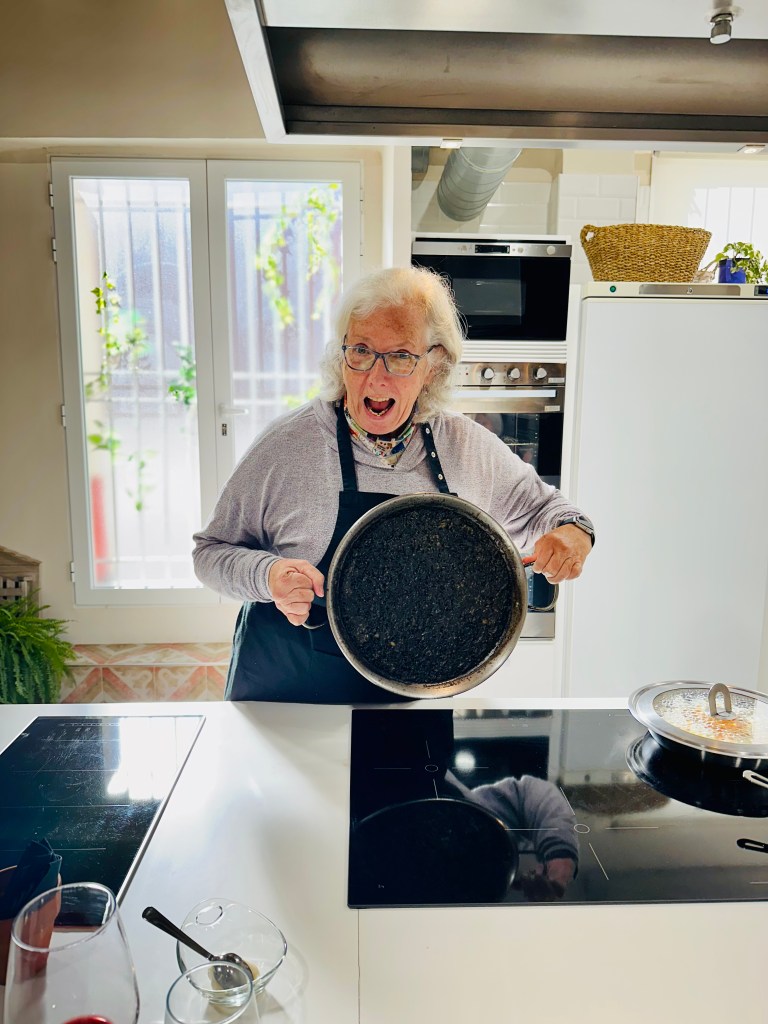
Taking a cooking class in Madrid and showing that the paella is ready because it is adhered to the pan.

This is why I’m mad about Madrid:

There will be art. I was able to go to three art museums while I was in Madrid and they were all less than a mile walking distance from my apartment. Museo del Prado is the main Spanish national art museum. It has art dating back to the 12th century with works from Goya, Bosch, Rubens, Titian, Velazquez and El Greco. There are countless paintings of the crucifixion of Christ and it’s remarkable to see the interpretation of various artists on this one subject. The Prado is an emotional experience with its mostly dark themes from either the crucifixion to enormous 40-foot paintings of battles and executions. You can also see the advancement of art through the centuries from painting on wood to frescos to canvases with immaculate perspective. I also went to the Museo Reina Sofia which is on the other end of the perspective from the Prado with all its works being from the 20th century.  It’s surprising to be in a museum in Madrid and to see painting from Hopper, Pollack and Wyeth. This is alongside an extensive collection of Picasso, Dali and Mora.  There was a temporary exhibit by Portuguese artist, Grada Kilomba in which she uses words and music in video or dancers representing her words.  It was quite unique. The Museo Thyssen-Bornemisza is another great museum in Madrid which fills the gap between the medieval Prado and the very modern Sofia. The Thyssen has many of the classic impressionists like Monet, Degas and Renoir which are some of my favorites so I really enjoyed it. Madrid has art for every taste.

There will be food. Madrid is a food lovers Mecca with everything from tapas to brunch to Michelin star restaurants. I was really glad I signed up for a tapas and paella class for the first day I arrived. There were only five of us in the class and the other four folks were from Mexico. When the instructor realized I spoke Spanish, she decided to teach the class in Spanish which was a confidence builder for me. I learned some amazing tricks like grating Roma tomatoes instead of chopping which seems crazy but the method effortlessly eliminates the skin of the tomato. We also cleaned cuttlefish which was something new for me. I really appreciate that was very hands on, similar to a class I took with my college roommates (Those Girls and the Blonde) in Paris some ten years ago. I have also found that throughout Spain if the name of the restaurant is in English then the restaurant is an easy place for English speakers like myself to go as the entire experience from greeting to menu is in English.  I also found that most restaurants serve tapas and that the portions are enormous. I received a plate of blistered peppers that were simple yet delicious and that alone could have been a meal. I did not venture into any fine dining places as most places don’t open until 7 PM and I’m not a big fan of walking at. Night. There were also tons of butcher shops and produce stands throughout the city. Grocery stores are amazing places throughout Europe. I would walk up to a Carrefour market and it would look like a simple convenience store until you walk inside the labyrinth which is almost always at least two floors with an elevator. I found that sparkling water is almost always at the far end of the second floor much like milk is always in the back row of Safeway. In Madrid, there are always full Jamons (legs of cured ham) hanging in the store where families will have one parked on a kitchen counter to take a slice whenever needed. There were also plenty of vegan restaurants to choose from as well. I really enjoyed eating my way through Madrid.

There will be walkways and parks. In a city the size of Madrid, I did not expect to see so many pedestrian walkways and parks. I have to say that even if there are cars on the road, the minute you step within a foot a crosswalk, the vehicle stops in its tracks. I found this to be amazing. I also took an amazing tour of Toledo (the cathedral is the second largest in Spain after Seville and is simply breathtaking) and the bus picked us up two stories below the Royal Palace. We then drove some ten miles underground (similar to Boston’s downtown). I didn’t realize until that moment but you don’t see large trucks or many cars in downtown Madrid. If there are vehicles, they are only taxis and delivery vans. This makes walking around very easy. In addition, they have a metro system as well, although I didn’t need it since everything for me was in walking distance. There are also enormous parks throughout the city with countless statues venerating various kings and conquerors. One of the main streets by the Sofia and Prado is closed to traffic on Sundays (similar to Central Park in NYC). This makes for terrific space for runners, skaters and sightseers like me. 

I found Madrid to be friendly and inviting. Folks sitting next to me at a table on the Plaza Mayor wished me a pleasant meal (buen provecho), and folks walking down the street would say hello (buenos dias or hola). One funny thing happened at the Thyssen.  The man behind the ticket counter asked if I wanted a discount and I said (in Spanish) well, I’m not a student but I am old. The couple in the next cue laughed and said, “Woman, you’re not old”. Probably the greatest gift in life is making someone laugh in another language. I got the discount by the way:). I am mad about Madrid and hope to return.

🧐Exploring Tenerife

I have always wanted to travel to Tenerife because my children have relatives that lived there and it was a reprieve from the colder temperatures of Southern Europe. Tenerife is the largest island of the seven Canary Islands which is a Spanish province 62 miles off the coast of Morocco. The indigenous people of the Canaries are called Guanches and have been around for 2 to 3 thousand years.  The Romans were there in 100 BC and countless others came through including the Phoenicians, Greeks, and Carthaginians. In 1402, the Castilian colonized the islands, there was genocide and enslavement of the native Guanches, a dispute with Portugal on this advantageous jumping off point for exploration and finally it was incorporated under the Kingdom of Castile in 1496. The Canaries then became wealthy as they were a major trade stop for Conquistadors on their way to the New World and the riches they brought back with them. Sugar cane was the main crop for many years until the New World could produce it more cheaply.  After sugar cane bananas became the new cash crop of choice. Tenerife in current times has almost 1 million inhabitants and the largest industry is tourism with over 4 million visitors a year. I was one of those tourists for a week and really enjoyed it’s topography, history and friendly people.

Mesa del Mar in Tenerife, Canary Islands, Spain

The only way around the island is by car and most rental cars are manual transmission.  I was fortunate that when I booked my car rental that I requested an automatic. This proved to be invaluable when I was descending the ten hairpin turns down the side of the cliff into Mesa del Mar which is where my apartment was for the week. My right foot ached from riding the brake all the way down the roadway and I prayed for no cars (or God forbid, busses) in the opposite direction. Once I arrived at the bottom, I was rewarded with a magnificent vista of crashing waves, an Olympic size natural pool right on the ocean and a black sand beach. It truly was mesmerizing to watch the waves crash relentlessly against black volcanic rocks and it was a view I didn’t tire of for the rest of the week. 

My apartment was in a 12-story tower right on the water with a view of Mount Teide, deep blue rolling waves and black volcanic rock outcroppings off shore. Truly amazing. The price of this view was a drive up and down a cliff in order to get groceries or see other sights of the island. I was on the 5th floor with an elevator that did a little dip when it arrived at each floor which was a bit unnerving. The walkway to the parking lot where my car was, was frequently hit by errant waves. As beautiful as it was it also felt a bit precarious with netting to guard the road from rockslides, ferocious wind gusts and the natural pool being inundated each high tide. The weather was terrific for my entire visit with sun and highs in the low 70’s and lows in the 60’s. 

I drove to the largest town on the island, Santa Cruz de Tenerife, which was about 25 minutes away and visited the Palmetum which is a botanical garden overlooking the ocean. It has an amazing array of palm trees and some pretty views of the ocean. I was really surprised to find Monarch butterflies because they are native to Central and North America. Apparently, they first appeared in the Canaries in 1880. Quite the feat from across the globe. 

I took a tour to Tiede National Park. I had initially thought that I would drive around the island but my cliffside road to my apartment, my ability to constantly take the wrong turn and have to be redirected by my GPS, told me otherwise. I cannot tell you how relieved I was to be in a tour up to Tiede National Park. The road to and from is not for the faint of heart. One of the first stops on the tour was to see a 700-year-old Dragon Tree in the town of Icod de los Vinos. It’s the largest and longest-lived tree of its kind in the world with a trunk that’s wider than its height. It looks like it belongs in a fairy tale with its vine like trunk and brush shaped branches.

The next stop was the town of Garachico. This town was founded in 1496 and was a major port on the island until a volcanic eruption in 1706 wiped out most of the town. This caused the port to be closed and operations moved to Santa Cruz de Tenerife. Throughout the western side of the island of Tenerife is evidence of all the volcanic activity on Tenerife with black sand beaches and long dormant lava flows. From Garachico, we headed inland to the small town of Masca. It’s a tiny town with 90 inhabitants at 2,000 feet above sea level that our guide told us was comparable to Machu Picchu. The view from town was magnificent with the sharp drop offs and views of the Atlantic Ocean out in the distance. 

We left Masca on what our guide referred to as “Ah Ya Ya” road. Being in a full-size tour bus on a narrow winding road with what felt like hundreds of tourists in rental cars seems like a recipe for disaster. There were times the driver motioned drivers to back up, uphill some 100 yards, so that we could navigate the hairpin turns and narrow road. We all clapped when we finally arrived in the Tiede National Park. The park itself is basically a Calderon of the volcano which is Mount Tiede. Apparently, it’s a unique volcano in that it’s located on top of a shield volcano and the second tallest (from the base under the ocean) in the world. Only Hawaii’s Mauna Kea is taller. It’s considered an active volcano since it last erupted in 1909. The landscape is truly amazing with large tower like rock formations, colorful striations and only Canarian pine trees that seem to be able to survive the volcanic eruptions. My Spanish seat mate described the pine trees as “Terrorists” because they burn quickly but have an astounding ability to regenerate. I think of the lava flows I saw near Bend Oregon which was desolate in comparison to Tiede National Park with its Canarian Pine groves. At lunch outside of the National Park I was finally able to snap a picture of a canary, throughout my stay on the island I could hear the birds but they were pretty elusive. 

I spent most of my time in Tenerife just staring out the window at the Atlantic Ocean. There were no screens on the windows and no central heat or air conditioning. Just the natural breeze blowing through the apartment and the sound of the ceaseless ocean. It truly was a nice pause with idyllic weather, a tremendous view and a topography that cannot be matched. 

🍊Seville: Oranges, Passion and History

I arrived in Seville on the afternoon of January 4th which happened to be the Cabalgata de Reyes or the Three Kings Parade.  Three Kings Day is celebrated on January 6th but the parade is scheduled depending on the day of the week.  I had no idea that this was going on until I couldn’t get an Uber from the airport due to incredible price increases.  I decided to find a cab instead and my driver told be about the parade. It’s a long parade that travels in a big loop through the city dropping candy for children and a spectacle for the adults. Had I known the route, I would have attended but I really wanted to get my bearings in a new city. It seems that being lost with luggage in tow is a norm for me at this point, I was dropped off by the cab about a quarter mile from my apartment because, as is the case in a lot of European cities, my apartment was on a pedestrian only street. I have found in my travels that being on a pedestrian street is advantageous in the ease of getting around on foot and they tend to be quieter at night. The main snafu is that it’s easy for me to get disoriented in a narrow alley trying to find the entrance. I did. The location was great. The cost is 15 minutes of figuring things out.

I absolutely love Seville. The weather in January is highs in the 60’s. I was able to walk safely to every sight of interest. The people are very warm and friendly. There are bitter orange trees everywhere. In January, that means that each tree will be full of ripe bitter oranges. I found this to be amazing and unexpected. In fact, there are over 14,000 bitter orange trees throughout the city. The oranges themselves are the property of the government and are harvested by temporary staff annually to make the famous Seville marmalade. So basically, I was walking through a bitter orange orchard for the week I spent in Seville. What’s not to love about that?

One of the magnificent rooms in the Real Alcazar in Seville

I am moderately conversant in Spanish and I found that practically everyone I met locally defaulted to speaking Spanish with me. I really appreciate this as it makes me feel more self-reliant to be able to converse in basic questions like “does this have onion?” or “is it very far?” In the previous weeks I muddled through with the basics of Italian “Grazie” and “Por Favore” and Portuguese “Obrigado”. It was a relief to be able to understand what people were talking about and for locals to be willing to engage with me in my mediocre Spanish. I compare this to a trip I took with my kids to Barcelona where the language is Catalan and practically everyone started speaking to us in English regardless of whether we tried to engage in Spanish (not Catalan). It’s not that they don’t speak Spanish, the locals default to Catalan or English.

There are probably a 100 flamenco shows within the Seville city limits. It is the birthplace of this passionate dance with Moorish and Roman roots. Most of the songs and dance are that of lament; the wailing and intensity sucks you in. I was in the second row crammed into a tiny tableau with maybe 50 seats. The singers, the guitarist and dancers are just feet away. Each performance is loosely planned and the songs and dance are improvised. There was one woman performer who could snap her fingers so delicately and eloquently, I was mesmerized. The clothing, the music, the wail and pain of the singer, and the incredible speed of the guitar; it is not to be missed.

When I traveled to Lisbon the month before I finally understood that Portugal and Spain were under Muslim rule from 711 to 1492. 800 years has an enormous impact on architecture and culture. “Ojala” in Spanish translates to “hopefully” but that root is actually from an Arabic word “Inshalla” or “If God wills.” The name for the main castle in Seville is Real Alcazar.  Alcazar is Arabic for castle and Real means Royal. This place is not to be missed. It was started as a citadel in the 10th century during the Abbasid dynasty. It had palaces (nine in total) added and enlarged over the next 4 centuries by both Arabs and Spaniards under different regimes. The Alcazar represents the melting pot of cultures with extensive tile from floor to ceiling with Moorish arches and floor fountains in many rooms. It’s surrounded by an extensive garden including the omnipresent bitter orange trees. Ferdinand III conquered Seville in 1248 and it was taken over by Castilian monarchs. Seville is about 60 miles from the coast along the Guadalquivir River. Many explorers including Christopher Columbus, Ponce de Leon and Nunez Balboa passed through the Real Alcazar to either bring back the spoils of the journey or ask for sponsorship on the next voyage. This was the hub for all things American. It’s remarkable to stand in a place so steeped in history.

I also visited the Seville Cathedral which is the largest gothic cathedral in the world. It opened as a Catholic Cathedral in 1507 (it originally was a mosque in 1172) and is an example of Gothic, Moorish and Renaissance styles.  There are countless chapels (there are 80 contained in the cathedral) in this enormous church. The stunning feature of the cathedral is the enormous gold altar piece that is called the Retablo Mayor which is the largest altar in the world with thirty-six relief panels depicting scenes from the Old Testament and the lives of saints. It stands 76 feet high is and is breathtaking to behold. 

There are many places to visit in Seville including the Gold Tower, the Plaza de Espana, and the very modern Setas de Seville (which look like giant mushrooms). I most enjoyed just walking the countless pedestrian streets through old historic neighborhoods with empanada shops, tapas bars and plenty of stores selling Flamenco dresses. I also enjoyed a paella class on a rooftop near the Gold Tower. It was mostly a demonstration instead of cooking but it was interesting none the less. 

I could have spent another week or two in Seville it had such a relaxed friendly vibe and I felt like I was immersed in the history of both Spain and the Americas. I know I will return.

🍝Experiencing Florence

I arrived in Florence on a train from Venice on New Year’s Eve of 2024. The train station is an enormous hub in the center of the city bustling with activity. As I had found previously in Rome and Venice, there were plenty of pedestrian streets to get to my apartment for my stay but navigating the streets with cars, busses and trams was a bit confusing.  It seems every time I arrive in a new destination in Europe, I get disoriented; but I eventually found my apartment. Since I knew that New Year’s Day was a holiday, I was quick to go to the local market and pick up some essentials assuming that they would be closed the next day.  My experience has been that all museums, stores and monuments are closed on holidays but many restaurants are open.  I had booked a few excursions prior to arriving in Florence and was excited to see what the city had to offer.

View of the Duomo from my cooking class in Florence

On New Year’s Day I walked to my pasta making class which was about a half mile from my apartment. It was supposed to rain that day so I was happy that it wasn’t raining when I arrived at the location. My instructor, Simone, took us up to the rooftop kitchen just 500 yards from the magnificent Duomo. I was in a class that had a mother and her two adult daughters from Connecticut.  The four of us learned to make pasta, bruschetta and tiramisu from scratch all while admiring the 360-degree view from the rooftop. It was nice to get my bearings by overlooking the entire city and all its landmark palaces and cathedrals. Even though I’m an accomplished cook, I learned a lot of new tricks like how to get the best of a garlic clove (i.e. never smash, cut the ends off and remove the heart) and the importance of texture and feel as you knead and roll out the pasta dough. I learned that you roll out the dough on semolina flour so it doesn’t stick to the dough while rolling and cooking. I had had a pasta class in Rome and I have to say that my pasta was much better in the class in Florence. I think the difference was rolling out the dough on semolina instead of 00 flour (which we used in Rome). I also found that they use an amazing amount of salt and oil in food like the bruschetta. It was best tasting bruschetta I have ever had although my doctor might be chagrined. I had selected this experience on New Year’s Day because it was one of the few things I could do on the holiday but I have to say that it was a terrific start to the New Year and my stay in Florence. 

The next day, I went to the Uffizi Gallery and the Académie Gallery on a guided tour of both. Unfortunately, it was raining and the group of us stood in the rain for about 45 minutes waiting to get into the Uffizi. I have been so fortunate to have terrific weather in cities like Lisbon and Venice but I feel like standing for an extended period of time made me appreciate the contents of the Uffizi. There are two Botticelli masterpieces that had been commissioned by the Medici family, The birth of Venus which is an enormous painting depicting Venus rising out of a shell and then there is the Primavera which also features Venus and Cupid above shooting arrows. I was most struck by the Leonardo Da Vinci painting of the Annunciation which is when Gabriel tells the Virgin Mary that she is pregnant. I had recently seen a documentary of Da Vinci and most of his masterpieces were never finished so seeing this rare example of his mastery of contour, shading and perspective where wonderful to experience in person. Then there is the painting Tondo Doni by Michelangelo which practically jumps off the wall with its sculpture like appearance. The Uffizi is an enormous gallery and I wish had more time but the tour was continuing on to the Académie Gallery. 

We waited in a similar line for the AcadémieGallery but at least it wasn’t raining anymore. This is the place for the original David by Michelangelo. There is a replica of David that stands near the Palazzo Vecchio which is impressive but seeing David at the Académie being lit from above it all its perfection is breathtaking  They say that Michelangelo personally picked his marble and he believed that the sculpture was already “alive” in the marble.  To see this statue alongside the various incomplete statues was informative. They included his last incomplete statue called Bandini Pietra it’s a marvel that he completed the David as these sculptures took years to finish.

My last full day in Florence was spent going through the Duomo Museum and the Duomo itself.  The Duomo is a massive cathedral in the heart of Florence.  It was conceived in 1293 and it took over 140 years to finish. Filippo Brunelleschi conceived its dome which is the world’s largest masonry dome. The museum for the Duomo has a lot of the exterior doors and sculptures that were originally on the Duomo but now are protected from the elements. It feels like hundreds of artists and sculptors worked on the tile floors, a multitude of artwork and sculptures. The mesmerizing exterior of the Duomo and its tower is made from white and green marble from around Tuscany. It’s the third largest cathedral in the world.  It’s quite something to experience the inside of the dome and the various religious stories represented high above your head.

I made a short side trip across the Ponte Vecchio. The original bridge was built in 996 and it spans the Arno River in the heart of Florence. It’s been swept away several times over the last 1,000 years but its current form is from 1345.  From the Uffizi Gallery you can see that there is a separate enclosed walkway on top of the bridge which the Medici’s built so that they could walk from Palazzo Vecchio to Palazzo Pitti.  There are stores and shops across the entire bridge.  Apparently, they made a decree to ban butcher shops from the bridge (who threw waste into the river) and to only allow goldsmiths and jewelers. 

Florence is a remarkable place steeped in history and the heart of the Early Renaissance art that exploded in Italy in the 15th Century.  The Medici family backed many artists and it feels like they all left their mark here including Pisano, Giotto, Donatello, Da Vinci. Brunelleschi and Michelangelo. It’s remarkable to see so many beautiful buildings, artwork and sculptures throughout the city some 500 years later.  I’m so glad I got to experience it. 

🥰Beguiling Venice

I traveled to Venice at the end of 2024. I expected it to be interesting but I was beguiled. It is a world apart from anything else I have ever experienced. I arrived by plane and took a shuttle out to the main island of Lido di Venzia. I wasn’t in another vehicle for the rest of my stay. I’ve been to islands where there are no cars, Mackinaw Island in Michigan comes to mind, but there are golf carts and bicycles.  In Venice the only way to get around is by boat or on foot.  After a few days I realized that there is a peace that comes from not having to dodge taxis like I did in Rome. There is a quiet outside of the multitude of travelers dragging their luggage on the cobblestone streets. 

Gondolas in Venice

Here are some the things that made Venice beguiling:

The Republic of Venice. Venice was founded in 687 as a Byzantine Territory and was a republic for over 1,100 years. There was no “Italy” (which was unified in 1861). Venice was ruled by 120 Doges over a 1,000.  Doges were elected by the aristocracy and ruled for life.  Each Doge lived in the Doge’s Palace which is right off St. Mark’s Square along the waterfront (but isn’t most of Venice waterfront?). I toured the palace and was struck by how the Doge lived in the same building as the courts, the parliamentary rooms and the prison. Eventually, they moved the prison across a canal which then created the “Bridge of Sighs” which is where the convicted prisoner would get one last glimpse of the outside world before being imprisoned. Apparently within the Palace and in other spots on the island there are Bocche dei Leone (Mouths of the Lion) where any citizen could slip a piece of paper into the mouth to denounce another citizen for illegal activity. It’s sort of a suggestion box on who to arrest. I found this to be fascinating. 

It’s Swampland. The islands are built on wood pilings from trees in nearby Croatia (which at one point was part of the Republic).  They are buried deep into the clay beneath the water and then topped with stone, brick and mortar. The bricks are made from nearby clay and the bricks themselves are smaller than bricks I’m familiar with in the US. It’s all an engineering marvel although I did get a little freakout when the floor of the Doge’s Palace actually moved. It was like walking on the Golden Gate Bridge, there is some give and flex to the larger buildings in Venice. There is also high tide and low time every six hours so the landscape and docks and boats are constantly rising and falling. The crazy thing is that it’s all very shallow and there are special channels made for the larger boats to go from one island to the next. So, it’s all really just floating. 

The Labyrinth. The main island of Lido di Venzia is one massive labyrinth. If I did not have cell coverage and Google maps, I’m pretty sure I would still be lost down some nameless dark tunnel. As I’ve said, there is no getting around the island except on foot or by boat.  If you are on foot there are at least five canals to traverse to get to any destination. It’s disorienting because most of the streets are sunless alleys and you can’t see any reference points (in NYC I think of the Empire State Building as a reference point).  I rarely knew if I was headed east or west and I know that although I walked to Saint Mark’s Square four different times from my apartment, I never went the same way twice and was lost or off track each time. It was so comforting to see the same cannoli or mask shop to know that at least I had been there before.  I also gave myself lots of time to arrive at a destination because I had to factor in getting lost. Regardless, being lost really makes me be present and pay attention to all available information.

Islands. There are 118 islands that make up Venice.  Some are abandoned and small, some are privately owned and two of the most interesting are Murano and Burano. Murano is where they make handcrafted glass works. I saw a very interesting glass demonstration where a master glassworker made a glass horse in under two minutes. It was amazing to watch this artisan effortlessly create this masterpiece in minutes standing feet away from an 1800 F degree oven that runs 365 days a year. All he used was a big pair of black scissors and snipped, tugged and gently pulled forth a masterpiece.

Burano was a multitude of colorful buildings and a tower that is leaning precariously. Burano is a fishing village and the fisherman painted their houses different bright colors so that they could find their way home (adorable, no?).  There is also the art of making intricate lace works that many of the women of the island are masters at. I saw table cloths that were so intricate it would take two women four months to create. Lace making is a dying art as the lace making school closed down in 1970. There are seven different types of lace styles and most women only knew one or two so it would take several women to complete even a small work of lace depending on the types needed. Truly beautiful works of art. 

I ate on the island of Burano and I had the best risotto of my life there. I found food in all of Italy to be perfectly seasoned and impeccably prepared. Risotto is only creamy if you take time and care to develop the rice over a long period of stirring, the risotto I had was creamy (without cream) and perfectly seasoned. 

I am so fortunate that I was able to visit Venice during beautiful weather.  It was sunny each day and the highs were in the mid 40’s. Every time I went over the enormous Rialto Bridge (which spans the main waterway Grand Canal) the steps were not wet. It’s almost always crowded with tourists (like me) taking photos and stopping on the steps which makes navigating the steps more difficult.  I can’t imagine if they were slick from rain. The fabulous weather also had the added benefit of beautiful pictures. Every corner and turn from the immense St. Mark’s Square to the tiny canals threading ancient buildings is photo worthy. I was absolutely beguiled

🇬🇷10 Things to Know about Greece

I took my first trip to Greece at Christmas time in 2024. I had just been to Lisbon and Rome for a week each and some of these observations are a comparison to those two cities. After leaving an immersive trip to Rome, I didn’t have high expectations of Athens but Athens did not disappoint. I flew into the Athens airport and then took an Uber/Taxi to my place in the Monastiraki neighborhood of Athens. The cab could not drop me off at the door since it was on a pedestrian thoroughfare.  It was a wide and very busy pedestrian thoroughfare the Saturday before Christmas and it was bustling. So, there I was with my carry-on suitcase and backpack, completely lost and confused for about 15 minutes until I found the entrance to my flat. It was in the front of a small store, next to an arcade and ice cream shop. I cannot tell you how relieved I was when I finally dropped my bags and got my bearings. I can cope with being lost but when I have my luggage, it’s especially disconcerting when surrounded by foreign sounds and smells of a totally new city.

The Theater at Delphi

Here are 10 things you should know about Greece:

Language.  The language is very hard. I was on a tour to Delphi and we had lunch with our tour guides.  I was showing them my Duolingo app and the Greek alphabet. The sounds and letters are completely the opposite of English (and other Romance languages).  So P’s are like R’s, X’s are like Ch, and so on.  At one point I ridiculously said “Greek is Greek to me”. One of the guides said she could teach the alphabet in one day…I humbly disagree. On the upside, most folks in the service world speak English so my brief vain attempt to learn Greek came to a quick halt.

Coffee. I saw several large coffee urns while walking the pedestrian thoroughfares of Athens.  They had strong bitter coffee inside. In my opinion it could only be drunk with at least a few teaspoons of sugar. Think about percolated coffee that’s been sitting all day.  That’s Greek coffee. You’ve been warned.

Cats. There are cats everywhere in Athens, Delphi and everywhere in between. Most seem pretty healthy and on the heavier side so I don’t think they are without food.  It’s so random you will see one sitting atop an ancient stone in the acropolis or walking down the street of a ski town high in the snow covered mountains of Arachova. There will be cats.

Church Bells.  I was half a block from the Agia Irini Church. I could not make sense of when the bells of that church would ring. Sometimes it was 6:53 AM or 2:25 PM or 10:36 AM.  It made absolutely no sense to me.  Too early for a service and never, I mean never on the hour. The church bells befuddled me.

Stores. There are hundreds of stands and souvenir shops in the area I w staying which is adjacent to the ancient shopping area called Plaka. Every time I looked at a souvenir or pair of earrings, the vendor would tell me it was 50% off.  Never a price, just that it was 50% off. The street vendors in particular would only take cash or paypal. So, if you want souvenirs in Athens, you are in luck, they are 50% off. 

Guards.  The changing of the guard in front of the Parliament Building is a free and unusual event that happens every hour on the hour. The costumes alone are worth the trip. They wear a red hat, and white billowy skirt and sleeves, and a huge pom pom on the end of their shoes all while holding a rifle. The exaggerated steps and movements are captivating. Check out the changing of the guards.

History. This place is deep in history.  The National Archeological Museum has items dating back to the Mycenaean Period (1750-1050 BC). Statues from 750 BC in remarkable shape for being close to 3,000 years old.  I thought Rome was old but Athens is an ancient city and with remarkably well-preserved artifacts including a bronze statue of a jockey on a horse that is still intact and the centerpiece of the museum.

Mythology. I knew about Poseidon and Zeus and Apollo but there seem to be hundreds of Gods and even more myths with each and everyone.  It’s fascinating with stories of how the Milky Way started by the jealous goddess Hera (wife of Zeus) sprayed milk across the sky. It was truly fascinating.

Get out of town. I took a tour to Delphi and it was terrific to get out of town and into the countryside for the day. The pace and crowds of the city are left behind and there were red rock caves, snowcapped peaks and endless orchards of olive trees.  Greece is not just Athens. Get out of town.

Ruins. Go to the ruins whether it’s the Acropolis or Delphi or Temple of Poseidon. There are way too many uneven steps and many without handrails, but it’s completely worth the journey to see where Athens started as the oldest city in Europe. The statues in the Acropolis Museum are a testament to the ancient Greek artisans who made them up to 4,000 years ago. It’s amazing to see what humans can accomplish.

When I planned this 7-week trip to Europe, I thought about starting in Athens. I’m glad I didn’t. Lisbon was a great starting point since it’s much easier to maneuver with everything focused on the waterfront. Athens is built around the Acropolis high on the hill top and the language is complex. It’s definitely worth the visit, I’m glad I was able to ease into it instead of it being my starting point.