🧐Exploring Tenerife

I have always wanted to travel to Tenerife because my children have relatives that lived there and it was a reprieve from the colder temperatures of Southern Europe. Tenerife is the largest island of the seven Canary Islands which is a Spanish province 62 miles off the coast of Morocco. The indigenous people of the Canaries are called Guanches and have been around for 2 to 3 thousand years.  The Romans were there in 100 BC and countless others came through including the Phoenicians, Greeks, and Carthaginians. In 1402, the Castilian colonized the islands, there was genocide and enslavement of the native Guanches, a dispute with Portugal on this advantageous jumping off point for exploration and finally it was incorporated under the Kingdom of Castile in 1496. The Canaries then became wealthy as they were a major trade stop for Conquistadors on their way to the New World and the riches they brought back with them. Sugar cane was the main crop for many years until the New World could produce it more cheaply.  After sugar cane bananas became the new cash crop of choice. Tenerife in current times has almost 1 million inhabitants and the largest industry is tourism with over 4 million visitors a year. I was one of those tourists for a week and really enjoyed it’s topography, history and friendly people.

Mesa del Mar in Tenerife, Canary Islands, Spain

The only way around the island is by car and most rental cars are manual transmission.  I was fortunate that when I booked my car rental that I requested an automatic. This proved to be invaluable when I was descending the ten hairpin turns down the side of the cliff into Mesa del Mar which is where my apartment was for the week. My right foot ached from riding the brake all the way down the roadway and I prayed for no cars (or God forbid, busses) in the opposite direction. Once I arrived at the bottom, I was rewarded with a magnificent vista of crashing waves, an Olympic size natural pool right on the ocean and a black sand beach. It truly was mesmerizing to watch the waves crash relentlessly against black volcanic rocks and it was a view I didn’t tire of for the rest of the week. 

My apartment was in a 12-story tower right on the water with a view of Mount Teide, deep blue rolling waves and black volcanic rock outcroppings off shore. Truly amazing. The price of this view was a drive up and down a cliff in order to get groceries or see other sights of the island. I was on the 5th floor with an elevator that did a little dip when it arrived at each floor which was a bit unnerving. The walkway to the parking lot where my car was, was frequently hit by errant waves. As beautiful as it was it also felt a bit precarious with netting to guard the road from rockslides, ferocious wind gusts and the natural pool being inundated each high tide. The weather was terrific for my entire visit with sun and highs in the low 70’s and lows in the 60’s. 

I drove to the largest town on the island, Santa Cruz de Tenerife, which was about 25 minutes away and visited the Palmetum which is a botanical garden overlooking the ocean. It has an amazing array of palm trees and some pretty views of the ocean. I was really surprised to find Monarch butterflies because they are native to Central and North America. Apparently, they first appeared in the Canaries in 1880. Quite the feat from across the globe. 

I took a tour to Tiede National Park. I had initially thought that I would drive around the island but my cliffside road to my apartment, my ability to constantly take the wrong turn and have to be redirected by my GPS, told me otherwise. I cannot tell you how relieved I was to be in a tour up to Tiede National Park. The road to and from is not for the faint of heart. One of the first stops on the tour was to see a 700-year-old Dragon Tree in the town of Icod de los Vinos. It’s the largest and longest-lived tree of its kind in the world with a trunk that’s wider than its height. It looks like it belongs in a fairy tale with its vine like trunk and brush shaped branches.

The next stop was the town of Garachico. This town was founded in 1496 and was a major port on the island until a volcanic eruption in 1706 wiped out most of the town. This caused the port to be closed and operations moved to Santa Cruz de Tenerife. Throughout the western side of the island of Tenerife is evidence of all the volcanic activity on Tenerife with black sand beaches and long dormant lava flows. From Garachico, we headed inland to the small town of Masca. It’s a tiny town with 90 inhabitants at 2,000 feet above sea level that our guide told us was comparable to Machu Picchu. The view from town was magnificent with the sharp drop offs and views of the Atlantic Ocean out in the distance. 

We left Masca on what our guide referred to as “Ah Ya Ya” road. Being in a full-size tour bus on a narrow winding road with what felt like hundreds of tourists in rental cars seems like a recipe for disaster. There were times the driver motioned drivers to back up, uphill some 100 yards, so that we could navigate the hairpin turns and narrow road. We all clapped when we finally arrived in the Tiede National Park. The park itself is basically a Calderon of the volcano which is Mount Tiede. Apparently, it’s a unique volcano in that it’s located on top of a shield volcano and the second tallest (from the base under the ocean) in the world. Only Hawaii’s Mauna Kea is taller. It’s considered an active volcano since it last erupted in 1909. The landscape is truly amazing with large tower like rock formations, colorful striations and only Canarian pine trees that seem to be able to survive the volcanic eruptions. My Spanish seat mate described the pine trees as “Terrorists” because they burn quickly but have an astounding ability to regenerate. I think of the lava flows I saw near Bend Oregon which was desolate in comparison to Tiede National Park with its Canarian Pine groves. At lunch outside of the National Park I was finally able to snap a picture of a canary, throughout my stay on the island I could hear the birds but they were pretty elusive. 

I spent most of my time in Tenerife just staring out the window at the Atlantic Ocean. There were no screens on the windows and no central heat or air conditioning. Just the natural breeze blowing through the apartment and the sound of the ceaseless ocean. It truly was a nice pause with idyllic weather, a tremendous view and a topography that cannot be matched. 

🍊Seville: Oranges, Passion and History

I arrived in Seville on the afternoon of January 4th which happened to be the Cabalgata de Reyes or the Three Kings Parade.  Three Kings Day is celebrated on January 6th but the parade is scheduled depending on the day of the week.  I had no idea that this was going on until I couldn’t get an Uber from the airport due to incredible price increases.  I decided to find a cab instead and my driver told be about the parade. It’s a long parade that travels in a big loop through the city dropping candy for children and a spectacle for the adults. Had I known the route, I would have attended but I really wanted to get my bearings in a new city. It seems that being lost with luggage in tow is a norm for me at this point, I was dropped off by the cab about a quarter mile from my apartment because, as is the case in a lot of European cities, my apartment was on a pedestrian only street. I have found in my travels that being on a pedestrian street is advantageous in the ease of getting around on foot and they tend to be quieter at night. The main snafu is that it’s easy for me to get disoriented in a narrow alley trying to find the entrance. I did. The location was great. The cost is 15 minutes of figuring things out.

I absolutely love Seville. The weather in January is highs in the 60’s. I was able to walk safely to every sight of interest. The people are very warm and friendly. There are bitter orange trees everywhere. In January, that means that each tree will be full of ripe bitter oranges. I found this to be amazing and unexpected. In fact, there are over 14,000 bitter orange trees throughout the city. The oranges themselves are the property of the government and are harvested by temporary staff annually to make the famous Seville marmalade. So basically, I was walking through a bitter orange orchard for the week I spent in Seville. What’s not to love about that?

One of the magnificent rooms in the Real Alcazar in Seville

I am moderately conversant in Spanish and I found that practically everyone I met locally defaulted to speaking Spanish with me. I really appreciate this as it makes me feel more self-reliant to be able to converse in basic questions like “does this have onion?” or “is it very far?” In the previous weeks I muddled through with the basics of Italian “Grazie” and “Por Favore” and Portuguese “Obrigado”. It was a relief to be able to understand what people were talking about and for locals to be willing to engage with me in my mediocre Spanish. I compare this to a trip I took with my kids to Barcelona where the language is Catalan and practically everyone started speaking to us in English regardless of whether we tried to engage in Spanish (not Catalan). It’s not that they don’t speak Spanish, the locals default to Catalan or English.

There are probably a 100 flamenco shows within the Seville city limits. It is the birthplace of this passionate dance with Moorish and Roman roots. Most of the songs and dance are that of lament; the wailing and intensity sucks you in. I was in the second row crammed into a tiny tableau with maybe 50 seats. The singers, the guitarist and dancers are just feet away. Each performance is loosely planned and the songs and dance are improvised. There was one woman performer who could snap her fingers so delicately and eloquently, I was mesmerized. The clothing, the music, the wail and pain of the singer, and the incredible speed of the guitar; it is not to be missed.

When I traveled to Lisbon the month before I finally understood that Portugal and Spain were under Muslim rule from 711 to 1492. 800 years has an enormous impact on architecture and culture. “Ojala” in Spanish translates to “hopefully” but that root is actually from an Arabic word “Inshalla” or “If God wills.” The name for the main castle in Seville is Real Alcazar.  Alcazar is Arabic for castle and Real means Royal. This place is not to be missed. It was started as a citadel in the 10th century during the Abbasid dynasty. It had palaces (nine in total) added and enlarged over the next 4 centuries by both Arabs and Spaniards under different regimes. The Alcazar represents the melting pot of cultures with extensive tile from floor to ceiling with Moorish arches and floor fountains in many rooms. It’s surrounded by an extensive garden including the omnipresent bitter orange trees. Ferdinand III conquered Seville in 1248 and it was taken over by Castilian monarchs. Seville is about 60 miles from the coast along the Guadalquivir River. Many explorers including Christopher Columbus, Ponce de Leon and Nunez Balboa passed through the Real Alcazar to either bring back the spoils of the journey or ask for sponsorship on the next voyage. This was the hub for all things American. It’s remarkable to stand in a place so steeped in history.

I also visited the Seville Cathedral which is the largest gothic cathedral in the world. It opened as a Catholic Cathedral in 1507 (it originally was a mosque in 1172) and is an example of Gothic, Moorish and Renaissance styles.  There are countless chapels (there are 80 contained in the cathedral) in this enormous church. The stunning feature of the cathedral is the enormous gold altar piece that is called the Retablo Mayor which is the largest altar in the world with thirty-six relief panels depicting scenes from the Old Testament and the lives of saints. It stands 76 feet high is and is breathtaking to behold. 

There are many places to visit in Seville including the Gold Tower, the Plaza de Espana, and the very modern Setas de Seville (which look like giant mushrooms). I most enjoyed just walking the countless pedestrian streets through old historic neighborhoods with empanada shops, tapas bars and plenty of stores selling Flamenco dresses. I also enjoyed a paella class on a rooftop near the Gold Tower. It was mostly a demonstration instead of cooking but it was interesting none the less. 

I could have spent another week or two in Seville it had such a relaxed friendly vibe and I felt like I was immersed in the history of both Spain and the Americas. I know I will return.

🍝Experiencing Florence

I arrived in Florence on a train from Venice on New Year’s Eve of 2024. The train station is an enormous hub in the center of the city bustling with activity. As I had found previously in Rome and Venice, there were plenty of pedestrian streets to get to my apartment for my stay but navigating the streets with cars, busses and trams was a bit confusing.  It seems every time I arrive in a new destination in Europe, I get disoriented; but I eventually found my apartment. Since I knew that New Year’s Day was a holiday, I was quick to go to the local market and pick up some essentials assuming that they would be closed the next day.  My experience has been that all museums, stores and monuments are closed on holidays but many restaurants are open.  I had booked a few excursions prior to arriving in Florence and was excited to see what the city had to offer.

View of the Duomo from my cooking class in Florence

On New Year’s Day I walked to my pasta making class which was about a half mile from my apartment. It was supposed to rain that day so I was happy that it wasn’t raining when I arrived at the location. My instructor, Simone, took us up to the rooftop kitchen just 500 yards from the magnificent Duomo. I was in a class that had a mother and her two adult daughters from Connecticut.  The four of us learned to make pasta, bruschetta and tiramisu from scratch all while admiring the 360-degree view from the rooftop. It was nice to get my bearings by overlooking the entire city and all its landmark palaces and cathedrals. Even though I’m an accomplished cook, I learned a lot of new tricks like how to get the best of a garlic clove (i.e. never smash, cut the ends off and remove the heart) and the importance of texture and feel as you knead and roll out the pasta dough. I learned that you roll out the dough on semolina flour so it doesn’t stick to the dough while rolling and cooking. I had had a pasta class in Rome and I have to say that my pasta was much better in the class in Florence. I think the difference was rolling out the dough on semolina instead of 00 flour (which we used in Rome). I also found that they use an amazing amount of salt and oil in food like the bruschetta. It was best tasting bruschetta I have ever had although my doctor might be chagrined. I had selected this experience on New Year’s Day because it was one of the few things I could do on the holiday but I have to say that it was a terrific start to the New Year and my stay in Florence. 

The next day, I went to the Uffizi Gallery and the Académie Gallery on a guided tour of both. Unfortunately, it was raining and the group of us stood in the rain for about 45 minutes waiting to get into the Uffizi. I have been so fortunate to have terrific weather in cities like Lisbon and Venice but I feel like standing for an extended period of time made me appreciate the contents of the Uffizi. There are two Botticelli masterpieces that had been commissioned by the Medici family, The birth of Venus which is an enormous painting depicting Venus rising out of a shell and then there is the Primavera which also features Venus and Cupid above shooting arrows. I was most struck by the Leonardo Da Vinci painting of the Annunciation which is when Gabriel tells the Virgin Mary that she is pregnant. I had recently seen a documentary of Da Vinci and most of his masterpieces were never finished so seeing this rare example of his mastery of contour, shading and perspective where wonderful to experience in person. Then there is the painting Tondo Doni by Michelangelo which practically jumps off the wall with its sculpture like appearance. The Uffizi is an enormous gallery and I wish had more time but the tour was continuing on to the Académie Gallery. 

We waited in a similar line for the AcadémieGallery but at least it wasn’t raining anymore. This is the place for the original David by Michelangelo. There is a replica of David that stands near the Palazzo Vecchio which is impressive but seeing David at the Académie being lit from above it all its perfection is breathtaking  They say that Michelangelo personally picked his marble and he believed that the sculpture was already “alive” in the marble.  To see this statue alongside the various incomplete statues was informative. They included his last incomplete statue called Bandini Pietra it’s a marvel that he completed the David as these sculptures took years to finish.

My last full day in Florence was spent going through the Duomo Museum and the Duomo itself.  The Duomo is a massive cathedral in the heart of Florence.  It was conceived in 1293 and it took over 140 years to finish. Filippo Brunelleschi conceived its dome which is the world’s largest masonry dome. The museum for the Duomo has a lot of the exterior doors and sculptures that were originally on the Duomo but now are protected from the elements. It feels like hundreds of artists and sculptors worked on the tile floors, a multitude of artwork and sculptures. The mesmerizing exterior of the Duomo and its tower is made from white and green marble from around Tuscany. It’s the third largest cathedral in the world.  It’s quite something to experience the inside of the dome and the various religious stories represented high above your head.

I made a short side trip across the Ponte Vecchio. The original bridge was built in 996 and it spans the Arno River in the heart of Florence. It’s been swept away several times over the last 1,000 years but its current form is from 1345.  From the Uffizi Gallery you can see that there is a separate enclosed walkway on top of the bridge which the Medici’s built so that they could walk from Palazzo Vecchio to Palazzo Pitti.  There are stores and shops across the entire bridge.  Apparently, they made a decree to ban butcher shops from the bridge (who threw waste into the river) and to only allow goldsmiths and jewelers. 

Florence is a remarkable place steeped in history and the heart of the Early Renaissance art that exploded in Italy in the 15th Century.  The Medici family backed many artists and it feels like they all left their mark here including Pisano, Giotto, Donatello, Da Vinci. Brunelleschi and Michelangelo. It’s remarkable to see so many beautiful buildings, artwork and sculptures throughout the city some 500 years later.  I’m so glad I got to experience it. 

🥰Beguiling Venice

I traveled to Venice at the end of 2024. I expected it to be interesting but I was beguiled. It is a world apart from anything else I have ever experienced. I arrived by plane and took a shuttle out to the main island of Lido di Venzia. I wasn’t in another vehicle for the rest of my stay. I’ve been to islands where there are no cars, Mackinaw Island in Michigan comes to mind, but there are golf carts and bicycles.  In Venice the only way to get around is by boat or on foot.  After a few days I realized that there is a peace that comes from not having to dodge taxis like I did in Rome. There is a quiet outside of the multitude of travelers dragging their luggage on the cobblestone streets. 

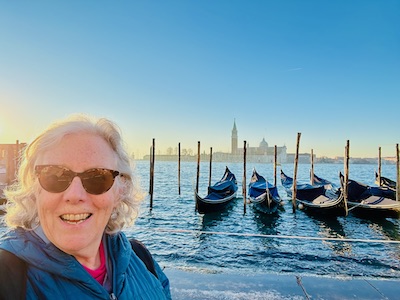
Gondolas in Venice

Here are some the things that made Venice beguiling:

The Republic of Venice. Venice was founded in 687 as a Byzantine Territory and was a republic for over 1,100 years. There was no “Italy” (which was unified in 1861). Venice was ruled by 120 Doges over a 1,000.  Doges were elected by the aristocracy and ruled for life.  Each Doge lived in the Doge’s Palace which is right off St. Mark’s Square along the waterfront (but isn’t most of Venice waterfront?). I toured the palace and was struck by how the Doge lived in the same building as the courts, the parliamentary rooms and the prison. Eventually, they moved the prison across a canal which then created the “Bridge of Sighs” which is where the convicted prisoner would get one last glimpse of the outside world before being imprisoned. Apparently within the Palace and in other spots on the island there are Bocche dei Leone (Mouths of the Lion) where any citizen could slip a piece of paper into the mouth to denounce another citizen for illegal activity. It’s sort of a suggestion box on who to arrest. I found this to be fascinating. 

It’s Swampland. The islands are built on wood pilings from trees in nearby Croatia (which at one point was part of the Republic).  They are buried deep into the clay beneath the water and then topped with stone, brick and mortar. The bricks are made from nearby clay and the bricks themselves are smaller than bricks I’m familiar with in the US. It’s all an engineering marvel although I did get a little freakout when the floor of the Doge’s Palace actually moved. It was like walking on the Golden Gate Bridge, there is some give and flex to the larger buildings in Venice. There is also high tide and low time every six hours so the landscape and docks and boats are constantly rising and falling. The crazy thing is that it’s all very shallow and there are special channels made for the larger boats to go from one island to the next. So, it’s all really just floating. 

The Labyrinth. The main island of Lido di Venzia is one massive labyrinth. If I did not have cell coverage and Google maps, I’m pretty sure I would still be lost down some nameless dark tunnel. As I’ve said, there is no getting around the island except on foot or by boat.  If you are on foot there are at least five canals to traverse to get to any destination. It’s disorienting because most of the streets are sunless alleys and you can’t see any reference points (in NYC I think of the Empire State Building as a reference point).  I rarely knew if I was headed east or west and I know that although I walked to Saint Mark’s Square four different times from my apartment, I never went the same way twice and was lost or off track each time. It was so comforting to see the same cannoli or mask shop to know that at least I had been there before.  I also gave myself lots of time to arrive at a destination because I had to factor in getting lost. Regardless, being lost really makes me be present and pay attention to all available information.

Islands. There are 118 islands that make up Venice.  Some are abandoned and small, some are privately owned and two of the most interesting are Murano and Burano. Murano is where they make handcrafted glass works. I saw a very interesting glass demonstration where a master glassworker made a glass horse in under two minutes. It was amazing to watch this artisan effortlessly create this masterpiece in minutes standing feet away from an 1800 F degree oven that runs 365 days a year. All he used was a big pair of black scissors and snipped, tugged and gently pulled forth a masterpiece.

Burano was a multitude of colorful buildings and a tower that is leaning precariously. Burano is a fishing village and the fisherman painted their houses different bright colors so that they could find their way home (adorable, no?).  There is also the art of making intricate lace works that many of the women of the island are masters at. I saw table cloths that were so intricate it would take two women four months to create. Lace making is a dying art as the lace making school closed down in 1970. There are seven different types of lace styles and most women only knew one or two so it would take several women to complete even a small work of lace depending on the types needed. Truly beautiful works of art. 

I ate on the island of Burano and I had the best risotto of my life there. I found food in all of Italy to be perfectly seasoned and impeccably prepared. Risotto is only creamy if you take time and care to develop the rice over a long period of stirring, the risotto I had was creamy (without cream) and perfectly seasoned. 

I am so fortunate that I was able to visit Venice during beautiful weather.  It was sunny each day and the highs were in the mid 40’s. Every time I went over the enormous Rialto Bridge (which spans the main waterway Grand Canal) the steps were not wet. It’s almost always crowded with tourists (like me) taking photos and stopping on the steps which makes navigating the steps more difficult.  I can’t imagine if they were slick from rain. The fabulous weather also had the added benefit of beautiful pictures. Every corner and turn from the immense St. Mark’s Square to the tiny canals threading ancient buildings is photo worthy. I was absolutely beguiled

🇬🇷10 Things to Know about Greece

I took my first trip to Greece at Christmas time in 2024. I had just been to Lisbon and Rome for a week each and some of these observations are a comparison to those two cities. After leaving an immersive trip to Rome, I didn’t have high expectations of Athens but Athens did not disappoint. I flew into the Athens airport and then took an Uber/Taxi to my place in the Monastiraki neighborhood of Athens. The cab could not drop me off at the door since it was on a pedestrian thoroughfare.  It was a wide and very busy pedestrian thoroughfare the Saturday before Christmas and it was bustling. So, there I was with my carry-on suitcase and backpack, completely lost and confused for about 15 minutes until I found the entrance to my flat. It was in the front of a small store, next to an arcade and ice cream shop. I cannot tell you how relieved I was when I finally dropped my bags and got my bearings. I can cope with being lost but when I have my luggage, it’s especially disconcerting when surrounded by foreign sounds and smells of a totally new city.

The Theater at Delphi

Here are 10 things you should know about Greece:

Language.  The language is very hard. I was on a tour to Delphi and we had lunch with our tour guides.  I was showing them my Duolingo app and the Greek alphabet. The sounds and letters are completely the opposite of English (and other Romance languages).  So P’s are like R’s, X’s are like Ch, and so on.  At one point I ridiculously said “Greek is Greek to me”. One of the guides said she could teach the alphabet in one day…I humbly disagree. On the upside, most folks in the service world speak English so my brief vain attempt to learn Greek came to a quick halt.

Coffee. I saw several large coffee urns while walking the pedestrian thoroughfares of Athens.  They had strong bitter coffee inside. In my opinion it could only be drunk with at least a few teaspoons of sugar. Think about percolated coffee that’s been sitting all day.  That’s Greek coffee. You’ve been warned.

Cats. There are cats everywhere in Athens, Delphi and everywhere in between. Most seem pretty healthy and on the heavier side so I don’t think they are without food.  It’s so random you will see one sitting atop an ancient stone in the acropolis or walking down the street of a ski town high in the snow covered mountains of Arachova. There will be cats.

Church Bells.  I was half a block from the Agia Irini Church. I could not make sense of when the bells of that church would ring. Sometimes it was 6:53 AM or 2:25 PM or 10:36 AM.  It made absolutely no sense to me.  Too early for a service and never, I mean never on the hour. The church bells befuddled me.

Stores. There are hundreds of stands and souvenir shops in the area I w staying which is adjacent to the ancient shopping area called Plaka. Every time I looked at a souvenir or pair of earrings, the vendor would tell me it was 50% off.  Never a price, just that it was 50% off. The street vendors in particular would only take cash or paypal. So, if you want souvenirs in Athens, you are in luck, they are 50% off. 

Guards.  The changing of the guard in front of the Parliament Building is a free and unusual event that happens every hour on the hour. The costumes alone are worth the trip. They wear a red hat, and white billowy skirt and sleeves, and a huge pom pom on the end of their shoes all while holding a rifle. The exaggerated steps and movements are captivating. Check out the changing of the guards.

History. This place is deep in history.  The National Archeological Museum has items dating back to the Mycenaean Period (1750-1050 BC). Statues from 750 BC in remarkable shape for being close to 3,000 years old.  I thought Rome was old but Athens is an ancient city and with remarkably well-preserved artifacts including a bronze statue of a jockey on a horse that is still intact and the centerpiece of the museum.

Mythology. I knew about Poseidon and Zeus and Apollo but there seem to be hundreds of Gods and even more myths with each and everyone.  It’s fascinating with stories of how the Milky Way started by the jealous goddess Hera (wife of Zeus) sprayed milk across the sky. It was truly fascinating.

Get out of town. I took a tour to Delphi and it was terrific to get out of town and into the countryside for the day. The pace and crowds of the city are left behind and there were red rock caves, snowcapped peaks and endless orchards of olive trees.  Greece is not just Athens. Get out of town.

Ruins. Go to the ruins whether it’s the Acropolis or Delphi or Temple of Poseidon. There are way too many uneven steps and many without handrails, but it’s completely worth the journey to see where Athens started as the oldest city in Europe. The statues in the Acropolis Museum are a testament to the ancient Greek artisans who made them up to 4,000 years ago. It’s amazing to see what humans can accomplish.

When I planned this 7-week trip to Europe, I thought about starting in Athens. I’m glad I didn’t. Lisbon was a great starting point since it’s much easier to maneuver with everything focused on the waterfront. Athens is built around the Acropolis high on the hill top and the language is complex. It’s definitely worth the visit, I’m glad I was able to ease into it instead of it being my starting point. 

🏛️Rome: Zebras, Lasagna and Popes

I went on a tour of Rome in December of 2024. I normally travel on my own staying at rented apartments and figuring it out as I go.  I went on a Road Scholar tour for seven days in the Eternal City and it was educational and well-paced. When I first landed at the Rome airport, I needed to freshen up.  I was really impressed with the bathrooms. They were super modern. When you entered there was a lit number indicating how many unisex stalls were available.  Each stall that is available has a green light indicating it’s free, you wave your hand and the door slides open to a private stall with toilet and sink. You wave your hand to close and then again to lock it.  All of it was touchless and hands-free. Simply amazing.

We all stayed at the Hotel Dei Mellini which was a small hotel along the Tiber River near the shopping district of Prati.  There were loads of restaurants and mostly high-end shops. For most communal dinners we could walk to a local restaurant and we were invariably the first group there at 7 PM. The restaurant would be full by the time we left at 9 PM.  Our group totaled twenty folks all over 60 from various parts of the United States.  Our fearless leader, Bruna, did a great job of keeping track of us all as we navigated the ancient streets of Rome. The term we all learned almost immediately was finding “Zebras” or the marked crosswalks. Bruna explained that if there was a Zebra and no traffic light that we (the pedestrians) had the right of way. She frequently, and bravely, walked out into traffic several times stopping motorcycles and taxis to let us cross a street on a zebra crosswalk. I soon learned that to get around I had to be acutely aware of where the “Zebras” were to find the best way to my destination.  There is no telling where a Zebra might be placed, sometimes it’s in the middle of the block, sometimes I had to travel a block out of my way in order to find a Zebra to get to my destination.  When in Rome on foot, follow the Zebras.


Teatro di Marcello  with three layers of lasagna from across 2000 years, one built on top of the other.

Our first day in Rome was spent at the Capitoline Museum which sits atop “Capitoline Hill”. The palazzo in front of the museum was designed by Michelangelo in 1536. It contains a treasure trove of sculptures countless busts of the over 80 emperors who ruled Rome. There is a bronze sculpture of a she-wolf nursing twins Romulus and Remus which is the origin story of Rome. There several versions of the story but Romulus is the victor and he founds Rome in 753 BC. In addition, there is an equestrian statue of Marcus Aurelius from 173 AD and parts of the Colossus of Constantine including the head and a foot (the foot alone was 6 feet long) of Roman emperor Constantine the Great. The real secret to the Capitoline Museum is the vantage point to see all of the Roman Forum which is centuries of various ruins dating back to Julius Caesar and the 7th century BC. The Pantheon is a marvel of a structure that was built in 609 AD on a site that was a temple during the reign of Augustus (27 BC- 14 AD). It is an engineering masterpiece and stands today as it did in 609 AD with it’s large circular dome and 30 ft. oculus or hole in the center of the Rotunda. So, when it rains, the water falls through the oculus and down to the floor where drains sweep the water away.  It’s simply amazing.

We went to the Colosseum and Roman Forum the next day. The Colosseum was originally named the Flavian Amphitheater for the emperors of the Flavian dynasty who ruled 69 – 81 AD and built the Colosseum. It held 50,000 to 80,000 spectators.  Our guide said that 10,000 exotic animals from Africa and 5,000 gladiators and slaves were killed here for sport in a 90-day period. They have recreated one of the trap doors from which an animal would be transported up to the arena. It has endured a fire and an earthquake in 1349. It has been torn apart and picked over to build other structures in Rome. There are thousands of pot marks that were left behind from iron clamps that held the stones together. As we walked through the Forum, we kept hearing about recycling and how one marble pillar from one structure was recycled into another structure some 3 centuries later. Limestone from the Colosseum was used in a church 200 years later. When we walked through the Forum, through the Arches and various structures left behind from years of emperors, popes and dictators, we walked on black basalt.  As we stood below the Arch of Titus, there are the original black rocks that Julius Caesar walked upon some two thousand years ago. In the middle of this bustling city just yards from the Colosseum. Rome is deep in history.

Our guides were constantly talking about recycling and the Teatro di Marcello which is a great example of lasagna or layering. It started construction under Julius Caesar in 17 BC. First it was a theater until the 4th century, then it was used as a fortress in the Middle Ages, then in the 16th century it was a residence for Orsini which was built on top of the original ruins, by the 19th century apartments were built above the lower floors. You can plainly see from the side that there are 3 distinct layers from 2000 years of existence for various purposes. Some very impressive lasagna!

Vatican City is the city state that sits in the center of Rome. It houses the pope, St. Peter’s Basilica and the Sistine Chapel. Throughout our travels there are countless buildings, monuments and statues marked clearly with whichever pope had paid for the monument.  Since there have been over 280 popes, there are A LOT of monuments and A LOT of lavish, opulent works of art and they are housed in the Vatican Museum and the rest of Vatican City.  We were fortunate to receive a one-hour class on the Sistine Chapel before entering this remarkable space whose ceiling and final judgement were painted by a captive Michelangelo.  The figures appear 3D in this hallowed space. St. Peter’s Basilica is the largest church in the world and I would bet that 30% of it is covered in gold. The guide told us as we entered this cavernous space that if it looks gold, it is gold. I was most overwhelmed by the Vatican Museum which is basically the opulent attic for 2000 years of popes acquiring or demanding various works of priceless art. One of the hallways we walked down was three football fields long covered from floor to ceiling with artwork and tapestries. 

I found Rome to be chaotic, energetic and wondrous. The history of dictators, emperors and popes all ruling this city along the Tiber River. It went from 2 million people to 20,000 people between the rise and fall of the Roman Empire.  Those that are still here are vibrant, resilient, welcoming people. All roads lead to Rome and I’m so glad I was able to experience its deep history, wondrous art and irresistible food. 

🚎Fascinating Lisbon

I traveled to Lisbon in December of 2024. There has been a lot of buzz about Portugal of late with many Americans seeking to move there. With Portugal’s generous visa options there is a lot of interest.. I wasn’t thinking to relocate to Lisbon but I have to say that it was more intriguing than I expected. If I had to describe Lisbon, I would say it’s as if San Francisco and Bordeaux had a baby. San Francisco because of the endless hills (Lisbon is called The City of Seven Hills) and the romantic 1930’s era trolley cars that are ubiquitous throughout the city. Bordeaux because Lisbon has all the charm of a mid-size European city, it sits on the Tagus River. Bordeaux’s Place de la Bourse Square and Lisbon’s Praca do Comercio feel almost identical with their riverside grandeur. Both Bordeaux and Lisbon have endless plazas, historic buildings and are very walkable (although in Lisbon, you will be walking up or down a hill).

When I arrived at the Lisbon airport, I was delighted by how fast the customs process was. I scanned my passport quickly and easily and walked over to a customs agent who opened my passport and stamped it without even asking any questions. I easily got a rideshare to my apartment for the week. The airport is about 4 miles from downtown Lisbon so it’s inexpensive and quick. It’s amazing how the proximity of an airport to the downtown of a city can make visiting so much more enjoyable and easier. I was amazed at how many signs and advertising are in English. Public bathrooms throughout the city. They are marked as WC (or Water Closet) and are nowhere close to the Portuguese “Banheiro” or “Sanitario”. Stops signs say “Stop” as opposed to “Parar” in Portuguese.  One of the bigger surprises for me was, was that the Christmas Music was entirely American classics like Jingle Bells and White Christmas. I guess I thought there would be classic Portuguese carols. It’s interesting how much our culture has impacted other parts of the world.

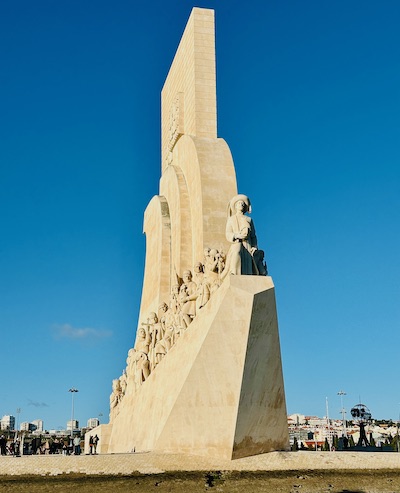
Padrao dos Descobrimentos – Monument to the Discoveries along the Tagus River in Lisbon

Lisbon is the second oldest city in Europe (after Athens). The Greeks and Phoenician’s set up trading posts here in 800 BC.  Its proximity to the Mediterranean, Atlantic,Red and Indian oceans make it perfect for trade routes. In fact, it’s many maritime discoveries during the 15th and 16th centuries included a trade route to India and eventually Macau which made the kingdom of Portugal vastly rich. This resulted in many magnificent structures like the Jeronimo’s Monastery and the Tower of Belem (both are UNESCO world heritage sites). The district of Belem is a must visit for anyone traveling to Lisbon. Besides the Monastery and Tower, the entire waterfront along the Tagus River is not to be missed. I thought the Monument of the Discoveries which was dedicated in 1960, a beautiful homage to the many navigators, writers, cartographers, kings and missionaries who set out on the Tagus into the great beyond. It stands 184 feet high and has 33 statues of these various explorers looking toward to the horizon. It has three large geometric sails and is uncomplicated in its beauty.

As I walked around Lisbon, I became obsessed with the Portuguese Pavement. White limestone and black basalt are used to create sidewalks and plazas with various designs. My first introduction to these types of designs was Rio de Janeiro some 35 years ago. Long endless designs of waves or checkerboards or stars are throughout the city. Some of these masterpieces date back to the 1880’s.  It’s like looking for easter eggs and trying to find a new and unique pattern. There is very little actual “pavement” as you would find in the United States. Practically every street and narrow sidewalk is made of cobblestone. I wore sneakers the entire time I was here and I defy you to find anyone who is not wearing comfortable rubber soled shoes in the city, tourist or no. Cobblestones mixed with steep hills was something to get used to and I am only glad that it didn’t rain as I can imagine it’s not a good mix. In fact, the cobblestone narrow streets and sidewalks are one of the main reasons I couldn’t see living here as I age.

Each little or big plaza in Lisbon usually has a “Bica” or a little round coffee kiosk for drinks and outdoor tables.  I was surprised that even in 40-degree temperatures there were plenty of folks sitting outside in their jackets enjoying a coffee or beer. Each evening there is invariably someone playing melancholy Fado music on a guitar. My apartment was overlooking a plaza and each night I would be serenaded to sleep by a nameless singer singing Fado.Fado is a characteristically mournful tunes and lyrics. They often reflect on the sea or the life in general.

No trip to Lisbon is complete without venturing on to Sintra, Cascais and Cabo de Roca. I highly recommend getting out on a tour or taking the train to Sintra at the very least and its many castles, quaint streets and natural beauty. On my tour the best stop was at Cabo de Roca which is the western most point in continental Europe.  It sits high on a cliff overlooking the Atlantic with its lighthouse. The wind gusts were powerful and erratic. I love the quote that sits out there at this remarkable point, “Where the land ends the sea begins” – poet Luis Vas de Cameos. Here on this land once occupied by Romans, Phoenicians, Celtics and Arabs, many bravely headed out into that windswept landscape to conquer the sea. They left the comfortable harbor of Lisbon and ventured out to see what else there was.

🤓Discover 4 Key Habit Components

I recently read BJ Fogg’s book, Tiny Habits.  It was eye opening to understand why some of my habit changes have failed and why some of them have succeeded.  He really tears apart a habit into its components and all the forces at work to make it fail or not.  He shines the light on how to succeed.  I was of the mindset that it was all up to my willpower to make a habit succeed.  This is probably why my best and most enduring habits are in the morning when I have the most willpower.  Before, I’m hungry, angry, lonely or tired (HALT) and I’m at my highest energy level. I have made several attempts at creating an afternoon habit like practicing my guitar or writing a blog post, without success.  I try once or twice and next thing I know; I’ve got the remote in my hand and I’m bingeing some show. 

Fogg does a great job of dissecting a habit and he does it without judgement.  As Fogg wrote, “In order to design successful habits and change your behaviors, you should do three things.  Stop judging yourself. Take your aspirations and break them down into tiny behaviors.  Embrace mistakes as discoveries and use them to move forward.” Understanding that it’s not a failure or opportunity to be self-critical when an attempt fails but to be able to hold it up to the light and see what’s available is empowering.

4 make or break components of a habit:

Make it small.  I mean really small.  Fogg’s example is to floss one tooth instead of the whole mouth.  Instead of “reading a book”, try “put the book on my nightstand” or “Read one chapter, or one page, or one paragraph, or one sentence.”  This makes it so much more accessible.  I actually started flossing my teeth after reading the book.  I have yet to floss just one tooth but I have, on a daily basis, been able to keep the habit because all I’m focused on is flossing one tooth.  I read part a book each night.  Sometimes it’s one page, sometimes it’s a chapter, it depends on how tired I am (and how interesting the book is).  I water my plants each Saturday.  My tiny habit that facilitates this is putting the watering can on the kitchen table.  I know it’s not done until the can is put away.  Keeping it small makes it all less daunting.

Make it easy. Fogg writes that B = MAP, or Behavior happens when three things come together at the same moment: Motivation, Ability, and a Prompt.  As Fogg points out, motivation cannot be depended upon.  Sure, there are times when I’m really motivated to go for a run or do a strength workout, but there are many times when I either had a poor night’s sleep or it’s raining outside or I’m just not feeling it. This was an insight for me.  So, I can’t just depend on willpower (motivation) alone.  In fact, I try to make whatever the habit is, as easy as possible.  So, I leave my dental floss out on my bathroom counter, I keep my shoes by the front door to go for a walk, I leave the book on my nightstand with the expectation that I will only read at least one page, I start my walk with only aiming for the corner of the street, and I leave a glass of water on the counter so that I drink it first thing in the morning. It’s like the engineers who look at how many clicks a customer has to make to purchase an item.  Eliminate the amount of clicks of the mouse, reduce the friction and noise for you to have the ability to actually do the habit. I have found that the easier a habit is to do, the more likely I am to form a habit.

Find a prompt. Fogg delineates three types of prompts.  

A Facilitator prompt is when you have high motivation but low ability.  So, it is a prompt like clicking a green button when you are tired (your ability is low) but you are motivated to be entertained (think of the next video loading up on Netflix).  

The Signal prompt is when you have high motivation and high ability to do the target behavior, so a simple reminder is enough like a calendar notification, sometimes, in my case, I don’t need the reminder because of my high motivation. 

The Spark prompt is when you lack motivation but have the ability. One of the best spark prompts for me is a Fresh Start Prompt.  So, it’s a Monday and I’m going to walk first thing in the morning for 10 minutes every day or it’s the first of the month or it’s the new year or it’s my birthday or it’s the vernal equinox.  

One of Fogg’s quintessential habits is what he calls “The Maui Habit” which is basically saying out loud, “It’s going to be an amazing day,” when your feet hit the floor in the morning.  I have to say I would get wrapped up in the fact that I forgot to say it until I got to the bathroom or when I was meditating later in the morning.  Then I realized, just because I missed the prompt of my feet hitting the floor, doesn’t mean I didn’t do the habit.  Whatever the prompt, if you remember to do the behavior for whatever reason, that’s terrific!

Celebrate. I have to say the Fogg had to prove this one to me.  I initially was skeptical of celebrating a new behavior. And by celebrating, it’s not throwing a party or getting a manicure.  It has to be immediate.  So, think of giving yourself a high-five or a fist pump or “Oh yeah.”  What would you say if your team just scored to win in the final seconds of a game? That?  That’s your celebration. It makes sense because of our brains.  When your brain realizes that you have a positive reaction (celebrating) to completing a new behavior, it wires it into your brain. It’s a positive neuropathway that your brain will seek to recreate again, and again, and again.  So, when I started flossing my teeth in the morning, I gave myself a fist pump.  I did that for about a week.  I do it periodically now, but now I see flossing as a positive experience.   As Fogg says, this is a critical piece that most folks dismiss.  Don’t forget to celebrate.

Since I finished this book several weeks ago, I’ve been successful in flossing my teeth every morning, drinking a glass of water first thing in the morning and I’ve taken an early morning 10-minute walk outside as recommended by Dr. Huberman to help with my circadian rhythm and general wellbeing for the rest of the day.  Now that I have a much better understanding of habit forming, I am much more adept at creating and keeping habits.  How do you create a habit?

🫶🏻In Memory of Mom

My mother passed away at the age of 90 in October of this year. It’s been difficult to come to terms with her being gone mostly because we had a complicated relationship. As I have met other women recently who are the “only” daughter of an exacting mother, there is comfort in knowing that it’s not just me. I carried a burden of my mother’s expectations for decades and it’s ironic that when I arrived in Sequim, WA this summer for her 90th birthday, it was one of the few times that she was actually proud of me. I had driven my RV, Abeona, on a 4,000-mile solo trip across the United States and I was finally living the life she wanted me to live. 

My mom was born in New York City in the middle of the depression. Her parents and her older brother, Dave, moved to Wilmington, DE by the time she was four years old.  My mother’s perspective on life was shaped by growing up during the depression and a meticulous, regimented father (10th of 11 children) who was an accountant for DuPont. She started elementary school a year early (a nun decided that she was tall enough to start school) and ended up being a valedictorian for her Catholic High School. She had a perfect SAT score; she was the first in her family to obtain a Bachelor’s of Science at the University of Delaware. That is someone who either had a lot of expectations for herself or was held to a high standard, or both. I don’t know which it is but leading up to her meeting my father and having three children within the next six years, she had achieved a lot for a woman in the 1950’s. 

My mother, brother Rick, myself and my brother Dave circa 1966

My mom always claimed that the happiest day of her life was meeting my dad but the second happiest was giving birth to a daughter (I don’t know how my two older brothers feel about this). She had a lot riding on having a daughter and she was going to make sure I fulfilled her dreams, it took me over 50 years to figure this out. My brothers and I all took piano lessons, we all played instruments through elementary and middle school. I assume this was important to my mother since she played the piano and my grandfather was an accomplished pianist. My parents rarely (like twice a year rarely) took us out to restaurants or bought us new clothes or the latest bike. I look back at photos and I realize we all have funky haircuts because my mother always cut our hair. I think I got my first proper haircut in junior high when I started earning money by babysitting. Frugality was paramount in my house growing up. This frugality led to my parents paying for any college we could get into, which now I see how generous that was but as a teenager in a penny-pinching home where my friends would get cars for their 16th birthday or pearl necklaces for Christmas seemed tremendously unfair. 

My mother ruled the family room in my house. I can see her after working a long day in a medical lab at the local hospital, making a dinner with hamburger helper and finally retreating to the family room and her recliner, glass of sherry and a cigarette. My father would be grading papers or reading in the living room with Joan Baez or Beethoven on the hifi. My brothers and I would be around the television in the family room with my mother watching The Waltons, M.A.S.H. and All in the Family. She cried at all the sad parts of shows and cheered loudly for the Eagles to get a touchdown. She was much more demonstrative than my more stoic father. Any time I had to call home from when I was sick at school even up until college, I would choke up when I heard my mother’s voice. She was safety and would, make it all better. She also did not suffer fools. There were plenty of times when I was sent to school because I didn’t have a fever. I remember getting very nauseous before a solo at a choral performance in elementary school. I said I was too sick to perform, she wouldn’t have it.  I ended up performing. 

My mother was there for probably the most critical diagnosis of my life when a I was told I had to terminate a pregnancy at 20 weeks. She was by my bedside after maxillofacial surgery when my face looked like a bowling ball. She sat with me as I labored for over 24 hours with my first child.  She took charge of caring for my 7-month-old daughter while I worked 60 hours a week and my husband was cross country selling our home. She was there when I gave birth to my second child. She and my dad were there every Christmas morning waiting for my children to open presents. No one made a better cinnamon toast in the world and her chicken and dumplings were delectable. 

I was on my way to Mount Washington, NH in my RV when my mother called to tell me to come to Sequim WA after breaking her femur. She wanted me. I can’t remember a time in my life when my mother truly asked for and needed me. I was there within 48 hours. In those two weeks, the roles reversed. I was the patient, doting mother addressing all her fears, she was vulnerable, fragile and scared. I held her hand and tried to make things right. My daughter came with her husband as well to help relieve my brother who had cared for her for over ten years. My mother rarely spoke about her mother who had passed away from cancer when she was 28 and I was one. In her delirium she called out for her “Mommy” in the weeks leading up to her death. Behind her bed were the pictures of her mother, Mary, and her grandmother, Gertrude Mary. It all felt full circle. Her mother was taking the baton and pulling her through to the other side. We all carried the name Mary.  My mother was born Mary Ann, my name is Catharine Mary and my daughter Natalie Mary. The Madonna that sat in the room that was originally my grandmothers.  All of us Marys.  Joined by name and blood and love. My mother passed away ten days later with my brother holding her hand. I’m fortunate to have had my mother so long and now she can spend eternity with her mother.

I was talking to a friend who had a similar relationship with her mother.  She said that since her mother passed that she has a much better relationship with her. It is about how I frame it now. I’m glad I was there to hold her hand; to reminisce and tell her I love her. I told her as I left her for the last time that I would be back in 3 weeks but that it’s OK if she can’t wait for me. She pointed to the sky and said that she would see me there. In the end, my mother needed me and was proud of me and that has given me the closure that I needed. 

🎁Holiday Happiness. 5 Ways to Not Covet.

It seems like every year around the holidays, I am invariably invited to a holiday party involving a game called “Dirty Santa”.  If you are not familiar with the game, participants bring a wrapped gift that is worth a certain amount like $20 and everyone draws numbers. Number 1 picks out a gift, and unwraps it. Number 2 gets to decide if they want to “steal” Number 1’s gift or pick out a new gift.  This goes on until all the gifts are selected and then Number 1 gets a second and last chance to look at all the gifts and decides whether to “steal” once more.

I find it ironic that we play this game during the holidays.  During a time of giving and selflessness, we play a game that encourages coveting thy neighbors goods.  Last year I was lucky, I pulled “Number 1” which is an advantageous position. You get the last “pick” but I have to say that I was robbed at least four times during the game.  By the third time it happened, I quit getting attached to whatever I selected.  It’s strange to not know when  someone was going to come over and take it.  I ended up with a gift I really like, a scarf from Italy, but I could have just as easily ended up with cheap men’s cologne (a clunker gift from a game a few years back).

I think these experiences have something to show us.  Don’t covet.  Yours, mine or theirs.

So here are some ways:

1. Detach.  Detach from the objects in your life.  I was on a business trip in Charlotte.  I left my favorite blouse and skirt in the hotel closet.  I didn’t realize it for about a week.  They were gone.  I resented it for weeks.  Every time I was getting ready to travel, or wear the perfect matching earrings, or shoes, it brought it up again.  I was filled with regret and continued beating myself up.  Water under the bridge.  Let. It. Go.

2. Content.  Have you ever noticed that when you are looking for a new car, all you notice is the make and model you are interested in on the road?  Or if, as I did, you really wanted a convertible, you regret it for months and start looking at the make you bought as a convertible with jealousy? Be happy with the toys you have.  Be content.

3. Path.  We all make our own path.  We all got here from different places.  Some went to college, some didn’t, some stay in the same town their entire life and some don’t. Some people value Ferrari’s and, others value surf boards.  If I grew up in Italy, I’d probably value that Ferrari and if I grew up in Florida or Hawaii, the surf board.  Don’t judge others by what they covet.  You don’t know their path.

4. Seek experiences. In an article in Psychology Today by Dr. Melanie Greenberg, she writes “Research studies show that spending money on experiences, such as family vacations, educational courses, or psychotherapy provides more happiness ‘bang for the buck’ than spending money on possessions. That is because much of the pleasure of possessions seems to be in acquiring them.” The lift you get from the purchase is short lived.  Buyer’s remorse.  Take a class, go to the musical or sign up for coaching.  Go for the experience.

5. Boost your set point.  There have been many theories that you might get a brief bounce in your happiness set point after winning the lottery, tie the knot or buy that new house.  Eventually you will return to your original happiness level (after the honeymoon is over).  The good news is that according to an article in American Psychological Association by Zak Stambor called “Is our happiness set in stone?’ we can change our set point.  He writes, “research shows that people can increase their happiness by making a conscious effort to count their blessings, reframe situations in a positive light or perform kind acts.” Reframe and count your blessings.  It’s difficult to covet when you are grateful.

My parents have taught me to not covet material objects.  The Christmases of my childhood were not blow out Toy-fests.  They were times of family, food and Monopoly marathons.  Outside of an Easy Bake Oven, I can’t remember many of the gifts from my childhood but I do know that I always want my brother, Rick, on my Pictionary team (he is a great artist) and my dad on my Trivial Pursuits team (retired History teachers are awesome teammates).  Enjoy your holiday and count your blessings.