🏝️ Discovering Biscayne National Park

 set out to check off three more national parks from my list this Spring by heading to the south of Florida. The National Parks in Florida don’t have mountains or canyons or glaciers or tall ancient trees.  What they have a lot of is water. What they have in common with most of the other National Parks is remoteness. For the most part, it takes preparation and planning to set out to truly discover these national parks. Traveling by motorhome in Florida takes at least 6 months of planning as most RV parks are frequently booked 6 months to a year in advance during high season. Many of the tours that are available in Biscayne National Park need to be booked over 6 months in advance or you have to be very flexible with your dates.  The closest RV park was a Miami-Dade Park called Larry and Penny Thompson Memorial Park and Campground. This is a nice jumping off point for everything south of Miami.

Biscayne National Park sits off the coast of Miami south of Key Biscayne. The only way to see it, outside of stopping by the visitor’s center near Homestead, FL is to get on a boat.  There are a slew of boat tours available out of the Dante Fascell Visitor Center whether it be via kayaking, snorkeling, canoeing or stand up paddle board.  I elected to take a 3-hour cruise out to Boca Chita Key.  I was shocked to find out that 95% of the park is under water. Beneath the waters are manatees, coral reefs and countless abandoned mangrove covered keys.  The water was crystal clear.  We learned about the history of the area that was once inhabited by the Tequesta people. Later in the 19th century, pineapples, tomatoes and key limes were cultivated on these teeny tiny islands.  This became obsolete with several hurricanes destroying the crops.  In the 60’s and 70’s two power plants and two nuclear power plants were built on the shores.  This caused a backlash against development so the Biscayne National Park was born to preserve the delicate ecosystems of coral reefs, sea turtle nesting grounds and mangroves. 

Visiting Boca Chita Key in Biscayne National Park

The highlight of my boat tour was on Boca Chita Key which was originally developed to be a private club with a small lighthouse and barn.  Now the only way to arrive is by boat and many folks dock overnight.  I could see the coral reefs and schools of fish 

from the edge of the island. I really enjoyed walking on the perimeter of the key to see the birds and mangroves and very small beaches and the fact that no one was out there. I felt a million miles away from the towering Miami skyline; it was just me and the sand and the mangroves.  It was quite the boat ride back although most of bay is only seven to ten feet deep, when the wind picks up the waves come splashing over the boat. I don’t think any of the 30 of us on the boat escaped getting soaked on the trip which made it more of an adventure.

The park is a juxtaposition with the enormous metropolitan center just minutes away and the vast expanse of crystal clear water and mangrove covered keys dotting the water. I had been to Key Biscayne and its lighthouse guarding the bay some years ago.  To travel from the visitor’s center for Biscayne NP to the Key Biscayne lighthouse would take 2 hours and I still would not have circumnavigated the entire park. I’m just so glad I was able to have this experience and I was grateful for the forethought of those who sought to protect it. 
🇪🇸 Historic Saint Augustine

I traveled to St. Augustine in March of 2025. I have wanted to go to one of the most historic cities in the United States for the last decade or so. I tried last year but as with most winter/spring plans involving an RV, St. Augustine was fully booked.  This time I was well prepared in advance and booked 9 months in advance. St. Augustine did not disappoint. 

I grew up in Wilmington, Delaware and most of my historic lens is built around the thirteen original colonies, the Mayflower and Delaware being the first state (Dover is closer to Philadelphia than Harrisburg; so Cesar Rodney arrived first to sign the Declaration of Independence). Florida and the history of the Americas has never really been in my knowledge base. It’s quite surprising to realize that St. Augustine is the oldest European inhabited city in the United States and that it wasn’t part of the United States until 1819. In fact, it was occupied for 300 years before it became part of the United States.  

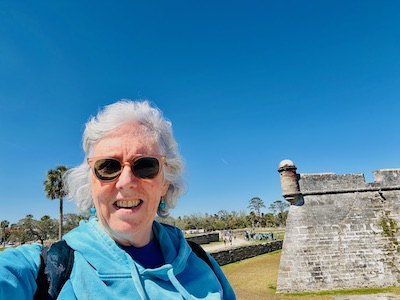
In front of the Castillo de San Marco

Ponce de Leon ventured onto what he thought was an island in 1513. He aptly named the island “La Florida” which means the place of flowers and claimed it for the Spanish crown. It was founded in 1565 by Menendez de Aviles. In contrast, the Mayflower sails to the United States in 1620.  The Spanish were here a century before the English. In St. Augustine most of the oldest homes in the United States are here as well as the oldest wooden school house which was built in 1702 and it still exists on St. George St. in the heart of old town St. Augustine.

Castillo de San Marcos was originally built by the Spanish in 1695 and is the oldest masonry fortification in the United States. A wooden fort was built after Sir Francis Drake attached St. Augustine in 1565. The masonry fort was built after an English privateer Robert Searles attacked and destroyed much of St. Augustine and the existing wooden fort. Most of the fortress was completed in 1672.  The Spanish Crown wanted to protect the shipping routes from Central and South America. Touring the fort is easy and it’s located right next to the water in central St. Augustine. It’s complete with a moat and drawbridge. It’s an unusual shape with pointed corners so that any intruder can be fired upon. The mortar is made from coquina or seashells which makes it extremely impregnable. The fortress itself was never breached or taken by force and was only exchanged through treaty or agreement. 

The Spanish held the fort from 1565 until 1763 when the British took over the fort in exchange for the British giving up control of occupied Havana. When this happened, many freedmen left for Cuba since they could not be assured of their rights under the English. In 1783, the Treaty of Paris ceded Florida back to Spain in recognition for their efforts on behalf of the American colonies during the Revolutionary War. Florida and the fort came under American rule when Spain ceded Florida in the 1819 Adams-Onis Treaty.  Quite the amazing history for an impenetrable fort. 

I was able to tour Flagler College which is on the site of the Hotel Ponce de Leon which was built by Standard Oil co-founder Henry Flagler.  It was built between 1885-1887 and it’s a terrific example of the Spanish Colonial Revival style. There are hundreds of homages to Spain inside and outside the hotel with the coats of armor for many Spanish cities. It has an incredible collection of Tiffany windows and many nautical themes throughout what once was a hotel that was only open for four months of the year for wealthy snow birds. It really is stepping back in time to tour the inside of the buildings which now house students for Flagler College.

Right across the street is the Lightner Museum of St. Augustine which is on the location for Flagler’s Hotel Alcazar. There is now a cafe in what once was an indoor pool.  I had lunch in the Cafe Alcazar and it’s wild to see pictures of this pool full of water and folks diving off of what is now a terrace. The museum if full of photos of the hotel from the late 1800’s. 

I was surprised by the beautiful architecture, the swaying palm tree lined avenues, the tiny shops in the historic district, and the mighty fortress that still sits perched on the Matanzas (which mean massacre in Spanish) River. Here the many folks that called this home and then had to either voluntarily or involuntarily move on as one ruler came on and another exited. So much history in an idyllic town which at one point was the north end of the entire Spanish kingdom. 

Let Them and Let Me 😃

I finished Mel Robbin’s book Let Them Theory last month and it’s a great mantra to keep in mind throughout the day. My friend didn’t respond to a text about stopping by, let them. Spouse leaves the dishes in the sink (while the dishwasher sits empty), let them. Flat tire on the way to an appointment, let them. Your boss is in a bad mood, let them. Your dad judges your new job, let them. Mel Robbins’ Let Them Theory has unlimited use moments. Every day. 

Robbins talks about seeing old friends on social media having a great getaway weekend…without her. She spiraled. How could they? What did she do wrong? That whole feeling of FOMO and feeling the injustice that someone could overlook her or shut her out. I think of this as the “story I’m telling myself”; where I create a whole story that everyone is against me and somehow I’m not worthy. It’s futile, damaging and painful. And it’s completely self-defeating. It does absolutely no good. 

Here are the steps to Let Them and Let Me:

Know what you can control. Almost everything that is outside of me is outside of my control. The weather, time, gravity, people’s opinions, other people’s effort, other people’s decisions and other people’s habits. My worry and consternation cannot change something that I have no control over. Making someone interested in you, getting a job offer, being picked on the kickball team, making the traffic jam disappear or getting that screaming baby to calm down on an overseas flight.  These are outside of my immediate control. What can I control? That’s the let me part. I can focus on what I’m interested in, I can keep putting out resumes and expanding my network, I can practice my kickball skills or pursue basketball instead, I can be grateful for the break in a traffic jam and hope that no one is seriously injured, and I can put on headphones or offer to fill a bottle for the baby. There is also my response to all these aggravations. I can breathe deep and stay centered instead of reacting or turning up the volume on my inner critic. I look for what I can control and that is where my peace lies.

Know your brain.  We all do our best thinking when we have access to our prefrontal cortex (PFC). This is where the magic happens.  We plan, we find solutions, we are creative and we are innovative when we are able to be in our PFC. Unfortunately, stress hijacks us out of our PFC and into our Amygdala. When we are in our Amygdala, it’s all fight, flight, freeze or fawn. This is when I say stupid things and frequently do things I regret (I’m looking at you Ben and Jerry’s).  I was alarmed this past year when I read in a research study that it takes a minimum of 20 minutes to get out of our Amygdala and back into our PFC. So, if I’m called out at a budget meeting in front of the entire senior staff, I’m not likely to have a well thought out eloquent response. In my opinion, this is the time to get some kind of break so that I don’t put my foot in my mouth. There are also centering exercises like thinking about my big toe, taking 3 deep breaths, or rubbing my thumb and forefinger together to feel my fingerprint ridges. The point is to focus on your body instead of your brain which is currently drowning in chemicals. So, before I engage in responding, I need to know where my brain is. Am I in my Amygdala or my PFC? Once I know the answer, I can take the next best steps. 

Know your power. Learning to let them is very powerful.  When I get caught up in someone else blocking my way or getting sucked into wanting to change them, I feel empty and fragile. By pushing back or resisting, I end up expending a lot of energy and I feel depleted. It’s like trying to push a rope.  I realize now it’s futile and exhausting. Let them helps me feel more powerful because I’m focused on what I can do and control instead of getting wrapped up in what I can’t. 

Know your values.  The Let Them Theory frees me up to make choices that align with my values. I’m not trying to appease someone or worry about “how something” will look to others.  As long as it’s aligned with my values, then I can Let Me. I get to take ownership of where I want to be and what I want to do instead of (unsuccessfully) trying to drive others to what I want.  Or what I think they should want. I get to follow my values and let them follow theirs. 

Know others. It’s impossible to change someone else. Robbins spent several chapters on a woman who wanted to get her husband to shape up. Nagging and cajoling just don’t work.  The more I push the less the other person wants to comply. If it’s not their own idea, it’s not going to happen. My son isn’t going to apply for an early decision at my alma mater.  My partner isn’t going to quit drinking. Respect that each person is on their own path and they get to decide which direction to go. Robbins suggests setting the example and then let go. So, If I want to get my friend to start running every morning, I can go running every morning and tell them how great I feel when I do.  Beyond that, sit back and see if they get there on their own.

Relinquishing power to control others is so powerful. Robbins does a great job making it so easy in just two words: Let Them. And then, Let Me. Let me respond with my values and set the example of having the boundaries that align with them. Can you let them?

The Universe is Winking. Quantum Flirts

From 10 years ago:

I have been training for the last year with CRR Global and a few weeks ago I went to the fourth installment of my Organization & Relationship Systems Coaching (ORSC) training. This stuff is magical. The topic on the last day was Quantum Flirts which is as described by CRR Global, “a short-lived, transient, perceptual signal which can be used to provide us with insight.” It is based on the work of Arnold Mindell and Quantum Mechanics. So the way I see it, it’s like the Universe is sending you a sign. As Arnold writes, “In everyday terms, Arny explained this idea of “many worlds” by saying that when we begin to focus on something, we see its most probable state, the one that fits into our culture and consensus reality. Yet, in each and every experience there is a multitude of other experiences lying in wait, though in Arny’s interpretation, we choose one and marginalize the others. To say it very simply, the moment we call something “a” or “b” we have marginalized all of its other possible states (c,d,e, etc).”The Universe is flirting with you and you need to pay attention to catch it so that you can see the possibility of a different outcome. It may be a flicker of a bulb, the song of a bird or a flash of sunlight on a wave, but it’s the Universe winking at you; laying out hints.

I was fortunate to be the volunteer coached by Grace Flannery in Quantum Flirts. She asked that I bring up a current issue or hot spot that had stressed me out with someone close to me. I talked about my son and his desire to find a place to live this summer instead of coming home and there are a multitude of options and growing for staying in Miami. I further explained how his mode of communication is texting which can leave one wanting (me) for more and frustrated. She then asked me to look around the room or outside and see if there was anything that caught my attention for just a second. I noticed how a classmate was flipping his reading glasses and the glint of light from it. This was my “flirt”. Grace ask me to animate the flirt and I flickered my fingers in an arc in front of me. Grace expounded on my gesture with a “Fa la la la la”. I copied her. She said, “So when your son texts, you can just say “fa la la la la”. We did it in unison. The observing class then copied me. We were all there “fa la la-ing” and copying my gesture. I could not stop laughing. We all cracked up. The Universe flirted with me and it was hysterical. My aggravation with my son was a construct of reality but by paying attention to the spark or “flirt” I could imagine that there could be a different outcome. I could let go and see it in a different light. It’s not a hot spot, there is potential in my relationship with my son to any outcome that I chose. His constant texting and options are his way to engage. So be it.

So how do you tune into the signals and flirts around you? Here are some ideas.

1. Presence. If you aren’t living in the moment, it’s going to be pretty hard to pick up on any signals. If you have ever meditated (and if you are a faithful reader of my blog you should be by now 🙂 ) do you start to notice every sound or smell or the crazy shapes on the inside of your eyelids when shut? You are officially “present”. I always notice the sound of the clock in my office, the birds outside or the ventilation system. Get present; become present.

2. Notice. Take notice of what is going on around you. I started noticing every animal that crossed my path and not just my dog. Turtle out in the lake bobbing with its head at the surface. A glint of light off a wet leaf, the clock is at 11:11, the receipt fell on the floor to only show the word “thanks”. Start to take note of what is going on out there or in there. My dog is sleeping, my dog is sighing, my dog is running around at lightning speed because geese are in her space, my dog is out of the water. I try and remember something about the dream I just woke up from. Take notice.

3. Offer. So what does this sign have to offer? Why is the universe or a higher power or quantum physics sending a signal to you? I know that each time I see a turtle I feel like I need to slow down and be patient. When I see a robin I think of rebirth and Spring. Canadian geese are a nuisance and I’m wondering if I am pestering someone. Perhaps my children? My boss? My dog is out of the water. Maybe I need water and nourishment as well. The receipt that fell with “thanks” showing is offering me gratitude. What is the offer?

4. It’s right. Don’t get caught up in perfection about what the sign or the flirt means. It means what it means to you. I know sometimes I “cheat” and Google “tornado as a symbol in a dream”. Apparently, this could be a sign of stress. Makes sense. That resonates for me. If it doesn’t, maybe the tornado is a sign of escaping danger. Animals like Robins, Herons and Turtles almost always have a Shamanic reference. Those are easy to Google as well. I dreamt about a broken bottle the other day and the reference for that symbol was “potential”. What it felt like for me was avoiding the broken glass. There was a person I was walking on egg shells for and I feel like the broken glass was the symbol I could relate to.

I’m less about everything happens for a reason and more about taking in information I do like to think that things show up at the right time and that the turtle that just stuck his head up through the surface of the lake is telling me to slow down. What signs do you see?

😎Got Stress? 5 Tricks to Reset

I coach around 30 to 40 professionals across many industries. They range from technology, manufacturing, finance and federal government.  I’ve noticed a real uptick in the amount of folks suffering from stress, uncertainty and overwhelm.  In the current global environment it can seem futile and exasperating. There is an underlying stress for many folks that a another shoe is going to drop at any moment whether it be a disaster or conflict. There is so much uncertainty around job and financial stability. It’s hard to rewire our brains into relaxing and resetting into calm.  Several of my high performing clients are petrified to open the next email or newsfeed.  It’s difficult to recapture calm once the cortisol is released in your body but there are some tricks that can be helpful.

Here are 5 tricks to reset to calm:

Take 20 Minutes.  When you perceive a threat whether real or imagined (I can’t tell you how many times I thought a root was a snake on a hiking trail), your breathing is shallow, your heart rate goes up, adrenaline and cortisol are released. As Donna Marino wrote for Fast Company, “Psychologists call this process the “fight, flight, or freeze response,” referring to the body’s instinctual reaction to this event. Once this process is triggered, it can take up to 20 minutes for the parasympathetic system to intervene and return you to a state of calm.” So, let’s say you were just embarrassed on a conference call or the offer on your house fell through or you are angry at your partner.  Take a 20-minute break.  Once you are triggered it’s very difficult to speak and think coherently.  If there is any way to take a break to later in the day or, better yet the next day, get some space and time to reset.

Best, Worst, Most Likely.  Perhaps you are nervous to confront your direct report on a poor-quality project or to present to the executive team or to get through this really challenging class.  Think through or write down or chat with a close friend or coach. 

Ask yourself the following three questions:  

  • What is the best outcome?  My employee turns around and gets promoted, I am flawless on the presentation and they tap me for a promotion I get an A+ in the course.  
  • What is the worst outcome? My employee quits and goes on Glass Door to trash me, the executive team hate the presentation and I’m demoted, and I flunk the course and have to take it over. I saw a fun example of this on “This Is Us” as a married couple tries to compete for worst case scenario usually involving a parenting decision.  
  • What is the most likely outcome?  My employee makes improvements and we have a better working relationship, my presentation goes well with only a few hiccups, and I get a B in the class which slightly drops my GPA.  

This helps keep me from dwelling on what could go wrong to imaging the best; realistically facing the worst and then relaxing into what is most likely.

Reframing. The words that I use to describe a situation can influence the way my body perceives it. If I say, “I’m nervous about this new client as opposed to I’m excited about this new client.”  My brain is deciding I’m on high alert in the first part and curious in the second part.  For many weeks leading up to a cross country trip last year I referred to putting my beloved dog Baci into prison for 4 weeks.  Imagine how that made me feel.  When I told a colleague about it he said, “That boarding place?  That’s a resort”.  When I reframed it into a resort, I was less stressed out and more excited (not nervous) to drop Baci off. My good friend Mark sold his family home and while it was daunting, he changed his language to be “I’m excited to clear the garage or cull through my parent’s books.”  The language we use in our head and how we frame it is very important to resetting our mind. 

Role play. It’s extremely helpful to role play or practice a difficult discussion or presentation.  I can play in my mind what I want to say but saying it out loud either by myself to a mirror or to a trusted colleague or to a coach can be super helpful in dampening down one’s nerves.  It’s helpful to work the kinks out.  I do this a lot with my clients and I can give helpful feedback like, “You said “um” six times and you rambled a bit in the last sentence Is there a way to tighten it up?” I personally like to have bullets if I’m going to speak to a crowd or facilitate to a group but you may want flash cards or talking points.  Figure out what makes you most comfortable and practice it to reset to calm. 

Comfortable.  If I know I’m going into something that might make me anxious like a performance discussion with an employee or speaking to a new group or taking an exam, I try to make sure I am as comfortable as possible while matching the situation (I’m not wearing pajamas to a speaking engagement).  As Francis Kuehnle wrote for Healthline, “Aromatherapy is thought to help activate certain receptors in your brain, potentially easing anxiety.” Wear a scent that makes you feel good.  If a shirt or blouse has a tag that rubs against your skin or you are constantly tugging on a top, wear something that makes you feel confident and comfortable. Being comfortable will help you reset into calm. 

These are more short-term ways to deal with stress and anxiety.  There are many regimes that can help with your ability to cope like yoga, meditation, walking outside, better sleep and reducing alcohol and caffeine. I’ve made many lifestyle changes over the last ten years and I have to say I’m much less anxious and tend to roll with the punches more easily.  My suggestion is to try out one of these and see if it has an impact.  How do you reduce stress?

🧐Narcissistic Boss? Here are 7 Secrets.

You made a big mistake. You criticized your boss for the way they delegated the project. Now you are in her sights. You’ve pulled the pin on the grenade and now you are holding it. No one critiques the narcissistic boss because the collateral damage is huge. Your next performance review will be toast and your next assignment will be unattainable and sure to fail with heroic deadlines not met. Hell hath no fury as a narcissistic boss who is criticized.

I haven’t had a narcissistic boss in decades but I sure see them around me. In fact, since I first wrote about narcissism, I’ve suddenly started to see them everywhere. Speaking engagements, workshops and parties, they are ubiquitous. How can you tell them? They do all the talking and very little listening. They are always right as well.

So here are the secrets to dealing with your narcissistic boss:

1. Do not complain to others. I know misery loves company but a narcissist is paranoid. Really paranoid. She is on the hunt for any detractors. And detractors will not be tolerated. Whether it’s texting or email or hushed voices by the water cooler, assume that the narcissist boss is omniscient. If there is a way to find out gossip about their carefully crafted image, they will find a way and there will be consequences.

2. Do not be friends. As Susan Price wrote for IvyExec, “Narcissists lack empathy, so they are not capable of true friendships. You might feel betrayed if you think you are becoming friends with one only to find they act without your interests in mind. If they are friendly to you, it is because they want something, whether your attention, your ideas, or anything else.” I have been personally burned by this several times in my career. I’ve had narcissists promise me the moon in my career only to find them to be completely empty. There is only one person they care about and that is themselves.

3. Keep your guard up. I know this can be exhausting. Constantly being vigilant for any sign of backstabbing or manipulation can take a lot of energy. Set boundaries and do not cross them. As Jacquelyn Smith wrote for Business Insider, “Understand that winds change quickly, and you may get undercut at any time. You can record and document every conversation and keep every email trail, but the narcissist has the ability to think quickly and act differently. And you will never see it coming.” Don’t get blindsided. Stay vigilant.

4. Give them praise. I know this seems like brown nosing, and it is, but the narcissist’s image of themselves is paramount in their mind. As Price writes, “Always remember that everything is about her/him. So if your words and actions make her/him feel good, she/he will be far more tolerable than if she/he feels that you are doing something that attacks her/him such as undermining her/him authority or criticizing her/him. Narcissists want praise and acknowledgement, so be prepared to give it to them.” A little sugar goes a long way.

5. Protect their image by taking the blame. Another bitter pill which is why you probably need to look at #7. Falling on the sword or keeping facts under wraps so that the narcissist’s image is maintained can be soul crushing. As Price posits, “Narcissists don’t take responsibility for anything negative, whether it is a bad culture in the office or declining revenues. It has to be someone else’s fault.” Scan the office for any detrimental indicators and proactively put them to bed.

6. Don’t compete with them. Narcissists are winners. They never lose. So don’t try and grab the limelight even if you worked 80 hours last week to get the project out the door. As Price writes, “Your boss will assume that you are doing good work because of what he taught you. Your award should be his; after all, you work for him, don’t you? You can’t win. Ever. So don’t play.” You are not opponents in a game, you are the support that helps them win.

7. Have an exit plan. I have a dear friend who was under the thumb of a narcissistic boss for upwards of three years. After empty promises and grueling months of 80 plus hour thankless work weeks, he started searching for his next job. So have a financial plan, keep your life in balance (don’t take this out on your family) and update your resume. There may be other opportunities in the organization. If you are not up to #1 through #6? Exiting gracefully is the best option. And don’t hesitate to use a professional coach or a friend help you with the plan and the process. You need someone on your side.

I think it’s like marriage. I was married to a narcissist and thought I could change him. It’s not possible. You can’t expect to change a narcissist boss. You can have all the staff development days in an organization but narcissists just point the fingers at everyone else. All they see in the mirror is their own carefully crafted image.

🤩You Are Enough

Have you been waiting to hear those words since say…kindergarten? I have. I generally have stayed uber-focused on my penmanship (sketchy), my height (too tall) and my value as a human being (a work-in-progress). This happens to the distraction from my more valuable traits like writing, coaching and being present. I am more worried about the illusive atta-boy (-girl) from my sixth-grade math teacher or my parents finally being happy with the career I have chosen.

Unfortunately, if you go looking for someone to say: “Cathy, you are good enough,” you will be waiting a long time. Your value is not determined by those outside of yourself. It’s an inside job. It’s between your ears. You need to decide you are good enough. No one is going to do it for you. Decide today. You are worthy. You are good enough. Go ahead. I’ll wait right here.

These might be the reasons holding you back from being enough:

The yardstick of perfectionAnne Lamott wrote brilliantly in Bird by Bird, “Perfectionism is the voice of the oppressor, the enemy of the people. It will keep you cramped and insane your whole life… I think perfectionism is based on the obsessive belief that if you run carefully enough, hitting each stepping-stone just right, you won’t have to die. The truth is that you will die anyway and that a lot of people who aren’t even looking at their feet are going to do a whole lot better than you and have a lot more fun while they’re doing it.” It’s OK if my handwriting isn’t that legible. It’s OK if I am taller than the rest. It’s OK if I have honestly wasted half a Saturday getting over vertigo and not writing. I just spent part of the morning criticizing myself for not going to the gym first thing or writing a post. Really? Like the exercise and blog gods are sitting around judging me for recovering from half a day spent getting to the bottom of my vertigo? So what? As Lamott says, you will die anyway. Spending time trying to be perfect is empty and completely unrewarding. You are good enough right now.

A gold medal won’t change a thing. Lamott famously quotes a 400 pound has-been coach, “If you’re not enough before the gold medal, you won’t be enough with it.” Interesting. If you are not enough before you lose 30 pounds, you won’t be enough after. If you are not enough before the big promotion, you won’t be after. If you are not enough before the divorce, you won’t be after. Worthiness is not a line in the sand. It’s not a point in time. It’s not after the big achievement or disappointment. You are worthy right now. And now. And now. Sit in that. Let it sink in. A gold medal will not make a difference.

You are uniquely you. The mold is busted and there is only one of you and your individual view on life. As Dr. Seuss famously said, “Today you are You, that is truer than true. There is no one alive who is Youer than You.” Even you and your identical twin would have different shortcuts on your desktop. One of you was picked last or first on the soccer team. It has made all the difference. You now fight for the downtrodden or represent soccer player’s rights. Neither is better or worse. Just unique. Be you. Own it. Embody it. Be the unique you that you are.

Comparison is futile. Lamott said, “Never compare your insides to everyone else’s outsides.” You have no idea what your neighbor is going through or your coworker or your dog for that matter. You may be jealous of that new car but don’t realize they had to take over payments for their daughter. Your coworker is battling stage 4 colon cancer. Your dog has been barking at that neighbor dog for the last ten years and has yet to get the last word. We really have no idea what is going on for someone else and comparing it to your current situation is a recipe for disaster. Comparing does not make you feel worthy or enough. So stop comparing.

What other people think of me is none of my business. This is a Wayne Dyer quote that stops me cold. You have absolutely no control over what other people think of you. Let it go. I’m not saying it’s easy. It’s not. We’ve spent so much time on worrying about what others think. I remember having 11 different pairs of colored corduroy Levis in high school. It did not increase the number of friends I had. AND I was probably the only one who noticed. If you cannot move the needle on it, don’t bother worrying about it. Besides, you are perfectly good enough right now.

I was the last pick a lot in elementary school. My mother was upset with how I held a pencil in my hand. I didn’t have a ton of friends in high school. It’s OK. Let the past go and move on. It has no impact on my worthiness right now. Let go of the judgments from the past and be enough. You are good enough. And so am I.

😳 Do It Scared: Overseas


I just got back from an eight city, seven-week escapade to Southern Europe. I’m moderately fluent in Spanish but besides that and a structured tour in Rome, I was on my own with my carry-on bag, backpack and my single pair of sneakers. The genesis of the trip was wanting to be in Rome on Christmas. Once I started booking things, it ended up that I was in Athens for Christmas and on a “Road Scholar” tour of Rome the week before. After talking to my world traveling friend Janine, I decided that Lisbon was the best place to start my trip as I recovered from jet lag. So, there it started, Lisbon, Rome, Athens and then on to Venice, Florence, Seville, Tenerife and finally Madrid. My route was set. Leading up to my departure, I started getting pangs in my stomach and started to wonder if I had an appendicitis or a burst gall bladder. I started to get nervous that I would land in Lisbon and then get rushed to a hospital.  It was all for naught. I think it was just like getting nervous before a speech or running a marathon; it was all in my head. I decided it was psychosomatic and pushed through anyway.  I’m so glad I did. 

Doing it scared at the Acropolis

Here are the ways I did it scared:

Carry on only. I had to pack light.  I had a trip a few weeks before to Seattle after my mother passed away and it was a test trip for packing extremely light.  One pair (yes ONE) of shoes, three pairs of pants, one rain jacket, one puffy jacket with hood and 6 long sleeve shirts, 1 t-shirt and 10 pairs of underwear. I had booked apartments with washers except for the hotel in Rome. I purchased a carry-on suitcase that is both the lightest and fits in all European airlines and had two sturdy wheels (no spinners) so that I could drag it for miles on cobblestone streets. I always purchased early boarding so that I wouldn’t have issues with getting my bag on board. I have heard enough nightmare stories of lost luggage that I wanted to make sure I had what I needed once I got my feet on the ground. I could easily pick up my bag and put it in the overhead bin and my backpack was a lower profile so it could easily fit in under the seat in front of me. One snafu to carry on is that many of the airports I traveled to had a bus to the airplane which meant maneuvering the bags on the bus and up a set of stairs to the plane. All of this gave the assurance that I wouldn’t be stuck without my luggage.

Embrace the unknown. Each time I was going from one city to the next city I almost always ran into a cab or public transit dropping me off some half mile from my destination due to pedestrian only streets. I had not factored this in the first time it happened in Lisbon. By the time I got to Athens, I would set up the directions to the apartment by getting the walking directions from the airport in my map app. That way, when the cab dropped me off, I would start following the directions of my phone/watch. There were still snafus like the closed park in Venice that I had to circumnavigate and the sheer confusion of massive amounts of shoppers in Athens. I was always my most vulnerable when I had my luggage with me and just finding a space off to the side of a major thoroughfare full of people to get my bearings was intimidating. There is also the fact that elevators start on level 0. I went up and down elevators several times looking for what I though was the second floor on floor 1 instead of going all the way to floor 2. I really had to embrace just being lost and to be OK with circling the block several times to figure out where I was. 

Figure out shopping. My first order of business once I found my apartment was figuring out what I was going to do for breakfast for the next day. I scoped out the coffee situation whether it was a Moka, electric kettle, Nespresso or Dolce Gusto machine. Off to the nearest Carrefour or Conad market I go with empty foldable backpack in hand. Most markets in Europe have self-checkout which is always interesting in a foreign language although sometimes you can select the British flag to get English. I never found oatmeal (Avena) until I arrived in Spain. In Portugal, Italy and Greece, I ended up buying Muesli (like granola) and milk. Fruits and vegetables almost always have a self-service station to weigh it.  You can imagine how intimidating finding a fruit or vegetable is on a foreign scale system. I’m not sure I was accurate but I survived getting a scanner code and was able to check out.  In addition, you scan or pay for each bag you use. I know some states have adopted this but taking along an empty backpack was handy. Every market payment system in Europe had a tap option so I didn’t have to figure out using what little Euros I had. Each time it was a new adventure. When I try to eat mostly vegetarian google translates by taking a picture of a product and was invaluable.

Travel on foot if possible. I ended up walking at least 5 miles a day during my travels. I never wore a headset. I try to be absolutely present and pay attention to the sounds and sights. It’s similar to walking a trail, I have to pay attention to each foot fall especially on narrow cobblestone streets. If something was wet, I’d walk slower. In retrospect the only place I saw folks with walkers and wheelchairs was in Madrid.  The rest of the cities I traveled to had stairs, cobblestones and rarely an elevator. Complete handrails (from top to bottom of a set of stairs) was a rarity. When I solo travel, I really slow down and carefully move forward. I also got to experience each city from the graffiti to the smells of roasting chestnuts to the sound of church bells. Each time I was in a precarious situation I would think about how it could be worse, like climbing up to the Acropolis, well at least it’s not raining and it’s only 60 degrees. Amongst the throngs the week before Christmas at the base of the Spanish Steps in Rome, I thought, at least I’m not shopping or trying to get a cab. Being on foot makes me be present and appreciate each moment.

Each time I plan my travel adventures; it feels like some long-lost dream until it’s behind me. I put a plan together and hope it all works out and figure if it doesn’t, I’ll just stay home. Fear is a fickle thing cropping up at inopportune times and I try to remember to bring curiosity and optimism. Mostly, I’m just grateful to have the opportunity to work remotely, see the world and do it scared.

🧐Curiosity: the Antidote for Fear

I’ve been taking several team coaching courses through CRR Global. Our facilitator said something really thought provoking. Curiosity is the antidote for fear. She posited that you can’t hold fear and curiosity at the same time. I guess this is why Curious George seemed to escape dire consequences because he wasn’t holding onto fear and examining all the “what if’s”. Rather liberating isn’t it? Just be curious and fear will melt away.

As I look back, I think the period of my life where I was consumed with fear and struggled with worrying about all that could go wrong was when my son was two. He was a toddler capable of dragging a tricycle onto a kitchen table and then sitting on it. He lacked any sense of fear. I was tethered to my son’s hand in every parking lot, store, amusement park, Movie Theater….for about three years. He had no sense of danger. No limits. I remember sitting several rows back at a Cirque du Soleil performance and he ran down the aisle to try and go on stage. We caught him just shy of the first step. Crisis averted. His curiosity struck fear in me. Thank goodness they grow up. Thank goodness he and I both survived.

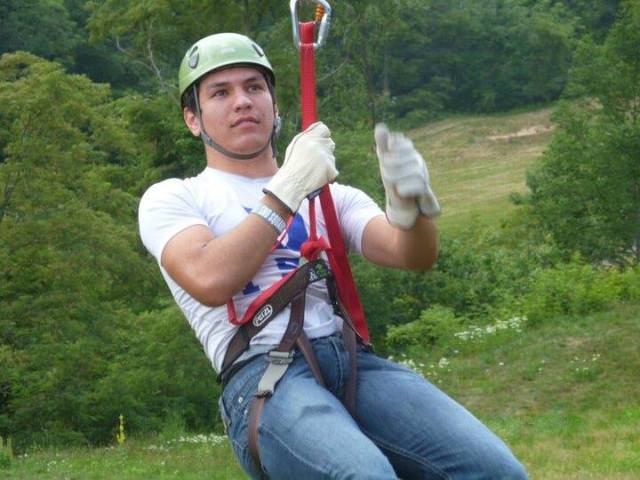
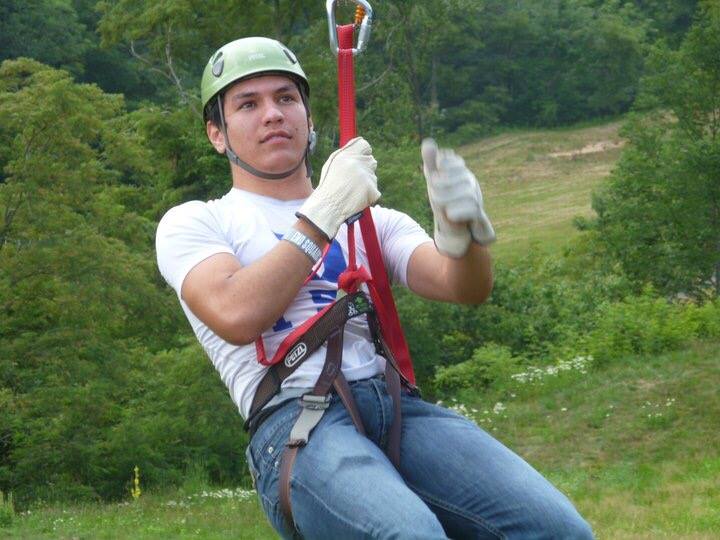
My son, Benson, zip lining.

I’m not saying we shouldn’t watch out for our toddlers and let them go play in traffic; but there is a lot to be learned from having an open curiosity about the world. I personally am game for any antidote for fear. So here are some ideas for embracing curiosity.

1. Open. To be able to embrace curiosity, you need to be open. Be available for the experience. I remember going for a zip line experience with my son a few years ago. I initially asked him if he wanted to go try it out and he was game (no surprise there). To be honest when I asked him I hadn’t really thought through that this meant I would be flying through a forest several hundred feet above the ground. I am not a dare devil but I was open. I didn’t come up with a laundry list of why I shouldn’t do it. It was more about seizing the opportunity to do something fun with my son before he headed off to college. When they strapped us into our gear and the helmet was on, well…it was too late to worry about fear. We had a blast and suffered no injuries. Be open.

2. Scientist. Put on your scientist hat…or a lab coat. I remember taking food chemistry lab at Cornell. I was a Hotel Administration major and we spent hours messing with something basic like baking a cake. In one recipe we would double the baking powder, in another, we would leave out the eggs, in another, we would use oil instead of butter. As you can imagine (if you bake at all you know it is a science) the resulting cakes would be vastly different. I could see the cause and effect at work. It was a great learning experience although some of the end products were awful. Tinkering with various aspects of recipes has helped me to be a better cook. Take time to become the scientist.

3. Wonder. To be in “wonder” for me, means to be absolutely present and free of assumption. You need to let go and be. I can remember my kids as toddlers on Christmas morning. The larger presents from Santa would be all set up (i.e. Hot Wheels race tracks, Barbie dream house…etc). There was an overwhelming amount of things in the room but my son would run up to the racetrack and start playing. He would spend 30 minutes before he was ready to move on. He was present in his wonder and took it all in at his pace. Embrace wonder.

4. Talk to your triggers. We just practiced this in my CRR Global class. Being triggered is when you go into fight or flight mode. I get triggered when someone says a sexist statement like “those football players are playing like girls.” Suddenly my 30 year old neighborhood bully named “Joe” breaks out and wants to teach somebody a lesson and I shut down and can’t think. When I separated from my triggered self (through coaching), I could dream up a new way to deal with Joe the next time I get triggered. I can show up as my adult self and keep Joe in the back room by the red phone. Having a plan to deal with your triggers helps keep you resilient, in the moment, and keeping fear in check.

5. Muscle. Work your curiosity muscle on a regular basis. This is kind of like getting out of the status quo. Shake up your routines. Try a different drink at Starbucks, cross your arms the opposite of normal, drive a different route to work, eat vegetarian all day or call your brother you haven’t spoken to in months. It might be a little (or a lot) uncomfortable but it gets easier the more you do it. You can flex that curiosity muscle more easily. Flex your muscles.

The beauty of embracing curiosity is that life becomes that much fuller, more interesting, more adventurous. The view is different there. Lean in.

🤪 Mad about Madrid

It’s ironic that the abbreviation for Madrid is Mad. Mad is the airport call letters and it’s used in the name of lots of things like restaurant names, “Mad Grill”, “Mad Mad Vegan”, and “Mad Cafe”. In American English, you wouldn’t normally call something mad but in British English it has a primary connotation to be crazy about something. Well, I decided that I’m mad about Madrid. Madrid was in the unfortunate position of being the last stop on my 8 city European tour in the winter of 2024-2025. I didn’t arrive with high expectations.  I had just been seduced by Seville with its flamenco, oranges and history. I had previously been to Barcelona and stayed in the romantic, intriguing Gothic Quarter. I really expected it to be like a Spanish New York City with tapas. Yes, it’s more cosmopolitan than Barcelona or Seville but it’s not the concrete jungle with canyons of tall buildings like New York City.

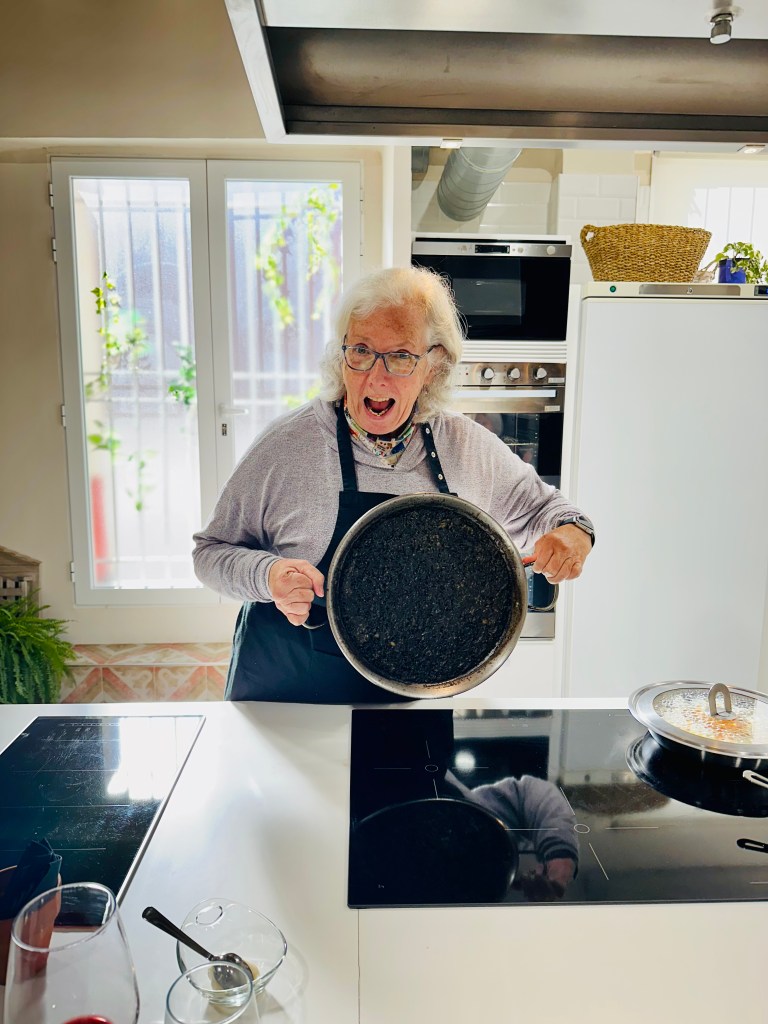
Taking a cooking class in Madrid and showing that the paella is ready because it is adhered to the pan.

This is why I’m mad about Madrid:

There will be art. I was able to go to three art museums while I was in Madrid and they were all less than a mile walking distance from my apartment. Museo del Prado is the main Spanish national art museum. It has art dating back to the 12th century with works from Goya, Bosch, Rubens, Titian, Velazquez and El Greco. There are countless paintings of the crucifixion of Christ and it’s remarkable to see the interpretation of various artists on this one subject. The Prado is an emotional experience with its mostly dark themes from either the crucifixion to enormous 40-foot paintings of battles and executions. You can also see the advancement of art through the centuries from painting on wood to frescos to canvases with immaculate perspective. I also went to the Museo Reina Sofia which is on the other end of the perspective from the Prado with all its works being from the 20th century.  It’s surprising to be in a museum in Madrid and to see painting from Hopper, Pollack and Wyeth. This is alongside an extensive collection of Picasso, Dali and Mora.  There was a temporary exhibit by Portuguese artist, Grada Kilomba in which she uses words and music in video or dancers representing her words.  It was quite unique. The Museo Thyssen-Bornemisza is another great museum in Madrid which fills the gap between the medieval Prado and the very modern Sofia. The Thyssen has many of the classic impressionists like Monet, Degas and Renoir which are some of my favorites so I really enjoyed it. Madrid has art for every taste.

There will be food. Madrid is a food lovers Mecca with everything from tapas to brunch to Michelin star restaurants. I was really glad I signed up for a tapas and paella class for the first day I arrived. There were only five of us in the class and the other four folks were from Mexico. When the instructor realized I spoke Spanish, she decided to teach the class in Spanish which was a confidence builder for me. I learned some amazing tricks like grating Roma tomatoes instead of chopping which seems crazy but the method effortlessly eliminates the skin of the tomato. We also cleaned cuttlefish which was something new for me. I really appreciate that was very hands on, similar to a class I took with my college roommates (Those Girls and the Blonde) in Paris some ten years ago. I have also found that throughout Spain if the name of the restaurant is in English then the restaurant is an easy place for English speakers like myself to go as the entire experience from greeting to menu is in English.  I also found that most restaurants serve tapas and that the portions are enormous. I received a plate of blistered peppers that were simple yet delicious and that alone could have been a meal. I did not venture into any fine dining places as most places don’t open until 7 PM and I’m not a big fan of walking at. Night. There were also tons of butcher shops and produce stands throughout the city. Grocery stores are amazing places throughout Europe. I would walk up to a Carrefour market and it would look like a simple convenience store until you walk inside the labyrinth which is almost always at least two floors with an elevator. I found that sparkling water is almost always at the far end of the second floor much like milk is always in the back row of Safeway. In Madrid, there are always full Jamons (legs of cured ham) hanging in the store where families will have one parked on a kitchen counter to take a slice whenever needed. There were also plenty of vegan restaurants to choose from as well. I really enjoyed eating my way through Madrid.

There will be walkways and parks. In a city the size of Madrid, I did not expect to see so many pedestrian walkways and parks. I have to say that even if there are cars on the road, the minute you step within a foot a crosswalk, the vehicle stops in its tracks. I found this to be amazing. I also took an amazing tour of Toledo (the cathedral is the second largest in Spain after Seville and is simply breathtaking) and the bus picked us up two stories below the Royal Palace. We then drove some ten miles underground (similar to Boston’s downtown). I didn’t realize until that moment but you don’t see large trucks or many cars in downtown Madrid. If there are vehicles, they are only taxis and delivery vans. This makes walking around very easy. In addition, they have a metro system as well, although I didn’t need it since everything for me was in walking distance. There are also enormous parks throughout the city with countless statues venerating various kings and conquerors. One of the main streets by the Sofia and Prado is closed to traffic on Sundays (similar to Central Park in NYC). This makes for terrific space for runners, skaters and sightseers like me. 

I found Madrid to be friendly and inviting. Folks sitting next to me at a table on the Plaza Mayor wished me a pleasant meal (buen provecho), and folks walking down the street would say hello (buenos dias or hola). One funny thing happened at the Thyssen.  The man behind the ticket counter asked if I wanted a discount and I said (in Spanish) well, I’m not a student but I am old. The couple in the next cue laughed and said, “Woman, you’re not old”. Probably the greatest gift in life is making someone laugh in another language. I got the discount by the way:). I am mad about Madrid and hope to return.