The Things I Hold On To: My Artifacts

In the last year, I went from a 3,000 square foot house with three garages down to a 1,000 square foot apartment sans garage. That is a lot of culling out. Boiling down to the essence. I have found the artifacts that matter. The mileposts of my life that I want to hold onto, at least for now. As my friend Janine said, “Someone told me that 3 moves is like a fire and I have found that to be true.” Well, I’m not quite there yet but shedding has been the name of the game for the last six months and I have come to understand what I value.

Here are some of the artifacts that I am holding onto:

Staffordshire England Dogs

This is a pair of porcelain dogs that have stared out at me unfazed for my entire childhood on the shelves of my parents living room at 10 Majestic Court in Delaware. When my parents moved to New Mexico about five years ago, I was given custody of these dogs. It is ironic that my parents had porcelain dogs because we never had a family dog growing up. These dogs were a surrogate of sorts. They are even more important to me because I remember seeing them in my grandfather’s photo albums. They were originally in my grandparents’ home which makes them so much more revered. I think of all the family members these dogs have stared out at and what stories they could tell. I think of the Twister games in my parents living room, the Easter egg hunts, and my grandparents sing a longs around my grandfather’s grand piano. Oh, if those dogs could talk.
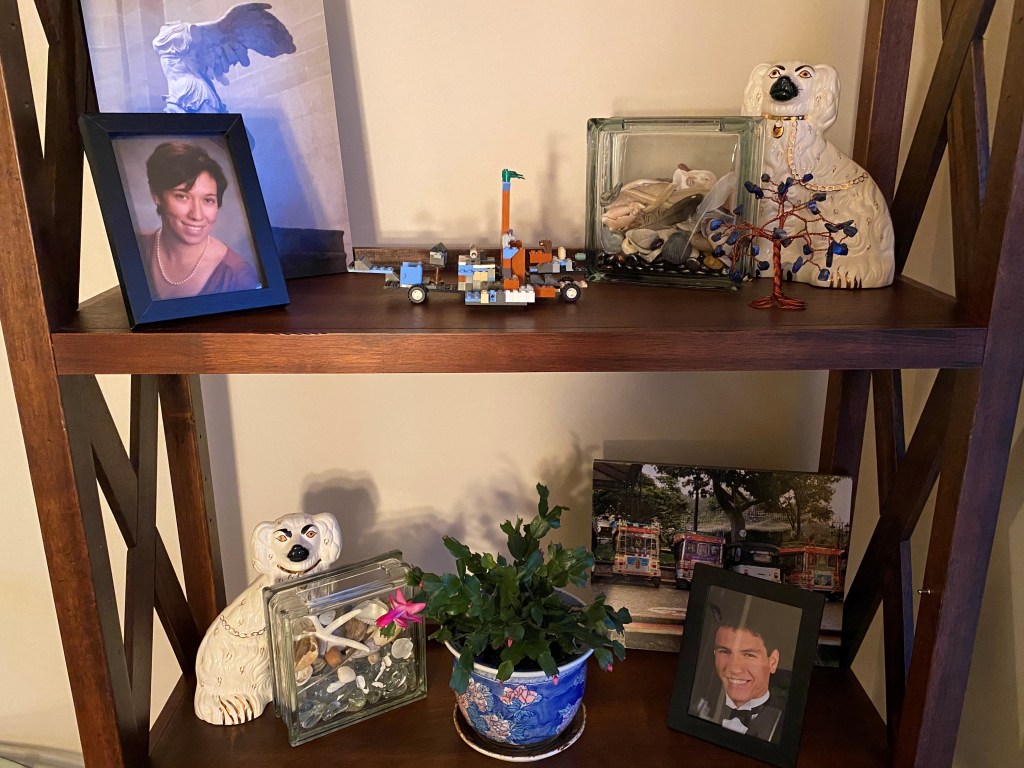
Some of my artifacts: Lego Airplane, Glass Blocks, Lapiz and Copper Tree and the Staffordshire Dogs

Wolfard Lamps

I think my mother purchased these lamps in Northern California. Wolfard’s are made in Cotati, CA so it would make sense that she bought them after moving to California. I was so fortunate that my parents lived about a block down the street from me in Windsor, CA. We spent most holidays and birthdays around my mother’s elegant dining room table and the glow of the Wolfard lamps. I have owned these lamps since my parents move, and Roy and I lit them this past Thanksgiving in my new apartment. I was worried that there was not enough oil in the lamp to stay lit but miraculously they glowed for hours. I think of the joint April birthday celebrations for my daughter and her twin cousins and my parents 40th wedding anniversary that my first husband and I catered. They were all lit by the glow of these lamps.

Brazilian Basket

My first husband Orlando and I traveled to South America in the late 1980’s. The end of our trip was trapsing through the Amazon jungle near the confluence of the Rio Negro and the Amazon River. We had paid for a private guide to travel on the rivers and explore the shacks and villages in the jungle. We fished for piranha, canoed in dugout canoes, watched monkeys swing in the tree branches above and walked along a trail to find a woman weaving baskets for sale. We bought that basket. I’ve held onto it through two marriages and cross country moves. I wonder where that woman is now and what she would think of the journey that basket has been on. Now it sits in my office and it’s much less pliable than when I first purchased it, much like myself. The basket may be stiff and cracked, but it has traveled the Western Hemisphere.

Lego Airplane

My son built a Lego airplane on wheels as a child. It isn’t that pretty but it is my son’s creation. I have had it on my office shelf for the last decade, at least. When my son came home to say goodbye to our lake house in September, I asked him to repair his plane. He immediately knew where the misplaced parts belong and reassembled his creation for travel to my new apartment. It’s a piece of him, wherever I land.

Lapiz and Copper Tree

My children and I traveled to Medellín, Colombia four years ago for the Christmas holiday. I remember buying the copper tree on a plaza near our Airbnb while shopping with my daughter, Natalie. Another handmade artifact from South America that always reminds me of that trip. It was a terrific adventure with my children as adults and that piece reminds me of it every day.

Glass Blocks

I have had a glass block for many years that I have thrown shells, pebbles, feathers and drift wood into. About two years ago, my first block started to fill up so I purchased a second. I have pieces and parts of so many beaches and mountain tops and trails. It’s a testament to my travels. Goat Rock, St. Pete Beach, Mount Washington, Lake Winnipesauke, Machu Picchu, Bohemian National Park, Ocracoke, Lake Mattamuskeet, Grand Canyon, Yosemite, Assateague Island, Spotsylvania, Gettysburg, and various spots on the Appalachian Trail. It’s all there. The pieces and parts of my travels. I hope I need another glass block to continue to memorize my travels.

There is so much that I have let go of over the last four years, and it’s lightened my load considerably. It’s helped me reconnect to the things I truly value and understand my roots. The things I value don’t have to be expensive, or beautiful, or sturdy, they just have to touch my heart in some way that connects me with my family and friends and my travels. What are your artifacts?

Completing the Stress Cycle

About a month ago, my insightful friend, Janine Allo posted a podcast on LinkedIn by Brene Brown called “Unlocking Us”. On this podcast, Brene interviewed twin sisters Emily and Amelia Nagoski on the topic of How to Complete the Stress Cycle. I ended up listening in, then subsequently bought their book, Burnout. I went on to recommend or send the book to any woman I could think of. It is just that profound. There are a multitude of brilliant ideas in the book but the most impactful for me is the idea of completing the stress cycle.

Stress is pervasive, especially in the isolation and uncertainty of a pandemic. We are hardwired to pick up stress from work interactions, technical snafus, personal disappointments, loss and general lack of control. But once the stressor is gone, the combative meeting is over, your friend slams down the phone, or the strange looking man has passed down the street, your stress cycle lives on.

As written in Burnout: “One thing we know for sure doesn’t work: just telling yourself that everything is okay now. Completing the cycle isn’t an intellectual decision; it’s a physiological shirt. Just as you don’t tell your heart to continue beating or your digestion to continue churning, the cycle doesn’t complete by deliberate choice. You give your body what it needs, and allow it to do what it does, in the time that it requires.” I’ve been looking to complete all open stress cycles (and there are MANY!) and it’s been an experiment. 

Here are some of the ideas on how to close the stress loop from the book:

  • Movement – Walk, run, hike, ski, swim, jump, skip, gallop, downward dog, dance, salsa, pirouette, saunter, bench press, jumping jacks, scoot, wiggle, jiggle, or twist for 20 minutes to an hour. Move your body. It’s the same sort of construct as Amy Cuddy’s posits on the power pose. Put your body in a position of feeling powerful and your brain will follow. Engaging in movement puts your body back in homeostasis so your brain closes the loop. It’s like your body says, “Hey I’m OK” and your brain follows along and says, “Whelp if the body says we’re OK, then we must be OK.” This is the Nagoski sister’s biggest recommendation in order to close the stress cycle. They say that it’s not the same amount of time or same activity for all folks or situations (even identical twins have different types of movement for different lengths of time). So, if the twenty-minute run worked yesterday, it may take a one-hour hike today after the contentious budget meeting. Get moving to close the cycle.
  • Breathing – As written in the book, “Deep, slow breaths down regulate the stress response – especially when the exhalation is long and slow and goes all the way to the end of the breath, so that your belly contracts.” When I coach clients and they are in the middle of a hectic day, I frequently take three minutes for long deep breaths to clear the space. Inhale for 5 beats, hold for 5 beats, exhale for 10 beats and hold for 5 beats. It’s almost miraculous how this clears the energy of anxiety and stress so that we can focus.
  • Positive Social Interaction – This is the most difficult cycle closer in the middle of a pandemic when you can’t even smile at the cashier from behind a mask. But you can wink or say “Thank you and have a nice day.” It takes effort. It means getting dressed for work in the morning and turning on your camera to try and connect with coworkers. It means connecting with those in your “bubble” or complimenting your assistant via zoom on her earrings. As the sisters write, “Reassure your brain that the world is a safe, sane place, and not all people suck. It helps!”
  • Laughter – I think of Dick Van Dyke singing the song “I Love to Laugh” in the movie Mary Poppins. I do love to laugh. Laughing with others like I did during a virtual bingo game for thirty coworkers last week was such a positive boost. Sophie Scott posits, “We use an ancient evolutionary system that mammals have evolved to make and maintain social bonds and regulate emotions.” I think of Roy, a southern boy, trying to teach me how to say “Fish” the down east way which is pronounced (completely incorrectly by me) as “Feeessshhh”. I’ve yet to get it right but the laughter in mispronouncing it is closing the stress loop.
  • Affection – This is yet another difficult cycle closer if you are isolated during a pandemic. I’m sure it’s one of the reasons so many are suffering from unclosed stress cycles. If you have someone in your “bubble” try either a 6-second kiss, a 20-second hug or petting a cat for a few minutes. As the sisters write, “Like a long mindful kiss, a twenty-second hug can teach your body that you are safe; you have escaped the lion and arrived home, safe and sound, to the people you love.” If you walk your dog while you exercise, you are getting the double bonus of movement and affection. Affection closes the loop.
  • Cry – Yep. It’s OK to cry. Let those tears stream down your face. It releases toxins and closes the cycle. In the book, they recommend finding your favorite tearjerker movie and bringing out the box of tissues for your favorite part. Close the stress loop by crying it out.
  • Creativity – I didn’t write a blog post for about 8 weeks. I was selling my house, moving and had a huge workload. It turns out that not writing was actually counterproductive. Writing could have helped me close my stress loop sooner. So here I am writing my sixth post in three weeks. I had no idea how therapeutic writing was until after I read the book, Burnout. So, write, story tell, paint, play your banjo, cook, color or create videos. Find ways to express yourself and close the loop.

So how do you know if you closed the cycle? I’m still figuring that out. I must say that since I started walking more with my dog, practicing twenty second hugs with Roy and writing blog posts again, I am calmer. I love the book’s metaphor: “It’s a gear shift – a slip of the chain to a smaller gear, and all of the sudden the wheels are spinning more freely.” I’d love to know what works for you. What helps you close your stress cycle?

Moments of Awe

I think it was happenstance that I found myself returning one year later to the Outer Banks of North Carolina on Thanksgiving Weekend. This time, it wasn’t my idea. Here it was a long weekend, the middle of a pandemic, my children not coming home, so why not socially distance at the beach with my sweetheart, Roy? Although I love the Outer Banks, on our trip in 2019, the weather was cold and dreary so my expectations weren’t set very high for 2020. Perhaps it was the low bar for expectations, but this year had many surprising, awe-inspiring moments that I won’t soon forget.

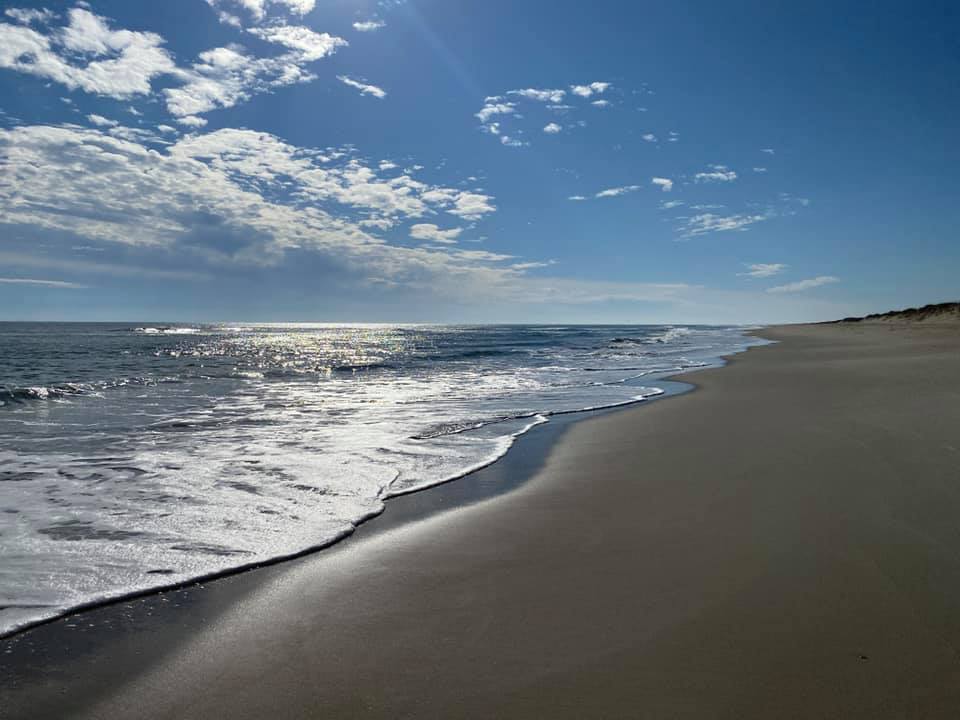
Afternoon sun on the beach at Ocracoke Island

My moments of awe:

Tundra Swan

On our way to the Outer Banks, we stopped once again at Mattamuskeet National Wildlife Refuge. This place feels like it is about two hours from civilization; indeed the closest grocery store is probably in Swan Quarter where the ferry docks. There are miles and miles and miles of driving the backroads of the Inner Banks where the only thing to count is roadkill. When we arrived at the refuge, it was socked in with fog. Roy and I were not hopeful that there would be many migrating birds which is one of the main draws in going. 

We arrived at the viewing deck and to our surprise there were hundreds of Tundra Swans and Canadian Geese floating in the marsh. The awe-inspiring moment came as I was filming the birds who were surrounded by fog. I could hear hundreds of swans flapping their wings and honking in flight but could not see them initially, until the fog slowly lifted and the swans appeared magically to land in the marsh next to the swans, who had arrived earlier, cooing lowly on top of the water. It was a ballet with the bright white flashing wings of the flying swans in formation and the low moan of cello-like base notes floating below. Awesome.

Ocracoke

The last time I was at Ocracoke island was about fifteen years ago when my children were young and we were headed for a visit with my good friend, Susannah and her family, in Avon. Ocracoke is a barrier island which means that the only way to get there is by ferry. The ferry starts in one of three very remote places: Cedar Island, Swan Quarter or Hatteras. The shortest ferry ride is from Hatteras, so Roy and I headed out and arrived at the ferry station in Hatteras at noon. We waited an hour to get on the ferry and then spent another 75 minutes on the ferry taking an absolutely crazy, circuitous route; I was a little worried we were headed to Swan Quarter instead of Ocracoke. 

It was overcast, it rained and finally, our journey was over. Upon our arrival to the remote island, the sun came out, as if on cue. We drove several miles on the spit on land between the ferry station and the town of Ocracoke. Roy pulled off along the Cape Hatteras National Seashore and I walked the boardwalk out to the beach. It was 2:30 PM in November and the place was desolate, high tide, and the sun was glinting on the water as waves crashed on the barren shores. We were alone on what felt like the end of the earth with nothing but 40 feet of sand between me and the North Atlantic. Nothing but crashing waves, a flying pelican and a shore bird meandering along poking the surf. There are these moments when you feel isolated yet part of something so much bigger. I could only stand there in awe and take it all in.

Sun

As Roy and I drove back from our return ferry in Hatteras, we were trying to time the sunset as we drove up what is the narrowest sliver of road called Highway 12. It is one of the rare highways where you can see the vast intercoastal waterway on one side the Atlantic Ocean on the other side. As we approached Rodanthe, we pulled off on the intercoastal waterway side of the road. There, surrounded by marsh and sand, we watched as the sun slipped below the surface and we faced the limitless water of the intercoastal waterway, knowing that there was the mainland out there somewhere but impossible to see.

The next morning, I woke up early to head out to the Kill Devil Hills beach to watch the sunrise. I was taken aback as I arrived at 6:30 AM only to find some twenty other hearty souls standing or sitting strewn along the beach waiting for the sunrise as well. We all faced the same altar – the East. Patient, quiet, communal, as we witnessed that instant where the red sliver creeps above the horizon to commence another day. Same sun, same barrier islands, same water and such continuity. Awe-some.

I need these moments as I have endured some nine months of isolation. Awe is available in isolation, it’s a matter of discovering it. It is seeking it out, letting it surface and accepting whatever shows up. What moments inspire awe in you?

Relationship Status with My Dog: It’s Complicated

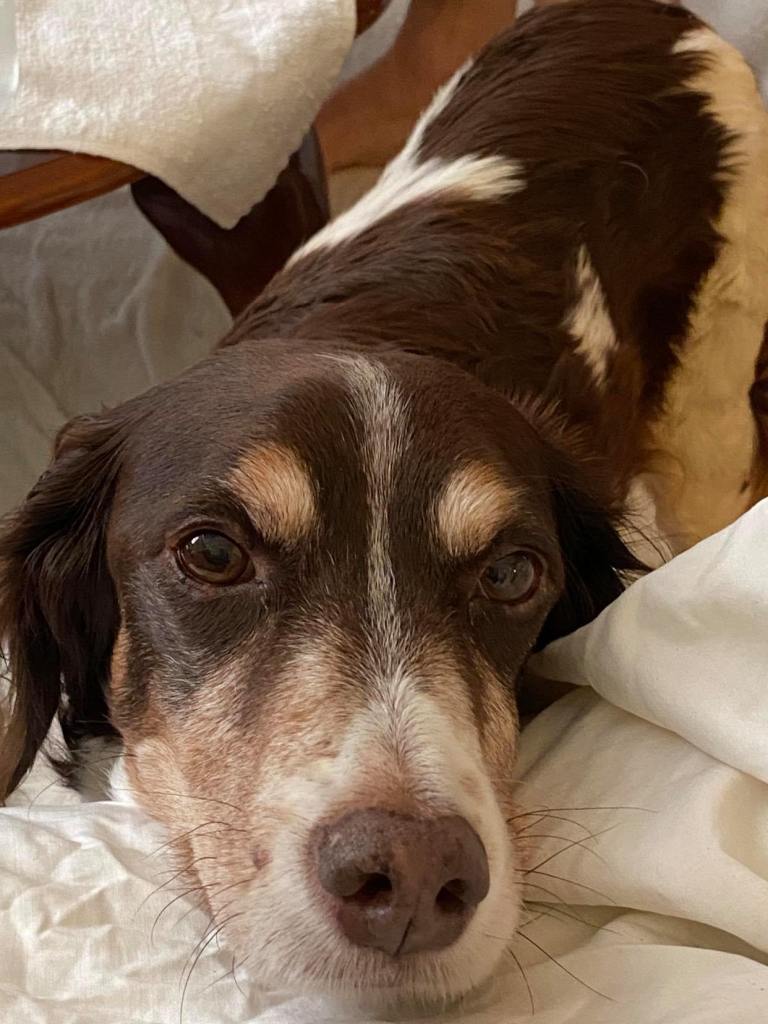
My beloved Brittany Spaniel, Baci (named for the Perugina chocolate) is 13 years old. In human years, that makes her a grouchy old woman of 91. She gets around really well for a senior citizen. She still loves to hunt a squirrel or, even better, a bunny rabbit. We’ve been together for all of her thirteen years. This relationship. This companionship. This love story has had some rocky sections and tests of patience (mostly on my part) but we endure.

My dog Baci

The many ways our relationship is complicated:

Houdini

When my family first adopted Baci from a breeder outside of Charlotte, we found it impossible to contain her. We had a crate but once morning came, she wanted out and let us know she wanted out. We tried keeping her in a bathroom and she would scratch at the door and bark for hours until we relinquished. At one point, we tried gating her on our back deck only to find she had escaped some ten minutes later. Finally, we purchased an invisible fence and the first day we left her outside, we came home to find her cold and wet by the mailbox (outside her territory). 

We’ve had mishaps since when her collar wasn’t working but for the better part of 12 years, she’s had free reign of her lakeside home. Typically, this resulted in me yelling out the front door, the back door, the garage door, checking her dog house and then, as if by magic, she would come trotting from around a blind corner. I wouldn’t know where she had been, but she was back and ready to come in. Fast forward to 8 weeks ago, and now she is constrained by an apartment; no way to go outside except to be attached to me. She loves me. I know she does, but she wants her freedom. Roy and I were trying to fit two mountain bikes in my small storage closet when Baci slipped out the back door. Panic ensued. I yelled. I cussed. She ran to the sidewalk and started barking at one of my neighbors, as I stormed toward her to grab her collar. I dragged her back to the apartment. I’ve tried to give her daily walks and weekend trips hiking but the majority of the time she remains a prisoner of circumstance. Locked up once more, she copes with her imprisonment and I remain her guard.

Surfaces

Baci has always had an aversion for surface changes. We put in a polished slate floor in the entryway of the house and she would not cross that new surface to save her life. It reminds me of the childhood superstition: “Step on a crack, break your mother’s back.” When we hike on a trail, she will come up to a surface change like a bridge over a creek and she will head down the embankment to cross the water instead of over the metal bridge. She does not like swimming in a pool or a lake. She can swim but she will exit immediately much like a cat.

There is a hysterical video from ten or so years ago with Baci bounding in about six inches of snow; she was unsure if she was mad at the white stuff or entranced by it. Now ensconced in the apartment most days for 24 hours in a day, she anticipates my every move. It’s 5 AM, Mom is going to the living room to mediate, it’s 6:30 AM and Mom will feed me now, it’s 7 AM, Mom is going into the office to work, it’s 10 AM, Mom will take me out for a walk, 11 AM and Mom will head to the kitchen and so forth. I see her anticipating my every move. She’s my guardian staying one step ahead.

Obsession

Baci can track and hunt almost anything smaller than a bread box. She will: obsess over squirrels tip-toeing across branches far above her head, stand for hours tracking a lizard under her dog house, bark incessantly at a cat a block away and spend an afternoon chasing a house fly. Roy refers to this as a prey drive.When we hike on a trail, all the smells of the woods overwhelm her. She unconsciously passes dogs and fellow hikers, transfixed by the odors of the forest. Now bottled up in an apartment, she searches out prey from open windows and barks at anything and anyone that moves. As she stands guard at a window watching me load or unload my car, she barks constantly as if to announce that she’s on duty and ready to kick anyone’s butt. She’s single minded while living in captivity.

Routine

I can remember when my parents lived in the in-law unit of my house. My dad had the same routine everyday and Baci knew precisely what that routine was. She would be two steps ahead of my dad through each door and footfall. My dad would always marvel at how “smart” she was although she really had just learned his precise routine and went in lockstep. Baci and I, in the last few years in the lake house, had our routines. She knew what time to wake me up, she would shake her head at 4:30 PM precisely for dinner and she always took the same route in the yard to give it the all clear. The first few months in this apartment have been a struggle. Several accidents in the apartment, barking in the middle of a conference call and grunting at 3 AM to wake me up to go out. I think we are both exhausted. Actually, perhaps it’s just me. I’m struggling to find the symbiosis we had just three months ago. I want to be in lockstep with her. I want us to know each other’s routines again. It’s almost like a dance, where we both want to follow the choreography but we keep running into each other; not out of spite but out of confusion. The dust is slowly starting to settle, and the rhythm is falling into place.

Baci and I are starting to find our groove in our new place. Sometimes I wonder how this would all be different if there weren’t a pandemic and we didn’t spend almost every waking hour together. But this is it. This is now normal and while I have been frustrated, as my insightful daughter pointed out on the phone the other day, “Mommy, the house was Baci’s only home. She spent her whole life there.” Baci really has been pretty resilient for a 91-year-old girl and it’s ok if our relationship is a bit complicated.

Are You Suffering from Time Poverty?

The most difficult part of this pandemic is that my day has no chapters, no boundaries. There are no bookends to my day. Traveling to work or to school or the daily arrival of my children home from school used to make a delineation in the day. There are the blurry lines of “Am I at work right now?” or “Am I on a break?” or “I’ll answer this one email even though it’s 3 PM on Sunday.” My days are one big smoosh of what feels like aimless work and yet at the end of the day I say to myself, “How was I home ALL day and I got NOTHING done?” This has been my excuse for months as I have barely written any new blog posts. I have been suffering from time poverty. I have plenty of time – I just have no idea where it goes.

I read an article from by Ashley Whillians on Ideas.Ted.com in which she wrote, “Time poverty is a serious problem, with serious costs for individuals and society. The data that I and others have amassed show a correlation between time poverty and misery. People who are time poor are less happy, less productive and more stressed out. They exercise less, eat fattier food and have a higher incidence of cardiovascular disease. Time poverty forces us to compromise. Instead of preparing a nutritious dinner, we grab chips and guac and munch mindlessly while staring at our screens.” Hmmm. It’s not just me that is sucked into screen time and feeling miserably unproductive. 

Here are some of the reasons I suffer from time poverty:

Technology

Whillians posits, “Technology interruptions break our hours into confetti.” I love that metaphor. Confetti. Light little pieces of magical colors that have absolutely no functionality and are a mess to clean up. That would be my inbox on 3 different email accounts, 4 different messaging systems and 2 different phone numbers. That is my technological confetti and I’m cleaning it up all day, every day.

Shawn Stevenson wrote, “Just being near your phone impairs cognitive performance. If we’re going to be empowered… if we’re going to be able to reach our potential in an increasingly distracted world, we MUST do some practical things to maintain control of our attention. This recent study uncovered that THE MERE PRESENCE of your phone can cause significant cognitive impairment. The researchers conclude that, even if your phone is not “dinging” with notifications, even if it’s face down, even if it’s turned OFF, your brain still has to use significant mental energy not to pick it up (whether we realize it or not).” Hence, in order to write this post, I put my phone in another room and shut down all apps on my laptop. 

Money

Whillians wrote, “Money does not buy joy. A culture obsessed with making more money believes, wrongly, that the way to become more time affluent is to become financially wealthier. We think, “I’ll work hard and make more so that I can afford more leisure time later.” This is the wrong solution. Focusing on chasing wealth leads only to an increased focus on chasing wealth.” I think it’s also a focus on material versus experience. This is tough in the middle of a pandemic. Why not buy a big television to binge on Netflix for the weekend or a freezer to store all my backup to the backup meals in case I get quarantined for two months? Amazon can get you anything you want in a matter of days, if not hours. Just because you can buy it, doesn’t mean you should. Time well spent is the new affluence.

Busyness

I can panic if I see that my schedule is back-to-back for the day and panic even more when my schedule gets freed up with a cancellation. I value the busyness and take pride in getting it all done in one day, taking the dog out, making dinner and setting up that long overdue dentist appointment while working all my meetings in flawlessly. Whillians wrote, “With our self-identity so wrapped up in work and productivity, the social appearance of being busy makes us feel good about ourselves. In contrast, focusing our attention on something other than work can threaten our livelihood and status. We worry we won’t be valued, and, in part, we are right.” I am trying to stop sending emails and texts outside of “normal” business hours. I’m trying to stop being part of the problem and not encourage the cult of busyness.

Future

I always think I’ll have plenty of time later. I plan and load up my Saturday with chores and errands. And when Saturday arrives the day evaporates into unplanned phone calls and a change in the weather. Whillians posits, “Statistically, the best predictor of how busy we are going to be next week is how busy we are right now. Our minds frequently forget this important point and trick us into believing we’ll have more time later than we do now. This overoptimism means that we become cavalier with our yeses, even with the small stuff we don’t want to do. We also want to say yes; we see it as a way to overcome idleness and feel productive, connected, valued, respected and loved.” I think of my Thanksgiving plans and the six recipes I was planning to make. Yes. SIX! For just Roy and me to eat. When the holiday was here, I kept thinking, what was I thinking? I don’t have time for all this. I ended up making three dishes and ended up feeling guilty that I didn’t get it ALL done. Plans change, the future is here, let it go.

One of the greatest gifts that Roy has brought to my life is the ability to rest. I cannot remember ever taking a nap since I was about four years old until hooking up with Roy. It’s not a daily thing but when we’re tired, he’ll suggest a nap. What a wonderful thing! A nap. No technology, no busyness, no planning, no cost, just a nap. Sometimes I sleep, sometimes I daydream, sometimes I am just grateful for the present moment. One antidote to time poverty for me is a deliberate break. What about you?

6 Things That I Don’t Need

I’ve lived in a house for over 30 years. From Albuquerque, NM to Windsor, CA to Goldsboro, NC. I am no longer a home owner. I am unattached to a mortgage, homeowners’ insurance, exterminator bills and landscaping fees. I am unencumbered. I now live in a 3-bedroom apartment with no garage, no yard and no lake view. In the process of moving I have discovered that, while I thought I had many mandatory requirements in the place I lived, I really can live without. 

Here are the things I can live without:

Garage

Every garage I have ever had has always been full of stuff. Stuff that I don’t need any longer or, perhaps, ever needed. Things like extra brooms, fly swatters, buckets, boxes, tile, storm doors, screens, rakes, mops, dust pans, kayaks, weights, life jackets, plungers, shovels, hammers, rope, garbage bags, cleaning solutions, and insecticide. Some items sat in the garage in a box for their entire life cycle; either not being found when needed or just never being needed again. I have taken on the idea often posited by The Minimalists:

               Anything we get rid of that we truly need, we can replace for less than $20 in less than 20 minutes from our current location. Thus far, this hypothesis has become a theory that has held true 100% of the time. Although we’ve rarely had to replace a just-in-case item (fewer than five times for the two of us combined), we’ve never had to pay more than $20 or go more than 20 minutes out of our way to replace the item. This theory likely works 99% of the time for 99% of all items and 99% of all people—including you.

So far, so good. I don’t have a garden that requires insecticide or shovels. At this point, the only thing in my storage closet is my mountain bike and a bird feeder. I have donated or given away everything else.

Side-by-Side Refrigerator

When I finally started moving into my apartment, it had a classic refrigerator with a freezer on top and no ice maker. I immediately decided I would purchase a new refrigerator until I went to Lowe’s and realized that the cost would be close to $2,000. Why exactly did I want a new refrigerator? I wanted an ice maker and an indoor water dispenser. I started calculating the cost of a new refrigerator (for just little ole me) and how much ice and filter water I could purchase instead of buying a whole new refrigerator that I would have to lug with me for the foreseeable future. I remember my sweetheart Roy coming over to look at the apartment before I was completely moved and he grabbed a cup and took a taste of the water out of the faucet, saying: “Tastes just fine.” I took a taste – it was just fine. I just saved myself $2,000 and purchased ice cube trays which, to date, I have not used the ice from. I don’t need a new refrigerator with all the bells and whistles.

Washer and Dryer

Yes. I did draw the line at going to a laundromat to wash clothes. Mostly because of the time saved doing it at home rather than sitting in a laundromat for 3 hours. But in the same trip to Lowe’s looking for a refrigerator, I looked at washer and dryer sets. $1,200. Again, do I really want to lug a super-duper washer and dryer set for the next ten years? No. I found a guy on Facebook Marketplace that sold rehabbed washer and dryer sets and he was willing to provide a 3-month warranty and install them. It’s a pretty old set and there’s no cute sound when the stuff is done but I have clean clothes and they were a third of the price.

Gas Range

I am a great cook. I love a gas range. I’ve either purchased a gas range for every home I’ve lived in or it already had a gas range. I knew when I went apartment hunting that the odds of finding a place with a gas range was going to be slim pickings. The truth is, now that I have been living with an electric range for two months and it’s not that bad. I just needed to adjust to not have a visual on the flame. Heat is heat. Heat cooks. I can still cook on an electric range.

Counter space

I went from about 12 feet of counter space to 2 feet of counter space. This, above all other things, has been the most difficult to adjust to. Everything must be put away. I cannot leave anything on the counter like a coffee maker or a toaster oven. Even a cutting board must be moved to the sink and washed before moving on to the next step in the cooking process. It has forced me to conserve space and steps in the cooking process. My stove top doubles as a cooling rack and holding space. It’s helped me be more creative.

Yard

My apartment complex does not allow anything to be attached to the outside of the building. There is no way to let my beloved, almost 13-year-old dog Baci run free in the yard. It also means I cannot attach a bird feeder to the overhang of the roof. It means that if it’s forty degrees outside at 3 AM and Baci wants to go out, I must suit up in my jacket and shoes and stay attached to my dog as she hunts for squirrels and rabbits or does her business. I admit it’s a real drag for me but I think Baci has suffered more from the lack of freedom to roam. It has brought us even closer and even as I sit here now writing, she is two feet from me sleeping on the floor.

I think back to my college years, where moving every 6 to 12 months was the norm. I never owned anything more than what could fit in a car or perhaps 6 boxes. It’s been cathartic to let go of so many things that have weighed me down for decades like used books, unused clothes, memorabilia and artifacts from failed relationships. I am boiling down to my essence. The things that really matter and it has been freeing.

Escaping on the Creeper Trail

It has been a tumultuous year for me personally. Sure, there’s a pandemic, toilet paper shortages, a confusing array of government programs to navigate and the isolation of being thousands of miles from my immediate family. But during this year, I am finally financially free of my ex and from the burden of taking care of my beloved lakeside home. Once I was moved into my apartment just miles away from my prior home, I really wanted an escape and my sweetheart Roy had the perfect solution: the Virginia Creeper Trail in Damascus, Virginia.

Roy and I on the Creeper Trail

As a thru hiker veteran, Roy is very familiar with the Virginia Creeper Trail as the Appalachian Trail goes through the middle of the tiny trail town.  In fact, right in the middle of town there is an entire side of a building painted with the bold letters: TRAIL TOWN USA. Roy had experienced riding down the Creeper Trail some five years ago and he had been riding his bike downhill for seventeen miles. I have to say that being newly reacquainted with bike riding in the last three years, I was pretty skeptical of sitting on a bike for several hours, regardless of riding downhill most of the way. But I was so focused on escaping the drudgery of unpacking and my dog’s anxiety with my new space (she’s newly attached to me anytime we go outside, i.e. not chasing squirrels at her leisure), I was willing to be uncomfortable for a few hours and get saddle sores from a bike seat.

My reflections of escaping on the Creeper Trail:

Rent bikes from an outfitter

Roy and I both have our own mountain bikes and figured we would take them to both save a few bucks and to be on a familiar bike rather than a rental. Thank goodness we changed our minds and decided to rent bikes instead. Carrying the bikes on the back of the car, dragging them in and out of a hotel room and being vigilant about whether they are securely stored is a drag. It was worth the extra $20 a piece to rent bikes and not have to contend with keeping track of our bikes on our three-day weekend vacation. There are at least five outfitters in Damascus that will rent you a bike and then carry you to the top of the trail in a van with a bike rack behind. They will even carry your bike up to the top of the trail. We went to Sundog Outfitter in Damascus, which is super convenient, because the Creeper Trail goes right by Sundog as it enters the town after the seventeen mile ride. No need to try and navigate returning the bike. The other advantage of the rental bike was an extra-large seat (don’t forget that seat, you’re on it for a minimum of two hours!) and they provide repair kits for free, in case any issues come up on the trail. 

The Virginia Creeper

The Virginia Creeper is the name of the train that ran from Abingdon, Virginia to Todd, North Carolina. The tracks were built in the 1894, mostly for moving timber and people in isolated far western Virginia. It was dubbed “The Creeper” because of the speed at which the train trudged up the mountainous terrain amidst sharp curves and rickety trestles; it went about 5 miles an hour. Eventually, the timber industry faded and the passage travel was not profitable. The last train ran in 1977. In 1978, the U.S. Forest Service purchased the right of way to build a hiking/biking trail that exists today.

Gliding down the trail

Sundog Outfitter took us up to Whitetop station on a beautiful fall day and we arrived around 10:30 AM. It was cold at the top of the mountain, and Roy and I set off down the wide 8-foot-wide trail with about twenty or so hearty souls. The top of the trail near Whitetop is pretty steep and it didn’t take long to figure out that brakes were about all I needed to know on the bike.

Roy stayed behind me as I started flying down the hill and I realized that there were no shock absorbers on the rental bike. The shock absorbers were apparently my arms. It is a bumpy trail and at high speeds (greater than I initially realized…gulp) I was pretty terrified in the beginning. I was torn between focusing on avoiding any large rocks, holding onto the brakes for dear life, passing other folks and trying to take in the spectacular fall foliage. I must say that the first fifteen minutes were a blur and once I was acclimated to the trail, the bike and my brakes, I finally was able to take in the experience. 

I think I have been waiting for this since first taking the training wheels off my bike at age 7. Gliding down a hill free of cars and pavement and barely any pedaling for almost three hours; covered by golden trees, gliding parallel to a picturesque river, and the smell of fall in the air while easily gliding through the air was a dream come true. It was wonderful.

Roy did not tell me how fast I was going until the trip was over. I think I had it in my head that I had to glide as fast as possible before the next uphill…which never came. It was a magical trip, almost dreamlike in its simplicity and its beauty. I pronounced at the end that we needed to make this an annual pilgrimage. I hope we do.

I almost felt with each bump, each change of scene, my recent traumas flew or melted away. It was nice to feel refreshed!

5 Steps Towards Compassion

I can get caught up in my own “stuff”. My own little corner of the world with my own little myopic view. Why isn’t everyone vegan, sober or trying to avoid sugar? I become that three-year-old stomping my feet wanting to get my way. If it’s raining, I want it to be sunny or if it’s hot I want it to be cold. The antidote I have found is to be compassionate.

marco-albuquerque-EyItxWgbefc-unsplash

I recently read Zen Habits: Handbook for Life by Leo Babauta. The book has a terrific list of habits to take on to make life less complicated. Somewhat similar to my own “102 Itzy Bitzy Habits”, it’s a simple approach to take on one or two small changes that can make a significant difference in one’s daily life. Embracing compassion is a mindset to let go of that three-year-old in your head who is having a tantrum. As Babauta espoused, compassion can be learned, developed and cultivated.

The Commonalities Practice, as outlined in Leo’s book, attempts to get us to recognize what we have in common with others, instead of our differences.

Here are the five steps to Compassion:

  1. Support others in their happiness

I can get fixated on seeking my own happiness without regard for others. It goes along with the expression, “Every man for themselves” or “Whoever gets there first wins!” Everyone wants happiness. The waiter, the flight attendant, the construction worker, my child, my mother, my boss, my ex. It’s freeing to accept that we all want it and there is no limit to the amount of happiness available. My slice of the happiness pie doesn’t diminish the amount left for someone (read: Anyone) else.

  1. Everyone experiences suffering

Suffering is universal. We are all trying to avoid it. We have many ways to try to numb out or stuff it or ‘walk’ around it and ignore it. Acknowledging that there is pain in everyone’s experience is humbling. It is the core of compassion. Everyone suffers just like me. Someone is losing their job, their pet, their home or loved one right now. We all want to avoid it but it helps to be surrounded by understanding others.

  1. Complete unseen altruism

Everyone has known heartbreak, been embarrassed, been dumped or cheated on. We all walk around with wounds on the inside unseen by most. The Tibetan practice of Tonglen is to take and receive someone’s pain. To figuratively breath it in. I believe what is so special about this practice is that it is not seen. It is a spiritual practice of empathy and compassion that is carried by the practitioner in their heart. Complete unseen altruism.

  1. Wish-list of desires

Accept that everyone has needs. We all have needs that are more than simply material; perhaps it’s recognition, acknowledgement, acceptance, peace, rest, presence, time, knowledge, friendship, or love. We all have a Wish-list of Desires that contribute to our happiness and well-being.

  1. Life’s learning curve

We all make mistakes and are on different learning curves. Your ex may be on a different learning curve which may have even precipitated your split or at least at a different spot on their journey. The thing is that we all have to live and learn at our own pace. We are all on our own path. I don’t want to see anyone fail, especially those I love; but fail they must. It’s the only way we learn. And it’s incumbent on me to understand and support those I care about.

Remember, you can use these phrases as a prescription for compassion.

Silently repeat these 5 phrases to yourself:

  1.  Just like me, this person is seeking happiness in his/her life
  2.  Just like me, this person is trying to avoid suffering in his/her life.
  3.  Just like me, this person has known sadness, loneliness and despair.
  4.  Just like me, this person is seeking to fill his/her needs.
  5.  Just like me, this person is learning about life.

We have a lot in common. Sure, there are things that divide us but at the base of it all is the need for compassion as a way to love ourselves and others. So the next time you are angry and need to get centered, think of the words “just like me” and see if it opens your heart.

No One Outside of You Has Your Answer

This is a repost from 2017. Enjoy!

No one outside of you has your answer.

This was the prompt for Day 114 of the Project 137 by Patti Digh. This idea really sets me adrift, like someone put me in a rowboat without oars and cut the towline. Go figure it out, Cathy. I feel like I have measured myself my entire life by living up to other people’s expectations; other’s dreams and wants. This comes down to me and what I want. My expectations of myself. Gulp.

I run into folks who are either followers or are curious about this blog. This is my sanctuary to work things out. My colander to strain out the unnecessary to find the good parts. I gave my card to someone at a conference last week and she asked about the blog. I said, “It helps me work out my stuff.” The hope is that the byproduct of me working out my stuff is that someone else gains some wisdom or thought-provoking question that propels them forward. But really, at the heart of it all, is me working out my stuff.

So here are some insights of looking inward:

  • Shoes. No one else really walks in your shoes. And I don’t really walk in anyone else’s shoes. I can make assumptions about a loved one’s journey or what my colleague aspires to or if that mystery man is unattached. While I can identify with someone else, I really can’t live in their shoes and they really don’t know what it’s like in my shoes. They probably don’t even know my shoe size! So, the answer is taking care of your shoes and throwing out the ones that don’t serve you anymore. I recently decided to hike Machu Picchu this summer. I will need new boots and will have to break them in. That answer is in me.
  • Advice.  I have spent the last month grilling friends and family about the fate of a huge financial decision. I sought advice from almost every trusted resource I have. It’s fine to get advice. To be informed. To find a devil’s advocate. To weigh out all your options. I feel really good that I have heard all the pros and cons of my next move. I’m glad I have trusted friends and family to confide in. In the end though, it really comes down to me. I need to make the decision. The answer is in me.
  • Faith.  I realize now that serendipity is always conspiring to help me. The Universe is in my corner and some pieces have fallen into my lap to help me forward; actually leaps forward. As they say, “Let go and let God.” So while I was gnashing my teeth in worry and fear, I learned to embrace the idea that there is a greater plan and I am at the center of that plan. It is freeing to release the pain of fear and uncertainty and know that, if I have faith in myself, the Universe will conspire to help me. The answer is in me.
  • Willingness. As Benjamin Foley writes for Medium, “Wisdom, in my opinion, is the willingness to live the questions of life with an acceptance of no immediate answer. In a world of immediacy, this is a difficult accomplishment, but one that is enormously important if you are to create anything of value.” As my trusted friend Janine says, “You don’t need to make a decision until you need to make a decision.” This means I need to be willing to be patient. Not my strongest suit, but knowing that the decision will appear before me, when it is needed, is powerful. The answer is in me.

I have said over the past year that “you can’t push a rope.” What will be, will be. Trust your intuition, listen to your gut and find the answer in you.

My Beginner’s Guide to Hiking the Appalachian Trail

This is a repost from 2018 when I hiked a section of the Appalachian Trail:

This is actually the over fifty’s guide to backpacking on the AT. For me, it’s actually a guide to returning to the woods after forty plus years. I have hiked a multitude of places, from Mount Saint Helena in Napa, California, Tent Rocks in New Mexico and Machu Picchu in Peru. None of those hikes were with a twenty-pound backpack. They were all day hikes, rather like a scenery stroll. And they all ended where I was sleeping comfortably in a cushy bed with running water, a flush toilet, and a solid roof over my head. The last time I had a backpack on was when I was at Camp Merrowvista in Ossipee, New Hampshire and I was sixteen years old. Things have changed. More importantly, I have changed.

45415072_277551429561820_681331862123053056_n

My boyfriend Roy attempted hiking the entire Appalachian Trail in 2015. If you are unfamiliar, this is no small task. It can take upwards of five to seven months to complete the 2,190 miles from Springer Mountain, Georgia to Mount Katahdin, Maine. Roy made it 531 miles before a medical issue derailed his attempt. This lent me the desire to experience the allure of the trail.

Here are my findings:

Water

This is a whole different ball game when it comes to backpacking versus day hiking. Though towns are close to the trail, it isn’t the point to hike and drop back into civilization. There aren’t handy convenience stores, faucets, or water fountains out on the trail. Carrying five to ten days of water is not feasible. Roy bought me a Sawyer Mini Water filter about a month before we went backpacking. I threw it in my closet and figured I’d be carrying my water with me. Nope. Water is the heaviest item you are carrying, so you should try and keep enough for one day. Make sure you know where the springs or water sources are along the trail. It’s not like a road trip, where you can stop off at the next exit to refill on water and use the restrooms! We had several empty water bottles to help filter from our bladder bags when we refilled at a water source on the trail. We were fortunate that the water source was a cistern on the trail versus a spring along the trail. It would have been a process and a lot more time consuming to retrieve water from a natural source. Sawyer filtration systems are very easy to use and are highly recommended by practically every A.T. thru-hiker. Don’t leave home without a water system at the ready and located water sources.

Guide

I was fortunate to be guided by a seasoned hiker like Roy. He knew that we needed the most recent A.T. Guide Northbound 2018. Roy had ripped out the page we needed for our hike. It showed the elevation, the location of the shelters, and water sources along the route we were taking. If we didn’t have the guide, it would have been impossible to know where the next water source or shelter might have been. You wouldn’t go on a road trip without a GPS or paper map. Make sure you have one that is most up-to-date before you head out. On the A.T., the white blazes on the trees and rocks are your guide. However, there are blue blazes (indicating a trail to a water source or shelter) and double white blazes (indicating some type of change coming up, such as a fire road crossing) as well. These indicate when you are off the main trail or if there is a change coming up. You might wonder why you need the most updated guide for the trail, but there are changes each year as trails become rerouted due to damage or are remeasured by volunteers. In contrast, my previous day hikes were trails that were heavily marked with frequent mileage indicators. The A.T. has very few signs, so the guide is invaluable when heading out. I found it frustrating, in retrospect, that I didn’t know whether I had walked a half mile or not. Most day hikes have a lot more signage with progress indicated along the way. It would be very easy to get lost rather quickly if we didn’t stick to the white blazes.

Clothing

My daughter Natalie is an experienced backpacker, as is Roy. Both kept warning me about not having ANY cotton clothing on the trip. Cotton will absorb sweat like a sponge and will not properly insulate. Boy, am I glad I listened. I opted for everything to be nylon or polyester, except for my wool socks. I tried a few shirts on that were merino wool but that particular material irritated my skin. In my practice hikes, I tested out several sets of shirts and pants to make sure nothing rubbed against my backpack. I cut every tag off every piece of clothing that I took with me. I get aggravated by anything rubbing against my skin. I didn’t want to be looking for a pair of scissors two miles in. I had a total of three (yes, three) jackets. One rain jacket for rain and wind. I started off the hike wearing a jacket since it was 40 degrees and windy at the start. I also brought a fleece jacket, which I changed into once the wind died down, as it was still cold. Finally, I wrapped myself in a puffy down jacket at the actual campsite since I was no longer exerting myself as much and needed to retain my body heat. I had a base layer under my hiking pants, which I kept on the entire trip to stay warm. The only thing I didn’t wear that was stored in my pack was my extra underwear. So my entire list was three pairs of wool socks (one for each day hiking and one pair to sleep in), two pairs of underwear, one short sleeve shirt, one long sleeve shirt, rain paints, convertible hiking pants, base layer pants (long johns), sports bra, bandana, buff, wool hat, cap, fleece jacket, rain jacket and down jacket. My advice is to try them all out with your backpack in different temperatures and weather conditions. Being as comfortable as possible is key.

Food

I figured that I would be starving the whole time we were backpacking. I’m not sure if it was nerves or exhaustion, but I ended up not eating that much. We had some peanut butter crackers, trail mix, and oatmeal bars. I think it’s easy to overthink and over-carry on food. We probably brought back about half as much as we started with. But gratefully, nothing went wrong on the trip. If we had been stranded for some reason due to injury, we would have needed all the food. We cooked a rice package for our only dinner on the trail and didn’t even bother cooking the ramen we brought. Having a hot cup of tea at the end of a daylong hike in our campsite was restorative. Coffee, the next morning, when it was 38 degrees was important as well. There is something about a warm beverage that makes everything feel better. Before you head out, make sure you’ve tested your burner and cookware. I’m not sure I would have been able to figure it out on my own in the waning light of day. Warm food makes a huge difference out on the trail.

Light

I had a light attached to the end of a cap for my entire trip. I knew where that hat was whether it was in the tent, in my pack or on my head. We hiked at the end of October and the sun was setting around 6:30 PM. I did not want to be stuck hiking, eating, finding water, or unpacking my sleeping bag without a light. It was critical to be able to see at night, especially when trying to go to relieve yourself. There were warnings about black bears in the area and being aware of my surroundings was critical. Have a light and know where it is always.

There are more must-haves like a backpack, tent, sleeping bag, and air mattress. Trekking polls were invaluable as well. If you take anything away from this at all, test out everything you are planning to take with you in as many ways possible. You don’t want to find out five miles into your trip that your hiking shoes are uncomfortable, your backpack is too small, or that the tags on your clothes won’t stop rubbing your skin. When you head out backpacking, you have your entire life on your back. Thankfully, we only went out for a two-day hike, but getting the right combination of necessities can make the difference between a miserable and wonderful hike. Make sure you have the right basics for you.