😎It is Not My Only Line in the Play

I heard this quote at a conference in October. It really put things into perspective. We have a lot more shots at a goal than we imagine. I think back to grade school theatrical productions and not wanting to flub the one line I was given. But in reality, we have a ton of lines. For that matter, a ton of plays in life. I can get wrapped up in perfection in the job interview, or the presentation to the board, or the first date. It’s freeing to realize there are a lot of opportunities in life and it’s grand to not get wrapped up in the perfection of your next line in the play.

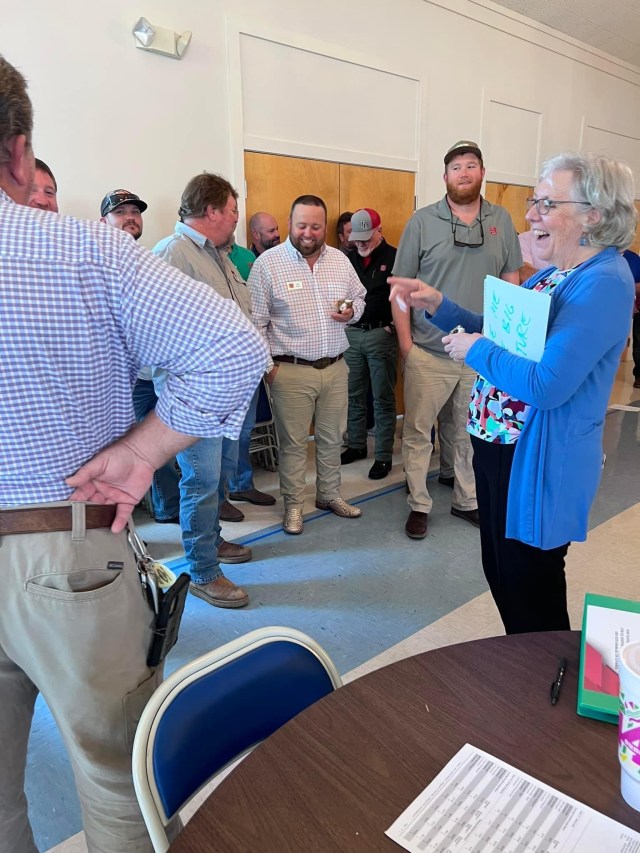
A recent facilitation for Daniels and Daniels Construction

I can relive conflicts in my life where I have an epiphany about what I should have said. The perfect comeback. The perfect redress. The perfect reparation. Finally putting someone in their place, and yet, the opportunity is long past. I can live in a loop in my head about how I should have played the situation differently. It takes energy. It zaps me. It’s completely unproductive. It was only one line.

So here are some ideas on how to move on to the next line in the play:

Piece it out

I facilitate a bunch of different trainings. They can range from Ethics, Sexual Harassment, or Human Resource Certification. Sometimes I present about CRR Global’ s “Lands Work”, Gallup’s Strengthsfinder, DiSC or Leadership Retreats. The thing is, when I first started facilitating, I would get completely caught up in the three upcoming events I had scheduled. I’d be worried about the one in three weeks when I was prepping for the one tomorrow. I would be overwhelmed and not sleep well. The secret is to focus on the next project. The next training. The next coaching client. By piecing it out to one project or event or client at a time, I can focus, be calm and better prepared. Focus on the next line in the play.

It’s about them

Delivering a line or a song or a presentation is all about the audience. Moving off of my own ego and onto the group in front of me is lifting an enormous burden off my shoulders. It’s not worrying about if I look fat in this outfit or if I can get a laugh out of the room. It’s delivering one piece that helps someone in their day. When you focus on them, it becomes a service. It makes it easier. I know that can seem like a lot of pressure but if I go into a room of two hundred people wanting to impress them all, it’s overwhelming and sure to fail. If I go into that same room with the intention to impact just one person’s life, it’s much easier. If it helps more than one person, terrific. If everyone gets it and loves the presentation? Even better. But the goal remains all about them.

$hitty first draft

Practically everything I facilitate, coach, or write is a first draft. I try not to overthink things. Granted, I have an editor for my blog, but the rest of what I deliver is on the fly. It’s in the moment. I’ve said some dumb things; I’ve said some witty things; I’ve said things I want to completely forget about (and usually don’t). Aren’t most conversations in life just $hitty first drafts anyway? Let go of perfection and be in the moment. If you mess up this line, there is another line coming up.

Be present in the moment

I’ve spent a lot of time rushing ahead. Planning. Mapping things out. I can be exhausting to be around. I can also spend a lot of time dwelling on the past. The Monday morning quarterbacking type stuff that is just as debilitating. The important thing is this moment right now. I facilitated a new group a few weeks back. I had never worked for this organization before. There were a bunch of unknowns: the audio visual; wall space for flip-charts; seating arrangements for the table. That’s all just flotsam. The real object is being present for the people in that room. It’s being present to tease out the wisdom in the room. It’s letting other folks shine their light for everyone else to benefit. If I’m more worried about the perfect room set up and refreshments, I’m not present for those in the room. So maybe you have to adjust the line in the play to fit the group in the room. Be present so you know it.

Be silent

It’s OK to be quiet. Not everything has to be filled with words. Time for folks to reflect is super important. Time for you to reflect is important as well. I think back to my first date with my ex. There was plenty of silence. I was OK with not filling every moment with language. I remember becoming certified to deliver a Myer’s Briggs facilitation. The instructor told us to wait 20 seconds after asking the group a question. Count out twenty seconds in your head.  Go ahead.                It’s an eternity, right? It’s an adjustment to be OK with silence. You don’t need to have language filling the air at all times. Give everyone time and space to reflect and digest. Some of the most profound moments in a play are when it is silent. Think back to all the pregnant pauses in a Hitchcock film. Rear Window would not be as griping without the silence. Silence can be powerful.

At the heart of all of this is just being authentic and present for as much as you can. Give up the need to know how it’s all going to end up. Every play is going to be different. Every line you deliver will have a different impact. What’s your next line in the play?

🙌 5 Tricks to Connection and Creativity

I recently read an interesting book by Gabriella Kellerman and Martin Seligman called Tomorrowmind. It’s a thought provoking book that looks at thriving at work with resilience, creativity and connection. Since I spent a good deal of my time coaching others, many of the tips resonated for me. They posit that we are naturally better at hunting and gathering and that every other kind of work is fundamentally a mismatch for our brain. 

As Kellerman and Seligman wrote, “Today our work is fast, uncertain, and full of complexity. We’ve come to expect that the challenges of next week will eat those of this week for lunch. Hunters and gatherers didn’t have to deal with that. The critical changes they saw were sudden and urgent, so our brains register change as threat. A huge part of the challenge of thriving at work today is overcoming the mental patterns that made sense for hunter-gatherers but no longer serve us today.” I can feel like I’m on high alert all week and yet, I’m never going to be eaten by a lion or the marketing department. The book looks for ways to cope with this mismatch.

Here are 5 tricks to connection and creativity:

Time Famine.  It frequently feels as if we don’t have enough time. Feeling like you have little time is detrimental to connecting with others. I can remember our weekly staff meetings at a company I worked for and the first half hour was spent talking about sports and events from the weekend. It was time to connect.  I remember thinking it was a waste of time but now I see that it was bringing about connection.  In a study called “Giving Times Gives You Time”, they found that, “Doing kind acts for others, even just for 15 minutes, converted people from time famine to time abundance.” When you feel behind think about ways to do something kind for others.

Connection Time.  Human beings are really bad at estimating the time something will take. Whether it’s goal setting or how long it will take to make a bed, we are woefully inaccurate.  As the authors wrote, A host of studies have been done looking at how long it takes for doctors to make patients feel seen and heard and cared for. It turns out to take less than one minute of kind words for a doctor to connect with their patient deeply enough to influence health outcomes and lower patient anxiety. Even increments as short as 10 seconds can make a difference.” Don’t we all have 10 seconds to connect? Some examples are, “It was so nice to catch up with you today. Let’s please do it again soon.”—three seconds. “I really admire how you navigated that question.”—two seconds. “I can tell you worked hard on this. Thank you for all of your effort. I’m so glad that we’re in this together.”—five seconds.” Spend time connecting.

Novelty. In order to build on your creativity, work in some novelty into your day.  Shake up your morning routine, drive a different route to the grocery store or work, or reach out to someone you haven’t talked to in a while.  A friend of mine that I haven’t spoken to in a while sent me a text about meditation a few weeks ago.  Out of the blue.  It made me think about my meditation routine and also introduced a new book for my reading list (Who knows? I might end up writing about it here).  Novelty introduces new pathways for your brain. I think this is why I like to travel so much, finding new experiences enhances my creativity.

Embrace Ambiguity. This is definitely a barrier for me.  I put off writing this piece for a while because I can feel uneasy about getting started if I can’t picture the whole thing in my mind.  This is a cornerstone of procrastination.  I want to see the whole thing and get it done in one sitting.  That, unfortunately, is rare and difficult in the current state of technology and the world.  As they wrote, “The murky uncertainty of the early phases of the creative process can feel uneasy to some of us, and we want to end them as quickly as possible. But when we shortchange the divergent parts of creativity, we put a ceiling on just how imaginative our solutions can be. Know that it’s normal to feel a little uneasy in ambiguity, but you can get used to it and even start to enjoy it. Try stretching this ambiguous phase just a little bit longer each time you hit it.”  I know it sounds painful to me.  Sitting in discomfort can be the mother of invention. 

Creative Confidence.  Henry Ford famously said “If you think you can, if you think you can’t, either way you are right.”  In the book Limitless by Jim Kwik, he writes about creating a limitless brain and practically every step starts with the belief that you can.  If I went around saying I have a bad memory….well…I’ll have a bad memory.  My body, my brain are feeding off each other.  If I walk around saying I can learn to improve my memory, I will. Think about the language you use in your head.  Catch yourself and others when they spark innovation even in the smallest of ways.  Create creative confidence in yourself and others.

I love that throughout the book they refer to the whitewater world of work.  It can really feel like we are running rapids all day and these are terrific ideas to expand your time and enhance your creative juices.  Which one will you try first?

🤔Ways to Quit Asking Why

I was the member of a Mastermind Group about ten years ago.  It was a terrific experience working with Human Resource professionals from different industries around the Raleigh/Durham area.  I always remember one of the ground rules for Mastermind, which is a group of like-minded professionals who discuss confidentially current issues in their job or business and meet on a regular basis. The ground rule was to not ask Why. I remember thinking that that seemed odd.  After all, haven’t I been asking why since I was about 3 years old?  Seems like an obvious, simple question to get to the bottom of an issue or problem.  But think about it for a moment when I ask you the following questions:

Why?

Why are you late?

Why are you early?

Why are you on time?

Why are we going?

Why is it hot?

Why haven’t you?

Why won’t you?

Why don’t you?

Why is that there?

Why don’t you just…?

How does that feel?  I know it makes me feel defensive and diminished. Like I belong on a stool facing the corner in my kindergarten class.  Is this really how I want to treat people? It can be interrogating, demanding, confrontational and judgmental all at the same time. It focuses on the problem instead of insight and solutions. What about some alternatives?

How to quit asking why:

Describe the situation.  Let’s say your employee is late with an important project.  Instead of asking “Why is this late?”, you could ask:

Tell me about the timeline for this project.

How did this get off track?

What were some obstacles you had to deal with?

What were the circumstances that led to this situation?

You are more likely to get better insight into what is causing delays for the employee that you may not realize; and be more proactive towards solutions going forward. This tests your assumptions and can open your eyes to the whole situation.

Getting unstuck. Let’s say your employee rarely seems to make progress on one aspect of their job like sending in status reports or proofing their work.  Instead of asking, “Why haven’t you completed the reports?” Or “Why don’t you check your work?”, you could ask:

What have you tried so far? 

How did it go? 

What is getting in the way? 

Who could help you? 

What other resources do you need? 

It’s important that this doesn’t open the door to you, as the boss, to take over.  It’s more about discovery for your employee to find ways to get unstuck. Instead of you prescribing the answer. 

Look for understanding.  What can be loaded into “why” is implying that the employee isn’t good enough.  Like, “Suzy finished on time so why didn’t you? “Or “Joe’s slideshow had 50 slides, why did you only have 10 slides?” This is loaded with blame and makes the employee feel less than.  You could ask instead:

What was your thought process…?

What other options have you explored?

How did you arrive at this decision?

Tell me more.

Tell me about that.

It’s important at this point to sit back and listen with an open mind and curiosity.  Frequently, if we are a new leader or new to the organization, we feel like we need to have an answer and solution for everything instead of looking for the wisdom in those that work for us.  

As a coach, I really try to steer clear of Why, and a little bit of shorthand for me is to ask either, “How” or “What” or “Help me understand”.  How about you?  What do you use in place of Why?

😌5 Steps to Hitting the Pause Button

I find that the holidays are a time of Absolute Overwhelm.  Making sure I have purchased gifts for the family equitably (like we all sit there with a calculator on Christmas morning), prepared joyful cards and letters for delivery before year end, made sure the holiday menu includes all the family traditions (Caramel Bubble is a Christmas morning must have), arranged travel home and back for my kids, find the tree and getting it decorated after Thanksgiving… is overwhelming.  The time between Thanksgiving and Christmas makes me feel like I’ll still have turkey leftovers on New Year’s Eve.  Whew.  Time to hit the pause button.

In Tara Brach‘s book Radical Acceptance, she recommends the “Sacred Pause”.  This is a break from constant striving.  Isn’t that the American way?  To constantly strive.  Who has time for a pause?  You do;  especially this time of year.  Have you ever woken up on New Year’s Day and wondered where the holidays went?  That means you never paused.  Take in the moment.  Drink it up.  Take a break and be present.

Here some ways to hit the pause button:

1. Stop. Stop what you are doing. Put down the dishes.  Stop liking on Facebook.  Get out of your inbox.  Put your phone on the charger and walk away.  Close out all the windows on your desk top.  Turn off the TV.  Don’t try this while driving, unless of course, you are not the driver.  Just stop.

2. Space.  Find a space to be.  Sit in your favorite chair.  Stand at the window.  Lay down on the couch.  Go for a walk outside.  Sometimes a complete change in environment or temperature can help break the spell.  If you are outside raking leaves, you might want to go inside.  If you are inside and have been sitting at your desk for two hours straight, you might want to go outside (this may require a jacket and gloves…use your best judgment).  Be in your space.

3. Eyes. Close your eyes.  When our eyes are shut, it’s so much easier to reconnect with ourselves.  It turns on our other senses.  You smell the coffee.  You hear the wind outside or the hum of the light bulb.  You feel the temperature of the room or the gravity of your feet against the floor. You taste the sourness of the orange juice.  Shutting your eyes turns off the constant barrage of information.

4. Breathe.  Take some deep breaths.  Feel your chest rise and fall.  Feel the air come in and out of your nostrils.  Feel your body soften as the air leaves your body.  When I find my breath, I become centered.  Present.  There is no grocery-list-making when you are focused on your breath.  Just breathe.

5. Inhabit. Tara recommends inhabiting the pause.  I love that image.  Inhabiting the pause.  Living in yourself.  Being yourself.  I invariably feel tension in my shoulders.  I concentrate on letting go.  Release the tension.  Let go and inhabit the pause.

Find a time to hit the pause button.  Before you take a shower, head into that meeting, decorate the tree or bake your sugar cookies, find a time to just pause.  Don’t wait till New Year’s Day and find the holidays are gone and you never just connected with the moment.  Do it now.

😇Angel: My Inflection Point

In 1989, I had been married for five years, toured South America with my Colombian husband, Orlando, we had recently purchased our first home and I was working in Sonoma County, California as a restaurant manager. If someone was looking from outside our marriage, you would think it was a good time to have a child. I was pretty intent on my career and wanted to rise to the position of General Manager at the time.  Out of the blue (and completely unplanned), I found out I was pregnant.  We had been using the rhythm method for birth control but regardless, Orlando assumed that I had been unfaithful (in hindsight this is a harbinger of his own infidelity) but I was astonished that he would accuse me. So, there I was 28 years old, pregnant with an unexpected child and a husband who had immediately suggested I get an abortion. This was incomprehensible to me.

I was very fortunate that my parents lived a few miles away from our 3-bedroom home in Windsor. I decided that husband or no husband, I was having this baby.  I had always wanted to be a mother.  Orlando must have come around to the idea because he ended staying and we soldiered forward into this new uncharted territory.  There were all the prenatal visits, the ultrasounds, and the sound of the heartbeat of my growing child. At about sixteen weeks, I started wearing maternity clothing and announced to my co-workers that I was expecting. In the state of California, it was mandatory to have an AFP test along with other prenatal tests.  I was surprised at about 18 weeks of pregnancy to receive a phone call that my test was abnormal and that I would need a special ultrasound at the Kaiser hospital in San Francisco (about an hour away).

My mother and I vividly remember that car trip to San Francisco.  Orlando was studying for his citizenship exam and we quizzed him on the thirteen original colonies and the constitution.  I was pretty confident that it must just be a false positive and that the ultrasound was just a formality. As with any prenatal ultrasound, I had to drink plenty of water beforehand, so by the time we arrived for the ultrasound, I was bursting to go to the bathroom and I recall having the first symptoms of high blood pressure. I remember having to walk up a hill (no surprise in San Francisco) but I had to stop several times and I started to see stars (just like the cartoons of my youth). 

I remember being in a dark room during the ultrasound as slowly more and more doctors came in to view the ultrasound.  Did I mention that this was my first pregnancy?  I had no idea what was on the ultrasound.  I couldn’t make out a thing. No one was speaking. Fortunately, they let me go to the bathroom before they brought my mother, Orlando and me into a small consulting room. They said that the placenta didn’t have enough amniotic fluid and that the fetus was not normal.  It’s all a blur in retrospect but they said they could try and add fluid to help the fetus develop although in all likelihood that if I kept the baby to term it would need a lot of care. And there was the issue of my blood pressure which was 200 over 120.  There was no way to know if I would survive carrying the baby to term. Mike drop.

I remember sitting there calmly asking questions trying to get my mind wrapped around the situation.  Tears were rolling down my face as I tried to weigh out the options based on the information they had at that moment. They needed to take blood for an HCG test which, if it was astronomically high, would point to a partial molar pregnancy and would indicate that I would have to end the pregnancy. My mother was a retired medical technologist and she warned the doctor to be sure to dilute the sample.  This in retrospect was very important as it quickened accurate results. From there, they sent me home.  Home to uncertainty as what was coming next.

The test results made it clear that it was indeed a partial molar pregnancy. This was before Google and WebMD. I do know that they told me that it was one in a million pregnancies.  As I researched this today it’s .0005% of pregnancies.  This arises at fertilization when two sperms implant one egg.  Instead of 46 chromosomes, the fetus has 69.  I remember having to wait a week until we traveled back to San Francisco for the surgery to end the pregnancy.  Kaiser had to find a specialist to do the procedure and they brought a doctor from Stanford who had performed this delicate surgery for this extremely rare condition.

When I was admitted it was in September of 1989.  At the time the Supreme Court had narrowed the rules of Roe v Wade in July of 1989.  I remember asking the resident who was inserting laminar tents (dried seaweed used to expand the cervix), if this procedure was still legal as I was then 20 weeks pregnant. He said it was but that he would do it regardless to save my life.  I don’t think I realized how serious my condition was up until that point. 

Right before the surgery, they told me that there was a chance I would lose my uterus and my ability to have children in the future. A horrendous turn of events from an unexpected pregnancy, to a wanted pregnancy to having no choice but to give it up and potentially, my ability to have children in the future. There was also the outside chance, I would lose my life.  The most poignant moment was my husband crawling into my hospital bed the hour leading up to the surgery. 

I remember waking from the surgery and only being concerned with still being able to have kids.  Fortunately, my uterus was intact but it would take a year of birth control and testing to assure the doctors that I was ready and able to safely get pregnant. There I lay in a step-down unit for a week. 

Post surgery, my husband and I escaped to the east coast to visit family and friends.  There in Jamaica, Queens was my newborn nephew, my husband’s brother, Oscar’s child, Jackie.  My mother-in-law could not understand why I didn’t want to hold the baby. It was so painful.  The last thing I wanted to be around was a newborn baby.  I held that guilt for many years although I am happy to say that Jackie is a terrific adult and cousin to my children and doesn’t bear any scars from my rejection. 

Perhaps because partial molar pregnancies are so rare, or my own ignorance, I never marked the date of the loss or gave the baby a name at the time.  A grief counselor called me about a month after the loss and I was just trying to shut the whole experience out of my life.

It was about thirty years ago when I finally named that child who never had a chance.  Their name is Angel because the sex was not able to be determined.  I have a Christmas porcelain ornament with a cherub looking up to the sky.  That’s my Angel. I light candles in churches all over the world for that Angel.  I learned that grieving Angel’s loss was an important step in my recovery from alcohol.  To sit with the pain of such a heart wrenching decision and to let grief take over and then, slowly, evaporate over time. I grieve the potential of what would have been a 34-year-old sibling to my two children.  The greatest gift that Angel gave me was the clear desire to be a mother and the knowledge that I can love something so deeply.  I will carry Angel in my heart for a lifetime. 

Dogs, Pink Jackets and Lessons on Leadership

This originally published in 2013 and my beloved dog, Baci, has since passed away but the lessons still resonate.

Dogs are amazing at reflecting back what humans’ desire.  Most of us treat our pets like they are part of the family but I think my dog, Baci, thinks that she is an employee and a damn good one.   My relationship with her has taught me as much as any off-site training or college course.  Our relationship is simple and can guide you in your relationships at work.

My dog Baci in her pink jacket.

1. Trust. Baci expects her meals to be timely and fair.  She’s the first one to speak up if the kibbles are late to the bowl.  My employees and customers expect the same when it comes to compensation, goods or services. You better be on time and accurate or there will be attrition.

2. Appreciation.  There isn’t a dog who doesn’t demand their belly scratched once, twice, countless times a day. Your coworkers, boss or clients want the same “scratch” but I doubt they are up front about asking for it. Show them appreciation and more frequently than they expect.

3. Dutiful.  Baci has very clear duties at the Noice House, keep it free of all squirrels, geese and lizards.  She does an outstanding job. I am confident that she is on duty no matter what.  We haven’t had squirrels take up residence, so I know she is on top of her game.  You should have the same confidence in those who surround you at work. It’s best to assume they have your best interest at heart; that they are looking out for you. If some squirrels move in, then clarify what your expectations are.

4. Perspective. Baci has a different lens. She views things from ground level. I might be cutting up pizza on the kitchen counter or potting a plant.  She doesn’t care except for whatever falls on the floor and hopefully it’s the former. Your clients, cohorts and boss all have a different perspective and some are from the penthouse and others are in the basement. Make sure you know their perspective if you end up dropping something.

5. Attention.  I admit that I lose sight of Baci’s priorities when I’m in my office concentrating on work.  Sometimes I get up from my desk to find her sprawled at my feet and surrounded by her army of toys. She has carefully brought each toy as a gift while I wasn’t paying attention. Are your direct reports doing the same? Showing up early, staying late, working extra hours on that overdue project…are you paying attention?

6. Needs.  Baci is exasperating at times. She can’t decide if she wants in or out, to sit on my lap or on her “princess” chair; upstairs or down. Are your clients fickle and difficult to figure out? Are they changing their minds and causing you frustration. They are taking the cue from your guidelines and how malleable you are (I give in easily on letting Baci in or out). Are you meeting your clients’ needs or tuning them out?

7. Team player.  I love to dress up Baci.  And she is happy to oblige (ok…I’m not sure she’s happy). Whether it’s some Halloween monstrosity or a pink rain jacket that I happen to think is cute; she patiently shows up to be the team player; poses for pictures and moves on.  I bet there are things your co-workers put up with just because you think it’s cute or critical.  Are you letting them put on that pink rain jacket once in a while?

Animals teach us humility, patience and appreciation.  Maybe it’s time we apply those lessons to the human race. 

What has your pet taught you?

😴 5 Steps to Better Sleep

I read Dr. Matthew Walker’s book, Why We Sleep, over two years ago and I’ve been making incremental changes to various aspects of my day and night to prioritize sleep.  The book is an eye opener when it comes to the impacts of poor quantity and quality of sleep.  Namely, drowsy driving is just as dangerous as drunk driving.  Besides being a danger to others on the road, not prioritizing sleep impacts your ability to learn (or consolidation of memories), your emotional regulation, your immune system and cognitive performance.  All of the things impact your relationships, your work and your wellbeing. So, I have tinkered with various practices and this is what has worked for me.

Here are my 5 steps to better sleep:

Stick to a Sleep Schedule.  Unless I am traveling internationally or cross country, I guard my sleep schedule.  I go to bed at the same time and typically get out of bed within a 30 minute window (sometime between 5 and 5:30 AM).  This drives my adult children nuts because I rarely participate in events occurring at night like New Years Eve or fireworks on the 4th of July.  I sometimes make exceptions like when visiting friends or at my daughter’s wedding but for the most part, I guard my sleep opportunity which is typically a 9-hour window. So even on the weekends and holidays, I’m up at 5 AM with my morning routine. 

Avoid Alcohol before bed.  I have been sober for over 6 years and one of the best benefits of not drinking is better quality sleep.  As Walker writes, “Having a “nightcap” or alcoholic beverage before sleep may help you relax, but heavy use robs you of deep sleep and REM sleep, keeping you in the lighter stages of sleep.” This improvement in the quality of my sleep has helped me retain information and, I believe, has improved my ability to be more adaptive.  So, if you aren’t sober, at least hold off on alcohol in the 2-3 hours before bed.

Get sunlight in the morning.  I have adapted some of Dr. Andrew Huberman’s morning routines in order to improve my sleep.  Huberman recommends getting at least 10 minutes of sun exposure within an hour or two of sunrise.  This was easy for me to adapt to as I was already walking in the morning.  Huberman says it can be a walk or sitting outside but he stipulates that it can’t be within a car or from behind window.  I look forward to getting outside regardless of the weather although when it was below 20 degrees (a rarity in North Carolina), I decided it was too dangerous for my dog, Baci, and I to go outside. I find getting outside first thing in the morning (I’m usually outside before the sun comes up but walk for 30 minutes until it rises) really jump starts my day.  Huberman posits that this sets your circadian rhythm and sure enough, by 8 PM I’m starting to get sleepy.  

Track your caffeine.  This was by far the hardest adjustment for me.  My first act upon walking into my kitchen in the morning was hitting my coffee pot brew button. Huberman recommends waiting 90 minutes (yes NINETY) after waking until you have any caffeine.  As he states, “Consuming caffeine too early in the day can lead to increased caffeine dependency, as your body relies more on the external stimulant rather than its natural cortisol rise. It also lets adenosine levels to rise slightly which supports wellbeing.  Walker recommends avoiding caffeine and/or nicotine in the afternoon to help get to sleep. And, sadly, by caffeine he also means chocolate, sodas and some teas.  For me, I started drinking a glass of water followed by an herbal tea in the morning and rarely even drink decaf coffee or eat chocolate after noon.  I find that if I find myself awake at 3 in the morning that I can trace it back to either “decaf” coffee or a piece of chocolate consumed later in the day.

Try on a Media Moat.  This is the latest iteration to my morning and evening routine.  I read recently that creating a one-hour Media Moat at the beginning and end of the day will help with sleep. So, I don’t look at any social media or email for the first hour of the day and the last hour of the day.  I use my phone in the morning to meditate and learn Spanish and Portuguese but I watch the clock until I’m able to open any email or social media apps.  I typically put my phone in the kitchen the last hour of the evening and leave it there overnight.  This is surprisingly hard for me. If I see a little red notification on my email account it can take all my willpower not to click on it. I have also started reading a book right before bed although I’m usually so tired that I only get a page or two down before going to sleep.  

I’m fortunate that I live alone, I work remotely part time and don’t have children or parents to care for.  My suggestion would be to add just one small change to your routine if you want to get better sleep.  As Matt Cutts says, “You can do anything for 30 days.”  What will you try first?

🤾‍♀️4 Ways to Kickstart Innovation

I was fortunate to attend the bi-annual International Coaching Foundation’s Converge Conference in August and see the keynote, Diana Kander.  She brought up some innovative ways to change up problem solving for individuals, teams and organizations.  Kander is a petite woman yet she owns the stage with thought provoking concepts and humor.  She was a refugee from Ukraine at the age of 8; and is an author, entrepreneur and a fireball of determination. 

Here are her 4 ways to kickstart innovation:

Is this the right problem? Think about your current offerings; are they solving the right problem or are they focused on “Is this the right solution?” I think of a tortilla manufacturing company who decided to retrofit the manufacturing plant to make tiny fried tostada shells.  They focused on the solution of increasing sales by adding another item on the grocery shelf but the real problem was producing enough regular tortillas to meet demand.  I remember looking for a box of Ritz crackers few years back and all I wanted was a “regular” box of crackers and there were upwards of 15 different types on the shelf. Some were even football shaped and/or low sodium.  What problem were they trying to solve? I think of managers who look to tighten deadlines to get more productivity as a solution when the problem is really the process in which items are handed off within the team or that someone needs more training on the team.  If someone needs more training, a tighter deadline is not the right solution if the problem is productivity.  Be sure to focus on the right problem.

Who else can we ask? It’s important to be focused using the right resource instead of on what else we can try. Kander brings up an issue at a children’s hospital in Great Britain that had a high mortality and complication rate after children were transferred after surgery.  They were able to reframe the problem and ask folks from a Ferrari race car team to come in and look at the time and communication it took to transfer the patient after surgery.  The Ferrari pit crew was able to reduce the time and mishaps significantly by focusing on communication problems and breakdowns during handoffs. When I coach people and I ask, “Is there another resource you could talk to about this that you haven’t thought of before?” It’s amazing to see the light bulbs go off.  Sometimes you realize that you have a cousin who’s really good at time management or have an old friend that is great at finding a deal.  Figure out who else you can ask. 

Is it a 1-10? How does the solution rank on a scale of 1 to 10 instead of “Is it a yes or no?”  I can think of a product an old employer added several years ago and I remember the discussion the leadership team had about adding the product.  I can tell you that if we had asked everyone in the room how they felt about this new product on a scale of 1 to 10, we would not have spent the next five years trying figure out how to add the product into into all of our systems and processes. Focusing on the binary view of yes or no is so limiting and it’s not an expression of confidence in the product or service.  So, if you ask your partner if they want to go to Aruba or Switzerland, ask them how they feel about it on a scale of 1 to 10. As a coach, I ask clients how confident they are in completing whatever task they committed to on a scale of 1 to 10.  If they are a 7, I ask what would it take for them to get to a 9.  To say you are going to do something is not the same as measuring your motivation on a scale of 1 to 10.  Focus your efforts on the 8, 9 and 10’s. 

What should we stop?  This was a big learning for me.  Kander mentioned something called the additive bias.  This is where we are constantly adding to do more instead of less.  My clients (and I!) fall into this bias all the time.  The way to better time management is through using a new app or getting up earlier or being more efficient with email.  We add more things to the list instead of subtracting.  It’s quite easy to buy stuff at the store but it’s an entirely different thing to get rid of stuff I don’t need or use any more.  Managers will feel like they have to attend every meeting instead of delegating one or two meetings to someone who could grow from it or to ask a peer to give them the notes.  We attend the meeting and then “multi task” doing email or slacking and aren’t really present for the meeting.  To multitask during a meeting is one of the most exhausting things to do because we are skimming everything…the emails, the slack messages AND the meeting.  We aren’t present for any of it. Think about what you can subtract. 

One last thing to point out is that you should innovate but you have to be able to cut your losses.  Kander calls these Zombies.  Things that are more effort than the value they add.  She showed over 15 products that Amazon had added and then torpedoed in the last ten years because they were more effort than the value they added.  What zombies are in your life?  

🎶 4 Ways Music is Powerful

Labor Day weekend of 2022, my friend Mark and I went to the annual outdoor Duke Symphony Orchestra Pop’s concert on Duke University’s east campus.  This was a pilgrimage of sorts for me.  My daughter Natalie, had played this very same concert as a freshman 12 years earlier.  It’s an amazing feat for the musicians as it was the first week of school and they had just auditioned, been selected and rehearsed together for a mere 6 hours before performing for a crowd of several hundred on a sunny Sunday afternoon in September. It was my experience 12 years earlier at this very concert that started a dream that eventually brought me to Durham to live.  So here we were, Mark and I, sitting in camp chairs, the orchestra players under a white canopy and all walks of life surrounding us from babies, toddlers, freshman with back packs, families with picnics, couples with wine and cheese and senior citizens barely managing their folding chairs. We waited to be entertained by the music.

Children dancing at the Duke Symphony Orchestra performance

The 4 ways music is powerful:

Music moves.  I usually write while listening to classical music.  It’s amazing how I instantly wanted to nod my head or tap my feet.  As written by Daniel Levitin for Psychological Science, “Researchers have shown that music stimulates the cerebellum, a region of the brain crucial to motor control. He says connections between the cerebellum and the limbic system (which is associated with emotion), may explain why movement, emotion, and music are tied together.” At the outdoor concert it was intriguing to watch the young children coming together to dance and swing and run and sway.  It was apparent that most didn’t know each other but they were drawn in by the music to dance in joyful exuberance. 

Music is nostalgic.  I had no idea what music they were going to play.  I may not know the name of a song but regardless I can be suddenly transported to another decade. They played part of Aaron Copland’s Appalachian Spring which has in its seventh section a rife on the Shaker tune Simple Gifts.  Simple Gifts supplants me to a beach on Dan Hole Pond in Ossipee NH at Camp Merrowvista at the age of fifteen. There we are – skinny teenage girls in overalls and t-shirts sitting in a circle under the moonlight singing, “’Tis the gift to come down where we ought to be, And when we find ourselves in the place just right.” I was in the right place 45 years ago and I was in the right place at that concert.  Time travel in the matter of a few seconds without a time machine or plane ticket. 

Music engages. The last song of the concert was John Philip Sousa’s “Stars and Stripes Forever” and the Maestro had us clapping in time.  At the flamenco performance I saw a month earlier in Barcelona, I was dying to stomp my feet and grab up a large flowing skirt.  The children at the outdoor concert were compelled to grab each other’s hand and spin in a circle. At the last choral performance I saw in the Duke Chapel, the entire group joined in singing Hallelujah. I remember my last day of work and my coworker Kiesha asking what walk out music I wanted.  I said I didn’t have one.  She selected one for me on her phone and played it as I strutted out of the office with my coworkers coming out of their cubicles to witness my last day of work to Pharrell Williams’ “Happy”.  Music calls you to be a part of it.  To engage in it.  To participate and belong to the experience. 

Music connects. As an undergrad at Cornell in the early 1980’s, we had a group of us that worked at the Pancake House called “The PhD’s” (pancake house drunks) that used to go out most Thursdays to bars around Ithaca, NY.  We only went to bars that had a jukebox with the song “Mack the Knife” sung by Bobby Darin on it.  There are hand movements (neh, body movements) that go with the song.  There would be twenty or more of us singing along with Bobby crooning away. I think every wedding I attended post-graduation, it was a “must play” song as well as Sinatra’s “New York, New York.” It was a PhD anthem. Anything from Pink Floyd connects me to my brother, Rick while sitting on a bean bag chair in the basement of our house between two giant speakers listening to “Wish you were here” or “Money”. My children and I took a terrific 2,000 mile road trip around the southwest United States when they were in elementary school.  We had a video player (very new age at the time) in the back seat.  We listened to Lion King countless times.  “Hakuna Matata” was the anthem for that trip. Music weaves connections in my life.

What is so powerful about music is that its meaning is different for each one of us.  I hear the Eurythmics “Sweet Dreams” and I am taken back to riding the subway to work in Manhattan with my Walkman cassette player.  For you?  You may have never heard it or it takes you to a hospital room or a senior prom or a marching band performance.  Its power is endless in its connection, nostalgia and engagement in countless ways. How does music move you?

🔍In of Search of Catharine

I am the only daughter of my parents so when it came to naming me there was a bit of give and take between my father and mother.  My mother had wanted to name me, Ann Mary or “Amy” for short.  My mother’s birth name was Mary Ann after her mother Mary Gertrude.  My understanding is that my mother had prevailed until my father asked that I be named Catharine after his mother Catharine Rogers Cooke. So, they settled on Catharine Mary to satisfy both grandmothers. 

My great, great grandmother, Catharine Amanda Rogers Sedgwick Stelle

I didn’t realize that the spelling was unusual until I started attending grade school and, in the ensuing years, I’ve seen my name misspelled in all kinds of variations but the most frequent (besides starting with the dreaded K) was Catherine. I went by Cathy for most of my life so how my name was spelled on school, medical, hiring and legal documents varied greatly and it is the single most frequent correction I have to make…that is replacing the “e” with an “a”.  I will frequently exaggerate my name by saying Cath-A-rine. 

My grandmother, Catharine Rogers Cooke Noice Barrows or “Grandby” lived in Winter Park, Florida with her daughter’s family and near her other son’s family close by.  I lived with my parents in Wilmington, Delaware.  Granby was very generous and would pay for transportation down to Florida about once a year so that all three of her children and their families could reconnect.  I remember the first time I flew on an airplane was on one of those trips.  I also remember 16-hour car rides from Wilmington to Winter Park with my two older brothers and my parents.  I always looked forward to all the South of the Border signs along I-95 indicating the border between North and South Carolina. 

Outside of those trips, I really don’t have many memories of Grandby.  I remember her calling our house from time to time and her wanting to talk to me.  I was always mortified to talk to a woman I hardly knew and answer the run of the mill questions like “How was school” and “What do you want to be when you grow up”.  As a seven- or eight-year-old this was incredibly awkward and I would shy away.  I regretted my shying away from that phone when Granby passed away in her sleep when I was eight years old. My father attended the funeral in Winter Park with the rest of my Florida family.  

My grandmother bequeathed me a beautiful sapphire and diamond ring which was given to her by her grandmother, Catharine Amanda Rogers Sedgwick Stelle. I think this was the first time I realized that my name was more than just my grandmother’s name, it was also my great, great grandmother’s name. This ring was from my namesakes from the late 1800’s. There was some vague story about her second husband Lewis Stelle being a silk manufacturer but outside of that and this stunning ring, I knew nothing.

My father started doing genealogy research after he retired and wrote and catalogued extensively about the various family lines like Noice, Sedgwick, Rogers, Benson and Cooke.  I was given a copy of the “Orange” book along with my brothers.  It contained the Noice genealogy and, sigh….I never read it (except for the parts about me).  When I decided to embark on a trip to the United Kingdom and Ireland in March of 2023, I decided I had better read the book since most of my father’s ancestors were from Northern Ireland, Scotland and England. It was right before I left for Glasgow, that I signed up for ancestry.com to see if I could find specific locals of the folks my father was unable to find before he died in 2019.  Well, Ancestry is a treasure trove of information including pictures of my more famous relatives like Major General John Sedgwick (the highest ranking general to die in the Civil War).

Around my daughter’s wedding in July of 2023, I was able to connect with my other female Noice cousin, Christie.  She still lives in the home that my Granby owned back in the late 1960’s and her mother, my Aunt Harriett, also had a treasure trove of family memorabilia.  Between Ancestry and my deceased aunt and grandmother’s photographs and documents, my father’s meticulous research, my cousin Christie and I have been able to piece together the history of the prior Catharines in the family.  So, I traveled to Winter Park a few weeks ago and we spent several hours putting the puzzle together. 

My grandmother, Catharine Rogers Cooke, was born in Chicago and grew up in Paterson NJ until she married at the age of 25 my grandfather, Benson Noice Sr. Her mother dies in the following year, her father died six months after that and my father Benson Noice Jr. was born one month after that. So, within two years she was married, orphaned and a mother. She had two more children and then my grandfather left. She survived the Great Depression through the benevolence of her Aunt Sadie, who was the only sister of her mother and a wealthy widow. After one more marriage to Harold Barrow who left her after a horrific car accident in which he was the driver, she eventually landed in Winter Park with her daughter, Harriet and close to her son, Jim. She was a woman of great resilience and my father always said that she gave unconditional love.  I aspire to have her grit. I was fortunate that on my recent trip to Winter Park, I was able to see her grave for the first time although seeing my name etched in stone was a bit of a wakeup call.

My great, great grandmother, Catharine Amanda Rogers, was born and grew up in Cornwall, CT. She married John Benjamin Sedgwick at the age of 20.  John was the nephew of Major General John Sedgwick.  Catharine and John had a daughter Harriett Sedgwick (my great grandmother) and she was pregnant with Sarah Adam Sedgwick when John passed away at the age of 27. Catharine was left with two babies and widowed. She lived with her widowed mother for many years. She married Lewis Stelle (President L. R. Stelle & Sons’ Sauquoit Silk Manufacturing Company) nine years later at the age of 34 (he was 63) and lived in Paris, NY and Paterson, NJ. Paris is close to Utica NY and many of the photos we could not identify were taken in Utica.  This helped close the loop on many of the photos being my great, great grandmother Catharine.  The silk industry ended up moving towards Paterson and both Lewis Stelle and Catharine are buried in Paterson. A photo of her tombstone shows the correct spelling of her name as Catharine.

In all my research the most surprising find was that Catharine Rebecca Clark was born in Cornwall CT.  This was my 3rd great grandmother and the original “Catharine” with an “a” in my family line.  Many of the documents have her name spelled with an “e” including a small booklet printed upon her death that has it spelled with an “e”.  But there on the tombstone which was on Ancestry was her name spelled Catharine.  This was a complete surprise.  She married Noah Rodgers V (yes…there are 4 Noah’s before him) and almost all of them are from Cornwall.  As written in the booklet, she was the eldest of eleven children and was born, raised and died in Cornwall. Her mother passed away after she married and she returned to her childhood home to help raise her siblings. One was an infant and she helped until her father remarried. Both the Clark and Rogers Family were some of the original inhabitants of Cornwall and the Rogers line traces back to the Mayflower. 

Tracing my name back has been a fascinating adventure.  I really have taken stock that all of my preceding Catharines have been resilient, resourceful, and fearless mothers.  I’m proud to be a Catharine and aspire to persevere as my ancestors have.