
Route 430 is the 257-mile road that goes from Corner Brook to L’Anse aux Meadow on the Great Northern Peninsula of Newfoundland. I traveled the entire route in my RV, Abeona, while exploring Newfoundland for a month in the summer of 2025. The route is called the Viking Trail for the Norse folks who came here in approximately 1000 AD (well before any other Europeans). There is an immense amount of beauty along this road which takes you from Deer Lake all the way to the tip of the peninsula at L’Anse aux Meadow and along the way there are two UNESCO world heritage sites. UNESCO sites are known for their universal value and protected for future generations.
Gros Morne National Park is stunning and enormous. It’s the second largest National Park in Atlantic Canada with 697 square miles. It’s part of the Long Range Mountain range which is an extension of the Appalachian Mountains. It became a UNESCO world heritage site in 1987 because “The park provides a rare example of the process of continental drift, where deep ocean crust and the rocks of the earth’s mantle lie exposed.” Geologists discovered the ancient North American trilobite fossils matched those in Spain and North Africa. I took a hike at Green Point and sure enough you can see the Earth’s mantle there on the side of a cliff. There is also a long shelf which causes the north Labrador Sea to crash sideways. It’s quite remarkable to stand in a place that was formed over 1.2 billion years ago.
I scored a boat ride on Western Brook Pond (quite an understatement) on a clear day. This was a two-hour tour which was simply awe inspiring. I felt transported as we traveled on a fresh water lake that once was attached to the sea. Here a 2,000-foot glacier carved fjords that loomed over us as we traveled the length of the lake. Impossibly high water falls and jagged cliffs with formations like the “tin man” and “the old man on the mountain” are here. Some of the waterfalls are so high that they evaporate into mist before reaching the lake below. At one point I felt like I was in Yosemite and looking at El Capitan as the rock face was so gigantic; even though El Capitan is a thousand feet higher. Perhaps it’s the stunning lake at the base but the fjords rise majestically above. It’s a 2 miles hike to get to the boat ride and back but it’s worth the effort to see this incredible site.
I camped overnight in Port aux Choix. It was pretty cool because the campsites were next to the Gulf of the Saint Lawrence. I ventured over to the Port aux Choix lighthouse and saw the lobster boats that go out at sunrise pulling in traps. This area has deep historical significance because there is evidence of over 5000 years of Archaic, Groswater and Dorset-Palaeo Eskimos in the area. Burial sites in the area discovered in the 1960’s are unusually well preserved due to the raised shoreline and alkaline soil. It makes sense that this area has been inhabited for so long because Port aux Choix has a large protected port which now has fishing vessels.
From Port aux Choix, I continued on to Flower’s Cove which is famous for thrombolites. Thrombolites are very rare fossils from 650 million years ago with remnants of bacteria and algae. The only other place in the world to find them are in Australia. They look dome shaped and dot the coast line.
I had two purposes in coming to Newfoundland, one was to see an iceberg; I am happy to report I saw many. And the other was to see the first place that Europeans landed in North America. I am the daughter of a history teacher and when I was eight years old, we traveled to Minnesota to investigate the Kensington Stone and look for evidence of Viking explorers. This was all to help my father teach investigative history to his students. The Kensington stone has since been debunked as a hoax, so coming to L’Anse aux Meadows, I was excited to find evidence of the discovery of the Americas by Europeans.
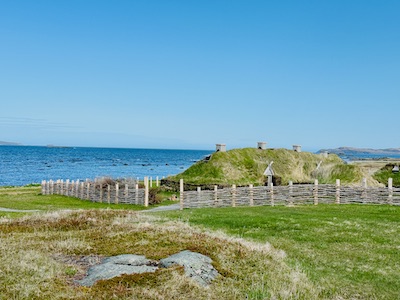
L’Anse aux Meadow was just a fishing village on the tip of Newfoundland when Helge and Anne Stine Ingstad were shown what was thought to be an Indigenous campsite by a local fisherman. It was an indigenous campsite and, as they discovered, also an 11th century Viking settlement. There were a few significant artifacts found including a forge and metal objects which were likely used in ship repair. It also corresponds with the stories told in the Vinland Sagas which document the voyages of Leif Erikson and other Norse explorers who came from Greenland and Iceland. They have rebuilt several of the dwellings based on Norse traditions. It’s quite remarkable to tour the area. This is seen as the end of the circle of exploration since crossing the Atlantic was the last piece of migration across the globe.
I was so excited to visit this remote area of the world and explore something that I know my father would have loved. I left some of my father’s ashes there so that he too could be a part of history, the subject he loved so much.
 Workplace Navigator