
I have been intrigued by South Georgia Island since reading about Sir Ernest Shackleton and the voyage of his ship the Endurance. It is such a remote place I assumed I would never actually see the island; nevertheless, set foot on it. I am happy to report that the island is far beyond my wildest imaginings. It is the convergence of history, topography and an unfathomable array of animals. I traveled there with my brother, Rick, in February of 2026 on the ship Hondius. We first traveled to the Falkland Islands and our second destination was to South Georgia Island. South Georgia, like the Falklands, is in a permanent state of dispute between Argentina and the United Kingdom. The Argentines say it’s theirs and the UK actually has a very small group of people who operate a research station there. There are a handful of people who winter through on the island and there are about twenty folks who live there in the summer operating a museum, post office and store.
Getting on the island is no small task. There is no airport or dock. The only way to arrive is by zodiac (a twenty foot inflatable boat with a motor and hard deck with seating on the pontoons that surround it) after all the passengers have been checked for any potential contamination. Boots and all outer wear must be inspected before anyone can arrive on land. This is to maintain the delicate environment for the various wildlife that come through South Georgia to mate, give birth and molt.
The first thing that is so utterly striking about the island is not only its size (it’s much larger than I imagined in my head) but its beautiful topography. While the Falklands were flat rolling hills, South Georgia is one long line of mountain peaks, many covered with glaciers. It’s quite the contrast to the Falklands. Outside of seven defunct whaling stations around the south side of the island, there is no infrastructure outside of the research station and museum complex in Grytviken. Most of the whaling stations contain asbestos and you are not allowed to enter the buildings. There are two mountain ranges here, the Allardyce Range and the Salvesen Range with 183 named peaks. The highest of which is Mount Paget at 9,629 feet. Even more remarkable is that there are 160 glaciers here that cover 50% of the land. Everywhere you turn you see another craggy peak covered in a glacier. It’s simply breathtaking although inhospitable. Shackleton found that out when he had to traverse the uncharted mountains to get to the Stromness whaling station in May of 1916 after his ship was crushed by ice flows and the majority of his crew were stranded on Elephant island. It’s a beautiful but dangerous land.
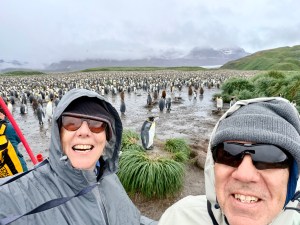
We took zodiacs several times to make landfall and enjoy the multitude of penguins who come here annually. The largest and second largest colony of King penguins come here for their rookery in the summer. Here they give birth to their young, raise them for several months and then experience a catastrophic molt which involves losing all their feathers and takes a month for their new feathers to come it. So, when we visited the two different colonies most of the penguins are just standing in place as they wait for their feathers to come in. Such patience.
The second largest King penguin colony in the world is on Salisbury Plain on South Georgia where there are over 150,000 mated pairs. We arrived by zodiac and the penguins and fur seals were EVERYWHERE. As we arrived on land, we took off our flotation devices and many curious seal pups and juvenile penguins started coming right up to us. We had been instructed to stay 15 feet away from any animal, I’m here to tell you that is virtually impossible. Rick and I soon learned how to run the gauntlet along the path that was set out by our guides. The seals are much more curious and the older seals are much more brazen at coming up. There were several times where we each put up our hands and backed away from an intruding adolescent seal. We traipsed through lots of mud, forged creeks but finally arrived at the heart of the colony. It’s amazing to see penguins as far as the eye can see all the way up the side of a valley. They all looked like a well-dressed standing room only crowd waiting for a show. 95% are standing up packed in next to each other. It was quite the experience. On our way back to the zodiacs, Rick almost went over backwards trying to back away from a more aggressive seal. Luckily, he didn’t fall because it would have been a mess to get cleaned up.
The next day was a zodiac observation ride along the largest King penguin colony at St. Andrew’s Bay. Here over a half million penguins congregate annually. The zodiacs ran parallel with the coast so that we could observe thousands of penguins milling along the water’s edge, diving into the water or standing like sentinels up the various valleys and up to the side of a hill as I previously mentioned It’s overwhelming to see so many live beings in one area of the world congregating peacefully. The fur seals and elephant seals are there as well. Rick got some great footage of two male elephant seals having what is essentially a shouting match with one eventually sulking away.
We went ashore at Grytviken and enjoyed the museum and a tour there. Rick and I ran the gauntlet of fur seals to get to the grave of Ernest Shackleton. I’ve learned that walking with purpose is the way to keep the curious seals at bay. They seem to back off if you don’t look tentative. There is also the replica of the James Cairn which is the lifeboat that Shackleton took from Elephant Island to South Georgia. When you see the size of the boat and have already experienced some of the big swells on the South Atlantic and Antarctic seas, it’s an amazing feat that 6 men survived the trip. There is also the defunct whaling station there and the knowledge that when it was first started in 1904, they didn’t have to leave the bay to be able to kill over 100 whales. The fact that so many whales were hunted until practical extinction is mind blowing.
Our final day was a stop at Cooper Bay and a colony of Macaroni penguins. These are adorable penguins that have crests on top of their heads with bright yellow plumes and dark red beaks. After five days in South Georgia, we set sail for the Orkney Islands and the home of Chin Strap penguins. I had no idea that there so many different kinds of penguins but each is unique and they are incredible fun to watch either swim or waddle on land. The fur seals are fun as well when they are together in a swimming hole as they frolic together in the water. For me, South Georgia has been such a fulfilling stop between the history of whaling, the storied end to Shackleton’s ill- fated journey across Antarctica, a stunning landscape of dark craggy mountains with endless glaciers to a potpourris of penguins, sea birds and seals. There is some spell binding experience at every turn and I hope to venture back some day.
 Workplace Navigator