Expedition to Antarctica 🇦🇶


My brother Rick and I traveled to Patagonia and Antarctica in late January and February of 2026. When we planned this trip, Antarctica was the goal and we added Patagonia as a “might as well”. Rick found a travel agency that specializes in Antarctica and Patagonia called Swoop. I’m so grateful that he found a specialist because we have truly been able to experience and explore both Patagonia and Antarctica in ways I never imagined I didn’t realize when we first started planning that most cruise ships don’t let you actually set foot on land. Antarctica has a multitude of rules about making landfall including no more than 100 people at a time on shore. This regulation is to maintain the pristine environment that is Antarctica. This rule makes all the larger cruise ships off limits for making landfall. I’m grateful that Swoop booked us on an expedition ship with only 162 passengers from 40 different countries. This meant that not only could we landfall at the Falkland Islands and South Georgia Island, we could make landfall on the continent of Antarctica and truly experience the environment and wildlife. 
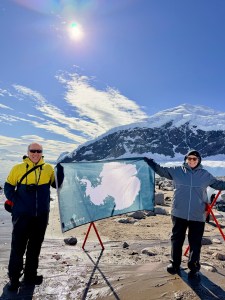
My brother Rick and I on the continent of Antarctica

Outside of days at sea, each day off the coast of Antarctica was organized into two zodiac rides per day to either make landfall or cruise. We were divided into the red group and the blue group so that we would never have more than 100 people on shore. Our first zodiac ride in Antarctica was in Mikkelson Harbor. We landed on an island that had a colony of Gentoo penguins. Gentoos are super animated and run or slide across the snow rather quickly making them adorable. They are utterly fearless and will walk right by you towards whatever their destination might be. We had to try and keep 15 feet away but they are so quiet and active, it can make it difficult to stay the minimum distance away. The bay we landed in was full of bergy bits and growlers (small icebergs) so the shore was strewn with large ice chunks.  There were also several whale skeletons on the beach as well and hundreds of Gentoos milling around in and out of the water. 

The next morning, we had tremendous weather with blue skies and no wind (unusual for Antarctica). The expedition guide, Marcel, had told us to be up at 5:30 AM to watch our ship, the Hondius, navigate the narrow Lemier Channel. Rick and I went up to the observation deck to see this magnificent channel with mountains and glaciers on both sides and hundreds of pieces of sea ice and icebergs floating on top of the clear, reflective water. It was absolutely surreal and picture perfect as we floated through the narrow channel, sometimes breaking through ice. The glow of the sunrise, the mist in the peaks of the mountains and the reflection on the ice strewn water was absolutely magical. It definitely will be one of my fondest memories of the trip.

We went for a zodiac cruise through the Iceberg Graveyard. There were hundreds of house size or bigger icebergs run aground. The icebergs calve off one of the many glaciers or sea ice and can’t move very far because it’s so shallow. If only 10% is above the water line, you can imagine how deep the icebergs go. There was one formation which had a hole in it making it look like it belonged in Arches National Park. When it’s perfect weather like we had, you can see all the shades of blue and green in the ice. The whole landscape looks like cool whip and ice cream and all of that bright white reflecting off the icebergs and glaciers can be blinding but wonderous. 

Each of the drivers on the zodiacs are also experts in one particular area of interest such as geology, penguins, ice, whales, history and seals. It’s a random assignment when you get on a zodiac but on this one day in Antarctica we had Pierre as our guide who is an expert on whales. It was fortuitous. We saw several humpback whales taking a nap which is a bizarre sight. They hover on the surface and make growls when they let out their air. These immense beings lying on the surface as we hover around in the zodiac. The most surprising thing was a group of Orcas (killer whales) swimming together in a pod. We could see the long dorsal fin of the male with several smaller whales with him. According to Pierre (who was super excited), they only see Orcas in Antarctica once a season.  Apparently, they swim so quickly they are hard to get a glimpse of. It felt very special that we were able to see this pod together and, at times, swimming under our zodiac which I found unnerving. I had hoped they didn’t want me for lunch.

On another zodiac cruise, we saw several varieties of seals lying on ice flows. It was like looking at a dog snuggled up next to a blanket except it was a seal snuggled up to the ice. We saw Weddel seals, crab eater seals and leopard seals during our various zodiac rides. These varieties of seals seem to be more solitary and we almost always spotted them on their own.  This is opposed to the fur seals which are in huge gangs playing together in the water as if in a swimming pool with their buddies. 

When we were on South Georgia Island there were half a million King penguins together on one shore line, in Antarctica, the penguin’s colonies are much smaller.  The shy little Adelie penguin is very small and timid. The entire group of Adelies was no more than twenty and they are completely black except for a white ring around their eye and a white abdomen. At our last landing, we saw a bunch of Gentoos swimming together and congregating on shore together. I’ve seen so many penguins on this trip that now I can identify each of the seven species that I’ve seen.

Our last stop was actually on the Antarctic continent. In previous landfalls we had been on islands and not on the mainland.  In this zodiac ride we went to Nekko harbor and set foot on what for many was their 7th continent. It was for Rick but not for me (I still need Asia and Australia). It’s momentous to stand on this white continent with all its beauty, wildlife and stunning landscape. It’s not easily achieved but it sure was worth the effort to experience this pristine, breathtaking landscape. 

🧐25 Peculiarities of Newfoundland

I’m finishing up a month-long solo RV tour of Newfoundland.  This is truly a beguiling place with vast amounts of seascapes, cliffs, and wilderness as well as tiny fishing villages and busier hubs like St. John. The vast Great Northern Peninsula is as desolate in areas as the Yukon Territory with nary a Tim Horton (Canada’s answer to Dunkin); while St. John’s is a major shipping port with countless restaurants and museums. I began my trip at Port aux Basques where I could travel for hours without seeing any facilities and I am finishing up my trip outside of St. John’s which has 40% of the province’s population complete with parking garages and pedestrian thoroughfares. There is a lot of contrast here and I’ve loved every moment.

An iceberg near St. Lunaire-Griquet

Here are the 25 peculiarities of Newfoundland:

  1. Pronouncing it. I have been corrected on the pronunciation of Newfoundland by several Newfies. From the best I can figure it is pronounced: New-FUN-lAnd. I tend to say NEW-fin-lund. 
  2. No Newfoundland dogs.  Outside of statue of a Newfoundland and Labrador dog in downtown St. John’s, I have yet to see a Newfoundland dog here.  I had a client ask if there were herds of them here. There are not.
  3. Only Dairy.  Especially in the remote northern end of Newfoundland, I could not find any non-dairy milk or yogurt.  It’s all dairy, dairy here.
  4. Moose. I went to a nature park called Salmonair and traveled over 1,000 miles in Newfoundland. I have yet to see a live moose although they claim that there is one moose for every 4 people or 125,000 moose. That’s an amazing number considering they were introduced here in 1904.
  5. Icebergs. I saw eight icebergs on my trip here and if you come in June and are willing to travel to St. Lunaire or Twillingate, I can pretty much guarantee you will see an iceberg and it’s an awe-inspiring sight.
  6. RDF. A Newfie clued me in that this is the general term for weather which stands for Rain, Drizzle and Fog (St. John is known as Fog town). There is no telling when it will rain and when it will be sunny and, in general, the forecast is wrong. This can make planning difficult and you just have to be adaptable. 
  7. National Parks. There are two National Parks (Gros Morne and Terra Nova) on Newfoundland and they are beautiful and super inexpensive compared to the US. It’s only $11.00 to enter these parks for the day.
  8. Provincial Parks. I saw several Provincial Parks and all of them have been free. The most stunning was the Dungeon Provincial Park which is a collapsed sea cave.  It was a gravel road out to it, but when there is a clear, blue sky and pounding waves below in “the dungeon”, it’s a spectacular sight. 
  9. Potholes. When I drove the Alaska Canada highway last year there were always signs to indicate that potholes were coming and they were accurate. While the Trans-Canada Highway here is terrific, there are several secondary roads that were riddled with potholes and/or frost heaves (undulating roadway from temperature changes). Sometime I had to drive 20 miles an hour to make sure Abeona held together.
  10. Brogue. Many of the locals sound like they are from Ireland or Scotland. A server or customer service person would approach me and I must have had a deer in the headlights look because I have no earthly idea what they just said. Expressions like “Whaddayat” or “How ya gettin’on” at times made me think I was across the pond. 
  11. Chatty. I was mentioning to a Newfie I met in St. Pierre that people were so nice in Newfoundland and she said, “Well, they are really just chatty.” She is right. People would talk to me about just anything but most likely the weather (see #6).  I had an older man come up to me while I was gassing up Abeona and said, “Whaddayat” and “Come from away” (are you visiting).  He thought I had a really nice rig and asked “Do you have a man in there?” The folks here are chatty.
  12. Time zones. I think it’s bizarre but Newfoundland and Labrador are a half hour ahead of the Atlantic Time zone (Nova Scotia, etc.). So, they have their very own time zone.
  13. Gas. A lot of the gas stations only have regular gas and you pump and then pay inside. Similar to my trip through the Yukon, I gassed up at almost each gas station I found open (some are closed on Sunday).
  14. Potable water. I was prepared for this before I came but several campgrounds had boil warnings on the water. I had to be sure I filled up at the campgrounds with safe drinking water.
  15. Cover shopping carts return. I found it strange that grocery stores had covered places for the carts to be returned. Gas stations were not normally covered (like they are in the US). 
  16. Cod. Cod is the center of the universe here and when there was a moratorium on cod fishing starting in 1992 it devastated the region.  As they say here, fish is cod and cod is God. The fishing just restarted in 2024 but only partially. It’s why the area was settled 400 years ago.
  17. Jigg’s Dinner.  This is a classic Sunday dinner in Newfoundland and is only served on Sunday.  It’s a boiled dinner that included salted beef, turkey, potatoes, turnips, mashed peas, carrots and greens. The whole thing is covered in gravy (similar to Poutine which is fries covered in gravy). I was finally able to be at an open restaurant on Sunday that was serving it and it was delicious.
  18. Lupin. Besides thousands of dandelions that almost look like they are cultivated along the highways and byways, swaths of lupin in blue, pink and white are along hiking trails and highways.
  19. Balsam Fir. Most of the landscape on the Great Northern Peninsula is barren and grassy but along the Avalon and Bonavista peninsula’s there are miles of balsam fir conifer forests and the smell is breathtaking. 
  20. Moose burgers. Besides fish and chips (see #16), another staple at roadside restaurants on the Great Northern Peninsula  is moose burgers. It’s more prevalent than regular hamburgers. 
  21. Painted Rocks. I found painted rocks on random hiking trails where school children from a particular class room painted rocks to line the trail at its apex. There are large boulders painted as well. It’s like finding Easter eggs while driving or hiking.
  22. Partridge Berries.  These are small red berries that are tart like a cranberry and many restaurants made tarts from them.
  23. Gift shops.  There are tiny gift shops next to lighthouses and on the road next to restaurants. These shops are filled with handknit gloves, homemade partridge berry jam (see #22) and painted rocks. They are all locally made and quite homespun. 
  24. Wood piles. I saw this the most on the Great Northern Peninsula but there would be random piles of wood along the Viking Trail on my way to St. Lunaire. Apparently, locals have a place to keep their wood for the winter.  It seems random but it’s not.  The same goes for piles of lobster traps.
  25. Names. I find it funny that there is an island called Random Island and two lakes right next to each other, one called 3 Corner Pond next to Triangle Pond. I wondered how they knew the difference since isn’t a three-corner pond a triangle? There is also the town of Dildo which Jimmy Kimmel featured on his show. There is the inappropriately named Western Brook Pond which is a fresh water fjord that is 10 miles long and 250 feet. Not really a pond. 

I love that Newfies and Newfoundland are so quirky and friendly. Regardless of whether I was walking down a trail, doing laundry or paying for gas, these people are so welcoming to those that come from away.  I can’t wait to return. 

🐳 Puffins, Whales and Lighthouses: Newfoundland

My original purpose in traveling to Newfoundland was to see icebergs and the Norse settlement, L’Anse aux Meadow. But in addition, I was secretly hoping for puffins and whales as well. I scheduled my trip at the height of iceberg season (May and June) so if I was able to see puffins and whales, all the better. I knew, of course, there had to be lighthouses because with 6,000 miles of coast line, there will be lighthouses. 

While I camped outside of St. John’s on the Avalon peninsula, I took a tour of the area surrounding St. John. I could have driven it but with a 24-foot motor home to park and St. John being full of narrow streets and hills, I figured I’d leave the parking and maneuvering to someone more knowledgeable. We headed to Cape Spear and the most easterly point of North America. We arrived there on a windy day and saw the two lighthouses that sit atop the craggy cliffs. The current lighthouse was built in 1955 and is completely white and stands 45 ft. tall. It’s quite picturesque above the rocky coastline. Behind it about 50 yards away is the original lighthouse which was built in 1836 and is a squat single story white building with a red and white light on top. This older lighthouse is the oldest surviving lighthouse in Newfoundland. They apparently used to use whale oil to light the original lighthouse. It doesn’t feel like it but Cape Spear is within the city limits of St. John, the heart of which is 7 miles away. Cape Spear is a windswept place on its isolated crag. The Portuguese named this place Cabo da Esperance meaning “cape of hope”, which became Cap d’Espoir in French and finally Cape Spear.  It feels like every European nation had hands in the naming of the towns and headlands of Newfoundland. If they were fishing for cod, they were here at some point.

The Bonavista Lighthouse in Newfoundland

My next conquest was puffins. Before coming to Newfoundland, I made sure I joined a few Facebook groups.  There are several iceberg, whale and puffin Facebook groups and you can find out in real time if there is any activity.  This proved invaluable. I was camped in Chance Cove and almost a three-hour drive to the best puffin viewing area.  When I come back to Newfoundland, and I know I will, I will definitely plan to camp closer to Elliston which is out on the Bonavista peninsula. Puffins are most active in June and July while they are nesting. The best time of day to see puffins is in the early morning and late evening.  Even though I headed out at 7:30 AM, I wasn’t able to park and see the puffins until around 10 AM so most of the activity had subsided by the time I trekked out around a very narrow isthmus to get to the Puffin Viewing Area. There were about twenty people out there. There were several hundred puffins out on the cliff walking and flying about in addition to seagulls. It was really interesting but I should have brought binoculars or a high zoom camera lens. They are such unusual looking birds that I wanted to see them up close. There was another puffin viewing area off the coast of the Bonavista lighthouse but by the time I got there around noon, I didn’t see any puffins. The Bonavista lighthouse built in 1843 is another squat lighthouse although it is painted with bold red and white stripes. So, no puffins but another lighthouse bagged.

Next up, the Whales Playground in St. Vincent, Newfoundland. I traveled there on the Sunday of the major holiday weekend of Canada Day (July 1st). It was sunny and I wanted to beat the crowds. I figured it would be busy since by all accounts on Facebook, the humpbacks were definitely there. I headed out at 7 AM and arrived just before 9 AM. There was plenty of parking and the crowds were already gathered to see this awe-inspiring site. Apparently, the small fish called Capelin migrate in June and July off the shores of Newfoundland and the humpbacks migrate as well to feast on the abundance of fish. The beach off of St. Vincent has a sharp drop-off so that the whales are just 25 feet away.  I parked and headed out to the beach where there were 30 or so spectators, many with enormous zoom lenses. I absolutely gasped and tears came to my eyes as I saw the shiny black back of a humpback whale right off the beach. There was one single whale at one end of the beach and a mother and her calf about 30 feet away. When they are feeding, they are super active with tails, blow holes and pectoral fins flying. They are such majestic animals and they seem like they are just barely out of reach from the stone covered beach. Many people set up and camp in a chair for the day. As I headed out around noon, I passed hundreds of cars on their way to see the whales. I was glad I got there early before the crowds descended. The Whales Playground on a sunny day in June is not to be missed.

Newfoundland has been a treasure trove of UNESCO world heritage sites, lighthouses, spectacular rocky cliffs, icebergs and encounters with beautiful wildlife. I had a short Wishlist before I arrived and it’s been completely fulfilled in my month here on the island referred to as The Rock.  It truly has been an adventure and I’m so glad I made the effort.