🥰Beguiling Venice

I traveled to Venice at the end of 2024. I expected it to be interesting but I was beguiled. It is a world apart from anything else I have ever experienced. I arrived by plane and took a shuttle out to the main island of Lido di Venzia. I wasn’t in another vehicle for the rest of my stay. I’ve been to islands where there are no cars, Mackinaw Island in Michigan comes to mind, but there are golf carts and bicycles.  In Venice the only way to get around is by boat or on foot.  After a few days I realized that there is a peace that comes from not having to dodge taxis like I did in Rome. There is a quiet outside of the multitude of travelers dragging their luggage on the cobblestone streets. 

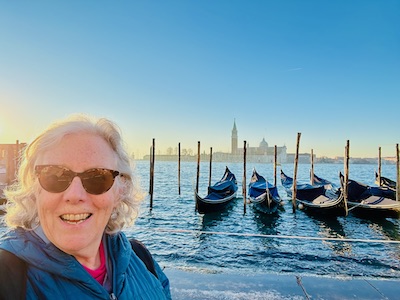
Gondolas in Venice

Here are some the things that made Venice beguiling:

The Republic of Venice. Venice was founded in 687 as a Byzantine Territory and was a republic for over 1,100 years. There was no “Italy” (which was unified in 1861). Venice was ruled by 120 Doges over a 1,000.  Doges were elected by the aristocracy and ruled for life.  Each Doge lived in the Doge’s Palace which is right off St. Mark’s Square along the waterfront (but isn’t most of Venice waterfront?). I toured the palace and was struck by how the Doge lived in the same building as the courts, the parliamentary rooms and the prison. Eventually, they moved the prison across a canal which then created the “Bridge of Sighs” which is where the convicted prisoner would get one last glimpse of the outside world before being imprisoned. Apparently within the Palace and in other spots on the island there are Bocche dei Leone (Mouths of the Lion) where any citizen could slip a piece of paper into the mouth to denounce another citizen for illegal activity. It’s sort of a suggestion box on who to arrest. I found this to be fascinating. 

It’s Swampland. The islands are built on wood pilings from trees in nearby Croatia (which at one point was part of the Republic).  They are buried deep into the clay beneath the water and then topped with stone, brick and mortar. The bricks are made from nearby clay and the bricks themselves are smaller than bricks I’m familiar with in the US. It’s all an engineering marvel although I did get a little freakout when the floor of the Doge’s Palace actually moved. It was like walking on the Golden Gate Bridge, there is some give and flex to the larger buildings in Venice. There is also high tide and low time every six hours so the landscape and docks and boats are constantly rising and falling. The crazy thing is that it’s all very shallow and there are special channels made for the larger boats to go from one island to the next. So, it’s all really just floating. 

The Labyrinth. The main island of Lido di Venzia is one massive labyrinth. If I did not have cell coverage and Google maps, I’m pretty sure I would still be lost down some nameless dark tunnel. As I’ve said, there is no getting around the island except on foot or by boat.  If you are on foot there are at least five canals to traverse to get to any destination. It’s disorienting because most of the streets are sunless alleys and you can’t see any reference points (in NYC I think of the Empire State Building as a reference point).  I rarely knew if I was headed east or west and I know that although I walked to Saint Mark’s Square four different times from my apartment, I never went the same way twice and was lost or off track each time. It was so comforting to see the same cannoli or mask shop to know that at least I had been there before.  I also gave myself lots of time to arrive at a destination because I had to factor in getting lost. Regardless, being lost really makes me be present and pay attention to all available information.

Islands. There are 118 islands that make up Venice.  Some are abandoned and small, some are privately owned and two of the most interesting are Murano and Burano. Murano is where they make handcrafted glass works. I saw a very interesting glass demonstration where a master glassworker made a glass horse in under two minutes. It was amazing to watch this artisan effortlessly create this masterpiece in minutes standing feet away from an 1800 F degree oven that runs 365 days a year. All he used was a big pair of black scissors and snipped, tugged and gently pulled forth a masterpiece.

Burano was a multitude of colorful buildings and a tower that is leaning precariously. Burano is a fishing village and the fisherman painted their houses different bright colors so that they could find their way home (adorable, no?).  There is also the art of making intricate lace works that many of the women of the island are masters at. I saw table cloths that were so intricate it would take two women four months to create. Lace making is a dying art as the lace making school closed down in 1970. There are seven different types of lace styles and most women only knew one or two so it would take several women to complete even a small work of lace depending on the types needed. Truly beautiful works of art. 

I ate on the island of Burano and I had the best risotto of my life there. I found food in all of Italy to be perfectly seasoned and impeccably prepared. Risotto is only creamy if you take time and care to develop the rice over a long period of stirring, the risotto I had was creamy (without cream) and perfectly seasoned. 

I am so fortunate that I was able to visit Venice during beautiful weather.  It was sunny each day and the highs were in the mid 40’s. Every time I went over the enormous Rialto Bridge (which spans the main waterway Grand Canal) the steps were not wet. It’s almost always crowded with tourists (like me) taking photos and stopping on the steps which makes navigating the steps more difficult.  I can’t imagine if they were slick from rain. The fabulous weather also had the added benefit of beautiful pictures. Every corner and turn from the immense St. Mark’s Square to the tiny canals threading ancient buildings is photo worthy. I was absolutely beguiled

🇬🇷10 Things to Know about Greece

I took my first trip to Greece at Christmas time in 2024. I had just been to Lisbon and Rome for a week each and some of these observations are a comparison to those two cities. After leaving an immersive trip to Rome, I didn’t have high expectations of Athens but Athens did not disappoint. I flew into the Athens airport and then took an Uber/Taxi to my place in the Monastiraki neighborhood of Athens. The cab could not drop me off at the door since it was on a pedestrian thoroughfare.  It was a wide and very busy pedestrian thoroughfare the Saturday before Christmas and it was bustling. So, there I was with my carry-on suitcase and backpack, completely lost and confused for about 15 minutes until I found the entrance to my flat. It was in the front of a small store, next to an arcade and ice cream shop. I cannot tell you how relieved I was when I finally dropped my bags and got my bearings. I can cope with being lost but when I have my luggage, it’s especially disconcerting when surrounded by foreign sounds and smells of a totally new city.

The Theater at Delphi

Here are 10 things you should know about Greece:

Language.  The language is very hard. I was on a tour to Delphi and we had lunch with our tour guides.  I was showing them my Duolingo app and the Greek alphabet. The sounds and letters are completely the opposite of English (and other Romance languages).  So P’s are like R’s, X’s are like Ch, and so on.  At one point I ridiculously said “Greek is Greek to me”. One of the guides said she could teach the alphabet in one day…I humbly disagree. On the upside, most folks in the service world speak English so my brief vain attempt to learn Greek came to a quick halt.

Coffee. I saw several large coffee urns while walking the pedestrian thoroughfares of Athens.  They had strong bitter coffee inside. In my opinion it could only be drunk with at least a few teaspoons of sugar. Think about percolated coffee that’s been sitting all day.  That’s Greek coffee. You’ve been warned.

Cats. There are cats everywhere in Athens, Delphi and everywhere in between. Most seem pretty healthy and on the heavier side so I don’t think they are without food.  It’s so random you will see one sitting atop an ancient stone in the acropolis or walking down the street of a ski town high in the snow covered mountains of Arachova. There will be cats.

Church Bells.  I was half a block from the Agia Irini Church. I could not make sense of when the bells of that church would ring. Sometimes it was 6:53 AM or 2:25 PM or 10:36 AM.  It made absolutely no sense to me.  Too early for a service and never, I mean never on the hour. The church bells befuddled me.

Stores. There are hundreds of stands and souvenir shops in the area I w staying which is adjacent to the ancient shopping area called Plaka. Every time I looked at a souvenir or pair of earrings, the vendor would tell me it was 50% off.  Never a price, just that it was 50% off. The street vendors in particular would only take cash or paypal. So, if you want souvenirs in Athens, you are in luck, they are 50% off. 

Guards.  The changing of the guard in front of the Parliament Building is a free and unusual event that happens every hour on the hour. The costumes alone are worth the trip. They wear a red hat, and white billowy skirt and sleeves, and a huge pom pom on the end of their shoes all while holding a rifle. The exaggerated steps and movements are captivating. Check out the changing of the guards.

History. This place is deep in history.  The National Archeological Museum has items dating back to the Mycenaean Period (1750-1050 BC). Statues from 750 BC in remarkable shape for being close to 3,000 years old.  I thought Rome was old but Athens is an ancient city and with remarkably well-preserved artifacts including a bronze statue of a jockey on a horse that is still intact and the centerpiece of the museum.

Mythology. I knew about Poseidon and Zeus and Apollo but there seem to be hundreds of Gods and even more myths with each and everyone.  It’s fascinating with stories of how the Milky Way started by the jealous goddess Hera (wife of Zeus) sprayed milk across the sky. It was truly fascinating.

Get out of town. I took a tour to Delphi and it was terrific to get out of town and into the countryside for the day. The pace and crowds of the city are left behind and there were red rock caves, snowcapped peaks and endless orchards of olive trees.  Greece is not just Athens. Get out of town.

Ruins. Go to the ruins whether it’s the Acropolis or Delphi or Temple of Poseidon. There are way too many uneven steps and many without handrails, but it’s completely worth the journey to see where Athens started as the oldest city in Europe. The statues in the Acropolis Museum are a testament to the ancient Greek artisans who made them up to 4,000 years ago. It’s amazing to see what humans can accomplish.

When I planned this 7-week trip to Europe, I thought about starting in Athens. I’m glad I didn’t. Lisbon was a great starting point since it’s much easier to maneuver with everything focused on the waterfront. Athens is built around the Acropolis high on the hill top and the language is complex. It’s definitely worth the visit, I’m glad I was able to ease into it instead of it being my starting point. 

🏛️Rome: Zebras, Lasagna and Popes

I went on a tour of Rome in December of 2024. I normally travel on my own staying at rented apartments and figuring it out as I go.  I went on a Road Scholar tour for seven days in the Eternal City and it was educational and well-paced. When I first landed at the Rome airport, I needed to freshen up.  I was really impressed with the bathrooms. They were super modern. When you entered there was a lit number indicating how many unisex stalls were available.  Each stall that is available has a green light indicating it’s free, you wave your hand and the door slides open to a private stall with toilet and sink. You wave your hand to close and then again to lock it.  All of it was touchless and hands-free. Simply amazing.

We all stayed at the Hotel Dei Mellini which was a small hotel along the Tiber River near the shopping district of Prati.  There were loads of restaurants and mostly high-end shops. For most communal dinners we could walk to a local restaurant and we were invariably the first group there at 7 PM. The restaurant would be full by the time we left at 9 PM.  Our group totaled twenty folks all over 60 from various parts of the United States.  Our fearless leader, Bruna, did a great job of keeping track of us all as we navigated the ancient streets of Rome. The term we all learned almost immediately was finding “Zebras” or the marked crosswalks. Bruna explained that if there was a Zebra and no traffic light that we (the pedestrians) had the right of way. She frequently, and bravely, walked out into traffic several times stopping motorcycles and taxis to let us cross a street on a zebra crosswalk. I soon learned that to get around I had to be acutely aware of where the “Zebras” were to find the best way to my destination.  There is no telling where a Zebra might be placed, sometimes it’s in the middle of the block, sometimes I had to travel a block out of my way in order to find a Zebra to get to my destination.  When in Rome on foot, follow the Zebras.


Teatro di Marcello  with three layers of lasagna from across 2000 years, one built on top of the other.

Our first day in Rome was spent at the Capitoline Museum which sits atop “Capitoline Hill”. The palazzo in front of the museum was designed by Michelangelo in 1536. It contains a treasure trove of sculptures countless busts of the over 80 emperors who ruled Rome. There is a bronze sculpture of a she-wolf nursing twins Romulus and Remus which is the origin story of Rome. There several versions of the story but Romulus is the victor and he founds Rome in 753 BC. In addition, there is an equestrian statue of Marcus Aurelius from 173 AD and parts of the Colossus of Constantine including the head and a foot (the foot alone was 6 feet long) of Roman emperor Constantine the Great. The real secret to the Capitoline Museum is the vantage point to see all of the Roman Forum which is centuries of various ruins dating back to Julius Caesar and the 7th century BC. The Pantheon is a marvel of a structure that was built in 609 AD on a site that was a temple during the reign of Augustus (27 BC- 14 AD). It is an engineering masterpiece and stands today as it did in 609 AD with it’s large circular dome and 30 ft. oculus or hole in the center of the Rotunda. So, when it rains, the water falls through the oculus and down to the floor where drains sweep the water away.  It’s simply amazing.

We went to the Colosseum and Roman Forum the next day. The Colosseum was originally named the Flavian Amphitheater for the emperors of the Flavian dynasty who ruled 69 – 81 AD and built the Colosseum. It held 50,000 to 80,000 spectators.  Our guide said that 10,000 exotic animals from Africa and 5,000 gladiators and slaves were killed here for sport in a 90-day period. They have recreated one of the trap doors from which an animal would be transported up to the arena. It has endured a fire and an earthquake in 1349. It has been torn apart and picked over to build other structures in Rome. There are thousands of pot marks that were left behind from iron clamps that held the stones together. As we walked through the Forum, we kept hearing about recycling and how one marble pillar from one structure was recycled into another structure some 3 centuries later. Limestone from the Colosseum was used in a church 200 years later. When we walked through the Forum, through the Arches and various structures left behind from years of emperors, popes and dictators, we walked on black basalt.  As we stood below the Arch of Titus, there are the original black rocks that Julius Caesar walked upon some two thousand years ago. In the middle of this bustling city just yards from the Colosseum. Rome is deep in history.

Our guides were constantly talking about recycling and the Teatro di Marcello which is a great example of lasagna or layering. It started construction under Julius Caesar in 17 BC. First it was a theater until the 4th century, then it was used as a fortress in the Middle Ages, then in the 16th century it was a residence for Orsini which was built on top of the original ruins, by the 19th century apartments were built above the lower floors. You can plainly see from the side that there are 3 distinct layers from 2000 years of existence for various purposes. Some very impressive lasagna!

Vatican City is the city state that sits in the center of Rome. It houses the pope, St. Peter’s Basilica and the Sistine Chapel. Throughout our travels there are countless buildings, monuments and statues marked clearly with whichever pope had paid for the monument.  Since there have been over 280 popes, there are A LOT of monuments and A LOT of lavish, opulent works of art and they are housed in the Vatican Museum and the rest of Vatican City.  We were fortunate to receive a one-hour class on the Sistine Chapel before entering this remarkable space whose ceiling and final judgement were painted by a captive Michelangelo.  The figures appear 3D in this hallowed space. St. Peter’s Basilica is the largest church in the world and I would bet that 30% of it is covered in gold. The guide told us as we entered this cavernous space that if it looks gold, it is gold. I was most overwhelmed by the Vatican Museum which is basically the opulent attic for 2000 years of popes acquiring or demanding various works of priceless art. One of the hallways we walked down was three football fields long covered from floor to ceiling with artwork and tapestries. 

I found Rome to be chaotic, energetic and wondrous. The history of dictators, emperors and popes all ruling this city along the Tiber River. It went from 2 million people to 20,000 people between the rise and fall of the Roman Empire.  Those that are still here are vibrant, resilient, welcoming people. All roads lead to Rome and I’m so glad I was able to experience its deep history, wondrous art and irresistible food. 

🏖️The Mysterious Driftwood Beach

I visited Jekyll Island, Georgia this past February and found it to be a mysterious and inspiring place along the Golden Isles of the Georgia barrier islands.  It has quite the history and an incredible Driftwood Beach which should be on everyone’s bucket list.  I was on my maiden voyage with my RV, Abeona, and we were on our way home from Florida. We camped for a week at the campground on the northern end of the island. 

Sunrise at Driftwood Beach, Jekyll Island, Georgia

I didn’t have a tow vehicle or a bike with me on the trip, so being within walking distance of the beach was a high priority (I didn’t want to pack up everything to go see the sunrise). The Jekyll Island Campground is the only campground on the island and I had no idea that it was just a mile from Driftwood Beach when I booked the campsite.  Imagine my surprise when I found that the beach was an easy walk each morning to photograph the sunrise. Serendipity. 

After arriving at my campsite, I decided to venture out to the beach during the daylight so that there wouldn’t be any surprises when I walked to the beach in the morning for sunrise. Arriving at around 4 PM on a Saturday afternoon after the mile walk to Driftwood Beach, I was astonished by how many cars were there and therefore, people on the beach.  This is not an umbrella and beach towel type of beach.  This is a photographer’s (re Instagram) Mecca. It also happened to be high tide. 

Driftwood Beach is a maritime forest that has been slowly overtaken by the sea.  There are hundreds of trees standing, fallen, eroded and sometime petrified, covered in barnacles on the beach. They are all driftwood, just most are full size trees as driftwood. Some stand as sentinels at attention with no branches, others are on their sides with their root structure solidified in an intricate web. Some look like they are trees on stilts with roots that grew long and straight in order to stay above the salt water.  It is mesmerizing to walk along the several hundred yards of what looks like a waste land of gray figures strewn haphazardly along the beach. 

The trees of Driftwood Beach stay on the beach because it’s very shallow for hundreds of yards off shore.  The waves are never high enough to pull them out.  In fact, when I first arrived, I thought I was in a bay because the water was so tranquil. Due to the shallowness, the trees over the last century have stayed where they have fallen. 

Jekyll island is a state owned and maintained island.  This means there aren’t any big resorts or towers along the beach. There were plenty of photographers each sunrise.  This was quite the contrast from when I recently stayed at a North Carolina barrier island of Ocracoke, where I was the sole person on the beach at sunrise.  Each morning at Driftwood Beach there was a minimum of twenty photographers each time I went out. Most with chairs and tripods, patiently waiting for that perfect shot as the sun slipped above the horizon. 

The real key to sunrise on Driftwood Beach is to know where the tide is and whether or not there will be clouds.  Some clouds are magical; when it’s fogged in, not so much.  If the water was high enough there were pools around some of the fallen trees making for a terrific reflection or you could capture the sun “caught” amongst the branches of the trees.  I had a ton of fun wandering up and down the beach looking for the magical combination of sun, tree, waves and cloud.  

It all seems so mysterious.  Like you are walking amongst fallen statues after some catastrophe. Like some civilization left these corpses behind.  The shape, the beauty and the serendipity of light, water and wood was amazing. 

🇩🇰 7 Surprises I found in Denmark

I recently returned from a 6 week trip to the UK, Ireland and Denmark.  Denmark was the last stop on my trip and I found it to be quite surprising.  I stayed at a flat in Copenhagen and really lucked out with the location.  It was only a block from Torvehallerne (a huge market open 7 days a week), the metro and train station. This made it a terrific jumping off point for traveling around Copenhagen, the countryside and made finding provisions quite easy. 

The author and her friend Alison on the canal in Copenhagen.

Here are the 7 surprises I found in Denmark:

  • Bikes, bikes and more bikes. I have never seen so many bikes ever.  When I got of the metro from the airport, I could not believe the massive amount of bikes parked at the metro station.  There had to be upwards of 1,000 bikes within a one block radius. As I walked to the flat, I saw bikes leaned up against every building and, to at least my untrained eye, they looked to not secured in anyway. Most of the bikes were basic black with a large basket up front. Copenhagen has the most cyclists per capita, and the city with the most cyclists with 62% of the population using bikes for the daily commute.  There are 6 bikes for every car in Denmark. 
  • Hej.  I studied Scottish and Irish before arriving in each country.  The thing is, while the signs might be written in Irish in Dublin, I never heard anyone speaking Irish.  On the other hand, in Denmark, people greet you will “Hi” which is how “Hej” sounds to me (Hej means Hello in Danish).  So I mistakenly thought that it was obvious I didn’t speak Danish but frequently, it was followed by something in Danish that I didn’t understand (although I did try to learn some Danish before arriving). The signs, the products, the menus are all in Danish although there is frequently a translation.  Everyone flawlessly (I mean without skipping a beat and in perfect English) would transition from Danish to English and then back with another person.  
  • Baby strollers.  They have taken baby stroller to new heights here.  Babies are cocooned in a padded cover, head covered and swaddled lying flat on a carriage with four sturdy wheels. In the US strollers are valued for being convertible and able to move from stroller to car easily.  When you don’t have a car (see number 1) you might as well have a Rolls-Royce for a stroller. Mom’s get 12 months of maternity leave (yes, 12 months) so why not make sure you can stroll with your baby in comfort.
  • Green energy.  As we took a canal tour of Copenhagen, we saw the very modern building called, Amager Bakke which is a combined heat and power waste-to-energy plant.  It’s shaped like a hill (ironic since Denmark is so flat) and while it’s converting waste to energy, you can dry ski down the slope, go hiking or climb a climbing wall.  Denmark has committed to being net zero on carbon emissions by 2025.  I have to say that for as close as we got to the plant, I didn’t smell anything and, probably due to so many bikes, I don’t remember smelling exhaust the whole time I was there.
  • Metro and trains.  Getting a train or metro ticket in Copenhagen was easy and simple.  There were kiosks at every stop and it was easy to buy a single or multi use ticket in English as well as Danish.  The trains themselves are immaculate and most that I traveled on, showed each stop of a lit board and let you know where you were on your journey. Every train had at least a half a car devoted to bikes and and baby strollers (see 1 and 3).  There was one point where I saw a man leave a stroller on the train and go sit down with his back to the stroller (through a doorway and about 10 feet from the stroller).  I could not believe that the man sat with his back to his baby and anyone could have taken the stroller off at any given stop.  I will say  I saw a least one mother stand next to their stroller while en route. 
  • Driving.  My dear friend Alison who is an American expat and has lived in Denmark for over 20 years. She picked me up at the train station with her car.  The first thing is that every road has pedestrian side walk on each side of it, has a bike path (one in each direction with bike traffic lights) and a two lane car lane.  This is found in the city of Copenhagen and out in the hinter land. Walking, biking and driving, are all equally welcome. The crazy part was that cars would park in the car lane in the middle of the street so as not to block the bike lane.  It almost feels like the bike is number one, followed by pedestrians and then, last on the list, is the car.  There is not right turn on red because of the bikers.  
  • Food.  I had wonderful food while in Denmark.  The highlight was probably the humble Danish which, as it turns out, they call “winderbrød” or Viennese bread.  So some Austrias who settled in Denmark, made the beloved pastry.  As opposed to what is called “danish” in the US, the flakey croissant like crust is amazing and the creamy rich center is divine. I also had a smorgasbord which is just an open face sandwich and they had many hearty breads on which they make the smorrebrød on.  There is also something called Flødeboller which is a chocolate covered marshmallow puff although the marshmallow part is light and delicate. The food was amazing.

I should mention the architecture and the all the color buildings along the canals, but you most likely already think of that with Copenhagen, I think that in the combination of electric transportation, their focus on green energy and the use of bikes, it’s amazing how quiet an pollution free it feels in Denmark.  That must be why it’s the one of the happiest places on Earth. 

Canada. It’s another country.

As I write this, it’s a rainy morning in Vancouver, British Columbia. I am here as an alumni to take the Path portion of ORSC (team and individual coaching), created by CRR Global. It’s been several decades since I have been to Vancouver. I am blessed in that, as a child, we took family trips to Canada and I had visited all the southern provinces of Canada by the time I was nine. As a kid, if everyone spoke the same language as I, I didn’t realize there were cultural differences. I remember the beautiful Butchart Gardens of Victoria and the profound crevasses of Banff National Park. And the adventure of the stretch of highway where there wasn’t gas for some 200 hundred miles and just praying we would make it with our enormous trailer that we were lugging behind us. Thankfully, we did.

27067173_10156006709958688_41099309857809483_n

As I order at a restaurant or check in at the hotel, I wonder if I am obviously from the United States. Do they hear an accent? Do I dress funny? Am I clumsy? I say this because it’s hard for me to tell who is a tourist and who is a native. I just went to Starbucks for a coffee and ordered my usual. I assume those working there are Canadians. Are most of their patrons tourists? I have no idea. The differences here are subtle but there are differences that weren’t apparent to my nine-year-old self.

Here they are:

Celsius. Temperature is temperature. Whether or not you relate to it as Celsius or Fahrenheit, it doesn’t really matter, right? The funny thing is that when I found the thermostat in my room, I saw it read 22 degrees. Wow. We could hang meat in here. So of course, I had to google to convert the temperature to Fahrenheit – like it mattered. Why not just sense whether it’s too warm or too cool? The funny thing is that in my class yesterday, which was largely Canadians, someone said, “It must be 25 degrees in here.” She meant that it was hot. I chuckled to myself. I’m glad I knew she was talking Celsius.

Taxis.  Luckily, I happened to research whether or not Lyft or Uber were available in Vancouver. They are not. I’m not sure about the rest of Canada, but in British Columbia, you must take public transit or a taxi. In the last year or so, I have realized that renting a car is an expensive encumbrance when traveling on business. Between parking, gassing up and tolls, it is just one more burden, kind of like an extra suitcase, that you have to take care of and keep track of. Luckily, there wasn’t a language barrier, which is the biggest plus to ridesharing apps. But if you aren’t in a well-populated location, it can be impossible to find a cab. In fact, I didn’t go to a museum I had planned on visiting because I wasn’t sure how I would get back to the hotel.

Currency. The last time I was in Canada, my daughter and I were in Quebec. I was trying not to have any Canadian currency. I try not to have any cash in any foreign country because it’s a mess to exchange back. In fact, like the euros I have from my trip to Paris, they are still clanging around in my wallet. Too minuscule to change and more of a remembrance of a great trip. The last time I was in Canada was a road trip with my daughter four years ago. We were in Montreal and visited the breathtaking Notre-Dame Basilica. I remember they only took cash for entrance and they did take US dollars. The exchange was pretty poor but I didn’t care. As I travel around Vancouver at restaurants and shops, I am careful that they take credit cards so I don’t have to mess with exchange of currency and I keep a few US dollars for tipping.

Language. So we speak the same language but as I said, my class is largely Canadian. I would guess that 95% of the words are exactly the same. It’s only the odd “PROOO-cess” or “Aboot” that crop up in conversation. The other difference, at least compared to Eastern North Carolina, is the diversity. The service jobs in Vancouver seemed to be staffed with people from all walks of life – from an Irish waiter, to a Korean busboy to a Nigerian desk clerk. It feels as cosmopolitan as Manhattan. As I walk down the street, there all sorts of languages being spoken. Again, I’m not sure if I’m in the middle of the tourist district (think Times Square) or if there is an international university nearby. But it feels as if everyone is welcome here, regardless of origin.

Pace.  This is a large city. The thing that strikes me that is vastly different from a city like New York is that the pace is much more relaxed. Considering the blend of diversity and the size, it seems very calm. None of that frenetic buzz that seems to increase your anxiety. There is no rushing to and fro. My walking pace is even slower. For such a large city, it’s very calm.

Hot sauce.  If there is a minus, it’s the hot sauce. No Tabasco. No Texas Pete. No Cholula. There is British Columbian grown-and-produced Verde and Salsa Diablo. I tried it out. It was acidic. I realized after I read the label that besides having Canola Oil in the top three ingredients (re. mayonnaise…yuck) there is lemon juice. I am not a fan. But this is a minor complaint compared to the rest of my experience.

Rain.  I recently traveled to Seattle for Thanksgiving. It rained a lot. It has rained or drizzled almost non-stop since my arrival in Vancouver. The difference it that this is an umbrella city versus a rain jacket city. Seattle is a rain jacket city. More people can fit on a sidewalk if they have a rain jacket on instead of an umbrella. In Vancouver, you have to maneuver down the street to make sure to not crash into someone else’s umbrella. Funny how different cities adapt to similar weather.

I wish I had more free time to investigate Vancouver but maybe next time. Our classroom was on the top floor of the building and was floor-to-ceiling glass facing out. We were suddenly interrupted by five flying bald eagles yesterday. We all stopped to gaze at their majestic flight with snow-capped mountains as a back drop. Uniquely awesome. I will be back.

7 Lessons from Reconnecting. No Regrets.

“Those Girls and The Blonde” sounds like a great name for an eighties girl band.  It wasn’t.  It’s the name of my two roommates and I from 1981 when our landlord (otherwise known as Dragon Lady) coined the phrase after “The Blonde” (Susannah) ripped up the carpeting in our basement, slummish apartment in College town.  Susannah is one of the few born and bred Manhattanites I know.  She takes charge.  She’s decisive.  The carpet was horrible and “there’s hard wood floors under there”.  So the other “Girl” Janine and I went along for the ride, ripping up the carpet.

We have remained friends for over 35 years.  We all had our first born children in 1993.  We’ve seen each other marry, sometimes divorce and move to various cities (Washington D.C., San Francisco, Boston, Croton-on-Hudson and Scottsdale).  We’ve never lived in the same city at the same time since Ithaca.  We’ve had a few reunions but since about 1983, TG&TB have not reunited at the same time sans kids and spouses.  So when I had an opportunity to go to Paris, I contacted them both and suggested we reunite in the City of Light.  Janine and I were both Paris Virgins and Susannah was fully versed in all things French.  We had a plan and TG&TB always execute a plan.  We spent 6 days reconnecting in a lovely apartment near the Eiffel Tower.

These are my lessons from reconnecting some 33 years later:

  1. Let someone lead. Several weeks before departing for Paris, I found some activities that we might want to try out. There were huge email trains between the three of us about costs, times, travel between arrondissements, etc.  It wasn’t working.  It would take several days to get confirmation.  So I finally suggested that Susannah take over the planning going forward.  Janine and I signed off on whatever Susannah wanted to cook up.  We had faith that she knew what we would like and what would work.  As they say, too many cooks spoil the broth.  Pick a leader, have faith and stick with it.


  1. Be willing to get lost. Ever since my daughter turned me on to Google Maps for walking directions in Manhattan, I’ve been pretty obsessed with not being lost. I realize now I am a “Direction Control Freak.”  I also hate to appear the tourist with the pocket map.  I had to let my judgment go.  For God’s sake Cathy, you are a tourist.  Who cares if someone else knows it?  They will the minute you try and say “Bon jour.”  So what if we walked the wrong direction for half a mile in the Marais. It’s Paris.  Every street is interesting and unique.  I believe it was Janine who said, “It’s all as intended. We are where we need to be. No regrets.” When we were lost, we stumbled on an out of the way café full of locals and sans tourists.  It was wonderful.  Get lost.


  1. Quality versus quantity. When you go into one of the largest museums in the world, focus on quality over quantity. We took a guided tour through the Louvre with an American expat who had phenomenal art and history knowledge.  We stood looking at a sculpture of Hercules for almost 20 minutes.  We discovered how his face change from docile to contemplative depending on the angle.  It was fascinating.  I’ve never spent that kind of time on one piece of art….ever.  I’m more of a fast food consumer of art.  Trying to check off each piece as fast as possible, Degas…check, Renoir….check, Mona Lisa…check.  This is not the way to appreciate art. This was a huge shift for me and I appreciate our guide’s contemplative example.  Don’t consume, appreciate.


  1. Make space for connection. I’m not positive but I think we ducked into at least three cafes a day. So if we had walked for an hour, let’s grab a table and a drink.  If we stumbled on an interesting café, let’s grab some café crème.   It was around one of these tables that we reconnected about career choices, our kids and reminiscing about our youth.  Those conversations may not have happened if we were too busy trying to make sure we went to every museum in Paris (which I’m not sure is possible but is certainly not practical).  I found fantastic advice and stories from two women I respect immensely.


  1. Utilize your strengths. We all were paying for different things. I figured, it would all wash out by the end.  I didn’t feel compelled to keep track.  Thank goodness Janine is incredibly organized and meticulous.  Between the exchange rate and dollars versus euros, she kept it all straight.  Susannah was our motivation.  She knew the best falafel place in Paris.  It might be a mile and a half away but her enthusiasm was contagious.  So what if we walk 8 miles in one day.  I was the compass.  Street crossing in Paris is pretty crazy.  There are cars and motorcycles come ricocheting in from all angles and walking at the cross walk is critical.  It became a chess match as to how to get to the street you wanted without losing life or limb.  Fall back on your strengths.


  1. Be realistic. We made sure that we were rarely rushed. So if we wanted to check out a park on the way to Notre Dame, we make sure it was doable at a slow pace with time to spare.  If it wasn’t?  Move on.  If the uber driver hasn’t been able to find you for twenty minutes, take a cab.  If the maître’d explains that the dish has raw duck in it, order something else.  Be realistic.


  1. Be open to adventure. Janine and I went up the Eiffel Tower together. It’s a pretty trippy adventure. The funicular is at an angle and with all the structure supports going by, it is a bit disorienting. When we got to the top, I wanted to stay inside.  I was as high as my acrophobia wanted to take me. Janine ran upstairs and ran back down.  “Cath.  You have to go to the top.  It’s not bad.”  I did and it was worth the flight of stairs up.  Susannah wanted to see the Saint-Chappelle.  From the outside, it’s not very impressive and we had just been through Notre Dame.  When we entered what I later found out was the first floor, it was some chipping paint with a low ceiling and trinket stands.  I thought, “What’s the big deal?”  Then we walked up a stone circular staircase (did I mention I’m claustrophobic?). At the top was, and is, the most beautiful chapel I have ever stood in.  My breath was taken away and tears were in my eyes.  I know that if I hadn’t gone with TG&TB to Paris, I would never have stood in that awe-inspiring spot.  Be an adventurer.


This was a trip of a lifetime with two of my favorite people in the world.  So think about it.  Who would you like to connect to again?  Break out of your normal agenda and take off on a reunion adventure of your own.  There will be no regrets.

5 Surprising Characteristics of Parisians

As I write this, I have finished my first two days in Paris on my own. Paris is beautiful and enchanting. I encountered many interesting surprises around almost every corner.  I had no idea it would take 45 minutes to get from Charles De Gaulle airport to my hotel. The traffic as you approach the city at 10 in the morning on a Thursday was just crazy. It felt like there was only one way into the city; kind of like everyone in New Jersey trying to get into Manhattan through the Holland tunnel. I was also taken aback by all the graffiti. I’ve thought that the French have it all figured out since Americans don’t seem to. But, alas, we all have our downfalls.

935370_10154009016568688_803073792879391620_n


The best part of the trip in was my taxi driver.   He kept calling me “My Lady”. We had a lovely conversation about his parents immigrating from Cambodia and how much he loves Paris. He explained the good neighborhoods from the bad and constantly complimented me on any French I attempted to speak. I was kind of hoping I could keep him for a few days as my guide. This young man was so polite and open, I had no idea what else was in store for me.  Can’t I just keep him? Is he the friendliest person I will meet in Paris? Who else is going to call me “My Lady”…. like ever?


Turns out that Paris revealed these surprises to me:


  1. Parisians are gracious. I had a friend advise me before I came to make sure I said “Bon jour” and “Merci.” Parisians are not a fan of the abrupt American. When I arrived at my hotel, two gentlemen opened the door saying “Beinvenue Madame, bon jour!”, with smiling faces. I think every employee in that lobby said “Bon jour, Madame!” You might be thinking, “Well, Cathy, isn’t this a hotel, shouldn’t they be that gracious?” The thing is every brasserie, cafe, shop and museum was the same tune. The sweet lyrical “Bon jour, Madame.” The Parisians graciousness made me feel welcome and humbled me.


  1. Parisians have a slower pace. One of my guides for a walking tour of Montmartre explained that if you purchase an espresso at a cafe, you had the right to the table for the entire day.  He wanted us to understand this in case some server tried to brush us off. This slower, you have all day, take a moment to be in the moment attitude was a big adjustment. I still ate my food too fast (especially when dining alone). I’m sure they thought I was an American Speedy Gonzales. This is in juxtaposition to say Manhattan or San Francisco when every minute counts in a race to get through the day. Savor the moment.


  1. Many Parisians are animated. On the drive in from the airport, there had been an accident and there in THE MIDDLE of the highway, the two men on opposites ends of the collision were boisterously yelling at each other waving their arms madly. Quite the theatrics. When the woman who was the concierge for the apartment we leased was showing us the place, she didn’t speak English. We didn’t speak French. The language barrier was crossed as she pantomimed how the locks worked, the door to the balcony, and all the various attributes of the apartment. It was hysterical. She bantered on in French stopping to ask “Oui?”…as we echoed back “Oui. Oui.” Enjoy the theatrics; they will often get you through what you need to know


  1. Parisians love their city. Parisian pride is even more fierce after the threat to Liberté, Égalité, Fraternité. Recent terrorist attacks on their own and their neighbor’s soil have fueled that fire.  This kind of pride, Parisian Pride, doesn’t develop overnight. Several guides and drivers I met were incredibly proud of their neighborhood whether it was Montmartre or Rive Gauche. I had the impression that every Parisian felt as if Paris was the center of the universe. It certainly is the center of theirs. The thing is, after 8 days in Paris, I was beginning to think the same thing.  Where else can you experience world class food, wine, art, history and music? ?  When I first arrived, I took pictures from every street corner because it was so beautiful and remarkable. Pretty soon I had WAY too many pictures of rambling cobblestone streets.  Every corner, every niche of Paris has something unique to offer. It’s okay to capture the moment even if you have to edit it later.


  1. Parisians are passionate. I’m talking the essence of passion, the pureness of passion. I mean passionate about their interests and what there is to love about life  I went on a walking tour of Montmartre and the guide was enlivened and passionate about Montmartre and the artists who lived there (i.e. Van Gough, Renoir, Monet, Picasso….).  I went on a cheese tasting in a cheese cave from the 1600’s and our guide was passionate about French cheese.  There are over 2,000 types of cheeses made in France, and this guy knew each one, the distinctions between them AND could combine a wine and cheese so that you thought you were eating cauliflower or grapefruit.  My friends and I took a cooking class and our instructor was almost beyond passionate about the food of Paris.  He knew the history of the dish, its origins, it’s modern adaptations and had sourced every product to identify organic and GMO free.  He orchestrated 8 novice cooks to create an amazing three course lunch in a matter of 4 hours. The passion of all these Parisians was contagious.


Paris has been on my bucket list for over 30 years.  Ever since my 7th grade French class.  It was an amazing vacation and the thing I learned is that it’s the residents I will remember most.  The Parisians themselves are the heart of the experience.

6 or 7 More Apps no Traveler Should be Without

I wrote a post a few months ago about apps for travel and received several more suggestions from some loyal readers! So I decided to road test a few and I have several to pass onto you. I don’t want to recommend what I haven’t tried out myself. Some of the apps I was already using and it took a nudge from a reader that it was an appropriate travel app. Actually, I kind of hit my forehead and said, duh, of course you have to have the Uber app.6 or 7 More Apps No Traveler should be without

Since my last post on travel, my husband has been using Waze and has been using it every day on his drive to and from work. They have updated the app to send ETAs to others on the app. I have to say it is fantastic to receive the ETA on my phone and know that he’ll be home in 22 minutes, shows the route he is on and will update the ETA when he stops as a gas station or is delayed in some other way. If I had a child in high school behind the wheel of a car, I would mandate the use of this app. No texting or calling while behind the wheel is necessary!

So here are my additional 6 (or 7) Must Have apps:

1. Uber. This is like a personal chauffeur service that is amazing and usually inexpensive. When you open the app it will get you a quote on how much it will cost to ride from your current location (say a hotel) to another location (perhaps a restaurant). If you decide the rate is acceptable, it gives you an ETA for the car to arrive, a description of the car and photo of the driver and follows the car as it comes to your location. The other amazing thing is that it automatically charges a credit card on file, so you don’t have to mess with swiping your credit card when you arrive at your destination. I love Uber but there has been some recent press and controversy over competition with taxis. I was recently in San Antonio and it was banned. So verify it’s available in the city you are traveling too.

2. GasBuddy. Have you ever been in the middle of eastern Georgia on Interstate 20 looking for a gas station? This is the app to have. It shows both by price and distance where the closest or cheapest gas station is. You can also update prices if you pass a gas station that has the incorrect price in the app and sort by type of gas you need such as diesel or premium. So if I’m low on gas I can check if I should wait and fill up in the next town and save 20 cents or stop at the next station. As a woman traveling alone in a car, this is a must have app.

3. Fly Delta. I’m not sure how long this app has been available but a passenger on a recent flight told me about it. Delta previously just had an app that showed flight status, arrival and departure gates. This new app is amazing. Now you can check in, have your boarding pass and find out your flight status. The minute you land it notifies you of your arrival gate and departure gate when making a connection. It also tracks your bag (you can rest easy that it’s on the same plane as you!) and lets you know the local weather. Phenomenal. That’s a lot of flight info packed into an app!

4. WebMD Allergy. I am allergic to dust, grass, and trees. I was suffering badly before a recent trip and found out this was going to be a really bad allergy season on the East coast because of the exceptionally cold winter. I searched for an allergy app and this one is terrific. It notifies me first thing in the morning if tree pollen is high and gives tips on what to do. You can search the city you are traveling to and find out whether there are any allergy issues there. I was relieved when I went to San Antonio because they had less allergens.

5. HHonors. This is Hiltons app which includes a whole host of hotels from Hampton Inns to Waldorf Astoria. This app has recently been improved because you can now check in using the app. You can even select which floor and room you want to have. In addition, at some hotels you can make requests for upgrades or items for your arrival. This app is invaluable if you ever get delayed beyond your control. I have booked a room after midnight on the DC beltway and used my honors points to pay for it.

6. Red Herring and 7 Little Words. These are just fun apps to play while on an airplane or at the airport. They start with 50 free games but you will have to pay for additional games eventually (because these games are addictive). Red Herring is about grouping 16 words into 3 groups while leaving aside 4 “Red Herring” words. It’s nice because you can set the difficulty. So if you are brain dead you can select “easy” and feel very superior by our grouping prowess. 7  Little Words is a cross between word find and crossword puzzles. The best part of this game is the smiley face when you put together all 7 little words.

Ok. So there you have it. 6 (actually 7) more apps to try out on your next trip across the country or across town. What apps do you travel with?

Cutting Loose. Lessons From Traveling With My 88 Year Old Father.

My dad’s 87 year old brother passed away suddenly several weeks ago in Florida. My dad wanted to attend the funeral and asked me to assist him. It turned out to be quite the adventure and gave me the opportunity to see my dad in a different light. My parents have traveled the world but in the last 15 years have remained “set” in their day to day routines. In retirement “auto-pilot” of doctor’s appointments, “Civilization” (a computer game), Food Network, checking for the newspaper and mail their rigid schedule is capped with dinner at 4:30…yes, 4:30. In the span of about 24 hours, we had made the arrangements and were prepared to venture beyond the envelope of about a 15 mile radius of our hometown. Ready or not, here we come.

This is my Dad's Thai lunch....ice cream.
This is my Dad’s Thai lunch….ice cream.

The amazing thing is that the trip opened my eyes to my dad’s resilience, adaptability and patience. One would think that one so set in his ways would have a difficult time adapting to modern technology, broken routines and uncertainty. Nope. Not a problem. It made me realized that a guy who traveled to Korea, hitch hiked across the US in his twenties and canoed in the wilderness of Canada…can handle just about anything you throw at him. Just because you usually live in a well honed routine, doesn’t mean you can’t break loose and venture out.

So this is what I learned:

1. Open. You need to be open; whether it’s Thai food, switching seats on the airplane or waiting to find the bathroom. My dad had no pre-set notions and was open to any change in course. I don’t think my dad ever had Thai food before but when my cousin suggested we eat there as a group, he was all in. Some folks sitting in his row on the airplane asked to switch seats…gladly. If we needed to find the gate at the airport before finding the men’s room; no sweat. Be open.

2. Trust. My dad trusted me completely. This was really gratifying. He had unfaltering faith in all the arrangements. I told him to check his bag (although he asked if it was free) he was willing to follow my direction and understood the rationale when everyone else came on the plane lugging a slew of carry-ons. Hotel, rental car, flights, parking, directions…he never questioned a single decision. If you want to break loose, go with someone you trust implicitly.

3. Patience. Pack some patience. My dad has this in spades. Anyone who taught 8th grade history for 30 years, has to have it in their DNA. We had two delayed flights and weren’t sure we were going to make a connection on the way home. He wasn’t anxious for a second. He would just open up his magazine and keep reading. Did I mention he is 88? If you aren’t blessed with the patience gene, try a little meditation.

4. Flexible. Anytime you want to break out of your routines, you need to be flexible. When we were connecting flights in Atlanta, we needed to find some lunch. “What do you want Dad?” Whichever line is shorter. Pizza it is. At a Thai restaurant for lunch but all you really want is dessert…ice cream it is. Three hours to kill? Head to the hotel for a nap. On the way back to Raleigh, we needed lunch again. Chinese food by gate A1 before getting on the plane. Be flexible.

5. Curiosity. When you venture out, make sure you have some curiosity. My dad can talk to anyone…I mean anyone. I remember when we were kids, if my dad was missing in action, he probably met someone in the check-out line. Upon his return, he would regale us with how interesting so and so was. He knew everyone in his row on the plane by the time we landed. You cannot talkto just anyone unless you have curiosity. Pack some curiosity when you break loose.

6. Habits. No matter where you venture to, you need to maintain some habits. Brushing your teeth, showering, and coffee in the morning. My dad has been telling me for years that he does 30 sit-ups in the morning…every morning. Sure enough, there he was at 7 AM in the bed next to me doing his sit-ups. Even amongst all of the travel and mayhem of unscheduled time, he managed to take his daily medications. Habits keep us on track and give us some normalcy amidst the chaos.

7. Prudence. Anyone from the depression era has a healthy dose of prudence. My dad wanted to know if the coffee on the plane was free…and the cookies as well. Was the coffee in the hotel lobby free? Was the breakfast free? It pays to double check. We didn’t realize some of the roads in the Orlando area were toll roads, but my co-pilot was ready with quarters by the second toll booth. It always pays to have a little prudence.

The experience of traveling with my dad was enlightening. I really admire him for his ability to roll with the punches (or plane delays) and his openness to constant schedule changes. Spending those three days with him was priceless. I’m glad we got to cut loose together.