Reflections on the Journey South🧭


My brother Rick and I spent 6 weeks in early 2026 traveling south starting in Santiago Chile, through Chilean and Argentina Patagonia and then on to Antarctica. It was the trip of a lifetime and I’m glad I had my fearless brother, Rick, along on the adventure. It wouldn’t have been the same with anyone else. Rick is always game to try anything. In fact, I’m pretty sure I would have chickened out of the rafting trip we took in Chile if we hadn’t been together. He pushes me but doesn’t insist. I remember him saying as we stood in the pouring rain, “If they say the trip is on, I’m going”. And so, we went. We were drenched and exhausted after an hour on that river but it was absolutely exhilarating. I would have missed it if he hadn’t been stalwart. As siblings, we have a lifetime of experience together. We don’t need to impress each other and there’s no judgement if one of us doesn’t want to hike for 12 hours in the rain and the other does (guess who). 
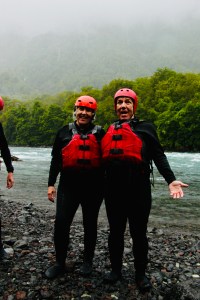
My fearless brother Rick and I on an exhilarating rafting trip

We both come to travel with an American lens. Rick has traveled more extensively but we both found some noteworthy oddities. Here are a few:

  • Plane landing. I remember this from traveling through South America some 35 years ago but when the plane lands the passengers clap. It’s cool to celebrate the minute you are safely back on land.  The other thing is that passengers unbuckle and start immediately going for the overhead luggage once the plane has landed. They don’t wait until they are at the gate.
  • Hiking.  We hiked a lot. I have to say it was a relief to not have to worry about snakes or bears. Patagonia certainly had rain and wind but there was no need to worry about a snake going across the trail.  It just felt like there were less critters in general like mosquitoes and spiders. Yes, there are snakes in Patagonia but they are extremely rare. The wind could definitely be a detriment. I remember on a hike to El Chalten that it was probably 30 mile an hour winds at the top of a mountain. One of our guides in Torres Del Paine had a wind speed detector which was helpful when determining to summit a trail. I’ve never thought twice about wind speed on a hike before Patagonia.
  • Shipboard. This was my first cruise outside of a few ferry rides (like Alaska, Ireland and Newfoundland). I’m so glad I had a prescription patch which Rick recommended and he didn’t need since he is ex-navy. So, I didn’t feel sick but taking a shower in 10-foot swells can be interesting while trying to hold onto the ship with one hand. I had to plan based on the forecast when it would be best to take a shower. Rick was so seaworthy he made me laugh when he would effortlessly dance down the hall. Each lunch and dinner, the servers would bring soup to your table. There was one lunch during 15-foot seas where they didn’t bring soup and the Creme Brûlée dessert was scrapped. It was our running joke that the seas were “no soup or creme brûlée” high. 
  • Zodiacs. Before the trip, outside of being terrified of crossing Drake’s Passage which is notorious for high seas, I was apprehensive about getting in and out of the zodiacs. Each zodiac held 10 passengers and one driver. First, we had to suit up with waterproof pants, jacket and muck boots.  These items had to be immaculately clean so that we would not transfer anything from say South Georgia island to Antarctica. Each landing had to be cleared to make sure there was no bird flu.  On top of being suited up, we had to wear a life preserver which had straps between the legs. It was quite the job to just get ready before embarking on the zodiac. Once suited up, you got in line to get down the stairs and out the open door to where the zodiac was. There was a small step up, then over the ship door, onto the pontoon and then down a step into the zodiac. If the seas were calm there would be one person leading you through the door from the ship side and the driver of the zodiac on the other. If the seas were high, there would be two on the ship and two on the zodiac.  Once on the zodiac, you sit on the side of the pontoon with only the rope behind you if you feel unsteady. From there you either head ashore to walk among half a million penguins or cruise amongst whales and icebergs for 3 hours in 30-degree temperatures. I was super fortunate that there was only one zodiac trip that was in larger swells.
  • Language.  We had several drivers while we made transfers across Patagonia. I don’t think any of them spoke English. I was really glad I could speak Spanish. If we had a guide, they were always bilingual but there were a few times where we only had a driver. Once on board the ship, all the Spanish came to a complete halt. I believe there might have been one other couple from the United States on the ship but everyone else including the crew was from Northern Europe, China, Philippines and Israel. We met several couples from the Netherlands and Germany who barely spoke English. Every lecture and briefing was done in English. I felt so fortunate to be able to understand it all. The ship itself is from the Netherlands so all the products like canned soda were Dutch. This was completely unexpected for me.

What has become apparent to me on this trip is that weather, outside of health, is the most important factor. We had three days at Antarctica where it was 35 degrees, sunny and little wind. Our excursion director, Marcel, kept saying that the bill was coming due (because we had such great weather). This meant that the last crossing through Drake’s Passage would likely be bad. Thankfully it wasn’t.  Seeing gigantic icebergs and tracking humpback whales on calm seas and sunny skies is priceless. It’s the luck of the draw and we drew the right cards on this trip.
Torres del Paine in Chilean Patagonia🏔️

My brother Rick and I are on a multiple week journey through Patagonia, starting off in Santiago, then onto the lakes region and ending our time in Chile in Torres del Paine (Blue Towers) National Park. This is the area of Patagonia that I imagined in my head before coming here. Sharp edged rocks soaring towards the heavens with pristine glaciers. It absolutely did not disappoint although it took three days for the weather to permit a stunning view of what are called “The Horns”.

We flew into the tiny airport of Puerto Natales. The airport is so small that there are no jet bridges and you exit from the front and back of the airplane directly onto the tarmac. It isn’t possible for more than one plane to be on the tarmac so they must turn around the same plane before the next plane can arrive. One gate, one baggage claim and no services other than a small booth selling sodas; just check-in and bathrooms. We knew that our transfer to Patagonia Camp (our next destination) would be delayed but luckily Max from Patagonia Camp met us and put us in a taxi to the small town of Puerto Natales where we grabbed some lunch. From there our transport picked us up along with some American folks coming from Argentina and headed to the same location. It’s a 90-minute drive on a very dusty, potholed road to get from Puerto Natales to Patagonia Camp. After about 30 minutes there was no more pavement; most of the roads while we were in Torres del Paine National Park were gravel and barely two lanes. It’s intimidating watching buses and large vans coming from the opposite direction but our driver was fortunately unflappable.

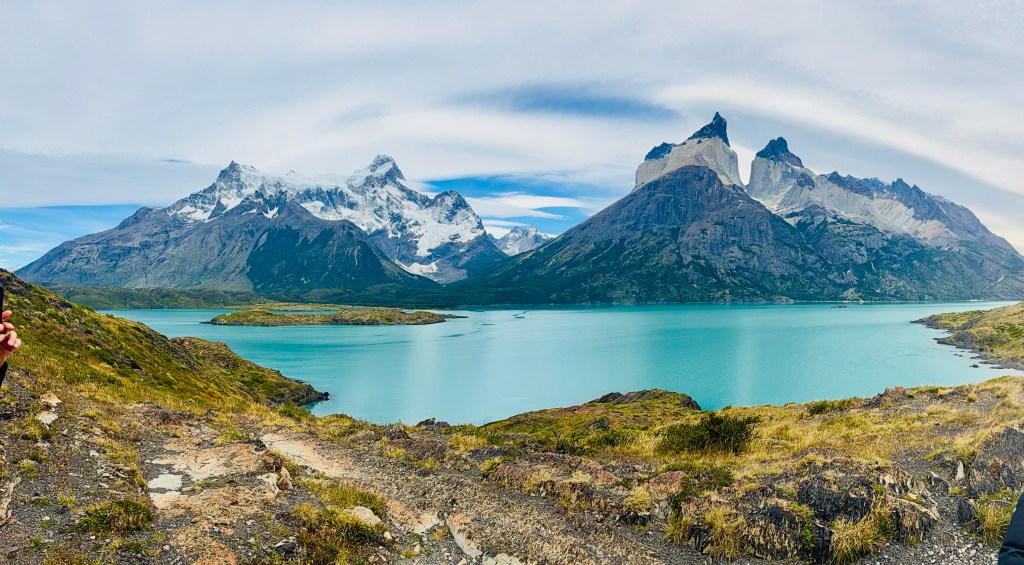
Torres del Paine National Park along the Miradores Trail with “The Horns” on the left

We arrived at Patagonia Camp at about 6 PM and were immediately ushered into an orientation about the property. They took our luggage to our yurt as we sat in the reception area where we were greeted with a welcome drink and appetizers. From there we went onto a different meeting room to select our excursions for the next three days. This is the first time I have stayed at an all-inclusive resort and both Rick and I felt like it had a White Lotus vibe (an HBO show) where everyone on the staff is so friendly and eager to make you comfortable. We had a lake front yurt with a hot tub. When I think “yurt”, I think of a tent in the middle of the dessert and a shared bathroom. That was not even close to the luxury of Patagonia Camp. The yurts are framed with wood and covered with tarp but also have a plastic top at the peak which gives a clear view of the starlit skies. There is a private bath off the side of the yurt which is a wooden structure. It’s really quite remarkable with natural formed wooden tables, comfortable beds and a fridge stocked with food and drinks. All we had to do was call the front desk to have the hot tub uncovered. The best aspect of the camp was the terrific food. The desserts and appetizers were works of art and there were new choices at each meal. The restaurant and bar had a beautiful view of Lago Toro and the spires of Torres del Paine in the distance.

Our first hike was the next day and we went for a hike within the National Park then to a rock outcropping that had cave paintings on the Aonikenk Trail. The trail is in puma (mountain lion) country and children under the age of fifteen are not allowed to hike since they are the main target of pumas. That’s a scary piece of information! You also have to hike with a guide in case you run into a puma. We did not have any puma encounters. We were able to see the handprints and figures on the rock from 11,000 BC. It rained, it was windy (gusts to 40 miles an hour) and the spires of the Torres del Paine were obscured for most of the day.

The next day my brother was able to check off a bucket list item for him; doing the 12-hour trip of hiking to the base of the horns in Torres del Paine. He hiked with the folks that we picked up on our transport from Puerto Natales on our arrival date which were two guys in their 60’s and their twenty something daughters from Michigan. It was a tough hike through windy canyons, intermittent frozen rain and a boulder field with many bottle necks. It is the most popular hike in the national park and that Saturday during high season there were several hundred hikers on the trail. He never saw the horns due to the low hanging fog but he was happy to complete the hike. I didn’t accompany him on this adventure.

Our final excursion was on our last full day at Patagonia Camp and it was amazing. We took the Miradores (viewpoint trail) which had an overview of the Salto Grande (Big Jump Falls) and a spectacular view of the Los Cuernos (The Horns), Paine Grande (the highest peak) Cerro Almirante Nieto, Valle del Frances and the turquoise Lake Nordenskjold in the foreground. The view is spectacular; after days of waiting to see the craggy tops, the shades of blue between the lakes, rivers, skies and rock along with shades of gray from the glaciers and granite is spectacular Perhaps it was the anticipation of hoping to see the elusive mountain tops but it was worth every minute of effort to see this spellbinding sight. One of our companions on the hike kept saying,” It’s not AI, it’s real”. It was appropriate because the colors were so vivid it felt like it must have been airbrushed or a simulation.

I can’t say enough about Patagonia Camp and its impeccable staff. The drivers, the servers, the housekeepers and guides were all terrific. On our last excursion, there were 8 of us, all in our 50’s and 60’s and the music on the van sound system was all obscure songs from the eighties from the Police to Talking Heads to Billie Joel. It’s hard not to believe that it was selected especially for us. If you ever venture to Patagonia, be sure to stay at this incredible oasis.