😎 PEI – Tiny and Unique

Prince Edward Island (PEI) is the smallest province in Canada but if it was a US state, it would be the second smallest right after Rhode Island. Yes, my Delaware friends, there is a Canadian province that is smaller than the state of Delaware. I traveled here on my Atlantic Maritimes Road trip in my RV, Abeona in the summer of 2025. I will say that getting to PEI is not for the faint of heart. My knuckles were white as I drove across the only bridge to the island called Confederation Bridge. First, I’d like to thank the travel gods because it wasn’t windy that day as I traversed the 8-mile bridge. I was dumbfounded as to why there weren’t any west bound cars as I came across the bridge until we were stopped for about 5 minutes due to construction on the bridge. It was nerve wracking to be about two thirds of the way across the bridge only to be stuck high above the Gulf of the St. Lawrence for what seemed like an eternity and to feel the roadway undulate from the weight of the cars (this takes me back to walking across the Golden Gate Bridge many years ago and feeling the ground constantly move). There is no toll on the east bound side of the bridge but on the way back it was 50.25 CAD ($36.70). That is definitely the most I have ever paid for a bridge toll. 

The red cliffs and beaches of Prince Edward Island

I headed immediately to the most western lighthouse on the island called West Point Lighthouse which is in Cedar Dunes Provincial Park. Here I got to see the tallest lighthouse on PEI at 68 feet tall. It’s situated right next to the red sand beaches of Cedar Dunes Provincial Park which is quite stunning as it was a clear sunny day and the dark blue ocean waves crashing next to the vast red sandy beach is impressive. It turns out that this tiny island province has over 55 lighthouses which is a lot compared to at the very least North Carolina which only has seven active lighthouses. Once I arrived at West Point Lighthouse I wanted to continue on to my next destination and there was no cell coverage. It wasn’t until later that I learned that driving on the island is more like navigating a maze. I definitely would have invested in a paper map if I had to do it again. I was able to start up my satellite dish to get my directions to my next destination but I have to say I was caught off guard. I think I had better cell coverage in the Yukon

When traveling on to The Bottle Houses and Garden, there was never a straight shot on a road for say 20 kilometers. It was more like 1.5 KM then right for 2 KM and then left for 1 KM. And so on. There are vast amounts of fields and farmland which is pastural but I felt like my GPS must be wrong that that there must be a more straight- forward way to get from point A to point B. I needed to let go and let faith take over. Later in the day I ended up on a gravel road for at least 5 KM which really rattled me both physically and mentally. 

The Bottle Houses and Gardens is a lovely spot; it has a chapel and two house built by Edouard Arsenault in 1980.  His first house was built with 12,000 bottles which he collected and carefully cleaned and then built using cement between the bottles. The second building is called the tavern and is built using 8,000 bottles and the last creation is a chapel which was completed posthumously with 10,000 bottles. The gardens around the site are picturesque and there are many bottle trees (metal tree shaped frames with bottles on the “branches”) in the gardens as well. It’s definitely worth the visit.

I visited the Green Gables Heritage Place along with Lucy Maud Montgomery’s birthplace. I’m not sure anyone would be interested to visit these places unless you have read Anne of Green Gables or watched one of the series or movies associated with the place. I have read the book and watched the series and it was neat to see where Montgomery got her inspiration. The Green Gables house was actually Montgomery’s grandparents’ house and she spent a lot of time there since her mother passed away when she was two and her father moved out to western Canada. You could feel that the book was very autobiographical as Montgomery like her main character, Anne Shirley, was also a teacher. As an aspiring writer it was really neat to see her first handwritten draft of Anne of Green Gables and the old typewriter she also used.  It’s an interesting walk back in time to see the farmhouse and its thatched beds and Victorian furnishings.

An interesting stop in PEI is The Dunes Studio Gallery and Cafe which is a great place to look at local art, buy some locally made crafts, eat seafood and wander the lovely gardens. There are also art studios for the artists who actually work here that you can see into. If it weren’t for the drizzle that morning, I could have wandered for hours. 

There is a laid-back pace to PEI with endless red sand beaches, striking red cliffs near the placid waves breaking on shore. I’m pretty sure I passed more farm equipment on the road than anywhere back home in North Carolina. This island is all about the farming and raising of world-famous PEI mussels which can be seen throughout the bays and inlets around the islands.  I’m glad I ventured here and now I’ve been to every province in Canada. 

🚐 Eclectic Historic Nova Scotia

I traveled to Nova Scotia in the summer of 2025. I am on a solo RV trip in my motorhome, Abeona. This was not my first time to Nova Scotia as my family traveled here in a tiny towable trailer when I was about 4. The only thing I remember about that trip is a picture that was taken by a canon and a bunch of men in kilts playing bagpipes. I have to say that I was truly expecting similar treatment when I arrived on my trip to Newfoundland in June but alas, was disappointed. No kilts. Worse yet no bagpipes. What I did find is an eclectic historic place full of beauty, seaside towns, fishing villages and, eventually, kilts. 

I first stayed near Cape Breton Island in Bras D’Or. I was heading on the ferry to Newfoundland by the end of the week and took the opportunity to explore the famously scenic Cabot Trail along the coast of Cape Breton Island. John Cabot who was a Venetian Italian explorer, Zuan Chabotto (John Cabot in English) was financed by Henry VII to explore North America.  He landed here in 1497. It’s believed that they were the first Europeans to North America after the Norsemen in L’Anse aux Meadow in 1014. Cabot Trail is a scenic drive with plunging coastline and fishing villages tucked in the bays. There were many craftspeople with storefronts along the way including a chocolatier, glass maker and eclectic restaurants. An odd thing here is that the signs on Cape Breton are all in Gaelic and English (no French except for National Parks). I knew I was returning to Nova Scotia after a month in Newfoundland so I saved the southern portions for my return trip.

Peggy’s Cove Lighthouse Nova Scotia

I also visited the Fortress of Louisbourg National Historic Site which is the rebuilt replica of an 18th century French colonial town. It’s really a trip back in time to walk past shops and bakeries from the 18th century with a large moat and fenced wall. People here are dressed in period costume of the French as it was a French fortress for 47 years after being founded in 1713.

Upon my return to Nova Scotia from Newfoundland, I headed to Halifax. As I have found in most larger cities, it’s difficult to navigate in a 24-foot motorhome. I randomly ended up on a bridge that was only for cars, I believe, and had no way to exit. I was quite nervous that I would be pulled over but it all went off just fine. I was headed to the Halifax Citadel and, although I had looked on Google for parking in advance, on a late sunny afternoon in July, parking is a premium. I finally found a spot, thankfully, so I didn’t have to abandon my trip to the Citadel. 

I was quite taken aback by the sheer size of the Citadel and its location in the heart of a bustling city with high rises and a shipping port. The Citadel itself has had four reincarnations with the first being in 1749.  This last fortification was built in 1828. Here finally I found men in kilts but alas, no bagpipes. I find it strange that although Nova Scotia means New Scotland in Latin,  the Scots where only here for 3 years (1629-1632). The Mi’kmaq people inhabited the region for several thousand years and then the French Acadian people came to establish the first colony in 1605. Then the British and French fought for the next few hundred years. It’s quite the eclectic mix of cultures. I was surprised to learn that Nova Scotia was almost the 14th colony during the American Revolution.  Even in the museums the information is in Mi’kmaq, English and French. The Citadel itself is a very nice intact fort. You can walk along the top of fortifications and it’s easily maneuvered. I was hoping for some long-hidden memory of this place assuming that it would have been important to my history loving father to visit but alas outside of a few canons and the kilts, nothing jumped out at me.

I headed to what is the most photographed lighthouse in Canada (and probably the world) at Peggy’s Cove. By now I’ve figured out that arriving at 9am at a touristy spot is paramount in order to park. I absolutely timed it perfectly. I was able to easily park and there were only one or two other tourists out there milling around so the pictures were perfect. The tiny cove with colorful houses and boats was so charming. The lighthouse itself is so special because it’s on an outcropping of granite that has been smoothed by glaciers and surrounded by the stunning Atlantic Ocean.  It truly is a terrific fishing village to walk through and has many eclectic shops like a pewter smith and art galleries.

I traveled up to Digby which is on the Bay of Fundy. Digby is renowned for their scallops. It was an adventure to travel up Digby Neck and take a ferry to Long Island which has the trail to Balancing Rock. This was quite the sight after hiking for close to a mile with nothing but boardwalk or trees and plenty of steps to suddenly see this enormous rock balancing precariously on the edge of a rock below. The rock formations along that coast reminded me of the Giant’s Causeway in North Ireland. Like someone deliberately made these enormous columns. 

The most serendipitous discovery was of Fort Anne National Historic Site. There were several locations to visit around the oldest settlement in Nova Scotia called Annapolis Royal. It was happenstance that I stopped here and to my utter amazement I found a placard that placed my 9th Great Grandfather, Major Robert Sedgwick here in 1654. He was a Major and later General for Cromwell. He was the first to conquer Annapolis Royal in 1654 and at the time was a British born American merchant in Massachusetts. Cromwell just two years later sent Sedgwick to Jamaica to be the governor although he sadly died almost on arrival due to illness. Annapolis Royal has changed hands at least seven times between the English and French over a century. It is in a protected bay adjacent to the Bay of Fundy and was a critical location.

I stopped by Burntcoat Head Park as a last stop in Nova Scotia to walk on the seafloor. Here is the location for the world’s highest recorded tides. Twice a day 160 billion tons of water flow in and out of the Bay of Fundy with the highest tide reaching 53 feet. Luckily, I arrived at low tide and was able to take the steps down to the bottom of the ocean. It’s quite surreal especially with all the bright red iron rich sandstone that is molded like soft ice cream. It was another terrific stop.

I really enjoyed this trip to Nova Scotia with the sheer variety of things to do and see. There were plenty of things I didn’t have time to see and I’ll be sure to allocate more time next time. Whether it’s natural phenomenon, eclectic history or picturesque seascapes, this is the place to visit.

🐊Exploring the Everglades

I headed to southern Florida to visit the three National Parks that make up most of the southern tip.  After experiencing the Biscayne and Dry Tortugas National Parks, I finally arrived in my RV at Everglades National Park.  I don’t camp that frequently in National Parks because most are so remote that connectivity is rare and I am unable to work. I was able to schedule my visit on the weekend, when connectivity is not an issue. I have previously been to the Everglades because it’s 1.5 million acres but I have never been “into” the National Park.  I had a terrific airboat ride 5 years ago with my family in the Everglades that was absolutely magical.  Those airboat rides are along the Tamiami Trail which is the northern border of the park. For the first time, I actually entered Everglades National Park and enjoyed the unparalleled landscape that 1.5 million acres of water and wetlands provide.

Planning is critical for any visit to Florida in March. I had to book the campsite 6 months earlier so that I could be assured of making the rest of my plans.  So, if it ends up raining or it’s super-hot, so be it. I also secured a Back Country Boat Tour that was operated close to my campsite in Flamingo. Flamingo itself is on the very tip of Florida and some 50 miles from the park entrance. I learned this while visiting Big Bend National Park in Texas.  It could take an hour or more to get from the entrance of the park to wherever you want to end up. Flamingo has a visitor center, marina, a restaurant, some lodging and a campground.  So, once you get down there, there are some amenities although you can’t take a hot shower in the campground (yikes). 

An Anhinga drying it’s wings on the Anhinga Trail in the Everglades

Based on my previous visit on the airboat ride, I expected the whole park to be wet grasslands.  That is completely untrue. The southern end of the park near Flamingo is mostly water and mangroves of all varieties.  I was really glad I had booked a boat ride that had a naturalist to explain all the flora and fauna in the area. There were about fifteen of us on the pontoon boat as we glided through the waterways of the park.  

We encountered a very large Osprey nest that had two active parents and two chicks that were starting to fledge. Apparently, it’s unusual to have two chicks survive so watching the two chicks and mother all in the nest with the father guarding from afar was pretty amazing. Osprey mate for life and these two had been coming back here for years. 

As we headed down a canal, we were constantly stopping the boat to observe Tricolor, Green Herons and Yellow Crowned Night Herons as we passed by.  The driver would stop and back up so that we could all observe the birds. Green Herons and Yellow Crowned Night Herons are much more elusive and almost immediately go hide in the brush.  The Tricolor Heron, on the other hand, frequently stay in the spotlight by flying ahead of the boat, stopping and then chasing us again.  It was remarkable.

By far the most elusive animals are American Crocodiles and Manatees. We had a woman on the boat spot a Crocodile.  I have no idea how she spotted it but sure enough we backed up and there it was hanging below the surface with just it’s eyes and snout pointing out of the water. We were able to see a Manatee when we returned to the marina and it was in between the docks. They can take a breath and go under for an extended period of time. 

It wasn’t until the end of the trip when I was connected to wifi again, that I saw how far we traveled on the boat tour. We had traveled from Florida Bay to Coot Bay and onto Whitewater Bay.  Whitewater Bay is an enormous body of water and one of the few places in the world where both alligators and crocodiles live.  Crocodiles need salty or at least brackish water to live. It’s hard to express how large a body of water it is. There are warnings not to kayak it without a guide since there is a monotony of mangroves ( and they all look the same).

My only hike in the park was on Anhinga Trail which is close to the main entrance.  I must have seen 30 or more Anhinga while hiking the boardwalk high above the swamp below. Anhingas are impressive because they open their wings like a bat and hang just about everywhere.  It’s intimidating to walk by but they don’t move. There were Great Blue Herons, Green Herons and Purple Gallinules as well.  It’s a bit creepy as I walked across the boardwalk because I could hear splashes of water below. I had no idea if it was a fish swimming in shallow water or an alligator grabbing lunch. 

I was really glad I ventured into the depths of Everglades National Park; it was dramatically different than an airboat ride gliding across wetlands but just as interesting and special.  It’s reassuring to see so much wetland protected and the preservation of habitat for endangered species like the manatee, American crocodile and Florida panther.  I hope this spurs you to venture out yourself. 

🚎A Solo 10,000 Mile Sojourn

I’ve just completed a solo 10,000-mile sojourn through North America in my RV, Abeona. It’s been quite the adventure and while this was some fanciful dream just 4 months ago, I’m amazed that I actually completed it without any major snafus and that I learned so much about myself and Abeona on the journey. I visited 22 states from the deep south to the southwest, up central California to the Pacific Northwest.  I took a ferry from Bellingham, WA to Skagway, Alaska, drove through the Yukon Territory on the Alaska Highway and back down through British Columbia and Alberta, Canada with an incredible 5 days in Jasper National Park just days before the fire. I went to three countries, the US, Canada and a 90-minute trip to Las Boquillas, Mexico by crossing the Rio Grande in a row boat followed by riding a burro into the village. I’m happy to report that I can still speak Spanish relatively well.

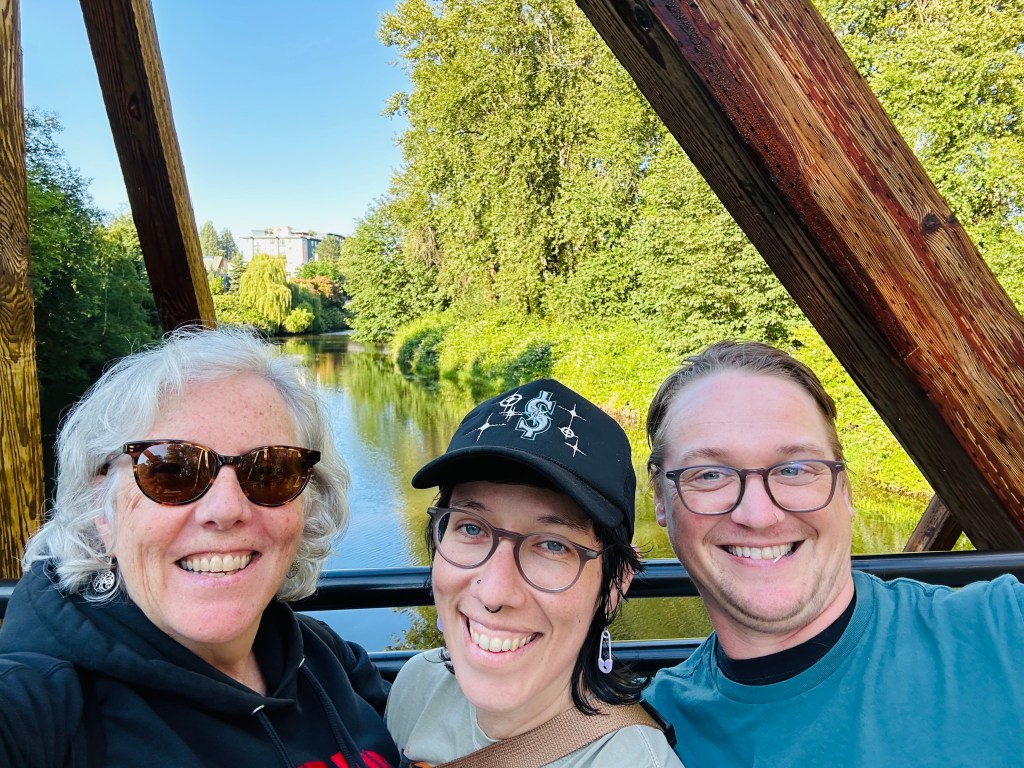
Myself, daughter Natalie and son -in-law Kevin hiking in the Sammamish River Park

While I was planning the trip, I had a certain cadence to each week.  I worked Tuesday through Thursday and would need to have WIFI and electricity since my air conditioning only works on “shore power”.  I would find my campsites on an app/website called RV Life which shows reviews, the amenities available and the strength of the WIFI connection based on the carrier.  I had each site reserved in advance and the app would show me the route and approximate time and miles between each spot.  This was invaluable and outside of one or two changes in campsites due to visits with friends, I stuck to the route as planned. Spots that were a must see such as Big Bend National Park and Joshua Tree National Park were all planned out so I knew how much time it would take to visit each spot.  I did some detours to visit a few spots when I realized how close they were like White Sands NP, Guadalupe NP and Carlsbad Caverns NP. In all I went to 11 National Parks and 2 Canadian National Parks.  Many I had visited before but the stand out new parks were Joshua Tree NP and Theodore Roosevelt NP (where two bison were crossing the road and right by Abeona!). My favorite revisited parks were a hike with my brother Rick to Olympic NP with marmots, deer, wildflowers and snowcapped peaks, the stunning Crater Lake NP and the incredible Jasper NP and Banff NP in Canada.  

I went to several state parks including Catalina SP in Tucson, Smith Rock SP in Oregon, Big Basin SP in California with my oldest brother Dave.  Many adventures were completely unplanned and were some “might as well” sort of opportunities. I went on a glider plane ride in Tehachapi, CA because I was camped next to the runway for my workweek and decided I would be mad at myself if I didn’t give it a try.  It was terrific and completely an analog as in nothing electronic which surprised me.  Not even a radio between the guide plane and the glider. I saw signs for Shasta Caverns and decided to sign up for a tour which included a boat ride and hike through the caverns. The best adventure by far was taking a helicopter ride to the Meade glacier near Skagway AK.  I signed up to walk on the glacier but the helicopter ride was terrific through the mountains and glaciers surrounding Skagway.  I was fortunate to sit in the front seat of the helicopter and I felt like a photographer for National Geographic gliding above the glacier lakes and waterfalls. 

Abeona handled like a champ on scary drives like the always windy Tehachapi pass, the 11 percent grade on the Klondike Highway out of Skagway and the countless gravel roads and unmarked portions of the Alaska Highway.  I accidentally backed into a large boulder in Catalina SP which dented my sewer system. I was so fortunate that there was a remote RV repair guy in Joshua Tree that repaired it in 112-degree weather.  I had a leak in my main water inlet but my brother Dave and a call to Leisure Travel Van (the manufacturer of my RV) helped me do a fix until I got home. I also learned to manually shift coming down the dreaded Tehachapi pass, I finally figured out my tire sensors after some help from a Facebook group for Leisure Travel Vans. The only other issue was a hitchhiking mouse I picked up in the Yukon but fell victim to a trap I set months before. I learned that tire places are perfectly happy to check and fill your tires for free (thank you Les Schwab!). 

I had the opportunity to see many friends and family along the way.  I have a dear friend Tammi and her husband Larry who took me to Saguaro NP and some fantastic Mexican food in Tucson. I visited an old coworker, Jeanne at my previous employer in Scottsdale and an old elementary school friend, Michael, in Mountain View. My brother, Dave, drove me to the Redwood Groves in the Bay Area and he and his wife, Judy, hosted me for several days in Palo Alto where I was able to see my nieces and my great nieces and great nephew. I met up with my daughter and her husband along with friend, James, in Portland for incomparable vegan food. The big celebration for my mother’s 90th birthday was a relaxed trip down memory lane and some great time spent with the entire family. I met with another elementary school chum, Jim, in Fernie, BC where we took an exciting drive up a mountain in his indestructible car (Abeona would not have survived). I was able to visit my dear old friend, Johno, from my NYC days in the mid 80’s. He has a lovely lakeside house with his husband, Jim, in Indiana.  I got to see Johno do a back flip off a swim platform and I went tubing around “Lake Jimmy John” (first time I’ve done that in 20 years). I wrapped up my trip in Covington, VA visiting my Aunt Karen, her children, Craig and Kristin and her husband, Angelo, for a lovely meal in Lewisburg, WV.

I cannot tell you how many times I talked to Abeona and thanked her for being such a bad ass for getting me on and off the ferry, and for the air conditioning working for the massive back up I experienced out of Phoenix where it took two hours to go ten miles when it was 115 degrees.  There were countless evenings where the air conditioner was on all night and it never quit! There were also the tight squeezes through road signs in Palm Springs, the pouring rain near Rusk TX, and windy roads of the Olympic Peninsula. Abeona never faltered. 

My wanderlust is definitely a gene imparted from my father and so is my hesitancy towards heights. I left my father’s ashes in places he had been to and other places where he wanted to travel and sometimes when I knew it was a view he would have loved. He said in his last few years of life that Peyto Lake was the most beautiful place on earth.  I was able to travel there on this trip and leave his ashes from the overlook.  I know he would be proud of me on this cross-country sojourn and I’m proud of myself for taking it on, doing it scared and always having Daddy riding shotgun.