
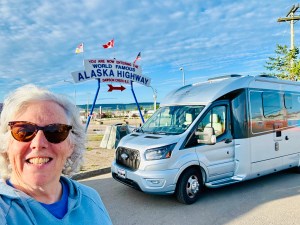
Last week I wrote a post on why I started traveling solo in an RV. This post is more about the nuts and bolts of traveling solo. The how to guide on how I set up a trip. I start working on trips sometimes up to a year in advance. I traveled to Alaska on my first cross country RV trip and I knew that I wanted to take a ferry from Bellingham Washington to Skagway Alaska. It’s an almost 3-day ferry ride off the coast of Canada and I knew that both space for an RV and a berth needed to be reserved at least 6 months in advance. Once I had that reservation, then I had a starting point for the rest of my trip, with a solid deadline of when I needed to be in Bellingham. I did the same thing for a trip to Newfoundland. Newfoundland can only be accessed by a ferry if you are in a vehicle and the ferry ride is 7 to 16 hours long depending on the port.
So, my first action is to set up the biggest constraint (like a ferry ride) and then work my way backwards and forwards from there. I have been using an app called RV Life which is a terrific tool because I can map out each RV park or destination like national parks and museums and it shows me the mileage and travel time between each destination. So, if set up an RV park and a National Park, it will show me that it’s either 15 miles apart or 90 miles apart. If I think it’s too far, I can find a different RV park. I generally will map out the major stops I want on a trip and then back my way into the timing over all. I’ve learned (the hard way) that 400 miles in Montana alone in an RV is unreasonable. There are very few services and most stops (if there are any) are on gravel roads. I have a hard stop now at about 300 miles which will take me about 6 hours depending on conditions. I have also learned to drive at least 10 miles below the speed limit. It really does save on gas mileage (remember when President Carter set a 55 mile an hour speed limit?) and when it’s windy, I am able to handle the driving better.
When planning my trips, I try to make sure I have full hook ups at least every third day so that if I need to empty by black (toilet) and gray (shower) tanks, I can. I’ve learned that I can fill my fresh water tank and it will last about 4 to 5 days depending on the length of my showers and being conservative with washing dishes. It’s amazing how in tune with my water levels I am at any given moment. Until this year, I had to make sure I had electric hook ups. I am almost always traveling in the heat of summer and I could only turn on the air conditioning if I was hooked up to “shore” power. When it was 110 in Joshua Tree, you can imagine that having hook ups was imperative.
This past year, I upgraded my solar inverter and my lithium batteries so that now I can run anything in the RV at any time. It has been a huge game changer. Not only can I run the air conditioner in the back of the RV while driving but I can also stop at a rest area and have lunch in the comfort of my rig. This may seem small but it saves on time and money and, most importantly, on decision fatigue. There are a multitude of decisions I have to make each day and trying to figure out a restaurant that I can park in that has vegetarian food in the middle of Montana can be exhausting. I can pull off the side of the road, run my microwave or make a sandwich in the comfort of a cool rig. It takes less time; I eat what I want and can always use my bathroom.
I generally fill up on gas when my tank is half full. I look for gas stations that are not busy and easy to get in and out of. Price is the last consideration. Ease of maneuvering is my main concern. I keep a running grocery list and try to shop when I am just getting into a town I am camping in or on my way out. This last trip across the United States from North Carolina to Seattle, I was moving almost every day. I constantly lock things and put things away knowing that I will be driving the next day. I have fitted Abeona with storage so that I don’t have to pack up soap, shampoo, coffee and water every day. I can set up in about 10 minutes and can break down just as quickly. I’m not putting out outdoor chairs or rugs. I’m packing the essentials, checking my tire pressure, tanks and route and heading out.
I just started using an app called “Harvest Host” this year where you can stay at farms, wineries and museums for free or for a small purchase. My first two years RVing, I always had an RV park booked with electric hook ups so that I could use my air conditioner. Since my solar upgrade, this year I spend several nights boon docking (not being hooked up to power). I like with Harvest Host that the organization is expecting me. I’m not heading out to BLM land to camp on my own in the middle of the high desert. For me, knowing that I have either paid to be somewhere or that someone is expecting me, it’s important. I don’t want a 4 AM knock on the door from someone. I want to be welcome and expected wherever I am.
Traveling solo has helped me feel so much more self-reliant. Everything is possible with a little planning, managing expectations and realizing my limits.

