Take the Stairs 👍

You’ve procrastinated all morning.  You keep checking your inbox or Instagram feed and haven’t touched that project you’ve been meaning to work on.  One more cup of coffee.  One more like on Facebook.  You’re staring at the staircase and then looking down at your phone to see if there is one more thing that you can use to distract yourself from actually, finally taking that step.

My dear friends Susannah and Janine on our trip to Paris

This has been me this morning.  I have set this time aside to write and all I want to do is putz around.  I keep opening my inbox thinking, “What are you doing here again? Get to work!”  I am never going to get to the top of the stairs unless I at least start.

So here are some things to keep in mind to get you going:

  • Time blocks. What really got me writing this morning was knowing that this was my time block to write.  I have a commitment to myself that I will get a post done by noon on the weekends.  It’s now 10:39 AM and I have to start.  I have to spend at least 30 minutes on it even if I have no idea what I am going to write.  So I write.  I know some of my clients have set up time blocks for returning phone calls, responding to emails, exercising and being with their families.  Set up time blocks and make a commitment to your work.
  • Have a vision.  What does the top of the stairs look like to you?  My vision is “Make a difference in people’s lives”.  Writing these posts aligns with that vision.  Even if one person reads this post and changes one thing in their life because of it, then it’s worth 45 minutes of my time to make that happen.  Know why you are doing what you are doing and align your efforts with it. How will that production report affect your organization?  How will that conversation with your co-worker move you forward in attaining your vision?  Line up your actions with your vision.
  • Frequently the steps aren’t easy.  I have struggled with this.  When I was in Paris several years ago, I ended up having to take a spiral staircase to many of my destinations.  I’m really tall and have large feet, so trudging up a small spiral staircase is not only difficult but I can’t see the top.  When we were visiting Sainte-Chapelle (a cathedral built in 1248), my friend and Francophile, Susannah, pointed to a very narrow stone spiral staircase to travel up.  I figured there is no way this building (built 8 centuries ago) is worth being claustrophobic or on my tip toes for.  I was wrong.  Against my better judgment, I followed Susannah up the staircase.  The top of the stairs revealed one of the most heart-stopping, breathtaking, stained glass-encrusted spaces I have ever been in. Take the steps–the view may surprise you.
  • Step into fear.  My friend Janine and I went to the Eiffel Tower the day after the Brussel airport bombing.  We had tickets to what I thought would be the 1st landing of the tower.  I’m not crazy about heights and I figured that would work just fine.  It turns out we had tickets to the top.  When we got to the top, there was another staircase to go up. Janine was game to go up and I was fine where I was.  She ran up the stairs and came back down to get me. “Cath, you gotta come!”  I stepped into my fear, took the steps and saw a Paris I will never forget.  If I reframed it as a challenge rather than a fear, it became much easier to conquer.
  • Have support.  I’ve already shown you two examples where my friends have supported me in venturing up staircases with terrific results.  These same friends are in “Cathy’s Brain Trust” and they give me weekly feedback on my posts.  I feel accountable to them to continue to write.  Who is depending on you?  Who are you supported by?  When pushing through to your highest aspirations, you need to make sure you have support.  My daughter is part of that group and she knows me well. Writing is definitely a challenge and I know she’s always cheering me on.
  • Be open to the unknown.  Frequently we don’t know exactly where we are headed.  We have a vision but there is so much that is unseen from the bottom of the staircase.  My friend Susannah and I were hiking in Haystack State Park.  At the end of the hike was Haystack Tower…with a spiral staircase no less.  It was a hot, humid day and I think the last thing I  wanted to do was go up the tower’s two flights of stairs.  Susannah assured me that the views were at the top of the tower.  So-you guessed it-I went up the two flights and the payoff was a view of three states at once: MA, CT and NY.  Stick it out and it will pay off.
  • One step at a time.  Many times I have clients who are frozen from being overwhelmed.  They want to take action, but when they decide they want to write a book, it’s paralyzing.  They can’t take any step because a step like “write a book” is not easily done in a morning.  The key is to break it down into chunks.  Bite-size chunks like “write an outline”, “decide what software to use” or “research books on writing non-fiction for one hour”.  Break it down one step at a time so that the step can be accomplished in 90 minutes or less.

This isn’t always easy when there are so many distractions in life.  It’s easy to think that skimming through and putting out fires is getting you to where you want to go.  Figure out which staircase you want to go up and start with one small step.  The view from the top is going to be awesome.
🧐Curiosity: the Antidote for Fear

I’ve been taking several team coaching courses through CRR Global. Our facilitator said something really thought provoking. Curiosity is the antidote for fear. She posited that you can’t hold fear and curiosity at the same time. I guess this is why Curious George seemed to escape dire consequences because he wasn’t holding onto fear and examining all the “what if’s”. Rather liberating isn’t it? Just be curious and fear will melt away.

As I look back, I think the period of my life where I was consumed with fear and struggled with worrying about all that could go wrong was when my son was two. He was a toddler capable of dragging a tricycle onto a kitchen table and then sitting on it. He lacked any sense of fear. I was tethered to my son’s hand in every parking lot, store, amusement park, Movie Theater….for about three years. He had no sense of danger. No limits. I remember sitting several rows back at a Cirque du Soleil performance and he ran down the aisle to try and go on stage. We caught him just shy of the first step. Crisis averted. His curiosity struck fear in me. Thank goodness they grow up. Thank goodness he and I both survived.

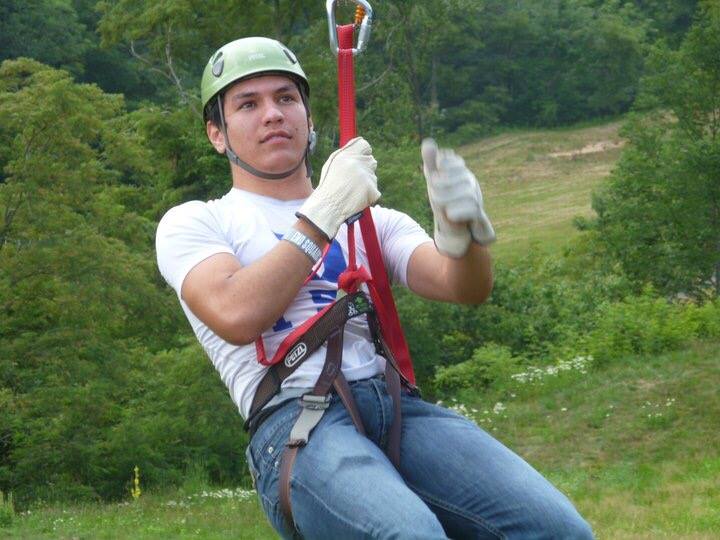
My son, Benson, zip lining.

I’m not saying we shouldn’t watch out for our toddlers and let them go play in traffic; but there is a lot to be learned from having an open curiosity about the world. I personally am game for any antidote for fear. So here are some ideas for embracing curiosity.

1. Open. To be able to embrace curiosity, you need to be open. Be available for the experience. I remember going for a zip line experience with my son a few years ago. I initially asked him if he wanted to go try it out and he was game (no surprise there). To be honest when I asked him I hadn’t really thought through that this meant I would be flying through a forest several hundred feet above the ground. I am not a dare devil but I was open. I didn’t come up with a laundry list of why I shouldn’t do it. It was more about seizing the opportunity to do something fun with my son before he headed off to college. When they strapped us into our gear and the helmet was on, well…it was too late to worry about fear. We had a blast and suffered no injuries. Be open.

2. Scientist. Put on your scientist hat…or a lab coat. I remember taking food chemistry lab at Cornell. I was a Hotel Administration major and we spent hours messing with something basic like baking a cake. In one recipe we would double the baking powder, in another, we would leave out the eggs, in another, we would use oil instead of butter. As you can imagine (if you bake at all you know it is a science) the resulting cakes would be vastly different. I could see the cause and effect at work. It was a great learning experience although some of the end products were awful. Tinkering with various aspects of recipes has helped me to be a better cook. Take time to become the scientist.

3. Wonder. To be in “wonder” for me, means to be absolutely present and free of assumption. You need to let go and be. I can remember my kids as toddlers on Christmas morning. The larger presents from Santa would be all set up (i.e. Hot Wheels race tracks, Barbie dream house…etc). There was an overwhelming amount of things in the room but my son would run up to the racetrack and start playing. He would spend 30 minutes before he was ready to move on. He was present in his wonder and took it all in at his pace. Embrace wonder.

4. Talk to your triggers. We just practiced this in my CRR Global class. Being triggered is when you go into fight or flight mode. I get triggered when someone says a sexist statement like “those football players are playing like girls.” Suddenly my 30 year old neighborhood bully named “Joe” breaks out and wants to teach somebody a lesson and I shut down and can’t think. When I separated from my triggered self (through coaching), I could dream up a new way to deal with Joe the next time I get triggered. I can show up as my adult self and keep Joe in the back room by the red phone. Having a plan to deal with your triggers helps keep you resilient, in the moment, and keeping fear in check.

5. Muscle. Work your curiosity muscle on a regular basis. This is kind of like getting out of the status quo. Shake up your routines. Try a different drink at Starbucks, cross your arms the opposite of normal, drive a different route to work, eat vegetarian all day or call your brother you haven’t spoken to in months. It might be a little (or a lot) uncomfortable but it gets easier the more you do it. You can flex that curiosity muscle more easily. Flex your muscles.

The beauty of embracing curiosity is that life becomes that much fuller, more interesting, more adventurous. The view is different there. Lean in.

My daughter. My Hero.

This is for my daughter on her twenty-ninth birthday!

My daughter, Natalie, is my stable rock. My ballast. My hero. She has recently turned twenty-five and moved to Seattle about a year ago.  I had the great fortune to spend a recent weekend with her in New Mexico where she was born.  It was great fun to return to a state that has many natural marvels and be able to give context to how her life began.  Some twenty-six years earlier, my first husband and I moved to Albuquerque to run a restaurant and try our luck as entrepreneurs.  The restaurant eventually failed and put immense pressure on our marriage.  The wonderful shining glory that came out of that ill fated move to Albuquerque was a delightful, precious blue-eyed baby girl with an infectious smile and laugh.

Outside of a return trip to New Mexico when Natalie was eight, she has not returned.  She has faint memories of that trip and certainly does not remember her first four months of life in the Land of Enchantment. We had a lot of fun returning to where it all began. It also brought up some of the reasons I have depended on her for so much in her quarter century on the Earth.

32105357_10156289247988688_8586567131481505792_o
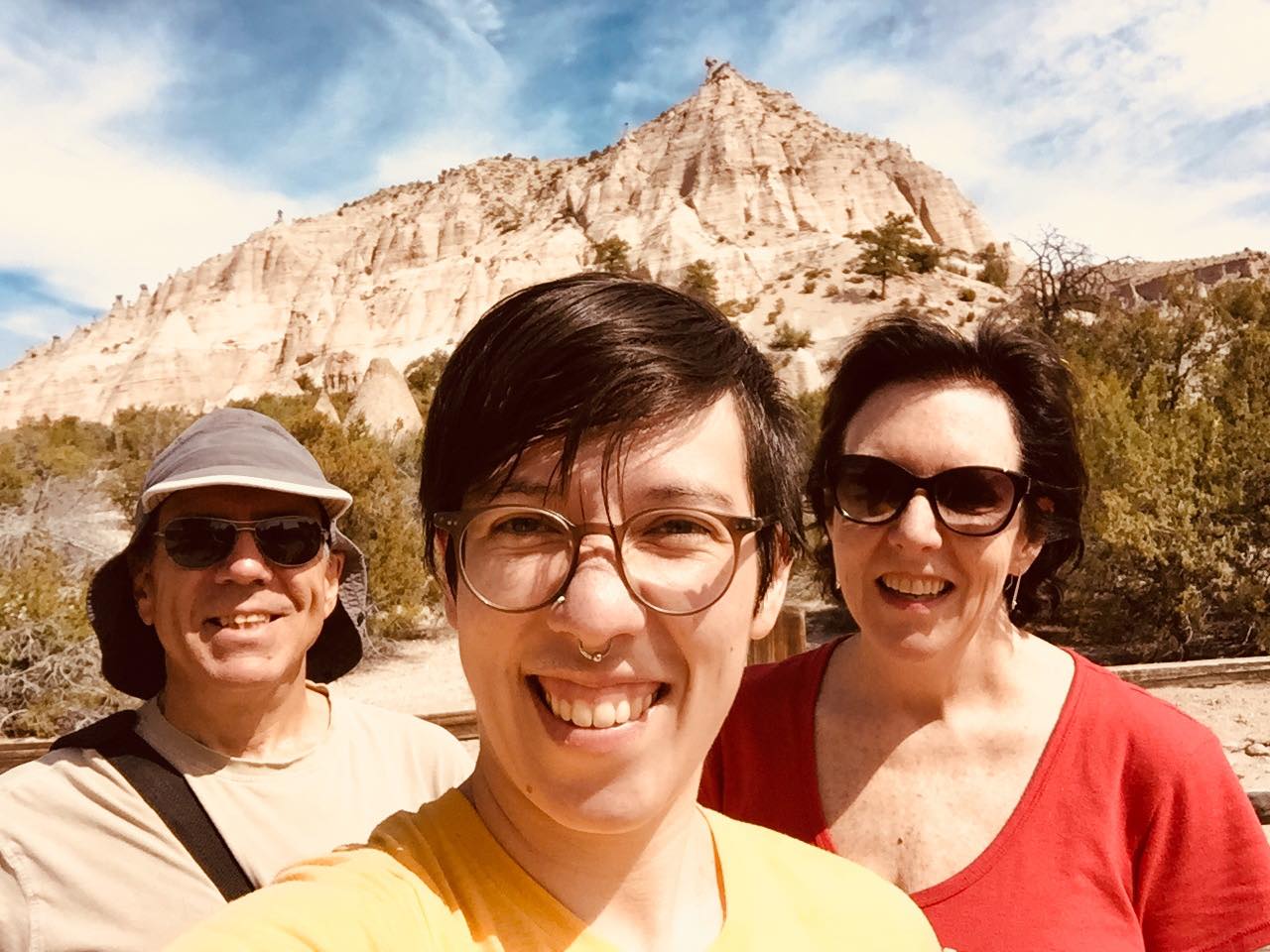
My brother, Rick, my daughter, Natalie and I hiking in New Mexico in 2018

Here are the ways Natalie is my hero:

Open. Natalie is open to any and all adventures. We did not have much of an agenda once we landed at Albuquerque’s Sunport except for a restaurant reservation or two.  Whether it was strolling the plaza in Santa Fe or taking a hike around a reservoir, Natalie was open.  She had no deadlines, no agenda, no must-see spots.  I feel like so many people in life have hidden agendas or hidden intentions.  Not Natalie. Anything goes. Wanna hike?  Sure.  Shop? You bet. Sleep in? OK. It makes me rethink how open I am to what is next. Be open.

Decisive.  Natalie may be open to all the options but once she has made up her mind, or the group has made up their mind, she goes after it. We had decided to hike Tent Rocks located outside of Santa Fe with my brother, Rick.  Once the decision was made, there was no going back.  I’m pretty sure that even if it was raining or 110 degrees, Natalie would have made it to the top of that slot canyon. She was committed. Even a random crossing of a rattlesnake on our path could not deter her from her destiny. Once you have weighed out all your options, be decisive.

Empathy. I have always had an issue with balance. I pause at the top of steps and escalators to get my barring. There were several times along the hike that Natalie grabbed my hand. I didn’t ask. She knew. When navigating very narrow footings, she said, “just one foot in front of the other.” I didn’t ask. She knew. As we hiked she would insist on a water break.  Not for her. For me. She pays attention. She senses the discomfort. She anticipates the need. It’s such a gift that I don’t know she is even aware she has it. Be in tune to those around you.

Navigator. Natalie and I had explored a trail near Santa Fe around a reservoir.  The trail was not well marked.  Towards the end of the hike we lost the trail. Pretty soon we were hiking through low uncharted brush and no fellow hikers were to be seen.  We had no GPS.  No cell coverage. I felt a bit of concern. There was no need. Natalie had a feel for where we were and led us back to the trail head and parking lot. There have been many hiccups and storms in my life over the last year and Natalie has been the calm navigator seeing me through. Make sure you have a sound navigator to help you through the storms.

Ballast. Every boat has a ballast to weight the boat upright. Natalie is my ballast. She is rarely rattled by events and keeps an even demeanor.  I can be easily flustered and fly into worst case scenarios. Natalie keeps me balanced by listening and asking questions to help me understand my own thinking. I may be ready to unload all the cargo on the boat or drop anchor but Natalie is the voice of reason.  Who is your ballast.  Maybe you are a ballast for someone else.  It’s important to have a ballast to even things out.

Joy. Natalie has infectious energy. She also happens to be a great selfie taker.  There she is in the center of the photo flashing her enchanting smile.  I cannot look at a photo of her without smiling. She is joy. She is possibility. She is magic. There are very few people that I know who exude that joyful energy. It sparks action. Everything seems possible when there is joy in the room.  I am so fortunate to have her in my life. Find joy.

I am so proud to be Natalie’s mother and, most importantly, that she is in my life. She makes everything brighter and more amazing. Who is your hero?

My Hero. My Daughter.

I originally posted this four years ago. She is still my hero.

My daughter, Natalie, is my stable rock. My ballast. My hero. She has recently turned twenty-five and moved to Seattle about a year ago.  I had the great fortune to spend a recent weekend with her in New Mexico where she was born.  It was great fun to return to a state that has many natural marvels and be able to give context to how her life began.  Some twenty-six years earlier, my first husband and I moved to Albuquerque to run a restaurant and try our luck as entrepreneurs.  The restaurant eventually failed and put immense pressure on our marriage.  The wonderful shining glory that came out of that ill fated move to Albuquerque was a delightful, precious blue-eyed baby girl with an infectious smile and laugh.

Outside of a return trip to New Mexico when Natalie was eight, she has not returned.  She has faint memories of that trip and certainly does not remember her first four months of life in the Land of Enchantment. We had a lot of fun returning to where it all began. It also brought up some of the reasons I have depended on her for so much in her quarter century on the Earth.

32105357_10156289247988688_8586567131481505792_o
My brother, Rick, my daughter, Natalie and I hiking in New Mexico

Here are the ways Natalie is my hero:

Open. Natalie is open to any and all adventures. We did not have much of an agenda once we landed at Albuquerque’s Sunport except for a restaurant reservation or two.  Whether it was strolling the plaza in Santa Fe or taking a hike around a reservoir, Natalie was open.  She had no deadlines, no agenda, no must-see spots.  I feel like so many people in life have hidden agendas or hidden intentions.  Not Natalie. Anything goes. Wanna hike?  Sure.  Shop? You bet. Sleep in? OK. It makes me rethink how open I am to what is next. Be open.

Decisive.  Natalie may be open to all the options but once she has made up her mind, or the group has made up their mind, she goes after it. We had decided to hike Tent Rocks located outside of Santa Fe with my brother, Rick.  Once the decision was made, there was no going back.  I’m pretty sure that even if it was raining or 110 degrees, Natalie would have made it to the top of that slot canyon. She was committed. Even a random crossing of a rattlesnake on our path could not deter her from her destiny. Once you have weighed out all your options, be decisive.

Empathy. I have always had an issue with balance. I pause at the top of steps and escalators to get my barring. There were several times along the hike that Natalie grabbed my hand. I didn’t ask. She knew. When navigating very narrow footings, she said, “just one foot in front of the other.” I didn’t ask. She knew. As we hiked she would insist on a water break.  Not for her. For me. She pays attention. She senses the discomfort. She anticipates the need. It’s such a gift that I don’t know she is even aware she has it. Be in tune to those around you.

Navigator. Natalie and I had explored a trail near Santa Fe around a reservoir.  The trail was not well marked.  Towards the end of the hike we lost the trail. Pretty soon we were hiking through low uncharted brush and no fellow hikers were to be seen.  We had no GPS.  No cell coverage. I felt a bit of concern. There was no need. Natalie had a feel for where we were and led us back to the trail head and parking lot. There have been many hiccups and storms in my life over the last year and Natalie has been the calm navigator seeing me through. Make sure you have a sound navigator to help you through the storms.

Ballast. Every boat has a ballast to weight the boat upright. Natalie is my ballast. She is rarely rattled by events and keeps an even demeanor.  I can be easily flustered and fly into worst case scenarios. Natalie keeps me balanced by listening and asking questions to help me understand my own thinking. I may be ready to unload all the cargo on the boat or drop anchor but Natalie is the voice of reason.  Who is your ballast.  Maybe you are a ballast for someone else.  It’s important to have a ballast to even things out.

Joy. Natalie has infectious energy. She also happens to be a great selfie taker.  There she is in the center of the photo flashing her enchanting smile.  I cannot look at a photo of her without smiling. She is joy. She is possibility. She is magic. There are very few people that I know who exude that joyful energy. It sparks action. Everything seems possible when there is joy in the room.  I am so fortunate to have her in my life. Find joy.

I am so proud to be Natalie’s mother and, most importantly, that she is in my life. She makes everything brighter and more amazing. Who is your hero?

My daughter. My hero.

My daughter, Natalie, is my stable rock. My ballast. My hero. She has recently turned twenty-five and moved to Seattle about a year ago.  I had the great fortune to spend a recent weekend with her in New Mexico where she was born.  It was great fun to return to a state that has many natural marvels and be able to give context to how her life began.  Some twenty-six years earlier, my first husband and I moved to Albuquerque to run a restaurant and try our luck as entrepreneurs.  The restaurant eventually failed and put immense pressure on our marriage.  The wonderful shining glory that came out of that ill fated move to Albuquerque was a delightful, precious blue-eyed baby girl with an infectious smile and laugh.

Outside of a return trip to New Mexico when Natalie was eight, she has not returned.  She has faint memories of that trip and certainly does not remember her first four months of life in the Land of Enchantment. We had a lot of fun returning to where it all began. It also brought up some of the reasons I have depended on her for so much in her quarter century on the Earth.

32105357_10156289247988688_8586567131481505792_o

Here are the ways Natalie is my hero:

Open. Natalie is open to any and all adventures. We did not have much of an agenda once we landed at Albuquerque’s Sunport except for a restaurant reservation or two.  Whether it was strolling the plaza in Santa Fe or taking a hike around a reservoir, Natalie was open.  She had no deadlines, no agenda, no must-see spots.  I feel like so many people in life have hidden agendas or hidden intentions.  Not Natalie. Anything goes. Wanna hike?  Sure.  Shop? You bet. Sleep in? OK. It makes me rethink how open I am to what is next. Be open.

Decisive.  Natalie may be open to all the options but once she has made up her mind, or the group has made up their mind, she goes after it. We had decided to hike Tent Rocks located outside of Santa Fe with my brother, Rick.  Once the decision was made, there was no going back.  I’m pretty sure that even if it was raining or 110 degrees, Natalie would have made it to the top of that slot canyon. She was committed. Even a random crossing of a rattlesnake on our path could not deter her from her destiny. Once you have weighed out all your options, be decisive.

Empathy. I have always had an issue with balance. I pause at the top of steps and escalators to get my barring. There were several times along the hike that Natalie grabbed my hand. I didn’t ask. She knew. When navigating very narrow footings, she said, “just one foot in front of the other.” I didn’t ask. She knew. As we hiked she would insist on a water break.  Not for her. For me. She pays attention. She senses the discomfort. She anticipates the need. It’s such a gift that I don’t know she is even aware she has it. Be in tune to those around you.

Navigator. Natalie and I had explored a trail near Santa Fe around a reservoir.  The trail was not well marked.  Towards the end of the hike we lost the trail. Pretty soon we were hiking through low uncharted brush and no fellow hikers were to be seen.  We had no GPS.  No cell coverage. I felt a bit of concern. There was no need. Natalie had a feel for where we were and led us back to the trail head and parking lot. There have been many hiccups and storms in my life over the last year and Natalie has been the calm navigator seeing me through. Make sure you have a sound navigator to help you through the storms.

Ballast. Every boat has a ballast to weight the boat upright. Natalie is my ballast. She is rarely rattled by events and keeps an even demeanor.  I can be easily flustered and fly into worst case scenarios. Natalie keeps me balanced by listening and asking questions to help me understand my own thinking. I may be ready to unload all the cargo on the boat or drop anchor but Natalie is the voice of reason.  Who is your ballast.  Maybe you are a ballast for someone else.  It’s important to have a ballast to even things out.

Joy. Natalie has infectious energy. She also happens to be a great selfie taker.  There she is in the center of the photo flashing her enchanting smile.  I cannot look at a photo of her without smiling. She is joy. She is possibility. She is magic. There are very few people that I know who exude that joyful energy. It sparks action. Everything seems possible when there is joy in the room.  I am so fortunate to have her in my life. Find joy.

I am so proud to be Natalie’s mother and, most importantly, that she is in my life. She makes everything brighter and more amazing. Who is your hero?

Good Enough

Good Enough IS Perfect. 5 Ways to Get Off the Perfection Treadmill.

Sometimes there is this feeling that you are settling when something is good enough. Like you left some money on the table or you aren’t trying to be an over achiever. But it turns out that good enough will make you happier, satisfied, and content. In Tal Ben-Shahar‘s book, Pursuit of Perfect, there is a big price to pay for the constant striving for perfection. The author paid the price while attending Harvard. Anything less than an “A” was failure, so he worked constantly to make sure he could maintain his perfection. And the price? He wasn’t happy. When you are constantly striving for perfection, you never get to the destination. You think you are but you never arrive. That’s if great success is supposed to be a college degree, making your first million or finally getting married. You might hit a bump in happiness, but the next day, you are back on the perfection treadmill.  Good Enough

I am amazed at how many of us are out there on that treadmill. Beating ourselves up for every B- paper, one pound gained or bad hair day. We are ever vigilant to find out how we failed and how we did not attain success. The constant interior score card. “I should have stayed late”, “I can’t believe I ate the chocolate cake,” or “I never spend enough time with my kids.” It’s the constant balancing act of being all things to all people. I remember thinking I was stretched in college between school work, my social life and my part-time job. That was way before email, smart phones and the digital deluge made you feel overwhelmed, let alone children, aging parents, full-time jobs and a spouse. Ben-Shahar had some great points on how to achieve good enough and to embrace being human.

Here are some ideas on how to be OK with good enough:

1. Accept. We need to accept the good with the bad. The problem is that we tend to over react and ruminate over the failures. In focusing on all that went wrong, we gloss over what went right. I can tell you ever bad training I’ve facilitated but will forget the successes. I remember everything the boss didn’t approve but when it comes to the laundry list of things she has approved, they are buried deep, never to see the light of day. I can’t tell you how many people can’t take a compliment. I say “I love that necklace!” Co-worker “This old thing? My mom bought it from a street vendor in Mexico. I don’t think it’s worth 5 bucks.” We are hard-wired to reject the good and focus on the bad. Accept what is good in your life.

2. Open. Be open to feedback. Perfectionists want to maintain a façade of perfection. They deflect criticism. They hide from it for fear they will crumble. If you seek out feedback from both good and bad experiences, you become more resilient. I seek out feedback from both coaching clients and training participants. I embrace and accept the “That was great, Cathy” and the “I felt rushed” comments equally. I find that people who aren’t open to feedback tend to get paranoid. They are afraid that everyone dislikes them which makes them even more fearful of feedback. Really? There aren’t that many people that are unilaterally disliked (i.e. Madoff, Hussain, etc.). But they are so busy preserving their self-image that they can’t make course corrections like “being a better listener” or “you could delegate more clearly” along with the “you have a great sense of humor” and “that meeting took courage”. Open up to it all.

3. Release. Try and release that you need to be all things to all people all the time. I have to admit that this has been a struggle. This is especially difficult during the holidays. There was a time when I baked 20 different types of holiday cookies with my then small children (they weren’t that helpful and there was a lot of raw cookie dough consumed) and delivered them to all my employees at the restaurant I owned. All the burnt, dented and mal formed cookies befell my stomach and the rest of the “perfect” cookies were given to all my deserving employees. While this was a very noble gesture, it was completely impractical and made me very anxious every Christmas as my kitchen filled with hundreds of cookies, my kids did not have my full attention, and I become overwhelmed. I am wiser now. I instead put out about a third of the holiday decorations, walk right past the chocolate chips at the grocery store and give a card to my employees. To be good enough means to release the unrealistic expectations.

4. Allocate. Find ways to reasonably allocate your time. Perfectionist are looking ways to maximize their day to try an accomplish EVERYTHING. When they don’t? They are crushed by the failure. Be realistic. Can you really take the dog for a walk, work 10 hours a day, make dinner, take your daughter to ball practice, do the laundry, read a novel, AND run for 2 miles? No. You can’t. OK, you can for maybe one day out of the week but you will be toast by the end of the day. Toast. Figure out how much time you want to spend in a given week on everything that is important to you and then back off about 30%. So if you want a date night with your spouse every week, go out every other. If you want to get that project done at work, schedule an hour every day instead of trying to plow through it in a day and a half. Knowing that you have allocated the time and will be able to have an adult conversation with your spouse at least every other week will feel great, and make sure it actually happens instead of feeling guilty that you couldn’t do it all. Allocate your time.

5. Mono-task. Multitasking is exhausting and it’s really just task switching. You aren’t really texting and driving, you are driving, then texting, then driving, then texting, then driving (then crashing). When you spend your day talking on the phone while answering email or watching TV while eating dinner, you are numbing yourself to the world. You are not present and it is completely unsatisfying. So decide you are going to text, and sit down and text. Talk to your brother on the phone and turn off the television. Go out to dinner with your son and put your cell phone in your pocket. You’ve decided where you want to allocate your time, so go be present for that time. Embrace mono-tasking.

The interesting thing is there are certain pockets of our lives that we reserve for perfection. For me, it has been my coaching and facilitation work. It was wonderfully freeing to me when my coach mentor, Satyam Chalmers, said that there was no perfect question. If a question falls flat, your presence is more important than finding the perfect question. Whew. What a relief. It’s the same for facilitation. I can feel like I haven’t followed the “script” but going with the flow of the room is much more important. I’m good enough and enjoying the work so much more.

Think outside the Boomer Box. How to work with Millennials.

The next generation is invading the workforce and we are all going to need to adapt.  The expectation of a recent college graduate is vastly different than those boomers who are checking their 401k balance everyday and trying to figure out their escape plan.  For those of you who haven’t been in a college classroom lately, let me bring you up to date, the twenty-somethings are texting on their smart phones, sitting behind laptops and  have never cracked the spine on an encyclopedia.  So imagine the shock and horror, when they enter the workforce and they are dumped into a joyless cubicle, only have access to company approved websites and can’t use their cell phone because it’s prohibited by company policy.  Hmmm.  I think we have a problem.  We just put the handcuffs on; we’re bridling a generation that doesn’t even know what that means.

The average Millennial, born between 1980 and 2000, is expected to work 1.7 years at any given company.  In Human Resource terms, that is a blink of the eye.  Recruiting, attracting, on-boarding, training and retaining seem hardly worth the effort for 1.7 years of tenure (unless of course you are McDonalds).

So how are you going to retain these “kids”?  We’re going to need to take a hard look at our work environments, policies and leadership skills and adapt.  Some boomers may delay retirement for a few more years but there is going to be deficit in the skilled employable talent pool.   The Bureau of Labor Statistics estimates that within 8 years, Gen Y will be the majority generation in the workforce.

Here are some ideas on how to hold on to Gen Y and Z:

1. Purpose.  GenY can easily work for the Peace Corps in Africa for 2 years as work for a for-profit company. This group is looking for a higher purpose.  Profit for shareholders isn’t likely to cut the mustard.  If you can link your company’s vision and mission to a higher purpose, Gen Y might stick around.  Is your company giving back to the community, developing green initiatives or supporting a cause?  Are you communicating that or are you writing checks and keeping your mouth shut?  Communicate it.  Often.  And in varied ways

2. Feedback. Give it to them straight.  In an article from the Harvard Business Review by Meister and Willyerd called Mentoring Millenials, what Millenials want from their boss is someone “who will give me straight feedback”.  No sugar coating.  No veiled criticism.  Cut to the chase.

3. Recognition.  This is the generation where everyone got a trophy for just participating and in some cases, they didn’t get grades or never kept score during the game.  They have been recognized just for showing up.  This doesn’t need to be a huge budget for purchasing trophies for “just showing up to work,” a specific, sincere thank you for a job well done and why it’s important to the company’s goals will suffice.  This will build loyalty.

4. Freedom. You might think about how much latitude you are giving this next generation.   Antiquated policies about dress code, cubicle decorum and a staunch 8 to 5 work schedule isn’t likely to attract these folks.  If your business permits (I’m not suggesting that a bank teller should be able to work virtually), loosen the reins a little.  If you want some contrast, check out this video about Zappos culture.

5. Social. This generation has been collaborating and socializing since grade school.  Is your company culture open to supporting collaboration below the executive team?  Are your departments throwing a BBQ once in a while?  What are you doing to get to know your younger employees?  Get social.

6. Technology.  They are going to demand that you have technology.  A 2008 LexisNexis® Technology Gap Survey found that only 14% of Boomers access social networking sites from work; 62% of Gen Y do. Does your workplace permit such things as Facebooking at work? Have you figured out how to manage it?  The workplace is changing.

7. Challenge.  Busy work isn’t going to cut it.  This group isn’t about “paying their dues” for 10 years before having an opportunity to test the waters.  My nineteen-year-old daughter had an internship this summer for a documentary company.  Within three weeks of starting, they let her edit a piece of the documentary.  Is your company willing to do that?  How are you challenging this next generation? Challenge them early and often.

8. Open. Whether you are ready or not, within the next eight years more than 50% of the workforce is going to be Millenials.  Are you open to change?  Regardless, it’s going to happen.  Work/life balance, flexible work schedules and virtual offices are here to stay.  Think outside of the boomer box and open yourself up to the next generation.

I realize that not all industries can adopt all of these measures, but we can take some steps on one or two.  This is not one-size-fits all.  The point here is to stay ahead of the talent war looming  within the next decade.

Humility is the secret sauce. 7 steps to grab some.

One of the best bosses I ever worked for was calm, patient and a great listener. He was also humble. He wasn’t humble in a self-deprecating Woody-Allen, sort of way. I can imagine that even if he just ran the football across the end zone in a game winning run he would never have done an end zone dance. He was the kind of guy that would pat everyone else on the back and never take credit for one iota of effort. He had the secret, elusive sauce which is difficult to find in most managers; he had humility in spades. Humility.  The secret sauce.

I have encountered many managers that are more like strutting peacocks. They’ve got their feathers out and want to make sure they get noticed by everyone. They take credit for all the wins and none of the losses. They are quick to make demands, dictate the outcomes and prescribe all tasks. These types of managers tend to be more about their agenda and closed off to input from the riff raff who actually have their hands on the product. They start believing their own delusions of grandeur and over valuing input from those hanging onto their coattails (otherwise known as brown-nosers).

So how do you foster humility? Here are some ways to get a hold of the secret sauce:

1. Admit. Make sure you admit your mistakes. I’ve seen managers spend an inordinate amount of time trying to cover up or search to find the culprit. Any culprit. Someone to peg the budget shortfall on or the loss of a big account. If you want a politically mired organization that has everyone pointing fingers, then don’t admit your mistakes. If, on the other hand, you want folks to trust you and respect you, be sure to admit your mistakes. Being perfect is way over rated. Admit your mistakes.

2. Even. Keep yourself on an even keel. No one likes reporting to a drama queen unless it’s RuPaul. If your direct reports are unsure of who might show up today: Dr. Jekyll or Mr. Hyde then you are unpredictable and that makes you difficult to work for. Humble leaders roll with the punches and inspire respect. People aren’t worried that the ship is going to sink just because we took on a little water, because you are sitting at the helm, confident and calm. Keep an even keel.

3. Open. Be open to all information. You don’t need to know all things to be a great leader. Humble leaders can say, “I don’t know”. I see this a lot in newly promoted leaders. They feel like they were promoted because they had all the answers, so therefore, they must have all the answers at all times or they are a fraud. I know you are in a difficult spot to prove yourself but your direct reports will have your back if you can admit you don’t know. Don’t be a know it all.

4. Them. It’s about your direct reports and making them shine. Selflessly promote those that are performing for you. You should be spanning the organization (and maybe even outside the organization) for growth opportunities for your direct reports. There are many managers in my past who went to the mat for me to either get me promotions or stretch assignments or money. I would go through fire for them. Leaders who look out for their flock, have life long advocates and trusted friends they can count on. You can never go wrong by watching out For and developing your team.

5. Listen. Listen without an agenda. Listen to all the ideas, the issues, the hiccups and the wins. It’s easy to dismiss some crazy idea for a purple squirrel catcher, but hear them out. Ask open ended questions to drill down. I love this quote “Speak in such a way that others love to listen to you. Listen in such a way that others love to speak to you.” – Unknown. If there is one talent a humble leader has it’s being a great listener. Listen to understand.

6. Hype. Don’t believe the hype. I can remember being a recently promoted manager when I was in the restaurant business. It’s easy to start thinking you can do no wrong and either resting on your laurels, or worse, resting on your team’s laurels. If we had record breaking sales on Mother’s Day (THE biggest restaurant day of the year), you need to celebrate it with your team and then, get back to work. Pull your weight. Show up and do the work.

7. Space. Make space for others to contribute. This involves delegation but also empowerment and collaboration as well. As Google’s SVP of People Operations, Lazlo Bock says ““Your end goal, is what we can do together to problem-solve. I’ve contributed my piece, and then I step back.” You haven’t dropped it but you are giving your folks latitude to go in new directions. This is the opposite of micro management for all you “fixers” out there. I know it’s tough, but let go and give some space.

I find it troubling that when you look up synonyms for humility, there are a lot of words that speak to weakness. I don’t think that is true. In fact, a humble leader is one who is confident enough to not have to prove it every day. They can stand back and help others blossom.

Attitude and the Flawless Croissant. Never Lost in Translation

I recently traveled to the province of Quebec with my daughter. French is the official language in Quebec and neither my daughter, who is fluent in Spanish, nor I speak French. I have to admit that I took three years of French in high school but outside of a few cooking terms like mise en place and sauté…I don’t remember a lick of it. This was quite intimidating as we crossed the border in our car on Interstate 89 just north of Burlington, Vermont needing to find a bathroom desperately.

Quebec is largely rural with a ton of farms, and, to our dismay, did not have any gas stations or fast food locations within the first 40 or so miles inside the border. And EVERY sign was in French. In addition, my cell coverage was not working. This might have been a bad idea. We are reading signs as we pass through the little villages near the border. “Bar Laiter” appeared on several signs. “Wow, they sure have a lot of bars here in Canada”. Finally, one of the signs that said “Bar Laiter” also had a picture of an ice cream cone. “Ohhhh. That’s a dairy bar. Let’s see if they have a bathroom”. We walked into the shop and there in the back was a sign saying “Toilettes”. Whew. When in doubt, always look for the food sign, a food sign, any food sign!

As we traveled through Montreal and Quebec City for the next few days, we learned that food would be our common denominator. Here are some key learning’s:

1. Greetings. Wherever you go, be sure to know the local greetings. Whether “bon jour” or “howdy” or “hola”…know how to greet folks in their own language. Making the effort to meet them in their own language shows respect and effort on your part. It’s ok if your “bon jour” lacks any Parisian flair and nuance (heck you don’t want them to think you really speak French anyway). It’s fine if if you sound like a New Yorker speaking Midwestern; people will make allowances if you try. There is nothing so sweet as the waiter or valet responding with a sweet , melodic “bon jour” in return. Study up on your greetings.

2. Smile. A smile forgives a thousand sins. It’s easy to get so nervous about a lack of fluency that we put our stone face of fear on. The best response is smiling. It is the international language. A smile is disarming. It’s very difficult to get upset if someone is smiling at you. Even if you don’t know how the credit card machine works or need directions to the ladies room ~ Smile.

3. Patience. Turn up your patience dial. Just 48 hours before arriving in Montreal, we had been in the center of stress inducing, manic, adrenaline provoking Manhattan. The pace in Manhattan is in stark contrast to laid back Montreal. When you eat in a restaurant, it’s expected as we later learned from our tour guide, that a meal will take hours and no one is ever going to ask you to leave or even present a check until you ask. We were on vacation for god’s sakes. Relax. Linger. Take your time. Embrace patience.

4. Local. Eat local. We found out on a food tour we took in Old Montreal, that Canada produces excellent duck and maple products. In the next three days, we had every manner of duck (canard in French) from confit, to pate, to a’la Orange. Delightful. In fact, every menu contained duck and every preparation was wonderful. Quebec is the center of the world on maple syrup and sugar production. Whether maple pie, maple crème brulee or maple ice cream…we had it all and it was perfection. The Flawless Croissant.

We stumbled upon a Patisserie that had a French trained chef who made the most perfect croissant my daughter and I have ever eaten. We didn’t need to know the language to understand great food. We may have killed our ability to have a Pillsbury Crescent Roll going forward but the experience of tasting that flaky perfection was worth it. Always try to eat local products.

5. Open. If you travel to places with different cultures and languages, you’re going to need to be open. If you want scrambled eggs and Maxwell house coffee for breakfast, stay home. If you are uncomfortable saying “merci” instead of “thank you”, stay on your couch. If you are afraid of being embarrassed by your pronunciation of “bonsoir”, don’t bother with a passport. My daughter and I had a blast practicing the common phrases we heard and tentatively tried them out on unsuspecting front desk and busboys. At one restaurant we were given a gigantic jar of cornichons with our pate, OK, so this is how they do this here, let’s give it a try. Service folks are there to shape your experience, be open to letting them do their job.

6. Permission. It was terrifying at first, but we got used to asking for permission to speak English. Like I said, we really didn’t know any French. So invariably, someone would bring our meals and rattle off what they were serving and we didn’t have a clue what they were saying. It took a few bungled requests but eventually, I would say “Do you speak English?” Of course they did. They ALL did. We watched one Maiter D’ go from one table and speak Spanish, another and speak French and then, ask us if we enjoyed our meal. Flawless. I am humbled by their outstanding service and their ability to effortlessly switch from one language to another (and they didn’t even need an app…which by the way we did to help translate). Ask for permission.

In every trip I have ever taken, it’s always been about the food. My memories are wrapped up in the flawless croissant and succulent Canard A ‘la Orange prepared table side. I’ll always remember it. Let the food be the mile posts in your memory and help you embrace a different language and culture.

Cutting Loose. Lessons From Traveling With My 88 Year Old Father.

My dad’s 87 year old brother passed away suddenly several weeks ago in Florida. My dad wanted to attend the funeral and asked me to assist him. It turned out to be quite the adventure and gave me the opportunity to see my dad in a different light. My parents have traveled the world but in the last 15 years have remained “set” in their day to day routines. In retirement “auto-pilot” of doctor’s appointments, “Civilization” (a computer game), Food Network, checking for the newspaper and mail their rigid schedule is capped with dinner at 4:30…yes, 4:30. In the span of about 24 hours, we had made the arrangements and were prepared to venture beyond the envelope of about a 15 mile radius of our hometown. Ready or not, here we come.

This is my Dad's Thai lunch....ice cream.
This is my Dad’s Thai lunch….ice cream.

The amazing thing is that the trip opened my eyes to my dad’s resilience, adaptability and patience. One would think that one so set in his ways would have a difficult time adapting to modern technology, broken routines and uncertainty. Nope. Not a problem. It made me realized that a guy who traveled to Korea, hitch hiked across the US in his twenties and canoed in the wilderness of Canada…can handle just about anything you throw at him. Just because you usually live in a well honed routine, doesn’t mean you can’t break loose and venture out.

So this is what I learned:

1. Open. You need to be open; whether it’s Thai food, switching seats on the airplane or waiting to find the bathroom. My dad had no pre-set notions and was open to any change in course. I don’t think my dad ever had Thai food before but when my cousin suggested we eat there as a group, he was all in. Some folks sitting in his row on the airplane asked to switch seats…gladly. If we needed to find the gate at the airport before finding the men’s room; no sweat. Be open.

2. Trust. My dad trusted me completely. This was really gratifying. He had unfaltering faith in all the arrangements. I told him to check his bag (although he asked if it was free) he was willing to follow my direction and understood the rationale when everyone else came on the plane lugging a slew of carry-ons. Hotel, rental car, flights, parking, directions…he never questioned a single decision. If you want to break loose, go with someone you trust implicitly.

3. Patience. Pack some patience. My dad has this in spades. Anyone who taught 8th grade history for 30 years, has to have it in their DNA. We had two delayed flights and weren’t sure we were going to make a connection on the way home. He wasn’t anxious for a second. He would just open up his magazine and keep reading. Did I mention he is 88? If you aren’t blessed with the patience gene, try a little meditation.

4. Flexible. Anytime you want to break out of your routines, you need to be flexible. When we were connecting flights in Atlanta, we needed to find some lunch. “What do you want Dad?” Whichever line is shorter. Pizza it is. At a Thai restaurant for lunch but all you really want is dessert…ice cream it is. Three hours to kill? Head to the hotel for a nap. On the way back to Raleigh, we needed lunch again. Chinese food by gate A1 before getting on the plane. Be flexible.

5. Curiosity. When you venture out, make sure you have some curiosity. My dad can talk to anyone…I mean anyone. I remember when we were kids, if my dad was missing in action, he probably met someone in the check-out line. Upon his return, he would regale us with how interesting so and so was. He knew everyone in his row on the plane by the time we landed. You cannot talkto just anyone unless you have curiosity. Pack some curiosity when you break loose.

6. Habits. No matter where you venture to, you need to maintain some habits. Brushing your teeth, showering, and coffee in the morning. My dad has been telling me for years that he does 30 sit-ups in the morning…every morning. Sure enough, there he was at 7 AM in the bed next to me doing his sit-ups. Even amongst all of the travel and mayhem of unscheduled time, he managed to take his daily medications. Habits keep us on track and give us some normalcy amidst the chaos.

7. Prudence. Anyone from the depression era has a healthy dose of prudence. My dad wanted to know if the coffee on the plane was free…and the cookies as well. Was the coffee in the hotel lobby free? Was the breakfast free? It pays to double check. We didn’t realize some of the roads in the Orlando area were toll roads, but my co-pilot was ready with quarters by the second toll booth. It always pays to have a little prudence.

The experience of traveling with my dad was enlightening. I really admire him for his ability to roll with the punches (or plane delays) and his openness to constant schedule changes. Spending those three days with him was priceless. I’m glad we got to cut loose together.