
A post for 2018.
My closest friends from high school and college all had babies in 1993. Five babies born all in one year. My good friend, Janine, was the first that year to give birth to her son in March. I followed closely behind in April. I remember talking to her on the phone after her some 48 hours in labor in the back hills of Vermont. I recall she said, “There is no gold star or medal if you don’t have drugs.” Interesting. If you take the shortcut, the easier way; the fast pass, you still arrive at the same place. No one remembers that you did or did not have an Epidural. All they remember is that you had a beautiful, healthy baby. All five of us did by the end of 1993. There was no one keeping score on who did or did not try and escape some pain. Point being, no one remembers if you asked for help or not.
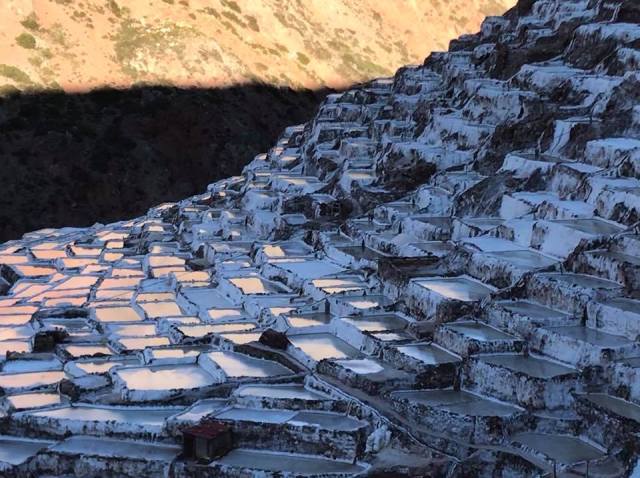
Fast forward to a few years ago. I am hiking in the Andes. I am navigating down the Salt Pans of Mara, Peru. The Salt Pans are man-made shallow evaporation pools for the harvesting of salt. They have been using these “pans” to harvest salt since the Incas. I have wobbly knees, the sun is slowly setting and my guide Danny has shown me the way forward. The way forward is what I feel looks like a balance beam across the edge of hundreds of salt pans. It’s about a four to five-foot drop off the edge I hesitate. Danny looks at me, “Do you need help?” I am embarrassed. I am the only one teetering on whether or not to proceed (although I have absolutely no choice since the bus has left). The rest of my group is ahead. Danny offers for me to hold onto his shoulders as we march across what was probably in reality a foot to 18-inch-wide path. I accepted his help.
Here is what I learned about asking for help:
Pride. I remember that there was a show many years ago called Weakest Link. The announcer would say to someone that was being eliminated, “You are the weakest link. Goodbye.” When Danny offered his help, I felt like everyone on that trip was looking down at their score card to check off [Cathy needed help. She is the weakest link.] That was my pride creeping in. Blasting in, actually. Pride is a dangerous occupation. You can put yourself in a lot of danger. You can worry more about what people think instead of plain old self-preservation. Don’t let your pride get in the way of your safety…and sanity. Ask for help.
One step. It is immensely cliché to say: “One foot in front of the other.” It is completely true. As I held onto Danny walking across that imagined “balance beam” on the salt pans, I really did just put one foot in front of the other. My head was down. I couldn’t see the finish line. I didn’t want to see the finish line. I focused on my feet. It’s amazing how an enormous project like my dear friend Susannah has been going through for the past several months of moving to another country; can become manageable by doing one step at a time. Otherwise, it’s overwhelming. It hijacks our brain into believing we must get it all done today. It won’t. It can’t. Take a breath. Take one small step. Worry about the next step when you need to. Get the help and take a step.
Adapt. On another leg of this trip, we ended up hiking down about 2,000 feet in altitude on the Inca Trail in a ruin called Pisac. There was rarely, if ever, a hand rail. The size, shape and width of the steps varied with each and every step. My foot would end up dropping from 18 inches to 2 inches. From gravel to stone to dirt. Hairpin switchbacks that llama’s apparently glide up and down. We had no idea what was next. There was no anticipating what the next ten feet might bring. Sometimes our trusty assistant (read Lifesaver) guide Juan Carlos anticipated my need for some balance and arrived at the ready as we descended yet another uneven set of steps. Sometimes he wasn’t. I muddled through. I adapted. There is no perfection in hiking. There is only a safe arrival at the bottom. Get help and adapt.
Acceptance. My hiking mentor and Appalachian Trail hiker, Roy, instructed me to do whatever I need in order to be safe on the trail. Even crawling. Well that doesn’t sound very graceful. I needed to accept that if I wanted to get on my butt and scoot down the mountain, that was just fine. If I wanted to accept help from my guides, that is also just fine. There are no gold stars at the bottom (or top) if you use or ask or accept help. When I arrived at my bucket list destination of Machu Picchu and needed to lean on Juan Carlos down a set of uneven steps, I finally accepted it. There is no one keeping score except for myself. Get the help and, most importantly, be accepting.
This might be an American construct where we all need to be like Teddy Roosevelt and be the rugged individual. The person who can conquer it all. I can’t. I admit it. It’s freeing to actually look for help instead of being what my brother calls “a juggernaut of strength.” Be human and accept the help. It will make all the difference.


