
I traveled to Nova Scotia in the summer of 2025. I am on a solo RV trip in my motorhome, Abeona. This was not my first time to Nova Scotia as my family traveled here in a tiny towable trailer when I was about 4. The only thing I remember about that trip is a picture that was taken by a canon and a bunch of men in kilts playing bagpipes. I have to say that I was truly expecting similar treatment when I arrived on my trip to Newfoundland in June but alas, was disappointed. No kilts. Worse yet no bagpipes. What I did find is an eclectic historic place full of beauty, seaside towns, fishing villages and, eventually, kilts.
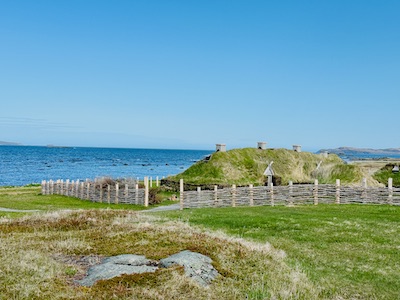
I first stayed near Cape Breton Island in Bras D’Or. I was heading on the ferry to Newfoundland by the end of the week and took the opportunity to explore the famously scenic Cabot Trail along the coast of Cape Breton Island. John Cabot who was a Venetian Italian explorer, Zuan Chabotto (John Cabot in English) was financed by Henry VII to explore North America. He landed here in 1497. It’s believed that they were the first Europeans to North America after the Norsemen in L’Anse aux Meadow in 1014. Cabot Trail is a scenic drive with plunging coastline and fishing villages tucked in the bays. There were many craftspeople with storefronts along the way including a chocolatier, glass maker and eclectic restaurants. An odd thing here is that the signs on Cape Breton are all in Gaelic and English (no French except for National Parks). I knew I was returning to Nova Scotia after a month in Newfoundland so I saved the southern portions for my return trip.

I also visited the Fortress of Louisbourg National Historic Site which is the rebuilt replica of an 18th century French colonial town. It’s really a trip back in time to walk past shops and bakeries from the 18th century with a large moat and fenced wall. People here are dressed in period costume of the French as it was a French fortress for 47 years after being founded in 1713.
Upon my return to Nova Scotia from Newfoundland, I headed to Halifax. As I have found in most larger cities, it’s difficult to navigate in a 24-foot motorhome. I randomly ended up on a bridge that was only for cars, I believe, and had no way to exit. I was quite nervous that I would be pulled over but it all went off just fine. I was headed to the Halifax Citadel and, although I had looked on Google for parking in advance, on a late sunny afternoon in July, parking is a premium. I finally found a spot, thankfully, so I didn’t have to abandon my trip to the Citadel.
I was quite taken aback by the sheer size of the Citadel and its location in the heart of a bustling city with high rises and a shipping port. The Citadel itself has had four reincarnations with the first being in 1749. This last fortification was built in 1828. Here finally I found men in kilts but alas, no bagpipes. I find it strange that although Nova Scotia means New Scotland in Latin, the Scots where only here for 3 years (1629-1632). The Mi’kmaq people inhabited the region for several thousand years and then the French Acadian people came to establish the first colony in 1605. Then the British and French fought for the next few hundred years. It’s quite the eclectic mix of cultures. I was surprised to learn that Nova Scotia was almost the 14th colony during the American Revolution. Even in the museums the information is in Mi’kmaq, English and French. The Citadel itself is a very nice intact fort. You can walk along the top of fortifications and it’s easily maneuvered. I was hoping for some long-hidden memory of this place assuming that it would have been important to my history loving father to visit but alas outside of a few canons and the kilts, nothing jumped out at me.
I headed to what is the most photographed lighthouse in Canada (and probably the world) at Peggy’s Cove. By now I’ve figured out that arriving at 9am at a touristy spot is paramount in order to park. I absolutely timed it perfectly. I was able to easily park and there were only one or two other tourists out there milling around so the pictures were perfect. The tiny cove with colorful houses and boats was so charming. The lighthouse itself is so special because it’s on an outcropping of granite that has been smoothed by glaciers and surrounded by the stunning Atlantic Ocean. It truly is a terrific fishing village to walk through and has many eclectic shops like a pewter smith and art galleries.
I traveled up to Digby which is on the Bay of Fundy. Digby is renowned for their scallops. It was an adventure to travel up Digby Neck and take a ferry to Long Island which has the trail to Balancing Rock. This was quite the sight after hiking for close to a mile with nothing but boardwalk or trees and plenty of steps to suddenly see this enormous rock balancing precariously on the edge of a rock below. The rock formations along that coast reminded me of the Giant’s Causeway in North Ireland. Like someone deliberately made these enormous columns.
The most serendipitous discovery was of Fort Anne National Historic Site. There were several locations to visit around the oldest settlement in Nova Scotia called Annapolis Royal. It was happenstance that I stopped here and to my utter amazement I found a placard that placed my 9th Great Grandfather, Major Robert Sedgwick here in 1654. He was a Major and later General for Cromwell. He was the first to conquer Annapolis Royal in 1654 and at the time was a British born American merchant in Massachusetts. Cromwell just two years later sent Sedgwick to Jamaica to be the governor although he sadly died almost on arrival due to illness. Annapolis Royal has changed hands at least seven times between the English and French over a century. It is in a protected bay adjacent to the Bay of Fundy and was a critical location.
I stopped by Burntcoat Head Park as a last stop in Nova Scotia to walk on the seafloor. Here is the location for the world’s highest recorded tides. Twice a day 160 billion tons of water flow in and out of the Bay of Fundy with the highest tide reaching 53 feet. Luckily, I arrived at low tide and was able to take the steps down to the bottom of the ocean. It’s quite surreal especially with all the bright red iron rich sandstone that is molded like soft ice cream. It was another terrific stop.
I really enjoyed this trip to Nova Scotia with the sheer variety of things to do and see. There were plenty of things I didn’t have time to see and I’ll be sure to allocate more time next time. Whether it’s natural phenomenon, eclectic history or picturesque seascapes, this is the place to visit.



 Workplace Navigator