😎 Surprising SoFlo

I have visited Southern Florida several times.  My son attended the University of Miami and then lived in Miami for about eight years.  I just returned from five weeks on the road in my RV, Abeona.  I wanted to check off the three National Parks in Florida and the historic town of St. Augustine. I found SoFlo to be a totally different vibe from other areas of Florida and certainly from North Carolina where I normally live. There is a Latin, family welcoming vibe and most people assume that you can speak Spanish which I have never found before in the United States. 

Flying over the vast expanse of Dry Tortugas National Park

Here is what I found surprising in SoFlo:

Farms. I always realized that a lot of citrus is grown in Florida but south of Miami in the towns of Homestead and Florida City, there are miles and miles of farms. And what seems like hundreds of fruit stands.  Two famous one’s which are not to be missed is one called, Robert is Here and Knaus Berry Farm. One is very different from the other. Robert is Here is a few miles from the entrance to Everglades National Park and is part fruit stand, food stand, milk shake stand and aviary. There is a small farm and aviary with everything from Goats to Cockatiels. They have tons of fruits you will only find in the Caribbean and South America like Mamey Sapote, Sapodilla, Cocao Pods, and Guanabana. They make the most delicious milkshakes I’ve ever had (I highly recommend coconut key lime). Knaus Berry Farm is in Homestead and they sell a terrific selection of baked goods in addition to being a farm stand.  The sticky buns are sold by the dozen and they are delectable. I’d like to thank my friend Sue (who lives in SoFlo) for recommending both places. Both are worth the journey to get to.

Animals.  The array of animals that happily exists in the wild is pretty amazing. If you have ever been to Key West then you know that Roosters are ubiquitous.  You can’t turn a corner downtown without seeing Roosters, Hens and chicks walking aimlessly. I was taken aback by the amount of Anhinga that were on the appropriately named Anhinga Trail in Everglades National Park. I could have stood two feet from one and it wouldn’t budge from sunning itself. Manatees, Ospreys, Crocodiles, Green Herons, Great Blue Herons, Egrets, Night Herons and Alligators.  They are all there coexisting in the vast region of wetlands that is south of Tamiami Trail. As I drove to Naples from Flamingo on Tamiami Trail, I stopped at several state and national preserves and saw upwards of 30 alligators hanging out sunning themselves. I was practically desensitized to being afraid of them because they were so plentiful but languid. 

Spanish. I went to a restaurant with my friend Sue and practically everyone that greeted us from the restaurant staff greeted us in Spanish. If you answer in English, they respond in Spanish.  It was wild.  The real test for me was going to a grocery store before heading to Key West. Both associates and customers were speaking Spanish throughout the store. I asked someone in the produce department for “Mushrooms” and he said “Don’t speakee English”. So, I asked for “Hongos” and he immediately took me to where the mushrooms were stored and he asked me how to say it in English. This was so wild for me. I think there were places in Spain that spoke more English than this enormous grocery store in Homestead. I had an issue checking out and the customers behind me were asking “Que pasa?” which I responded to in Spanish.  If you have ever tried to speak another language, most folks default to speaking English. I really enjoyed immersing myself back into Spanish.  It was an unexpected delight. 

Water. There are vast expanses of water everywhere.  Even if it looks like solid ground, it’s most likely a swamp. It’s humbling to drive Route 1 all the way down to Key West. It’s almost a hundred miles from Key Largo to Key West down the only connecting road, Route 1 or Overseas Highway.  It’s called Overseas for the reason most of the time all you can see on either side of the road is water.  Crystal clear water dotted with tiny keys covered in mangroves or grass. It’s quite the adventure.  Then there is the massive Biscayne Bay which is mostly National Park and water. Within the Everglades there is another gigantic body of water called Whitewater Bay. I realize there have been jokes about buying swamp land in Florida but there is a ton of it. It’s important to get out on it or over it by boat or seaplane or kayak.  There is so much to explore.

I admit that my expectations for SoFlo have mostly been driving around Miami and enjoying the restaurants, the beaches and the murals of the Wynwood Art District. There is so much more there than giant mojitos in South Beach and trending murals.  There is a ton of nature and culture to be explored. I hope you get a chance to do so. 

✈️ Secluded and Intriguing Dry Tortugas National Park

I decided to check off three more National Parks from my bucket list in the Spring of 2025. Dry Tortugas was the one I was most intrigued by. Dry Tortugas was discovered in 1513 by Ponce de Leon and it was initially called Las Tortugas (Spanish for turtles) and later called Dry Tortugas since it doesn’t have fresh water.  It’s very inaccessible because you can only get there by boat or seaplane and it’s one of the least visited National Parks with about 70,000 folks visiting annually.  It encompasses seven tiny islands (keys) 68 miles southwest of Key West and most of the National Park, like Biscayne National Park, is water. Just getting to Key West is an adventure as there is only one way in and one way out by road. Factor in construction, traffic and, in my case, a few fires, I was quite relieved to successfully finish the drive to Key West. 

This goes down as one of the most amazing adventures I’ve ever embarked on. In fact, outside of visiting historic Saint Augustine, this was the main point of venturing to the bottom of the continental United States. Traveling by motorhome in Florida in March is something that must be planned at least six months in advance and finding a campsite took several weeks to finally obtain.  After that, I booked my seat on Key West Seaplane Adventures. Yes, it’s expensive, but it’s oh so worth it.

The Seaplane to Dry Tortugas National Park

I had a 10 AM flight out of the Key West airport. First of all, a seaplane can take off on a regular runway, which I did not know.  There were two other groups on my plane which were families with kids and then me for a total of 10 adventurous souls all with window seats.  We donned our headsets and listened to our pilot as we took off in the middle of the airstrip (because the whole airstrip wasn’t necessary). It’s not a pressurized cabin so the wind, disconcertingly, is blowing in. But the view? Mesmerizing. The seaplane flies at 500 feet above the crystal-clear water and all of the coral and sand are visible from above. Much of the trip the water is only 3-7 feet deep and the water is a bright aqua blue. Our pilot described the various shipwrecks, pointed out dolphins and sharks and told stories of Spanish treasure. The seaplane ride alone was worth the effort. 

We landed a 100-yards from the edge of the Garden Key which is home to Fort Jefferson and the area of Dry Tortugas that you can visit. The airplane backed up to the beach and we all came down the ladder and stepped safely onto the beach. It feels like about 90 percent of the island is taken up by Fort Jefferson. It is the largest brick masonry structure in the Western Hemisphere with more than 16 million bricks.  Construction started in 1847 although it was never completed. At the time it was being constructed there were upwards of 400 people living on the island which seems crazy since there is no fresh water source. It also was never used as a fort although it was a prison during and after the Civil War.   Dr. Samuel Mudd who aided John Wilkes Booth and three other conspirators were held in the fort. 

It was interesting to explore the fort which doesn’t have electricity or running water.  If you head up the spiral staircase, don’t expect lighting or a handrail. Apparently, they abandoned finishing the fort which was designed to house 7,500 men. It became obsolete due to the invention of rifled cannons; the weight of the bricks caused the fort to sink and there were several yellow fever outbreaks. There is a lighthouse on the fort itself and another lighthouse on Loggerhead Key which is visible from the fort. It’s disconcerting to hike around a fort with absolutely no safety features and realize that the whole thing is sinking. 

There is also Bush Key which is connected to Garden Key that is closed while there are nesting bird colonies of Sooty Tern and Brown Noddies.  It’s open in the fall once the birds have finished breeding. All the birds fly high above the fort along with Magnificent Frigatebirds which are quite stunning. 

The seaplane ride back was just as terrific as we went over shipwrecks from the last 400 years. One famous one is the Nuestra Señora Atocha which was a Spanish treasure galleon which sank in 1622 and was famously discovered by Mel Fisher in 1985 with almost a half billion dollars in treasure. From the seaplane I could see one ship with its mast from my seat on the plane. 

It was such an adventure all wrapped up in one spot.  The beauty of the scenic plane ride practically gliding over the crystal-clear water, the ecosystem of nesting birds, the massive coral reef and visible fish from the seawall as well as the deep history of an immense fortress that was never complete. Go see it for yourself!

🏝️ Discovering Biscayne National Park

 set out to check off three more national parks from my list this Spring by heading to the south of Florida. The National Parks in Florida don’t have mountains or canyons or glaciers or tall ancient trees.  What they have a lot of is water. What they have in common with most of the other National Parks is remoteness. For the most part, it takes preparation and planning to set out to truly discover these national parks. Traveling by motorhome in Florida takes at least 6 months of planning as most RV parks are frequently booked 6 months to a year in advance during high season. Many of the tours that are available in Biscayne National Park need to be booked over 6 months in advance or you have to be very flexible with your dates.  The closest RV park was a Miami-Dade Park called Larry and Penny Thompson Memorial Park and Campground. This is a nice jumping off point for everything south of Miami.

Biscayne National Park sits off the coast of Miami south of Key Biscayne. The only way to see it, outside of stopping by the visitor’s center near Homestead, FL is to get on a boat.  There are a slew of boat tours available out of the Dante Fascell Visitor Center whether it be via kayaking, snorkeling, canoeing or stand up paddle board.  I elected to take a 3-hour cruise out to Boca Chita Key.  I was shocked to find out that 95% of the park is under water. Beneath the waters are manatees, coral reefs and countless abandoned mangrove covered keys.  The water was crystal clear.  We learned about the history of the area that was once inhabited by the Tequesta people. Later in the 19th century, pineapples, tomatoes and key limes were cultivated on these teeny tiny islands.  This became obsolete with several hurricanes destroying the crops.  In the 60’s and 70’s two power plants and two nuclear power plants were built on the shores.  This caused a backlash against development so the Biscayne National Park was born to preserve the delicate ecosystems of coral reefs, sea turtle nesting grounds and mangroves. 

Visiting Boca Chita Key in Biscayne National Park

The highlight of my boat tour was on Boca Chita Key which was originally developed to be a private club with a small lighthouse and barn.  Now the only way to arrive is by boat and many folks dock overnight.  I could see the coral reefs and schools of fish 

from the edge of the island. I really enjoyed walking on the perimeter of the key to see the birds and mangroves and very small beaches and the fact that no one was out there. I felt a million miles away from the towering Miami skyline; it was just me and the sand and the mangroves.  It was quite the boat ride back although most of bay is only seven to ten feet deep, when the wind picks up the waves come splashing over the boat. I don’t think any of the 30 of us on the boat escaped getting soaked on the trip which made it more of an adventure.

The park is a juxtaposition with the enormous metropolitan center just minutes away and the vast expanse of crystal clear water and mangrove covered keys dotting the water. I had been to Key Biscayne and its lighthouse guarding the bay some years ago.  To travel from the visitor’s center for Biscayne NP to the Key Biscayne lighthouse would take 2 hours and I still would not have circumnavigated the entire park. I’m just so glad I was able to have this experience and I was grateful for the forethought of those who sought to protect it. 

🚎A Solo 10,000 Mile Sojourn

I’ve just completed a solo 10,000-mile sojourn through North America in my RV, Abeona. It’s been quite the adventure and while this was some fanciful dream just 4 months ago, I’m amazed that I actually completed it without any major snafus and that I learned so much about myself and Abeona on the journey. I visited 22 states from the deep south to the southwest, up central California to the Pacific Northwest.  I took a ferry from Bellingham, WA to Skagway, Alaska, drove through the Yukon Territory on the Alaska Highway and back down through British Columbia and Alberta, Canada with an incredible 5 days in Jasper National Park just days before the fire. I went to three countries, the US, Canada and a 90-minute trip to Las Boquillas, Mexico by crossing the Rio Grande in a row boat followed by riding a burro into the village. I’m happy to report that I can still speak Spanish relatively well.

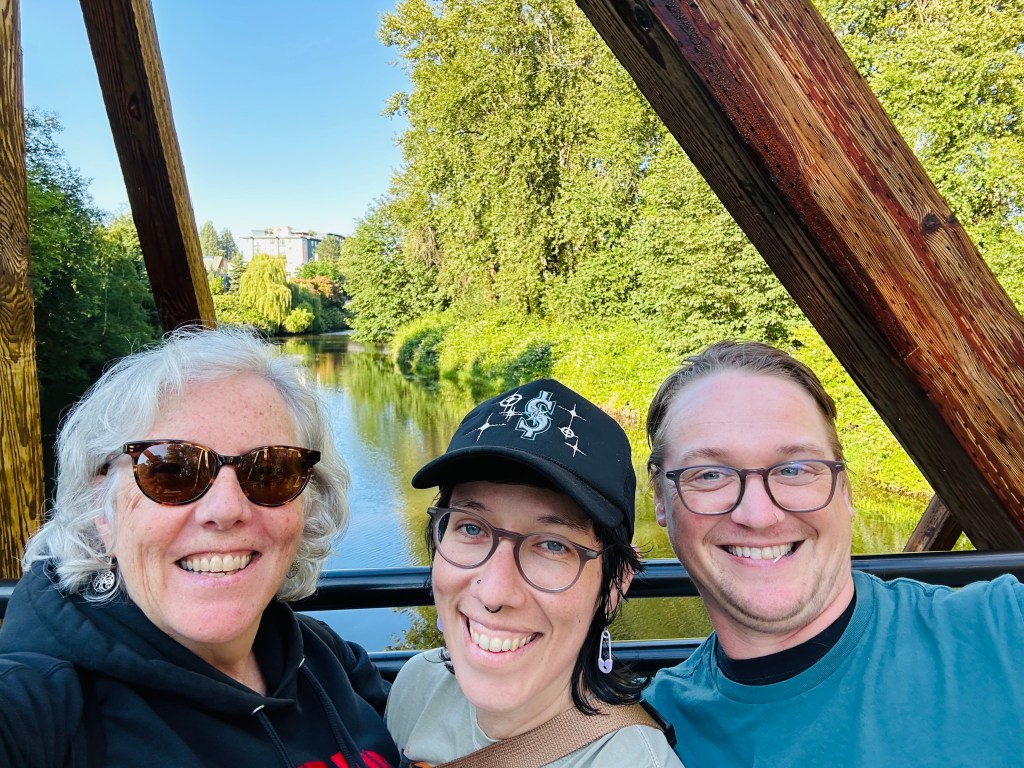
Myself, daughter Natalie and son -in-law Kevin hiking in the Sammamish River Park

While I was planning the trip, I had a certain cadence to each week.  I worked Tuesday through Thursday and would need to have WIFI and electricity since my air conditioning only works on “shore power”.  I would find my campsites on an app/website called RV Life which shows reviews, the amenities available and the strength of the WIFI connection based on the carrier.  I had each site reserved in advance and the app would show me the route and approximate time and miles between each spot.  This was invaluable and outside of one or two changes in campsites due to visits with friends, I stuck to the route as planned. Spots that were a must see such as Big Bend National Park and Joshua Tree National Park were all planned out so I knew how much time it would take to visit each spot.  I did some detours to visit a few spots when I realized how close they were like White Sands NP, Guadalupe NP and Carlsbad Caverns NP. In all I went to 11 National Parks and 2 Canadian National Parks.  Many I had visited before but the stand out new parks were Joshua Tree NP and Theodore Roosevelt NP (where two bison were crossing the road and right by Abeona!). My favorite revisited parks were a hike with my brother Rick to Olympic NP with marmots, deer, wildflowers and snowcapped peaks, the stunning Crater Lake NP and the incredible Jasper NP and Banff NP in Canada.  

I went to several state parks including Catalina SP in Tucson, Smith Rock SP in Oregon, Big Basin SP in California with my oldest brother Dave.  Many adventures were completely unplanned and were some “might as well” sort of opportunities. I went on a glider plane ride in Tehachapi, CA because I was camped next to the runway for my workweek and decided I would be mad at myself if I didn’t give it a try.  It was terrific and completely an analog as in nothing electronic which surprised me.  Not even a radio between the guide plane and the glider. I saw signs for Shasta Caverns and decided to sign up for a tour which included a boat ride and hike through the caverns. The best adventure by far was taking a helicopter ride to the Meade glacier near Skagway AK.  I signed up to walk on the glacier but the helicopter ride was terrific through the mountains and glaciers surrounding Skagway.  I was fortunate to sit in the front seat of the helicopter and I felt like a photographer for National Geographic gliding above the glacier lakes and waterfalls. 

Abeona handled like a champ on scary drives like the always windy Tehachapi pass, the 11 percent grade on the Klondike Highway out of Skagway and the countless gravel roads and unmarked portions of the Alaska Highway.  I accidentally backed into a large boulder in Catalina SP which dented my sewer system. I was so fortunate that there was a remote RV repair guy in Joshua Tree that repaired it in 112-degree weather.  I had a leak in my main water inlet but my brother Dave and a call to Leisure Travel Van (the manufacturer of my RV) helped me do a fix until I got home. I also learned to manually shift coming down the dreaded Tehachapi pass, I finally figured out my tire sensors after some help from a Facebook group for Leisure Travel Vans. The only other issue was a hitchhiking mouse I picked up in the Yukon but fell victim to a trap I set months before. I learned that tire places are perfectly happy to check and fill your tires for free (thank you Les Schwab!). 

I had the opportunity to see many friends and family along the way.  I have a dear friend Tammi and her husband Larry who took me to Saguaro NP and some fantastic Mexican food in Tucson. I visited an old coworker, Jeanne at my previous employer in Scottsdale and an old elementary school friend, Michael, in Mountain View. My brother, Dave, drove me to the Redwood Groves in the Bay Area and he and his wife, Judy, hosted me for several days in Palo Alto where I was able to see my nieces and my great nieces and great nephew. I met up with my daughter and her husband along with friend, James, in Portland for incomparable vegan food. The big celebration for my mother’s 90th birthday was a relaxed trip down memory lane and some great time spent with the entire family. I met with another elementary school chum, Jim, in Fernie, BC where we took an exciting drive up a mountain in his indestructible car (Abeona would not have survived). I was able to visit my dear old friend, Johno, from my NYC days in the mid 80’s. He has a lovely lakeside house with his husband, Jim, in Indiana.  I got to see Johno do a back flip off a swim platform and I went tubing around “Lake Jimmy John” (first time I’ve done that in 20 years). I wrapped up my trip in Covington, VA visiting my Aunt Karen, her children, Craig and Kristin and her husband, Angelo, for a lovely meal in Lewisburg, WV.

I cannot tell you how many times I talked to Abeona and thanked her for being such a bad ass for getting me on and off the ferry, and for the air conditioning working for the massive back up I experienced out of Phoenix where it took two hours to go ten miles when it was 115 degrees.  There were countless evenings where the air conditioner was on all night and it never quit! There were also the tight squeezes through road signs in Palm Springs, the pouring rain near Rusk TX, and windy roads of the Olympic Peninsula. Abeona never faltered. 

My wanderlust is definitely a gene imparted from my father and so is my hesitancy towards heights. I left my father’s ashes in places he had been to and other places where he wanted to travel and sometimes when I knew it was a view he would have loved. He said in his last few years of life that Peyto Lake was the most beautiful place on earth.  I was able to travel there on this trip and leave his ashes from the overlook.  I know he would be proud of me on this cross-country sojourn and I’m proud of myself for taking it on, doing it scared and always having Daddy riding shotgun.

🧐Fascinating Joshua Tree

I went to Joshua Tree National Park and the town of Joshua Tree in Southern California in early June of 2024.  It’s always interesting to travel through a desert but when temperatures are starting to hit triple digits, it adds an element of danger.  I remember traveling through Death Valley a few years ago when it was 120 degrees. You think twice before you head out that you have plenty of water, the tire pressure is good, gas tank full and check for sunscreen.  Cell phone coverage is non-existent and there are no restaurants or gas stations for 50 miles. It pays to be prepared. 

Here is what I found in Joshua Tree:

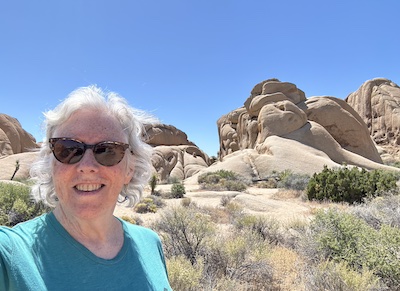
Standing in front of rocks and boulders at Joshua Tree National Park

Wilderness.  I entered through the Cottonwood entrance at the southern end of the park.  This is definitely the road less traveled. There is a visitor center about 6 miles in but there is about 30 miles of blank wilderness desert for most of the road to get to the heart of Joshua Tree National Park. There are vast swaths of desert that lead to the Coxcomb Mountains and well beyond the immense Pinto Basin. This is all untouched land.  I didn’t expect to see so much empty arid desolate land that goes on for as far as the eye can see;  there are only a few cacti. I find the entering any National Park from the less traveled entrance has advantages because there has never been a  line and I end up traveling the park in the opposite direction from the rest of the crowd.

Cholla Cactus Garden.  This is one of the few stops and parking places when entering from the Cottonwood entrance.  When you actually walk through the Cholla Cactus Garden, it looks as if someone intentionally planted all these cacti. There were probably thousands of the cacti for miles in every direction.  The same cactus for miles.  Almost like someone planted them all to harvest them, but it’s in the middle of the desert in the middle of nowhere. It’s intimidating walking on the trail through the garden because their barbed cactus spines are easily detached or “jump” off the plant onto a passerby.  

Rock Formations.  When I turned the corner and got on Park Boulevard, the entire landscape transformed into what can only be referred to as Bedrock or the land of where the Flintstones resided.  It went from desert wilderness to jumbled rock formations.  There were hundreds of these rock piles in various sizes and dimensions. I found an interesting video on how the formations formed over millions of years but basically the tectonic plates moved and the magma eventually belched up and then cracked to create these formations.  I would drive a half mile and there would be formations and then another half mile and even more formations.  There are no bad spots to pull off and walk around; they’re all other worldly.

Joshua Trees. The plant for which the town and National Park are named is not actually a tree but a succulent Yucca Brevifolia.  19th Century Mormons named them after the biblical figure because they believed that the outstretched tree limbs guided them on their westward journey. I’m sure that there are thousands of Joshua Trees in the park and in the surrounding area. Sometimes I would see one lone tree in front of a rock formation or come across several acres of trees seemingly marching across the landscape. Some are tall with many branches and some are low to the ground with just a palm frond top.  Unusual and fascinating.

The Town. I camped in the town of Joshua Tree which seems like a desert oasis for rock climbers, artists and off grid folks. There was an enormous farmers market on the Saturday that I arrived with produce and treasures for sale. The actual main visitors center for the National Park is in the town and outside of the park itself which is very unusual. It’s a bit confusing because you have the actual plant, the town and the national park all referred to by the same name.

It was an interesting adventure through the park.  There was one area I didn’t get to visit because RVs were not recommended to drive to Keys View overlook which has a panoramic view of the Little San Bernardino Mountains.  As I learned in White Sands National Park, be sure to read if a road is recommended for RV’s, if not it’s likely  to have hairpin turns, steep inclines or, as in White Sands case, ten miles of unpaved roads across the dunes. Regardless the landscape and flora were epic.