
I’ve been on a quest to visit all of the United States National Parks for the last several years. There are 63 National Parks and that might sound like too little, but it does not include National Historic Parks or National Monuments. I traveled to Florida last year to visit the 3 parks in southern Florida including, Dry Tortugas, Biscayne and the Everglades. I’m in my RV, Abeona, zigzagging across the US to hit some of the more obscure National Parks. The majority are in the West and Alaska. Mammoth Cave is in southern Kentucky and is quite an impressive National Park. As the name suggests, most of the National Park is underground and they have upwards of 20 different tours you can take to experience this enormous cave.
Mammoth Cave is the largest cave in the world. Is that not crazy? Over 426 miles of the cave have been discovered thus far. They have a representation of the caves and it’s kind of like a big wad of spaghetti that is all interconnected. My first tour was the Mammoth Passage tour. I have previously toured Carlsbad Caverns which is a completely different experience because it’s a 2 mile walk down to the bottom of the cavern. On the Mammoth Passage tour we went into the historic entrance of the cave which was 125 steps to the main passage of the cave. It’s much more accessible than Carlsbad. It’s also called a dry cave so in that section of the cave there are no stalagmites or stalactites although there are plenty of bats. The ranger explained that indigenous people started using the caves between 5,000 and 2,000 BC and were able to mine them for minerals like gypsum, mirabilite and selenite crystals.
In 1790 John Houchin settled near the cave. It was used extensively to mine for saltpeter which was used for gunpowder. In fact, we saw remnants of early settlers who mined the saltpeter on the tour which was used during the War of 1812. Early tourism started in the 1830’s and many enslaved African Americans played a critical role in exploring the caves due to the dangerous nature of the job so they were left risking their lives to explore the extensive caves. It became a National Park in 1941 as the federal government stepped in to take over the land of competing cave owners during the “Kentucky Cave Wars”.
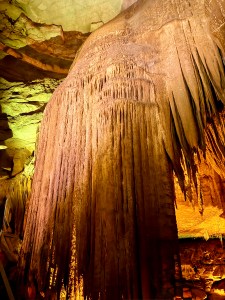
I took a second tour call Frozen Niagara Tour. This entrance was several miles away from the visitor’s center and we took a bus to get there. This is a wet cave so we got to see the amazing formations caused by thousands of years of dripping water. It’s a very short set of stairs down into the cave and some rather tight passage ways where you have to hunch over. I had a tall guy in front of me to use a barometer of how far I would have to hunch. They ask you not to touch the walls but I have to say that one passage way was so tight I had no way to avoid it. At one point you could see down some three stories to a small “lake” called Crystal Lake. Looking at stalagmites that extend some two to three stories down from the ceiling was really amazing. The actual Frozen Niagara is 75 feet high and 50 feet wide. It’s interesting that it took hundreds of thousands of years for it to form. There is also the drapery room which had huge formations that look, of course, like drapes. We also saw several hundred Kentucky cave crickets. Of course, I didn’t notice them overhead until the ranger pointed them out by flashing a light on them. They are silent, so it’s a bit unnerving to look up and see a hundred or so crickets hanging out over your head.
I camped at Mammoth Cave Campground which was walking distance to the Visitor’s Center and is where all the cave tours depart. The day I arrived it was raining but it didn’t put a damper on touring the national park since so much of what there is to see is below ground. I will say that there are two rivers and tons of hiking trails above ground as well. I highly recommend visiting this natural wonder in south central Kentucky and be sure to explore both the dry and wet caves on a tour. To think that there are 426 miles that have been discovered so far and they believe there could be anywhere from another 200 to 600 miles that are still undiscovered is rather astounding.
 Workplace Navigator