🤪 Mad about Madrid

It’s ironic that the abbreviation for Madrid is Mad. Mad is the airport call letters and it’s used in the name of lots of things like restaurant names, “Mad Grill”, “Mad Mad Vegan”, and “Mad Cafe”. In American English, you wouldn’t normally call something mad but in British English it has a primary connotation to be crazy about something. Well, I decided that I’m mad about Madrid. Madrid was in the unfortunate position of being the last stop on my 8 city European tour in the winter of 2024-2025. I didn’t arrive with high expectations.  I had just been seduced by Seville with its flamenco, oranges and history. I had previously been to Barcelona and stayed in the romantic, intriguing Gothic Quarter. I really expected it to be like a Spanish New York City with tapas. Yes, it’s more cosmopolitan than Barcelona or Seville but it’s not the concrete jungle with canyons of tall buildings like New York City.
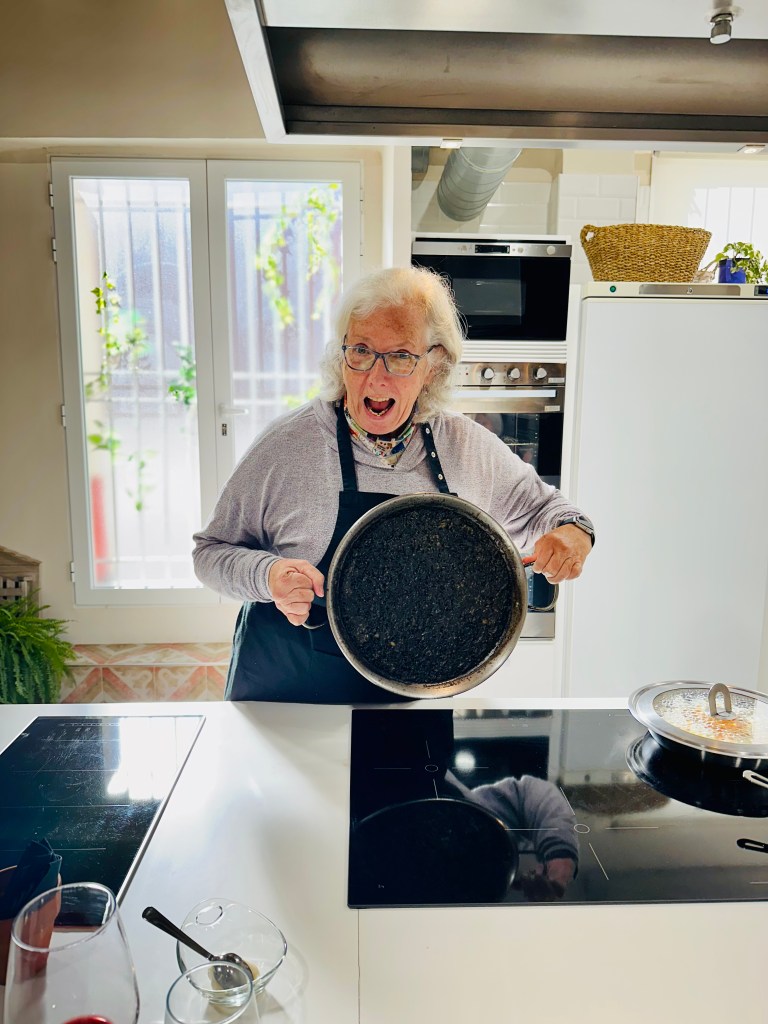
Taking a cooking class in Madrid and showing that the paella is ready because it is adhered to the pan.

This is why I’m mad about Madrid:

There will be art. I was able to go to three art museums while I was in Madrid and they were all less than a mile walking distance from my apartment. Museo del Prado is the main Spanish national art museum. It has art dating back to the 12th century with works from Goya, Bosch, Rubens, Titian, Velazquez and El Greco. There are countless paintings of the crucifixion of Christ and it’s remarkable to see the interpretation of various artists on this one subject. The Prado is an emotional experience with its mostly dark themes from either the crucifixion to enormous 40-foot paintings of battles and executions. You can also see the advancement of art through the centuries from painting on wood to frescos to canvases with immaculate perspective. I also went to the Museo Reina Sofia which is on the other end of the perspective from the Prado with all its works being from the 20th century.  It’s surprising to be in a museum in Madrid and to see painting from Hopper, Pollack and Wyeth. This is alongside an extensive collection of Picasso, Dali and Mora.  There was a temporary exhibit by Portuguese artist, Grada Kilomba in which she uses words and music in video or dancers representing her words.  It was quite unique. The Museo Thyssen-Bornemisza is another great museum in Madrid which fills the gap between the medieval Prado and the very modern Sofia. The Thyssen has many of the classic impressionists like Monet, Degas and Renoir which are some of my favorites so I really enjoyed it. Madrid has art for every taste.

There will be food. Madrid is a food lovers Mecca with everything from tapas to brunch to Michelin star restaurants. I was really glad I signed up for a tapas and paella class for the first day I arrived. There were only five of us in the class and the other four folks were from Mexico. When the instructor realized I spoke Spanish, she decided to teach the class in Spanish which was a confidence builder for me. I learned some amazing tricks like grating Roma tomatoes instead of chopping which seems crazy but the method effortlessly eliminates the skin of the tomato. We also cleaned cuttlefish which was something new for me. I really appreciate that was very hands on, similar to a class I took with my college roommates (Those Girls and the Blonde) in Paris some ten years ago. I have also found that throughout Spain if the name of the restaurant is in English then the restaurant is an easy place for English speakers like myself to go as the entire experience from greeting to menu is in English.  I also found that most restaurants serve tapas and that the portions are enormous. I received a plate of blistered peppers that were simple yet delicious and that alone could have been a meal. I did not venture into any fine dining places as most places don’t open until 7 PM and I’m not a big fan of walking at. Night. There were also tons of butcher shops and produce stands throughout the city. Grocery stores are amazing places throughout Europe. I would walk up to a Carrefour market and it would look like a simple convenience store until you walk inside the labyrinth which is almost always at least two floors with an elevator. I found that sparkling water is almost always at the far end of the second floor much like milk is always in the back row of Safeway. In Madrid, there are always full Jamons (legs of cured ham) hanging in the store where families will have one parked on a kitchen counter to take a slice whenever needed. There were also plenty of vegan restaurants to choose from as well. I really enjoyed eating my way through Madrid.

There will be walkways and parks. In a city the size of Madrid, I did not expect to see so many pedestrian walkways and parks. I have to say that even if there are cars on the road, the minute you step within a foot a crosswalk, the vehicle stops in its tracks. I found this to be amazing. I also took an amazing tour of Toledo (the cathedral is the second largest in Spain after Seville and is simply breathtaking) and the bus picked us up two stories below the Royal Palace. We then drove some ten miles underground (similar to Boston’s downtown). I didn’t realize until that moment but you don’t see large trucks or many cars in downtown Madrid. If there are vehicles, they are only taxis and delivery vans. This makes walking around very easy. In addition, they have a metro system as well, although I didn’t need it since everything for me was in walking distance. There are also enormous parks throughout the city with countless statues venerating various kings and conquerors. One of the main streets by the Sofia and Prado is closed to traffic on Sundays (similar to Central Park in NYC). This makes for terrific space for runners, skaters and sightseers like me. 

I found Madrid to be friendly and inviting. Folks sitting next to me at a table on the Plaza Mayor wished me a pleasant meal (buen provecho), and folks walking down the street would say hello (buenos dias or hola). One funny thing happened at the Thyssen.  The man behind the ticket counter asked if I wanted a discount and I said (in Spanish) well, I’m not a student but I am old. The couple in the next cue laughed and said, “Woman, you’re not old”. Probably the greatest gift in life is making someone laugh in another language. I got the discount by the way:). I am mad about Madrid and hope to return.
🇩🇰 7 Surprises I found in Denmark

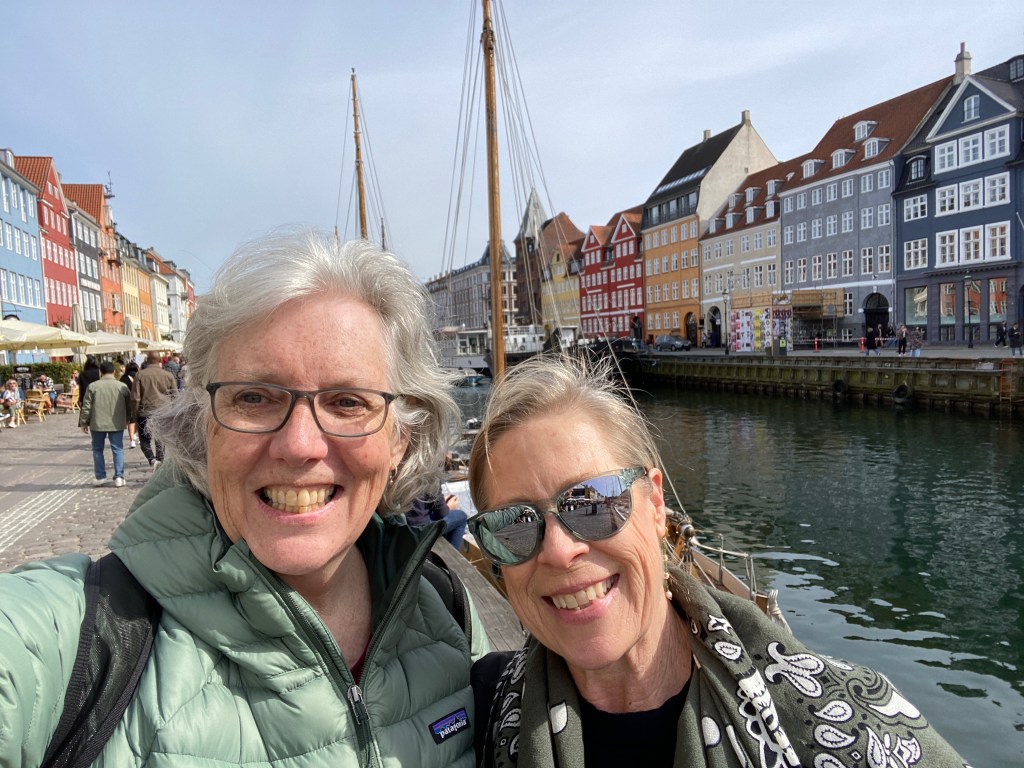
I recently returned from a 6 week trip to the UK, Ireland and Denmark.  Denmark was the last stop on my trip and I found it to be quite surprising.  I stayed at a flat in Copenhagen and really lucked out with the location.  It was only a block from Torvehallerne (a huge market open 7 days a week), the metro and train station. This made it a terrific jumping off point for traveling around Copenhagen, the countryside and made finding provisions quite easy. 

The author and her friend Alison on the canal in Copenhagen.

Here are the 7 surprises I found in Denmark:

  • Bikes, bikes and more bikes. I have never seen so many bikes ever.  When I got of the metro from the airport, I could not believe the massive amount of bikes parked at the metro station.  There had to be upwards of 1,000 bikes within a one block radius. As I walked to the flat, I saw bikes leaned up against every building and, to at least my untrained eye, they looked to not secured in anyway. Most of the bikes were basic black with a large basket up front. Copenhagen has the most cyclists per capita, and the city with the most cyclists with 62% of the population using bikes for the daily commute.  There are 6 bikes for every car in Denmark. 
  • Hej.  I studied Scottish and Irish before arriving in each country.  The thing is, while the signs might be written in Irish in Dublin, I never heard anyone speaking Irish.  On the other hand, in Denmark, people greet you will “Hi” which is how “Hej” sounds to me (Hej means Hello in Danish).  So I mistakenly thought that it was obvious I didn’t speak Danish but frequently, it was followed by something in Danish that I didn’t understand (although I did try to learn some Danish before arriving). The signs, the products, the menus are all in Danish although there is frequently a translation.  Everyone flawlessly (I mean without skipping a beat and in perfect English) would transition from Danish to English and then back with another person.  
  • Baby strollers.  They have taken baby stroller to new heights here.  Babies are cocooned in a padded cover, head covered and swaddled lying flat on a carriage with four sturdy wheels. In the US strollers are valued for being convertible and able to move from stroller to car easily.  When you don’t have a car (see number 1) you might as well have a Rolls-Royce for a stroller. Mom’s get 12 months of maternity leave (yes, 12 months) so why not make sure you can stroll with your baby in comfort.
  • Green energy.  As we took a canal tour of Copenhagen, we saw the very modern building called, Amager Bakke which is a combined heat and power waste-to-energy plant.  It’s shaped like a hill (ironic since Denmark is so flat) and while it’s converting waste to energy, you can dry ski down the slope, go hiking or climb a climbing wall.  Denmark has committed to being net zero on carbon emissions by 2025.  I have to say that for as close as we got to the plant, I didn’t smell anything and, probably due to so many bikes, I don’t remember smelling exhaust the whole time I was there.
  • Metro and trains.  Getting a train or metro ticket in Copenhagen was easy and simple.  There were kiosks at every stop and it was easy to buy a single or multi use ticket in English as well as Danish.  The trains themselves are immaculate and most that I traveled on, showed each stop of a lit board and let you know where you were on your journey. Every train had at least a half a car devoted to bikes and and baby strollers (see 1 and 3).  There was one point where I saw a man leave a stroller on the train and go sit down with his back to the stroller (through a doorway and about 10 feet from the stroller).  I could not believe that the man sat with his back to his baby and anyone could have taken the stroller off at any given stop.  I will say  I saw a least one mother stand next to their stroller while en route. 
  • Driving.  My dear friend Alison who is an American expat and has lived in Denmark for over 20 years. She picked me up at the train station with her car.  The first thing is that every road has pedestrian side walk on each side of it, has a bike path (one in each direction with bike traffic lights) and a two lane car lane.  This is found in the city of Copenhagen and out in the hinter land. Walking, biking and driving, are all equally welcome. The crazy part was that cars would park in the car lane in the middle of the street so as not to block the bike lane.  It almost feels like the bike is number one, followed by pedestrians and then, last on the list, is the car.  There is not right turn on red because of the bikers.  
  • Food.  I had wonderful food while in Denmark.  The highlight was probably the humble Danish which, as it turns out, they call “winderbrød” or Viennese bread.  So some Austrias who settled in Denmark, made the beloved pastry.  As opposed to what is called “danish” in the US, the flakey croissant like crust is amazing and the creamy rich center is divine. I also had a smorgasbord which is just an open face sandwich and they had many hearty breads on which they make the smorrebrød on.  There is also something called Flødeboller which is a chocolate covered marshmallow puff although the marshmallow part is light and delicate. The food was amazing.

I should mention the architecture and the all the color buildings along the canals, but you most likely already think of that with Copenhagen, I think that in the combination of electric transportation, their focus on green energy and the use of bikes, it’s amazing how quiet an pollution free it feels in Denmark.  That must be why it’s the one of the happiest places on Earth. 

Beginner’s Guide to Backpacking on the Appalachian Trail

This is actually the over fifty’s guide to backpacking on the AT. For me it’s actually a guide to returning to the woods after forty plus years. I have hiked a multitude of places, from Mount Saint Helena in Napa, California, Tent Rocks in New Mexico and Machu Picchu in Peru. None of those hikes were with a twenty-pound backpack. They were all day hikes; rather like a scenery stroll. And they all ended where I was sleeping comfortably in a cushy bed with running water, a flush toilet, and a solid roof over my head. The last time I had a backpack on was when I was at Camp Merrowvista in Ossipee, New Hampshire and I was sixteen years old. Things have changed. More importantly, I have changed.

45415072_277551429561820_681331862123053056_n

My boyfriend Roy attempted hiking the entire Appalachian trail in 2015. If you are unfamiliar, this is no small task. It can take upwards of five to seven months to complete the 2,190 miles from Springer Mountain, Georgia to Mount Katahdin, Maine. Roy made it 531 miles before a medical issue derailed his attempt. This brought me to wanting to experience the allure of the trail.

Here are my findings:

Water

This is a whole different ball game when it comes to backpacking versus day hiking. Though towns are close to the trail, it isn’t the point to hike and drop back into civilization. There aren’t handy convenience stores, faucets, or water fountains out on the trail. Carrying five to ten days of water is not feasible. Roy bought me a Sawyer Mini Water filter about a month before we went backpacking. I threw it in my closet and figured I’d be carrying my water with me. Nope. Water is the heaviest item you are carrying, so you should try and keep enough for one day. Make sure you know where the springs or water sources are along the trail. It’s not like a road trip, where you can stop off at the next exit to refill on water and use the restrooms! We had several empty water bottles to help filter from our bladder bags when we refilled at a water source on the trail. We were fortunate that the water source was a cistern on the trail versus a spring along the trail. It would have been a process and a lot more time consuming to retrieve water from a natural source. Sawyer filtration systems are very easy to use and are highly recommended by practically every A.T. thru-hiker. Don’t leave home without a water system at the ready and located water sources.

Guide

I was fortunate to be guided by a seasoned hiker like Roy. He knew that we needed the most recent A.T. Guide Northbound 2018. Roy had ripped out the page we needed for our hike. It showed the elevation, the location of the shelters, and water sources along the route we were taking. If we didn’t have the guide, it would have been impossible to know where the next water source or shelter might have been. You wouldn’t go on a road trip without a GPS or paper map. Make sure you have one that is most up-to-date before you head out. On the A.T., the white blazes on the trees and rocks are your guide. However, there are blue blazes (indicating a trail to a water source or shelter) and double white blazes (indicating some type of change coming up, such as a fire road crossing) as well. These indicate when you are off the main trail or if there is a change coming up. You might wonder why you need the most updated guide for the trail, but there are changes each year as trails become rerouted due to damage or are remeasured by volunteers. In contrast, my previous day hikes were trails that were heavily marked with frequent mileage indicators. The A.T. has very few signs, so the guide is invaluable when heading out. I found it frustrating, in retrospect, that I didn’t know whether I had walked a half mile or not. Most day hikes have a lot more signage with progress indicated along the way. It would be very easy to get lost rather quickly if we didn’t stick to the white blazes.

Clothing

My daughter Natalie is an experienced backpacker, as is Roy. Both kept warning me about not having ANY cotton clothing on the trip. Cotton will absorb sweat like a sponge and will not properly insulate. Boy, am I glad I listened. I opted for everything to be nylon or polyester, except for my wool socks. I tried a few shirts on that were merino wool but that particular material irritated my skin. In my practice hikes, I tested out several sets of shirts and pants to make sure nothing rubbed against my backpack. I cut every tag off every piece of clothing that I took with me. I get aggravated by anything rubbing against my skin. I didn’t want to be looking for a pair of scissors two miles in. I had a total of three (yes, three) jackets. One rain jacket for rain and wind. I started off the hike wearing a jacket since it was 40 degrees and windy at the start. I also brought a fleece jacket, which I changed into once the wind died down, as it was still cold. Finally, I wrapped myself in a puffy down jacket at the actual campsite since I was no longer exerting myself as much and needed to retain my body heat. I had a base layer under my hiking pants, which I kept on the entire trip to stay warm. The only thing I didn’t wear that was stored in my pack was my extra underwear. So my entire list was three pairs of wool socks (one for each day hiking and one pair to sleep in), two pairs of underwear, one short sleeve shirt, one long sleeve shirt, rain paints, convertible hiking pants, base layer pants (long johns), sports bra, bandana, buff, wool hat, cap, fleece jacket, rain jacket and down jacket. My advice is to try them all out with your backpack in different temperatures and weather conditions. Being as comfortable as possible is key.

Food

I figured that I would be starving the whole time we were backpacking. I’m not sure if it was nerves or exhaustion, but I ended up not eating that much. We had some peanut butter crackers, trail mix, and oatmeal bars. I think it’s easy to overthink and over-carry on food. We probably brought back about half as much as we started with. But gratefully, nothing went wrong on the trip. If we had been stranded for some reason due to injury, we would have needed all the food. We cooked a rice package for our only dinner on the trail and didn’t even bother cooking the ramen we brought. Having a hot cup of tea at the end of a daylong hike in our campsite was restorative. Coffee, the next morning, when it was 38 degrees was important as well. There is something about a warm beverage that makes everything feel better. Before you head out, make sure you’ve tested your burner and cookware. I’m not sure I would have been able to figure it out on my own in the waning light of day. Warm food makes a huge difference out on the trail.

Light

I had a light attached to the end of a cap for my entire trip. I knew where that hat was whether it was in the tent, in my pack or on my head. We hiked at the end of October and the sun was setting around 6:30 PM. I did not want to be stuck hiking, eating, finding water, or unpacking my sleeping bag without a light. It was critical to be able to see at night, especially when trying to go to relieve yourself. There were warnings about black bears in the area and being aware of my surroundings was critical. Have a light and know where it is always.

There are more must-haves like a backpack, tent, sleeping bag, and air mattress. Trekking polls were invaluable as well. If you take anything away from this at all, test out everything you are planning to take with you in as many ways possible. You don’t want to find out five miles into your trip that your hiking shoes are uncomfortable, your backpack is too small, or that the tags on your clothes won’t stop rubbing your skin. When you head out backpacking, you have your entire life on your back. Thankfully, we only went out for a two-day hike, but getting the right combination of necessities can make the difference between a miserable and wonderful hike. Make sure you have the right basics for you.

Thoughts on Seattle

My son and I spent Thanksgiving in Seattle with my daughter and her boyfriend. It was a first-time trip for my son and probably my fourth. My daughter moved to Seattle this July and it was fun to have her as the tour guide for her new stomping grounds. To see the city as a resident rather than a tourist.

24139221_10155832936643688_1467014347_o

Here are my observations about Seattle:

Rain.  This is by far the rainiest it has been on a trip to Seattle for me. Cold, windy rain. It’s funny but because of the rain, I realized how the city is built around rain. There are coat racks and umbrella racks by the doors of most of the establishments we went into. It reminded me of Phoenix with its covered parking spaces; obviously used for different reasons. Seattle has set up the infrastructure that works with its weather. Somehow it makes it all more tolerable. By the third day, I was just expecting rain at some point and carried along my umbrella. This apparently, is a sure sign of a tourist. Seattleites usually just wear raincoats. By the end of my visit, I had purchased said raincoat with a hood because carrying an umbrella is a wet, messy drag. Adapt to the rain because you know it’s coming.

Coffee.  I have been to plenty of cities with ample coffee shops but in Seattle coffee is an art. It’s where the gourmet coffee industry started. Whether it was a freshly brewed pour-over coffee, a latte or a cup of coffee at a local diner, it was all terrific. You can’t serve Maxwell House in Seattle, only the best will do. There are the ubiquitous Starbucks everywhere, but we found a place called La Marzocco Café, which was a coffee shop inside a radio station studio. It was amazing. The kind of place to sit down and relax while you watch it rain outside and listen to great music from KEXP. It is a must-see in Seattle. My son and I ended going there several times to chill out and relax. It’s within walking distance of the Space Needle, so even tourists can make their way there. My daughter’s boyfriend, Kevin, made several pots of delicious coffee at their apartment. Be sure to relax and enjoy the coffee.

Transit.  There are many modes of transportation in Seattle, and my son and I used Lyft for most of our journeys. Walking is another popular mode, and once you have purchased a raincoat (see bullet one), it’s really not that bad. Plus, walking with an umbrella becomes a game of strategy on crowded streets, so I highly recommend wearing a rain jacket instead, just so there isn’t collateral damage as you make your way on foot. Kevin and his brother Brian suggested we take a bus from Pike Place Market to their apartment in Ballard. We had a whole afternoon together with no rush, so I was game. I have to say I was skeptical. I can’t remember the last time I rode a bus, but it was cheap ($2.50) and took us to within a half mile of the apartment. There is a certain Zen to riding a bus, as the world rolls past and riders stare blankly ahead, or intently at their phones. I was glad I had the experience, since my daughter rides the bus to work every day and I now understand the appeal. There is this transition from home to work or vice versa that frees up time for thought and reflection that driving doesn’t.

Food.  We had amazing food all week. Whether it was a diner near the Space Needle, pho at a local Vietnamese restaurant, or tacos at a Mexican spot. When we were walking around Ballard one night there must have been twenty plus restaurants we passed. I would have eaten in any one of them. There is something comforting about walking in the rain (again see bullet 1) and ducking into a cozy spot for some delicious food. Pike Place Market (with the world-renowned fish throwers) has an amazing assortment of everything, from chanterelle mushrooms to Dungeness crabs to moon drop grapes. I’ve always thought of the San Francisco Bay Area as the food mecca of the world, but Seattle could give it a run for its money. It was ironic that several of the places where we ate were Southern in theme. Whether it was shrimp and grits, biscuits or collards, I didn’t feel like I was a 6-hour flight from home. I think the cold rain makes food taste better. The pinnacle of food was our Thanksgiving meal with Brian and Natalie at the helm.  There is a peace in letting go and not being responsible for the biggest meal of the year. I don’t need to worry about whether the turkey is carved. Turns out, it is still delicious, regardless of how it is carved.

It was a great trip with the highlight being a trip to the Japanese gardens at the Washington Arboretum and spectacular Chihuly Garden and Glass Museum. There is always something fascinating to do in Seattle, regardless of the weather. What are your favorite spots in Seattle?