
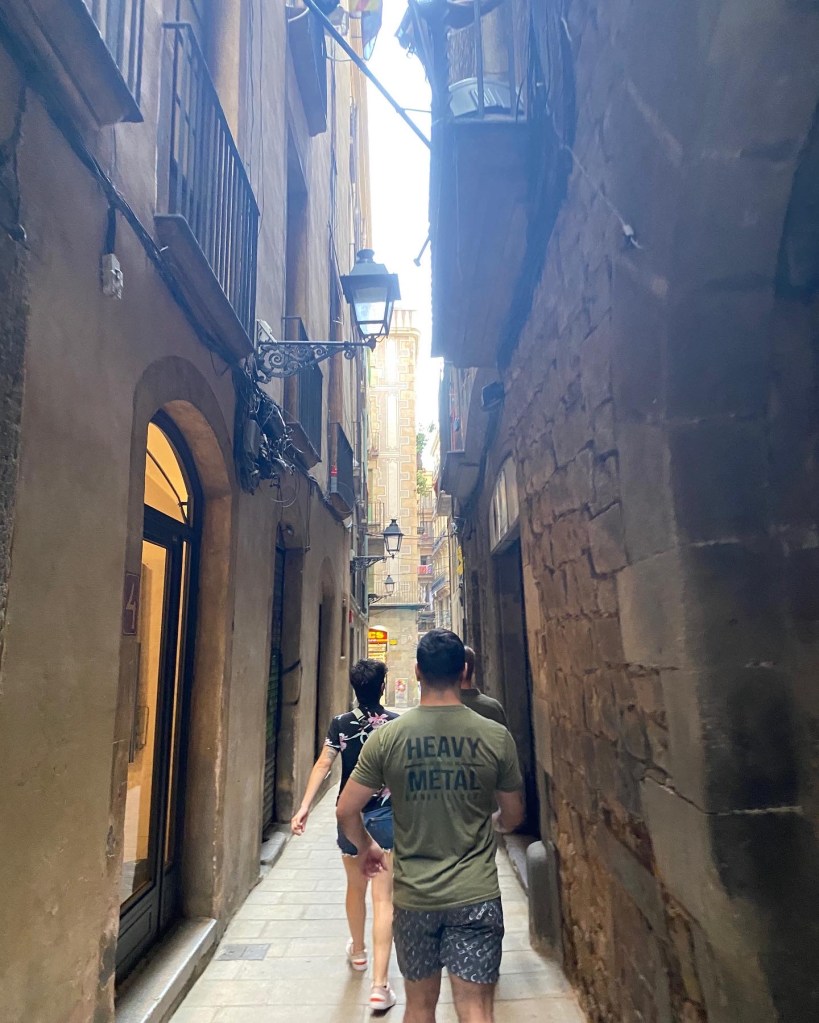
I arrived in Seville on the afternoon of January 4th which happened to be the Cabalgata de Reyes or the Three Kings Parade. Three Kings Day is celebrated on January 6th but the parade is scheduled depending on the day of the week. I had no idea that this was going on until I couldn’t get an Uber from the airport due to incredible price increases. I decided to find a cab instead and my driver told be about the parade. It’s a long parade that travels in a big loop through the city dropping candy for children and a spectacle for the adults. Had I known the route, I would have attended but I really wanted to get my bearings in a new city. It seems that being lost with luggage in tow is a norm for me at this point, I was dropped off by the cab about a quarter mile from my apartment because, as is the case in a lot of European cities, my apartment was on a pedestrian only street. I have found in my travels that being on a pedestrian street is advantageous in the ease of getting around on foot and they tend to be quieter at night. The main snafu is that it’s easy for me to get disoriented in a narrow alley trying to find the entrance. I did. The location was great. The cost is 15 minutes of figuring things out.
I absolutely love Seville. The weather in January is highs in the 60’s. I was able to walk safely to every sight of interest. The people are very warm and friendly. There are bitter orange trees everywhere. In January, that means that each tree will be full of ripe bitter oranges. I found this to be amazing and unexpected. In fact, there are over 14,000 bitter orange trees throughout the city. The oranges themselves are the property of the government and are harvested by temporary staff annually to make the famous Seville marmalade. So basically, I was walking through a bitter orange orchard for the week I spent in Seville. What’s not to love about that?

I am moderately conversant in Spanish and I found that practically everyone I met locally defaulted to speaking Spanish with me. I really appreciate this as it makes me feel more self-reliant to be able to converse in basic questions like “does this have onion?” or “is it very far?” In the previous weeks I muddled through with the basics of Italian “Grazie” and “Por Favore” and Portuguese “Obrigado”. It was a relief to be able to understand what people were talking about and for locals to be willing to engage with me in my mediocre Spanish. I compare this to a trip I took with my kids to Barcelona where the language is Catalan and practically everyone started speaking to us in English regardless of whether we tried to engage in Spanish (not Catalan). It’s not that they don’t speak Spanish, the locals default to Catalan or English.
There are probably a 100 flamenco shows within the Seville city limits. It is the birthplace of this passionate dance with Moorish and Roman roots. Most of the songs and dance are that of lament; the wailing and intensity sucks you in. I was in the second row crammed into a tiny tableau with maybe 50 seats. The singers, the guitarist and dancers are just feet away. Each performance is loosely planned and the songs and dance are improvised. There was one woman performer who could snap her fingers so delicately and eloquently, I was mesmerized. The clothing, the music, the wail and pain of the singer, and the incredible speed of the guitar; it is not to be missed.
When I traveled to Lisbon the month before I finally understood that Portugal and Spain were under Muslim rule from 711 to 1492. 800 years has an enormous impact on architecture and culture. “Ojala” in Spanish translates to “hopefully” but that root is actually from an Arabic word “Inshalla” or “If God wills.” The name for the main castle in Seville is Real Alcazar. Alcazar is Arabic for castle and Real means Royal. This place is not to be missed. It was started as a citadel in the 10th century during the Abbasid dynasty. It had palaces (nine in total) added and enlarged over the next 4 centuries by both Arabs and Spaniards under different regimes. The Alcazar represents the melting pot of cultures with extensive tile from floor to ceiling with Moorish arches and floor fountains in many rooms. It’s surrounded by an extensive garden including the omnipresent bitter orange trees. Ferdinand III conquered Seville in 1248 and it was taken over by Castilian monarchs. Seville is about 60 miles from the coast along the Guadalquivir River. Many explorers including Christopher Columbus, Ponce de Leon and Nunez Balboa passed through the Real Alcazar to either bring back the spoils of the journey or ask for sponsorship on the next voyage. This was the hub for all things American. It’s remarkable to stand in a place so steeped in history.
I also visited the Seville Cathedral which is the largest gothic cathedral in the world. It opened as a Catholic Cathedral in 1507 (it originally was a mosque in 1172) and is an example of Gothic, Moorish and Renaissance styles. There are countless chapels (there are 80 contained in the cathedral) in this enormous church. The stunning feature of the cathedral is the enormous gold altar piece that is called the Retablo Mayor which is the largest altar in the world with thirty-six relief panels depicting scenes from the Old Testament and the lives of saints. It stands 76 feet high is and is breathtaking to behold.
There are many places to visit in Seville including the Gold Tower, the Plaza de Espana, and the very modern Setas de Seville (which look like giant mushrooms). I most enjoyed just walking the countless pedestrian streets through old historic neighborhoods with empanada shops, tapas bars and plenty of stores selling Flamenco dresses. I also enjoyed a paella class on a rooftop near the Gold Tower. It was mostly a demonstration instead of cooking but it was interesting none the less.
I could have spent another week or two in Seville it had such a relaxed friendly vibe and I felt like I was immersed in the history of both Spain and the Americas. I know I will return.

 Workplace Navigator