
My brother Rick and I traveled to the Falkland Islands (Islas Malvinas) in January of 2026 aboard an expedition cruise on the Dutch ship “Hondius”. We boarded in Ushuaia, Argentina and spent a day and a half sailing to the Falkland Islands. This was my first expedition trip and I must say, it has a lot of advantages to being on a much larger ship. There are only 162 passengers and 70 crew on board. The reason for the smaller ship is that there are restrictions in the Falklands, South Georgia and Antarctica. No more than 100 people can make landfall at the same time. Thus, immediately upon boarding we were assigned to the Red Group or the Blue Group. When the Red Group went on shore, the Blue Group would cruise the coast line in zodiacs. Large cruise ships don’t go to the Falklands or South Georgia It’s much more intimate. In fact, the only other cruise ships we saw were in Stanley (the capital of the Falkland Islands), where there is a dock available.
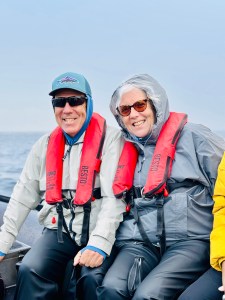
Preparing to go on shore via the zodiac is no small ordeal. We had to clean all of our outer gear like rain jacket, rain pants, muck boots and gloves to make sure it was free of any foreign objects such as crumbs, seeds, and dirt. We used brushes and paper clips to clean out the tread on the bottom of the boots. All of these preparations are to keep from contaminating the environment. Once we were all suited up in the mandatory rain jacket, waterproof pants and muck boots, we had to put our life preserver on top of it all. A hat was next, sunglasses, trekking poles and waterproof back pack. I felt like I was suiting up for Mars. Once suited up and our group had been called, we headed to where they load the zodiacs. They took our room key to make sure they had everyone accounted for before leaving the ship. There was an attendant on the inside of the ship and then the zodiac arrived next to the door outside the ship. The driver and attendant helped each rider over the pontoon to sit on the edge of the zodiac. The first few times we got onto the zodiac was quite intimidating because the ocean swell was relatively high (maybe 2 feet) and it’s a timing thing to get on the zodiac. We all had to wear water-proof gear because of riding in an open zodiac. You have to assume that you will get wet and we did.
Our first day in the Falklands, we took a zodiac and landed on the beach at Carcass Island (gruesome name). Upon landing we were greeted by hundreds of Magellanic penguins. They have eyes that are encircled with white. Gentoo penguins were also present and are about the same size but have a less distinctive white spot behind their eyes. It is incredible to see hundreds of penguins milling around the beach or running into the water with their hapless saunter. We were told to always keep our distance of 15 feet from any animal we encountered. Rick and I also spied black-brow albatross which are elegant birds when they are soaring in the sky but are quite clumsy on land. Apparently 70% of the world population of these albatrosses are located in the Falklands. We hiked across the island to a pick-up point for the zodiacs which was about 4 miles away. I was really struck by the fact that there are no trees on the island, just rolling grass covered hills and white sandy beaches. It reminded me of Northern California.
The afternoon of the first day was spent at Saunders Beach. Here there are Rockhopper penguins that look like they have a bad toupee with black and white hair making a crown. They are rather squat in height and hop everywhere so it’s absolutely adorable. There was also a slew of King penguins which are the tallest penguins and they have neon orange on their beaks, back of the head and on their chest. Some of the King penguins were still caring for eggs on top of their feet. There was also a giant rookery for black-browed albatross who mate for life and return each year to the same nest. The higher the nest, the longer the mated couple have been together. There were hundreds of chicks sitting on top of the nests waiting for their parents to come back with food. It’s amazing to walk amongst the circle of life with these beautiful creatures.
The last day was spent in Stanley, Falkland Islands. This is the largest village on the 700 plus islands that make up the Falklands. The Falklands have a population of 3,600 and 3,000 of the residents live in Stanley. If you live here, you hold several jobs at once since the population is so small. The Falklands are a British overseas territory so only English or Falkland pounds are taken as currency. Everyone speaks with a British accent; they drive on the left-hand side of the road and it’s the largest Land Rover market per capita in the world. It’s strange to feel like you are in a small village outside of London but you are in reality 8,000 miles away near the end of the world. The relationship between the Falklands and the Argentines is difficult. Argentina will only let resupply ships in once a month and the only flights you can take to Stanley are through the military or Montevideo, Uruguay or Santiago, Chile. When we were in Ushuaia, the Argentinians still claim that the Malvinas are part of their territory extending to the Antarctic although there are no Argentines living there.
The Falklands (Malvinas) is a desolate oasis at the bottom of the Atlantic Ocean with a rich history, varied wildlife and resilient residents who love their heritage. I would guess that about the only way you can visit is by water or airplane and a lot of planning.
 Workplace Navigator