Patagonia Surprised Me: The Little Cultural Differences I Didn’t Expect👀

My brother, Rick and I traveled through the Chilean and Argentinian portions of Patagonia for three weeks. I love travel because I get to learn about different cultures and it never fails to surprise me. I have traveled to Colombia, Peru, Brazil and Venezuela before and I have to admit that I had assumed that Chile and Argentina were going to be pretty similar to those countries since they are all part of the same continent. I was incorrect.
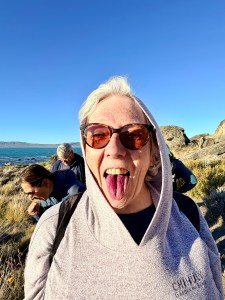
My blue tongue from eating Calafate berries

Here are some of the surprises and differences:

·      Pronunciation. There are several words and terms that are unique in their pronunciation. WIFI is pronounced as wee-fee (it sounds adorable). An IPA beer is pronounced as EE-pah (short and sweet). It took me a few minutes to figure out that locals in Chile and Argentina refer to a boat tour as “navigation”. This confused me for a bit until I clarified what “navigation” meant. I briefly thought it meant we would be on a sailboat (we weren’t). All of the various guides we had on this trip referred to wilderness as wild-erness. The folks from Argentina pronounce the double L in Spanish as “sh” instead of “y”. This one pronunciation threw off my Spanish while traveling in Argentina. There are a ton of Spanish words like silla (chair), llama (called), llave (key), calle (road), lluvia (rain), pollo (chicken) and ella (she) with the double L. I am relatively fluent in Spanish but this change in pronunciation absolutely threw me off.

·      Traffic. We took a tour in downtown Santiago and there are crosswalk signals on a lot of streets. What is crazy is that when the signal turns to “Walk” there is a small green stick figure walking slowly at the beginning of the signal but then they slowly start walking faster until it’s sprinting. It’s pretty funny to see it go from standing, to walking, to jogging to sprinting. Road signs in Argentina are covered with stickers. It’s almost like graffiti everywhere and it’s a wonder that you can even read the signs like how many kilometers to El Calafate.

·      Bathrooms. In every national park I went to in Chile, there is either no toilet paper or there is a communal toilet paper outside the stalls. I did not realize this the first time I used the bathroom and another woman on my tour instinctively knew to hand me some over the stall wall. I got into the practice of always carrying a few spare squares before heading into the stall. There is also the practice of not throwing any toilet paper into the toilet due to their sewer systems. It took me a few days to break the habit of throwing paper into the toilet but into a small garbage can. Every hotel room we had in Argentina had a bidet in the bathroom (even a hostel we stayed at).  I also never saw a pit toilet in any of the National Parks. Regardless of how remote something was (say a 90-minute ride on gravel road) there was a full bathroom with a flush toilet available.

·      Drinks. When we traveled to hiking excursions in Patagonia, there frequently was a guide and driver for the vehicle. They have this communal habit of sharing a Yerba Mate. The driver drives and the guide (seated next to them) is constantly refilling hot water into the Mate vessel and they pass the drink with a single metal straw back and forth. Rick tried a few times to order ice tea. We had one waiter in Puerto Varas that was providing the best service and when Rick asked if they had ice tea he said “yes”. Luckily, I enquired further in Spanish. The waiter had suggested a hot tea with ice cream (not ice) on top. Luckily, we figured that out and Rick ordered Coke Zero which had been available all across Patagonia. I always order “aqua con gas” or sparkling water as it assures me that it’s not tap water which they say can be hard for foreigners to digest.

·      Food. I believe that every guide we had in Chile or Argentina introduced (or reintroduced) Calafate berries to us. There are bushes all over Patagonia with Calafate berries. The guide would point it out and invariably asked us to have a few. It’s pretty funny because it turns your tongue blue and the berries are tasty and a little sour. Rick loves lamb and he came to the right place. There were countless restaurants and events where lamb was served in addition to beef and Guanaco. Guanaco are a mix between llamas and camels and are ubiquitous across Patagonia. Both the Guanaco and Calafate berries can’t be domesticated which I found amazing since so many places sell guanaco empanadas or Calafate jam. Porotos en escabeche is frequently served with bread (not butter). It’s beans in vinegar and herbs and used to put on your bread.

·      Music. I remember traveling to Lisbon last year and there being English Christmas songs being piped into all the streets in town. In isolated Patagonia in both Chile and Argentina, we heard old American songs like the Beatles, Billy Joel, Michael Jackson and even Pink Floyd in restaurants and tour vehicles. It’s disconcerting to hear songs from fifty years ago playing all the time. I rarely heard any music in Spanish.

I really enjoy discovering new cultural experiences. I noticed a sign on the wall that said “Zorro” with a picture of a fox. I did not realize that the name for Zorro came from Spanish and not by the television/movie from years ago. The native people and Spanish conquistadors came long before an American tourist like me.
Torres del Paine in Chilean Patagonia🏔️

My brother Rick and I are on a multiple week journey through Patagonia, starting off in Santiago, then onto the lakes region and ending our time in Chile in Torres del Paine (Blue Towers) National Park. This is the area of Patagonia that I imagined in my head before coming here. Sharp edged rocks soaring towards the heavens with pristine glaciers. It absolutely did not disappoint although it took three days for the weather to permit a stunning view of what are called “The Horns”.

We flew into the tiny airport of Puerto Natales. The airport is so small that there are no jet bridges and you exit from the front and back of the airplane directly onto the tarmac. It isn’t possible for more than one plane to be on the tarmac so they must turn around the same plane before the next plane can arrive. One gate, one baggage claim and no services other than a small booth selling sodas; just check-in and bathrooms. We knew that our transfer to Patagonia Camp (our next destination) would be delayed but luckily Max from Patagonia Camp met us and put us in a taxi to the small town of Puerto Natales where we grabbed some lunch. From there our transport picked us up along with some American folks coming from Argentina and headed to the same location. It’s a 90-minute drive on a very dusty, potholed road to get from Puerto Natales to Patagonia Camp. After about 30 minutes there was no more pavement; most of the roads while we were in Torres del Paine National Park were gravel and barely two lanes. It’s intimidating watching buses and large vans coming from the opposite direction but our driver was fortunately unflappable.

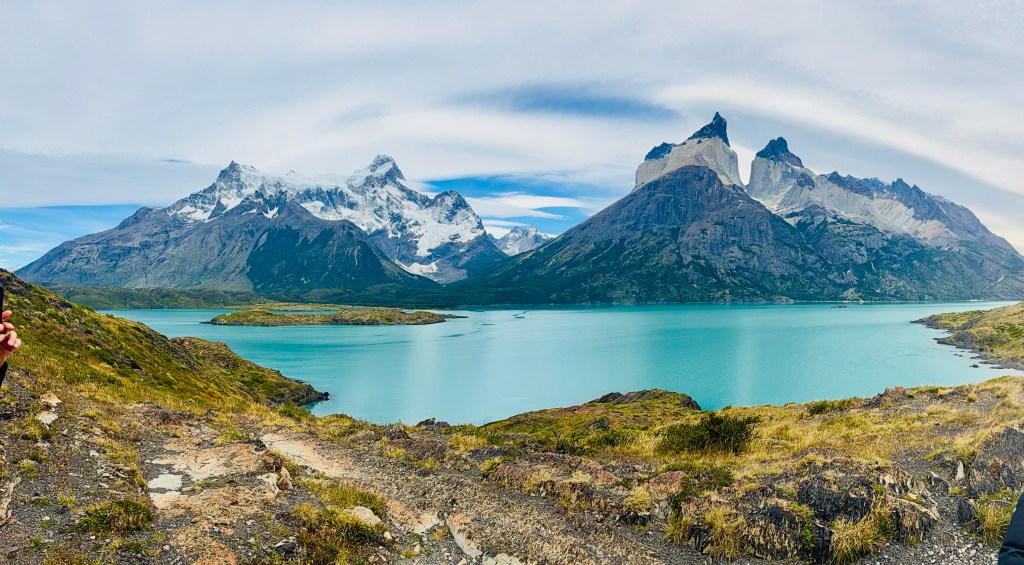
Torres del Paine National Park along the Miradores Trail with “The Horns” on the left

We arrived at Patagonia Camp at about 6 PM and were immediately ushered into an orientation about the property. They took our luggage to our yurt as we sat in the reception area where we were greeted with a welcome drink and appetizers. From there we went onto a different meeting room to select our excursions for the next three days. This is the first time I have stayed at an all-inclusive resort and both Rick and I felt like it had a White Lotus vibe (an HBO show) where everyone on the staff is so friendly and eager to make you comfortable. We had a lake front yurt with a hot tub. When I think “yurt”, I think of a tent in the middle of the dessert and a shared bathroom. That was not even close to the luxury of Patagonia Camp. The yurts are framed with wood and covered with tarp but also have a plastic top at the peak which gives a clear view of the starlit skies. There is a private bath off the side of the yurt which is a wooden structure. It’s really quite remarkable with natural formed wooden tables, comfortable beds and a fridge stocked with food and drinks. All we had to do was call the front desk to have the hot tub uncovered. The best aspect of the camp was the terrific food. The desserts and appetizers were works of art and there were new choices at each meal. The restaurant and bar had a beautiful view of Lago Toro and the spires of Torres del Paine in the distance.

Our first hike was the next day and we went for a hike within the National Park then to a rock outcropping that had cave paintings on the Aonikenk Trail. The trail is in puma (mountain lion) country and children under the age of fifteen are not allowed to hike since they are the main target of pumas. That’s a scary piece of information! You also have to hike with a guide in case you run into a puma. We did not have any puma encounters. We were able to see the handprints and figures on the rock from 11,000 BC. It rained, it was windy (gusts to 40 miles an hour) and the spires of the Torres del Paine were obscured for most of the day.

The next day my brother was able to check off a bucket list item for him; doing the 12-hour trip of hiking to the base of the horns in Torres del Paine. He hiked with the folks that we picked up on our transport from Puerto Natales on our arrival date which were two guys in their 60’s and their twenty something daughters from Michigan. It was a tough hike through windy canyons, intermittent frozen rain and a boulder field with many bottle necks. It is the most popular hike in the national park and that Saturday during high season there were several hundred hikers on the trail. He never saw the horns due to the low hanging fog but he was happy to complete the hike. I didn’t accompany him on this adventure.

Our final excursion was on our last full day at Patagonia Camp and it was amazing. We took the Miradores (viewpoint trail) which had an overview of the Salto Grande (Big Jump Falls) and a spectacular view of the Los Cuernos (The Horns), Paine Grande (the highest peak) Cerro Almirante Nieto, Valle del Frances and the turquoise Lake Nordenskjold in the foreground. The view is spectacular; after days of waiting to see the craggy tops, the shades of blue between the lakes, rivers, skies and rock along with shades of gray from the glaciers and granite is spectacular Perhaps it was the anticipation of hoping to see the elusive mountain tops but it was worth every minute of effort to see this spellbinding sight. One of our companions on the hike kept saying,” It’s not AI, it’s real”. It was appropriate because the colors were so vivid it felt like it must have been airbrushed or a simulation.

I can’t say enough about Patagonia Camp and its impeccable staff. The drivers, the servers, the housekeepers and guides were all terrific. On our last excursion, there were 8 of us, all in our 50’s and 60’s and the music on the van sound system was all obscure songs from the eighties from the Police to Talking Heads to Billie Joel. It’s hard not to believe that it was selected especially for us. If you ever venture to Patagonia, be sure to stay at this incredible oasis.

🌋Discovering the Lakes Region of Chilean Patagonia

My brother, Rick, and I traveled to the Chilean portion of Patagonia in January of 2026. Patagonia is the lower third of South America straddling Chile and Argentina.  We arrived there by traveling through Santiago. We traveled by plane to Puerto Montt and then took ground transportation to Puerto Varas on the beautiful Llanquihue Lake. We stayed at a lakeside hotel and could watch the sunrise with the extinct Osorno Volcano (Rick referred to it as Mount Fuji’s cousin) in the background. It’s 8,700 feet tall and has a glacier on top which gives it the conical snow-capped shape which is similar to Mount Fuji. Having arrived in Patagonia we learned that it can take days to have a clear view of a mountain or rock formation. When we arrived in Puerto Varas, it took us three days to see the entire profile of the volcano.

Puerto Varas is in the Lakes Region and Llanquihue Lake is the second largest lake in Chile. If you look at a map of the very southern tip of Chile, you can see that it is riddled with fjords and islands and small bays. It’s almost more water than land and the land is riddled with volcanoes both active and extinct jutting above sea level to thousands of feet and rocky formations from volcanic and glacial activity. It was very unique.

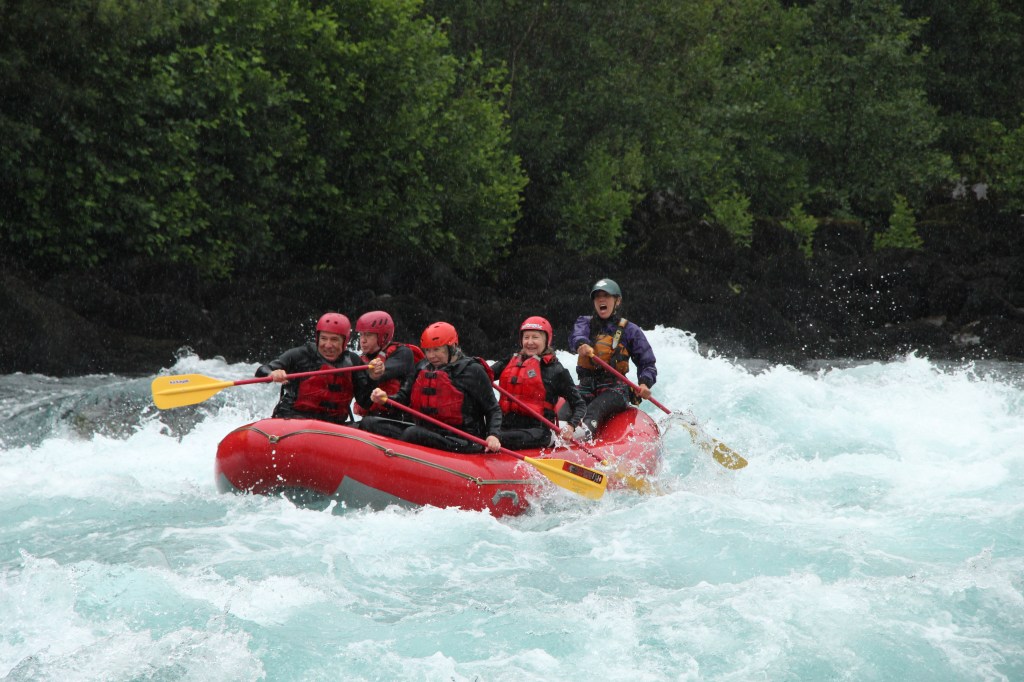
My brother Rick, Paul, myself, Debra and Camilla (left to right) rafting near Puerto Varas Chile

We enjoyed an incredible meal at a small farm about 25 miles north of Puerto Varas on the shores of Llanquihue Lake.  It’s a family run farm and we got to harvest all the produce used for the meal including rhubarb, plums, several varieties of tomatoes, various greens, edible flowers, potatoes (a Chilean staple) and zucchini. We dug up the potatoes, cut the greens and foraged for plums. We also had a fresh caught salmon which was smoked along with the zucchini in a makeshift smoker. We ate in the lovely farmhouse and I have to tell you that salad of the mixed fresh cut greens was the best salad I’ve ever had. Verdant, bright and tender.

We drove out to the coast the next day. Chile’s width is 100 miles on average, so it’s pretty easy to ski the Andes and take a dip in the Pacific in the same day. The original inhabitants of southern South America are the indigenous group called the Mapuche Nation. They are the largest group of indigenous people that survive today and are divided into several groups and regions. We visited a group called the Huilliche who are in the southern subgroup associated with the Chiloe Archipelago. These Mapuche can be traced back to 500 BC and are largely fisherman and farmers.

We met the lonco or chief and he took us through a welcoming ceremony where we hugged and greeted each member of the tribe. We learned how they prepare wheat by toasting it on a fire inside their hut and then ground it with a mortar and pestle. The women of the tribe prepared chochoca which is raw grated potato and cooked potato blended by hand into a masa or dough. They then pat the masa along with what looks like a 7-foot giant rolling pin covered on all sides (except the handles). They then carry the enormous rolling pin to a large pit lined with coals. They turn the rolling pin for about thirty minutes as the masa cooks and the exterior starts to toast and turn brown. They then cut off the entire piece of potato masa into a large husk. From there they add cooked pork and then roll it and cut it into sandwich size pieces. It was fascinating to watch the wife of the lonco work so diligently to create this masterpiece. We enjoyed a meal with the entire group, briefly played field hockey with sticks and a ball shaped from reeds. I think the highlight was both the visitors and residents all introducing themselves to each other and reflecting on what we were grateful for. It was a bonding experience to learn of their trials and tribulations and for them to have a greater understanding of us. We are 6,000 miles a part but we are all parents, children and siblings. We all embraced and said goodbye.

We were scheduled to go kayaking on the final day in Puerto Varas but we had to replace it with a rafting trip because it was too windy. It was supposed to rain the entire day. I assumed that they would cancel the rafting trip. I had also assumed that the rafting meant something akin to a lazy river, something relaxing and mellow.  I was wrong. Very wrong. We traveled to the rafting vendor with a fellow retired traveler named Paul who was from Ireland and Debra from London. We piled aboard the transport van to get a briefing from the rafting vendor.  Rick, Paul, Debra and I were at least twice if not three times the age of all the other twelve or so rafting participants. The woman giving the briefing on all the potential safety issues and what to do when we fall out of the raft (!?!##) and not to ever let go of your paddle. I was pretty shaken up by the end of the briefing which felt like she was trying to scare me straight. I was on the edge of bailing and Paul, who apparently couldn’t swim, was on the same wavelength. Rick was stalwart that if they were able to take us rafting, he was going. We all acquiesced and, ironically, we were all put in the same raft with our fearless leader Camilla who was a tough young vibrant leader and an outstanding guide. We were all suited up in wet suits, booties and jackets. We left all our belongings behind on a bus as we entered the tumultuous waters of the Petrohue River adorned with helmets. I was glad to protect my head but what about the rest?

We were instructed to jam our foot closest to the wall of the raft into the crevice to stay stable on the boat. There is a rope that goes around the entirety of the raft but outside of that, there is nothing (and I mean nothing) to hold onto. Camila would instruct us to go forward HARD, and it was typically about three paddles and then tell us to “Stop”. As we entered the various rapids (it seemed countless but theoretically it was 8 sets of class 3 rapids), Camila would let us know if we would have to “Go Down” or bend over and grab the rope on the outside of the raft while holding onto our paddle and, hopefully, not going overboard. Then, after whatever massive wave had hit our boat, we would go back to “Position” which was upright with the paddle at the ready. You can imagine that four paddlers over 60 have various paddling, hearing and dexterity skills. Camila had an accent and there were several times Debra, Paul, Rick and I would have to check in on what the current “order” was. Debra and Paul were in the front row for the first 4 to 5 sets of rapids. I was relieved as the amount of water coming off the bow of the boat was a torrent and staring into the upcoming waves and rocks was intimidating.

About halfway through, Camila instructed Rick and me to move to the front of the boat. GULP! Just changing seats mid river was all about balance and space and fear. So now Rick and I were in front and, let me tell you, this was the center of the storm. I have to say that I said a little prayer for the first time we had to “Go Down” and grab the rope on the raft. It was like diving into a tidal wave. I had water completely wash over me and there was water down the back of my wetsuit. Each time we survived a rapid without getting thrown out of the boat was exhilarating. I was always thinking, “Wow, how did that happen?” The final rapid felt like I was swimming underwater. The entire boat was filled with water which miraculously emptied almost immediately. All four of us elders survived the trip without a broken bone or falling out of the boat. I was completely soaked from head to foot but I had a smile on my face for surviving one of the most exciting experiences of my entire life. It was right up there with zip lining and kayaking Lake Titicaca. As Rick said later, I was pretty sure that 99.9% of participants typically survive.

The Patagonia Lakes region is full of adventure, culture and breathtaking views and even though it was intimidating and scary at times, it was an experience of a lifetime. I’m so glad we went.