
I’ve been traveling across the United States in my motorhome, Abeona, for the last few weeks; and have been following a zig zag route. The intent is to check off some more of the National Parks in an effort to see all 63. There are no National Parks between Amarillo and Santa Fe but there are some fun Easter eggs if you go looking. An easter egg is a surprise where you aren’t expecting it. A friend of mine turned me onto an app called Atlas Obscura which has a handy map feature to show you some offbeat locations to stop by. I was really glad I had the app because it helped me locate a few interesting stops along what would be a boring stretch of highway.
Route 66 was established in 1926 and connected Chicago to Santa Monica. It became a migrant route and then a post war tourist mainstay. I lived in Albuquerque NM for several years and “the Mother Road” cuts down from Santa Fe right through Albuquerque. A lot of what is currently Interstate 40 from Oklahoma to Tucumcari NM is the old Route 66. It’s interesting to think of all the folks who have traveled this road in search of a better life or simply seeking the sun of southern California.
When I arrived in Amarillo, I first ventured to Slug Bug Ranch. I had expected it to be just 5 VW bugs face down in the ground (similar to Cadillac Ranch) but was surprised to find 10 VW bugs and several stretch limousines face planted in the ground and covered in graffiti. It was expanded in 2024. Unfortunately, parking (ironic) was not easy in a motorhome so I just looked at it from Abeona. It’s definitely a quirky free stop but fun.
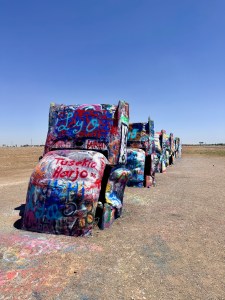
Cadillac Ranch is about three miles down the road along I-40 (route 66). The ten Cadillacs that make up Cadillac Ranch have been around since 1974 but they were moved in 1997. They are now visible form I-40. There is a ton of parking along the frontage road and there are dumpsters full of spent spray paint cans. The ten Cadillacs are in the middle of a barren field and there had to be upwards of 40 folks mingling and painting the structures. It’s remarkable to watch different families and groups making their art on these huge metal objects. It’s wild to watch graffiti in action. The entrance to the park as well as parking are free and sometimes there are leftover spray cans for use.
The trip from Amarillo to Tucumcari was a white-knuckle trip that I had not anticipated. I had wanted to get out of Oklahoma and the threat of tornados. High winds in west Texas and New Mexico are a whole other animal. Driving a high-profile vehicle along a large stretch of road in the high desert is like holding onto a sailboat in high swells. The winds were 25 miles an hour with gusts to 50 miles an hour. I could see off into the distance (because it’s such a huge flat expanse) and there were red dust clouds looming and tumble weeds careening across the roadway.. By the time I got to my campground in Tucumcari, both of my hands were numb from holding the steering wheel so tightly.
The next day, I headed up a long-lost road from Tucumcari to Santa Fe. This was a bit of a crazy experience. It was fortunate that I filled up with gas before heading out because there were no services along the road. I remember seeing a roadrunner cross the road and I felt like it was a lucky sign that I was on the right road. They are such beautiful birds and its namesake cartoon really doesn’t illustrate the delicate beauty of this tenacious bird. On my three-hour trip to Santa Fe there on this barren road, I saw two trees(some 40 miles apart) decorated with Christmas decorations for no apparent reason.
My last stop on my trip to Santa Fe was the Pecos National Historical Park in Pecos, NM. I lived in Albuquerque for several years and I spent a lot of time traveling the state to check out different landmarks; this was a new place for me. It was a major 14th-century community that thrived as a trade hub between the Puebloan and Plains Apache tribes. At its peak it was a 2,000-person community with 5 story buildings and they have done a great job recreating some of the ruins and kivas. The Spanish first visited in 1541. I think it’s always so mind blowing to see how successful indigenous folks were and how early and so far inland the Spanish were in the United States. It’s truly a remarkable exhibit.
I enjoyed my return to the Mother Road and outside of some hairy driving during high winds, there were lots of interesting stopping points to take along the way. It really pays to plan to seek them out before heading out so that you can take in these remarkable places. It’s all part of the journey.

