Missing Daddy

My father passed away on July 12, 2019. Our family was unable to gather on what would have been his 95th birthday on June 19, 2020 because of the global pandemic. Since we were unable to celebrate him together in person, I realized I can celebrate him with my words.

My father, Benson Noice, wandering the world.

Grief is a fickle thing. I won’t lie and tell you that I think about him every day. I certainly did in the months following his death. In the last few months, it’s been sporadic. It might be a commercial about a father teaching his teenage daughter to drive or a mini-series about Ulysses S. Grant, and suddenly I evaporate into tears. I miss my father even though I am so grateful he died in 2019.. It gave us the chance to visit him (pre-COVID) as he slowly succumbed to congestive heart failure.

Here are the things I miss about Daddy:

Unflappable

I challenge anyone to tell me a time when my dad lost his temper. He rarely raised his voice and only did so to tell his opinion in a heated debate. When my two brothers and I were kids there was a lot of rough housing, teasing and taunting that took place; my father was loathe to intervene. He headed up field trips to Gettysburg and Washington, D.C. as a history teacher and always managed to return bus loads of rebellious and raucous teenagers home with rarely an incident.

I’ve read several books about Ulysses S. Grant. There are many references as to how calm and cool Grant would be in the middle of a battle and to be able to keep his wits about him. I think of all the challenges my father dealt with as a sailor on a schooner during a hurricane. As a Merchant Marine traveling from the Pacific to the Atlantic in an oil tanker with a sheared-off bow during World War II. He was never a man who was easily roused. 

I think of him when a co-worker loses their cool. I think of him when I lose my cool. I miss seeing my father and being able to watch him be unflappable.

Wanderlust

The biggest road trip of my life was with my family. We traveled from the East Coast to the West Coast of the United States and then from the Western provinces of Canada to the Eastern ones when I was eight years old. My father loved a view. He really loved the view of a mountain in particular. Whether it was the Rockies, the Sierra Nevada or the Canadian Rockies, my father (who drove our old Ford station wagon and 24-foot trail for all but 10 miles of the trip) would always pull off to an overlook…to have a look. 

I remember rolling my eyes as an impatient eight-year-old as my father would marvel at the view. At the time, I didn’t appreciate the marvelous opportunity my parents were giving me to see so much of the U.S. and Canada. After retirement, my parents traveled the world from Russia to China to Australia. He was always intrigued by foreign cultures, politics and natural beauty. He had wanderlust. I think of him when I see a tall mountain peak or hike to the summit of a trail. I miss and am grateful for my father’s wanderlust as he instilled it in me.

Patience

I have never been as patient as my father and have always been envious of it. He was the best grandfather. He traveled to my children’s marching band competitions, wrestling meets and football games. He never cared how far it was or how long we might sit in the cold or hot humid stands. He was just happy to be there. My son’s football team might be losing by 40 points but he’d be sitting there on the cold hard bleachers until the bitter end.

My father was the man who would patiently walk around the neighborhood with my then 2-year-old daughter reading license plates. At the ripened age of two, she was able to read all the letters and numbers on a license plate, all because her grandfather encouraged her to read. It reminds me of the times when I was in grade school and putting on plays in the basement. He was always willing to pay a quarter for admission and would sit through some haphazard, ill-conceived play for the love of his daughter. I think of him often during this pandemic and how easily he would have dealt with this big pause. I miss his patienceand try to summon it often to cope with plans that are scrapped or delayed.

Wisdom

Anyone who lives to 94 is wise. They have survived catastrophes, wars and circumvented fatal errors. My father studied at eight different colleges and universities. He actually went to the University of Pennsylvania and attended West Chester College at the same time without one knowing about the other. My parents scrimped and saved their entire married life in order to send all three of us to the university of our choice. My father was a revered mentor to several young men that he taught in school or who he met as a counselor at a boy’s camp called Camp DeWitt. He was sought after for his advice and counsel for decades after their first meeting. My father’s opinion was one that I always valued. I remember the difficult decision to leave my first husband when I had very young children and countless responsibilities. I valued his opinion above everyone else’s. I never wanted to disappoint him. I miss his advice and counsel. He was the wisest man I’ve ever known.

I remember being with him on his 94th birthday. He was hunched over with an oxygen tube but was still able to read the book “Benson Noice Junior the Great” written by his namesake grandson as a grade school project a decade or more earlier. We all sat in his room as he told stories about his life. I was surprised that he talked about seeing both of my children being born and how miraculous it was. I will always remember kissing him goodbye for the last time in person and him telling me, “I love your blogs.” I find my father in all kinds of places now. In the wind, on a sailboat, at the top of trail or a scenic overlook. I may be missing him but he is there if I just pay attention.

🦶My Pilgrimage to Walberton

As I write this, I’ve been in the United Kingdom and Ireland since late March, 2023.  I’m sitting here on a couch next to a window with a view of the English Channel in Southsea, Great Britain.  You may ask why I’m in a relatively small town on the English seaside when there are hundreds of other more compelling places to visit in Great Britain. 

What has brought me here is the work my late father did some 30 years ago on my family surname of Noice. He painstakingly documented his findings using various pre-Google and pre-ancestry.com resources. This involved obtaining info from The Church of Jesus Christ of Latter-Day Saints, as well as Census and library records to find out where the Noices came from. In his introduction to his book about the 11 generations of Noices he says that he was spurred to write the book to answer his daughter, Cathy’s question, “Where do we come from?”  I’m mortified to report that I finally read the book from cover to cover about four months ago. I’ve dragged that book through at least five moves (even one cross country), and I finally prioritized reading it.

The road to Walberton

In reading the book, I was compelled to make a pilgrimage to Walberton, GB, where at least 4 generations of Noices made their home.  In fact, getting to Walberton was the entire underlying reason for coming to the United Kingdom although the trip grew as I learned more about other off shoots of my family including Dunfermline, SC, Armagh NI, Tipperary, IR and Wallingford, GB. The one thing I have learned in my genealogical research is that the best records are found in Anglican Churches in England.  Unfortunately for research, branches of my family were practicing non-Anglicans, who at some point fell out of favor such as Presbyterians in Scotland and, later, Northern Ireland and poor, famine-stricken Catholics, in the country side of Tipperary, Ireland. I found a lot of dead ends. But, at least I was there to find them! 

The first Edward Noice Sr. and my 7th Great Grandfather moved from Abbotts Ann, Hampshire, England, and married Elizabeth Risbridger in 1705. She had three children, including my 6th Great Grandfather Edward Noice Jr. but died shortly later in Walberton, Sussex, England.  My father was unable to trace back further than Edward Sr. but I have since found roots back to Hampshire England to 1596 and three generations of Richard Noyes.  This lines up with the majority of the Noice (Noyes, Noyce) surname to be located in Hampshire England in the 1850’s.  

The sheep along the road to Walberton

Edward Noice Jr. was born in Walberton, married his wife, Mary Stubbs, there on May 4th, 1736 at St. Mary’s Church and their son, Edward Noice III, was baptized in the same church in 1737.  Walberton was then home to Edward IV who was born there and baptized at St. Mary’s in 1771. Edward Noice V was born in Walberton in 1813 and he was the Noice who traveled to the United States with his wife Elizabeth. She gave birth to Edward Harrington Noice in 1839 in Princeton, NJ. Four generations of Noices and they all lived in the tiny village of Walberton, Sussex, England (population 2,174). I researched and found that St. Mary’s Church (founded in the 11th century) is still there.  I had to go.

The reality of traveling to Walberton was a bit more difficult than I realized.  I booked a flat in Southsea that had transit connections, places to visit, the ocean close by, convenient shopping and restaurants. Southsea had taxis, trains and buses.  Walberton did not except for a daily bus from Arundel (the opposite direction).  I found a train that took me to Barnham but I had no idea if I could walk (did it have safe walkways) from Barnham to St. Mary’s in Walberton although it was only 2 miles. I was dead set against renting a car as, even after three weeks of watching, walking and riding

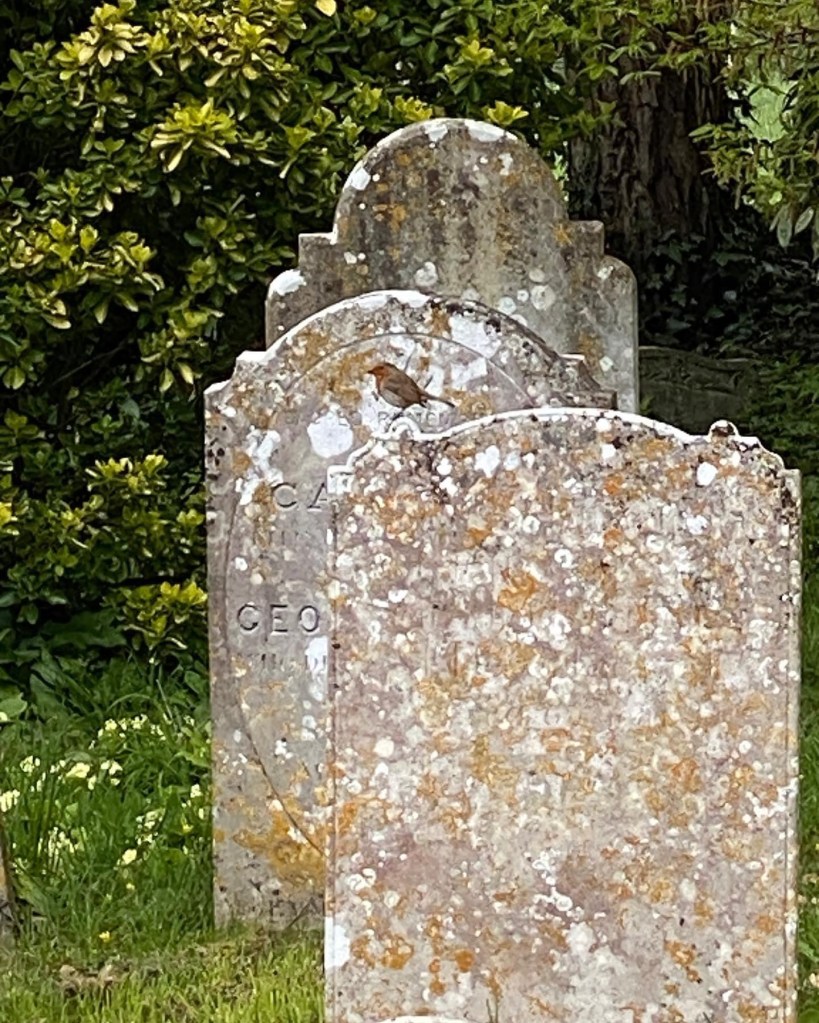
A European Robin on one of the many graves at St. Mary’s Church in Walberton

 left side of the road driving in the United Kingdom, I just didn’t have the guts to get behind the wheel of what would likely be a stick shift car and drive on the left-hand side.  I really started to panic on Sunday when I couldn’t find Ubers in Barnham to take me to St. Mary’s.  I delayed my trip to Monday, hoping a regular workday would produce more Uber drivers. It did not.  I decided that Monday was the last day since I had ample time to walk.  I also was able to map the trip on Google maps and it showed me that there was a sidewalk/walkway for what looked like the entire trip.  Off I went on Monday at around 11 AM to catch the train to Barnham.

Arriving at the Barnham train station at about 11:30 and I was glad to see a taxi there but I just felt like that would be too short a ride and that I wouldn’t truly experience the walk to Walberton. I wanted my “boots on the ground”.  I decided to walk.  I have to say that I was glad to see several folks on bikes, moms with strollers and some joggers on my walk to Walberton.  The walk itself was bucolic. I walked on a separate bike path through several fields full of sheep and wild flowers.  Passersby were friendly and there wasn’t a single moment when I thought I was in danger of being run over by a car. The town of Walberton is lovely with several thatched roof homes , many of them having names like Dairy Lane Cottage and Chamomile Cottage. The main drag of Walberton is called The Street and the church is on Church Lane.  I enjoyed the walk so much as it really felt like a pilgrimage to my ancestral home and a way to honor them 

Myself in front of the St. Mary’s Church where 4 generations of Noices lived, baptized and married in the 18th and 19th century

St. Mary’s Church is surrounded by graves and headstones.  My first inclination was to walk to find some gravestone with Noice on it.  I realized this was probably foolhardy as most of the stones were unreadable.  I probably searched about 70 percent of the stones that were in the older section of the cemetery but most of the grave markings that I could read were from the late 1800’s, so I’m not sure how long they have been burying folks there. I was able to enter the front section of the church but the main church’s doors were locked.  It didn’t matter.  I could feel my ancestors there.  Here in this tiny village in southern England where 4 generations of Noices loved, lived and raised families.  I made it there and left a piece of my father’s ashes there.  He, too, has been brought home. My lesson in all of this is to seize the day, walk it if you can and lean into the unknown. I will always have that memory of a beautiful walk to Walberton and taking my father with me. 

😳My Father’s Experience in Korea in 1947

My late father went in the Army on February 20, 1946 at Fort Devens, Massachusetts and then onto basic training at Camp Crower in Missouri. World War II had ended with the Japanese surrendering on September 2, 1945 and the Korean War didn’t start until June 25, 1950. This means that when my father ended up in Korea in 1947, he was there during a tumultuous time. The Japanese were gone, and the United States military were there as military oversight. My father at the age of 22 was in a foreign land, that spoke a foreign language during uncertain times.

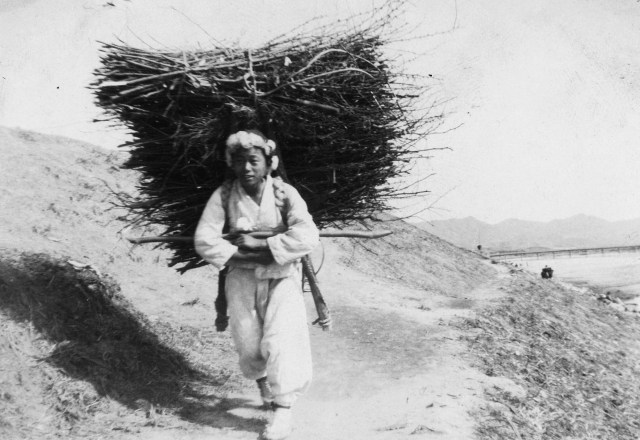
Korean man
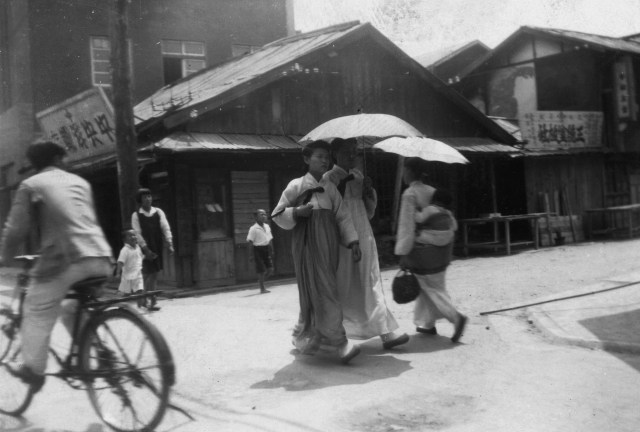
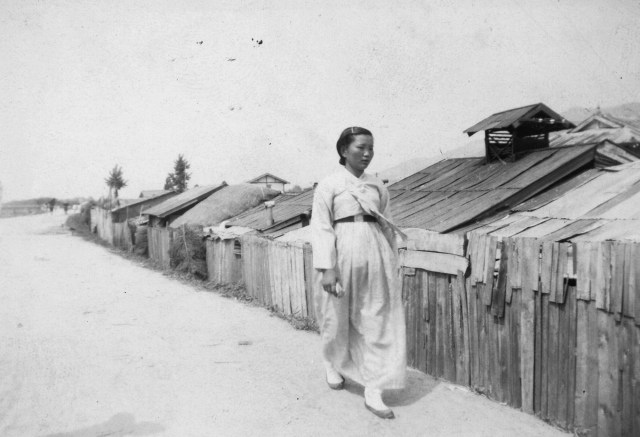
Photos from my father’s army service in Korea 1947

In 1947, my father was about halfway through his bachelor’s degree. He had two semesters at Colby College and one summer semester at the University of Minnesota.

From my father’s personal history:

I volunteered for duty overseas. Signing up in the regular army to be sure I got out in 18 months, I awaited assignment to culture laden Europe where most GI’s went. What a shock when I was shipped to Fort Stoneman in California on the Sacramento River, near San Francisco. I was shipped out as a radio repairman to Korea – I didn’t even get stationed in Japan!

So, there was my father on his way across the Pacific on a life defining journey:

Authority

From my father’s personal history:

With hundreds of men confined to foc’siles in bunks stacked 5 high, the trip across the Pacific became a nightmare when a 3-day storm made most troops seasick. Not allowed on deck for air, the mess halls had no one to man them, latrines were stopped up by vomit and the stench become overwhelming as men threw up and relieved themselves in their bunks. I was OK till someone 4 bunks above vomited on me—then I heaved too. During all this, officers kicked us out of their way to get by and I learned to hate arbitrary authority—military law could put us behind bars if we hit back.

This scene is horrendous. The disarray. The lack of humanity. The impact on my father was a life led with levelheaded fairness. In the multitude of comments from his past students from his 30 plus years of teaching history was that he was fair. Grades were earned. Rules around discipline were clear on the first day of his class. He was never one to abuse authority and he used it judiciously.

Korea in town.JPG

Respect

As my father wrote:

We rode a train down the Peninsula to Ch’ongju, a mountainous area between Seoul and Pusan. We broke up wooden seats and started fires in the passageway – to prevent frostbite from bitter winds whistling through broken out windows. Seeing young Korean boys with a single shirt, shorts and rubber shoes without socks staring at us from railroad stops along the way, left me incredulous. I, near a fire, with heavy army boots, two sets of socks, a hat and helmet liner, was damn near freezing to death, so how in hell could those kids survive?!? I hoped we’d never have to fight such people. Though we had better weapons it was clear their survivability and toughness were far superior to ours.

When my father ever spoke about his life challenges, he never brought this experience up. When he spoke of life not being fair, his experience in Korea did come up. He never forgot the cold and those kids. Even though his experience was one small step above those kids, his respect for them was immense.

Curiosity

My father wrote:

One day, befriending our houseboy with a pack of matches, he took me far back into the mountains to visit his grandfather’s village. Kids and most adults had never seen an American before. Sitting in his grandfather’s hut amidst male villagers, I saw women peeking from another room for their first wide-eyed stare at a real man from the West. Politely declining pipes of opium, I passed around chicklets and showed photos of my family in response – pointed to a worn newspaper blowup of N.Y.C. skyscrapers on their wall and telling them through my houseboy interpreter I had lived near there. They laughed, shaking their heads, insisting it was just artistic imagination and that there was no such city like that.

My father was not a news reporter, he wasn’t working on behalf of the army, he did this all on his own. He ventured out to find out what was out “there”. I find this to be amazing. For the price of a pack of matches, he sought out a new perspective. In the many condolences I received from his past students, the over arching theme is that he made history come alive. He marched around classrooms with a pointer as a rifle and made the students feel like they were there. This curiosity. This wanderlust. I don’t believe it started in Korea but it certainly opened the door.

Korea street with ladies.JPG

Shift       

My father always famously said that he went to Korea a liberal and came back a conservative. As he wrote:

My 7 months’ allowed me to contrast our America with poorer lands in a way unobtainable from books, converting me from a liberal critic of our way of life to a defender of American society thereafter. The poverty imposed upon Koreans by 50 years of Japanese conquest was grim. Men and women squatted and defecated anywhere outdoors even in the river they got their cooking and drinking water from. A pungent stench of human excrement overpowered us wherever we went, reminding GI’s of missing sanitation, a lack of paved roads, bridges, safe drinking water, electricity and unheated houses in sub-zero weather. I pondered how Koreans could be happy in a land stripped of forests for fuel, widespread malnutrition, open body sores, universal disease and general mistreatment by local police and authorities.

It also shifted his trajectory of his career and future studies. He sailed under the Golden Gate Bridge with the Army and decided to finish his interrupted Sophomore year at Berkeley. He studied Intro to Government, Foreign Policies and U. S. History (he proudly received two B’s and an A). This lit the fuse to his 34-year career teaching and demonstrating history.

Korean Woman

This piece was prompted by finding the pictures attached from my father’s photos.  I am fortunate that he left behind his legacy in written and photographic form. But isn’t that his way. The great historian leaving his thoughts and personal evidence for me to have a better understanding of this great pivot point of his life. I asked him in his last few months if he had any regrets. The only one was not getting a PhD. The rest is all a life full of adventure, stories told and sharing his experiences. His students and his children are the fortunate and enriched receivers. We got to live it with him.

Leaving Pieces of Daddy

My father passed away three years ago at the age of 94.  He was a lifelong adventurer;  Whether  being a Merchant Marine in WWII or stationed in Korea, hitchhiking across the United States or traveling to the Great Wall of China in retirement. He led teenage boys from Camp DeWitt on canoe trips into the uncharted deep woods and rivers of Quebec and dragged a 26-foot camper behind an aging station wagon with his young family from coast to coast to coast.  He loved to pull off the highway in the Sierra Nevada’s to appreciate a view, marvel at the Terracotta Army in Qin Shi Huang China and appreciate the classic romantic architecture of Saint Petersburg.  My father was the definition of wanderlust.

My father, Benson Noice, traveling the world.

I requested and received a small portion of my father’s remains after his passing.  I wasn’t sure what I was going to do with them except to put some in a necklace.  It was my keepsake for good luck as well as keep him with me wherever I went.  I had a trip to New Hampshire to support my then boyfriend on his hike of the Appalachian Trail. I decided to take some of my dad’s ashes to leave pieces of him in some of the memorable places of his life (and some of my life as well).

These are some of the places where I left a piece of my Daddy:

The Cove at Camp DeWitt

Camp DeWitt is a boy’s camp that my father was the Waterfront Director every summer from the mid-1960’s through the 1970’s.  My father stood on the beach overseeing the sunfish sailboats, canoes and kayaks and countless life preservers while teenage boys, including my brothers, cycled through different activities throughout the camp.  My mother and I lounged, tanned and swam in the crystal-clear waters of the lake. Camp DeWitt was sold some years ago and now has elegant homes along the shores of Lake Winnipesaukee.  When I think of my happiest, most serene, carefree moments of my childhood, they are on that beach. The most frightening moment would be an errant crayfish or not putting on enough sun screen. I left a piece of my father on the beach of the former cove of Camp DeWitt.

The Statues of Major General Sedgwick

General Sedgwick is a family ancestor who fell at Spotsylvania in the Civil War whose famous last words were “They couldn’t hit an elephant at this distance.” My father wrote his Master’s Thesis on John Sedgwick and we did countless trips to Gettysburg where there is a stunning statue of Sedgwick on horseback on Sedgwick Drive.  Over the last few years since my dad passed, I’ve traveled to the monument where Sedgwick fell in Spotsylvania, the statue of Sedgwick at West Point where legend has it that a cadet who spins the spurs on boots of the statue at midnight, wearing full parade dress gray will have good luck on his or her final exam, and to his equestrian statue at Gettysburg. I left pieces of my father at each monument.

Hoosac School

My father spent his teenage years attending boarding schools thanks to his beloved Aunt Sadie.  Growing up in a broken home during the depression and moving countless times, Hoosac school was a safe haven for my dad.  He played football, wrestled and sung in the choir in this remote prep school in upstate New York, just spitting distance from Vermont.  As I was driving to New Hampshire and was trying to avoid the traffic in the greater metropolitan area of Boston, my circuitous route took me, serendipitously through Hoosac New York.  There I was driving alone and looking at the GPS when it showed that I was on Hoosac Road as I headed towards Vermont.  I felt like my father was willing me towards this prep school that I had only heard stories of and had never seen.  Sure enough, the sign for the school was along the road and I drove on campus. There at the top of a hill and at the base of the bell that I’m sure my father heard daily as a teenager, I left a piece of my father.

Penobscot Bay

Last fall, I traveled to the coast of Maine in the fall to see the changing foliage and to see where my parent’s relationship began.  My parents met aboard The Adventure, a schooner that traveled the islands and coves of Penobscot Bay, my mother as a guest and my father as crew.  As we drove into the quaint town of Camden, there was a lone parking space available on the crowded streets right in front of a sign for daily schooner tours out of Camden harbor.  It felt like a sign that I needed to get on one of the boats.  The next day I did, and even though it was cloudy and windless, I imaged my parents meeting in that boat some 65 years earlier; the prologue written that summer when my father turned 30 and met the woman of his dreams. I left a piece of my father in Penobscot Bay.

There have been other places along my travels to scatter pieces of my dad, Longwood Gardens where my father proposed to my mother, the top of Mount Washington, Goat Rock on the Sonoma Coast, Mount Rainer, and his headstone at St. Joe’s on the Brandywine.   I’m never sure of the next location but I know he’ll let me know like an ethereal tug on my attention.  I do know one location for sure and that is Peyto Lake in Banff.  In my father’s last days, he said it was the most beautiful place on earth and I’d like to leave a piece of him there so that he can be a part of that spectacular view forever.