How to Travel Solo in an RV🧍🏼‍♀️

Last week I wrote a post on why I started traveling solo in an RV.  This post is more about the nuts and bolts of traveling solo. The how to guide on how I set up a trip.  I start working on trips sometimes up to a year in advance.  I traveled to Alaska on my first cross country RV trip and I knew that I wanted to take a ferry from Bellingham Washington to Skagway Alaska. It’s an almost 3-day ferry ride off the coast of Canada and I knew that both space for an RV and a berth needed to be reserved at least 6 months in advance. Once I had that reservation, then I had a starting point for the rest of my trip, with a solid deadline of when I needed to be in Bellingham. I did the same thing for a trip to Newfoundland. Newfoundland can only be accessed by a ferry if you are in a vehicle and the ferry ride is 7 to 16 hours long depending on the port. 

So, my first action is to set up the biggest constraint (like a ferry ride) and then work my way backwards and forwards from there. I have been using an app called RV Life which is a terrific tool because I can map out each RV park or destination like national parks and museums and it shows me the mileage and travel time between each destination.  So, if set up an RV park and a National Park, it will show me that it’s either 15 miles apart or 90 miles apart. If I think it’s too far, I can find a different RV park. I generally will map out the major stops I want on a trip and then back my way into the timing over all.  I’ve learned (the hard way) that 400 miles in Montana alone in an RV is unreasonable. There are very few services and most stops (if there are any) are on gravel roads. I have a hard stop now at about 300 miles which will take me about 6 hours depending on conditions. I have also learned to drive at least 10 miles below the speed limit. It really does save on gas mileage (remember when President Carter set a 55 mile an hour speed limit?)  and when it’s windy, I am able to handle the driving better.
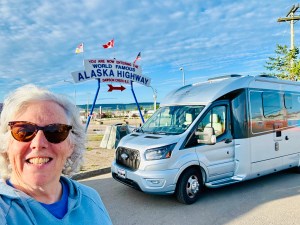
Myself and Abeona (my rv) on the Alaska Highway

When planning my trips, I try to make sure I have full hook ups at least every third day so that if I need to empty by black (toilet) and gray (shower) tanks, I can. I’ve learned that I can fill my fresh water tank and it will last about 4 to 5 days depending on the length of my showers and being conservative with washing dishes. It’s amazing how in tune with my water levels I am at any given moment. Until this year, I had to make sure I had electric hook ups. I am almost always traveling in the heat of summer and I could only turn on the air conditioning if I was hooked up to “shore” power. When it was 110 in Joshua Tree, you can imagine that having hook ups was imperative. 

This past year, I upgraded my solar inverter and my lithium batteries so that now I can run anything in the RV at any time. It has been a huge game changer.  Not only can I run the air conditioner in the back of the RV while driving but I can also stop at a rest area and have lunch in the comfort of my rig.  This may seem small but it saves on time and money and, most importantly, on decision fatigue. There are a multitude of decisions I have to make each day and trying to figure out a restaurant that I can park in that has vegetarian food in the middle of Montana can be exhausting. I can pull off the side of the road, run my microwave or make a sandwich in the comfort of a cool rig.  It takes less time; I eat what I want and can always use my bathroom. 

I generally fill up on gas when my tank is half full. I look for gas stations that are not busy and easy to get in and out of. Price is the last consideration.  Ease of maneuvering is my main concern. I keep a running grocery list and try to shop when I am just getting into a town I am camping in or on my way out. This last trip across the United States from North Carolina to Seattle, I was moving almost every day. I constantly lock things and put things away knowing that I will be driving the next day. I have fitted Abeona with storage so that I don’t have to pack up soap, shampoo, coffee and water every day. I can set up in about 10 minutes and can break down just as quickly.  I’m not putting out outdoor chairs or rugs.  I’m packing the essentials, checking my tire pressure, tanks and route and heading out. 

I just started using an app called “Harvest Host” this year where you can stay at farms, wineries and museums for free or for a small purchase. My first two years RVing, I always had an RV park booked with electric hook ups so that I could use my air conditioner.  Since my solar upgrade, this year I spend several nights boon docking (not being hooked up to power). I like with Harvest Host that the organization is expecting me.  I’m not heading out to BLM land to camp on my own in the middle of the high desert.  For me, knowing that I have either paid to be somewhere or that someone is expecting me, it’s important.  I don’t want a 4 AM knock on the door from someone. I want to be welcome and expected wherever I am. 

Traveling solo has helped me feel so much more self-reliant. Everything is possible with a little planning, managing expectations and realizing my limits. 
Reflecting on Solo RV Travel 🚐

I just completed my 3rd solo trip of over 3,000 miles in my RV, Abeona. It’s been a terrific adventure over the last three years and I’m so glad I decided to take it on. I get a lot of quizzical looks when friends and acquaintances find out that I travel cross country alone. Most are from people in committed long term relationships. If I were in their shoes, I might think, why ARE you traveling alone? It’s not something I initially elected to do. Most of my travels until my children were adults and I was in a committed relationship were in the company of family, friends or partners. Once I hit my 60’s and my children had their own lives and I was no longer in a relationship, it felt like it was the only choice in front of me. If I wanted to see things, I was going to have to do it on my own. 

In addition to it being the only choice (in my mind), I also had a lot of experience traveling solo with my job. I can remember my first business trip when I was in my early 30’s.  I was traveling to Albuquerque NM to turn a failing restaurant around. I spent six weeks in a corporate apartment.  It was on that trip that I “got over” eating at a restaurant alone. I was quite the foodie at the time and wanted to try the better restaurants of Albuquerque instead of driving through fast food. I remember taking a book with me almost as a security blanket. I can also remember that I spent all my free time driving around New Mexico and hitting up ruins and petroglyphs, sometimes an 8-hour roundtrip drive on my own. This was all way before cell phones, so I would have a map, cash and a guidebook in the company car. I had an enormous Lincoln Continental. I didn’t go to New Mexico to be a budding solo traveler but it was a happy result.  I learned that I could eat alone in a restaurant and see some magnificent places like Bosque de Apache (a terrific natural preserve full of migrating snow geese and sandhill cranes) all on my own.

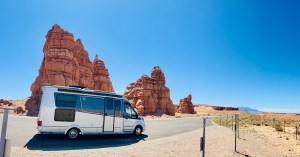
My 2024 Leisure Travel Van Wonder RL, Abeona on the drive to Capitol Reef National Park

Fast forward 30 years and I was bored at the beginning of the pandemic. I had gone on a trip with my boyfriend at the time to upstate New York and Niagara Falls. Eating out and hotel stays were next to impossible due to restrictions.  It seemed obvious that if I wanted to travel, I was going to have to get an RV. I looked at a 25-foot motor home called Leisure Travel Van; driving it was super easy, it could be parked in most parking places and it had a full bathroom, a work space, compact kitchen and queen size bed. At the time they were back ordered due to supply chain issues and it took almost 3 years to finally get Abeona in February of 2024. I have to say that I assumed that I would be camping in Abeona with my boyfriend but when that relationship came to a close in the time it took to receive Abeona, I wasn’t going to look for some other travel companion. So, I didn’t aim to be a solo traveler but if that was the only way forward, it was my way forward.

My maiden voyage was to Jekyll Island Georgia and Parrish Florida. I headed out in March and wanted to make sure that I had warm weather. I had spent my first night in Abeona at the dealership in Wilmington NC where I had learned to hook up and tear down the RV on my own. My son stayed with me that first night mostly because he was my ride. I remember taking a ton of notes and insisting on actually being hands on with everything. If something was difficult to do, I would have them show me a second time. The fresh water and water heater situation is difficult. I remember when I got to my first campground in South Carolina that I ended up taking a shower at the campground instead of in the RV because I couldn’t figure out what was wrong (the water was coming out cold). I had already joined several Facebook groups for my RV brand and I was given help almost immediately so I figured out what switch was in the wrong direction. I remember overfilling my fresh water tank and finding out with a knock on my door at my campground in Georgia.  I was spilling water all over my campsite. Were these events embarrassing? Yes.  Did I learn from them? Yes. 

My biggest error was the first time I emptied by black (toilet) and gray (shower) tanks. I remember the guy at the dealership reminding me to make sure the coupling “clicked” when I hooked up the hose.  Well, I thought it was tight and thankfully I remembered to test it with the “gray” water first but of course the hose popped off and the gray water started spilling everywhere. I was mortified but was able to turn it off immediately. In all likelihood this would have happened if I had a traveling companion, I just always had to figure out how to solve it on my own or with help from my friends on Facebook and sometimes a text to the dealership. 

I think that if I have learned anything over the course of the 30,000 miles I have driven Abeona over the last three years is that I’m going to make mistakes, and none of it (so far) is catastrophic. I’ve set mouse traps and emptied them (yikes), checked all six tire pressures (until someone on FB told me about an app that can give them to me automatically), installed a device to show how out of level I am, figured out Wi-Fi, driven Abeona on a side loading ferry, broke my sewer pipe by driving over a boulder, driven out of Skagway Alaska along the side of a cliff, had my windshield hit by a seagull in the Florida keys, blown out my water system with too high water pressure in Newfoundland, and have seen countless deer alongside the road and managed to avoid them. 

I survived it all but have had a terrific time seeing at least a dozen National Parks, visited family and friends and have thoroughly loved seeing both coasts of North America. I truly live in a beautiful country and can’t wait to see even more over the next few years. Would it have been great with someone else along for the ride and/or trials and tribulations? Yes. But am I glad that I did it alone? Absolutely. 

🛳️Traveling on the Ferry to Alaska

I had no idea that you could take a ferry to Alaska until I started researching travel to Alaska.  It’s a remarkable way to travel and a great way for me to have my RV, Abeona, along for the ride for the road trip back home.  I had just finished a week in Sequim, Washington for my family’s celebration of my mother’s 90th birthday.  I had secured a ticket for the 3-day cruise from Bellingham, WA to Skagway, AK. My entire goal in going to Alaska was to visit my 50th state.  I had crossed off North Dakota, Nebraska and Iowa about 5 years ago so finishing this item on my bucket list was pressing. 

Bellingham Washington is a beautiful town on the water.  I really thought I would have had time to explore but my focus was making sure I was on that ferry. I was surprised that, even though I had arrived 2 hours before departure, almost 80% of the cars, trucks and trailers were already lined up before I arrived. I’m glad I didn’t cut it close by exploring Bellingham.

Coming in to Haines on the Kennicott Ferry

Loading the vehicles on the Kennicott ferry is like Tetris on steroids. There were 16 number lanes (I was in lane 14 and the only RV headed to Skagway).  I started to question my selection of Skagway since there were no other RV’s or trailers headed there.  Like, what’s the problem with Skagway? When I was told to head down to get loaded on the ferry, I was shocked by some of the vehicles being loaded in the opposite direction.  I figured out, when I got off in Skagway, that loading is more like a circle instead of other ferries I’ve traveled on where the first car in is the first car off. In addition, we loaded from the back of the ship in Bellingham but every other port, the vehicles go off on the side (crazy right?).  I can’t imagine the mastermind that figures out where all the vehicles go.  There were trucks with campers on the back, motorcycles, cars with trailers and some motorhomes larger than mine with tow vehicles.  The menagerie of vehicles was mind boggling.

Once on board, I took an elevator to the cabin floor which was two flights above the vehicle floor.  There the purser gave me a key to my berth.  This was a no frills, metal bunk bed with a 4-inch-thick mattress in a narrow soulless windowless room with a small chair and a sink.  Once I dropped my bag, I went up to the observation deck which is where there was seating, tables, a cafeteria, a movie theater and a playroom for small children. We all gathered at the front of the observation deck because it was a warm, sunny day and waited expectantly for the ferry to finally get underway.  We were about ten minutes late departing but once we left the dock it was a terrific view from Bellingham Bay and the Rosario Strait of the Olympic Mountains, Mount Baker and the Pacific Range above Vancouver. 

The ferry, Kennicott, travels via the inner passage.  It’s remarkable that a ship the size of Kennicott can manage traveling all the way to Skagway without being in the open ocean. One thing that messed me up for the first 36 hours on the ferry was that all the ships activities were on Alaska time.  My watch, my laptop, and my phone were all on Pacific Time as we traveled through British Columbia.  This caused me to be early and frustrated on car checks (times allocated to go down to your vehicle), movies and the cafeteria.  In addition, the ferry had no wifi.  This in retrospect was relaxing.  For the first 24 hours we were never close to any town or city so, no cell coverage.  So, time was spent looking out at the coastline and islands passing you by, reading or as many people did, doing puzzles.  I was amazed at how many 1000-piece puzzles I saw completed by various, changing groups and individuals.  

There was also something called mustering.  I had never heard this term before but there is a place, based on where your berth was, that you gather on the observation deck in case of emergency.  So, there are signs all over the boat on how to get to Muster A or B.  There are also some hearty souls who camped on the solarium deck.  These folks tape down their tents or brave the elements in a sleeping bag.  As you can imagine, it’s an eclectic group that takes the ferry to the various ports of Alaska on what is called the Alaska Marine Highway.  There were Alaskans returning home, comfort travelers like myself traveling in motor homes, folks on bicycles, motor cycles and some backpackers.  

There were several whale and bald eagle sightings.  Traversing the Wrangell Narrows a bit nerve racking.  This very narrow passage that cruise ships do NOT travel seemed about 50 feet wide.  As we arrived to travel the 22-mile passage, there was a spotter at the front of the boat for the entire length. It is from this passage that we arrived at the tiny town of Petersburg.  Without these ferries traveling this route, these isolated towns would not receive products from the outside world.  It was amazing to see how these tiny towns exist where, if you don’t have a boat or seaplane, you will be stuck.

As we arrived and departed at the various ports, Ketchican, Wrangell, Petersburg, Juneau, Haines and Skagway.  People would get on and off the boat.  So, when I finally arrived in Skagway, there were many vehicles getting off as well.  It also meant that when we were in the preceding ports, it would be about 45 minutes so I couldn’t afford to get off the ship to explore.  It was a terrific, interesting, journey where I met a friendly group of travelers. The last day was spent overwhelmed by the beauty of the snow and glacier capped mountains that encircle the inner passage.  Simply breathtaking. I highly recommend taking the journey via a ferry.