💡6 Coping Mechanisms for Blamers

Your co-worker is constantly blaming his boss for his 80 hour plus work weeks.  You are blamed by the project chair for the missed deadline although they were responsible for the delay.  Your partner blames you for the cold dinner, after arriving thirty minutes late.  You end up embarrassed.  Dumbfounded.  Sometimes seething.  These destructive feelings, when ongoing, cause irreparable damage to the relationship and your self-esteem.

blamers

Blamers are everywhere.  I see blamers as those who have external locus of control.  As defined by Psychology Today, “The belief that events in one’s life, whether good or bad, are caused by uncontrollable factors such as the environment, other people, or a higher power.”  If you feel as though everything is out of your control and out of your realm of responsibility, you’re going to have lost that responsibility elsewhere.  This is what blamers do.  “A person with an internal locus of control believes that he or she can influence events and their outcomes.” Odds are that if you are suffering from the blamers around you, you have an internal locus of control and are feeling responsible for the blame that is heaped on you.  Fear not!  There are ways to cope with this.

6 Ways to Cope with Blamers:

  1. Own your piece. Everyone has at least 2% of the truth. This is a tenet of CRR Global. So does the blamer.  If you get defensive and start arguing with the blamer, it is discounting the 2% of truth.  Maybe you were late with one little piece of the project, maybe you didn’t answer the email by the deadline, maybe your ideas weren’t well fleshed out.  I’m not suggesting you be a doormat, but acknowledge the 2% that is correct.  It’s not “I completely blew this, I’m sorry” but “I can see that responding faster to that email would have impacted the outcome.”  Everyone is right…partially.
  1. Find the brilliance. A lot of people rarely compliment the other folks in their lives. Whether at home or at work, we don’t try and catch people doing something right.  But everyone does something right every day.  Even if it’s brush their teeth or complete the monthly report on time.  Look for the positive.  Hunt for it.  I was working with a narcissist once.  She didn’t like any of my ideas for a project.  She showed me one of her ideas which I sincerely thought was innovative.  I said, “This is brilliant.”  She did a 180 degree change on the project.  Now she was onboard.  If I had held my tongue, we would have remained at logger heads.   Look for the brilliance.  Then broadcast it.
  1. Listen with empathy. When someone is blaming either someone else or you, be sure to actively listen with empathy. This can be difficult.  It can be painful to hear someone trash your best efforts.  It will help to focus on your breath so that you can stay out of going to your lizard brain and activating your limbic system (the fight or flight response). It may even take returning to the topic later after you’ve had a chance to cool off.  My son was upset with me a few nights ago and asked that we talk about the topic on Sunday morning.  This was really effective.  I had time to reflect and he had time to reflect.  We were in a better space to listen and be empathetic. Make space to listen.
  1. Respond looking for solutions. Aja Frost wrote a great article called 7 Perfect Replies to (Politely) Shut Down Negative People. My two favorite for coping with the chronic blamer is, “Is there anything I can do?” and “I’m sorry to hear that. Did anything good come out of the situation?” This can shut the blamer down because it is focused on forward positive motion.  Blamers typically want to dwell on how bad everything is. I have asked clients who are focusing on blame, “What 2% are you responsible for?”   This is a proactive approach.  It focuses on what can be versus what was
  1. Come from a place of love. As Kelly Smith wrote for Tiny Buddha, “Remember, all actions are based in either fear or love. Base yours in love. Realize their actions are based in fear. Often, these fears are ones that no one can reach because they are too deep-seated for the person to acknowledge. Accept that, and continue to operate from your own base of love.” I personally have been meditating on loving kindness for years.  My mantra has been to be the “Love and light” in my life.  Having an open heart and compassion for others helps me see the good in all people regardless of the facade they may be exhibiting.  We all want to be loved, happy and at peace.
  1. Let go. As Kelly Smith wrote, “It’s not worth your constant wondering and worrying. It isn’t good for you to hold onto it and over-analyze it. Let it go; visualize yourself blowing it all into a balloon, tying it off, and letting it drift away. Feel lighter because of it!” I love the balloon metaphor.  Another practice is to clench your hand in a fist with your anger towards the blamer, and then release.  Let the blame dissolve into the ether.

Sometimes your best efforts can’t change or pacify other people’s behavior.  There may be a difficult decision in front of you.  Chronic blamers can be toxic for an organization or family unit.  If you’ve tried these coping mechanisms and you still feel like your self-esteem is being affected, you might need to move on.

😉Letting Go and Moving On

You are still mad that you didn’t get that plum promotion. You are still ruminating on the time you totally blew Thanksgiving dinner some 15…er 20 years ago. You still can’t believe that that guy from Sophomore year never called you back. You’ll never forgive your parents for not being perfect. Turns out that all this ruminating and dredging up all the past sins of you and others is a recipe for long term unhappiness. It’s time to let go and move on.

It’s crazy how much time that most of us spend on rehashing the sins and failures of the past again and again and again. Or “should-ing” all over ourselves. The “what ifs” take over and suddenly we are on a new trajectory that is completely false and, in fact, painful. There are some steps you can take to get past the past. The rehash. The regurgitation. Want some freedom? Here are a few ideas:

  • Reframe.  As Mark Chernoff writes, “Oftentimes letting go is simply changing the labels you place on a situation – it’s looking at the same situation with fresh eyes and an open mind.”  So, change the frame around the situation.  Didn’t get the promotion? This is a great opportunity to learn something new and completely different.  You could be kicking butt as a yoga instructor. What an opportunity.  That dry turkey from so many years ago?  It’s a success because absolutely no one remembers it but you.  They all remember what a great time they had and how you produced the WHOLE dinner on your own.  You are the Thanksgiving Hero!  Your imperfect parents?  Yeah but didn’t they get you safely to adulthood.  Are you a bit thicker skinned because of the bumps along the way?  Thanks Mom and Dad for giving me resilience.  Reframe your trials and tribulations.
  • Effort.   This was my insight from this past week’s meditation. Did you give “it” your best effort? Especially at the end of what you thought was a lifetime relationship.  Did you give it your best? Were you your best self? If so, let it go. If you didn’t give your best effort then maybe you should revisit and show up with your best. When you have given it your very best, then it’s time to let go. Giving only a little effort and letting go just means it was never that important to you. If you are constantly doing this, you may just be skimming through life. Give your best effort and then, walk away with your head held high. You gave it your best. Move on.
  • Emotions.  You cannot go around, you must go through. I believed that I could cry a few times and then tip toe around the grief. Nope. You need to feel it. Accept it. Live it.  Fully sense the constraint in the pit of your stomach, the heat on your forehead and the tightening of your throat. Then label it. “Oh…so this is grief.” Definitely find a time and private place to do this (so staff meeting isn’t a good time for this). Skipping this step only ensures that it will come back again and again. Experiencing it eventually makes it clear enough so that you can move on.  For me the barometer was when I told the story of loss to someone new, I didn’t get choked up anymore.  Be sure to live through the emotions.
  • Care.  Take care of yourself. What does self-care look like for you? Is it a new dress? A facial? Going for a ten-mile hike? Fishing along a stream? Making a seven-course meal for yourself? Seeing the latest feature film? Karaoke? Roller skating? Sky diving? Scuba diving? Sitting on the beach with a great book? Taking that new yoga class? One of the main things about letting go and moving on is making yourself a priority. Since suffering my loss, I’ve been driving once a week for 70 miles for a group meditation practice. It recharges me and resets my brain. Take care of yourself.
  • Gratitude.  My home was flooded during Hurricane Matthew in 2016. I had a list of over ten thousand things that needed to get done to finish the house. I don’t focus on that list. It’s debilitating to focus on all that is wrong. Instead I write in my gratitude journal every day about what is going right! It’s much more uplifting. After a few weeks, my attic was finally empty of all its contents. E.V.E.R.Y.T.H.I.N.G. What a weight was lifted. I was so grateful. Being grateful rewires your brain to the positive. Show your gratitude.
  • Truth.   In one of my recent readings I read the Total Truth Process by Jack Canfield. The premise is to write a letter to someone who has hurt or injured you at any point in your life. It could be anything from your parents to middle school to the nun who smacked your hand in catechism class. I have a list of folks and I am working my way through the list (don’t worry, I’m sure you aren’t on my list).  Anyway, write a letter answering Canfield’s questions:
  1. Anger and resentment. I’m angry that … I hate that … I’m fed up with … I resent …
  2. Hurt. It hurt me when … I felt sad when … I feel hurt that … I feel disappointed…
  3. Fear. I was afraid that … I feel scared when … I get afraid that I…
  4. Remorse, regret, and accountability. I’m sorry that … Please forgive me for …
  5. Wants. All I ever want(ed) … I want you to … I want(ed) … I deserve …
  6. Love, compassion, forgiveness, and appreciation. I understand that … I appreciate … I  love you for … I forgive you for … Thank you for …

I haven’t given the letters or talked about them with the person I have addressed  them to but it is quite cathartic to get it on paper and out of my head.  Sometimes bullet #3 showed up.  Sometimes not.  But I highly recommend writing the truth down.

This is all a process and cannot be sped up (although I wish it could be).  Having a coach can be helpful as well.  My coach pointed out some great resources on transitions.  Having a third unrelated party to provide insight and thoughtful questions can be invaluable. What do you need to let go of?

😎6 Years of Sobriety

On July 8th 2023, I will have been sober for 6 years.  This is not a milestone I ever thought would be an important one for me.  I was never a “low bottom” drunk.  I didn’t lose my job, my house, my family over alcohol.  I didn’t drink in the morning (except maybe in college but we had been up all night….so it doesn’t count, right?).  I never drank a fifth of liquor in one sitting. Although, there was a memorable 19th birthday bonfire where I drank at least half of a Jack Daniels bottle but that and the chewing tobacco came right back up somewhere in the woods of New Hampshire.  Jack Daniels didn’t pass my lips for at least a decade. The issue was that my lessons from alcohol were always fleeting and there was always some occasion where it seemed an imperative that I have a glass, a bottle or shot of whatever. 

I began drinking as a teenager.  I’m guessing fifteen. I remember my parents having bridge parties at our house, complete with whiskey sours that I’d grab a taste of. They had a sweet tangy flavor with a slight throat burn.  There was always my mother’s dry sherry in the refrigerator or beer stacked on the wall of our basement staircase. My father was never a big drinker and rarely drank except on special occasions.  I can remember my mother reclining in the family room La-Z-boy with a cigarette and a glass of sherry after working all day, and after preparing the family meal.  I thought it was all the great reward for getting through the day.  Kick back, light up and numb out to some sherry. My friends and I would pilfer beers from each other’s houses and sit outside drinking a can or bottle of whatever we might scrounge. I don’t remember being drunk, at least not in the beginning. 

My early twenties were spent in plenty of bars

By the time I went to college in upstate New York, I found that drinking helped me numb out my feelings of inadequacy.  My two older brothers were straight A students and athletes as well.  I always suffered from a recessed chin even after braces and head gear for 3 years. I always thought that contacts and my braces being removed would magically make me beautiful. It didn’t.  At least in my eyes. Teasing in high school was merciless and I can only thank God that at least I didn’t ride a bus but walked to school each day.  There was this horrible ritual of guys standing at the entrance of the cafeteria holding up numbers (remember Bo Derek and “10”?). There was nothing more painful than walking into that cafeteria and hoping they didn’t notice me to assign a dreaded number.  

I remember freshman year at Cornell in isolated upstate New York.  The drinking age was 18 at the time which wasn’t helpful.  Going to the Thirsty Bear which was an on-campus bar a short 200 yards from my freshman dorm room made drinking so convenient. I worked at an on-campus restaurant called “Noyes Lodge” (aka Pancake House) and the crew that worked there became lifelong friends as well as drinking buddies. We created a group called the PHD’s or Pancake House Drunks.  We went drinking every Thursday night, complete with white lab coats and only went to bars that had tables big enough for our group (some nights up to 30 people), beer by the pitcher and Mack the Knife on the jukebox. We had countless drinking games.  Instead of drinking to numb out, I drank to have fun.

My first job out of college (yes, I even graduated), was in Midtown Manhattan.  I remember initially feeling incredibly lonely on the 11th floor of the Hotel Lucerne on 77th street. It was summer and no air-conditioning and I didn’t know a soul. I worked at the west side location of the catering company but once they moved me to manage the east side location, I fell into a group of actors, dancers and musicians.  We spent Monday mornings reviewing where we had brunched the previous day and who had the best Bloody Mary’s and which bar had the best happy hour.  Alcohol was now a revered art. 

My first husband and I moved to San Francisco where, as always in the restaurant business, everything was permeated with alcohol.  I was a cocktail waitress at the San Francisco Airport and there were bartenders who would pour Kahlua into my coffee on the day shift. I didn’t object. Eventually I was a restaurant manager for a Sizzler franchise in Sonoma County and I’d always pour a glass of wine or two at the end of the night to take the edge off and relax.  By now alcohol was a way to try and get to sleep after a twelve- or thirteen-hour shift. There were only two times that I was sober for an extended period of time, when I was pregnant with my two kids.  It’s remarkable because, I was concerned about their health and welfare but not my own.  Within a few months of giving birth, I would be having that crisp Chardonnay at the end of the day.

Eventually, I divorced and changed careers to Human Resources.  You would think that getting out of the alcohol centered hospitality business would help me reduce my two glass of wine drinking habit.  I remember my first mass layoff of some 40 manufacturing workers.  The stress of taking someone’s livelihood from folks who were mostly immigrants was devastating. I remember thinking that the owners should pay for the case of Chardonnay that it was going to take to get me past the nightmares. Alcohol was now my eraser.  

I moved back to the east coast with my second husband and my two kids about 20 years ago.  We lived in a lovely lakeside home that was walking distance to the country club. Pretty soon the bartender knew my name and which Chardonnay I wanted.  We took up golfing and an enormous Styrofoam cup filled to the brim with Gin and Tonic was a great way to float through the afternoon. When my second husband started working for a distillery, I realized that my drinking habit now had an endless supply of gin and whiskey.  All our friends were based around the distillery and brewery. It was nothing to drink several stiff glasses of gin and I remember rarely making it past 8 PM without falling asleep on the couch.  I can remember saying to my husband that we were drinking too much.  In retrospect, what was he going to do? He loved his work, his product and his friends, you can’t distill gin without tasting it. Hurricane Matthew didn’t help when our house was flooded by that beautiful lake.  During the stress of living in a temporary situation, the stress of the remodel of the house and the ever present demon alcohol which was always plentiful;  he left.  I fell into a deep bucket of Chardonnay.  Within two months, I realized that I needed a reengineering of my life and that sobriety was the only choice. 

I couldn’t have done it without my dear friend Sandy mentioning a book on my 56th birthday.  The 30-Day Sobriety Challenge.  I took my last drink 10 days later.  Another great book is Quit Like a Woman.  I’m so grateful for not being dependent on a substance to take the edge off. I’ve learned to embrace being truly present for each moment.  Nothing is hazy anymore. I’m so much better at rolling with the punches and feeling through the pain and joy of each and every moment. It was one of the best decisions I’ve ever made. 

🫣4 Ways to Combat Anxiety

Looking back, it’s amazing how many things I used to get anxious about..  I had this crazy phobia about being the first person to walk into a new place like a restaurant or store.  If I was with my first husband, I would follow him in the door.  I had the same anxiety about being the first person to use a shower in a new living space.  I’m not sure if it was residue from watching Psycho, or what, but having these types of anxiety can be paralyzing, especially when I started traveling on business alone many years later. When I was in elementary school, I would wait to be the last person to present to the group, which, in retrospect was the worst as I would sit for an hour wrapped up in my head and then stumble through my presentation.  

Author and monk, Pema Chodron calls this getting hooked or shenpa. She writes, “At the subtlest level, we feel a tightening, a tensing, a sense of closing down. Then we feel a sense of withdrawing, not wanting to be where we are.” The secret is to get unhooked. As Chodron writes, “We could think of this whole process in terms of four R’s: recognizing the shenpa, refraining from scratching, relaxing into the underlying urge to scratch and then resolving to continue to interrupt our habitual patterns like this for the rest of our lives.” I love the image of refraining from scratching, if you’ve ever had a mosquito bite you know how hard this is.  The restraint from the urge and relaxing into it. It’s not easy but I’ve learned it’s possible. 

4 ways to combat anxiety:

Breathe.  I frequently get on a call with a client mid business day, who is completely overwhelmed by back-to-back zoom calls. They are unable to get present and are wrapped up in anxiety.  I ask if it’s OK if we take a minute to take three deep breaths.  That’s all it takes…one minute. Breathe in for 4 counts, hold for 4 counts and breathe out for 4 counts, three times.  It’s amazing how this relaxes the body.  It’s like when I’m doing yoga and the instructor says remember to breathe. It’s remarkable how much breath has control over being anxious. I’ve never been in a situation where 3 deep breaths didn’t help.  Remember to breathe. 

Body Scan.  I try to get out of my head and into my body when I get anxious.  I think about my big toe or my right pinky or as Positive Intelligence author Shirzad Chamine suggests rubbing my index finger and thumb together to feel the ridges of your finger print.  Robyn Ashbaugh recommends sensing the five senses by identifying the following “5 things that you can see, 4 things that you can touch, 3 things that you can hear, 2 things that you can smell and 1 thing that you can taste.”  Focusing on the body takes me out of my head where there are all sorts of chemicals like cortisol and adrenaline firing off in my brain.  Remember to scan the body.

Visualize.  This can be used when you are anticipating going into an uncomfortable situation, which for me was a new restaurant or getting up in front of a group to present.  Michael Phelps has a pre swim routine where he visualizes a perfect swim and outcome. I don’t need to be an Olympic Swimmer to do this.  I just imagine that the presentation is going to go well and that I am standing in front of the room with my shoulders back, chin up and making eye contact with the audience in a clear voice. Envision success.

Gratitude. It’s amazing how powerful gratitude is. A writer for Harvard Health Publishing, “Gratitude helps people feel more positive emotions, relish good experiences, improve their health, deal with adversity, and build strong relationships.” As written in the book The Tools, “Grateful Flow is silently saying to yourself specific things in your life you’re grateful for, particularly items you’d normally take for granted. Go slowly and feel the gratitude.”  Embrace a grateful heart. 

I recently went to an out-of-town meeting and was late.  It was a new venue for me and I had trouble finding parking and finding the door to get in. Ten years ago, I probably would have not gone or abandoned the meetings when I pulled on the first door and it didn’t open. I remember thinking how grateful I was for this group that I facilitate annually and visualized seeing the group leader.  It was just fine and I’m glad I went. How do you combat anxiety?

😁5 Tools for Forward Motion

I recently read “The Tools” by Barry Michels and Phil Stutz and found its ideas quite useful in all aspects of life; regardless if I’m procrastinating, frustrated with my child or helping a client. What I find so useful is that  it can be used in real time when I’m dreading a meeting with an adversary or trying to reframe my thoughts about a run-in with my boss.  The authors want to start a movement and welcome sharing the information they posit in the book.  So here is my take on forward motion with the 5 tools:

Reversal of Desire.  I use this tool when I’m feeling resistance or fear or when I’m anticipating something uncomfortable.  This would typically cause me to procrastinate and put off the pain. Kick the can down the road a bit. Delay the confrontation and hope it goes away.  The first step is to face the pain and focus on the pain as if it is a cloud in front of you and internally scream, “Bring it on!”. I want it because it will bring value. The second step is to internally scream, “I love pain!” and keep moving forward to be one with the cloud of pain.  The final step is to feel the pain cloud spit me out and close behind me. Say inwardly, “Pain sets me free!” As I leave the cloud I am propelled forward. I find this to be similar to going through pain instead of around it; to feel the feels. To face adversity head on, and to use it to catapult yourself forward.

Active Love. I’ve started practicing this every day, especially during my loving kindness meditation in which I wish loving kindness of family, friends, clients and adversaries. I will pick out one or two folks to focus my love on whether it’s my son that I had a disagreement with, someone in need of encouragement or a client that is refusing to budge. It can be used the moment someone angers me or when I’m reliving an injustice from the past or when I know I have to confront someone. The first step is concentrating on bringing a world of infinite love into my heart and filling my chest.  The next step is transmitting all the love into the other person and not holding anything back.  The last step is feeling the love enter the other person and feeling a sense of oneness and then relax into all the energy reverberating back so that we are both enhanced by the love.  I recently suggested this to a client who was anticipating an uncomfortable meeting with their boss and they were amazed how the meeting went so smoothly and didn’t hold the animosity that they were anticipating.  I think to some degree this works because you aren’t carrying a sword and shield into a conflict but instead an openness and oneness with the other person. 

Inner Authority.  This tool is all about taking a look at my insecurities in the form of The Shadow. The Shadow represents everything that makes you and me feel insecure like appearance, education or economic status. I imagine my shadow as an 11-year-old painful skinny girl with blue horn rim glasses and buck teeth. The are many occasions to use this: When I’m having anxiety about speaking to a new client, a confrontation, or a speaking engagement. Also when worrying about a future event I’m attending or traveling overseas or anticipating conflicts at an upcoming event.  First, I image myself on stage (in front of one person or a hundred).  Step two is to bond with my shadow. I ignore the audience and focus on my eleven-year-old self and create an unbreakable bond with her so that we are one unit. Step three is to internally shout in unison with my shadow, “Listen!”. The authority comes from myself and my shadow speaking in one voice.  This tool helps me speak with clarity and authority.

Grateful Flow.  I use this tool when I’m wrapped up in negative thinking and I’ve been taken over by the Black Cloud. The Black Cloud limits me in what I can accomplish and keeps me stuck where I am instead of forward motion.  This tool can be used when I’m in a negative spiral of thoughts like “that client is never going to pay me” and “they don’t want to use me anymore” or “ I’m charging too much.” It can also be used when sitting at a red light or waiting in line or upon waking or going to sleep.  The first step is to list what I’m grateful for. As I list what I am grateful for I try to pace myself and really connect to what I am grateful for like the new orchid blossom, the blue bird, the green leaves in the breeze or my mother’s phone call.  It’s important to mix it up each time. After 30 seconds I stop listing and embrace the sensations of gratefulness. The last step is I to connect to the energy coming from my heart and feel the power of infinite giving. I have historically kept a gratitude journal and this has been an extension of that and I’ve learned to expand my list of what I am grateful for and to embrace the power of it.

Jeopardy.  The authors emphasized that everyone will slack off from using the tools. Sort of resting on your laurels that now you have this magical state and it doesn’t need to be practiced anymore.  I’m not here yet but cues to use this tool are when you know you need to use a tool but, for whatever reason, can’t get yourself to use one or when you think you’ve grown beyond the tool.  The first step is called Deathbed Scene and you imagine yourself lying on your deathbed.  The next step is to when your older self, screams at you not to waste the present moment.  The last step is to use fear as a motivator; you don’t want to squander your life which creates an urgent desire to start using one of the first four tools. 

I think that once I really learned the tools, it became easier and more second nature to use it. I recommend you go to their website It took me trying to use them several times before I really embraced the steps. I was surprised how quickly any one of the steps take because it’s all internal and can be used any time.  Which tool would you like to try?

Missing Daddy

My father passed away on July 12, 2019. Our family was unable to gather on what would have been his 95th birthday on June 19, 2020 because of the global pandemic. Since we were unable to celebrate him together in person, I realized I can celebrate him with my words.

My father, Benson Noice, wandering the world.

Grief is a fickle thing. I won’t lie and tell you that I think about him every day. I certainly did in the months following his death. In the last few months, it’s been sporadic. It might be a commercial about a father teaching his teenage daughter to drive or a mini-series about Ulysses S. Grant, and suddenly I evaporate into tears. I miss my father even though I am so grateful he died in 2019.. It gave us the chance to visit him (pre-COVID) as he slowly succumbed to congestive heart failure.

Here are the things I miss about Daddy:

Unflappable

I challenge anyone to tell me a time when my dad lost his temper. He rarely raised his voice and only did so to tell his opinion in a heated debate. When my two brothers and I were kids there was a lot of rough housing, teasing and taunting that took place; my father was loathe to intervene. He headed up field trips to Gettysburg and Washington, D.C. as a history teacher and always managed to return bus loads of rebellious and raucous teenagers home with rarely an incident.

I’ve read several books about Ulysses S. Grant. There are many references as to how calm and cool Grant would be in the middle of a battle and to be able to keep his wits about him. I think of all the challenges my father dealt with as a sailor on a schooner during a hurricane. As a Merchant Marine traveling from the Pacific to the Atlantic in an oil tanker with a sheared-off bow during World War II. He was never a man who was easily roused. 

I think of him when a co-worker loses their cool. I think of him when I lose my cool. I miss seeing my father and being able to watch him be unflappable.

Wanderlust

The biggest road trip of my life was with my family. We traveled from the East Coast to the West Coast of the United States and then from the Western provinces of Canada to the Eastern ones when I was eight years old. My father loved a view. He really loved the view of a mountain in particular. Whether it was the Rockies, the Sierra Nevada or the Canadian Rockies, my father (who drove our old Ford station wagon and 24-foot trail for all but 10 miles of the trip) would always pull off to an overlook…to have a look. 

I remember rolling my eyes as an impatient eight-year-old as my father would marvel at the view. At the time, I didn’t appreciate the marvelous opportunity my parents were giving me to see so much of the U.S. and Canada. After retirement, my parents traveled the world from Russia to China to Australia. He was always intrigued by foreign cultures, politics and natural beauty. He had wanderlust. I think of him when I see a tall mountain peak or hike to the summit of a trail. I miss and am grateful for my father’s wanderlust as he instilled it in me.

Patience

I have never been as patient as my father and have always been envious of it. He was the best grandfather. He traveled to my children’s marching band competitions, wrestling meets and football games. He never cared how far it was or how long we might sit in the cold or hot humid stands. He was just happy to be there. My son’s football team might be losing by 40 points but he’d be sitting there on the cold hard bleachers until the bitter end.

My father was the man who would patiently walk around the neighborhood with my then 2-year-old daughter reading license plates. At the ripened age of two, she was able to read all the letters and numbers on a license plate, all because her grandfather encouraged her to read. It reminds me of the times when I was in grade school and putting on plays in the basement. He was always willing to pay a quarter for admission and would sit through some haphazard, ill-conceived play for the love of his daughter. I think of him often during this pandemic and how easily he would have dealt with this big pause. I miss his patienceand try to summon it often to cope with plans that are scrapped or delayed.

Wisdom

Anyone who lives to 94 is wise. They have survived catastrophes, wars and circumvented fatal errors. My father studied at eight different colleges and universities. He actually went to the University of Pennsylvania and attended West Chester College at the same time without one knowing about the other. My parents scrimped and saved their entire married life in order to send all three of us to the university of our choice. My father was a revered mentor to several young men that he taught in school or who he met as a counselor at a boy’s camp called Camp DeWitt. He was sought after for his advice and counsel for decades after their first meeting. My father’s opinion was one that I always valued. I remember the difficult decision to leave my first husband when I had very young children and countless responsibilities. I valued his opinion above everyone else’s. I never wanted to disappoint him. I miss his advice and counsel. He was the wisest man I’ve ever known.

I remember being with him on his 94th birthday. He was hunched over with an oxygen tube but was still able to read the book “Benson Noice Junior the Great” written by his namesake grandson as a grade school project a decade or more earlier. We all sat in his room as he told stories about his life. I was surprised that he talked about seeing both of my children being born and how miraculous it was. I will always remember kissing him goodbye for the last time in person and him telling me, “I love your blogs.” I find my father in all kinds of places now. In the wind, on a sailboat, at the top of trail or a scenic overlook. I may be missing him but he is there if I just pay attention.

😊5 Tricks to Find Joy

Happiness and joy used to feel elusive.  They felt like unattainable States of Being.  I’d be happy when I got married, had a child, bought a house, sold a house, got into college, graduated, traveled to Paris, paid off student loans, found my soul mate.  The list was never ending. There seemed to always be another door to walk through to get there.  I never seemed to arrive at the train station called “Joy”. I find that the issue is that joy cannot be found outside of myself.  It must be found within and it doesn’t take a particular milestone or a million dollars to achieve it.  

Here are 5 tricks to find joy:

The Love Wave.  I read this a few months ago on Tiny Buddha in an article by Jennifer Agugliaro. It’s about taking a moment to connect your heart with someone in your life.  As Agugliaro wrote, “Close your eyes and take a minute to connect in your heart with a person in your life that could use a little love. Feel yourself smiling into their eyes and embracing them in a giant, warm hug. Allow the love to flow. Sit in this love. Let it grow in strength and surround you both. Then send it out into the world, creating a wave of love. Know that you can come back to this place of flowing love at any time.” I do a loving kindness meditation each morning and I usually focus on one person in my life to concentrate on to send out my Love Wave.  It’s such a joyful feeling to wish love to someone in my life. 

Being Present.  In this distracted world full of screens and notifications, try coming back to the present moment. I find it easiest to do this outside (especially weather permitting). Walk out your front door and just stand there for a moment.  Or take a five-minute walk.  What do you see?  The rustling leaves, the worm on the ground, the neighbor’s dog. What do you feel? The breeze, the sun, the rain drops.  What do you smell? The honeysuckle, the cut grass, a wood fire. What do you hear? The birds, a car, a lawn mower.  It’s the noticing that brings me joy. This moment as it stands will never be the same again and I was able to find joy in that moment.

Acts of Kindness.  Kindness and altruism are great for connection, a sense of belonging, purpose and wellbeing.  It’s almost like you get more back than you give. It also doesn’t have to be a long-term commitment.  It could be as simple as holding the door open for someone, picking up trash, or paying for someone else’s coffee.  I had an issue with my credit card on a bus while traveling to Oxford, England. I started to walk off the bus and the guy behind me asked what the problem was, and he went ahead and paid for me.  It was such a great feeling that a man I would never see again helped me out. I definitely spent the week paying it forward with small acts of kindness. Start a kindness wave and feel the joy.

The Vulcan Mind Meld. Agugliaro espoused, “Close your eyes and imagine yourself ten years from now. Give your future self that thing you believe will bring you happiness. Maybe it’s kids, money, power, or something else entirely. Notice how you feel. You might feel confident and secure. Or perhaps loved and important. Whatever you feel, allow it to expand and grow. Sit in it. Enjoy it. Then, while keeping your attention on the way you feel, bring back the image of yourself today. Think about what you already have that fulfills you. Maybe you don’t have kids, but you have amazing friends. Maybe you wanted a better income, but you can afford things you enjoy already. Look for the abundance within you now. Keep going until your “present self” feels the same as your “future self.” It’s almost like a mind meld—make those two beings, one. Again, sit in the wonderfulness of it all. When you are ready, open your eyes.” This reminds me of a time travel meditation from “The 30-day sobriety challenge” where you see yourself in 10 years if you keep doing what you are doing and then you imagine yourself in 10 years if you give up drinking.  It was quite profound for me.  Imagine the future you want and then meld it into today.

Gratitude.   I almost always start my coaching session with asking, “What are you grateful for?” This helps my clients take stock in what is going right. It’s easy to get caught up in what is going wrong since we all have a negativity bias. I write a gratitude journal every morning with 5 things I’m grateful for and one thing I’m grateful for that I did such as, wrote a blog post, went for a swim or rode my bike.  Being grateful makes me more joyful.  It helps me focus on the relationships in my life, how fortunate I am and the wonderful things that surround me in the world.  This brings me joy.

I think that novelty also provides joy and I believe it’s related to being present and gratitude.  I rode my bike for the first time in over a year and it was a joyful experience mostly because I was so present (it’s hard to ride a bike on a new pathway and not be present!).  But I was grateful because I made the opportunity happen.  I try to make finding joy an everyday event regardless if I’m trying something new or I’m sitting with a cup of coffee next to my dog.  How do you find joy?

🌎6 Must Haves for Overseas Travel

I spent 6 weeks traveling alone in the United Kingdom, Ireland and Denmark from the end of March until May of 2023.  Most of my previous overseas travel was before the pandemic, although I did travel with my children to Barcelona and Bordeaux in August of 2022. Things have changed, and will continue to, but I have to say that with some of these items, traveling alone is much easier than five years ago. 

On the Westminster Bridge in London, England

Here are my 6 must have items for overseas travel:

A Portable Charger.  I have an iPhone 11 that’s about 4 years old and the battery, especially when taking pictures, is easily depleted.  I bought a portable charger about 7 years ago and, while I know there are lighter, more efficient chargers on the market, my current charger can recharge my phone at least three times before being depleted. I would carry the charger everywhere with me, whether on a plane, bus or walking the streets.  Sometimes in my jacket pocket and sometimes in my backpack.  There were several all-day tours I went on like the highlands of Scotland, that I know I would have lost the charge on my phone without it.  Without a charge on my phone, I would have been lost (sometimes literally).

iWatch.  I’ve had an iWatch for over 7 years and have come to depend on it especially when walking in unknown areas (like the streets of Dublin or Copenhagen).  One of the great features of the iWatch is that it will give you turn by turn directions on foot if you have put your destination on your Maps application on your phone.  This was critical when, while in southern England, I was walking two miles to the train station with my luggage.  No need to juggle getting out my phone, I could just look at my watch and it would tell me how many feet to my next turn and the street name (did I mention it was about to rain?).  It saved time and would vibrate in advance of my next turn.

Google Maps.  Google Maps is a game changer in Europe.  When I wanted to walk to my ancestral home in Walberton England, I wasn’t sure if there was a walkway (the roads in England are tiny!). I could look at the entire route and could see a picture (yes, photo) of each turn and see if there was a pedestrian walkway.  I’m not sure I would have taken the pilgrimage without google maps.  In addition, when I was in Wallingford, England trying to get to Oxford on a bus, they had recently changed the bus schedule to eliminate some of the time slots.  Apple Maps was not up to date, but Google Maps could tell me where the next bus was and when it was going to arrive.  I helped a woman with a small child in a stroller by keeping her up to date as to where the bus was (it ended up being 25 minutes late). In both Apple Maps and Google Maps, you need to select mass transit instead of driving directions and it will give you a plethora of options.

Packable Backpack.  I bought a 16 Liter packable backpack several years ago and it’s been awesome. It comes with a small wallet size bag that it packs into which takes up less space in my luggage.  I had a carry-on suitcase and larger laptop carrying backpack to take on the plane and didn’t carry a purse or fanny pack.  I kept my passport and phone in my pocket. When I would arrive at a location, I would take out the backpack and be able to put in my portable charger and sunglasses, umbrella, water, jacket or other essentials for a day long tour.

Air Tags.  I watched several YouTube Videos about overseas travel before embarking on my trip and several folks suggested air tags.  Air tags are a small disk the size of a quarter that you can slide into anything to keep track of them.  They send a signal as to where they are located. Air tags saved my butt at the Copenhagen airport. I had slid one tag in my laptop backpack and one in my roller bag.  I ended up checking my roller bag from London to Copenhagen.  When I arrived, I had to go through customs so by the time I got to baggage claim, I had no idea what carousel the bag was on (it was not clear and certainly not in English).  Sure enough, I opened my ”Find My Tag App” on my phone and the suitcase sent out a signal that it was close by.  I turned my head and there was my bag coming down the carousel. It would also send me a reminder when I left my Airbnb for the day that my bags were left behind.

Food Basics.  I packed instant coffee packets, decaf tea bags and oatmeal packets before leaving the United States.  I always assume that something will go wrong or there won’t be a grocery store close by when I first arrive to a destination.  The last thing I want to do after an 8-hour red eye is go find a grocery store.  I took about 10 coffee packets, 10 tea bags and 6 oatmeal packets.  As I got the lay of the land, I would replenish my supplies or use what was available in the Airbnb I was staying at (most had tea bags but not coffee).  Yes, I missed a good old cup of brewed coffee but instant will work in a pinch.  I also kept one packable microwavable meal and used it my last night in Copenhagen before returning home. I have to say that I slept better knowing that I would at least have breakfast in the morning before heading out to wander.

There are a few more items that made my trip easier, an International Travel Adapter that had usb plugs as well as electrical plugs all in one.  I bought a carry-on bag with four spinning wheels which was a game changer walking down cobblestone streets.  I also invested in packing cubes which kept me organized and able to pick up some gifts on my trip.  I didn’t think they would make a difference but they really reduced the space my clothes took up in my suitcase. So, there you have my list with 3 bonus items to help keep your world traveling more enjoyable.  What are your overseas travel must haves?

😁5 Strategies to Praise

I’m reading Shawn Achor’s book, Big Potential, How transforming the pursuit of success raises our achievement, happiness and well-being. I was really struck by his strategies to use praise and I think it’s valuable information for anyone with direct reports, children, co-workers, coaches or partners.  Achor views praise as a prism rather than being a praise miser (one who keeps praise to themselves). He said, ““By denying the light of praise, we extinguish it. By bending the light toward others, we magnify it.” It is such a beautiful sentiment.  I think it’s similar to the analogy that lighting someone else’s flame won’t diminish our own flame.  Praise can be used in useful ways to transform a family, team or organization.  

Here are Achor’s strategies to praise:

Stop comparison praise.  Ugh!  Guilty as charged!  I have done this countless times with my children over their lifetime. And yet I know that as Theodore Roosevelt famously said, “Comparison is the thief of joy.” So, what makes me think that saying my daughter is the best writer or my son is the fastest on the team is really authentic praising. I never realized it but if you tell me I’m the best coach then, I have to wonder, who else has coached you or am I just the “best” coach today.  Anchor exposes not using superlatives like “best, fastest, prettiest, thinnest, strongest, and smartest.”  Much like stopping to say “why” in the last few years as it can be accusatory, using superlatives is a difficult habit to break. Achor says “Don’t prop people up by kicking others down.” This is a new realization for me and a new awareness I am trying to embrace.

Spotlight the right. This is catching things that are going right.  Just as focusing on everything that is wrong brings the whole team down, focusing on what is right can bring the whole team up.  We are walking around with a negativity bias so it’s much easier to focus on what is going wrong.  I’m trying to be the person who is finding what’s going right.  This ties into the Losada Ratio: The ratio represents the number of positive interactions with an individual, divided by the number of negative interactions, measured over a period of time. As an example, if you made five positive comments for every negative comment you made when talking with a team member, your ratio would be 5:1. For employees to feel engaged and happy they need at least a 3:1 ratio, for a marriage it’s 5:1.  As Achor espouses, “The more you praise and celebrate your life, the more there is in life to celebrate.”

Praise the base. This is about acknowledging and sharing the love.  So, if your team put in the work to get the project over the finish line and people are acknowledging your presentation, be sure to point out all the work the team did to get you there. As Achor wrote, “When we help others become better, we can actually increase the available opportunities, instead of vying for them.” Teams don’t win championships without supporting the whole team to get there. And while I write this, I think about my brain trust of friends who read this blog for me for feedback and edits,  Thank you Susan, Janine, Susannah and Natalie, you are the reason this blog is still here after 12 years! Acknowledge those that got you here.

Democratize praise. Spread it around.  It’s like paying forward to some degree.  When the woman behind the desk at the swim center tells me to have a nice day, or I hold the door for someone at the coffee shop and they pick up the coin that fell from the man’s wallet and on and on and on. Kindness and praise is infectious; so spread it around.

Unlock the hidden 31. As Achor wrote, “31% of people are secretly positive but do not express it at work.  Instead of targeting the negative people, get the hidden 31 to start expressing their positive outlook and transform your culture.” There are terrific systems like Globoforce where folks can give positive feedback or Kudos to co-workers, direct reports and CEOs’. These types of systems can help unlock the hidden 31.  Figure out a way to get these folks spreading their praise and positivity.

The families, organizations and teams that figure this out can go far as is illustrated in the book’s title Big Potential.  Praise is a critical piece to transforming the culture into one of mutual appreciation and growth.  How do you praise?

🇩🇰 7 Surprises I found in Denmark

I recently returned from a 6 week trip to the UK, Ireland and Denmark.  Denmark was the last stop on my trip and I found it to be quite surprising.  I stayed at a flat in Copenhagen and really lucked out with the location.  It was only a block from Torvehallerne (a huge market open 7 days a week), the metro and train station. This made it a terrific jumping off point for traveling around Copenhagen, the countryside and made finding provisions quite easy. 

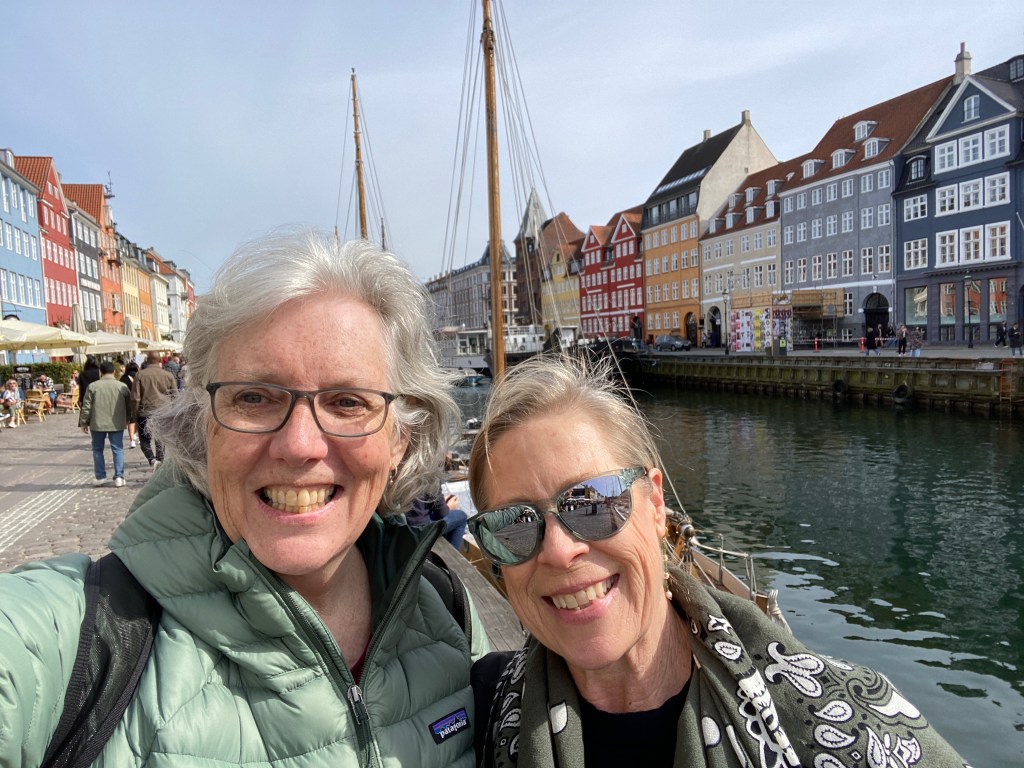
The author and her friend Alison on the canal in Copenhagen.

Here are the 7 surprises I found in Denmark:

  • Bikes, bikes and more bikes. I have never seen so many bikes ever.  When I got of the metro from the airport, I could not believe the massive amount of bikes parked at the metro station.  There had to be upwards of 1,000 bikes within a one block radius. As I walked to the flat, I saw bikes leaned up against every building and, to at least my untrained eye, they looked to not secured in anyway. Most of the bikes were basic black with a large basket up front. Copenhagen has the most cyclists per capita, and the city with the most cyclists with 62% of the population using bikes for the daily commute.  There are 6 bikes for every car in Denmark. 
  • Hej.  I studied Scottish and Irish before arriving in each country.  The thing is, while the signs might be written in Irish in Dublin, I never heard anyone speaking Irish.  On the other hand, in Denmark, people greet you will “Hi” which is how “Hej” sounds to me (Hej means Hello in Danish).  So I mistakenly thought that it was obvious I didn’t speak Danish but frequently, it was followed by something in Danish that I didn’t understand (although I did try to learn some Danish before arriving). The signs, the products, the menus are all in Danish although there is frequently a translation.  Everyone flawlessly (I mean without skipping a beat and in perfect English) would transition from Danish to English and then back with another person.  
  • Baby strollers.  They have taken baby stroller to new heights here.  Babies are cocooned in a padded cover, head covered and swaddled lying flat on a carriage with four sturdy wheels. In the US strollers are valued for being convertible and able to move from stroller to car easily.  When you don’t have a car (see number 1) you might as well have a Rolls-Royce for a stroller. Mom’s get 12 months of maternity leave (yes, 12 months) so why not make sure you can stroll with your baby in comfort.
  • Green energy.  As we took a canal tour of Copenhagen, we saw the very modern building called, Amager Bakke which is a combined heat and power waste-to-energy plant.  It’s shaped like a hill (ironic since Denmark is so flat) and while it’s converting waste to energy, you can dry ski down the slope, go hiking or climb a climbing wall.  Denmark has committed to being net zero on carbon emissions by 2025.  I have to say that for as close as we got to the plant, I didn’t smell anything and, probably due to so many bikes, I don’t remember smelling exhaust the whole time I was there.
  • Metro and trains.  Getting a train or metro ticket in Copenhagen was easy and simple.  There were kiosks at every stop and it was easy to buy a single or multi use ticket in English as well as Danish.  The trains themselves are immaculate and most that I traveled on, showed each stop of a lit board and let you know where you were on your journey. Every train had at least a half a car devoted to bikes and and baby strollers (see 1 and 3).  There was one point where I saw a man leave a stroller on the train and go sit down with his back to the stroller (through a doorway and about 10 feet from the stroller).  I could not believe that the man sat with his back to his baby and anyone could have taken the stroller off at any given stop.  I will say  I saw a least one mother stand next to their stroller while en route. 
  • Driving.  My dear friend Alison who is an American expat and has lived in Denmark for over 20 years. She picked me up at the train station with her car.  The first thing is that every road has pedestrian side walk on each side of it, has a bike path (one in each direction with bike traffic lights) and a two lane car lane.  This is found in the city of Copenhagen and out in the hinter land. Walking, biking and driving, are all equally welcome. The crazy part was that cars would park in the car lane in the middle of the street so as not to block the bike lane.  It almost feels like the bike is number one, followed by pedestrians and then, last on the list, is the car.  There is not right turn on red because of the bikers.  
  • Food.  I had wonderful food while in Denmark.  The highlight was probably the humble Danish which, as it turns out, they call “winderbrød” or Viennese bread.  So some Austrias who settled in Denmark, made the beloved pastry.  As opposed to what is called “danish” in the US, the flakey croissant like crust is amazing and the creamy rich center is divine. I also had a smorgasbord which is just an open face sandwich and they had many hearty breads on which they make the smorrebrød on.  There is also something called Flødeboller which is a chocolate covered marshmallow puff although the marshmallow part is light and delicate. The food was amazing.

I should mention the architecture and the all the color buildings along the canals, but you most likely already think of that with Copenhagen, I think that in the combination of electric transportation, their focus on green energy and the use of bikes, it’s amazing how quiet an pollution free it feels in Denmark.  That must be why it’s the one of the happiest places on Earth.