Got Horsepower? Found Mine With A Horse Named Lollipop.

I had the great privilege to work with Renee Sievert and Michele Woodward at an Equus Coaching outing (a methodology created by Koelle Simpson) a few weeks back in the hills of Northern Virginia. Equus Coaching involves interacting one on one with a horse and, through that experience, have a better understanding of yourself and how you “show up” in the world. I thought I was going to be learning about horses but the horse held up a mirror to me.

My past experience with horses had been at camp when I was about 8 and a few trail rides. I always felt disconnected to horses. I felt like they were leading me and I had little to do in directing the path. I was just the terrified kid bobbing on top hoping we ended up at the end of the trail in one piece. I am happy to report that the Equus experience brought about a new appreciation for horses and a new self-awareness.
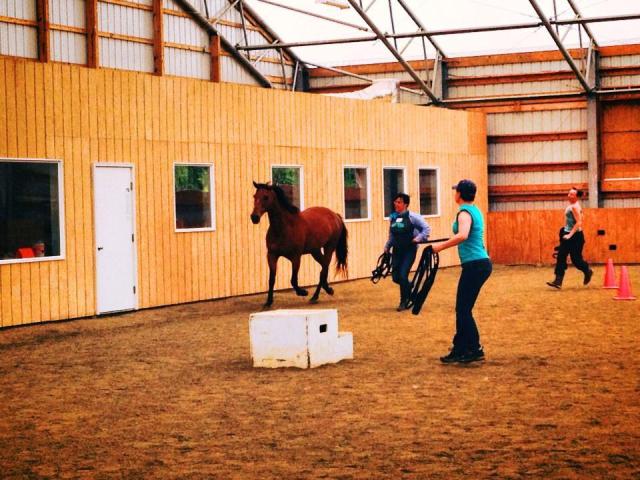
Rusty on the move.
Rusty on the move.

This is what I learned from my teachers, Lollipop and Rusty:

1. Attention. I love to be the center of attention. Lollipop came right over to me as I went into the round pen. He is a smaller, younger horse and he made a b-line for me. I had ten minutes to spend with him, and I think I would have been happy just petting him the entire time. I realize now, it’s one of the reasons I adore my dog, Baci, because she will follow me around the house and lay at my feet wherever I land. I feel a bit guilty, but I love the attention.

2. Intention. I need to be clear in my intention. Renee initially modeled how to lead a horse in the round pen. She stood alone in the pen with Coco (a horse she had never worked with) and through focus, attention and directed arm movements, Coco magically moved in a circle around the pen. No harness. No whistling. No strings. It was amazing (I had goosebumps). By just telegraphing her intention to the horse, she got her to move wherever and whenever she wanted. You have to know what you want to get done so if you want to be the world’s best purple squirrel catcher, set your intention and get started. Be clear in your intention.

3. Focus. I can’t lose my focus. I was amazed that I was able to move Lollipop in the same way around the pen that Renee had moved Coco. I focused in, moved my arms and he followed my intention and focus. Pretty soon he was galloping around the pen in a circle….magic….but….I lost focus. The very second I took my eye off of Lollipop, he came over to me like a moth to a flame. I lost my focus and Lollipop came back to me to find it again. This shows up everywhere in my life: unfinished books, deserted projects, languishing relationships. Stay focused.

4. Sync Up. When you are working in a group, sync up. This is going to sound crazy (cause I thought it was crazy) but I was on a team of three women that had to herd a handsome, albeit obstinate horse named Rusty without communicating using the most obvious of skills, spoken language. Using hand jesters, hope and a little bit of grit, we had to decide where we wanted Rusty to go and then go make it happen. In the end, Rusty didn’t do exactly as we expected but that was largely due to the fact that all three of us had slightly different agendas. Where does this show up for you? Did your assistant put in too much detail maybe because you didn’t communicate your expectations? If all three team members are on even the slightest different tangent, the horse does not know where to go. Sync up your team.

5. Power. I need to find my power. At one point, when we were trying to move Rusty, he stood there; and.would.not.budge. My teammate tried and then she motioned me over. I went over and got behind Rusty. I started slapping a rope against my leg. He.would.not.budge. Ugh. I was getting frustrated. I was going to move this horse. I summoned my power. My energy. I put it into my entire body and slapped the rope against my leg with full force, intention and focus. Magic. Rusty started to move. I stayed on him focusing all my intent and energy forward. He moved. I moved a 2,000 pound beast by finding my power. You cannot phone it in. If you want to move mountains, you need to find your power; FIRST.

It’s amazing how much Nature can teach us if we just pay attention to the lessons. Having a facilitator like Renee was really enlightening. She was constantly observing and saying things like “what’s your body saying to the horse?” or “where is your focus?” Think about how you show up in the world and how you are being observed. Pay attention. You can change more than you think you can.

Untether The Balloon. 5 Ways To Detach From The Outcome.

I’ve just spent a few days on the West Coast and met up with a great college friend. We spent a lot of time talking about “Not being attached to the outcome.” She shared an example of a conference she attended where, a group of 30 had to divide into three learning groups. There was no guidance as to how the groups needed to be put together but that everyone in the group had to agree with the makeup of the group. That’s a tall order. She said they spent two days trying to divide up the groups. She was tracking certain folks she wanted to be with, but the turning point for her was letting go and not being attached to the outcome. She ended up in a group sans any of the folks she was tracking but it still proved to be a great group. Letting go of the outcome let her be open to other possibilities.

I was coaching a client this week who wasn’t sure they wanted to do an Ultra Marathon (over 26.2 miles). So I asked what the worst case scenario was and he said a, “To not finish.” I asked, “What is so bad about that?” He said ” Well, I guess I could try again, especially if it’s an injury”. Exactly. We don’t need to be so tied to the outcome….it is…what it is. Let the balloon go and let it float away.  Let. It. Go. red_balloon_by_snnr

So how do we let go, become untethered from the outcome? Here are some steps to try on for size:

1. Meditation. This seems appropriate since non-attachment has its roots in Buddhism. Spending even five or ten minutes on mediation each day helps you to let go of thought. It’s not like you stop thinking, but you learn to let go of thoughts as they come into your mind for ten minutes like little balloons lifting off. It helps you learn to let go of the story. Let the story balloons go as you meditate.

2. Open. Be open to all avenues. I have several ways to get to work. Some are longer, some have more red lights and some are prettier rides. Mess up your ride today. Go a different route. Quit being on auto pilot. I bet you don’t even remember the last drive you took to work. Let go of the assumptions of what is around the next corner, what will happen if your daughter drops out of college, or if you call back that client you aren’t sure about? What if you let go of the fear of quitting your job. Be open to possibilities.

3. Paradigm. Some paradigms are meant to be broken. A paradigm is a set of rules in your head. Many of these paradigms are built on the back of ghosts. If you struggled for money as a child, your paradigm might be about making a million dollars being THE only sign of success. If you only notice that thin people are successful, you might think you can only find success once you are thin. If you had a bad relationship with someone who is Korean, you might think that your child is doomed if they date a Korean. If you don’t want to be attached to the outcome, examine your paradigms…they are likely built on the ghosts of the past.

4. Acceptance. Last week I had the pleasure of hearing Brene Brown speak on her inspiring new book “Daring Greatly”. As Brene pointed out, it’s amazing how we all spend so much time judging each other. I can be devastated by a friend looking me up and down and assume they are judging my clothing selection. I can lose sleep over the fact that my neighbors must be mortified by our uncut lawn. I can make my child change what they are wearing to hope that they are judged by the pink polka dot socks and the purple suspenders. As Brene pointed out, everyone is busy being self-conscious and worried about their own thoughts. So how would you be without that thought? Let it go and accept.

5. Enough. You are enough. Let go of the struggle. You are perfectly you and no one else is exactly as perfectly you. Don’t wait for the next raise, or to hit the lottery, to lose twenty pounds or to marry the guy with the Ferrari. You are enough right now and forever. If you can be enough…right now in this moment…you can be enough even when you fail. Be enough (because you already are).

I have to say that I’ve been working on this for several years. It doesn’t happen overnight, but if you stick with it and reflect on your progress, you will evolve into that floating balloon and let the wind take you where it will…and oh what a ride!

Living (And Cooking) by Feel. 4 Tactics to Learn From Failure.

I’m a cook. I’m a great cook. It’s taken years of practice to be great cook. I began my cooking career by making Hamburger Helper at about the age of 12 or so. My Mother wanted a night off and relinquished her kitchen to my novice hands. I can remember running back and forth into the living room and asking “how do I know when the meat is brown” or “what is sauteing” or “what number do I put the burner on the stove to if it’s medium-high”. My Mother was exasperated. It reached the point of my Mother saying, “I’ll just do it myself” but I prevailed. Who knew that making a meal from Hamburger Helper could be so full of questions? I’m sure my Mother could have made it with her eyes closed but I had to begin the Inquisition to make sure I did it correctly. It’s amazing how when you are new at something, it all seems so unfamiliar and foreign; like rooting around in the dark trying to find the light switch. Logic doesn’t always prevail. 1003p108-cooking-mistakes-intro-l

Flash forward 8 years and now I’m at the Cornell Hotel School and working in an institutional kitchen. I can’t remember the name of the course but we (the students) prepared food for the Rathskeller restaurant located in the hotel school. I was in charge of making a carrot cake. I burned the edges of the cake. I figured it was salvageable and then trimmed about 30% of the cake to get rid of the edges. I then inadvertently spilled some milk on the cake. I shrugged and just continued to trim and covered up all the remaining madness with icing. I took it out to the line to serve only to have the famed Professor Vance Christian take a piece. I cringed, sweated profusely and hid in the back of the kitchen. He hunted me down some 20 minutes later as I cowered in the back to compliment me on the cake. “It was so moist”. Hmmm, my hodgepodge had worked out. This was a long way from Hamburger Helper, I was flying by the seat of my pants and it actually worked out!

Sometimes I think we think that perfection equals mastery. What it really comes down to is having enough experience to be able to let go and riff. And maybe it’s not experience as much as confidence to know you can create something delicious out of failure.

So how to you let go of perfectionism and just go by feel? Here are some ideas:

1. Ask for help. We spend so much time acting like we know everything. It’s OK not to know everything, especially when you are new at something, like Hamburger Helper…or playing the clarinet…or being a boss. Ask your Mom, your best friend or a mentor for help. You can’t let go and go by feel if you haven’t learned the basics first. I didn’t come out of the hotel school knowing how to manage, I had to ask for help from coworkers, other managers, friends and my boss. Ask for help.

2. Read the book (slow down). My favorite chef is Alton Brown. He always says to read the recipe like a good book. I have to admit that most flops in the kitchen have come from not reading the recipe like a good book first. Invariably, there is some step I “skimmed” over and now the meat has to marinate overnight…for the dinner party in two hours. Oops. Read the instructions. This is helpful with anything involving upgrades on your computer to a newer version like say “Java”. I click through and don’t realize I have now committed to a new browser along with the upgrade. Slow down and read the book.

3. Experiment. Once you’ve learned the ropes, experiment. If I’m facilitating a new training, or a new recipe, or trying a new coaching model; I try it the first time by the book. Once I’ve got the hang of it? I experiment. Less stock, more salt, more cooling time, more students in the class, less time on the activity. Try it out by the book the first time, but then tweak it the next, and more after that. Now you are starting to go by feel.

4. Let go. Let go of the perfectionism, the technology, the “way we’ve always done it”. I was coaching a client recently who was able to run a personal record in a half marathon. He knew what his pace had to be to finish faster but he bailed on his running app. He “ran by feel”. He realized that “the numbers rob you of the joy”. When you are focused on what the app says your pace is or making sure you follow the recipe by the letter, you lose a little bit (or a lot) of the joy in the process. Let go.

As I write this, I’m trying to make homemade gnocchi for the first time. I have to say I read many recipes before trying this particular recipe out. I read them like good books. I’m following this to the letter, but if it turns out great, next time there will definitely be some revisions, I’ll let go and cook by feel.

Empathy in the Workplace. How to be Human And Not be Called a Wimp.

First of all, sympathy and empathy are similar but different. As Dictionary.com explains ” You feel empathy when you’ve “been there”, and sympathy when you haven’t.” So if your cat just died and I’ve never had a cat, I have sympathy for you. If you are disappointed because you didn’t get the raise you wanted, I can empathize, because I’ve “been there”. Empathy, from my point of view, is one rung up the emotional intelligence ladder from sympathy. It’s the ability to stand in your fellow co-worker’s shoes and “feel” how they feel. Empathy in the Workplace

.
For most Baby Boomer managers reading this, the “F” word or feelings, is their kryptonite. We associate good management with the tough minded, angry, direct communication style of Mary Tyler Moore Shows’ Lou Grant or 30 Rock’s Jack Donaghy. The F word means shedding tears over budget shortfalls or kumbaya moments around the water cooler. Actually my association (being a Boomer manager and all) is with the 70’s radio hit by Morris Albert called “Feelings”. Listen to it at your peril, as it is a sure fire earworm. Whoa, whoa, whoa…feelings. Feelings = weakness. It’s not true. The single best way to lead others, have more productive employees and bring more money to the bottom line is through empathic leadership.

.
So here are some ways to bring empathy skills into your wheelhouse:

.
1. Learn. The first thing to know is that it is possible to learn to be more empathetic. According to the Center for Creative Leadership, “fortunately, empathy is not a fixed trait. It can be learned.” (Shapiro, 2002) This is great news. So just because you aren’t sure how to be more empathic, you can take baby steps toward the goal. Read some books, google it or take a class. The key is to start learning.

.
2. Listen. There has been a lot written about active listening. We spend way too much time listening with the intent to respond, or argue, or repute. Try listening with the intent to change your mind. Wow, what a concept. Try to dispel some of your long held beliefs. This is truly listening; listening to agree with another point of view. Conservatives and Liberals alike are looking to find more information that backs up their point of view while ignoring anything that might refute it. If you want to stand in another person’s shoes, listen with the intent to change your mind.

.
3. Observe. Observe the feelings of those you are listening to. As written by Marshall Rosenberg in his book, Nonviolent Communication: A Language of Life, “First, we observe what is actually happening in a situation: what are we observing others saying or doing that is either enriching or not enriching our life? The trick is to be able to articulate this observation without introducing any judgment or evaluation—to simply say what people are doing that we either like or don’t like.” I think of this as what Jane Goodall, the anthropologist must be doing when observing primates in the jungle. It needs to be devoid of judgment and focus only on the facts. It’s so easy to be wrapped up in our own “stuff”. Be the anthropologist and just observe.

.
4. Label. Most models including Nonviolent Communication (NVC) and Organization and Relationship Systems Coaching (ORSC) state it’s important to label the feelings that you have observed. My shorthand for this over the years has been “I hear that you are frustrated”. Mostly because most people are frustrated and it’s not as triggered as “angry” or “upset”. I find that when I coach folks and I try to label or clarify the feeling they are having, that, even if I am wrong, they will help to redirect me to what they are feeling. They know I am listening. So Joe might say, “No, I’m not frustrated, I’m disappointed.” OK, so we are clear on how Joe is feeling. Try and label the feelings of the person you are talking to.

.
5. Needs. Acknowledge that we all have needs and they are either being met or not. In NVC, the process includes stating yours or your coworkers unmet needs without blame or judgment. This is a tall order. So much of our language includes blame or judgment. “You’re selfish…lazy…self-centered.” All judgments. “I’m feeling disappointed because I am not confident that I’m going to meet the deadline.” In this statement, I am not blaming or judging but owning my unmet needs…that of being on time. State your needs without judgment.

.
6. Shoes. I recently learned a process through ORSC called “The Third Entity Exercise” on how to understand someone else’s point of view. In this case, I was coached through understanding mine and my son’s point of view. The coach had me stand in my point of view and speak to my son (hypothetically). I was upset that he would take so long to get ready. The coach then had me physically stand in the opposite space (as if I was my son) and then speak from his point of view. Light bulb moment. Suddenly I could see how demanding I was being. I understood the dynamic of our relationship. He was reacting to my bluntness. I was lacking empathy. As the coach said, ” your 18 year old son went to Key West with you?” Wow. Cut him some slack. If you get a chance, physically stand in someone else’s shoes. It’s incredibly enlightening.

.
Maybe the real end result is compassion. Everyone wants to be acknowledged and understood. Regardless, it creates a healthier more productive workplace. Folks want to show up and do their best work when the people around have an empathetic compassionate heart and they feel understood and appreciated.

7 Surefire Ways to Decrease Chaos and Focus on What Matters

I had the pleasure of teaching a class on “Focusing on Priorities” at our local Wayne County Chamber of Commerce last week. Lecturing is not my forte but I have taught many corporate and university classes. I always try to make teaching a more collaborative event. The seminar last week was no exception and most of the ideas that came out of the class were terrific. I am constantly amazed how a random group of folks can come up with much better ideas and content as a group than an individual can. Having everyone find their voice and to be heard by everyone else can be so powerful because others can add to the ideas, reinforce them and make an even more powerful framework for action. I love it. It’s always amazing to experience! covey-s-matrix-2

The focus of the class was how to get things done and to diminish the sense of being overwhelmed that comes from the constant barrage of information and requests. We used the Franklin Covey model of the Time Matrix in which you want to spend your time “above the line” or working in areas that are important instead of falling to the areas of what is urgent but not important (i.e. phone calls, email, text and voice mail). It’s also a balance between your own priorities and those of others (i.e. your boss, spouse, parents, clients, etc.).

So for the benefit of all of those who didn’t get to attend, here are some of the ideas that came out of the class:

1. Barricades. There were several thoughts that were related to barricading out interruptions and notification. If you need to work on an important project and want to focus: close the door, turn off the iPhone, turn off all notifications and turn off the internet browser. Proactively barricade the interruptions and attention-grabbers out of your sight.

2. Commit. One of the attendees suggested dedicating a run to someone. So if you plan on running 5 miles on Saturday, dedicate it to your Godmother so that you have a deeper sense of commitment. Or give up something, say Facebook or Twitter for Lent. Commit to something greater than yourself.

3. Chunk. Chuck up the big projects and tasks into smaller parts. This is one of the main reasons folks seek out coaching. They want help chunking and planning out the execution. Setting a time zone and blocking it for writing, exercise, getting one shelf uncluttered or spending 15 minutes on a project. Even creating “e-time” or the time you spend on the internet and answering emails (if your job permits). Plan your chunks, separate them into smaller pieces and then schedule a time to work on them.

4. Calendar. Most of the folks had a calendar for all of their appointments, meetings and important tasks. It doesn’t matter if it’s electronic or paper. Have one location for all of your personal and work related to-dos. If you have two separate locations, you have to be religious in keeping them both up to do date; and quite honestly, with the ability to access and post so easily with electronic media, there’s really no reason to One person highlighted in different colors and her assistant had access to the calendar. My recommendation is whatever you use be consistent. Calendar your important but not urgent items like exercise, project work, reading and writing. They need a time slot in your life along with everything else.

5. Priority. One participant had a business size card that had space to write three goals to focus on in the Personal, Business and Money areas of her life. She kept it in the visor of her car and changed it once a month. Some folks had checklists. There are many apps for that as well: Trello, Wunderlist and Do It (tomorrow) are just a few examples. Keeping goals at the top of one’s mind is critical to keep focus and accomplish what you want to.

6. Communication. This came up repeatedly. We all need to be more proactive about setting expectations when we delegate or are being delegated to. If my project depends on other folks getting information to me…I need to let them know before I get behind the 8 ball and need help digging out. If someone is dependent on me for a critical report so that the presentation goes off as planned, I need to request the deadline up front. Knowing what someone else’s priority and focus are can help you understand your own. Be more proactive in your communication.

7. Good girl. We need to let go of the “good girl” or “wonder woman” syndrome (yes, I know you are surprised but 90% of the class were women). We don’t have to get everything done. We never will get “it all done”. Let go of the guilt, the worry and negative self talk and delegate. It’s only stressing you out. LET.IT.GO.

Sometimes it’s just nice to get into a room with some other overwhelmed folks in order to find out that we are all going through similar experiences and that we can learn from each other’s stumbles and limiting beliefs. It’s invigorating when everyone, including me, takes a piece of new insight and utilizes the new knowledge.

A special thanks to Kate and Lara for putting it all together!

7 Ways to Take the Road Less Traveled. My Daughter, My Hero.

I’m not here to give people voices because I don’t have the ability to do so for anyone but myself.  All I do is merely remind them that we are all human and that all stories are deserved of being heard.” – Natalie Robles

My daughter, Natalie, graduated from Duke University this past Sunday. I could not be prouder of her accomplishment. Not that it’s Duke or that she is graduating from college period. It’s that she has always taken the road less traveled; thrown herself into and embraced every experience. She has always followed her heart regardless of naysayers along the way. She has always been true to herself. She is my hero. My Daughter, My Hero

Natalie started school a year early. At the age of 4, she knew her alphabet and numbers and tested into kindergarten. In a time where parents are red-shirting (holding their kids back a year) so that they can excel at sports and academics, she was a maverick. She held her own and still placed into the accelerated classes throughout elementary school and into high school. As a sophomore in high school, she auditioned for an elite residential arts school (some 3 hours from home) and managed to be accepted into their prestigious music school. These are very brave steps for a 15 year old fledgling clarinetist but she did it. Her fearlessness, resilience, fortitude and aspirations made her my hero.

Natalie has a laundry list of attributes, but these are the one’s that stand out for me:

1. Resilience. Natalie bounces back even when things are tough. She had a terrible experience her Junior year of high school with a roommate. The roommate left school but Natalie returned the next year. She has had frost bite from backpacking in the snow and returned the following year for the same subzero experience.   She had an unpaid internship in NYC, living hand to mouth for 8 weeks and went back the following summer for yet another unpaid internship in NYC. She may struggle and stumble but she will not fall.

2. Curiosity. In Natalie’s freshman year of college, she hiked for 2 weeks in the Pisgah National forest, performed in a dance recital (she had never taken dance), played with the symphony, tromped around at half time at the football games in the marching band, joined the water polo team (yeah…a newbie), and taught at local elementary schools in her..ahem…”free time”. Natalie inhaled every opportunity. Not all of them were her cup of tea, but she tried them all on for size.

3. Openness. Natalie’s passion is documentaries. It aligns with her ability to let folks find their voice. She doesn’t rush. She doesn’t push. She is present and listens. She distills and edits and blends and creates magic. She is open to all possibilities. And we get to enjoy the product of her openness.

4. Empathy. Her first experience with documentaries was in Medillin, Colombia. She was selected for a Summer program during her freshman year to travel to South America and document families displaced by drug violence.  When she was instructed to interview some three to four families a day, she balked. She could feel the tension in folks as she tried to film. She knew they weren’t comfortable. She wanted to spend time with one family. She wanted to go back to the same family so that she could create trust. She did. She connects with folks and regardless of the cultural and language barriers, she honors them.

5. Decisiveness. Every family has disagreements. It might be what restaurant we are eating at or which movie to rent. The rest of us can get into a quagmire of indecisive infinite possibilities and unspoken agendas. Natalie takes the reigns and makes a decision. Done. Resolved. (Thanks)

6. Joy. As I write this, Natalie is having her wisdom teeth removed. I can hear her in the exam room laughing. She has an infectious laugh that I would recognize anywhere. She brings that joy and laughter to endless folks. No one is immune to her joy (especially her brother). They can crack each other up with just a look. She brings joy.

7. Bravery. Natalie went to a camp in the golden hinter lands of Northern California at the ripe old age of 8. It was emotional to leave your first born in what we later referred to as the “hippie” camp. When I returned to pick her up some three weeks later, she showed us the 20 foot high platform she had, while harnessed, jumped off of as she took a leap of faith to grab a trapeze. She has run a 10k obstacle course race, tried zero gravity and Bikram yoga, auditioned for countless music camps and organizations, and, her greatest feat, repelled up a mountain side after several years of conquering her fear. She faces her limiting beliefs.

I remember when Natalie left for Colombia some three years ago, she read a diary of a journey I had taken to South America some 30 years before. She said, “Mommy, I’m following in your footsteps”. In reality she has gone way beyond the steps I’ve taken. I can only hope to be as accomplished in my entire life as she has been in just 21 short years. My hero.

8 Ways To Be A Jerk At Work.

It’s amazing how we tend to focus on work from an egocentric point of view. We see what everyone else is doing wrong but fail to see our own missteps. I can get frustrated because I never know my boss’ schedule yet I never tell my team when I’m going to be out. I pounce on every error by my direct report yet rationalize why I missed a deadline. I focus on everyone else’s failings and gloss over mine. how to be a jerk at work

.
If all you do is find fault in everyone else and need a brace on your finger from all your finger pointing and blaming….you might be a “jerk”. If you have never been content one day at work…you might be a “jerk”. If folks can’t be authentic and honest with you for fear of retribution….you might be a “jerk”. There many good reasons to be a “jerk” at work. You never get put on any teams because you don’t ever do any heavy lifting. You only have superficial conversations and there’s no need to connect with folks. You have more free time because everyone avoids you.

.
If this sound like the gig for you….follow these steps:

.
1. Gossip. Everyone knows where to get the sensationalized information in a company…the Company Gossip. Find out as much information on other folks and regurgitate it in an exaggerated half-truth fictionalized manner to as many folks as possible. Make it sound like you are only telling your closest network but make sure the lies spread like wild fire across the entire organization. Be a gossip.

.
2. Sly. If you have the opportunity, make sure you trip your co-worker. Copy their boss on an email requesting information you know they haven’t been able to get yet. Move a deadline up on a project while the leader of the project is on vacation. Go Roadrunner on Wiley Coyote…make it seem the project is almost done and then have them fall off a cliff. Be sly.

.
3. Keeper. Hold all the information you can and guard it with your life. Skip important meetings where you would be expected to share the critical information. When the organization starts going down the wrong path, bite your tongue. If the boss is rolling the bus over the wrong poor soul, smile and nod. Be the keeper.

.
4. Backstabber. Keep your knives sharp. Find out your team’s Achilles heel (I.e. They are poor at details, they’re always late, they are insecure) and capitalize on it. Tell your victim you have their back and then find the opportune time to mention their weakness to the boss. They never saw it coming.

.
5. Ice. Be as cold as ice. CEO and Juicesoft founder, Kim Scott said “There’s a Russian anecdote about a man who loved his dog so much that when the vet told him he needed to cut the dog’s tail off he couldn’t do it all at once, so he did it an inch at a time.” Cruel empathy.

.
6. Quit but stay. One of my biggest pet peeves is when folks announce their retirement 2 to 3 years in advance. This in theory is supposed to help the organization prepare for their departure. In reality, the retiree is just quitting and staying. Everyone ends up counting the days until they leave so we can all be put out of our misery. Announce your retirement.

.
7. Pump sunshine. I can remember two different job offers I took because one of the folks from the company was so enthusiastic about the company. Both people turned out to be jerks. They were pumping sunshine. Disingenuous sunshine. The companies were great; but the sunshine pumpers were jerks.

.
8. Micro. Micromanage everything you touch. Of course, if you are following #3, you won’t be delegating anything anyway. Dictate very detail and double…triple check that every detail is being followed. Return every typo and double period for a redraft (this will keep folks in their place and you will look so superior). Be sure to micromanage.

.
I’m not advocating that we all be jerks. Just a reflection on some things you (and I) might be doing unconsciously that might be rubbing your co-workers the wrong way.

Traveling DNA: Lessons I Learned From My Son

“Because he had no place he could stay in without getting tired of it and because there was nowhere to

go but everywhere,keep rolling under the stars…” -Jack Kerouac

In a span of about a month, I traveled separately with my 88 year old father and then with my 18 year old son. Not surprisingly there were some vast differences along with some ironic similarities considering they are 70 years apart in age. Both trips were insightful, it really was a lesson in learning more about myself.

My son, Benson, sailing off the coast of Key West.

My son is in the last weeks of his Freshman year at the University of Miami. The timing of a weekend trip to Key West was not likely ideal considering he was supposed to be studying for finals, but his willingness to adapt his schedule to accompany his mother to the end of the Continental United States is admirable. Key West with your mother…when you are 18…that is one secure teenager.

So these are my lessons from this trip:

1. Patience. My Father might have patience, but mine was sorely lacking the morning I arrived to pick up my son to drive to Key West. I thought we would be leaving promptly for the 3 plus hour drive. He was at the track, running sprints. Two hours later we were finally on the road. I have to say I had to take a breath and say to myself, “Cathy, you will wait patiently for your Father to use the Men’s room but you can’t be patient with your own son?” Chill out and be patient.

2. Agenda. Let go of it. I had a plan to make it to a recommended lunch spot in Marathon (some 2 hours away) When we left 2 hours late and my son suggested Cracker Barrel, I needed to let go of my agenda. Again, I didn’t seem to care where I ate with my Father, why did it matter with my son? He was used to heading to bed at 3 AM (yes…or even later) but he hit the sack at 10 PM. He could have stayed up watching YouTube until 2 AM but he didn’t have an agenda to stick to. Give up your agenda.

3. Generous. My son is generous to a fault. So generous that, he once went to an ATM to give a homeless man twenty dollars. When his uncle gave him a twenty dollar bill at the ripe old age of 5, he took it to the Boys and Girls Club and bought every soda and snack in the vending machine and shared it with his compatriots. My son’s first thought when we arrived in Key West was what gifts he wanted to buy for his friends. So maybe his generosity isn’t a fault but something I need to embrace myself. Instead of looking at what coffee mug I want for myself, I need to take a lesson from his generosity to others. Be generous.

4. Flexible. My son is flexible to any change in course. We wanted to see the famous sunset from Mallory Square on the edge of Key West. We had an hour to kill and he was open to where we ate, what we ate and didn’t care how long a walk it was. If the roles were reversed, I would have had a checklist of “must haves” before leaving the island (i.e. Oysters, conch fritters, mojito…etc). If I told him we were going to the Waffle House, he would have been on board. Much like my father, my son can change course easily and be flexible.

5. Curiosity. While my son doesn’t have random conversations with anyone he meets (like my father), he has the same wanderlust. In fact this is definitely in the family DNA. Me -“Do you want to check out the southern most point in the US?” Him – “sure”. Me -“Do you want to take a sailboat ride?” Him – “sure”. Me – “Want to check out the oldest restaurant in the US?” Him -“OK”. When we were driving back to Miami, he turned to me and said “What is our next adventure?”. Be curious.

6. Co-pilot. My son is an excellent co-pilot. Whether taking pictures, cueing up music or finding change for the toll, he is at the ready. We both love to listen to podcasts like “The Moth“, “This American Life” and “A Prairie Home Companion”. He was the car DJ setting up the one’s he wanted me to hear even if he had already heard them. I actually look forward to long drives with him as my co-pilot, because I know we are going to listen to some interesting stuff.

7. Line. My son knows when to draw the line. A waiter had forgotten an appetizer we had ordered. My son spoke up. We got a free dessert. When he had to spend some time studying (did I mention this was just days before finals), he stayed behind to study. When we were headed back and were short on time, he found a lunch place close to campus. He knows when to cut loose and when to reign it in. He knows where to draw the line.

I’m glad I got to spend some quality time with my son. I know that times like these are few and far between as he continues on with his college studies and then on to a career. It was time well spent. It’s great when your children can teach you things about yourself. It makes me proud to be his mom.

Cutting Loose. Lessons From Traveling With My 88 Year Old Father.

My dad’s 87 year old brother passed away suddenly several weeks ago in Florida. My dad wanted to attend the funeral and asked me to assist him. It turned out to be quite the adventure and gave me the opportunity to see my dad in a different light. My parents have traveled the world but in the last 15 years have remained “set” in their day to day routines. In retirement “auto-pilot” of doctor’s appointments, “Civilization” (a computer game), Food Network, checking for the newspaper and mail their rigid schedule is capped with dinner at 4:30…yes, 4:30. In the span of about 24 hours, we had made the arrangements and were prepared to venture beyond the envelope of about a 15 mile radius of our hometown. Ready or not, here we come.

This is my Dad's Thai lunch....ice cream.
This is my Dad’s Thai lunch….ice cream.

The amazing thing is that the trip opened my eyes to my dad’s resilience, adaptability and patience. One would think that one so set in his ways would have a difficult time adapting to modern technology, broken routines and uncertainty. Nope. Not a problem. It made me realized that a guy who traveled to Korea, hitch hiked across the US in his twenties and canoed in the wilderness of Canada…can handle just about anything you throw at him. Just because you usually live in a well honed routine, doesn’t mean you can’t break loose and venture out.

So this is what I learned:

1. Open. You need to be open; whether it’s Thai food, switching seats on the airplane or waiting to find the bathroom. My dad had no pre-set notions and was open to any change in course. I don’t think my dad ever had Thai food before but when my cousin suggested we eat there as a group, he was all in. Some folks sitting in his row on the airplane asked to switch seats…gladly. If we needed to find the gate at the airport before finding the men’s room; no sweat. Be open.

2. Trust. My dad trusted me completely. This was really gratifying. He had unfaltering faith in all the arrangements. I told him to check his bag (although he asked if it was free) he was willing to follow my direction and understood the rationale when everyone else came on the plane lugging a slew of carry-ons. Hotel, rental car, flights, parking, directions…he never questioned a single decision. If you want to break loose, go with someone you trust implicitly.

3. Patience. Pack some patience. My dad has this in spades. Anyone who taught 8th grade history for 30 years, has to have it in their DNA. We had two delayed flights and weren’t sure we were going to make a connection on the way home. He wasn’t anxious for a second. He would just open up his magazine and keep reading. Did I mention he is 88? If you aren’t blessed with the patience gene, try a little meditation.

4. Flexible. Anytime you want to break out of your routines, you need to be flexible. When we were connecting flights in Atlanta, we needed to find some lunch. “What do you want Dad?” Whichever line is shorter. Pizza it is. At a Thai restaurant for lunch but all you really want is dessert…ice cream it is. Three hours to kill? Head to the hotel for a nap. On the way back to Raleigh, we needed lunch again. Chinese food by gate A1 before getting on the plane. Be flexible.

5. Curiosity. When you venture out, make sure you have some curiosity. My dad can talk to anyone…I mean anyone. I remember when we were kids, if my dad was missing in action, he probably met someone in the check-out line. Upon his return, he would regale us with how interesting so and so was. He knew everyone in his row on the plane by the time we landed. You cannot talkto just anyone unless you have curiosity. Pack some curiosity when you break loose.

6. Habits. No matter where you venture to, you need to maintain some habits. Brushing your teeth, showering, and coffee in the morning. My dad has been telling me for years that he does 30 sit-ups in the morning…every morning. Sure enough, there he was at 7 AM in the bed next to me doing his sit-ups. Even amongst all of the travel and mayhem of unscheduled time, he managed to take his daily medications. Habits keep us on track and give us some normalcy amidst the chaos.

7. Prudence. Anyone from the depression era has a healthy dose of prudence. My dad wanted to know if the coffee on the plane was free…and the cookies as well. Was the coffee in the hotel lobby free? Was the breakfast free? It pays to double check. We didn’t realize some of the roads in the Orlando area were toll roads, but my co-pilot was ready with quarters by the second toll booth. It always pays to have a little prudence.

The experience of traveling with my dad was enlightening. I really admire him for his ability to roll with the punches (or plane delays) and his openness to constant schedule changes. Spending those three days with him was priceless. I’m glad we got to cut loose together.

Nailing an Interview: 7 Rules to Get the Job.

In the course of my career, I have interviewed thousands of candidates in industries as disparate as plastics to tortillas and from Vice Presidents to dishwashers. You might think that the rules of interviewing would be vastly different with all these jobs but they really don’t vary that much. Granted, the Vice President candidate may show up in a 3 piece suit and the dishwasher is likely to be in jeans but if both are not clean and neat in their attire, they will not be called back.

It comes down to the same points: First impression, being in congruence with the resume/application or the referral [whatever the person told us who landed you the interview]. So if your neighbor got you the job interview and said that you were engaging and charismatic…you better be. Don’t show up staring at the floor, slumped shoulders wearing a frown.  youre-hired

So here are the rules for getting a second interview and landing the job:

1. Appearance. It matters. Dress appropriately for the position. In fact, dress up. You want to be the best dressed person in the room. You certainly don’t want to be the worst. Just because you are unemployed is not an excuse. Investigate and find out the usual attire for this position in this company and dress up one level. If the interviewer is wearing a golf shirt, you should have on a button down shirt. If she is wearing slacks, you should have on a skirt. Appearance matters.

2. Prompt. Be on time, no matter what. In fact be there 10 minutes early. Confirm the time, know how to get there, make a test run the day before to make sure you know any potential snafus. If they ask you to call in at 10:30 AM, call at precisely that minute. Not a minute late. This is an indication of your conscientiousness. Be prompt.

3. Distractions. Eliminate anything distracting, including but not limited to: gum, any beverage (if they offer say no), food (no one looks appealing while eating…cause you are going to be talking), cell phones, iPods, pagers, clunky jewelry, scarves, tie tacks, cuff links, short skirts, back packs, large purses, laptops, Starbucks and anything that can be a potential drumstick (i.e. pencil, pen, marker, stir stick, straw, ruler, etc.) The focus is you. Don’t have anything available that might distract the interviewer.

4. Succinct. Make your answers succinct and to the point. As my neighbors says “don’t go to Raleigh by way of Atlanta”. It is deceiving to think that the interviewer is enthralled with your every word. Not that you aren’t interesting but you may be the sixth person they’ve spoken to in the last two hours. Don’t be remembered as the guy who would never get to the point or who went down six different paths. As a candidate you can be deceived that someone is (finally) listening to you and you bask in the attention. Stay on point and be succinct.

5. Impact. What has been your impact on other organizations? Did you reduce costs, make a process faster and have outstanding customer satisfaction scores? The organization wants someone who is going to make a difference, is innovative and is a problem solver. Think through these examples before the interview. Be able to articulate how you have made an impact.

6. Them. It’s about them and not you. Don’t ask about dental, casual Fridays, pay or relocation reimbursement in the first interview. You can ask that stuff if you are offered a position. Make sure you know about the company. You should at least Google the company and check out their website. Ask what they are looking for in a candidate. What keeps them up at night? Where do they see the company in 5 years. It’s not about you…it’s them.

7. Charisma. You can create charisma as written by Olivia Cabane Fox in the “Charisma Myth”. Make eye contact (about 8-10 seconds). Smile genuinely (the corner of your eyes should be engaged). Before the interview – Do the power move outlined in her book as well. Stand in a private space (or not) and put your hands out in front of you and legs spread apart (imitate superwoman or batman) and think powerful thoughts for two minutes. Be charismatic.

If you focus on these items, you will be much more effective at nailing an interview…and you can land that dream job. Trust me. Do it.