🚎A Solo 10,000 Mile Sojourn

I’ve just completed a solo 10,000-mile sojourn through North America in my RV, Abeona. It’s been quite the adventure and while this was some fanciful dream just 4 months ago, I’m amazed that I actually completed it without any major snafus and that I learned so much about myself and Abeona on the journey. I visited 22 states from the deep south to the southwest, up central California to the Pacific Northwest.  I took a ferry from Bellingham, WA to Skagway, Alaska, drove through the Yukon Territory on the Alaska Highway and back down through British Columbia and Alberta, Canada with an incredible 5 days in Jasper National Park just days before the fire. I went to three countries, the US, Canada and a 90-minute trip to Las Boquillas, Mexico by crossing the Rio Grande in a row boat followed by riding a burro into the village. I’m happy to report that I can still speak Spanish relatively well.

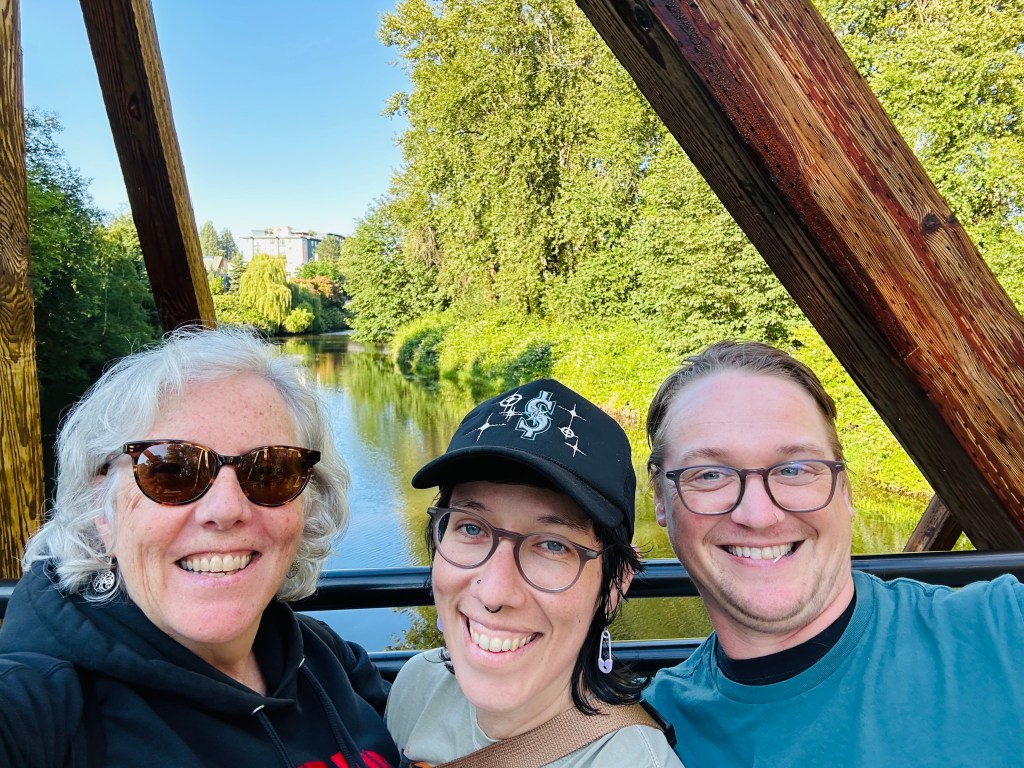
Myself, daughter Natalie and son -in-law Kevin hiking in the Sammamish River Park

While I was planning the trip, I had a certain cadence to each week.  I worked Tuesday through Thursday and would need to have WIFI and electricity since my air conditioning only works on “shore power”.  I would find my campsites on an app/website called RV Life which shows reviews, the amenities available and the strength of the WIFI connection based on the carrier.  I had each site reserved in advance and the app would show me the route and approximate time and miles between each spot.  This was invaluable and outside of one or two changes in campsites due to visits with friends, I stuck to the route as planned. Spots that were a must see such as Big Bend National Park and Joshua Tree National Park were all planned out so I knew how much time it would take to visit each spot.  I did some detours to visit a few spots when I realized how close they were like White Sands NP, Guadalupe NP and Carlsbad Caverns NP. In all I went to 11 National Parks and 2 Canadian National Parks.  Many I had visited before but the stand out new parks were Joshua Tree NP and Theodore Roosevelt NP (where two bison were crossing the road and right by Abeona!). My favorite revisited parks were a hike with my brother Rick to Olympic NP with marmots, deer, wildflowers and snowcapped peaks, the stunning Crater Lake NP and the incredible Jasper NP and Banff NP in Canada.  

I went to several state parks including Catalina SP in Tucson, Smith Rock SP in Oregon, Big Basin SP in California with my oldest brother Dave.  Many adventures were completely unplanned and were some “might as well” sort of opportunities. I went on a glider plane ride in Tehachapi, CA because I was camped next to the runway for my workweek and decided I would be mad at myself if I didn’t give it a try.  It was terrific and completely an analog as in nothing electronic which surprised me.  Not even a radio between the guide plane and the glider. I saw signs for Shasta Caverns and decided to sign up for a tour which included a boat ride and hike through the caverns. The best adventure by far was taking a helicopter ride to the Meade glacier near Skagway AK.  I signed up to walk on the glacier but the helicopter ride was terrific through the mountains and glaciers surrounding Skagway.  I was fortunate to sit in the front seat of the helicopter and I felt like a photographer for National Geographic gliding above the glacier lakes and waterfalls. 

Abeona handled like a champ on scary drives like the always windy Tehachapi pass, the 11 percent grade on the Klondike Highway out of Skagway and the countless gravel roads and unmarked portions of the Alaska Highway.  I accidentally backed into a large boulder in Catalina SP which dented my sewer system. I was so fortunate that there was a remote RV repair guy in Joshua Tree that repaired it in 112-degree weather.  I had a leak in my main water inlet but my brother Dave and a call to Leisure Travel Van (the manufacturer of my RV) helped me do a fix until I got home. I also learned to manually shift coming down the dreaded Tehachapi pass, I finally figured out my tire sensors after some help from a Facebook group for Leisure Travel Vans. The only other issue was a hitchhiking mouse I picked up in the Yukon but fell victim to a trap I set months before. I learned that tire places are perfectly happy to check and fill your tires for free (thank you Les Schwab!). 

I had the opportunity to see many friends and family along the way.  I have a dear friend Tammi and her husband Larry who took me to Saguaro NP and some fantastic Mexican food in Tucson. I visited an old coworker, Jeanne at my previous employer in Scottsdale and an old elementary school friend, Michael, in Mountain View. My brother, Dave, drove me to the Redwood Groves in the Bay Area and he and his wife, Judy, hosted me for several days in Palo Alto where I was able to see my nieces and my great nieces and great nephew. I met up with my daughter and her husband along with friend, James, in Portland for incomparable vegan food. The big celebration for my mother’s 90th birthday was a relaxed trip down memory lane and some great time spent with the entire family. I met with another elementary school chum, Jim, in Fernie, BC where we took an exciting drive up a mountain in his indestructible car (Abeona would not have survived). I was able to visit my dear old friend, Johno, from my NYC days in the mid 80’s. He has a lovely lakeside house with his husband, Jim, in Indiana.  I got to see Johno do a back flip off a swim platform and I went tubing around “Lake Jimmy John” (first time I’ve done that in 20 years). I wrapped up my trip in Covington, VA visiting my Aunt Karen, her children, Craig and Kristin and her husband, Angelo, for a lovely meal in Lewisburg, WV.

I cannot tell you how many times I talked to Abeona and thanked her for being such a bad ass for getting me on and off the ferry, and for the air conditioning working for the massive back up I experienced out of Phoenix where it took two hours to go ten miles when it was 115 degrees.  There were countless evenings where the air conditioner was on all night and it never quit! There were also the tight squeezes through road signs in Palm Springs, the pouring rain near Rusk TX, and windy roads of the Olympic Peninsula. Abeona never faltered. 

My wanderlust is definitely a gene imparted from my father and so is my hesitancy towards heights. I left my father’s ashes in places he had been to and other places where he wanted to travel and sometimes when I knew it was a view he would have loved. He said in his last few years of life that Peyto Lake was the most beautiful place on earth.  I was able to travel there on this trip and leave his ashes from the overlook.  I know he would be proud of me on this cross-country sojourn and I’m proud of myself for taking it on, doing it scared and always having Daddy riding shotgun.

🫶🏻Ode to Jasper

I visited Jasper National Park and the town of Jasper from July 15th until July 19th of 2024.  It was the absolute highlight of my cross-country trip with my RV, Abeona. I traveled from South Western Texas to the Olympic Peninsula, then a ferry to Alaska and the road from Skagway to Jasper which was mostly on the Alaska Highway.  I had already traveled over 10,000 miles when I arrived in Hinton just outside Jasper National Park to camp. I usually work remotely Tuesday through Thursday and was expecting to when I realized that I didn’t have connectivity and, therefore, had to cancel all my calls for that week.  I was disappointed that I wouldn’t be working but I didn’t realize how fortuitous having four days to tour around and in Jasper National Park would be. Between the gorgeous weather, the visibility, the abundance of wildlife and 4 days all to myself to go where ever I wanted to was stupendous.

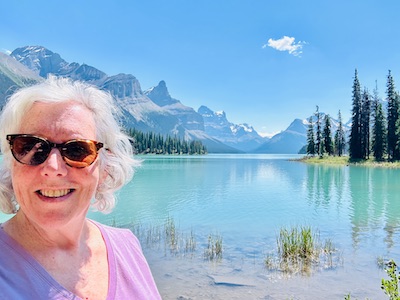
On Lake Maligne in Jasper National Park

This was not my first trip to Jasper but I didn’t realize that until I traveled southbound on the famous, scenic Icefield Highway.  The Columbia Icefields are actually in Jasper National Park because it butts up against Banff National Park to the south, I had assumed that I had only been to Banff.  Now I realize, because of the cross-country trailer trip with my family when I was 8 years old that we had gone to the Columbia Icefields, so this was my second trip here although some 50 plus years apart. 

I went into the town of Jasper which is an adorable, vacation town with coffee shops, bakeries, gift shops, all manner of tour options including rafting, snowshoeing, scenic flights, bus tours, restaurants and some 20 different hotels. The downtown is about three blocks wide and ten blocks long.  It’s easy to park and walk around. There are hanging flower pots from the light posts, totem poles, there are small parks and benches.  There is a train station in the center of town.  It’s quaint, understated, easily assessable and it’s obvious that people live there year-round and they love the place. 

My first adventure was up the Jasper Sky tram.  This is a tram up the side of the Whistlers.  There is a hiking trail at the top and the most magnificent views of all the various mountains within the Canadian Rockies but most impressively I could see the top of Mount Robson which is the highest peak in the Canadian Rockies.  Apparently, the mountain top is only visible about 10 days out of the year. 

The next day I took a tour of Maligne Canyon and Lake Maligne. There were corkscrew waterfalls down deep crevices, nesting eaglets above Medicine Lake with marmots frolicking below. Maligne Lake is an absolute mesmerizing place.  We took an hour boat ride to see Spirit Island with the “Hall of the Gods” which are the mountains as a backdrop.  It was almost a cloudless day and the beauty that surrounded us was breathtaking. We heard a loon wailing in the background and a small deer swimming across the middle of the turquoise-colored lake. It was magical.

My last tour was driving to the town of McBride past Mount Robson Provincial Park and yet another cloudless day to see the top of Mount Robson.  We took the train back from McBride which was a lovely relaxed pace to see the mountains and lakes pass by. I had to leave the next day and made my way down the Icefield Parkway and the incomprehensible string of endless jagged snowcapped mountains, mighty waterfalls and turquoise lakes that are the centerpiece of Jasper and Banff. I managed to see Peyto Lake which is what my father believed to be the most beautiful place on earth, considering all his travels in his life, it’s high praise and, outside of Spirit Island on Lake Maligne, I would have to agree.

Some 48 hours after I left Jasper and Banff, a lightning storm caused a fire that, as I write this in early August, is still not under control.  30% of the buildings in the town of Jasper were destroyed, the entire National Park and all of the residents and visitors were evacuated. It sits empty and the heartbreaking pictures of the bighorn sheep and elk roaming through the downtown streets looking for food and refuge in burned out buildings is devastating. All the tour guides and waitstaff and service folks and families that depend on them, all transplanted to who knows where. I feel like I stole a masterpiece and somehow, it’s misplaced until, ten or twenty or thirty years from now, it’s back to its original beauty.  The beauty I got to experience and now I’ve moved on to the next state and onward to home as all those truly lovely people and animals have to rebuild or move on from what is the “Jewel of Canada”.  I pray for an end to the fire and safety and health to all those affected. 

🧭Southbound on the Alaska Highway

The Alaska Highway (or Alcan: Alaska Canada Highway) runs 1,387 miles from Dawson Creek BC to Delta Junction AK.  On my trip from North Carolina to Alaska and back, I took a ferry from Bellingham, WA to Skagway, AK.  I decided on Skagway as my final port on the Alaska Marine Highway (the ferry system) because there was a road that connected to the Alaska Highway. That meant I could return down to mainland United States via the roads.  This part of my trip was by far what I was most apprehensive about before departing Durham, NC. Going solo in a 25-foot RV on some of the most remote roads in North America without a copilot, a spare tire or cell coverage is intimidating. In fact, I got about 3 hours sleep before ascending the Klondike Highway which originates in Skagway and travels up 15 miles with an 11% grade to White Pass. I was so fortunate on the morning when I departed Skagway because it was calm and foggy.  Wind, a high-profile vehicle and shear drop offs are not a good mix for me, so being shrouded in fog and stillness was actually a good thing; out of sight, out of mind.  I hooked up with the Alaska Highway in the tiny town of Carcross originally called Caribou Crossing (population 301).

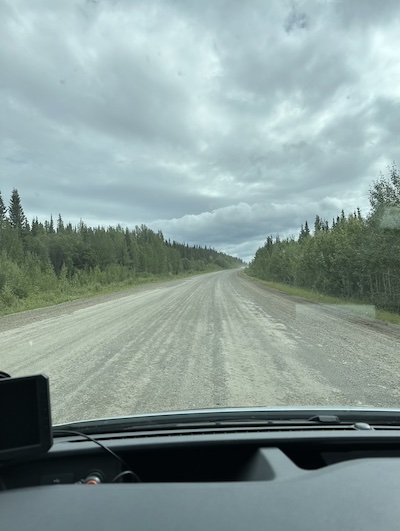
Part of the Alaska Highway in the Yukon

This is what I found after traveling 855 miles on the Alaska Highway:

Wildlife. The minute I got on the Alaska Highway out of Carcross YT, I saw a moose on the side of the road.  I have waited my whole life to see a live moose (including several trips to Maine) and I was taken aback by the size of her eating along the side of the road. Just outside of Watson Lake YT, there was an entire herd of bison on both sides of the highway.  I would guess upwards of 40 bison eating along the side of the road. I saw a fox, bighorn sheep and caribou as well.  In fact, if you drive the Alaska Highway, I challenge you NOT to see wildlife. I was on high alert for most of the drive because they mark the areas where there may be wildlife present. 

Highway. I would loosely call this a highway.  There was never a section of divided, fully marked, four lane immaculately paved road.  There were sections for upwards of a mile or two where the entire width of the road was gravel due to construction.  I would bet that, especially the roadway in the Yukon (the entire population for the territory is 40,000!) and northern British Columbia, that 40% of the road was unmarked; So, passing vehicles in the opposite direction is a game of trust. I would guess that it’s about 50% trucks and 45% Recreational Vehicles on the road with motorcycles, SUVs or even a brave bicyclist for the last 5%. There were almost always ample gravel shoulders but who wants to drive 55 miles an hour on a gravel shoulder. It’s not like there was much traffic, especially in the Yukon. Canada uses completely different road signs to indicate rough road, wildlife ahead and so on. The funniest one is of a metal bridge which shows the person being rattled. There are also random box trucks left to decay but have an advertisement plastered on its side.  The highways are a unique experience. 

Services.  If I saw a gas station, I filled up.  Sometimes the road would have a warning that there weren’t services for the next 133 KM, sometimes not.  If I saw a gas pump and I still had 3/4 of a tank of gas, I still filled up. When you might see only a handful of vehicles while driving all day, the last thing I wanted was to run out of gas. I saw maybe 4 businesses (i.e. restaurants, gas stations and lodges) that were actually open between Carcross and Watson Lake. I assume that COVID wiped out a lot of the businesses up here but I ended up eating in my RV for the first two days on the Alaska Highway.  I can’t imagine not having at least a tent on this trip as I only saw a handful of lodges on the entire route. There were several businesses that hung a “closed” sign out front and most were dilapidated. I kept thinking, thank god I wasn’t depending on that place to be open.

Metric. Being fully versed in the metric system before driving the Alaska Highway would have been very helpful.  Sure, I’ve been to Europe but I have never driven in Europe.  All the signs are in kilometers which I basically just divided by two even though that is not accurate.  I was fortunate that my speedometer has metric although it’s small print.  The km per hour were constantly changing depending on the condition of the road. In addition, and probably the most startling is when a bridge would put that limit of weight in grams.  I had no idea how many grams my 11,000-pound RV was but I had to assume that the gas tanker I passed an hour ago must have gone on the same bridge.  I was definitely doing it scared. And then there were the gas stations.  I can tell you have absolutely no ideas how much gas I purchased and if I paid $2.00 a gallon or $100 a gallon.  Between liters and the Canadian dollar and the fact that the price was irrelevant if it was the only station for the next 150 miles. The metric system had me flummoxed. 

Views. I was amazed by the sheer beauty that was around each corner.  I was very fortunate that the weather was great on the four days I was traveling on the Alcan. Whether it was glacier lakes, meandering wild rivers, wildlife, miles of aspen and pine trees or the stunning views of long-lost mountains, each turn was a gift. Some rivers were bright turquoise and some were black, some groves of tress were decimated by fires and some were deep green and endless.  It’s a fascinating journey that a good portion of the world never gets to experience. I would think about pulling off on a random side road but since they were all narrow and gravel, I demurred.  The last thing I wanted to do was end up on a dead end and unable to turn around. I think of all the pictures I wanted to take but sometimes I just needed to experience regardless of whether I was able to document it.  

Dawson Creek is the end (or in most cases the beginning) of the Alaska Highway.  It’s definitely where I saw my first McDonalds in several weeks.  There are traffic lights, divided highway, neighborhoods, and the roadway is clearly marked.  All the things I take for granted back home. I am happy to report that my GPS worked for the entire route although I did have the Alcan bible, “Milepost” (a book with every highway and milepost detailed for Alaska and Western Canada). In retrospect, I’m glad I took on the journey with my RV, Abeona, because I’m so much more self-reliant.  I know that so long as I am prepared, calm and focused, I can accomplish almost anything. 

🛳️Traveling on the Ferry to Alaska

I had no idea that you could take a ferry to Alaska until I started researching travel to Alaska.  It’s a remarkable way to travel and a great way for me to have my RV, Abeona, along for the ride for the road trip back home.  I had just finished a week in Sequim, Washington for my family’s celebration of my mother’s 90th birthday.  I had secured a ticket for the 3-day cruise from Bellingham, WA to Skagway, AK. My entire goal in going to Alaska was to visit my 50th state.  I had crossed off North Dakota, Nebraska and Iowa about 5 years ago so finishing this item on my bucket list was pressing. 

Bellingham Washington is a beautiful town on the water.  I really thought I would have had time to explore but my focus was making sure I was on that ferry. I was surprised that, even though I had arrived 2 hours before departure, almost 80% of the cars, trucks and trailers were already lined up before I arrived. I’m glad I didn’t cut it close by exploring Bellingham.

Coming in to Haines on the Kennicott Ferry

Loading the vehicles on the Kennicott ferry is like Tetris on steroids. There were 16 number lanes (I was in lane 14 and the only RV headed to Skagway).  I started to question my selection of Skagway since there were no other RV’s or trailers headed there.  Like, what’s the problem with Skagway? When I was told to head down to get loaded on the ferry, I was shocked by some of the vehicles being loaded in the opposite direction.  I figured out, when I got off in Skagway, that loading is more like a circle instead of other ferries I’ve traveled on where the first car in is the first car off. In addition, we loaded from the back of the ship in Bellingham but every other port, the vehicles go off on the side (crazy right?).  I can’t imagine the mastermind that figures out where all the vehicles go.  There were trucks with campers on the back, motorcycles, cars with trailers and some motorhomes larger than mine with tow vehicles.  The menagerie of vehicles was mind boggling.

Once on board, I took an elevator to the cabin floor which was two flights above the vehicle floor.  There the purser gave me a key to my berth.  This was a no frills, metal bunk bed with a 4-inch-thick mattress in a narrow soulless windowless room with a small chair and a sink.  Once I dropped my bag, I went up to the observation deck which is where there was seating, tables, a cafeteria, a movie theater and a playroom for small children. We all gathered at the front of the observation deck because it was a warm, sunny day and waited expectantly for the ferry to finally get underway.  We were about ten minutes late departing but once we left the dock it was a terrific view from Bellingham Bay and the Rosario Strait of the Olympic Mountains, Mount Baker and the Pacific Range above Vancouver. 

The ferry, Kennicott, travels via the inner passage.  It’s remarkable that a ship the size of Kennicott can manage traveling all the way to Skagway without being in the open ocean. One thing that messed me up for the first 36 hours on the ferry was that all the ships activities were on Alaska time.  My watch, my laptop, and my phone were all on Pacific Time as we traveled through British Columbia.  This caused me to be early and frustrated on car checks (times allocated to go down to your vehicle), movies and the cafeteria.  In addition, the ferry had no wifi.  This in retrospect was relaxing.  For the first 24 hours we were never close to any town or city so, no cell coverage.  So, time was spent looking out at the coastline and islands passing you by, reading or as many people did, doing puzzles.  I was amazed at how many 1000-piece puzzles I saw completed by various, changing groups and individuals.  

There was also something called mustering.  I had never heard this term before but there is a place, based on where your berth was, that you gather on the observation deck in case of emergency.  So, there are signs all over the boat on how to get to Muster A or B.  There are also some hearty souls who camped on the solarium deck.  These folks tape down their tents or brave the elements in a sleeping bag.  As you can imagine, it’s an eclectic group that takes the ferry to the various ports of Alaska on what is called the Alaska Marine Highway.  There were Alaskans returning home, comfort travelers like myself traveling in motor homes, folks on bicycles, motor cycles and some backpackers.  

There were several whale and bald eagle sightings.  Traversing the Wrangell Narrows a bit nerve racking.  This very narrow passage that cruise ships do NOT travel seemed about 50 feet wide.  As we arrived to travel the 22-mile passage, there was a spotter at the front of the boat for the entire length. It is from this passage that we arrived at the tiny town of Petersburg.  Without these ferries traveling this route, these isolated towns would not receive products from the outside world.  It was amazing to see how these tiny towns exist where, if you don’t have a boat or seaplane, you will be stuck.

As we arrived and departed at the various ports, Ketchican, Wrangell, Petersburg, Juneau, Haines and Skagway.  People would get on and off the boat.  So, when I finally arrived in Skagway, there were many vehicles getting off as well.  It also meant that when we were in the preceding ports, it would be about 45 minutes so I couldn’t afford to get off the ship to explore.  It was a terrific, interesting, journey where I met a friendly group of travelers. The last day was spent overwhelmed by the beauty of the snow and glacier capped mountains that encircle the inner passage.  Simply breathtaking. I highly recommend taking the journey via a ferry.

☺️Surprising Sequim

Sequim, Washington is on the northern edge of the Olympic peninsula at the base of the Olympic Mountains and along the shores of the Dungeness River.  Its population is around 8,000. My brother, Rick, and my mother have lived in Sequim for about 5 years. I’ve visited several times since they moved here and each time I come back, I find even more surprises.  It’s in what is referred to as a “Rain Shadow” which is an area with significantly reduced rainfall.  Seattle just a few short hours away is known for its annual rainfall where rain jackets and boots are a must. Sequim only averages 16 inches a year. This is actually one of the reasons my brother and his girlfriend decided to move here 5 years ago.  There are more surprises here than just it’s lack of rain.

My brother Rick and me hiking up Hurricane Hill with the Olympic Mountains in the background

Here are some surprising things about Sequim:

Coffee.  Well of course there is coffee in Seattle but considering there are only 8,000 potential coffee drinkers in Sequim, there are an inordinate amount of coffee shops.  I stayed in both an Airbnb and an RV park in different areas of Sequim. I could have crawled to two or three coffee shops from each location.  When I did a search, there were 25 coffee shops…25!  I highly recommend both Hurricane Coffee and Essence Coffee Roasters.

Lavender.  I go for a walk every morning and, in Sequim in June, it’s an aromatic experience.  There are lavender plants along practically every street in downtown Sequim.  There seems to be several different varieties but some are especially fragrant. There is also the annual Lavender Festival which takes place in mid-July.  I know I passed at least 10 lavender farms while scooting around Sequim.  During the lavender festival this year, 19 farms will be open. In fact, my daughter, Natalie, and son in law, Kevin, had a magical wedding on a lavender farm called Purple Haze.  In addition to all the farms, there many gift shops that specialize in all things lavender.  So, you don’t need to go to Provence, just head over to Sequim.

Biking. Another one of the reasons my brother moved here was because it was a bike friendly town.  A few years ago, we rode electric bikes over to Railroad Bridge Park which is within the city limits of Sequim and is a lovely park with a bridge over the Dungeness River.   There is the Olympic Discovery Trail which is a 135 mile multi use trail from Fort Townsend to La Push (on the Pacific Ocean).  40 miles of the trail is paved and my brother explores a lot of the Olympic peninsula on his bike.  We also took a rail trail a few years ago along Crescent Lake which is about an hour west of Sequim.  Whether in town or out of town, there are bike trails.

Olympic National Park.  I think the first time I was in Olympic National Park I was on a cross country trailer trip with my family when I was 8 years old.  As an adult, I’ve been up to Hurricane Ridge in Olympic National Park which has a tremendous view of the Olympic Mountain Range including Mount Olympus, Obstruction Peak, Elk Mountain and Blue Mountain.  My brother took me on a hike up to Hurricane Hill (not to be confused with Hurricane Ridge).  It was a spectacular hike in late June with marine fog hiding the valleys below with a clear blue sky above and at least 15 snow covered peaks.  The wildflowers came out throughout the day as the sun rose as the deer and marmots rested in the various meadows.  If you hike one hike, head up to Hurricane Hill.  I felt like Julie Andrews in Sound of Music with the vast meadows and snowy peaks in the distance. 

Strait of Juan de Fuca. Sequim is only a few miles from the Strait of Juan de Fuca which is the waterway between Canada (specifically Victoria and Vancouver Island) and the United States.  From Hurricane Hill we could see Victoria across the water.  There are kayaking, paddle boarding, sailing and ferries that cross the straits on a daily basis. In the last few years, I have taken the ferry to Victoria for a vacation and went with my family on a day long whale watching boat with a stop at Friday Harbor. If you are headed to Sequim, there will be water.

Each time I visit Sequim I find new discoveries.  I’m sure that there are many more waiting for me when I return.  It’s a small town with a terrific location and many opportunities to explore.

🌲Experience Central Oregon

I’ve been on a 3-month solo RV trip across the United States starting in the Spring and including the Summer of 2024.  I have wanted to visit Bend, Oregon for several years but the timing was always off.  Either there was snow, or smoke from wildfires or it just seemed to far from the coast to make it practical from a timing perspective.  I finally arrived in Bend in late June and can attest it was worth the trip.  

On my way to Bend from Redding, California, I drove to Crater Lake National Park.  I have been to Crater Lake multiple times but, similar to the Grand Canyon or Yosemite, it is always, always worth the side trip to go to Crater Lake.  The beauty of the lake is incomprehensible. Any other lake this beautiful would have million-dollar homes on the rim or house boats floating in the middle. It’s a relatively harrowing drive up from the Park Headquarters to Rim Village.  Harrowing because of the hairpin turns, abundance of snow (in JUNE!) and the lack of guardrails as I drove my 25-foot, 5-ton RV up to the top. I embraced doing it scared.  Perhaps it was because my eyes were glued to the road but I didn’t see the lake until after I parked at Rim Village and took the short trail to the overlook.  It is the deepest blue I’ve ever seen (apparently in 1853 Isaac Skeeter indeed called it Deep Blue Lake).  It’s known for its water clarity and for being the deepest lake in the United States and third in the world for average depth.  When I was there in June and there were snowcapped peaks surrounding the pristine lake against that deep blue color on a clear day, it was just breath taking. I had hoped to hike some of the many trails but was not prepared for the amount of snow on the ground so I opted out of hiking. Regardless, if it’s not on your bucket list, please add it.

Hiking along the River Trail at Smith Rock State Park, Oregon

I camped in Bend, just a few hours from Crater Lake,  for several days to work and explore. My dear friend, Janine, had made some recommendation and I tried out several.  There are multiple trails along the Deschutes River all across central Oregon.  Many trails are in the city of Bend but I started on the Benham Falls trail from the Upper Deschutes River within the Deschutes National Forest and the Newberry National Volcanic Monument. It was an easy hike along the Upper Deschutes River to see a 25-foot-high cascade waterfall.  I was struck by how I could see the remainder of an enormous lava flow on the opposite side of the river.  This led me to my next hike at Lava Butte which is within the same national forest and monument.  

Lava Butte and its trails through the lava field are just a couple of miles from the trailhead for Benham Falls.  The cinder cone that remains from a volcanic eruption from 7,000 years ago.  It’s a fascinating hike on the paved trail through a large lava flow.  There are now wild flowers and some small trees that are starting to pop up through the lava tubes.  At the time of the volcanic eruption the lava flowed down to the Deschutes River and dammed the river to create Lake Benham.  The river eventually overflowed and eroded the dam which created the Benham Falls.  The lake is gone. There is a payoff to hiking up to the vista overlook on the Trail of Molten Land.  From the vista overlook Mount Bachelor and the Sisters with their snowcapped peaks are visible as well as the vastness of the lava field.

Walking around the Old Mill and Downtown areas of Bend are very nice.  I happened to be there on their farmer’s market on a Wednesday afternoon and all of these areas are next to the Deschutes River and the trail that runs next to it.  This is a walkers, paddlers and tubers haven.  I also was there on a warm, sunny day so it seemed the Chamber of Commerce had ordered it up for me. Great restaurants and shopping abound.

Finally, while heading to on my way to Portland, I stopped by Smith Rock State Park.  This is one of many state parks in my travels that could easily be a National Park.  The sheer cliffs and stone formations that line the canyon around the Crooked River are not to be missed.  I think almost everything is better if it’s experienced rather than just viewed.  Smith Rock can be easily view from some vantage points near the parking lots but actually hiking down into the canyon really gives a better perspective of the sheer size of the 600-foot cliffs and the beauty of the river beneath. There were several groups of rock climbers headed out the morning I was there, weighed down my carabiners and rope.  I did not venture up Misery Ridge but the hike along the river at the bottom was less traveled and tranquil next to the water.  Even if you don’t have time to hike, I highly recommend heading to Smith Rock State Park.

I feel so fortunate that the weather and conditions were so perfect during my trip to Centeral Oregon.  Perhaps I appreciate it more because there were several trips that were cancelled due to weather and fire conditions before. It’s truly an adventurer’s paradise between the skiing, rock climbing, caving and kayaking.  I hope to return in the future.  

😟Do it Scared

This has been my mantra for the last two months.  I struck out alone for the west coast to attend my mother’s 90th birthday in my RV, Abeona (goddess of the outward journey), in May of 2024.  I’m not mechanically inclined, I am skittish of heights, not a fan of enclosed places and really like a good night’s sleep. This journey would have been a lot easier by just booking a plane ticket instead of driving some 4,000 miles to celebrate my mother’s landmark birthday.  But instead, I have embraced doing it scared.

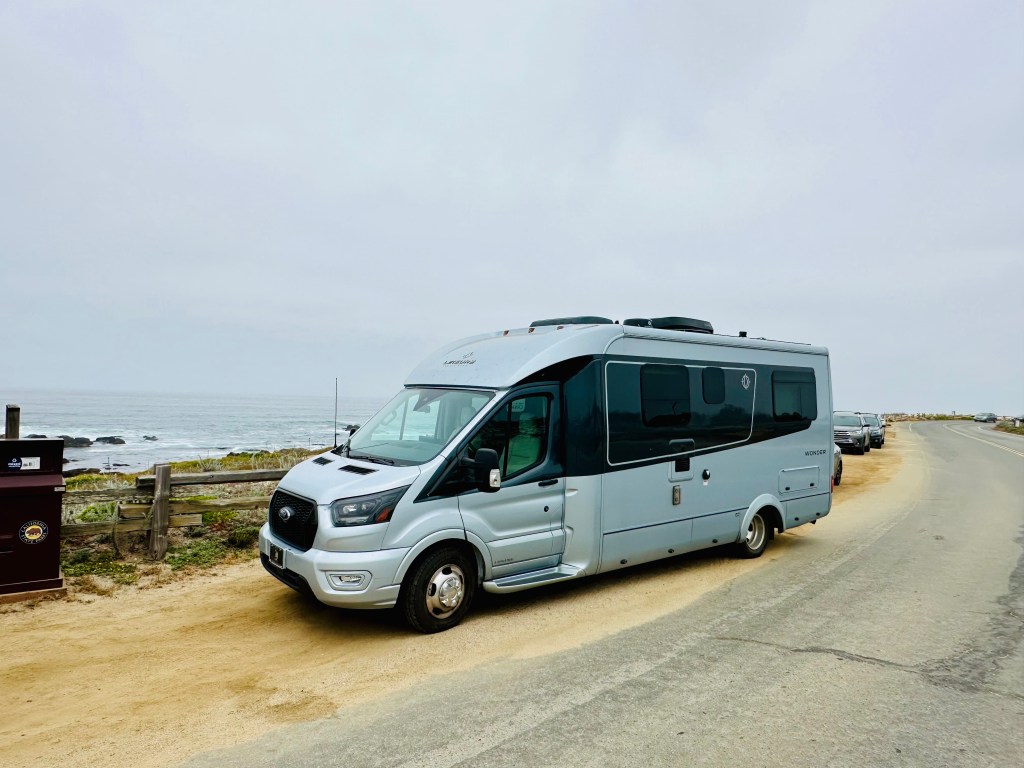
Abeona arrived on the Pacific Ocean after a cross country trip

Here are the things I faced doing it scared:

Rain in east Texas.  As I was headed to Rusk Texas (look it up, it’s in the middle of nowhere) there were all kinds of warnings on my map apps that the roads could be flooded.  It was a torrential downpour as I drove on desolate route 84 to my campground and out the next day. I saw whole fields inundated with water, rivers out of their banks but never any water across the road. I figured that the campground would have alerted me that it was underwater (and it wasn’t) but the drive was intimidating because of the unknown. 

Big Bend. Big Bend National Park is in the middle of nowhere on the border between Texas and Mexico.  I drove over a hundred miles without seeing a gas station from Fort Stockton down route 385 which enters the park from the north entrance.  I didn’t see one car as I drove down from the north entrance to the park headquarters.  This is rare for a National Park in May but when it’s 112 degrees outside and no cell coverage;it appeared to not be a popular spot in the Spring. When you are driving an RV by yourself and know there isn’t much of a safety net if you break down; you do it scared.

Boquillas Mexico. When I get nervous, my stomach twists in knots. I had a morning planned to cross the border at the edge of Big Bend NP where there is an official entry point into the United States. I knew that it was possible to take a very short row boat ride across the Rio Grande into the little town of Boquillas. I didn’t sleep well in anticipation of crossing the border and back.  I was imagining something going wrong. It’s hot, dusty, no cell coverage and my Spanish was rusty.  As with most uncertain things, I was looking for things to control.  I texted my kids letting them know that I was crossing the border without cell coverage and that I expected to be back to cell coverage in 3 hours. The town itself, my guide and burro ride into town were a step into a whole other reality with this small-town dependent on brave Americans to take a chance on seeing another way of life. I’m glad I did it scared. 

White Sands National Park. I’ve been to over 30 national parks.  I had been to White Sands as a newlywed with my husband, Orlando, in the mid 80’s.  I do not remember the road, about 3 miles into the dunes loop, ending into what was essentially sand dunes for some 10 miles. This mistake, in that I didn’t have all wheel drive on the RV, was something I’m glad I did in retrospect but had I known, I’m sure I would have skipped. Getting my Abeona stuck in the sand and the rattling of the dual tires in the back was unnerving. I turned around as soon as I could but I can tell you to pay more attention to park maps and advisories now.

Tehachapi Pass. This is an infamous road that skirts Los Angeles through a mountain pass.  I have been over it several times in a car although I probably wasn’t driving.  When driving up from the south there are over 4,500 wind turbines which, immediately alert you to the fact that “there will be wind.” On the day I came up the pass from the south there were signs alerting high profile vehicles.  My campground was on top of the pass.  I went anyway. Gulp.  It felt like hurricane force winds, I was clenching the steering wheel and maintained a 45 mile an hour pace.  I was fortunate that there weren’t may trucks and gratified to see other folks with trailers going over the pass (if they can do it, I can do it). After 4 camping days in Tehachapi, I came down the other side of the pass which is longer, steeper and full of curves (it forced me to learn how to use manual gears).  I kept thinking to myself, Rick Hanson’s “Are you alright right now?” I was.

Glider Ride. When I was camped in Tehachapi, it was right next to a glider plane airport.  After the first two days of watching gliders take off attached to small planes, I decided that, if I don’t do this, I’ll regret it. I had every afternoon free and why not just walk over and get in a glider. I was going to tell my daughter but she was occupied so I just went over and did it.  In retrospect, I think that because I was by myself, I couldn’t be talked out of it.  Perhaps someone else would have discouraged me.  Maybe I thought I had survived the trip thus far, let’s go for broke. I was shocked that all you had to do was pay and that I didn’t sign 5 pages of waivers.  Perhaps it was because I didn’t sign waivers, I decided it was safe.  My pilot Cam was great.  They wheeled the glider into position. There was nothing but manual signals between him and the pilot of the guide plane.  The glider itself was airborne before the guide plane which was freaky.  Did I mention that I was in the front of the glider with all the controls to fly (but didn’t).  When the tow rope releases, we were gliding above the Tehachapi Valley at 6,500 feet.  Outside of the wind and the conversation with Cam, it was silence. It’s incredible that this little plane, that is shorter than my RV can glide through the air without any technology and land safely on the ground.  I’m glad I did it scared.

I find that, traveling alone as a woman over 50, I get a lot of folks opining on my choice. Mostly it’s from women over 50 saying “I could never do that”, “So you are alone? Driving by yourself?” I’m always flummoxed as to what to respond with.  And then?  Then there is Lucky Lu (her license plate).  I was departing Joshua Tree and at a stop light in Yucca Valley when I hear a car honking at me. I turn to the left and see a woman beaming and giving me the thumbs up.  I rolled down my window and she said” You have the toy I want!  I love it!  Are you by yourself?”, I answered yes, and she responds “YOU GO GIRL!”  That moment?  That was worth it all. There is also my co-pilot, my inspiration, my dearly departed father had wanderlust in spades and he would drive 4,000 miles just to see a view.  Daddy is always riding shotgun.

🤓How to Be an Original


 I recently read Adam Grant’s Originals. It’s a thought-provoking book with hundreds of examples of how we can all be more creative and original.  The biggest example that Grant uses is Warby Parker which is an online seller of prescription glasses. Grant commented that he missed the opportunity to invest in Warby Parker because he was skeptical. When something is original there will likely be skepticism.  A big takeaway from the book for me is that you should be able to address the weaknesses first.  That seems like baring your soul before getting any buy in but if you think about it, people relax once you’ve addressed the weaknesses and are more open to listen to the upside or strengths once you’ve acknowledged the weaknesses.

Here are some ideas on how to be Original:

Quantity leads to quality.  Grant says, “It’s widely assumed that there’s a tradeoff between quantity and quality – if you want to do better work, you have to do less of it – but this turns out to be false.  In fact, when it comes to idea generation, quantity is the most predictable path to quality.” So, it pays to brainstorm lots of ideas before honing in on one or two to bring to fruition. I think there is a lot to be said for listening to many voices as well.  And when you select those voices, bring in different, varying perspectives.  If there are too many heads in the room nodding in agreement, it’s probably not a very original or creative idea.  Come up with lots of ideas with varying voices and it will be more innovative.  

When someone weighs in with their ideas, they feel heard especially when acknowledged.  It can be so powerful if a coworker or boss says, “So you think we should have pink balloons to acknowledge the cancer survivors.”  It’s so powerful that, even if your idea isn’t selected, the fact that it was acknowledged and/or appreciated, you feel heard and are therefore more on board with whichever direction the group takes.  So, create lots of ideas, acknowledge them and the quality will appear.

Strategic procrastination.  I have to say that I was skeptical of strategic procrastination as I read the book. I have coached hundreds of coaches on how to stop procrastinating.  I can see now that it dovetails nicely with Oliver Burkeman’s 4000 Weeks. Burkeman espouses serializing or setting apart 30 minutes a day for focus time and to just start a project knowing that you won’t finish it.  This is what’s so counterintuitive. Why start if you can’t finish? Well, we procrastinate because we can’t finish the 6 annual reviews, we have to write. So, we keep kicking the can down the road for the perfect day to completely begin and finish something.  Burkeman says to just start and acknowledge that you won’t finish.  This to me is strategic procrastination.  

As Grant wrote, “But surprisingly, as I’ve studied originals, I’ve learned that the advantages of acting quickly and being first are often outweighed by the disadvantages. It’s true that the early bird gets the worm, but we can’t forget that the early worm gets caught.” There is also the time between starting something and it’s floating around your unconscious.  So, when you are taking a shower or driving a car or walking the dog, suddenly you come up with the perfect conclusion to the project or how you represent the findings on a chart.  That’s where the magic is.  Your unconscious brain is hard at working pulling memories and diverse topics together to have an ah ha moment.  

So, start but make sure there are gaps to strategically procrastinate.

Exposure and repeating normalizes.  As written by Grant, “The mere exposure effect has been replicated many times—the more familiar a face, letter, number, sound, flavor, brand, or Chinese character becomes, the more we like it.” I think back when I was first planning my cross-country RV trip.  The first few times I spoke it out load (or even in my head), I was intimidated and anxious.  The more I started planning and seeing the path forward, the more doable it was.  When things are repeated and broken into smaller pieces like 350-mile chunks of the United States, it doesn’t seem so intimidating.  Now that I’m out here on the West Coast of the United States and I’ve been living in my RV for a month, it feels normal and completely accessible and certainly less novel.  My perception has changed over time; traveling cross country is status quo.

Common points of reference were shown through Grant’s book as well.  When the concept for Lion King was pitched to Disney it was a dark story.  When someone compared it to Hamlet, suddenly everyone was on board. So, in order to sell your idea, find common points of reference to make it more understandable.

I think realizing that being creative doesn’t mean you have to be first with an idea is very powerful.  I’ve had lots of thoughts in the past that if I wasn’t the first to do something, then I was last.  Being later to the party with an idea is actually an advantage. How will you be more creative?

🧐Fascinating Joshua Tree

I went to Joshua Tree National Park and the town of Joshua Tree in Southern California in early June of 2024.  It’s always interesting to travel through a desert but when temperatures are starting to hit triple digits, it adds an element of danger.  I remember traveling through Death Valley a few years ago when it was 120 degrees. You think twice before you head out that you have plenty of water, the tire pressure is good, gas tank full and check for sunscreen.  Cell phone coverage is non-existent and there are no restaurants or gas stations for 50 miles. It pays to be prepared. 

Here is what I found in Joshua Tree:

Standing in front of rocks and boulders at Joshua Tree National Park

Wilderness.  I entered through the Cottonwood entrance at the southern end of the park.  This is definitely the road less traveled. There is a visitor center about 6 miles in but there is about 30 miles of blank wilderness desert for most of the road to get to the heart of Joshua Tree National Park. There are vast swaths of desert that lead to the Coxcomb Mountains and well beyond the immense Pinto Basin. This is all untouched land.  I didn’t expect to see so much empty arid desolate land that goes on for as far as the eye can see;  there are only a few cacti. I find the entering any National Park from the less traveled entrance has advantages because there has never been a  line and I end up traveling the park in the opposite direction from the rest of the crowd.

Cholla Cactus Garden.  This is one of the few stops and parking places when entering from the Cottonwood entrance.  When you actually walk through the Cholla Cactus Garden, it looks as if someone intentionally planted all these cacti. There were probably thousands of the cacti for miles in every direction.  The same cactus for miles.  Almost like someone planted them all to harvest them, but it’s in the middle of the desert in the middle of nowhere. It’s intimidating walking on the trail through the garden because their barbed cactus spines are easily detached or “jump” off the plant onto a passerby.  

Rock Formations.  When I turned the corner and got on Park Boulevard, the entire landscape transformed into what can only be referred to as Bedrock or the land of where the Flintstones resided.  It went from desert wilderness to jumbled rock formations.  There were hundreds of these rock piles in various sizes and dimensions. I found an interesting video on how the formations formed over millions of years but basically the tectonic plates moved and the magma eventually belched up and then cracked to create these formations.  I would drive a half mile and there would be formations and then another half mile and even more formations.  There are no bad spots to pull off and walk around; they’re all other worldly.

Joshua Trees. The plant for which the town and National Park are named is not actually a tree but a succulent Yucca Brevifolia.  19th Century Mormons named them after the biblical figure because they believed that the outstretched tree limbs guided them on their westward journey. I’m sure that there are thousands of Joshua Trees in the park and in the surrounding area. Sometimes I would see one lone tree in front of a rock formation or come across several acres of trees seemingly marching across the landscape. Some are tall with many branches and some are low to the ground with just a palm frond top.  Unusual and fascinating.

The Town. I camped in the town of Joshua Tree which seems like a desert oasis for rock climbers, artists and off grid folks. There was an enormous farmers market on the Saturday that I arrived with produce and treasures for sale. The actual main visitors center for the National Park is in the town and outside of the park itself which is very unusual. It’s a bit confusing because you have the actual plant, the town and the national park all referred to by the same name.

It was an interesting adventure through the park.  There was one area I didn’t get to visit because RVs were not recommended to drive to Keys View overlook which has a panoramic view of the Little San Bernardino Mountains.  As I learned in White Sands National Park, be sure to read if a road is recommended for RV’s, if not it’s likely  to have hairpin turns, steep inclines or, as in White Sands case, ten miles of unpaved roads across the dunes. Regardless the landscape and flora were epic. 

🫰🏻Strategies to Stop Procrastinating

This is the first blog post I’ve written in about 2 months.  I have found hundreds of distractions and reasons to push off writing.  I think I have a headache, I need to do the laundry, I want to hike a new trail today, there’s a notification on my Facebook page, there’s a new email, I don’t know what I’m having for dinner, maybe my son is coming to visit this weekend, it looks like rain, I don’t have any ideas to write about, maybe I’ve written about everything I can write about, etc. In reality, the main reason I didn’t write is because my computer has been SSSLLLLOOOWWWWIIIINNNGGG down. I spent three weekends trying to figure out what the problem was with my desktop pc and I have finally resorted to writing on my laptop.  I’m amazed at how one hang-up like a computer can derail me for weeks.  I say to myself “Whelp, it’s taking too long; might as well go watch Netflix.” 

So how did I finally stop procrastinating and get to work?  Here are some strategies I put into place that might work for you too:

  1. Break it down into the tiniest of pieces. I mean really tiny.  Like instead of saying “I’m going to read Gone with the Wind”, say “I’m going to put the book next to my reading chair”, or “Open the book and read one chapter, or one page or one paragraph”.  This is advice from BJ Fogg and his excellent book, Tiny Habits.  The tiny habit should take less than 30 seconds to complete, according to Fogg, so that time is not a deterrent and the new habit grows naturally. So, to get started on this post, I set up the actual blank document so it was ready to go.
  2. Change your environment.  I had no idea that this was holding me back but I usually have my desktop computer and laptop on the same desk.  I kept getting sucked into the abyss of the “My desktop slowing down” and not responding to even the smallest of actions.  Pretty soon, I had my phone open and I was scrolling Facebook while “I waited” for a page to load on my computer. I had my fully functioning laptop on the same desk but I still never started to write.  I was completely hung up on using my desktop.  So, I got the bright idea to move my laptop yesterday to my “writing” chair.  And suddenly, perhaps because the laptop was in plain sight and in a different environment, I started writing. Changing my environment got me at the keyboard once again.
  3. Music.  This may not be for everyone but I play classical music when I write.  It has to be an instrumental for it to be the right vibe for me to write.  I don’t want to get caught up in the lyrics of a song.  Turning on a classical playlist sets the right tone for me to work.  It also sets the tone that I will be working and writing if there is classical music playing in the background.  I find my muse in classical music.
  4. Shut down distractions.  I take coaching calls most of the day on my laptop.  If I hear a beep or ding or a notification shows up on my screen, I will research the source of the distraction and eliminate it.  Outside of my calendar reminding me of my next appointment, I don’t want to have anything disrupting my coaching calls.  By eliminating these distractions, I am able to be fully present for my calls.  This has the added benefit of eliminating distractions when I’m writing as well.  I generally try to write on the weekends so there aren’t usually any upcoming appointments but I’m also not receiving email or social media notifications which could potentially derail me from focusing on my writing.  Shut down distractions.
  5. Serializing. This is a terrific suggestion from Oliver Burke in his book, 4000 Weeks. Burke wrote, “Focus only on one big project at a time. Though it’s alluring to try to alleviate the anxiety of having too many responsibilities or ambitions by getting started on them all at once, you’ll make little progress that way. Multitasking rarely works well — and you’ll soon find that serializing helps you to complete more projects anyway, thereby helping relieve your anxiety.” So set up on your schedule that you’ll work 30 minutes each day on the Gnarly Project or the budget or the annual review process.  Once the 30 minutes is done, move on and come back to it the next day.  Serialize big projects.
  6. Eat that frog.  Mark Twain once said, “Eat a live frog first thing in the morning and nothing worse will happen to you the rest of the day.” Start your day with the worst thing you don’t want to do and then it’s clear coasting the rest of the day.  It might be that a five-mile run, cleaning out the garage, or finishing the annual review for your worst performing direct report is the best way to start your day.   Eat that frog.
  7. Choose what you do.  Change up your self-talk around that which you are procrastinating.  As written on MindTools, the phrases “need to” and “have to,” for example, imply that you have no choice in what you do. This can make you feel disempowered and might even result in self-sabotage. However, saying, “I choose to,” implies that you own a project, and can make you feel more in control of your workload. Elect to work on a blog post instead of “needing” to. 
  8. Celebrate or reward.  This made a big difference in my flossing habit in the morning. Dr. Fogg advocates either a high five or fist pump when you finish a new behavior like flossing your teeth.  It wires positivity into your brain.  You could also set up a reward when you are done like a latte from your favorite coffee shop or phoning a friend or watching an episode of your favorite show.  Wiring positivity helps set up the expectation that something good will come after eating the frog.

I used several of these tools to get back to writing again.  It feels good to get back to writing and the sense of accomplishment is a reward enough for me at this point.  What are some of your tricks to overcome procrastination?