Finding Magic in Maine

I’ve just finished five days in Abbot Maine in a cabin by Whetstone Pond with my boyfriend, Roy. It’s been a terrific visit.  I had initially tried to plan this in October of 2020.  The pandemic, at that time, had so many unknowns, that a trip to anywhere beyond my home state of North Carolina seemed foolhardy. I’m glad, in retrospect, it took a year to get here.  I feel like I appreciate it more because I anticipated it for over a year. The waiting made it that much better;  that, and a good deal of luck with weather and health made it a magical trip.
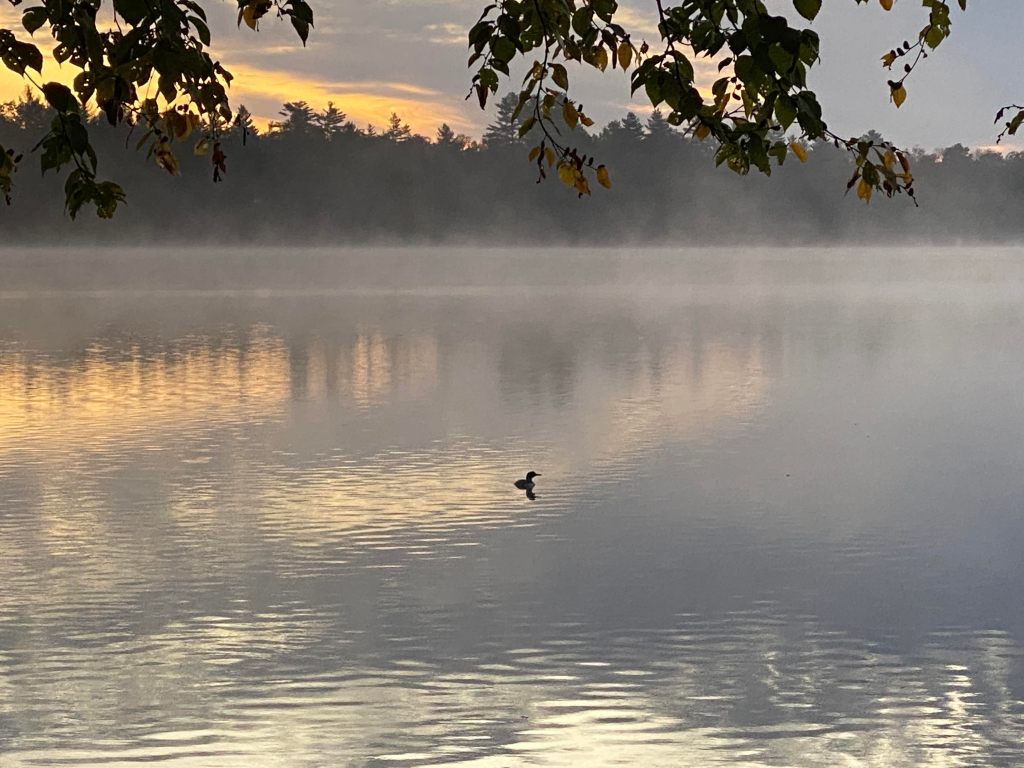
A lone loon on Whetstone Pond in Abbot Maine

Here is where I found magic in central Maine:

Loons

My summers as a child were spent in New Hampshire.  There must have been loons at some point.  I don’t remember them.  But the minute we arrived at our cabin by the lake, I went out on the deck that sat precariously close to the clear, lapping water of the pond (which would in any other state be called a lake).  I heard this echoing, mournful sound reverberating across the pond. It touched me so deeply.  It was sad, and mesmerizing, and resolute. Throughout the five days, there were pairs and solo loons swimming on various parts of the pond and their calls and yodels could be heard at all hours of the day or night.  There was no pattern. No way to predict when the next cry for attention would come but it was such a magical soundtrack that it punctuated the experience.

Leaves

There was no way to know eight months ago when I made the reservation what the state of the trees in central Maine was going to be during the first week of October.  As we drove to Abbot from North Carolina, the trees started to faintly change as we drove through Pennsylvania and Massachusetts. Upon arriving in Abbot, they were just coming into the burnt orange, buttery yellows and crimson reds.  As we looked out over the lake and drove north towards Moosehead Lake, the colors became vivid and vibrant. It was like turning up a dimmer switch with the peak of the color coming the day before we planned to leave; the afternoon sun sinking and becoming a spotlight to enhance the colors as if on cue.  The mountain tops and lakeside trees stood in line to take a bow in full fanfare. The tree right next to the deck of the cabin lets its leaves loose to float down like snowflakes onto the water below. The leaves had shown up magically and brightly.

Pond

The water on the pond was in a constant state of change.  I was excited to wake up at dawn to see what present awaited me as the sun started to illuminate the landscape.  One morning the pond was still, there wasn’t a cloud in the sky. There was just a sliver of a sunrise bolstered by a dark blue sky and waters.  The next day, a misty fog swept up the water and created a lavender smoke floating across the water in wafting billows. The third day, we kayaked across the water and saw the willows and lily pads and an otter swimming across the pond. Water can be still, or glistening in the sun, or creating white caps from the wind. It’s never the same experience from moment to moment. It’s hypnotizing with its magic.

Quiet

There was a stillness there.  A quiet that enveloped everything.  No trains, no cars, no airplanes or trucks.  The lapping of water at the pond’s edge, the tick of a clock, the footfall on crushing leaves on the deck, the heater turning on or the pump for the water; those were the only disturbances to the silence. It was a quiet that brings you into the present moment. It brought me back to the time of my childhood, sleeping on a cot in the cabin I lived in with my parents at Camp DeWitt, where moments seemed long and hung in the air with the lack of distraction.  The quiet was magical.

It was a sensory experience in Maine.  The smell of pine while hiking a trail, the visual kaleidoscope of autumnal color, the echoes of loons across the pond, the need for a sweatshirt to stay warm in a cabin and the unadulterated view of the milky way on a moonless night.  It was magic and I wish I could have bottled it up and taken it home.

Going to the Sun Road

Glacier National Park is referred to as the “Crown of the Continent” because of its spectacular peaks and glacier sculpted bowls. It’s one of those places, like the Ocracoke Island, where you can’t there from here. It looks close on a map but there isn’t an interstate taking you quickly and efficiently to the destination. It sits astride the border between Canada and the United States with the U.S.’s Glacier National Park on one side and Canada’s Waterton Lakes National Park on the other.  As my boyfriend, Roy and I were journeying across the country, we arrived at the park from the east side having traveled through the grasslands and wind turbines of Montana.  This ended up being fortuitous as most visitors arrive from Kalispel on the west side of the park.

Here are some highlights from the journey:

Lake McDonald, the largest lake along the Going to the Sun Road

Shelby

We found a hotel in Shelby, MT to stay the night before heading to the park.  Shelby is mostly a railway center.  It was established in 1892 as a junction between the Great Northern Railway and the Great Falls & Canada Railway.  Besides miles of railroad tracks and a Main Street that has seen better days, there is not much to do for the 3,000 some inhabitants.  Our hotel was right next to the railroad tracks, and I was amazed that I never woke up to the sound of a train or even a whistle during the night.  I was really astounded when, in the middle of a pandemic, a passenger train arrived in town. Apparently, Amtrak has service between Chicago and Seattle.  I can imagine that it must be a spectacular train ride as the only way to Seattle is through Glacier National Park.  It’s off the beaten path, which practically everything east of the park is, but it was a nice spot to launch our travels into the park the next day.

Sun Road

In July of 2021, we had to have a reserved ticket to drive on the Going to the Sun Road that I had reserved 60 days in advance.  If you don’t have a reservation, you must arrive early to get a same day pass.  This two-dollar ticket saved us an immense amount of time, so make sure you “splurge” and get a ticket if you plan on taking the drive.  I had a colleague who was in Glacier in early July and he was unable to go on the road because the spring…er summer plowing had not been complete.  The road officially opens on July 8th in 2021 after the herculean task of plowing the 50 miles the road traverses. This has to be one of the most scenic roads in the world between the pristine lakes, shear granite cliffs and glacier laden mountain peaks.  We traveled east to west which is by far the direction less traveled and was by far the best way to travel based on my acrophobia. When you head east to west, most of the ride is on the inside of the road but there are plenty of pull offs to enjoy the astounding views.

Saint Mary Lake

We entered the park and the Sun Road by Saint Mary Lake.  This is the second largest lake in the park and sits at 4,484 ft of elevation. It is a stunning lake as the Sun Road rises parallel to the length of the lake with the Rocky Mountains on the opposite side.  After a several days of riding through the grasslands of the mid-west, this was a stark contrast with Little Chief Mountain looming high above the lake. As we stopped at Rising Sun boat dock, dark ominous clouds rolled in and it started to rain.  As suddenly as they rolled in, they almost immediately rolled out. There are boats that tour the lake and drop hikers off at trailheads.  Because it is near the end of the Sun Road if you are traveling eastbound, there are very few cars and tourists.  Just the drive along this 10-mile-long pristine lake was worth the price of admission.

Grizzly Bears

Glacier has about 300 grizzly bears living inside the park boundaries.  When we arrived in late July, it was prime berry season.  Bears depend on berries to store up for hibernation.  We pulled off at Sunrift Gorge to take a trail down to a waterfall.  It was only about a mile down but Roy and I had left our bear spray in the car.  As we headed down the trail, it seemed to close in with vegetation covered in berries.  There were no other folks on the trail at the time.  After about a half a mile I chickened out and Roy and I headed back to the car.  There are so many warnings about grizzly bears in the park and at every trailhead, I felt like it would be impossible to not see a bear and we had no way to defend ourselves.  At a pull out close to Logan Pass (the highest point on the road at 6,647 ft), a ranger had a skull of a grizzly and was showing it to onlookers and warned that bears were loading up on berries.  Between the bear spray videos Roy and I watched on YouTube, the ranger and all the warnings in the park, I was too spooked to really enjoy a hike.  No, I didn’t see a bear in the park.

Lake McDonald

Towards the end of the Sun Road are the clear waters of Lake McDonald. This is the largest lake in the park and it is the big draw for all photographers.  Since most folks enter the road from this end, it was little bit more congested but it is a must stop.  We stopped near Lake McDonald Lodge and walked along the stony beach. The water is crystal clear and the colorful stones carpet the bottom of the lake as it sits beneath a crown of glaciered peaks. As we walked long the shore a family of three deer came sauntering by.  It was one of those moments in nature I will not soon forget.

As we left the park headed to Kalispel, we headed out the West Glacier entrance. The western end of the park has by far the most services both in and outside the park.  It was about 4 PM and we passed a line of cars waiting to get in and on the Going to the Sun Road as least 5 miles long sitting at a standstill. We had such good fortune to be heading east to west, terrific weather, and no bear encounters. The Going to the Sun Road was worth being on my bucket list and I’m happy I was able to check it off.

The Magic Pill for Learning

I’ve been reading Dr. Matthew Walker’s book, Why We Sleep. It was recommended by a client of mine and the book has some terrific insights and revelations related to sleep.  The most profound for me is the affect of sleep on my ability to learn. Sleep is the magic pill for learning.  The problem with this finding is that it’s so hard for me to set up my day to make sure I get enough sleep to create the environment that will let me do my best thinking and learning.  It would be so much easier to just take a “learning” pill.  In today’s world of constant distraction, twenty-four-hour connectivity and incessant demands on time, sleep seems to be on the short end of the stick. 

Here are the reasons to make sleep a priority for learning:

Preparation

Sleep prepares your brain for encoding memories and learning. As quoted on News In Health, “We’ve learned that sleep before learning helps prepare your brain for initial formation of memories,” says Dr. Matthew Walker, a sleep scientist at the University of California, Berkeley.” So, getting at least 7 hours of sleep before preparing to learn something is important to set up your brain for success.  A good night’s sleep before your guitar lesson, before your Spanish class, before your study session with your classmates may be as important as the sleep before the exam or recital.

Storage

Your capacity to store information is linked to the amount of sleep you have received. As written on Found my Fitness, “Sleep also facilitates the more permanent storage of new information that has been stored in the hippocampus – the region of the brain responsible for the formation and consolidation of short-term memories. Sleep that occurs after exposure to new information fulfills the role of the brain’s “save button.” I think back to my undergraduate days at Cornell.  I always crammed for several hours right before I went to sleep.  I rarely looked at notes on the day of the test.  In retrospect, I was storing the information the night before.  I don’t remember if I was getting a good night’s sleep but I was definitely putting my sleep between me and the exam. Sleep creates a space for better storage.

Transfer

Sleep is the mechanism by which your new learning is transferred into long term memories. As posited by Found my Fitness, “The intake and storage of mere short-term information are insufficient for optimal learning, however. The final, and perhaps most critical, way in which sleep aids in learning is that it provides a mechanism by which new information can be permanently stored – the formation of long-term memories via transfer to the brain’s cortex, where they can be retained and then retrieved for future use. Without this transfer phase, we run the risk of hippocampal-associated memory impairment.” I rarely, if ever, did an all-nighter while in college. Perhaps I realized that it was futile.  Like when I reread a sentence or bullet over and over again and couldn’t remember what I’d just read, I realize I’m too tired and go to sleep. The transfer of information won’t happen without a good night’s sleep.

Replay

There are studies where they were able to cue up study participants to remember certain aspects of learning.  As written by Dr. Walker, “When we sleep, memories and their associated events acquired during periods of wakefulness are reactivated. Essentially, the brain “replays” the events that occurred prior to sleeping, a process that stabilizes memories by serving as a pruning mechanism, selectively strengthening strongly associated memories and weakening weakly associated ones. A surprising fact is that this process can be amplified by “cueing” the reactivation during sleep with sub-awakening threshold sounds, odors, or other sensory cues – based on the context of the learning received the previous day.” Unfortunately, they haven’t figured out how to do this outside of the laboratory, but I think of cramming for an exam and how I would prime myself to remember certain aspects and try and disregard the periphery. Of course, there were the uncomfortable moments on an exam when the one section I didn’t study showed up and caught me up.  It was not “cued” up in my memory regardless of my sleep the night before.

I teach an evening online Human Resource Certification class at Duke University.  I polled the students the other night and almost all were tired and exhausted from the three-hour fire hose of information. Now I realize that they need to make sure they get a good night’s sleep the night before and, a good night’s sleep after to make sure the information gets solidified in memories. I had no idea that sleep was the magic pill for learning.  Are you getting enough sleep around your learning?

Stark and Serene Little Big Horn

On our summer coast to coast trip, my boyfriend Roy and I had the opportunity to visit the Little Bighorn Battlefield National Monument.  In talking with my brother Rick later, I believe that I had been there as an eight-year-old with my family on a cross country trailer trip.  It would make sense since my dad was a history buff and what is known as “Custer’s Last Stand” would have been a place he would have wanted to visit. So, in driving from Devil’s Tower in Wyoming to Billings Montana, there appeared on the map Little Big Horn.  We decided to venture into the park.

On June 25 and 26th of 1876, “Custer’s Last Stand” took place with the U.S. Army losing 268 and 55 severely wounded; 31 Native American warriors and 10 bystanders lost their lives.  It was a great victory for Lakota leaders, Sitting Bull and Crazy Horse. Among the Lakota people it is referred to as the Battle of Greasy Grass. It is a place for reverence for all who lost their lives.

Here are my highlights from the battlefield:

Stark

This place is in the middle of vast rolling grasslands.  We arrived on an unusually hot, windy day.  It was 113 degrees and it was very gusty. I almost felt transported back to the dust bowl.  Dry, hot and windy.  Amid this starkness and undulating grass are headstones, a single lane road and several monuments.  It is barren.  As you drive from one vantage point to the next or walk from one monument to another, there is nothing but wind and infinite space.  Among that space are headstones dotted in hilltops, gullies, and plains. This place is stark and austere.

Horses

We spotted several groups of wild horse roaming free on the grasslands. There was a mix of graceful chestnut, palomino and pinto horses communing close to the banks of the Little Big Horn River. It’s fascinating to me that these beautiful beasts are roaming free in the Montana grasslands.

Crow

As we traveled across the west, many of the national parks have a good bit of their land that is Native American property. Depending on the tribe, that portion of the park can be closed.  At Little Big Horn, we were able to travel through the whole park. I felt fortunate that we were able to see the whole park. I was really touched to see that the Crow people had donated a good portion of the land on which the national monument sits “in hopes that people of all races could enjoy this place of beauty together.” I felt honored to be able to enjoy it.

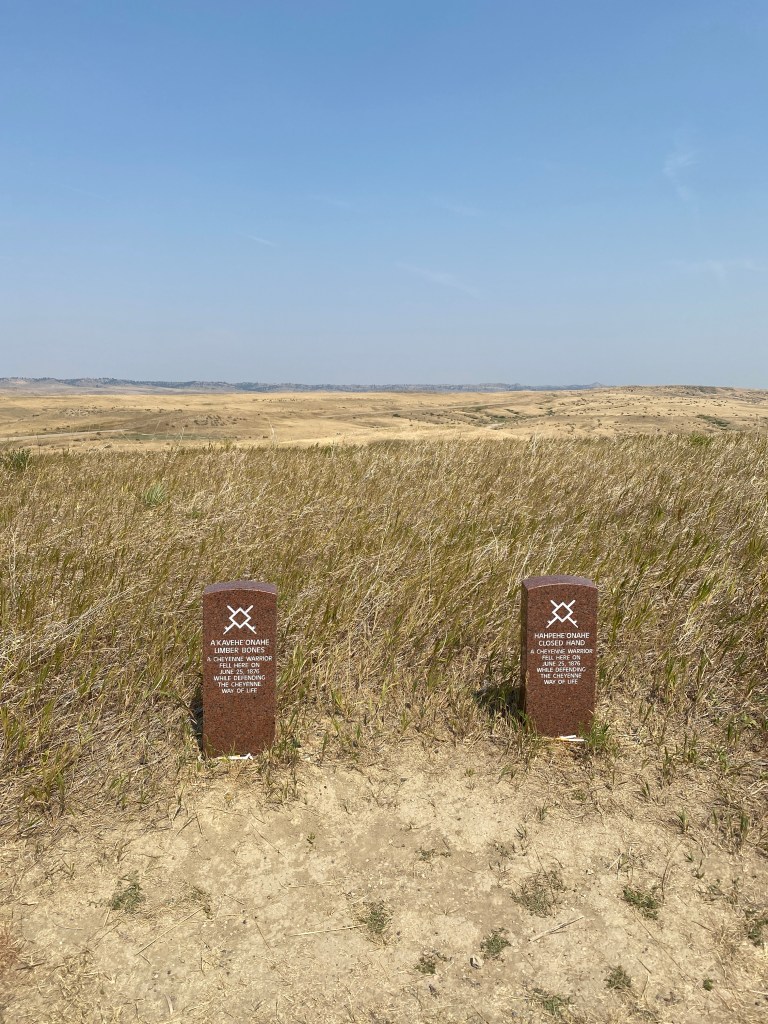
Two fallen Native American warriors

Serene

I felt as if the place was utterly serene.  Roy described it as spiritual.  There is reverence here.  In the quiet beauty of the swaying grass, the roaming horses and the headstones dotting the hills where warriors fell. I was most struck by the headstones that were side by side.  Two by two randomly across the countryside. There is the main graveyard where most of the U.S. Calvary and Lt. Col. Custer lost their lives but beyond that, scattered on the hillsides there are pairs of head stones. The white stones were of the fallen army soldiers and the red stones were of the fallen Native Americans.   Somehow, I found it comforting to know that perhaps when they fell, they were not alone.

In 1992, this hollowed place was renamed Little Big Horn Battlefield (from Custer’s Battlefield) to recognize the Native Americans on both sides of the conflict, Custer had Crow and Arika scouts working for him while there were over one thousand Lakota and Northern Cheyenne warriors on the other side of the fight. There is a beautiful sculpture called “Peace through Unity” to create understanding between all races.  It’s a place of serenity, reverence and stark beauty, I highly recommend taking it in.

Return to the Badlands

Merriam-Webster

noun:

badlands: a region marked by intricate erosional sculpturing, scanty vegetation, and fantastically formed hills —usually used in plural.

It’s been fifty-plus years since I stood looking out over the masterful beauty of the Badlands National Park in South Dakota. The first time was on a coast-to-coast trip with my family at the age of eight in a roll down the window station wagon and trailer; no AC. In my faded memory, I remember driving through the park at sunset and being overwhelmed by the pastel glow of the Badlands as the sun drifted into the horizon. At that point in my life, the stark barren beauty of the Badlands was completely foreign to me.  It’s a visceral memory for me. All I remember is what I felt. Awed and part of something much bigger than myself. So, when my boyfriend, Roy, and I set out on a coast-to-coast trip this summer, the badlands were a must revisit destination.

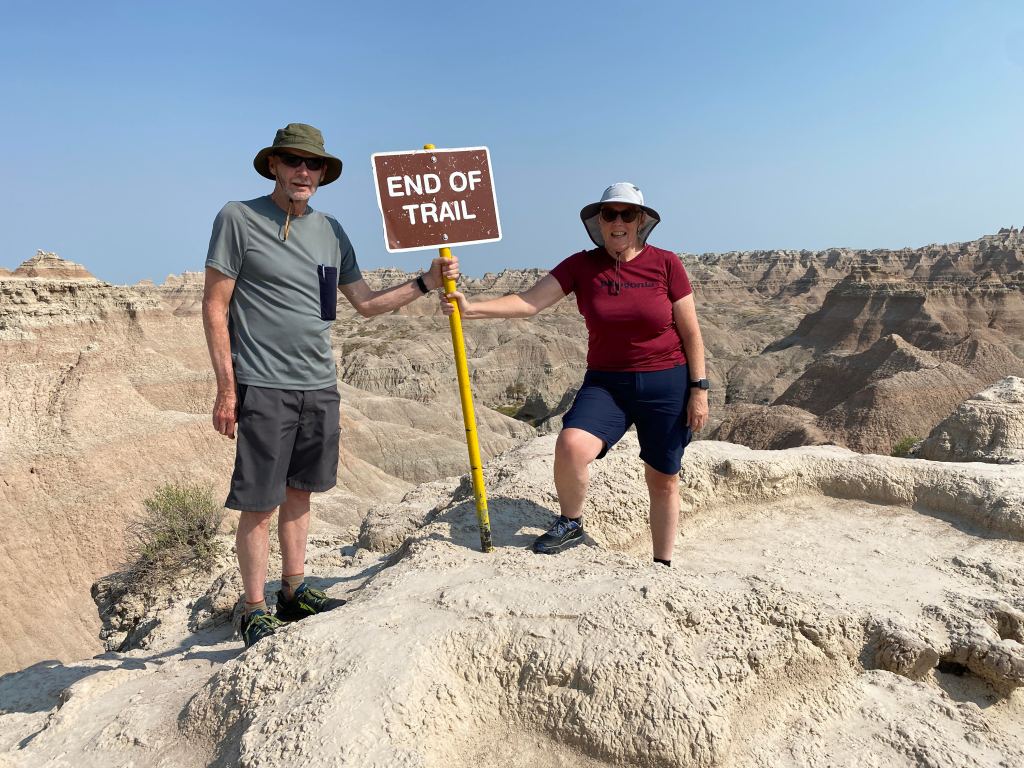
Roy and I at the end of Door Trail in the Badlands.

Here are the highlights from my return to the Badlands:

The Door Trail

I think part of the reason I remember this park is that it is so easily experienced. While I might get frustrated standing on the rim of the Grand Canyon looking down at an ice-encrusted impassable trail, the Badlands begs to be experienced. The Door Trail does not disappoint. After walking down a boardwalk for about 2/10’s of a mile, you go off into the badlands and follow numbered yellow markers until you get to a poignant sign marked “End of the Trail”. It requires mental and physical agility to make your way through the trail (or lack of a trail). I was completely engaged on a way forward by climbing, stepping and hiking within and around hills, mounds, steps and gullies. It was hot and windy and many folks were out there climbing around. There was camaraderie with the other hikers as I watched how others traversed the obstacles. Experience the Door Trail.

The Prairie

Unlike the southwestern portion of the United States (i.e., Grand Canyon, Arches, etc.), the Badlands of South Dakota are interspersed among vast swaths of prairie. I was taken aback by how, after countless hours of driving on I-90 and miles and miles of prairie, there were these barren formations of the badlands. When driving through the park, I kept miscalculating where we were because we were suddenly surrounded by prairie again so I thought, well, I guess we’re almost done; and then we would take another corner and the prairie receded and there were more stark colorful formations taking over the horizon. The prairie, on the other hand, was flat and covered in grass or small mounds. It’s quite the juxtaposition.

The Animals

Even though it’s called Badlands, there is an abundance of wildlife. I saw two animals I had never seen in the wild before on this trip. One was pronghorn antelope. There was a small herd grazing in the prairie very close to the road. Next was prairie dogs. There were hundreds of prairie dogs in mounds across the prairie. I was surprised and intrigued by their little chirps to each other. There was a private business outside the park that advertised feeding prairie dogs. There is no need, there were plenty to behold, video and gawk at from the drive through the park. The last animal I had seen before hiking at Canyonlands in Utah were bighorn sheep. I was surprised that bighorn sheep could be found in the middle of the prairie instead of stalking the barren rocks. In about 2 hours we ended up spotting pronghorn antelope, prairie dogs, bighorn sheep and longhorn cattle. Amazing.

When I reminisced with my brother Rick about returning to the Badlands, his memory is that we had just pulled off the side of the road in the park and camped there that night in the trailer. Perhaps that’s why I remember sunset and the glow of the Badlands. What’s remarkable is how little it has changed yet my experience was so different as I have a new appreciation for the size and diversity of the park. I’m glad I had the chance to return.

The Cruel and Stunning Death Valley

I’ve crossed the Mojave Desert several times in my life. I used to live in Northern California and either driving along I-15 to Las Vegas or I-40 to Albuquerque or Phoenix, took me through the Mojave at least ten times. I always longed to take the detour to Death Valley. It was just never practical to drive the extra 3-4 hours round trip until August of this year. My boyfriend Roy and I were on a coast-to-coast-to-coast trip visiting National Parks and family when we planned to head back to the East Coast. There it was. Looming in the middle of the map. A gigantic chunk in Eastern California: Death Valley. Sure…it’s August. Yeah…it’s hot. OK…it’s a long drive with very few services. But why not? When was this opportunity going to land in my lap again while I live in North Carolina? Likely never. So, Roy (having already driven some 5,000 miles) was game and off to Death Valley we went.

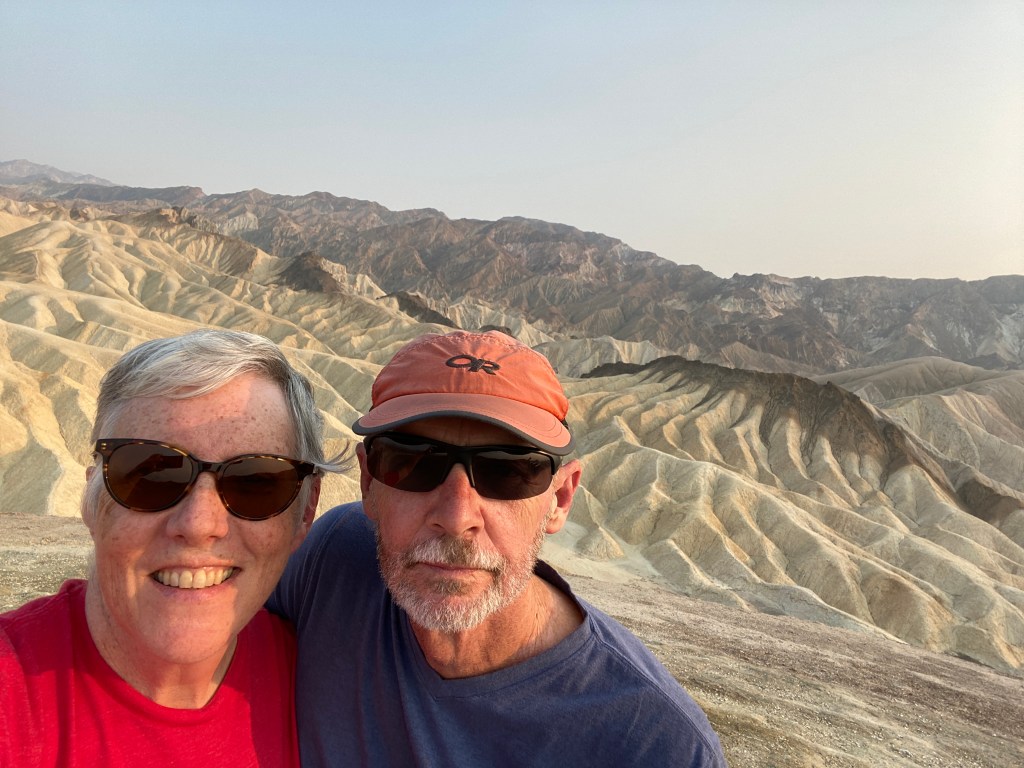
Roy and I at Zabriskie Point in Death Valley

Here are some of the highlights:

Shoshone – We set off from my brother and sister-in-law’s home in Palo Alto. As we made plans the day of our travels, I searched for places to stay as we drove down I-5 on our way to Bakersfield. I found a motel that was in the town of Shoshone about 45 minutes from one of the park entrances. Shoshone was just a little dot on the map. By the time we passed through the dilapidated town of Baker, I had no cell coverage. I had no idea if the motel had even 2 stars on their reviews. I was starting to get nervous because, arriving in Shoshone after driving 500 miles into the middle of nowhere, we had no other air-conditioned options. Thankfully the Shoshone Inn was a completely renovated delightful motel. We almost opted to buy a few gallons of gas but at $5.49 per gallon, we figured that a half tank would get us to Las Vegas. If you go to Death Valley, the Shoshone Inn is a must-stay although make sure you go with a full tank of gas.

Sweet little Shoshone Inn outside Death Valley

Jubilee Pass Road

We left for the park from the motel around 6 PM. We had no idea how long it would take to visit the park but we knew we at least wanted to go to Badwater Basin, so we headed out, according to the map, by the most direct route. We had no GPS as we headed on Jubilee Pass Road. It was 115 degrees, a blazing sun, a desolate road, and absolutely no other living things as we drove on a road with no signs except to instruct to stay on the road (no problem there). I was nervous. We had a few bottles of water but you start thinking about “what if’s” as you drive in such inhospitable territory. If we break down, if we get a flat tire, if the engine overheats….you get the picture. This was obviously not the main road in the park, the terrain was other worldly with its orange, yellow and white rock without vegetation or signs of life. I know what you’re thinking…. it’s not call Death Valley for its abundance in flora and fauna but the reality of driving through it is breathtaking. Scary, cruel but breathtaking.

Badwater Basin

From the motel, it took 90 minutes to arrive at Badwater Basin. 90 long, dry, hot minutes to arrive at what is the money-shot of Death Valley. This is the lowest point in North America at 282 feet below sea level.  When we arrived, it was 120 degrees. It was remarkable how the temperature climbed as we started going below sea level.  We parked and walked out on the salt flats of the evaporated “badwater”. It was oppressively hot and the wind was relentless. Buffeting winds whipped across stark salt flats and the Panamint Mountain range 10 to 11 thousand feet (obscured by smoke) loomed as a silhouette. There were two cars in the parking lot, so it was comforting to know that we were no longer alone in such an inhospitable place. High up on the valley wall was a sign that said “SEA LEVEL” which really makes you grasp how truly isolated we were.

Badwater Basin at 282 feet below sea level in Death Valley

Zabriskie Point

We decided to go back on a more heavily traveled road and stumbled on Zabriskie Point. By this time there were three cars in the parking lot (a CROWD!). A winding paved path goes up the Zabriskie Point which is named after Christian Brevoort Zabriskie, general manager of the Pacific Coast Borax Company (the company used twenty mule teams to transport borax mining operations in Death Valley). This vantage point is stunning. Again, there is no vegetation, or birds, or bugs. Just rock formations some of which look like jello molds or waves of soft ice cream. It felt like I was standing on the precipice of a cataclysmic change that had occurred many thousands of years ago and that I could have traveled by rocket ship to have witnessed it.

We only visited about a quarter of the National Park. I feel like it was just a taste. Perhaps a nibble of the entirety of the park. If you can make the trip, in a sturdy, gas-filled car with plenty of water, I would highly recommend it. I know I will be going back. The best of course is that I remembered as we arrived back at the motel that I wanted to make sure I went outside to look at the stars. Roy and I walked outside and looked up at the milky blanket of stars above. If you go, don’t forget to look up at the stunning beauty above.

What Story Are You Telling?

You walk into the room and everyone snickers. They must hate the new shoes I am wearing. Your assistant forgets to copy you on an email. She must have it out for me. Your boss doesn’t return your text for at least 2 hours. She must not think I am important enough.

These are all stories we tell ourselves. We take a few floating facts and put them into a story that sets us up for disappointment. We feel marginalized and often shut down. The thing is that everyone tells Their Story in their own head. But how often do we test our assumptions? How often do we verify that we have The Story right? This whole concept was illuminated in Brene Brown’s powerful book, Rising Strong.

Here is how to unravel your story:

  • Curious.  As Brene wrote, “Choosing to be curious is choosing to be vulnerable because it requires us to surrender to uncertainty.” It is so much easier to live in our self-deprecating assumptions that everyone is out to get us. When we open ourselves to curiosity, we open to possibility. This helps reframe or re-write the story. So how does this play out? Hmmm. Maybe my boss is in an important meeting. Maybe my assistant didn’t forget to copy me intentionally. Maybe I should ask my friend why everyone was snickering. Remain curious.
  • Wabi-Sabi.  Wabi-Sabi is accepting imperfection and uncertainty. As Brene wrote, “It’s always helpful to remember that when perfectionism is driving, shame is riding shotgun.” Striving for perfection is exhausting. You will never be ________ (fill in the blank: good, smart, thin, funny) enough. Seeking perfection is inviting shame. The shoes will never be right. The report not all encompassing enough. Shame will not help the story in your head. Embrace the wabi-sabi in your life.
  • Enough.  This is one of the best quotes from the book: “Many of us will spend our entire lives trying to slog through the shame swampland to get to a place where we can give ourselves permission to both be imperfect and to believe we are enough.” It’s so important to tell yourself that you are enough. Try this: Shoulder’s back, stride into the room, smile and make eye contact. The next time you are walking into a room of new people, try it. It makes a remarkable difference in how you show up and how you feel. You are enough.
  • Own it.  Brene wrote, “Owning our story and loving ourselves through that process is the bravest thing we’ll ever do.” I’ve done this a few times with my son over the last few weeks. When I started believing that he was mad at me or was upset about something, I would start by saying, “So I have two stories that I’m telling myself. One is that you have a lot of irons in the fire and can’t respond to my text. The other is that you are distancing yourself from me.” Guess which story was true. Now I can own the real story.
  • Discomfort. This can be uncomfortable. It takes bravery. As Brene posits, “People who wade into discomfort and vulnerability and tell the truth about their stories are the real bad-asses.” Think of yourself as a New York Times reporter fact-checking your story. It’s definitely uncomfortable to step into the vulnerability of uncertainty. If it’s too comfortable, are you really challenging the facts of the story. Engage in discomfort.
  • Ditch comparison. Comparing yourself to other’s is another way of writing the wrong story. As Brene wrote, “Stay in your own lane. Comparison kills creativity and joy.” Comparison is a limiting belief. In addition, it invites in perfectionism. My neighbor has a nicer car. My boss has a bigger office. I don’t make as much money as my colleague. Not very inspiring. Nothing to compel you onward and upward! We are all on our own path. As Brene says, “Stay in your own lane.”

I have slowly tried to incorporate this into my life. I take a step back when I am angry or resentful over something and try to reframe my story. It’s not easy but I do feel more present and I am able to re-write the story. What story do you need to reframe?

4 Steps to Act “As If”

To act As If is to invite or attract what you want into your life. It is a basic tenant of the Law of Attraction. As I headed home from New Bern, North Carolina driving in the rain, I initially became tense behind the wheel and was afraid I was going to hydroplane. I decided that I needed to act as if I would arrive safely at home and to let go of the tension. I imagined that the rain would slow, and I focused on the book I was listening to. The rain didn’t stop immediately, the car didn’t drive itself but once I relaxed into the feeling that I was a safe driver and could handle this, the rain subsided, the car handled beautifully, and I was home. I think that the initial stress and tension had me caught up in fear. When I relaxed and acted as if I was almost home and that the driving was easy, I eased into my goal of arriving safely at home.

It’s not just about positive thoughts. It’s also about positive action. I needed to slow down my car regardless of the truck bearing down behind me. I remember consciously relaxing my hands on the wheel from a vice grip to gentle navigation. I envisioned driving down my driveway safely at home. Most of the work is between the ears, but some of it can be body posture and a smile on your face. All of it is an inside game.

Four easy steps to act As If:

Actor

Imagine that you are Daniel Day-Lewis or Christian Bale preparing for a role. Acting as if requires acting; getting into the role. If you are a successful millionaire, how do you act? If you are a Vice President instead of a director, how do you act? If you are Daniel Day-Lewis performing as Abraham Lincoln, you keep your American accent all day and sign your text “Yours, A.” If you are a drug addict like Christian Bale in The Fighter, you lose 50 pounds and run for 4 hours a day. I have to say when I saw that movie, I remembered thinking, where did they find drug addict to play this part? I had no idea it was Bale. Method actors are famous for taking on the role off-set. They live and breathe it. If you are going to be that millionaire or own that seaside house, you’re going to need to act the part.

As Leeor Alexandra writes for Living Lovelee, “Act accordingly. If you would like to be rich, act rich by spending happily and generously. This is something you might have to practice, especially if you are short on cash. So many of us dread spending even a dollar, and we pay for things reluctantly and with regret. That is the quickest way to become even poorer.” I pay bills the minute they show up and do it with a smile. And, remarkably, money keeps showing up. Act the part and it will be so.

Feel

Take a look at past history and conjure up the feelings and emotions you are looking for. If it’s a new relationship, think back to the first months with your first love and how you felt. The joy, the smile, the giddiness, the wonder of the world. This will attract the same. As written on the Wisdom Post, “If driving a new car makes you feel like a ‘success’, find out an example that you have felt this same feeling before. Take note and be conscious every time when you feel this feeling of ‘success’ every day. Focus on how this feeling has already been attracted to you and continued to come to you on a daily basis. The key is to feel your root emotion in order to feel as if you already have it. As you project more of this emotion, your desire will draw closer to you.”

I have focused on a feeling of being carefree and full of abundance. I am careful not to get caught up in other’s sense of lacking. I don’t hold resentment if I pick up the check or need to help my son with a plane ticket. I feel into the abundance and sense of generosity. I’m not saying I never backslide; I am a work in progress. I regroup and see that I am infinite and can handle anything coming my way. Feel into it.

Speak

Your words are what you manifest. If you say to yourself you are fat, you will be fat. If you say to yourself that you are slim and healthy, you will be slim and healthy. Speak it so it will be so. I lived a long time from a sense of lack. I would tell my kids that we didn’t have enough money for new soccer cleats, a new clarinet or a Vera Bradley bag. I spoke the language of lack and therefore it was so. When I see a large bill now, I say to myself, “I always have money coming in.” It’s amazing how new clients and money are constantly showing up.

As Alexandra wrote, “Watch the way you speak about yourself and your life – if it doesn’t align with the reality you desire, you have to change it. And change it on the spot. Also, take notice of how you react to things people say as well as to every day occurrences. Make sure to only speak and react in the way that you would speak and react once you have manifested your desire. That is how to act as if you already have it.” Speak the language of what you want to attract.

Look

I think of that song, “You’ve got the look.” I plan on hiking a section of the Appalachian Trail with my boyfriend, Roy, this summer. I have the trail runners, the convertible pants and the quick dry shirt. I wear it on the weekends when I walk in my neighborhood. I may only be at 150 feet above sea level and not at 4,000 feet, but I look the part. It helps me feel the part. If you want to be a yoga instructor, buy the yoga pants. If you want to be a Chief People Officer, wear the suit as if you were born into it. If you want that motorcycle, buy the leather jacket and helmet.

As Alexandra wrote, “If you look the way you want, you will raise your vibration and speed the creation process along even more. Look the part is the equivalent of: ‘Dress for the job you want, not the job you have.’ Find clothes that fit the life you’re creating and make you feel amazing.” I know when I lost a bunch of weight after getting sober, I eliminated anything in my closet that didn’t fit my new lifestyle. No more loose clothes or things that didn’t make me feel great. As Marie Kondo says, “Does it spark joy?” If it doesn’t spark joy or align with what I desire, it’s gone.

It all comes down to belief and aligning with what you truly want. I originally titled this “4 Easy Steps to Act As If,” but the truth of the matter is that it’s not easy. I have to keep coming back to it. It’s easy to slide back into a sense of lack. I must stay vigilant to stay the course, but over time, it’s all coming into alignment. What do you want to attract into your life?

Return to Assateague Island

I had the great fortune to attend a lovely wedding in Dewey Beach, Delaware. It was a long 7-hour drive from my home in North Carolina, so I decided to stop off in Chincoteague, Virginia for a night’s stay. Assateague and Chincoteague are very foggy memories for me. I grew up in Wilmington, Delaware and we took many trips when I was a child along the eastern seaboard. I faintly remembering the trip to Assateague and wanting to see the fabled ponies but it was a lingering memory of disappointment. I don’t remember seeing the ponies. So, this was a trip to recapture something I simply could not remember. It did not disappoint.

22154516_10155678526503688_6150938079784357948_n

I made a reservation on the highest rated boat excursion on Trip Advisor called Daisey’s Island Cruises. When I called, the guy recommended a 9 AM ride, so I made the reservation. I was relieved to not be going on the trip the afternoon I arrived because I was road weary and wanted a good night’s sleep.

These were the highlights of the trip:

Small boat.  Daisey apparently operates several large and small boats but we were on a pontoon boat that sat about ten people. There were seven of us including Captain Nate on the boat. I had expected a larger boat and a slew of people much like a boat ride around Manhattan with a prerecorded tape pointing out the sights. This was much more intimate and there was no preset destination. Kind of like a road trip on a boat with no particular agenda; an open book for discovery. If you can choose, get on the smaller boat as it will be more of an adventure.

Dolphins. Captain Nate was on his radio as soon as we left the marina. He said he had a surprise for us as soon as we left the port. Sure enough, there were ten to twenty dolphins swimming in the channel right outside the marina. It was amazing. We must have sat out there for some thirty minutes as a whole pod of dolphins wrestled in the water. I felt like Jacque Cousteau observing these friendly creatures. Just seeing the dolphins was enough for me but there was so much more.

NASA.  We passed Wallops Island and saw all the launch pads for unmanned missions to resupply Spacelab and a host of other missions. There have been over 1,500 launches since the Mid-Atlantic Regional Spaceport was developed back in 1947. So you don’t need to travel all the way to Florida to see rockets take off. Apparently, you can check out the scheduled launches on the NOAA website. All this on a six-square mile island off the Eastern Shore of Virginia.

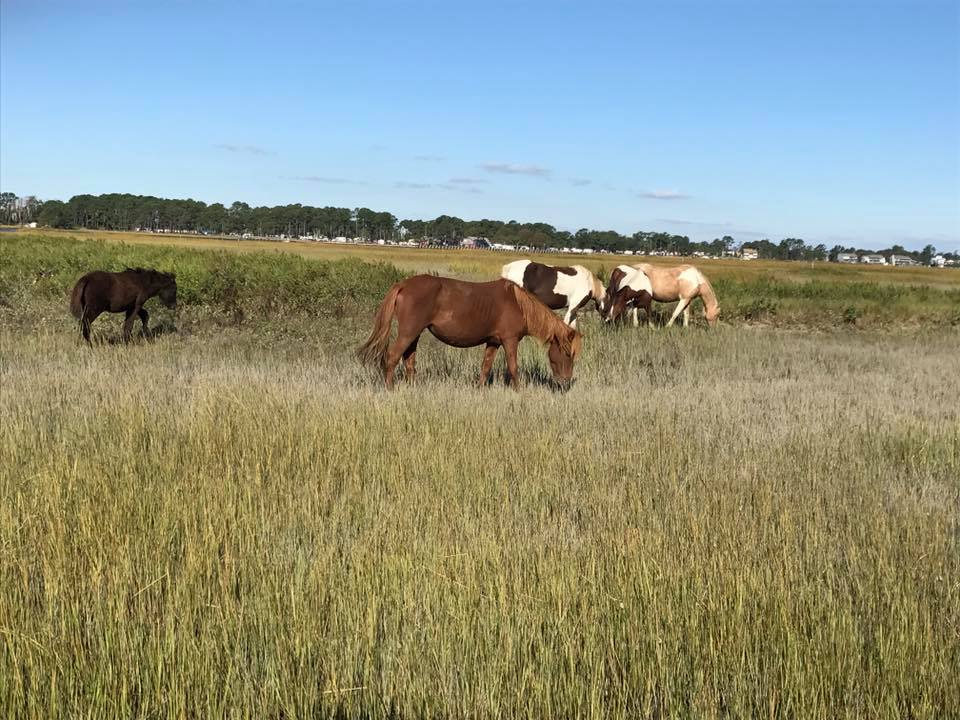
Chincoteague Ponies.  As mentioned earlier, I had it in my mind that looking for ponies would be a letdown. As we traveled across the water at a fair clip, I assumed that we would be staring at vacant marsh land. But Captain Nate and the other Daisey boats were in constant communication. There were two ponies spotted and we were off to find them. As we sped towards the coast there were two ponies eating marsh grass oblivious to us encroaching on their space. Captain Nate pointed out into the distance at three other ponies and the Stallion off in the trees. Because we were on a small boat we were able to travel up a shallow creek bed to be less than ten feet from the ponies. There were the unseen ponies from my childhood only feet away. Absolutely magical.

Birds.  There were all manner of birds on the trip. There was a whole set of cormorants drying off their wings as they sat atop moorings in the middle of the water. We rode by only feet away but they sat regally benign to our presence. White crane were fishing in the marshy shallows. Seagulls were flecked among the sky. It felt like nature was conspiring to impress me at every turn.

Shellfish.  We passed by countless oyster beds. Apparently, the beds are leased by fishmongers and we happened to see one group out among the beds harvesting oysters. We came up on one bed and Captain Nate laid down and picked out a mass of oysters. Apparently, they grow on each other’s shells, so the one handful was several oysters, some 5 years old and others less than a year depending on size. He shucked the oyster to reveal an enormous thumb size oyster meat which he promptly ate when everyone on the boat turned it down. We also rode by clams resting in the sea water in crates; apparently, a catch being kept for future shipment.

I never imagined that there would be so much so much to see and take in. If you ever get to the eastern shore of Virginia, I highly recommend a boat trip to Assateague Island.

Are You Sovereign?

SOVEREIGN (noun)

a: one possessing or held to possess supreme political power or sovereignty

b: one that exercises supreme authority within a limited sphere

c: an acknowledged leader : arbiter

Each of us is sovereign.

I learned this concept from a great coach I know, Alysia Vrolyk. I think this is completely applicable to all sorts of areas of your life (and of course mine). It’s probably most applicable if you have a teenage son, are in a committed relationship, work with others or are a coach. So if you are a hermit? Not so much. But if you aren’t, pay attention. You have supreme power over you. I am the acknowledged leader of me. I can love you or lead you or teach you but it is only you who decides what to do with what I give you. Sovereign. 

Sovereign

The best illustration or example of this is the first time a teenage child gets behind the wheel and drives off without any co-pilot…without their mom to tell them to slow down or turn the iPod down. It’s terrifying but true – they are now officially sovereign. Whether that car (and its contents) returns to the driveway is completely and utterly up to that child behind the wheel and all the other sovereigns out there on the road. I have to say I wish I had this concept when my kids were looking at colleges. It’s not up to me, or their guidance counselor or their best friend. The decision of what school is completely up to my sovereign child.

So how do you incorporate a little sovereignty into your life? Here are some tips:

  1. No meddling. Do not meddle in other sovereigns unless you are invited to a détente. So if I’ve started a new exercise regime and I think it would be an awesome idea if my significant other would do the same….stop. If I think the Vice President of Operations should make her whole crew work every weekend until the backlog is gone…stop.   If I think the client’s goal should be to get a promotion instead of feeling confident in their industry knowledge…stop. Respect the authority of others to make their own decisions. If you have not been invited to meddle, don’t.
  2. Detach from the outcome. I wrote recently that my daughter had to decide between three jobs. One of them would have left her in NYC and the other two brought her back home to North Carolina. I could not get attached to any outcome. All three jobs had their pros and cons but if I was excessively attached (like calling every day to find out how job prospect B was coming or constantly talking up prospect B), she would not have ultimately been able to make her own decision. I would have been way too invested in one outcome over another and…she would have resented my opinion. Detach from the outcome.
  3. The gift you bring is your presence. Just because they are their own sovereigns does not mean you can’t be present. In the anguishing weeks where my daughter had to decide where she wanted to be this Fall, we talked several times on the phone. I was present. I listened. She played through the scenarios. She made decisions. I was a sounding board. I wasn’t there to sell her on what I wanted. I was there to let her think things through. It’s the same with clients working through a dilemma. I am present and ask the questions that help them do their own best thinking. You don’t know what you don’t know until you know. Only a sovereign can know what they really want. Sit back and be present.
  4. No sweat. The great facilitator Paul McGinniss uses this phrase when modeling the coaching dialogue and the client hasn’t taken a step they planned. This happens all the time when a client doesn’t do the action they said they wanted to. They didn’t start… exercising, studying for the exam, standing up to their boss, having a meeting with their team. No sweat. Is it still important to you? What would make you feel like you are moving forward on this goal? They are their own sovereign. Let them decide the direction they want to go. You aren’t there for accountability; you are there for reflection and re-framing. Don’t sweat it.
  5. You need to respect your own sovereignty. Don’t lose yourself in giving your time and presence to others. Don’t change the borders of your sovereign just because your neighbor asks. This is not a time to let folks roll over you. Keep the moat filled, the drawbridge in working order and your crown shined up. Don’t diminish your own self-respect. It is great to respect someone else’s space as long as they don’t tread on yours. Keep your back bone and self-respect.

When you grant other’s sovereignty, it’s freeing. You are no longer trying to be a backseat driver for everyone else. You have control of your steering wheel; if someone else fails, let it be. They are on their journey and you are on yours. Accepting that everyone has their own sovereignty untangles the expectations so that we are free to make decisions for ourselves and no one else.