4 Steps to Amor Fati

This is a repost from two years ago. Enjoy!

Definition of amor fati : love of fate : the welcoming of all life’s experiences as good

German philosopher Friedrich Nietzsche describes Amor Fati: “That one wants nothing to be different, not forward, not backwards, not in all eternity. Not merely bear what is necessary, still less conceal it…. but love it.” Appalachian Trail thru-hikers (an epic, several-month-long trek over 2,000 miles) would express this as “Embrace the Suck.” Bryon Katie wrote a whole book on the topic called Loving What Is. I’ve spent decades trying to recreate history and control the path of my future, my kid’s future and my family’s future. I imagine I have a giant eraser to take back a failed marriage and wallow in regret, or project forward that my father will miraculously cheat death as he slowly succumbs to congestive heart failure. I have learned over the last few years that I am powerless to rewrite history and to meaningfully alter the future. Amor Fati.

Here are the 4 steps to Amor Fati:

Quit Complaining

As Will Bowen says, “Complaining is like bad breath – you notice it when it comes out of someone else’s mouth, but not when it comes out of your own.” Bowen is the creator of A Complaint Free World  and challenges folks to go complaint free for 21 days. I remember taking this challenge some 7 years ago and I have to say, it’s pretty tough. I mean there is the weather, the traffic, my son still hasn’t responded to my text, the soup is cold, the package is late, my assistant hasn’t responded…but I digress into complaining. It’s so easy to deny what is. It’s like the negativity bias that saved your ancestors from saber-toothed tigers. It is constantly scanning the environment to track everything that is wrong. Try it for today. Just today. Be focused on what’s right with the world. With your world. I have a roof, a loving dog, a warm house and potable water. Welcome the rain, the red light, the screaming infant. Amor Fati.

Jump Forward

When I was going through my Brain Based Coaching training some eight years ago, I remember a tool we used called 10:10:10. This is a concept developed by Suzy Welch for decision making. “Here’s how it works. Every time I find myself in a situation where there appears to be no solution that will make everyone happy, I ask myself three questions: What are the consequences of my decision in 10 minutes? In 10 months? And in 10 years?” So, if staying late to complete a project for your boss means missing your child’s play at school using the 10:10:10 process there may be a happy boss and perhaps a more resilient child. As Ryan Holiday wrote, “The loss of a loved one, a breakup, some public embarrassment… In five years, are you still going to be mortified, or are you still going to be wracked with grief? Probably not. That’s not saying that you won’t feel bad, but you’re not going to feel as terrible as you do now. So, why are you punishing yourself?” I’ve been thinking about selling my house for the last year or so. I remember selling my house some 18 years ago in California. I thought, at the time, I will never live like this again. It was true, not because my current situation is worse, it’s just different and I never would have imagined how terrific things are right now. Maybe the future is so much better than you think. Amor Fati.

Embrace the Challenge

When my ex-husband left me hanging after my home was flooded by Hurricane Matthew, I was devastated. And then? I decided that this was a challenge. I was going to get the home repaired, fix my devastated finances and create a space of tranquility and comfort. I had an endless punch list and day-by-day, week-by-week, month-by-month, I took it on and conquered it all. I would not succumb regardless of my lack of knowledge of plumbing, HVAC or foreclosure. In retrospect, the challenge of overcoming all the obstacles was the best part. I didn’t want to go through it, but now that I have, I am so glad I did. As Holiday wrote, “It’s like in a game, right? Let’s say I throw you into a football game. If you stop and spend all your time arguing over the rules, you’re never going play. Maybe it doesn’t make sense that the overtime rules are this way or that quarterbacks get special protection, or this or that, right? There are all these different rules that make no sense that are arbitrarily how the game has developed since its inception. The Stoics are asking you in some ways to accept the arbitrary rules. Then they’re saying you play the game with everything you’ve got.” Play the game and embrace the challenge. Amor Fati.

Grateful

Amor means love. It’s not just about accepting the suffering or fate; it’s about loving it. I think about this a lot as I sort through the aftermath of my divorce. I am grateful for the process, for each and every decision, good or bad, for the pain and the release, for the deception and the triumph. I would not be where I am now without the journey, without the emotional bruises, without the struggle. I am so grateful to be the woman I have become. Sober, independent, present and courageous. I do a loving kindness meditation every morning. I wish happiness, peace, health and living with ease to everyone in my family, my boyfriend, my sick cousin, my enemies and, lastly, my ex-husband. I imagine embracing each one. I love them all for what they have brought to my life and love the hand I have been dealt. I am most grateful for my ex-husband leaving me to live my life to the fullest. Amor Fati.

It’s all about reframing the journey. Instead of dreading the court date, looking forward to and loving what fate has in store for me. I think a lot about, “Hmm, I wonder what exciting twist will occur?” or “What does the universe have planned for me now?” I’m not sure where I will be in 5 or 10 years but I know the journey will be exciting. Amor Fati.

Shut Down Station KFKD

“Out of the right speaker in your inner ear will come the endless stream of self-aggrandizement, the recitation of one’s specialness, of how much more open, and gifted and brilliant and knowing and misunderstood and humble one is.

Out of the left speaker will be the rap songs of self-loathing, the lists of all the things one doesn’t do well, of all the mistakes one has made today and over an entire lifetime, the doubt, the assertion that everything one touches turns to s#it, that one doesn’t do relationships well, that one is in every way a fraud, incapable of selfless love, that one has no talent or insight, and on and on and on.”

This is Anne Lamott’s metaphor from her brilliant book on writing called Bird by Bird. Radio station Kf**ked is basically in constant stereo in your head.

Shut down station KFKD

This is not just for writers. This is for any project you might have standing in front of you. From the closet stuffed to the gills with unwearable clothing, the enormous realignment project at work, and that trip to Peru you haven’t really planned out yet. To get it done. Heck, to even get it started. It is imperative you shut down Station KFKD.

Here are some ideas:

Ritual.  When I write; when I start a project, I have a ritual. Actually, this is my daily ritual: write in my gratitude journal, affirmations, meditation, brain teasers and then learning a second language. I do this everyday without fail. I won’t start anything until I have finished my daily ritual. I do this everyday even if I am not writing or working on a project. It sets me up for success. It’s like putting on a cozy robe and soft slippers. It’s familiar. I feel warm, relaxed, and ready to launch. You don’t need this ritual, but it’s nice to have a ritual so the loose ends are tied up before starting your best new work.

Frog.  Eat That Frog. This is a book by Brian Tracy. He espouses that you should start your day with the biggest gnarliest item. So eat that frog. Write that post you have delayed for the last few days. Sign into that online platform you are not familiar with. Buy the damn plane tickets to Peru. Clear out the floor of your closet. When you get that frog; that hurdle out of the way early in your day, the rest of the day is downhill. It’s time to coast because you already ate the frog. The rest of the day is nothing but cherries and whip cream.

Flow.  Mihaly Csikszentmihalyi asks, “What makes a life worth living?” Noting that money cannot make us happy, he looks to those who find pleasure and lasting satisfaction in activities that bring about a state of “flow.” Flow happens when you shut down Station KFKD and tap into your creative flow. You aren’t worried about impressing your boss or what that critic will say. It’s all about letting the words, art or lyrics spill out. It’s like opening the dam. Let it spill out without any regulation. Getting into flow shuts out KFKD.

Breathe.  No duh, Cathy, we all have to breathe. The issue is that we frequently don’t pay attention to our bodies. Breathing brings us back into our bodies, out of our heads, and far away from station KFKD. How is your big toe right now? Can you feel the breath through your nostrils? Are you present? It sounds counter intuitive to get back into your body and out of your head when you want to produce your best work. The problem is that your mind is full of land mines and illusions. Listen to your body and breathe.

Wandering.  Thoughts may wander off. You may start thinking about what lunch will be and when you need to head out for that appointment later. Gently. Ever so gently, bring it back to the work at hand. No need to scold or beat yourself up. Sometimes wandering brings you to a wonderful place and magical ideas. Going off the trail can take you places you never thought of going. Embrace the wandering.

I write first thing in the morning for the most part. I feel at my best. I am a lark. I got up this morning at 4 AM and started writing at 6 AM. This may not be for you. I have found my zone for keeping Station KFKD turned down. When do you do your best work?

Genesis on the Waters of Penobscot Bay

My boyfriend, Roy, and I traveled to the coast of Maine in October of 2021.  While I have been to Boothbay Harbor and Ogunquit Beach in my childhood summers, this was the first time I visited the origin of my family on the waters of Penobscot Bay.  It was on these waters that my father survived incredible odds, discovered his love of sailing and the love of his life. Without these waters, I would not be. There is no start. No genesis to create my parents long sixty plus year marriage, three thriving children, four grandchildren and two great grandchildren. Without the waters of Penobscot Bay, there is no spark to start the fuse.

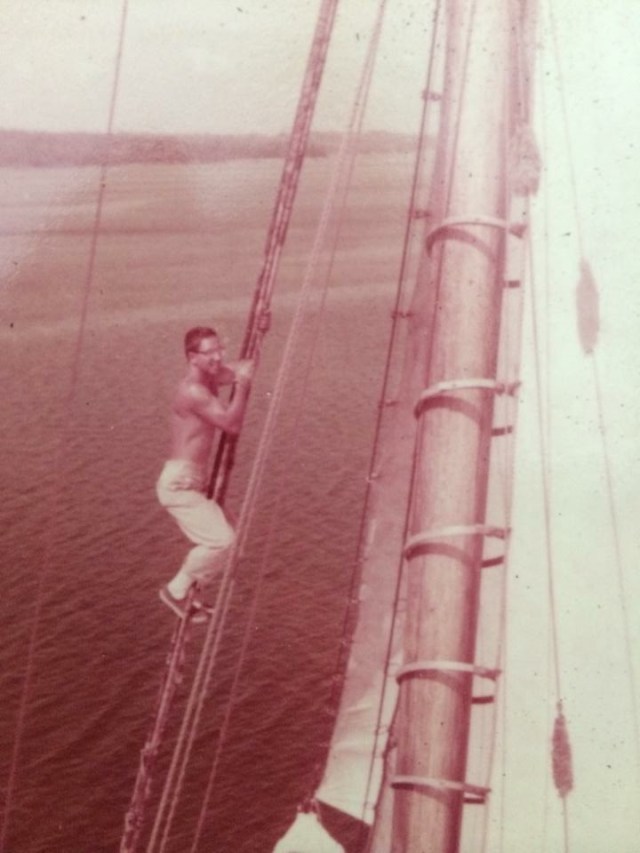
My father on the rigging of The Adventure on Penobscot Bay

Admiral Farragut Academy

My father’s first teaching job was at a boarding school in north New Jersey near Tom’s River, called Farragut, a 200-boy naval academy.  It was a grueling schedule teaching 5 different lessons a day, supervising a    120-boy dorm and presiding over a table of uniformed cadets three meals a day.  He coached football, wrestling and track and worked his first two summers as well.  This demanding schedule and a Farragut choral teacher named, Newt, is what brought my father to vacation on the waters of Penobscot Bay. 

Adventure

Newt and, his financial partner, Herb, owned a 119’ Gloucester Grand Banks schooner named the Adventure which sailed out of Rockland, Maine.  In the summer of 1954, Newt allowed my dad on the ship for free if he helped crew the boat.  The boat was fitted to take up to 50 passengers on a week’s trip around the myriad of islands of Penobscot Bay for an inexpensive week of sailing, sightseeing and partying during the summer tourist season. My father had no sailing experience!

Hurricane

After my father had been on the Adventure for just one day, there were hurricane warnings and they returned to let the passengers off the boat.  My father volunteered to stay with the Newt, two crew members and the cook to help anchor the boat behind a breakwater. As my father writes in his autobiography, “About midnight we dragged past the harbor opening toward the rocky shore south of us.  When a large coast guard cutter was spied shooting messenger lines towards us every five minutes, I thought we were saved.  But hurricane winds made it impossible to stand without hanging onto the riggings, and with horizontal rain slanting into your eyes, grabby monkey fists flying by became impossible in the blackness of night.  As waves got higher and the harbor shallower near foaming south shore rocks, the cutter gave up and left us. Newt warned me to tie myself to the main mast when the ship hit the rocks. As we drifted closer, I realized that at 29, I might not see that next half century of life I had hoped for. With an empty feeling turning edgy, wondering if being scared would turn to panic, I suddenly spied a smaller coast guard boat appear dimly nearby and begin to shoot monkey fists at us again.  I almost caught one but missed. On the next shot, Newt risked his life high on the bow stay—catching the tag end of the line before it fell into the breakers a few yards away.” They were pulled to safety.   As I write this, I can’t imagine how this inspired my father’s love of sailing. I’m just grateful that Penobscot Bay is not where he vanished into the water and rocks below. {What are monkey fists?}

Graduation

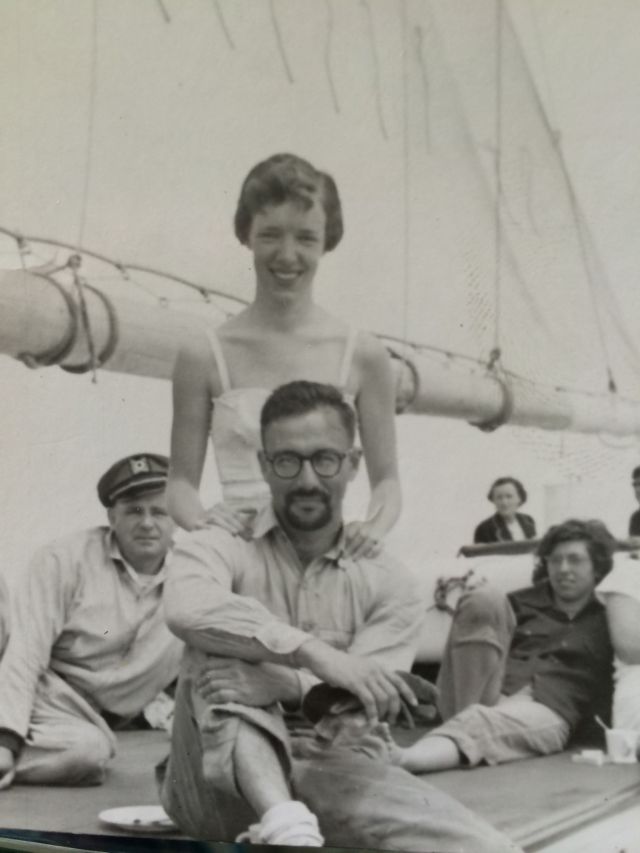
My mother drove from Wilmington, Delaware to Rockland, Maine with two other Clinical Laboratory Scientists, Margaret and Alta, just after their graduation from the University of Delaware. They were there for a celebration of their graduation and a week of fun and sailing on the Adventure. They arrived on Sunday, June 19, 1955 (my father’s 30th birthday). When my mother came on board, she noticed a well-tanned goateed man talking to a married woman. My mother was asked out by a guy in a motorboat to attend a dance at a local country club that evening.  She agreed and said she would bring along her two college friends. My mother set her hair and came out on deck to dry it.  There’s my mother on the waters of Penobscot Bay, a bright future laid before her, a blue sky and my father about to get her attention.

Splash

My father was irked that my mother had accepted a date with the guy in the motorboat.  He writes, “While she prepared for her date by washing her hair over the railing in her bathing suit that afternoon, I gave a gentle push – it was ten feet down. What a splash! Maine water is ve-e-ry cold. Sputtering in fury, she climbed the ladder and stomped to Captain Newt to ask how he could tolerate a crew member pushing a passenger overboard. With a quizzical smile, Newt opined as how any young man who did that must be interested.  “What right’s a married man got to push single girls overboard?” she exploded. Pointing out that I wasn’t wed, he guessed that I had wanted to get her attention.  I did.” My mother’s dive into Penobscot Bay at my father’s hand is the genesis of my family. Without the water, there is no origin.

My parents on board The Adventure

I’ve heard these stories my entire life. It’s not until I was there and took a schooner ride out of Camden harbor and saw the rocks of Rockland and the myriad of islands of Penobscot Bay that it hit me. Without all the pieces falling into place, without all the dominos falling just so, the love story never ignites, and they each go in a different direction.  But it does fall into place and the match is lit and the genesis is created on and in the waters of Penobscot Bay.

Remembering Daddy-Ott

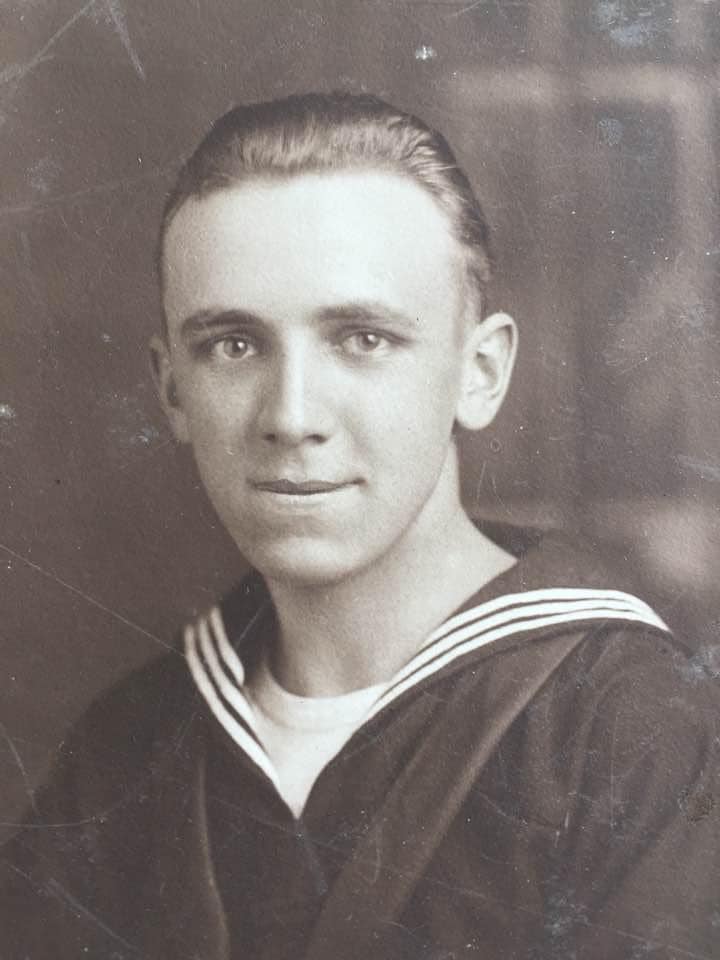
Otto Wenke was born on the shortest day of the year, December 21, 1897 in Olean, New York. He was one of eleven siblings and his mother died when he was a small child. He was the first in his family to graduate from high school and went on to study business in Buffalo, NY. He served in the Navy. He met my grandmother, Mary Hammond, and eventually had a son, David, and daughter, Mary Ann (my mother). My grandfather, often referred to as Daddy-Ott, was an accountant for DuPont. DuPont was one of the first companies to occupy part of the Empire State Building after it opened in 1931. At one point in his career, he worked directly in New York, but eventually, my grandfather and his family landed in Wilmington, Delaware where DuPont was based. And that is where me, my brothers and my cousins all grew up together in close proximity to my grandparents.

This image has an empty alt attribute; its file name is 131926419_10158932757218688_6136837116294058826_n.jpg
My grandfather, Otto R. Wenke, aka Daddy-Ott

My grandmother Daddy-Mar (crazy name for a grandmother, my oldest cousin Claire is responsible) died in 1962, one year after I was born. I have no memory of her but I have a multitude of memories of my Daddy-Ott.

Here are some memories of him:

Wenkeville

Every Labor Day weekend, the Wenke reunion is held in Olean, New York. With 11 siblings, some of those siblings ended up having upward of nine kids, meaning a multitude of Wenkes who grew up in Olean. There is even an area of Olean called Wenkeville! The family reunions garner upwards of 300 folks every year who get together and sing German drinking songs, remember their ancestors, play games and eat. We went several times and I can remember them all calling my grandfather “Gros Uncle” as he was the only remaining sibling of the original eleven. He was revered. Everyone came to see him and would give their kind regards. I felt like he was a celebrity. He was always in his element at the Wenke Reunion. What I appreciate most is that he wrote a history of his family to chronicle the escapades of his sister, Clara (the rebel), his father’s truck garden that helped keep the family afloat, and mapped out the various Wenke cousins on the family tree. I was always proud of being Ott’s granddaughter especially in Wenkeville.

Traveler

My grandfather was a traveler. He took a trip to the West Coast with my grandmother in the late 1950’s and accounted for every penny of the trip. The whole trip came to $724 with notable entries for 533 gallons of gas for a total of $202, 20 motel room nights at $181 and meals and snacks at $182. I think of how incredibly brave this was to head out on an 8,800 mile trip across country without a cell phone or GPS. That is wanderlust. After he retired and my grandmother passed away, he would travel to Florida, Canada and the west coast on his own. He always memorialized the trip with photos and meticulously wrote in his block pencil handwriting each location and person in the photo. Between my dad and my grandfather, I can understand why I love to wander.

Gardner

I lived in the same home in Wilmington, Delaware from the age of two. We lived next to park land and we had an enormous rock garden behind the house. The entire garden was the hard work of my grandfather. I’m sure he was inspired by the local DuPont estate, Longwood Gardens and the Butchart Gardens from his travels to Victoria, B.C. I can remember as a child that my grandfather came over every Saturday, without fail, to work on that garden. Dogwood, azaleas, impatiens, pansies, lilies, hens and chicks, and a maple tree. He had them all blooming throughout the spring and summer with nary a weed to disrupt his work of art. I can remember his voice coming in the front door of the house, “Hello, anybody home?” and sitting down to a hot cup of coffee, taking a sip and saying “hot ta ta.” He was a man of habits and we were able to enjoy the fruits of his labor.

Babysitter

Fortunately for me, I am the youngest of his grandchildren. As I was growing up and my mother returned to work, my grandfather cared for me on many occasions. What I remember most is escaping from the house in his Maroon Skylark Buick and riding “down the valley”, which included Beaver Valley Road, its hills and the Brandywine River. I loved to go gliding down in this big air-conditioned car with my grandfather behind the wheel and the farmland streaming by, honeysuckles perfuming the air. Even into high school, my grandfather would pick me up after swim practice or take me to a doctor’s visit. I could depend on him no matter what.

Piano

My grandfather had a grand piano in his apartment. He played it beautifully. In fact, he played piano when he was a teenager at silent movie houses. I had little appreciation for his talent when I was a child. I can remember visiting his apartment and him setting out block puzzles for my brother, Rick and me to play with and him playing his piano. It’s not until I tried to play the piano in elementary school that I understood what tenacity and practice it took to play the piano the way my grandfather did.

Regimented

My Daddy-Ott was regimented. Perhaps it was his motherless German upbringing, or becoming a parent amidst the Depression, but my grandfather was uniquely suited to being an accountant. He wrote in his diary every day of his adult life. Each day was memorialized with the external temperature and his daily activities in a brief 7 to 10 sentence paragraph. I believe you could set your watch to my grandfather’s activities. He was a devout Phillies fan and listened to the radio to follow their progress. I can remember crying when they won the World Series in 1980 because I was happy that my Daddy-Ott was alive to witness it. My grandfather and I had two struggles that I recall. Once when I was about 5 and he was babysitting me around lunchtime. He insisted that I could only have plain milk and I threw a tantrum over wanting chocolate milk. I can’t remember who won but boy, I remember us both being stubborn over who should prevail. For a brief year, my grandfather lived with my family, while I was in high school. Every Saturday night he insisted on watching The Lawrence Welk Show. This was excruciating for me. I loved Pink Floyd and Yes, and there I was suffering, listening to Polkas and watching bubbles float above the Lennon Sisters. What I would give to spend an afternoon watching Lawrence Welk with my Daddy-Ott now — although I’d still insist on chocolate milk!

My Daddy-Ott was a fixture in my childhood growing up in Wilmington, Delaware. He was there for Sunday dinners, Mother’s Day at the DuPont Country Club and escaping down the valley in his Buick. How fortunate I was to have a grandparent close by and involved in my upbringing. We always ended our Sunday dinners by my grandfather asking if we were “sufficiently suffonsified”? I have no idea where this expression came from but it’s basically asking if you are sufficiently full. He lives in my heart now and in my memories. I love you, Daddy-Ott.

My Hero. My Daughter.

I originally posted this four years ago. She is still my hero.

My daughter, Natalie, is my stable rock. My ballast. My hero. She has recently turned twenty-five and moved to Seattle about a year ago.  I had the great fortune to spend a recent weekend with her in New Mexico where she was born.  It was great fun to return to a state that has many natural marvels and be able to give context to how her life began.  Some twenty-six years earlier, my first husband and I moved to Albuquerque to run a restaurant and try our luck as entrepreneurs.  The restaurant eventually failed and put immense pressure on our marriage.  The wonderful shining glory that came out of that ill fated move to Albuquerque was a delightful, precious blue-eyed baby girl with an infectious smile and laugh.

Outside of a return trip to New Mexico when Natalie was eight, she has not returned.  She has faint memories of that trip and certainly does not remember her first four months of life in the Land of Enchantment. We had a lot of fun returning to where it all began. It also brought up some of the reasons I have depended on her for so much in her quarter century on the Earth.

32105357_10156289247988688_8586567131481505792_o
My brother, Rick, my daughter, Natalie and I hiking in New Mexico

Here are the ways Natalie is my hero:

Open. Natalie is open to any and all adventures. We did not have much of an agenda once we landed at Albuquerque’s Sunport except for a restaurant reservation or two.  Whether it was strolling the plaza in Santa Fe or taking a hike around a reservoir, Natalie was open.  She had no deadlines, no agenda, no must-see spots.  I feel like so many people in life have hidden agendas or hidden intentions.  Not Natalie. Anything goes. Wanna hike?  Sure.  Shop? You bet. Sleep in? OK. It makes me rethink how open I am to what is next. Be open.

Decisive.  Natalie may be open to all the options but once she has made up her mind, or the group has made up their mind, she goes after it. We had decided to hike Tent Rocks located outside of Santa Fe with my brother, Rick.  Once the decision was made, there was no going back.  I’m pretty sure that even if it was raining or 110 degrees, Natalie would have made it to the top of that slot canyon. She was committed. Even a random crossing of a rattlesnake on our path could not deter her from her destiny. Once you have weighed out all your options, be decisive.

Empathy. I have always had an issue with balance. I pause at the top of steps and escalators to get my barring. There were several times along the hike that Natalie grabbed my hand. I didn’t ask. She knew. When navigating very narrow footings, she said, “just one foot in front of the other.” I didn’t ask. She knew. As we hiked she would insist on a water break.  Not for her. For me. She pays attention. She senses the discomfort. She anticipates the need. It’s such a gift that I don’t know she is even aware she has it. Be in tune to those around you.

Navigator. Natalie and I had explored a trail near Santa Fe around a reservoir.  The trail was not well marked.  Towards the end of the hike we lost the trail. Pretty soon we were hiking through low uncharted brush and no fellow hikers were to be seen.  We had no GPS.  No cell coverage. I felt a bit of concern. There was no need. Natalie had a feel for where we were and led us back to the trail head and parking lot. There have been many hiccups and storms in my life over the last year and Natalie has been the calm navigator seeing me through. Make sure you have a sound navigator to help you through the storms.

Ballast. Every boat has a ballast to weight the boat upright. Natalie is my ballast. She is rarely rattled by events and keeps an even demeanor.  I can be easily flustered and fly into worst case scenarios. Natalie keeps me balanced by listening and asking questions to help me understand my own thinking. I may be ready to unload all the cargo on the boat or drop anchor but Natalie is the voice of reason.  Who is your ballast.  Maybe you are a ballast for someone else.  It’s important to have a ballast to even things out.

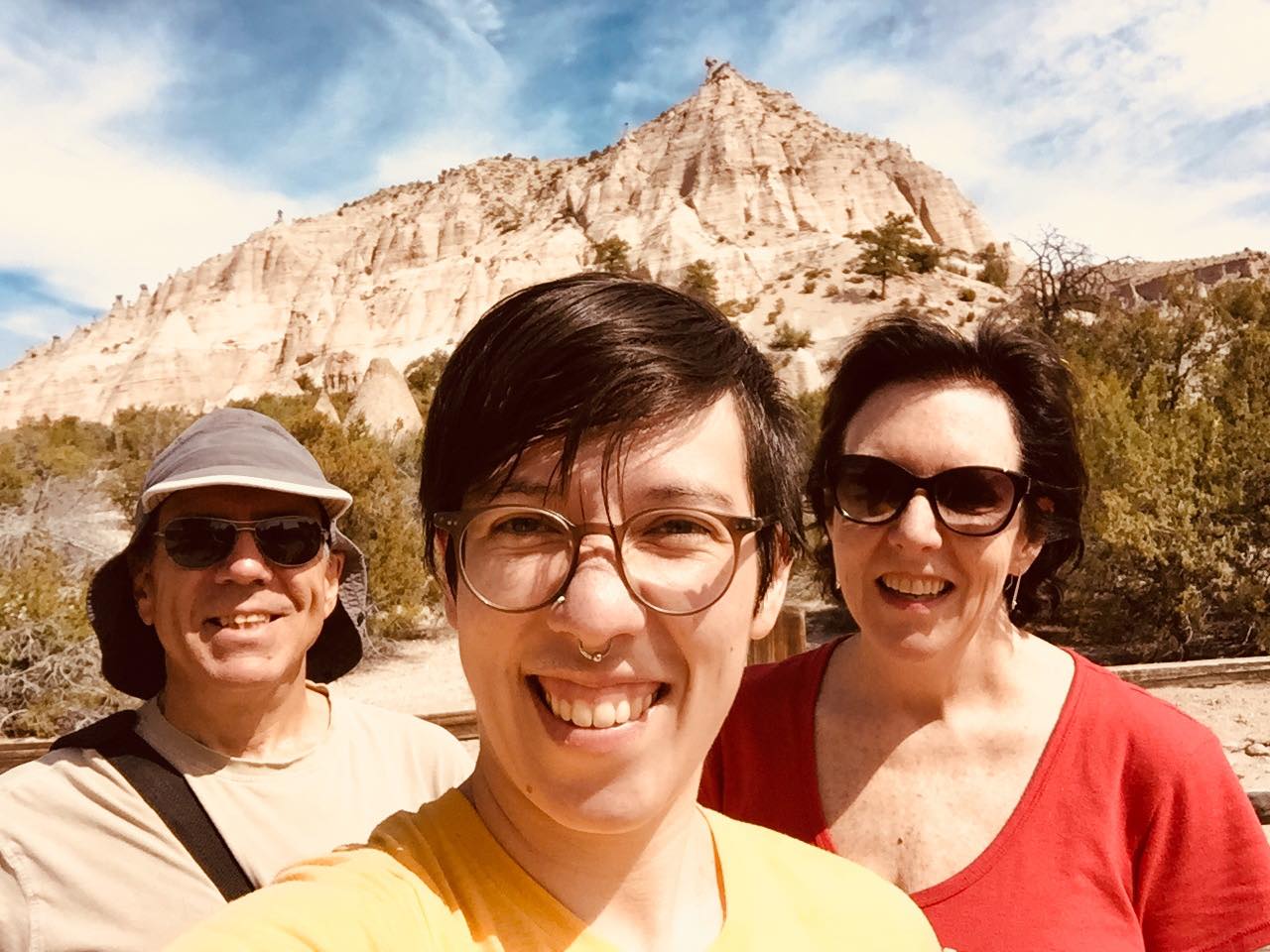
Joy. Natalie has infectious energy. She also happens to be a great selfie taker.  There she is in the center of the photo flashing her enchanting smile.  I cannot look at a photo of her without smiling. She is joy. She is possibility. She is magic. There are very few people that I know who exude that joyful energy. It sparks action. Everything seems possible when there is joy in the room.  I am so fortunate to have her in my life. Find joy.

I am so proud to be Natalie’s mother and, most importantly, that she is in my life. She makes everything brighter and more amazing. Who is your hero?

Ways to Reset Your Happiness Set Point

I wrote this over 7 years ago and as I reread it now, I realize that I really have reset my happiness set point. Enjoy!

I wrote a post a few weeks ago about perfectionism. In the post, I brought up Hedonic Adaptation which involves a happiness “set point”, whereby humans generally maintain a constant level of happiness throughout their lives, despite events that occur in their environment. So whether it’s buying a new Mercedes or crashing your new Mercedes, your level of happiness resets to the same pre-event level. A reader asked that I expound on how I have tried to reset my happiness set point.

So I’ve tried to reset my “set point” and it turns out there is some science behind it. I think I first became aware of this by reading “The Happiness Project” by Gretchen Rubin. In the book, she chronicles twelve months of changing her approach and raising her happiness set point. By the end of the year she felt like she had a sustained increase in her happiness. In another article called “Making Happiness Last” by Katherine Jacobs Bao and Sonja Lyubomirsky, they posit it is possible to reverse the effects of the hedonic adaptation. So here is some advice:

  •      Gratitude. Start a gratitude journal. All the authors recommended this and studies have shown that this has a positive effect. I have had a gratitude journal for over 5 years. I have varied it from writing actual paragraphs, to four bullets to my current style which is just to list events and names that had a positive impact on me or I had a positive impact on them. I don’t have a limited number but generally it’s somewhere between 4 and 12. I’m not a big fan of rules, so I just go with what works for me. Count your blessings.
  •      Kindness. Perform random acts of kindness. Apparently it matters if the acts of kindness are varied. It makes sense. If I always buy my team a dozen donuts every Friday, after a while, it has diminishing returns. So you need to shake it up. Buy a stranger a cup of coffee, offer to help the mother with the toddler and infant at the airport, compliment the cashier on her earrings, volunteer at the local triathlon, or bring the mail to your elderly neighbor. I have done all of these. If it becomes rote, it’s not the same impact. Spread kindness.
  •      Intrinsic. The things you do for intrinsic reasons have a much greater impact than those for extrinsic reasons. So I write this blog to inspire others. It brings me joy. If I was writing this blog just to make money, it would not bring me joy. It would be drudgery. Find things that line up with your soul. Paint, sing, play the banjo, run a half marathon, write, cook, bake, raise chickens. Find something that feeds your soul and do it.
  •      Friend. If you can find some way to make your activities social, it will add to your happiness. I have to say that when I walk my dog instead of walking alone, I feel much better. Cooking with my son is more fun than cooking solo. Finding or making a friend while volunteering at a triathlon will multiply the results and the impact is tremendous. All these measures stave off the hedonic adaptation and keep your set point higher.
  •      Perspective. It’s important to remember where you started. Gretchen Rubin had a checklist where she kept track of what she did and didn’t do every day. I tried this but I just couldn’t work it into my routine. But I do remember where I started. Three years ago when I started this blog, I felt self-conscious, overwhelmed and resentful. Working on resetting my set point has made me happier and, I think, helped me live in the present. If you just look back a week, there may not be a big difference but when you look back to where you started, you will be able to see that your set point has changed and is much higher. So start now. Record or journal where you are today. A year from now, look back and see how far you have come.
  •      Self. It’s important that you are doing this for yourself. So don’t go pick up some paint and an easel because I or anyone else told you to. It won’t have the same effect. What is missing in your life? What’s not there right now that you want to have there? Only you can answer that. Maybe you want to raise goldfish or have always wanted to make homemade gnocchi or want to write a book or play the oboe. Whatever it is. Go do it. For you and you alone.
  •     Aware. You need to be aware of the strides you have made. I have the evidence of 154 blog posts (wow that’s a lot!). Studies have shown that if you can appreciate the changes you’ve made, you are keeping Hedonic adaptation at bay or keeping your set point higher. I know that in general, I have a more optimistic view of life. I know that stress and conflict roll off me more easily. I appreciate that my happiness set point is higher. Acknowledge the changes you have made.
  •     Help. Sometimes this is a great opportunity to get help. I think the biggest advantage a coach or therapist brings is the space to reflect and create insight. To see where you have come from and all that is possible. We get so caught up in striving that having someone give you the space to just stop and think is such a relief. You may be able to find this in a friend or partner but having an outside, unattached, viewpoint can be life changing.

Happiness can seem elusive if you have had a recent catastrophic event. But even these downward resets in happiness can be overcome with time. Hedonic adaptation eventually will buoy you up. The secret is to keep moving it up or at least maintaining at a new set point.

5 Reasons to Prioritize Sleep

I recently finished Matthew Walker’s book, Why We Sleep. It’s changed my view of sleep and I have a new focus on making it a priority in my life. If fact, since finishing the book over two months ago, I can only think of one night when I stayed up past 9:30 PM. I have always been a lark (someone who rises early) and 9 PM was my standing bedtime for decades although I made exceptions for parties, movies, travel and events.  Since finishing the book and realizing the importance of sleep in my life and wishing I had read the book before raising my children into adulthood, I have staked out sleep as priority one.

Here are 5 reasons to prioritize sleep:

Cognitive Performance

Before reading Walker’s book, I figured that 7 hours of sleep on most nights was pretty good.  I thought I was a slumbering bad ass. Apparently, 7 hours isn’t enough. As written by Walker, “After ten days of just seven hours of sleep, the brain is as dysfunctional as it would be after going without sleep for twenty-four hours. Three full nights of recovery sleep (i.e., more nights than a weekend) are insufficient to restore performance back to normal levels after a week of short sleeping. Finally, the human mind cannot accurately sense how sleep-deprived it is when sleep-deprived.” So even if you are consistently sleeping 7 hours a night, you are diminishing your cognitive ability. This gives me pause. I wonder just how much I could have accomplished in my life if I had been getting 8 hours of sleep on a consistent basis.

Immune System

I think of the times I’ve tried to recover from surgery or the flu, sleep has been the single best ingredient for repairing my body. As Walker posits, “Routinely sleeping less than six or seven hours a night demolishes your immune system, more than doubling your risk of cancer.” As I write this, we’ve been 18 months into a pandemic. I have been working almost exclusively remotely and have had a much greater sleep opportunity because of the lack of commuting and travel. I haven’t been sick. Not even a cold in that time frame. Yes, I’m vaccinated and am rarely in a crowd, but perhaps it’s my focus on sleep that’s been a boost to my immunity.

Driving

This is the single most shocking statistic from the book. Alcohol consumption and sleep deprivation had the same impact on driving skills. Drinking and lack of sleep together? It’s abysmal. Walker wrote, “It is disquieting to learn that vehicular accidents caused by drowsy driving exceed those caused by alcohol and drugs combined.” Since reading the book, I have made it a priority to not drive after dusk if I can help it. I’m concerned about my driving and everyone else on the road.  Lack of sleep is unilateral in its affects. No one is exempt from its affects.

Learning

A good night’s sleep has a powerful impact on your ability to learn and retain information. Walker espoused, “If you don’t sleep the very first night after learning, you lose the chance to consolidate those memories, even if you get lots of “catch-up” sleep thereafter. In terms of memory, then, sleep is not like the bank. You cannot accumulate a debt and hope to pay it off at a later point in time. Sleep for memory consolidation is an all-or-nothing event.” Sleep has a way of hardwiring the information you learn into your memory bank.  If you lose that opportunity by pulling an all-nighter;  the opportunity is lost forever. 

Emotional Regulation

I’ve been sober for over four years now. Alcohol has an enormous effect on quality of sleep and restorative REM sleep.  I know my sleep quality is better over the last four years and I believe it’s had an impact on my ability to regulate my emotions. I’m not saying I never get angry or upset, but I do feel much more able to roll with the punches. As written by Walker, “More specifically, the coolheaded ability to regulate our emotions each day—a key to what we call emotional IQ—depends on getting sufficient REM sleep night after night. (If your mind immediately jumped to particular colleagues, friends, and public figures who lack these traits, you may well wonder about how much sleep, especially late-morning REM-rich sleep, they are getting.)” I’m fortunate. Between getting sober and working from home, I’ve been able to make sleep a priority and the impact has paid off.

While reading the book, I realized that I needed to give myself a 9-hour sleep “opportunity”. As my iWatch sleep app “AutoSleep” captures, I’m not sleeping the whole time in bed. I’ve worked hard in setting boundaries for my sleep opportunity each night and my average sleep length has increased to 8 hours and 2 minutes. It’s had an impact. I feel healthy, rested, agile and happier. I must give a shout out to my boyfriend, Roy, and my dog, Baci, as I have been pretty hard core about maintaining my 9-hour sleep opportunity.  What would it take for you to get more sleep?

It’s OK to Not Be OK

There. Be with that for a moment. I read that line in an insightful post from Marita Fridjhon, the CEO and Co-Founder of CRR Global. She wrote an eloquent piece called “The Case for Taking Space: A Bigger Picture Approach.” I am writing this article in the middle of the COVID-19 pandemic. I’ve found myself on auto-pilot when friends and co-workers ask, “How are you?” and I, on auto-response, say: “Good. And you?” No. Actually, I’m not good. I’m not ok. I’m getting by. I’m coping. I’m trying to find some semblance of control. I so appreciate when there is permission to not be ok, whether I give that permission to myself or it’s offered by someone else.

Here are some thoughts on being not ok:

Don’t rush.  Marita writes: “Let’s not rush through to the ‘everything is okay’ stage. Otherwise, the steam is going to continue to build and reactivity is going to direct our choices. Instead, we could take some time to be with this. To process what we’re going through and to grieve what is lost.” This resonates for me. I want to push through to get on to the next step. I don’t want to scrap a trip to visit my mother in her new home on the west coast. I want to wave a magic wand and make this all go away so I can get on an airplane (again) and just go. My absolute fatal flaw is impatience (inherited, ironically, from my mother). I want to skip all the chapters and get to the end of the book and see how this all ends. This is like pushing a rope, it’s frustrating and gets me nowhere closer. Don’t rush.

Feel the feelsThis is not the time for a stiff upper lip. I think of Marita’s analogy of continuing to build up steam. Over the last few weeks, I’ve seen a lot of steam billowing out of people. The steam shows up as anger, frustration, tears, shutting down and stonewalling. Co-workers crying at work (virtually), managers popping off in knee jerk reactions, and directors passive aggressively ignoring urgent requests. Some of us are releasing the pressure while the rest try to keep it bottled up. Let the pressure go. It doesn’t need to be public but don’t be surprised if it is. I was taking a walk two days ago listening to a podcast and suddenly, there were tears streaming down my face. Marita wrote, “Take the pressure off yourself to be super positive and cheery so that you don’t end up feeling stressed about being stressed or sad about being sad. These emotions are understandable and taking space to honor them will help you to eventually shift them into something else.” Let go of the pressure and feel the feels.

You have permission to just process.  You have a hall pass on your exercise regime, starting your book, clearing out your closet, learning guitar, planting a garden, reading War and Peace, or painting. It’s fine if you do and it’s fine if you don’t. Take time to reflect on this experience and see what is present for you. It’s great to invite others to process as well. Marita suggests asking: “What’s been the most challenging thing for you about working from home?” I’ve tried this out and it can have humorous results from, “I’ll be a big fat drunk by the end of this” to “I had no idea my dog was so neurotic” to interesting insights like, “I like these four walls, I just want four different walls.” I need to give myself permission to be lazy. To process. To let go of expectations and be safe.

A step back.  Marita posited, “Before we innovate and create, we need to take space. If we create space to process reactivity, we can choose to respond differently. Instead of letting fear and worry drive the show, we can step in with the response pattern that will best serve us, and others, in the situation.” For me, this is about slowing down and letting things be. It’s allowing what will happen unfold and to be an observer. I let go of my inclination to be the fixer and to have the broom out in front of the mess before it happens. Taking the space to be curious instead of consumed by anxiety and dread. I wonder what career my daughter will pivot too.  I’m curious if my son will be able to compete in Korea in October. I’m curious if world travel will be as accessible going forward and how will my life change if does. It’s about stepping back and responding with an open mind and heart.

Annie Grace wrote an interesting quote, “I’m Okay, You’re Okay, We’re All Not Okay.” There is that comparative suffering where we feel guilt for not being in worse shape. Not exactly survivor’s remorse but close. It’s ok for me to suffer even as there are those who are suffering as well. Process this time in our lives and try not to skim through as fast as possible. Be present. Be safe. Be here right now.

The Best Way Out is Always Through

This is a repost from a year ago. Enjoy!

“The best way out is always through.” – Robert Frost.

This seems counter intuitive. Why go through if there is a faster, seemingly easier way around? Why not just avoid the gnarly, ugly problem, conflict, or ordeal? How about just escape? Perhaps just numb out? I am an expert at all of these attempts at avoidance and procrastination.  I have tried them all with little success. Like right now, I do not want to write. I’m forcing myself to “go through” as I want to get this written and…”it’s not going to write itself.” It is not that the writing is painful. It is the reliving of the grief, betrayal and suffering I’ve experienced that feels like picking at a scab. I reflect back on the last four years and it’s amazing how far I have come, but it was not easy and I can assure you that I “went through.” The hurricane, the end of a marriage, the decline and death of my beloved father, and the endless, costly fight over property with my ex. At every milestone, there always seems like there was one more hurdle.

The best way out is always through.

I am not a professional at grief and betrayal, but I have learned a few things along the way. I am resilient and much more aware of what is important to me than I was a decade ago. Here are few things I have learned about getting out by going through:

Feel the feels

If I have learned anything, it is to feel the feels. I stuffed, drowned, ignored, and glossed over my feelings for most of my adult life. I was a temper tantrum adolescent. I can remember vividly stomping up the stairs in my childhood house and slamming the door when my parents either grounded or forbade me from some (at the time) life-altering excursion (say roller skating or going to an R-rated movie). I was, to say the least, a bit melodramatic. At some point, most likely in college, I found other ways to disregard my discontent. I numbed it instead of feeling it. Got dumped? Pour a glass of wine. Failed an exam? Bloody Mary’s with Julie. Parking ticket? Pitchers with the gang. To feel the feels is to acknowledge the feeling and pay attention. Accept the onset of what is going on in your body and feel it. Seems strange that I needed to learn this. As an infant, I’m sure if I was hungry, lonely or wet, I cried. I spent the next twenty years trying to ignore or avoid whatever ailed me. I let the heat rise in my neck, my stomach turn, the tension mount in my shoulders, I let it in. To go through, you must feel it.

Label it

This has been the most important learning for me. It is to not only feel the discomfort but to label it. It is the same as labeling thoughts while trying to meditate. By acknowledging and labeling the thought, it is easier to let it go. Name it and let it rise. I remember vividly being angry at my ex’s betrayal. I labeled it “betrayal”. So, this is what betrayal feels like: tight stomach, clenched shoulders, tears running down my face. It helped me be with the feeling but announcing it to myself as “betrayal” somehow let me observe myself.  So allow the pain and it will dissipate. The loss of my father and labeling it “grief” as I felt the heat on my face, the tears streaming and the shuddering of sobs. This is what “grief” feels like. It turns me into the omniscient observer as I watch the feelings rise and lift away once labeled. Going through you must label the path.

No judgement

This is the heart of it all to me. If I feel it, I will judge it and then hold on tight. The key is to not allow judgment in. People grieve. People get angry. People cry. All of us, if we let it, experience feelings. I can think, why is a 50 something grown ass woman crying for her Daddy or I can think, it’s completely natural to grieve. I have found that when I allow the feelings to rise and don’t try to hid it from the daylight, it passes more easily. It’s when I try to bury it, blink away the tears and stuff the feeling down so that I won’t be judged a cry baby that it lingers, sometimes for years or decades. August Gold wrote, “To enter the conversation with Life we only have to change one key word: We have to stop asking, ‘Why is this happening to me?’ and start asking, ‘Why is this happening for me?’ When we can do this, we’re free.” Going through is accepting each twist in the path and seeing the gift in it.

Getting sober over three years ago was a game changer. Everything is available with clean edges. No longer muted by Chardonnay or Gin. Somehow numbing out only increased and prolonged the suffering. I feel an empty vessel that permits it in, acknowledge it and then softly, setting it free. The best way out is always through.

Memories of My Lake House

It’s the one year anniversary of leaving my lake house and here is the blog post I wrote:

This house has been home for over 17 years. My children grew up here. My parents built onto the house. My dog has fought tirelessly against squirrels and honed her fly catching skills (yes…she can catch a fly) in this house. My friends have visited to stand on the deck and take a selfie with the lake as a backdrop. My boyfriend has observed all manner of wildlife with his morning coffee while perched on a deck chair. I have documented and marveled at countless sunrises. It’s been home and the center of my life for seventeen years.

My last sunrise picture from the lake house

My son came home this past weekend to say goodbye to the house. We moved here when he was eight and his sister Natalie when she was ten. Their heights and weights are marked on a closet door. The slow evolution of my son’s height lagging his sister until a growth spurt propelled him ahead. It’s all there. Each penciled line and scrawled date. Years in the making. Time marches on and, so do my children. He is in Miami and she is in Seattle. My father passed away, my mother is on the West Coast. The boyfriend Roy is in Carteret County or as he refers to it: “God’s Country.” All that is left is me and my dog and the move to an apartment about 8 miles away.

Memories of our lake house:

Remodeling

The house was built in 1975 and for almost every minute I have lived here, it’s been in a perpetual state of remodel. When we first moved in the kitchen was completely gutted and I remember trying to feed a family of four with a microwave in the family room, a refrigerator in the dining room and washing dishes in the bathroom sink. I think back now, why the heck didn’t we just eat at McDonald’s every day? There was the porch and carport that eventually became a sunroom and garage. There was the three weeks of summer camp when we decided to surprise the kids by completely remodeling the second-floor bedrooms, bath and all (and yes, I actually painted). The dining room and living room remodel where my dog would not walk across the new floor for weeks (yes…she’s that neurotic). And the addition of the in-law unit and a front porch; my parents moved in six years ago. Finally, the reflooring of the first floor and a brand-new deck across the back of the house. The paint colors have changed, the seventies wood paneling is gone, and popcorn ceilings were scraped off, but the bones are still there. It’s the same steps my kids came down each Christmas morning to see what Santa left.

Games

My fondest memories are of playing games around the kitchen table. My son remembers Tripoly, using macaroni to ante up and dreaming of ending up with a huge pile of macaroni by the end of the evening. I remember playing Uno and prefacing each +2 draw card (a really bad card) with “I love you!” to try and soften the blow. I remember always wanting my Dad on my team for Trivial Pursuit, especially for the history questions and my Mom for all the science questions (Medical Technologists know a bunch of medical and scientific terms). I looked forward to every Christmas break when my college-bound children would come home and play Super Mario Brothers on the Wii. I can hear Natalie laughing and screaming at her brother as he always seemed to be charging ahead and taking advantage of his sister’s good graces. There was also the brief stint of playing with the Wii and having endless sword fights. There is a ton of laughter in these walls.

Boats

I remember when we bought this house and the original owner pointed to the boat slip and said, “You’ll need to get a boat.” Well, sure enough we did. This led to knee boards, beginner skis, wake boards, single skis, and a tube. You name it, we tried it. Benson was amazingly tenacious on an innertube as we tried in vain (most of the time) to kick him off banking the boat on a tight corner. I remember the one and only time I got onto an innertube behind the boat and I could not stop laughing from fear and exhilaration. My poor kids stared from the back of the boat forlorn yelling, “Mommy, are you OK?” I survived. Later there were kayaks and paddle boats. I have truly learned this lake from stem to stern. It’s an amazing eco system that changes from cormorants to martins to mallards in an endless cycle with the ospreys and herons being the only apparent constant. There are a multitude of memories in that lake.

Neighbors

For almost seventeen years we have had the same neighbors. I can remember the original owner, Pat Jones, pointing to the houses and saying, “Well, there’s Fred and Pete across the street and the Nuns next door.” I was a recent transplant from California and I remember thinking: “Wow, a gay couple across the street and catholic nuns next door…pretty progressive.” Of course, this was incorrect, “Pete” was Marilyn’s nick name and the catholic nuns were actually “The Nunns.” Terrific neighbors all. We didn’t need neighborhood watch because I’d get a text or call if anything out of the norm was happening in my yard while I was away at work. The best story that Natalie remembers is that the original owners let us drop the kids off at the top of the driveway to be picked up by the bus at the beginning of the school year (before we moved in). We had instructed the kids not to bother the owners and that we would swing by to pick them up. One time, Natalie desperately had to use the bathroom and she ran across the street to Miss Pete’s house. Natalie asked to use the bathroom and, of course, Miss Pete obliged. This started a family friendship that led to many shared gatherings and Thanksgivings together.

This week has been a week of lasts. The last loaf of bread baked in the oven. The last sunrise photo posted on Facebook. The last evening watching a lone Great Blue Heron pacing the lake bank searching for a fish. The last cup of coffee. The last shower. The last walk through the neighborhood. The last post written from my chair looking out at the lake. As Dr. Suess said, “Don’t cry because it’s over, smile because it happened.” Goodbye, Sweet House – thank you for the memories.