☘️5 Places to Find Awe in Ireland

I spent two weeks in Belfast and Dublin in April 2023 wandering the Emerald Isle.  I ventured out into the countryside and roamed the streets of Dublin and Belfast and there were many awe-inspiring moments.  I’m never sure where I will stumble onto awe but when I do, I’m so glad I ventured there.  I never know when wandering will pay off but when it does, the experience touches my soul and fills me up.

Climbing around the Giant’s Causeway in Northern Ireland

5 places to find awe in Ireland:

Giant’s Causeway.  This is on the very northern end of Ireland.  I took a bus tour here and the three coves that make up this other worldly place are magnificent. Here along the cold Inner Seas of Scotland are countless hexagonal basalt columns created from 60 million years of volcanic rock. Traversing the hexagon stones with the many tourists was a game of hop scotch meets chess, strategically selecting the next stone to avoid running into someone else, not slipping on the rock and somehow getting to your intended location.  The myth is that Fionn (the Giant) tore up pieces from the Antrim coast and built a land bridge to Scotland to face the dreaded Benandonner. When Fionn realized how big Benandonner was, he returned to Ireland and placed himself in a cradle. When Benandonner saw how big the “baby” was, he decided that Fionn must be huge and retreated across the sea and tore down the bridge in his wake.  Hence, “The Giant’s Causeway.” It’s awesome to see these enormous hexagonal columns and wonder at the power, time and nature. 

The Dominican Black Abbey. The abbey is in Kilkenny and was established in 1225 and is still in operation today.  It has survived the Black Death in 1349, Protestant King James I confiscating the property in 1603 and Oliver Cromwell in 1650.  We arrived on Easter Sunday so I have to say, this made the experience quite spiritual.  As I entered the abbey, there were several parishioners and a priest reciting Hail Marys as I walked through the abbey.  The floor to ceiling stained glass at the back of the abbey is simply breathtaking.  I found awe in the stillness, beauty and chant of the prayers.

Cushendun Caves. These caves are located along the County Antrim coast. There is a free trail from the small coast side town of Cushendun.  The caves are 50 yards high in some places and there were several to explore.  These were formed by 400 million years of natural erosion and I was lucky to arrive there at low tide so that I could walk between some of the formations. These caves have become famous due to some scenes shot here for Game of Thrones.  I found it awesome due to the reddish hue of the rocks, the size of the caves and the sea coast in constant churn.

Glendalough Monastic Ruins. This is the early medieval monastic settlement founded in the 6th century by St. Kevin. There were 7 churches and an entire community built around the site even though English forces destroyed it in 1398.  The Glendalough Round Tower stands 30 meters high and was built in the 11th century.  St. Kevin’s Church was built in the 12th century and still has its original stone roof and is one of two fully intact mediaeval churches in Ireland. Kevin’s’ cross is a plain cross that was carved out of a single granite stone in the 8th century.  This place is steeped in history and pilgrims still journey here.  There is something awe inspiring about touching stones that were form over a thousand years ago and walking below a sacred stone arch. 

The Book of Kells and The Long Room (the old library).  At Trinity College in Dublin, there is a treasure which is the Book of Kells and the Long Room.  The Book of Kells in Ireland’s greatest cultural treasure and the world’s most famous medieval manuscript.  It is written in Latin and contains four gospels of the New Testament and was drafted by Celtic monks in Iona (Scotland) in the 800’s. I found it interesting that if they made an error in the book, they drew little pictures to cover the mistake. The book itself is in a case.  Beyond that is the Long Room which is the most beautiful library I have ever seen and the smell of 200,0000 Trinity College’s oldest books is intoxicating. I really loved the busts at the end of each aisle of famous writers from throughout the world including Plato and Socrates. The old timber ceiling stands some three stories high. It’s awesome to me from the depth of history and countless hours of human thought and toil it represents. 

There’s one last item that I found memorable as well, and that was the spot (next to St. Patrick’s Cathedral), where St. Patrick baptized many of the local inhabitants in the 5th century. There was a small rock marking the place where Christianity was brought to Ireland in an understated way. Awe can be found in nature or in buildings or in the countless tiny lambs hopping across the countryside.  I found the experience enriching, awe inspiring and I’ll not soon forget it. 

😎An American in Belfast

As I write this, I am preparing to depart Belfast after a week of wanderings and discoveries.  Tomorrow is the 25th anniversary of the Good Friday Agreement which basically brought to an end “The Troubles” in Northern Ireland.  

Northern Ireland  is situated on the island of Ireland and shares it with the Republic of Ireland (a member of the EU) to the south. Northern Ireland belongs to the United Kingdom with strong ties to Scotland. It is only separated by 13 miles of the Irish Sea. There were hundreds of years of traversing those waters for trade as well as religious reasons.  It also uses the British pound and is no longer in the EU due to Brexit. 

The author in front of the Palm House in Belfast, NI

I have discovered in my genealogical research (started by my father) that my father’s maternal family came from Northern Ireland and Scotland which is termed Ulster Scots or Scotch-Irish as it is typically referred to in the states.  The reason for the migration from Scotland to Northern Ireland and then onto Montreal in 1822 was for the right to practice their Presbyterian religion. Watts Cooke Sr. and Lavinia Donaldson Cooke (my 3rd great grandparents) traveled by sea in 1822.  The only reason I know it was that year, since I haven’t found any shipping records, is that Lavinia gave birth to their first child, Amelia Cooke, at sea. What a brave and courageous woman! 

Here are my musings on Belfast:

New city.  Belfast was established as a city in 1888 by Queen Victoria.  This is well after the American Revolution and the Civil War.  It was in the early 19th century referred to as Linenopolis because it was the biggest linen producer in the world.  There is an entire Linen Quarter in downtown Belfast and several of the larger older buildings are known for being a leader in the industry.  Most of the older part of the city is on landfill. Subsequently, the Albert Memorial Tower is actually leaning and has been shored up several times (it’s not as bad as the Leaning Tower of Pisa). The largest shipyard in the world was in Belfast and it was the home to RMS Titanic (yes, that Titanic) and the SS Canberra. After the Good Friday Agreement, tourism is becoming one its leading industries as well as financial tech and technology.  There are castles and fortresses outside of Belfast but the city itself is young and trendy

Eating out.  You can get breakfast until 5 PM in most restaurants that are open.  It’s like having brunch every day of the week.  The big dish here is called a Full Fry which is an egg, bacon, sausage, potato bread, soda bread, pancake, hash brown, mushrooms and tomato (yes…. ALL of that). I have found that if any food item has mayonnaise on it, it’s an obscene amount of mayonnaise; like spill all over your hands, need three napkins, amount of mayonnaise. And usually, you are given one thin napkin to keep yourself tidy.  In most cafes, there’s table service so a server will bring your food after taking your order; but you go up to the counter at the end to pay (so you have to remember your table number, or you might be buying someone else’s food!).  The waiters and hosts in Belfast have been greeting me with “Hey oh.” This is in juxtaposition to the Scottish servers who said “Hou’s it guan”.  Since I really like breakfast, this all day breakfast has been a pleasant surprise. 

Apartments.  I’ve been staying in Airbnbs for my stays as it’s easier to work and I can eat at home when I want to.  The heating in the flats is through radiators, which I haven’t seen since I left New York City in 1985.  It takes hours for the place to warm up but it’s not noisy which is nice. There are no electrical outlets in the bathroom and all light switches are on the outside of the bathroom.  I’m glad I don’t blow dry my hair but it’s still an adjustment. The shower is about the size of a small hula hoop which makes dropping a bar of soap problematic and I’ve had to open the shower door to lean over to pick it up. Every electrical outlet in the kitchen has an on/off switch attached to it; this, makes for a lot of switches for each countertop appliance. I scored at this Airbnb in Belfast because it actually had a coffee maker in this tea centric country.  It’s been a comfortable and interesting stay.

Walking around.  I went on an interesting walking tour of Belfast. That’s really when I realized how relatively young this city is. There are several alley ways in the middle of city blocks that have names like “Joy Way” and “Wilson Way”.  If my guide had not taken me down a few of them, I’m not sure I would have realized their existence. I’m pretty much dazed and confused when I’m walking around by myself and am always looking for crosswalks with “the little green figures” that tell me it’s safe to cross. Crosswalks are pretty confusing because the streets are not a grid, they come together at various angles and a lot of times they are one way. I realized coming home yesterday that I had thought the street outside my flat was one way but there were about 30% of the cars parked in the opposite direction on the same side of the road. This only affirms that I will not be renting a car.

There are tons of places to discover in Northern Ireland and I highly recommend coming to Belfast for a visit. It’s worth if for the museums, markets and gardens but there’s a whole world beyond that as well. I was able to go to the Giant’s Causeway on the very northern end of Ireland and it is a must see.  The fable is that Finn the Giant made a causeway to Scotland.  The stones and pillars are in perfectly formed hexagons and are amazing in that they are not man made.  Come to Belfast to see it all for yourself. 

🥾5 Ways to Stick to Your Path

You’re jealous because your coworker just got a new red sports car and your car is a beat up 90’s Honda. You’re upset because you weren’t selected for the super duper high profile project but your arch nemesis from work did. Your ex is posting cozy pictures of her new boyfriend all over social media and you’re home alone on a Grey’s Anatomy binge. You feel inadequate. You feel sorry for yourself. You are on the comparison Highway to Inadequacy. You need to get off that highway and focus on your own path.

I’m a speaker. An executive coach. A mother. A dog owner. An author. I don’t get paid what Tony Robbins gets paid to speak. I don’t have the same client list as Marshall Goldsmith. My kids (are awesome) but they aren’t on the cover of Time magazine or on a Wheaties box (yet). My dog hasn’t won any Westminster Dog Shows. I haven’t written a single book and, therefore, never sold one. The point is, how high is that bar for you? If I compared myself to everyone around me on all aspects of my life, I would be sorely disappointed. Stick to your path and quit looking at everyone else’s.

Here are some ways to do that:

  • Acceptance.  Be Ok with the path that is in front of you. I was stuck in a should cycle for nine months on decisions regarding the rebuilding of my house post-Hurricane Matthew. I should have purchased all new cabinets. I should have bought new kitchen furniture. I should have gone with a different electrician. This is wearing you down. All that “should-ing“. Accept what decisions you have made and move forward. All that should-ing is making you dwell on the past and draining you.
  • Different.  I love this quote from Internal Acceptance Movement: “Everyone has their own unique journey. A path that’s right for someone else won’t necessarily be a path that’s right for you. Your path isn’t right or wrong, or good or bad. It’s just different.” What I try to do, say when I see that new red sports car in the company parking lot, is tell myself: “Wow. Suzy really likes cars. Good for her.” Everyone values different things, be it material possessions or experiences. I love to travel and maybe my son doesn’t. We are on different paths and that’s OK.
  • Pace.  This is my biggest problem. I am always in forward motion. I want to accomplish the next thing. I want it done yesterday. This makes me incredibly impatient with other folks who operate on a different pace (i.e.: slower). It doesn’t bring out my best side. As I tap my fingers, waiting for a response to ten rapid fire texts to my assistant. Take a breath and connect with your inner Buddha. Acknowledge your pace and quit trying to have people get on board with your pace. That’s how people start to stumble. Stay in lane and keep your own pace and don’t worry about anyone else’s.
  • Suspend.  I know you’ve done this. You see that your coworker has put on weight or is wearing something that, from your vantage point, is unattractive. You pass judgment in your head. “Wow. Janet needs to drop a few pounds” or “What made her think that looked good on her?” It’s difficult to suspend judgment but you can label it. Say instead, “So Cathy, this is what judgment looks like.” Step away from the comparing paths and label it.
  • Present.  Be in this moment right now. And now. And now. Don’t try and recreate history. No, your ex is not coming back and that’s OK right now. Trust that the path you are on is just fine and it’s taking you in the right direction. Don’t “catastrophicize” the future. Sometimes paths cross and it’s lovely, and there are wonderful memories made, and then they uncross. There will be new paths to cross in the future. As you walk your path, be present.

You may not end up where you intended to go but you will be off of the Highway of Inadequacy. Trust you are exactly where you need to be. Trust that you are enough. You are enough.

🏴󠁧󠁢󠁳󠁣󠁴󠁿6 Observations about Scotland

I’ve been in Scotland for the first time this past week.  It’s late March , mostly overcast, highs in the upper 40’s and low 50’s.  So, the weather has not been great but it hasn’t been a major deterrent either. When I set up this trip I planned to look for my roots in the United Kingdom and Ireland. Until about a week before I left, I didn’t realize that I had ancestors who came from Scotland.  I was gratified to find my 10th great grandmother, Isobel Glossop Gillies, was born in Bendochy, Scotland in 1554.  This traces back through my paternal grandmother.  So, on a very tenuous, long thin string, I trace parts of me back to this beguiling place.

My 6 observations about Scotland:

Left side.  This is my first experience with cars on the left side of the road.  It’s been quite disconcerting.  I feel like I’m in a fun house of mirrors most of the time and end up triple checking both ways endlessly before crossing a road, and for the most part, have learned to follow a local like a lost puppy.  It doesn’t help that so many cars are hybrid or electric so, I just can’t depend on hearing as a warning.  There were several times where I saw children pop into the front right-hand side of a car and thought, “What the hell? Is that 10-year-old driving?” If I realize anything, there’s no way I’m renting a car while I’m here.

Museums are free (for the most part).  I’ve been able to see several museums in Glasgow (where I’m staying) and I’ve been really pleasantly surprised that they have all been free including the Botanical Gardens, Kelvingrove Art Gallery and Museum and the ancient Glasgow Cathedral.  They all accept contributions and each one had a way to do so by credit card so it wasn’t critical to have cash.  The only exception was the Edinburgh Castle, which as a main tourist attraction and certainly the most popular place I went, makes sense if only to control the crowds. 

Hou’s it guan? I was seated at a restaurant on the west end of Glasgow and the server came to my table and said “Hou’s it guan?”. I immediately said just fine.  Then I realized she wanted me to give my order and she really didn’t care much about my state of being. I had to laugh at myself because I had watched a YouTube video about Scottish expressions and I recall that the woman said that this is just saying hello and you don’t respond with how you are actually doing. It’s funny when it actually happens to you and “Hou’s it guan” is really just a greeting and not a question.

Hairy Coos. I was so happy I planned a trip to the highlands and was able to see the Highland Cows.  They are everywhere in the gift shops, stuffy cows with big horns and a big shaggy coat.  We were able to see these gentle giants, as well has thousands of sheep, on the tour, but the Hairy Coos in real life grazing in a stone fenced field was terrific.  

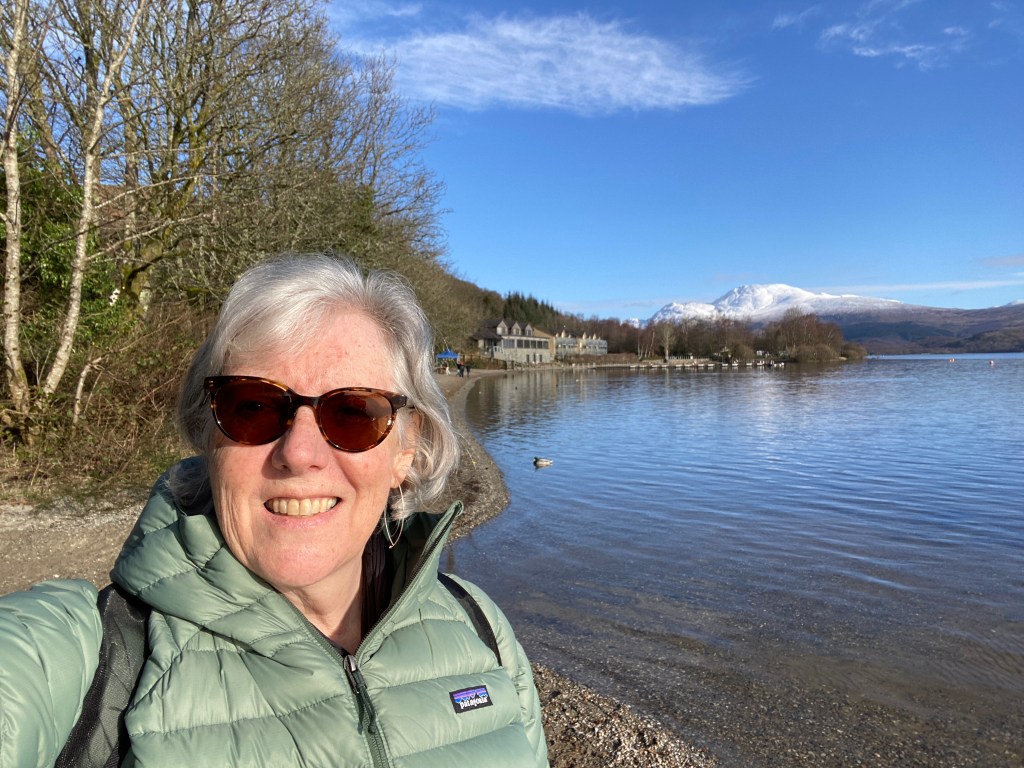
On the bonnie banks of Loch Lomond with snow capped Ben Lomond behind

Dogs.  I was pretty surprised that dogs are allowed on the subway, busses and a lot of restaurants.  They are truly companions here.  The breeds are quite different than what I am used to seeing in the US.  Tons of Scottish Deerhounds, Shelties, Gordon Setters and Scottish Terriers.  I haven’t seen any pit bulls or Rottweilers in the week I have been here.

Weather.  My weather app might say it will just be cloudy all day but inevitably it will be raining when I walk out the door.  My first day exploring it was overcast, then sprinkles, then sunny and then rain followed by a rainbow.  If you don’t like the weather, just wait and it will change. I would take an umbrella but rarely bothered to get it out because then I would have to drag a wet umbrella around.  I’ve slowly adapted to take whatever comes.

I have to say that the ancient architecture is amazing, the history incredibly rich and deep and the highlands and its stark austere mountains by pristine lakes, is not to be missed.  I can’t wait to come back again. 

🫣5 Ways to Combat Guilt

I just took my 14-year-old dog, Baci, to the vet for her annual checkup.  I inevitably feel guilty by the end of the visit because I failed to brush her teeth or try out the pain reliever that the vet recommended last year. I also was told to listen to Baci when she does not want to walk more than a block.  Ugh.  I feel the full rathe of guilt as I walk my sweet Baci back to the car. 

I had a client who was unable to sign into the coaching platform I use. He was frustrated and opted out of coaching because of the poor technology of the platform. Ugh. More guilt. When my children come home, I frequently forget to stock their favorite cereal or snack. Ugh.  Guilty of being a bad mom. There are countless sources of guilt in my life and how I address it is important so that I don’t lapse into shame.

Here are the 5 ways I combat guilt:

Make a list.  Prepare a list of all the things I do for my dog, my children, my clients, my family, my friends and neighbors. I collect the evidence of what I do for others.  In Baci’s case, I have constantly said that “When I come back as a dog, I want to live Baci’s life.”  She’s fed every day, gets to go on a walk (when she wants), gets full run of the house inclusive of all the snuggly couches and love seats.  I drive her 90 minutes to a boarding place in my old town when I’m on a trip because they are so sweet to her.  It’s hard for me to feel guilty when I take stock of all that I do for Baci and others.

Ask for more information.  Check in on those that I feel I’m neglecting.  Obviously, my dog is unable to answer but I can tell you that she doesn’t cower when I am near her. She is always excited to see me in the morning and to head out for a walk. Baci does not feel neglected. My adult children are pretty clear about their expectations although there was a moment over the holidays when my daughter had expected dinner and I said “I didn’t think you’d be here.” I suddenly realized that she was hurt (she had to extend her visit for several weeks) and then I said “I didn’t expect you to be here for tonight’s dinner, I thought you would be hanging with your friend.” Sometimes guilt can occur because we aren’t explicit with our own expectations.

Self Gratitude.  I keep a gratitude journal every day where I write 5 things or people I am grateful for as well as one thing I’m grateful I did for myself, like writing this blog, walking, swimming or safe travels. I do this because we are wired towards a negativity bias. If your ancestors weren’t listening for the rustle in the bushes, they would not have survived the saber tooth tiger. This constant scanning of what is wrong in the environment skews what could be fun to look at to what is wrong; like I shouldn’t have eaten that bagel or I should have walked 5 miles.  I try to be grateful every day and look for my accomplishments and successes

Role reversal.  I try to think about if the roles were reversed. Obviously, this is difficult with my dog, Baci, but let’s face it, she is living the good life. As for my children, I think about this a lot as I try not to invade their lives too much but rather to be supportive when needed. My son can think that I know more than I do about what’s going on in his life. If he’s under a lot of stress, he can assume that I realize this, even when he’s not in the same room or city. I come from a place of “If he wants to talk, he will.”  Sometimes I need to be more proactive and reach out.  I think about how I would feel if I was in his shoes and it makes me more compassionate. 

Decide on boundaries.  I know that with Baci, I’m not likely at this point to invest in extraordinary means to extend her life. Outside of regular vaccines and vet visits, she’s been the center of my life for 14 years. Keeping a decent quality of life is what’s important. With my children, I try to be clear about how much help and support I’m willing to give and be clear in communicating those boundaries. If they’ll be arriving home after 2 AM, I appreciate a text. I stay out of their relationship with their father as it’s none of my business and I don’t need the guilt associated with trying to fix anyone but myself.  I’ve made and continue to work on my boundaries. 

I don’t get as overwhelmed by guilt anymore. I certainly get pangs of guilt like not flossing enough when I head to the dentist or staying 100% plant based when I get my cholesterol results but for the most part, I’ve done pretty well combating guilt.  How about you?  How do you combat guilt?

🐒7 Steps to Delegating Monkeys

Delegating monkeys is an important part of being a leader, partner or parent.  There is a delicate balance between abdicating and delegating.  Abdicating can happen when a leader chooses to ignore a situation (usually a sticky, messy and uncomfortable monkey) which allows the issue to slide down to the next level of management.  Not good delegation.

As Ken Blanchard said in his book, The One Minute Manager meets the Monkey, “for every monkey there are two parties involved, one to work it and one to supervise it”.  The monkey is the task or project.  You may have given the monkey to your child, co-worker or assistant but that doesn’t mean that you have absolved yourself of any other responsibilities.  You’ll need to make sure that the monkey is getting fed….and not over fed.  You don’t want to have a bunch of chunky monkeys running..er swinging around.

So how do you take care of the monkeys without getting them back?  Here are some ideas:

1. Pick.  Pick the right time and place to delegate.  If you are in the middle of serving twenty people a Thanksgiving meal and your daughter has never made gravy before…maybe you should wait until there is a little more time and (in my case) more patience before you give a gravy clinic.  If you are going to give a monkey to someone, pick the right time to do it.

2. Decide.  Decide if this task or project should be delegated.  If it’s not clear who is caring for a particular monkey, then you have decided.  You have abdicated and the monkey is running loose and no one knows who is in charge.  Like that annoying employee that reports to you but that no one likes and is afraid of.  You aren’t handling the monkey, so everyone else has to.  Decide if the monkey is yours or…not.

3. Select.  Once you have decided it’s the right monkey to delegate, select the right person or group to take care of the monkey.  If the new incentive plan needs an Excel expert, then find one.  Don’t just give the project to the closest person who seems available (especially if you don’t know their Excel abilities).  The monkey needs the right talent to take care of it.  Not just another animal at the zoo.

4. Define.  Define what success looks like.  If you ask your child to mow the lawn, you better be clear with timelines, parameters for what mowing the lawn entails (leaf blowing, edging, bagging of grass, etc.), and if there will be any compensation involved.  There have been plenty of family squabbles over something as minor as what mowing the lawn entails.  Make sure you define how to take care of the monkey.

5. Ask.  Make sure that they are up to the challenge of caring for a new monkey right now.  Maybe their plate is full.  Maybe they already have 50 monkeys and 13 of them are sick and in need of intensive care.  If I ask my daughter to edit a blog post for me (and I frequently do), I better make sure she’s not in the middle of mid-terms.  It’s important to ask if she has time for one more monkey.

6. Delegate.  Once you have completed steps 1-5, then hand off the monkey.  Knowing that it is the right time, place and person will make this much easier.  Instill your confidence in their monkey care-taking abilities and then walk away.  If they think there is any chance that you will be back for the monkey, it will erode their confidence and commitment to care for the monkey.

7. Track.  Track progress after you delegate.  Make sure they’re grooming, training and not over feeding the monkey. Make sure they aren’t taking on too many other monkeys or that the monkey you delegated to them may not get as much care and attention.  Let them know their progress along the way.  Just because you delegated, doesn’t mean you have absolved yourself of all responsibility.  Check in on the care and feeding of the monkey.

People who effectively delegate their monkeys are ultimately better leaders and citizens.  The team around them is more highly skilled and feels more empowered.  Try these steps and see if you can’t be more effective with your monkey management.

How do you delegate your monkeys?

3 Actions to Flip Your Perspective

There is an accident on the way to that critical meeting. You will never make it in time. Well, that deal is lost. Your coworker called in sick. Ugh. That project is stalled yet again. Can we never make a deadline? Your son is not returning your text. He must have been in a car accident. Or abducted by aliens. Or in jail. The one constant in all these situations is your negative bias in the interpretation of events. It’s stressing you out. Believe it or not, you oversee how you view these events. But Cathy! How can I possibly view these things in a different light?

I just started reading Shawn Achor’s book Before Happiness. Shawn suggests that success is based on being a positive genius. A positive genius is someone who can change their brain patterns to view the world in a positive light; to take in  information and put a positive spin on it rather than wallowing in negativity. Seems hard, doesn’t it? So much easier to succumb to the negativity bias that our brains are seemly hardwired for. You can change it, though. You can overcome your predisposition to view information in a negative light. You can. Really. Imagine all the worry and stress you can let go of if you choose to be the architect of your reality.

Here are Shawn’s three main points in choosing the most valuable reality:

  • Recognize the existence of multiple realities by simply changing the details your brain chooses to focus on. This reminds me of Byron Katie’s The Work. The first question in The Work is “Is it the truth?” I want to look at my son not returning a text as, “He doesn’t love me.” I can ask myself, “Is it the truth?” Let’s see. He got up at 6 AM to take me to a Colonoscopy. He’s been really supportive with recent issues with my dog. He sent me flowers for Mother’s Day. Nope. It’s not true. Of course, he loves me. So I need to realize that there are many interpretations of the information I have. So what if it’s been twenty minutes since I texted him. Maybe his phone is dead. Maybe he is working out. Maybe he is sleeping in. Focus on the details in a more positive light. As Mike Dooley says, “Thoughts become things. Choose the good ones.” There are multiple realities at any given time. Decide on which reality to focus on.
  • See a greater range of realities by training your brain to see vantage points and see the world from a broader perspective. Shawn quotes a study where a group of people were asked to draw a coffee cup and saucer. EVERY person drew the cup from a side perspective. EVERY LAST ONE. I have to admit, if I am asked to draw a coffee cup or a house (for that matter), I will draw it from the side perspective. But can’t you draw it from a bird’s eye perspective? Are both true?Don’t you look down at your coffee cup in the morning? Isn’t that the perspective you usually see? There are hundreds of vantage points. It’s so easy to get caught up with our status quo perspective. We don’t typically re-frame it. There is a whole range of views. If my coworker is sick and the project might be delayed, maybe there are more resources I haven’t thought about. Maybe this is my chance to step up and own the spotlight. Maybe we need more data before proceeding. Open up your perspective to see more points of view.
  • Select the most valuable reality that is both positive and true, using a simple formula called the positive ratio. This is not creating a panacea. Choose data that is true and the most positive. If you constantly seek positive data, the outcomes are better. In companies, a Losada ratio of 3 positives to one negative indicates a more profitable business. So, when you get a seemingly negative data point, look for something positive. Rethink it – the car accident on the way to work, not a big deal? If you had been five minutes earlier that could have been you in that accident. At least you are still on your way to your destination. Be grateful for not being involved in an accident and still on your way. As Achor has advised, “Go out of your way to build employee strengths instead of routinely correcting weaknesses. When you dip below the Losada line, performance quickly suffers.” Look for the good and it will appear.

I’ve been trying to live by this over the last week or so. I look to interpret the current reality in a positive light. I’m not saying that my negativity bias doesn’t creep in from time to time, but I am slowly changing my default to looking at what’s right, rather than what’s wrong. Be a positive genius.

🏖️6 Surprises at Tybee Island

Tybee island is a barrier island off the coast of Georgia.  Even though it is an island, there is no need to take a ferry to escape the mainland to enjoy this funky, tranquil gem. I spent a week here in February of 2023 and I was surprised in many ways.  I love Savannah Georgia.  I stop in Savannah anytime I am on a road trip to Florida. When my son lived in Miami it was at least an annual trip.  Every time I traveled to Savannah, I knew there was a beach close by but it always seemed just too far out of the way.  Tybee Island is about a 25-minute ride from Savannah but it is so worth the extra time to get there. Having Tybee Island as the base camp for my trip was truly enjoyable as it was easy to park, walk almost anywhere and had lots of things to explore. 

The Tybee Island Lighthouse

Here is what are the 6 surprises I found at Tybee Island:

  1. Sunrise perfection.  My place was about a half mile walk to the beach.  After my initial morning of navigating a private neighborhood with my dog, Baci, in tow, I realized that pets are not allowed on the beach and that, although there are several boardwalks to the beach, the initial few walkways were private.  There was a handy bench on the boardwalk so Baci and I dutifully waited for the sunrise over the Atlantic from the boardwalk.  The sun would slowly peak over the horizon as the birds seemed to be choreographed to fly through the majestic scene.  Each subsequent morning, I went by myself so that I could walk on the beach. It was compelling how each morning was either a stark line across the horizon or a lavender haze seemed to envelope the sky. Clouds often created a cotton candy orange glow as the sun rose each morning. In the eight days I was there, I never failed to get up so that I could attend this spiritual rising.
  2. Tybee Island Lighthouse. One big surprise was that the lighthouse was about a 5-minute walk to the public beach on the north end of the island.  So, my daily sojourn to the sunrise brought terrific views of the lighted sentinel from the beach.  The lighthouse was first ordered in1732 by the Governor of the Georgia colony as boats sought to make a safe entrance into the Savannah River.  It also has a First Order Fresnel Lens. It’s part of what would later be Fort Screven which was a military post during the Spanish American war.  So, the lighthouse, the batteries of Fort Screven, the Atlantic Ocean and the Savannah River all converge on the north tip of the island amongst quaint summer cottages. 
  3. Eclectic neighborhoods.  Many of the homes I walked by each morning had a bohemian, down home charm about them.  There would be painted buoys hanging in the trees, pink flamingos standing guard next to statues of unicorns, alligators and dragons. The neighborhood’s tiny library had a red roof (like the base of the lighthouse) and was surrounded by a pile of oyster shells. Mismatched painted fences, sea turtle signs, narrow meandering gravel streets and flip flops as door handles created a funky artistic vibe. This is not a pristine manicured resort that is found at Hilton Head.  This is a one of a kind artistic mix and you never know what you will spy around the next corner.
  4. Joints and Shacks. The selection of restaurants in Tybee is definitely slanted towards seafood and dock/beach/marsh-side dining.   This proved to be somewhat difficult for a vegetarian so I ended up having some great seafood at several spots.  I never saw a McDonalds or Starbucks in my week at Tybee.  These are all mom-and-pop joints or shacks.  The Crab Shack is definitely NOT some franchise.  It’s a shack with most of its seating outdoors under precarious roofing, alligators in a pond out front and garbage cans in the middle of the table with a roll of paper towels for napkins.  Delicious fresh seafood but you will not find a white table cloth or metal silverware anywhere. Bubba Gumbo’s is a dockside joint right off the Lazaretto Creek which is more marina than tourist destination.  Just some hand painted plywood warning not to eat imported shrimp. When I parked, I almost turned around as it felt like I was invading a working marina.  The table I ate at had such a slant that I am sure an egg could have rolled off without any trouble.  No fluff or polish but great food.
  5. Cockspur Island.  Cockspur island is the home of both the Cockspur Lighthouse and Fort Pulaski.  It’s a National Monument and requires an entrance fee.  It has several trails on the island, one of which, I took to see the Cockspur Lighthouse which, at this point, sits in the middle of the south channel of the Savannah River.  It’s an easy hike and you have a view of both the Tybee Island Lighthouse and Cockspur lighthouse at trails end. Fort Pulaski was completed in 1847 and the recent West Point graduate, Robert E. Lee, was in charge to a good degree of the planning the construction.  It was never fired upon by foreign invasion but played a role in the Civil War.  The state of Georgia initially occupied the fort at the beginning of the war and the Union fired upon it in April 1862 and it was taken under Union control.  It was used as a prison for Confederate soldiers for the rest of the war.  You can still see the artillery damage on the outside of the fort and it’s completely surrounded by a moat which you don’t see often in the US. 
  6. Savannah.  The best part of staying in Tybee is that if you want to go explore Savannah, it’s less than a 30-minute drive. I love the riverfront of Savannah and its cobblestone streets and array of shops and restaurants. Even in February, there were loads of tourists on a Thursday afternoon which surprised me. On a recommendation, I took a tour of the Bonaventure Cemetery which was absolutely serene and lovely in late February with its angelic sculptures, Spanish moss and live oak trees.  There were plenty of stories about those buried in its hollowed ground. I finally got to see Forsyth Park with its enormous fountain and pedestrian thoroughfares.  Savannah is always worth a visit or two.

Tybee Island is a delightful, laid-back break from a hurried world.  I felt like I had hit the reset button while there and enjoyed all the surprises it had to offer.  Do you need a reset?

6 Tips on Developing Patience

Patience is the ability to reframe one’s reality into something that is more acceptable.  So, if there is suddenly a delay on the highway on the way to the airport, you can reframe it in a way that doesn’t cause you anger and frustration.  Perhaps there is another flight if you miss this one or maybe I get to spend one more day in paradise or in my cozy home. Jane Bolton wrote in article for Psychology Today that “impatience was a happiness killer.” That got my attention.  My habitual slide into impatience was killing my happiness.  Perhaps it was time to address my foot tapping anxiety, my constant clock watching or interrupting others to “get to the point” and embrace the space for just this moment.  

Here are 6 tips on developing patience:

  1. Determine what type of impatience you are suffering from.  Sarah Schnitker breaks it down into three types: Interpersonal patience (our ability to be patient with others like children and co-workers), patience in life hardships (when we deal with a significant setback like a hurricane or loss of a spouse or job), and patience for daily hassles (the irritation of daily hassles like wifi outages and traffic issues).  I tend to have an easier time with being patient interpersonally but can completely lose my cool when my Wi-Fi slows down or other daily hassles.  I can struggle with wanting to push a rope like when my returning to my house after Hurricane Matthew was dependent on one lowly cabinet that was back ordered.  Without the cabinet, can’t have a counter top, therefore, can’t have a sink, therefore can’t put in the flooring.  Ugh. It’s good to know that I’m strong in some areas so maybe I can build in other areas.
  2. Be an active listener. It’s pretty hard to fake being a good listener.  I knew an executive that was pretty good at faking listening but regardless of what story I was telling, they would respond with a completely unrelated statement.  Although they were great at maintaining eye contact and leaning in, their lack of understanding with a reframe of what I said, asking a relevant question or giving additional information made it clear they weren’t listening. Failing to be an active listener creates disconnection. I try not to check out but look for ways to create understanding by reframing and asking clarifying questions.
  3. Pay attention when the irritation starts.  I just completed a long drive from Tybee Island Georgia to Durham NC.  Every time I would see brake lights a quarter mile ahead headed north bound on 95, I could feel the stress take over.  I personally have been stuck in a 4 hour delay on 95 before and just the whisper that it could happen again can cause me angst. There was an oversize load that several semis needed to pass.  I remember thinking, “Well, let this just pass.”  I actually got in the slow lane to let all my impatient road buddies pass.  We were going 50 miles an hour after all, it’s not like I was walking home.  But knowing that I was starting to get frustrated help center me.
  4. Get comfortable with being uncomfortable. As written on the Goodwill Blog, “Waiting around for something you really want or need doesn’t’t feel good. For many of us, waiting can be downright uncomfortable. And this discomfort often results in feeling impatient. How do you fix this? You can increase your tolerance for uncomfortable waiting periods by making yourself wait more often. That might sound counterintuitive, but, if you think about it, you can really become a more patient person.”  I remember reading this many years ago and the example was to get in the longest checkout line at the grocery store or (God forbid) DMV.  Another great test for me is to follow my beloved dog Baci on her smell wanderings.  I typically want to hurry up and get inside; letting her just wander with me tagging along can be a test in developing patience.
  5. Stop Multitasking. As much as I like to think that I am robustly juggling several things flawlessly, I am, in fact, just skimming from one task to another to another and spreading myself too thin.  As written by Goodwill, “Multitasking can also force us to move too quickly from one task to another. We might then expect others to move quickly with us. Forcing others around us to rush is a form of interpersonal impatience, and it can put a bad taste in others’ mouths about you.” The opposite of this is uni-tasking.  Focus on what is in front of you right now and put away everything else as a distraction. 
  6. Be here now.  When I was in that “almost stuck on 95 north” moment. I remember pulling into the right lane and thinking, these other folks like these truckers have some place they have to be.  I only have to be here alive, safe and with plenty of gas.  I’ll let everyone else be on their way and, eventually, I’ll be able to pass when it’s the right time for me. I always love Rick Hanson’s question, “Are you alright right now?’ Yes, yes I am. And now. And now.  And now. When I am Ok with the current moment, I don’t need to get impatient for the next moment.

I always admired my late father for what I saw as his infinite patience. A 35-year veteran of teaching 8th grade history and a doting grandfather to 4 grandchildren.  He was, as I reflect back, always just in the moment.  I imagine channeling him when I have felt impatience rear its ugly head.  “What would Daddy do? “How do you find patience? 

😳 4 Tips to Quit Judging People

I know you’ve done this. You’ve walked into Wal-Mart and have seen some atrocious outfit that is two sizes too small on an overweight woman or man. You roll your eyes and suddenly don’t feel so bad that you didn’t put on lipstick before heading out to shop on a Saturday morning. You’re at least presentable. Or, you’re reading a company email and notice someone’s name has been misspelled. You smugly fire off an email to the offending author to point out their error. You feel you have one over on everyone else. You are mentally making the case for your own superiority. It’s nice to be you. You get to be Judge and Jury to all the “lessers” gliding by. The problem is that it saps your energy and puts you into what the Arbinger Institute calls “a heart at war.” When you judge others you are ticking off the ways that they are not perfect. The gain is fleeting, the long term affects are that you start judging yourself as well. You are seeking perfection in everyone, especially that person in the mirror. I can remember asking my now ex-husband if I was as fat as another woman walking down the street. Like, as long as I’m not as fat as that woman, then I’m better than. You end up in a constant state of comparison.

I recently read The Anatomy of Peace, by the Arbinger Institute. It’s a great read as it is written as a story instead of being a text book on resolving conflict. The minute the lead character “Lou” starts justifying his feelings and thinks, “…when I betray myself, others’ faults become immediately inflated in my heart and mind. I begin to ‘horribilize’ others. That is, I begin to make them out to be worse than they really are. And I do this because the worse they are, the more justified I feel as myself.” This is me at Wal-Mart. I’m thinking, “Look at how poorly that screaming child is behaving” or “That cashier is incredibly slow” or “Can you believe that family has six kids?” I’m viewing them as objects which means I am so much better. It’s this constant exercise in comparison and justification that is exhausting and closes you off from really relating and connecting with others.

So here are the 4 surefire steps to quit judging others:

1. See others as people. This seems like it should be obvious. But when you really think about it, although you might see that they are living human beings, the minute you discount them in your head, you are turning them into objects. What I try to do instead is think “I wonder how her day is going.” This keeps me from seeing someone as an object and helps me be more empathetic and human I just tried this at Walmart. The cashier was going through the motions ringing up my stuff and I kept trying to make eye contact. I wanted to meet her gaze so I could smile at her. She wouldn’t let me in. I was an object in her eyes. It’s a two-way street and you have to keep to it.

2. They appear just as real to me as I do to myself. I think this is what John Gottman calls “Turning towards.” As Gottman defines it, “A bid is any attempt from one partner to another for attention, affirmation, affection, or any other positive connection. Bids show up in simple ways, a smile or wink, and more complex ways like a request for advice or help.” Accepting bids is a way to turn towards others in your life whether they be at work or at home or out in the world. Turning toward at work would be saying something like “yes and” instead of “no” to the idea of a new venue for an event. This is an old improv trick. Improv doesn’t work unless you accept the “bid” from the other person. Saying “no” or “but” is turning away or shutting down the bid.

3. Their cares and concerns matter to me as my own. This is true empathy. If you think about it, how can you be in conflict with a co-worker if their concerns matter to you as much as your own? It’s similar to the CRR Global tenet, “Everyone is right…partially.” Owning that everyone has some truth is critical for progress. It gets you out of digging your heels into your own righteousness. Go out and imagine slipping into your adversary’s shoes and walk around a bit.

4. I actively respond to their humanity. I’ve spoken on this topic at several corporate events. Everyone (I mean everyone) wants to be heard. I can remember the most sickening moment of my life was in a class when I was earning my Master’s Degree. The instructor had me sit in the middle of the room and told me to say something very profound. In the meantime, she secretly told everyone else to turn their backs to me and talk to each other. I felt ill. Marginalized. Small. Insignificant. There was no air in the room. No one was listening. The thing I learned from that experiment is being heard is a basic human need that is about as important as air.

I know this isn’t easy. It’s much simpler to pass judgment on someone. To discount them into an object and roll on. But as the Arbinger Institute says, this is a heart at war and a heart at war is in constant conflict. Open your heart to being a heart at peace and embrace the humanity that surrounds you.