Are you alright…right now?

I bet you are. Mostly because if you are reading this you are not being chased by the police, or an elephant or even a shark. If you are in the middle of a major medical procedure like heart bypass or having your gall bladder removed, you are probably not reading this. The truth of the matter is, most of the time you are alright right now.

I’ve been reading Just One Thing by Rick Hanson. It’s a book of simple practices to add to your life to develop a buddha brain. A buddha brain, as defined by Dr. Hanson, is using neuroscience and emotional balance to create happiness, love and wisdom. Couldn’t we all use a dose of that? Well, this is lesson 42, which is titled: “Notice that you’re alright right now.”

Here is how to implement this into your own life:

PauseAs I write this, it’s ten days before Christmas. I’m busy putting up the Christmas Tree and I can’t seem to get one strand of lights to work. I’m not sure if I have bought enough presents for both my kids, my house is getting repaired, and I have huge financial decisions looming on the horizon. I know you have similar preoccupations. It may be a medical decision or the unknown leak under your car. There is something preoccupying your head. Press pause. Stop. This very instant. You may think you don’t have time, but unless you are in the middle of performing brain surgery, you have time to pause. So pause.

Sense.  Now that you have stopped your monkey brain from ping ponging from issue to problem to disaster to worry, scan your body. How is your big toe doing? Still there? Any pain? What about your ear lobes? Still hanging in there? Slight pain in your back from that workout yesterday? Ok. But you are doing okay for the most part. Sense it. After I read this lesson last night, I was snug under the covers of my bed. That’s a wonderful feeling. Sense the moment. Right now.

hs-lee-315171

Stock.  Take stock in the moment right now. Is there a roof over your head? Do you have food in the fridge? Shoes on your feet? People you love and care about? When you take stock, you figure out that it’s not so bad. In the past few months, I have gone down the rabbit hole of catastrophizing my financial situation. When I do that, I am diminished. Reduced. Small. A victim. But when I take stock in the moment? I am a badass. I have the tiger by the tail. How would you rather feel? I thought so. Grab the tiger by the tail and take stock in how much you have.

Relax. As Dr. Hanson writes in Psychology Today, “This background of unsettled-ness and watchfulness is so automatic that you can forget it’s there. So see if you can tune into a tension, guarding or bracing in your body. Or a vigilance about your environment or other people. Or a block against completely relaxing, letting down, letting go.” This is going to take practice. We are so hardwired for scanning the environment for threat that relaxing into the moment is against our biology. Feel your shoulders, let them sag. Relax your jaw. Let your thoughts go like balloons into the blue sky. Breathe. Try it. I’ll wait. There is no rush.


So how did that feel? Pretty good, huh? Check in throughout the day. Is everything alright right now? Maybe it’s at the top of the hour. Maybe it’s when you wash your hands. The important thing is just to notice


Gate B4 at Hartsfield International

My son, Benson, and I arrived at our connecting gate to Raleigh-Durham. We were about an hour and 15 minutes early for our connection and sat down next to each other pretty close to the gate for our final leg home after spending Thanksgiving in Seattle. Benson settled into his iPhone and I sat skimming Facebook. Then a woman in a wheelchair was placed next to my seat. The wheelchair agent looked at the woman and said, “Are you all set?” The woman in the wheelchair was silent. The wheelchair agent looked at me with an expression of Well, I guess that’s it and left.

mike-wilson-274649

About 5 minutes later, the woman in the wheelchair started speaking in Spanish. I wasn’t sure who she was talking to but there was no one around responding. I spoke up and asked, “¿Hables ingles?” (Do you speak English?). She replied: “No” and asked where the wheelchair agent was. I responded in Spanish that she had left. The woman then explained that she could not see. So there I am, sitting at gate B4 next to a blind, Spanish-speaking woman in a wheelchair. I felt, at that moment, that I was the only one in the world responsible for this woman and that I needed to make sure she got where she intended to go.

Here are my lessons from that experience:

Language.  It’s been over a decade since I had to speak Spanish on a regular basis as the Human Resource Director for a Mission Foods tortilla manufacturing plant. My Spanish is rusty. It did not matter. I had enough to figure out that she didn’t speak English, she could not see and that she was headed to Raleigh-Durham. I think it’s easy to get caught up in the perfection of speaking another language, reminding yourself to use the correct tense and the proper form of “you” (tu is more familiar and usted is more formal). It didn’t matter. Language is language, and any form of communication was better than what the rest of the folks sitting at the gate could provide. I know if I was in Miami, I could have found someone to help me out. But messy and imperfect or not, we were able to communicate. Use the language you have right now and quit worrying about whether or not it’s perfect.

Information.  It was important to relay basic information like what time it was, what time the plane would leave, and where it was headed. I was glad that she was at least headed to Raleigh-Durham. I wasn’t sure what I would do if she was at the wrong gate. I kept updating her with the time and what was going on at the gate. As soon as the gate agent was there, I walked up to her to let her know that: A. This woman did not speak English and, B. She was blind. This was important information and the gate agent thanked me. She said that it was not indicated on her ticket at all which would have helped everyone to make sure she got where she wanted to go. Be sure to relay important information.

Connect.  The extent of my airport Spanish was exhausted in about 2 minutes. So, I decided to ask where she was from, where she was headed, and what it was for. Turns out, she was headed to Burlington, NC and lives in Veracruz, Mexico. She was headed to Raleigh-Durham to meet her brother, her niece and her sister. They were coming from various parts of the United States for a reunion. Her journey had taken her from Veracruz to Mexico City to Atlanta. Now she was hoping to make it to Raleigh-Durham to meet her family. I was astounded that she had traveled so far all by herself. I was glad that I connected to her story. If I had not spoken Spanish, I would have thought she was a crazy woman, because it’s not necessarily obvious when someone is blind. She didn’t acknowledge people because she couldn’t see them. Take the time to connect.

Responsible.  As soon as they started boarding the plane, the gate agent came over and took the woman in the wheelchair onto the plane. I was relieved that she was on the plane. I never saw her when I boarded later and never saw her get off. I saw several wheelchair agents by the airplane door with various names written on paper as I exited but I had never asked her name. I felt responsible for her. How would I know if she met up with her family or not? I cannot tell you how relieved I was when I got to baggage claim and I saw her surrounded by family as we all waited for our bags. It’s amazing how we can feel responsible for something completely out of our control. I wasn’t that woman’s daughter or sister. I was just another human who happened to speak Spanish.

I can’t tell you how happy I am that this had a happy ending. I’m sure she would have made it to Raleigh-Durham without my help but it felt so gratifying to be a part of the end result. It also made me appreciate that we don’t always know if someone is disabled or doesn’t speak the same language. It’s so easy to jump to conclusions and not investigate further. I’m glad I did.

Thoughts on Seattle

My son and I spent Thanksgiving in Seattle with my daughter and her boyfriend. It was a first-time trip for my son and probably my fourth. My daughter moved to Seattle this July and it was fun to have her as the tour guide for her new stomping grounds. To see the city as a resident rather than a tourist.

24139221_10155832936643688_1467014347_o

Here are my observations about Seattle:

Rain.  This is by far the rainiest it has been on a trip to Seattle for me. Cold, windy rain. It’s funny but because of the rain, I realized how the city is built around rain. There are coat racks and umbrella racks by the doors of most of the establishments we went into. It reminded me of Phoenix with its covered parking spaces; obviously used for different reasons. Seattle has set up the infrastructure that works with its weather. Somehow it makes it all more tolerable. By the third day, I was just expecting rain at some point and carried along my umbrella. This apparently, is a sure sign of a tourist. Seattleites usually just wear raincoats. By the end of my visit, I had purchased said raincoat with a hood because carrying an umbrella is a wet, messy drag. Adapt to the rain because you know it’s coming.

Coffee.  I have been to plenty of cities with ample coffee shops but in Seattle coffee is an art. It’s where the gourmet coffee industry started. Whether it was a freshly brewed pour-over coffee, a latte or a cup of coffee at a local diner, it was all terrific. You can’t serve Maxwell House in Seattle, only the best will do. There are the ubiquitous Starbucks everywhere, but we found a place called La Marzocco Café, which was a coffee shop inside a radio station studio. It was amazing. The kind of place to sit down and relax while you watch it rain outside and listen to great music from KEXP. It is a must-see in Seattle. My son and I ended going there several times to chill out and relax. It’s within walking distance of the Space Needle, so even tourists can make their way there. My daughter’s boyfriend, Kevin, made several pots of delicious coffee at their apartment. Be sure to relax and enjoy the coffee.

Transit.  There are many modes of transportation in Seattle, and my son and I used Lyft for most of our journeys. Walking is another popular mode, and once you have purchased a raincoat (see bullet one), it’s really not that bad. Plus, walking with an umbrella becomes a game of strategy on crowded streets, so I highly recommend wearing a rain jacket instead, just so there isn’t collateral damage as you make your way on foot. Kevin and his brother Brian suggested we take a bus from Pike Place Market to their apartment in Ballard. We had a whole afternoon together with no rush, so I was game. I have to say I was skeptical. I can’t remember the last time I rode a bus, but it was cheap ($2.50) and took us to within a half mile of the apartment. There is a certain Zen to riding a bus, as the world rolls past and riders stare blankly ahead, or intently at their phones. I was glad I had the experience, since my daughter rides the bus to work every day and I now understand the appeal. There is this transition from home to work or vice versa that frees up time for thought and reflection that driving doesn’t.

Food.  We had amazing food all week. Whether it was a diner near the Space Needle, pho at a local Vietnamese restaurant, or tacos at a Mexican spot. When we were walking around Ballard one night there must have been twenty plus restaurants we passed. I would have eaten in any one of them. There is something comforting about walking in the rain (again see bullet 1) and ducking into a cozy spot for some delicious food. Pike Place Market (with the world-renowned fish throwers) has an amazing assortment of everything, from chanterelle mushrooms to Dungeness crabs to moon drop grapes. I’ve always thought of the San Francisco Bay Area as the food mecca of the world, but Seattle could give it a run for its money. It was ironic that several of the places where we ate were Southern in theme. Whether it was shrimp and grits, biscuits or collards, I didn’t feel like I was a 6-hour flight from home. I think the cold rain makes food taste better. The pinnacle of food was our Thanksgiving meal with Brian and Natalie at the helm.  There is a peace in letting go and not being responsible for the biggest meal of the year. I don’t need to worry about whether the turkey is carved. Turns out, it is still delicious, regardless of how it is carved.

It was a great trip with the highlight being a trip to the Japanese gardens at the Washington Arboretum and spectacular Chihuly Garden and Glass Museum. There is always something fascinating to do in Seattle, regardless of the weather. What are your favorite spots in Seattle?

Learnings from the Escape Room

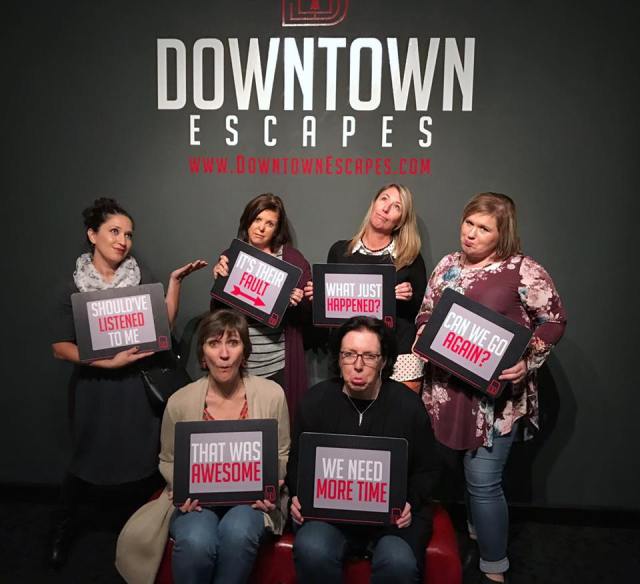
I was not familiar with an escape room experience but having just survived one, I figured I’d enlighten my readers so that you can be forearmed in case someone convinces you to take part. When someone on my employee activities committee suggested we go to an escape room, I was hesitant. It didn’t sound very appealing. Why be locked up in a room with some co-workers to try and solve puzzles for an hour while hoping to outsmart the puzzles? Perhaps I overthought it. It turns out it was fun. And in the process, some hidden talents of my co-workers were uncovered.

Here is the Wikipedia definition of an escape room: “An escape room is a physical adventure game in which players solve a series of puzzles and riddles using clues, hints and strategy to complete the objectives at hand. Players are given a set time limit to unveil the secret plot which is hidden within the rooms. Games are set in a variety of fictional locations, such as prison cells, dungeons and space stations, and usually the various puzzles and riddles themselves follow the theme of the room. Escape rooms are great activities for families, friends, students, and even businesses because they rely on team building exercises.”

22780677_358230514624403_3403396061402698180_n

Apparently, these escape rooms are cropping up all over the country. I mean, if they have one in lil’ ole Goldsboro, North Carolina, they must have them everywhere. So, before you turn up your nose at the experience, let me share some of my learning.

  • Think outside the box. When the six of us were given the instructions before entering our room, “The Heist” escape room, our guide told us to think outside the box when we were trying to puzzle our way out. This was really important advice. While pursuing our escape, we had a bunch of pieces to what seemed to be a picture frame. My immediate impulse was to make a rectangle (er…a box). It turns out that if we followed some color-coding, we actually extrapolated some numbers instead of the form of a box. I had a really hard time not just making a rectangle in my head, instead of seeing the numbers. This prompted a reconsideration on my part. Are we all just assuming that what we see is accurate or that following the status quo is the only correct path? It might stretch you and be uncomfortable, but think outside the box.


  • Pay attention to details.  We were in a room full of art pieces and paintings. We were instructed to count up all the rowboats as part of our escape solutions. I remember one or two of my coworkers kept wanting to count every boat, which included sailboats and canoes. The important detail was that there were only a few actual rowboats with oars. We could not move ahead in the puzzle until we counted the rowboats instead of every boat (and no, we could not use our cell phones). It’s important to know the difference, and if you don’t, then maybe you need to figure out someone in the group who does. There were several times when we burned minutes by ignoring the details and not really looking for the answer. Make sure you look at the details.


  • Take risks. One of my co-workers is a huge risk taker. She has always taken matters into her own hands and tested things out. I mention this only because it was a huge advantage for us as a team in our escape from our escape room. There were two puzzles that I can think of that she single-handedly figured out. She didn’t ask for affirmation from us for solving the puzzle. She just charged ahead. Here’s a perfect example: at one point we had a blow dryer and, well, wow. I saw no reason for a blow dryer; and honestly, I didn’t see the light going on for anyone else. I figured it was a joke of some sort. The blow dryer solution ended up catapulting us forward because she took a risk with the interpretation. This taught me to remain open to the reality that those around us are looking for solutions and finding them; I need to remain open and risk. Are you taking any risks, remaining open to interpretations, or playing it safe?


  • Sometimes you don’t need everything. If someone gives you a puzzle challenge and you are given ten puzzle pieces, you would want to use them all, right? There were several times during the hour-long escape that we didn’t need all of the objects placed in front of us. Sometimes just eight pieces, or six, or even two would work. Just because you are given something, doesn’t mean you will even use it. Getting wrapped up in using everything in front of you can bog down the process. Remind yourself of this.


  • Take the clues as you go. We had the option of getting three clues during the hour-long game. I had it in my head that we should get one every 15 minutes or so, and it ended up being one of the best ideas. So, we would try to figure out a few puzzles and locks and then request a clue. We would go for fifteen more minutes and then request another clue. The puzzles sort of build on each other, so if you had all the clues at the start, it wouldn’t be as helpful. By taking them over time, they were of the most benefit. So, don’t wait for the last minute for help and don’t ask for all the help up front. Assess and use it over time.


We did not escape in the time allotted. Our guide told us we were about 75% complete. That’s really good since it was the first escape room experience for all six of us. I think the biggest takeaway is that I now know my team’s strongest attributes. I got to witness a process that they each go through. So, whether a risk taker, willing to get down on the ground or someone patiently trying a padlock for 10 minutes; we could never have done it alone. Together we had terrific progress and learned wonderful things about each other.

Straining to Be

You’re ten minutes late for the conference and you are stuck in bumper-to-bumper traffic. You merge left, then right, and end up five cars farther behind. You check the mail for the important document from the bank and it’s still not there. You sigh in disgust. You’re hoping your co-worker is finally going to step up on the project, but he left all the details from your input out the project. Left out again. You are straining to just be.

22561000_10155719025443688_1255532297_o

The photo above is the inspiration for this post. I saw it in the town of Wilmington, North Carolina a few months back. I identified with that dog. Straining forward. Putting all the effort in moving with very little reward. I think of a negotiation I’ve been in the middle of recently, and equate it with, “You can’t push a rope.” In fact, all that straining to push forward is exhausting. An energy drain. I can feel the potential in that dog, but feel its futility as well.


How can we let go of straining to be?  Here are some thoughts:

  • Decide not to decide. My dear friend Janine told me this several months back. She gave me some examples of how not deciding had changed the course of events in her life. This is difficult for someone as tenacious and impatient as myself. I want to push things and be done with them. There is a difference between “not deciding” versus “indecision.” One is inactive and the other is active. Indecision creates stress and a constant waffling between options. “Not deciding” is being OK with what is now and not trying to change the course of events. Not deciding is where your power is.


  • Quit lugging the weight. Dragging things down the road is nothing, but expending energy when it’s not necessary. When I walk my dog Baci, she will try to pull and tug and strain when she sees the top of the driveway, closing in on home at end of our walk. She tries to lug me with all her might to get into the house. It makes no difference in our progress, as we head towards the sacred water bowl. It frustrates the both of us, and can damage our relationship. I find that my coachees, who have Responsibility as one of their strengths, can feel responsible for everyone on their team’s work (re: weight). They metaphorically end up carrying the weight of the team. When you strain against others, it can hurt your relationship.


  • Second can be just as good. They say that the athlete who is most disappointed is the one who wins the silver. Seems crazy. The woman who won bronze is just happy to make the podium and the guy who won gold is beaming with pride at the top. The silver medalist is so full of regret that they didn’t make gold. But they are on the podium! I used to have a Labrador and a Siberian Husky. The husky always wanted to lead. She would never be happy in second place. The lab didn’t care. He knew that he was going for a walk and would just happy to be there. Be accepting of second place. At least you are on the podium or the walk.


  • Are we there yet? Straining forward focuses on the future. You remember when you were eight years old and headed out on a ten-hour drive to a vacation spot. You were focused on getting to the vacation spot, never the present moment. You never thought you would arrive and so, you miss out on the joke your brother just told or the elusive “Hawaii” license plate trying to attain all fifty states. Be present right now. And now. And now. You have arrived at right now.


  • Be grateful.  Acknowledge what you have accomplished. I did this yesterday with my coach, Tammi Wheeler. When you reflect back from where you have come, it is really gratifying. Having a coach is a great way to reflect on your accomplishments and to be grateful. Keeping track of what has gone right and having a positive mindset creates possibilities. Take stock in what you are grateful for.


All this can be difficult because of our negativity bias. We are hardwired to look for what is wrong. It’s a slow meticulous process but letting go of the straining forward and learning to just be is freeing. How do you let go of straining to be?