😱The Cruel and Stunning Death Valley

I’ve crossed the Mojave Desert several times in my life. I used to live in Northern California and either driving along I-15 to Las Vegas or I-40 to Albuquerque or Phoenix, took me through the Mojave at least ten times. I always longed to take the detour to Death Valley. It was just never practical to drive the extra 3-4 hours round trip until August of 2021. My then boyfriend Roy and I were on a coast-to-coast-to-coast trip visiting National Parks and family when we planned to head back to the East Coast. There it was. Looming in the middle of the map. A gigantic chunk in Eastern California: Death Valley. Sure…it’s August. Yeah…it’s hot. OK…it’s a long drive with very few services. But why not? When was this opportunity going to land in my lap again while I live in North Carolina? Likely never. So, Roy (having already driven some 5,000 miles) was game and off to Death Valley we went.

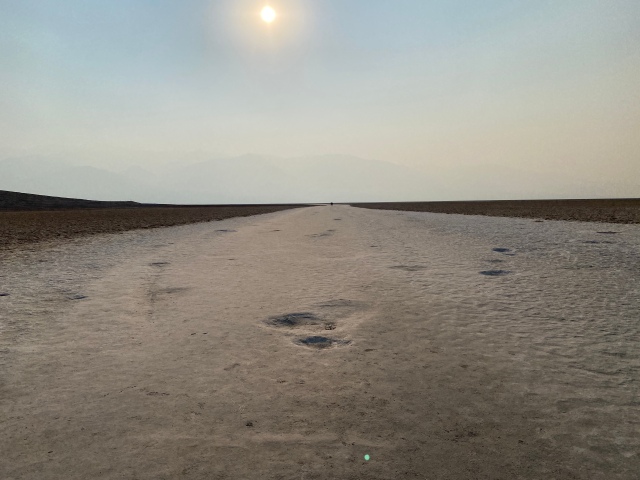
Badwater Basin at 282 feet below sea level in Death Valley

Here are some of the highlights:

Shoshone – We set off from my brother and sister-in-law’s home in Palo Alto. As we made plans the day of our travels, I searched for places to stay as we drove down I-5 on our way to Bakersfield. I found a motel that was in the town of Shoshone about 45 minutes from one of the park entrances. Shoshone was just a little dot on the map. By the time we passed through the dilapidated town of Baker, I had no cell coverage. I had no idea if the motel had even 2 stars on their reviews. I was starting to get nervous because, arriving in Shoshone after driving 500 miles into the middle of nowhere, we had no other air-conditioned options. Thankfully the Shoshone Inn was a completely renovated delightful motel. We almost opted to buy a few gallons of gas but at $5.49 per gallon, we figured that a half tank would get us to Las Vegas. If you go to Death Valley, the Shoshone Inn is a must-stay although make sure you go with a full tank of gas.

Jubilee Pass Road

We left for the park from the motel around 6 PM. We had no idea how long it would take to visit the park but we knew we at least wanted to go to Badwater Basin, so we headed out, according to the map, by the most direct route. We had no GPS as we headed on Jubilee Pass Road. It was 115 degrees, a blazing sun, a desolate road, and absolutely no other living things as we drove on a road with no signs except to instruct to stay on the road (no problem there). I was nervous. We had a few bottles of water but you start thinking about “what if’s” as you drive in such inhospitable territory. If we break down, if we get a flat tire, if the engine overheats….you get the picture. This was obviously not the main road in the park, the terrain was other worldly with its orange, yellow and white rock without vegetation or signs of life. I know what you’re thinking…. it’s not call Death Valley for its abundance in flora and fauna but the reality of driving through it is breathtaking. Scary, cruel but breathtaking.

Badwater Basin

From the motel, it took 90 minutes to arrive at Badwater Basin. 90 long, dry, hot minutes to arrive at what is the money-shot of Death Valley. This is the lowest point in North America at 282 feet below sea level.  When we arrived, it was 120 degrees. It was remarkable how the temperature climbed as we started going below sea level.  We parked and walked out on the salt flats of the evaporated “badwater”. It was oppressively hot and the wind was relentless. Buffeting winds whipped across stark salt flats and the Panamint Mountain range 10 to 11 thousand feet (obscured by smoke) loomed as a silhouette. There were two cars in the parking lot, so it was comforting to know that we were no longer alone in such an inhospitable place. High up on the valley wall was a sign that said “SEA LEVEL” which really makes you grasp how truly isolated we were.

Zabriskie Point

We decided to go back on a more heavily traveled road and stumbled on Zabriskie Point. By this time there were three cars in the parking lot (a CROWD!). A winding paved path goes up the Zabriskie Point which is named after Christian Brevoort Zabriskie, general manager of the Pacific Coast Borax Company (the company used twenty mule teams to transport borax mining operations in Death Valley). This vantage point is stunning. Again, there is no vegetation, or birds, or bugs. Just rock formations some of which look like jello molds or waves of soft ice cream. It felt like I was standing on the precipice of a cataclysmic change that had occurred many thousands of years ago and that I could have traveled by rocket ship to have witnessed it.

We only visited about a quarter of the National Park. I feel like it was just a taste. Perhaps a nibble of the entirety of the park. If you can make the trip, in a sturdy, gas-filled car with plenty of water, I would highly recommend it. I know I will be going back. The best of course is that I remembered as we arrived back at the motel that I wanted to make sure I went outside to look at the stars. Roy and I walked outside and looked up at the milky blanket of stars above. If you go, don’t forget to look up at the stunning beauty above.

🐾 In Honor of my Beloved Baci

My beloved dog, Baci, passed away on August 8th, 2023 at the age of 14 just shy of 15 years. She was the center of my family for the first eight years of her life while we lived in a lake front home that was her oyster.  For the last six years, she has been my constant companion as I moved from house to apartment to town home.  In each successive move, the place got smaller and her ability to roam was hampered. I began working from home in 2020, and she became essentially an appendage.  Typically, being within 3 feet of me or, at the very least, within her field of vision as she perched on her beloved spot on the love seat. 

My beloved dog Baci

Here are all the things I will miss about my beloved Baci:

  • A morning scratch. When Baci was much more agile, she would hop up on the coach where I was sitting (or any other possible scratcher) and put her paw on my arm to get my attention to give her a scratch.  The minute I backed off scratches, she would put her paw on me again to continue.
  • Punctual. She always knew what time it was especially if it was time for a walk or a meal or a kid needed to get to the school bus.  She was always a step ahead, anticipating each upcoming event and would happily remind you in case you had forgotten.
  • Alert.  She definitely lost her vision and hearing in recent years but I can remember her starting to bark when a garbage truck was a half mile away. I couldn’t hear it but she could. She knew the rumble of the truck and knew a stranger would be in the driveway pulling out the garbage cans.  She always had a perch by the front window to bark at walkers, runners and, most especially, dogs. And if she was outside, she ran along the perimeter of her area to ward off “the enemy”.
  • Her sworn enemy was the lake.  She grew up next to the lake since she was a puppy. She ran up and down the lake bank especially on summer weekends as jet skiers and boats made waves for her to try to attack from the bank.  She fell in rarely, she was able to swim but for some reason she saw the lake as a huge wet monster.
  • Compliant. Baci would always go along with whatever was asked of her like being put in a motor boat and watching her family get on an inner tube on the dreaded wet monster (see above).  There were her Halloween costumes, a pink jacket, ugly Christmas sweaters and, probably worst of all, the dreaded bell collar on Christmas Day that hampered her ability to catch a squirrel. Near the end, I had started putting her in diapers at night and she never baulked. The obligatory picture of each kid holding her before heading off to college.  If Mom wanted it, she complied.
  • Squirrels.  Baci had an incredible prey drive.  There was one tree in the front yard that Baci chased many a squirrel up.  She would race around the base of the tree and would charge the trunk trying to get up it, to no avail. In the last two years while walking the trails of Woodcroft, she would tug on the leash trying to chase them. 
  • Rabbits. Baci would stop and “point” especially at a rabbit.  She could stand still for 15 minutes waiting to stomp on top of the rabbit.  She was never successful and, in fact, frequently would overshoot the rabbit giving it an escape route. In all of her hunting, she never brought anything home expect a bird and a vol and that was over ten years ago.
  • Flies.  Baci could catch a fly.  She could sit by a window sill and focus on the fly and then hit it with her tongue. 
  • Steps.  At the lake house my children’s bedrooms were on the second floor up a carpet covered staircase.  There were many times when she would sneak upstairs to snuggle with one of my kids in their room.  Unfortunately, we updated the house to get rid of the carpet not thinking about Baci’s ability to navigate hardwood steps. After the carpet was removed we would often have to coax her back down the stairs.  
  • Her spot.  Baci always had her “spot” in the house or apartment.  For many years until Hurricane Matthew, it was a burgundy lounge chair we started calling the Princess Chair since she always held court in the chair.  Later it was the brown love seat that she always occupied until she was less agile and then it became her gray bed.  
  • Toys.  Baci stopped destroying toys after the first few years.  She had a beloved bunny or tug toy she would grab onto and pull and growl.  She really loved a lacrosse ball for a while and many tennis balls.  She could chase and return a ball but really loved to pull on a tug.
  • Hikes.  She went on countless hikes with me and would be overwhelmed by all the smells that surrounded her.  So much so that she rarely paid attention to other hikers and their dogs.  It’s so strange that she would bark at dogs crossing her home space but didn’t pay attention to them out in the world and really wanted to forage in the forest to chase down smells. Some of my best memories of her will be hiking down a tree lined trail looking for what was around the next bend.

And now there is silence. My days are aimless without my companion to remind me of what is coming up next. Her absolute joy at each and every meal and snack. Her waiting for me expectantly to return home. The anticipation of the leash and a walk outside in a wonderful exploration of world. The happy, unconditional symbiosis broken with only memories to sustain me and knowing she had and was the best. 

👍 Steps to the Positive No

I just finished William Ury’s The Power of a Positive No.  Ury is the coauthor of Getting to Yes and Getting Past No and is a negotiating expert as well as the cofounder of the Harvard Program on Negotiation.  He knows of what he writes. “No” is one of the most uncomfortable things to say as it puts a stake in the ground or sets up a boundary. And for most folks, including myself, this can be difficult.  To push back in scenarios where work is impeding your personal life or standing firm in a decision to go down one path instead of another (more popular, better supported) path can be anguishing. 

The first paradigm around No that I learned was from coach and author Christine Kane in what she originally referred to as the Proactive No and, has since changed it to, the Natural No.  I can see now that they have some of the same principles although Ury’s has a lot more detail. Kane’s structure is really more a combination of Ury’s Step 1 and Step 2 and leaves out Step 3 which I can see is very imporant.

Here are the 3 steps to the Positive No:

Express your Yes. As Ury writes, “Perhaps the single biggest mistake we make when we say No is to start from No. We derive our No from what we are against – the other’s demand or behavior.  A Positive No calls on us to do the exact opposite and base our No on what we are for.  Root your No in a deeper Yes – a Yes to your core interests and to what truly matters.” So, I have to think about what my core belief is or my why.  If my boss wants me to work this Saturday, my Yes is quality time with my family.  My Yes is spending dinners with my family.  My Yes is getting 8 hours of sleep.  My Yes is focusing on plant-based foods.  I have to figure out my underlying Yes before saying No which takes thought.  Leading with Yes is a much more positive, respectful approach.  Kane’s framework involves preset boundaries and expressing them like “Sunday nights are for family” or “I only work with 10 clients at a time.” Being very clear with your boundaries or what you say Yes to. It’s not about stopping someone in their tracks, it’s shedding light on another aspect of your work or life that perhaps the other person is not aware of. It takes preparation and thought but start with your Yes. And it gives the other person a chance to understand you better.

Assert your No. Ury posits, “Saying No is essential to life.  Every living cell has a membrane that allows certain needed nutrients to pass through and repels others.  Every living organism needs such boundaries to protect itself.  To survive and thrive, every human being and every organization needs to be able to say No to anything that threatens their safety, dignity and integrity.” He says that No is quiet, deep and firm. He also suggests having a Plan B which is a backup plan but is not dependent on the other person. He also recommends answering three questions before saying No, “Do I have the interest in saying No? Do I have the power?  Do I have the right?” It’s important to focus on yourself and not to sweeten it up to be more receptive by the receiver. I’ve waffled many times in the past on my No.  No is not a negotiation, it’s a statement.  Controlling the other’s person’s reaction is not up to you.  You can always empathize with how they feel like “I can see this caught your off guard” or “I understand you are upset with this”.   Just don’t sympathize or feel their pain, just understand their pain. In Kane’s Proactive No, the No is the main focus although the Yes is embedded in it by saying “I spend dinners with my family so I can’t attend this meeting.” It gives the why Yes and the No all in the same statement. It leaves off the next step which I think is the most important. 

Propose a Yes. Ury states, “Delivering a Positive No is the cure of the process, requiring skill and tact.  It begins with an affirmation (Yes!), proceeds to establish a limit (No) and ends with a proposal (Yes?). This gives the opportunity for a positive outcome. You’re closing one door and asking the other to walk through another door.”  Making a proposal shows respect and anticipates their needs. “Quality family time is important to me (Yes), I can’t work on the project this weekend (No), I propose I work late Monday and Tuesday to get it done (Yes?).”  It also gives the other person a chance to say yes.  Sometimes, the other person is angry or triggered. Sometimes, you can be upset or triggered.  Giving space to cool off and coming back to a proposal may be in order.  Sometimes, there’s not enough information and you can suggest a later time or to gather more information. You can also you If…Then proposals, “If I get project C done by noon, I can sit in on the interview.” I think the proposal aspect is the most freeing of the process because it’s not the cold hard No.  It’s a No with a possibility of a different Yes. It’s a great opportunity to test assumptions. 

I really think this framework is empowering because I typically would get caught up in being nice and not wanting to ruffle feathers so I would avoid saying no.  It’s also important to know that someone could get angry or defensive or sad but none of that is in your control.  What is important is making space to live your values and being able to set up boundaries.  How do you say No?

🇨🇦 5 Reasons to Visit Victoria

I visited Victoria, British Columbia in July of 2023.  This is a trip I had wanted to do for some three years but was waylaid due to Covid and Canada basically being locked down for over two years.  I had taken a cross country trip in 2021 and had hoped to visit Victoria but hopes were dashed as Canada continued to keep its borders closed to tourists.  I absolutely love Victoria, as I had visited it over 20 years ago and I was excited to return. It did not disappoint. It’s like Seattle and Oxford had a baby, modern Pacific Northwest meets quaint, countryside England.

Along the inner harbor of Victoria BC

Here are the 5 reasons to visit Victoria:

Butchart Gardens.   I have been a garden devote since growing up in Northern Delaware in close proximity to the magnificent Longwood Gardens.  I was always drawn to gardens and Butchart in particular because of my dear grandfather “Daddy Ott”.   He came over every Saturday morning to my childhood home to work on his masterpiece rock garden.  He used to take me to Longwood as a child and I remember seeing his photos of Butchart in the 1960’s and 1970’s when he traveled extensively.  His photos did not do Butchart justice.  Butchart is an old limestone quarry where Robert Butchart used the limestone to manufacture cement.  His wife, Jennie Butchart, took it upon herself to use the leftover quarry to initially design a Japanese garden and then, after 30 years, developed it into the 55 acre display gardens that it is today.  What I am struck by is the expanse of color, it’s not a row of Zinnia’s or a trim of Marigolds, it’s a carpet of Zinnias next to an entire plot of marigolds.  I’ve never seen the sheer quantity and types of roses in bloom in the rose garden.  It’s mind boggling! And the entire place is still privately owned after 119 years. Every nook and cranny holds a deliberate fountain, statue, totem pole or gazebo.  It is all so exquisite and is like a treasure hunt around each impeccably manicured corner. It is not to be missed and a reason to travel to Victoria all on its own.

The wonderful sunken gardens at Butchart Gardens

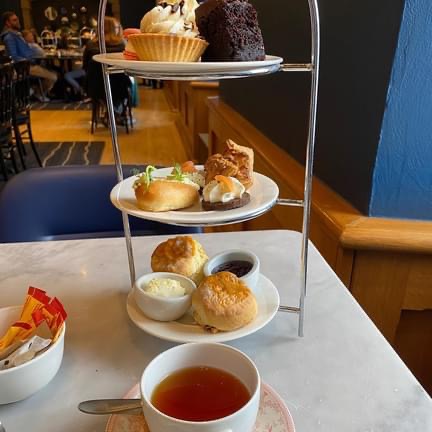
The Empress Hotel.  On my first trip to Victoria back in the late 90’s with my then boyfriend, David, he made a reservation at the Empress for afternoon tea.  I’m pretty sure this was my first ever afternoon tea.  I decided to go on my own this time, and it was, as to be expected, flawless. The hotel itself has been facing the banks of the Victoria Inner Harbor since 1908. Afternoon Tea has been served at the hotel since it opened.  The piano playing, the flawless service and impeccable finger sandwiches are a once (or twice) in a lifetime experience.  I really enjoyed it as some of the ladies coming for tea came resplendent in floral dresses and fascinators. I’ve now had afternoon tea across the United Kingdom and Denmark and can confirm the clotted cream and tea timer were perfection.

The Duen.  Nothing in this world brings me closer to my father than going on a sailboat.  I was excited to see a historic tall ship in Victoria’s inner harbor when I came in on the Black Ball Ferry from Port Angeles, WA the Monday after my daughter’s wedding in Sequim, WA.  The Duen is a Norwegian built Ketch and is 72 feet long.  I was able to book a 3-hour sail right out of the inner harbor.  The owner and Captain, Michael, his wife, Manon, and crew, Ryan, were about the nicest people I’ve ever met.  The other passages were from other parts of Canada and Switzerland.  We sailed by the historic Fisgard Lighthouse (oldest lighthouse in BC) and Esquimalt Lagoon.  It was also a great vantage point to see the floating Fisherman’s Wharf along Victoria Harbor. I was given the helm for about 20 minutes as Mike gave me hand signals on how to steer the boat.  It just doesn’t get any better than being on the water with 25 knot winds, the spray coming over the boat and the glacial Olympic Mountains in the distance. The Duen is not to be missed.

Restaurants. I remember on my first trip to Victoria, I had not yet traveled to England.  The many tea shops and pubs were foreign to me.  It’s like every day is Sunday here in Victoria.  Every cafe has upwards of ten different kinds of Eggs Benedict and the best restaurant coffee.  I highly recommend John’s Place, Blue Fox Cafe, Frankie’s Modern Diner and Murchie’s Tea & Coffee. There are ice cream shops and plenty of Chinese restaurants as well with what was the largest Chinatown on the west coast of Canada.  Of course, there is also afternoon tea at the Empress and at Butchart Gardens as well.  Victoria is a restaurant destination. 

Weather.  Victoria is a weather destination for Canadians as it’s the most southern point and is in a “Rain Shadow” similarly to Sequim, WA in that it doesn’t get as much rain as the surrounding areas like Seattle and Vancouver. When I went out on the Duen you could plainly see the fog along the Washington State shore as we were sailing to the north under clear blue skies.  During my week in Victoria, the temperatures were lows in the 50’s overnight and highs in the upper 60’s to 72 degrees.  This was as the rest of the US was under heat and smoke advisories.  The hanging flowers on every light post were in full bloom and the flowers in front of the Legislative Assembly Building spelling out Welcome to Victoria were in full bloom. Each day was picture perfect so that when I return, I will definitely try to come back during the summer.

There are some quirky things to see in Victoria like Fan Tan Alley which is a super narrow alley where they hid opium dens back in the 1800’s and the Miniature Museum with probably a hundred different miniature scenes.  It was a wonderful escape to a foreign country with nice people, great coffee and a British slant on food.  I will be back. 

💜 6 Elements of a Magical Wedding

My daughter, Natalie, married her long-time love, Kevin in July of 2023.  This wedding was two years in the making partly because of Covid and the many impacts it had on scoring the right venue and the backlog of the nuptial pipeline.  They became engaged in a cemetery in Portland, Oregon, Kevin has an October birthday and both Natalie and Kevin are devotees of costumes and all things spooky. The engagement itself represents something important about them as a couple, they follow their hearts and easily shun the conventional. They knew what they wanted and they made sure that everything from the engagement to the wedding aligned with those desires.  

My daughter Natalie and her husband Kevin at their magical wedding on a lavender farm

Here are the 6 elements of a magical wedding:

Location. Natalie and Kevin were married on a lavender farm in Sequim, on the Olympic Peninsula of Washington State.  Not only was it a lavender farm but it was in the height of bloom. The Sequim Lavender Festival was two weeks after the wedding. Being surrounded by lavender (and many other flowers on the property) was a magical backdrop.  I’m not sure you could take a bad picture anywhere on the grounds and you certainly couldn’t at the golden hour when the sun is a glow at around 8:30 PM.  Not only was it beautiful but every slight breeze wafted up an enveloping fragrance.  I’m pretty sure that for the rest of my life, the smell of lavender will kick off memories of this lovely, magical union.

Food.  Kevin is a born and bred Georgian and a big fan of BBQ.  They were able to have a great BBQ joint out of Seattle supply the BBQ, Collards and Mac and Cheese.  Having authentic southern BBQ in the Pacific Northwest is no small feat from a BBQ place in Southern Seattle.  Instead of the classic wedding cake, they had cupcakes from a bakery in Seattle (Sequim is over 2 hours from Seattle), red velvet, lavender and creme brulé were the flavors offered.  I was fortunate enough to have the last creme brulé cupcake which is probably the best cupcake I’ve had in my life. They selected soulful food that connected them with their southern roots.  Enjoying this delicious food in ambiance on a farm was magical.

Music. Natalie and Kevin’s friend and previous neighbor DJ’d the music.  They had selected the processional music for the ceremony which was upbeat and fun. I remember them saying before the wedding that they had a specific list and order to all the music and that if someone had a request for a particular song well…they would need to go elsewhere.  There were many times during the reception when the dance floor was full.  The mix was eclectic and fun and it appealed to practically everyone but most especially the happy couple. Music creates magic.

Family. Natalie’s cousin, Megan officiated the ceremony with a generous but firm presence, her daughter, Jude was the flower girl although I think she felt more like a cat-lion as she meowed while dropping petals. My brothers, sisters in law, my mom, my great nieces, and Kevin’s parents and many aunts and uncles were all in attendance. Natalie and Kevins’ brothers, Brian and Benson were best man and groomsman respectively.  Family flew in from all parts of the country from Florida, California and Georgia to be a part of this magical event. I’m not sure I’ve met such authentically nice folks as Kevin’s family and the joining of all of us together felt like people I had known all my life. My brother dancing with his young granddaughters on the dance floor and my son and daughter dancing together are memories I won’t soon forget.  The most memorable moment will be Brian, the best man’s, speech during the ceremony when he brought out of his pocket on a red heart…” because it was from the heart”. It was so heartfelt, his brother Kevin had to comfort him in order to get through it. Magic is in the family.

Friends.  Natalie and Kevin have the strongest friend group I’ve ever met.  They’ve been together for over 8 years and have friends from Duke, NC State, U of Georgia and from the greater Seattle area. If someone is a friend of Natalie’s they are also, if not equally, a friend of Kevin’s and vis-a-versa. Perhaps it’s because they have moved together or because they have known each other so long but there are strong bonds between them and their friends regardless of where the friendship started.  Kevin and Natalie are deeply loved by their friends and it was pervasive throughout the week leading up to the event and during the event.  Upwards of twenty different friends helped set up and bring things to Sequim for the wedding.  Each person in the bridal party was helpful and pulled their weight whether it was steaming someone’s gown, finding one more bobby pin or lugging coolers full of wine and beer. There was more than one friend that told me how much they love this wonderful couple. Lauren, the person of honor and a roommate of Natalie’s from Duke gave both a heartfelt speech during the ceremony and a memorable toast during the reception. Friends create the magic.

Love.  One of the most memorable aspects of the ceremony is that both Natalie and Kevin spoke twice. They wrote their vows and passed the microphone back and forth.  It’s the first time I’ve seen that. It felt like a conversation that we were all a part of.  That the end of the ceremony wasn’t the end of conversation but that it would continue on for a lifetime. Kevin brought up taking Natalie to the emergency room on Christmas Day last year. She was having an issue after a surgery and Kevin sprang into action immediately. He was there for her.  We also lost power on the coldest day in Durham, NC and he took charge by getting wood and candles as we huddled around the fire playing Uno. Natalie was in charge of the wedding plans from the start and had a clear vision of what they wanted and knew exactly how to make it happen. She loves Kevin and she wanted it to be a memorable wedding.  It was.  It was memorable and magical.

I had the greatest honor to guide my beautiful, precious daughter and her infectious smile and spirit down the aisle surrounded by love, acceptance and belonging by all those loved ones on a picturesque, magical Saturday evening. She will always be in my heart and the memory of that wonderful union will live with me forever.

💡6 Coping Mechanisms for Blamers

Your co-worker is constantly blaming his boss for his 80 hour plus work weeks.  You are blamed by the project chair for the missed deadline although they were responsible for the delay.  Your partner blames you for the cold dinner, after arriving thirty minutes late.  You end up embarrassed.  Dumbfounded.  Sometimes seething.  These destructive feelings, when ongoing, cause irreparable damage to the relationship and your self-esteem.

blamers

Blamers are everywhere.  I see blamers as those who have external locus of control.  As defined by Psychology Today, “The belief that events in one’s life, whether good or bad, are caused by uncontrollable factors such as the environment, other people, or a higher power.”  If you feel as though everything is out of your control and out of your realm of responsibility, you’re going to have lost that responsibility elsewhere.  This is what blamers do.  “A person with an internal locus of control believes that he or she can influence events and their outcomes.” Odds are that if you are suffering from the blamers around you, you have an internal locus of control and are feeling responsible for the blame that is heaped on you.  Fear not!  There are ways to cope with this.

6 Ways to Cope with Blamers:

  1. Own your piece. Everyone has at least 2% of the truth. This is a tenet of CRR Global. So does the blamer.  If you get defensive and start arguing with the blamer, it is discounting the 2% of truth.  Maybe you were late with one little piece of the project, maybe you didn’t answer the email by the deadline, maybe your ideas weren’t well fleshed out.  I’m not suggesting you be a doormat, but acknowledge the 2% that is correct.  It’s not “I completely blew this, I’m sorry” but “I can see that responding faster to that email would have impacted the outcome.”  Everyone is right…partially.
  1. Find the brilliance. A lot of people rarely compliment the other folks in their lives. Whether at home or at work, we don’t try and catch people doing something right.  But everyone does something right every day.  Even if it’s brush their teeth or complete the monthly report on time.  Look for the positive.  Hunt for it.  I was working with a narcissist once.  She didn’t like any of my ideas for a project.  She showed me one of her ideas which I sincerely thought was innovative.  I said, “This is brilliant.”  She did a 180 degree change on the project.  Now she was onboard.  If I had held my tongue, we would have remained at logger heads.   Look for the brilliance.  Then broadcast it.
  1. Listen with empathy. When someone is blaming either someone else or you, be sure to actively listen with empathy. This can be difficult.  It can be painful to hear someone trash your best efforts.  It will help to focus on your breath so that you can stay out of going to your lizard brain and activating your limbic system (the fight or flight response). It may even take returning to the topic later after you’ve had a chance to cool off.  My son was upset with me a few nights ago and asked that we talk about the topic on Sunday morning.  This was really effective.  I had time to reflect and he had time to reflect.  We were in a better space to listen and be empathetic. Make space to listen.
  1. Respond looking for solutions. Aja Frost wrote a great article called 7 Perfect Replies to (Politely) Shut Down Negative People. My two favorite for coping with the chronic blamer is, “Is there anything I can do?” and “I’m sorry to hear that. Did anything good come out of the situation?” This can shut the blamer down because it is focused on forward positive motion.  Blamers typically want to dwell on how bad everything is. I have asked clients who are focusing on blame, “What 2% are you responsible for?”   This is a proactive approach.  It focuses on what can be versus what was
  1. Come from a place of love. As Kelly Smith wrote for Tiny Buddha, “Remember, all actions are based in either fear or love. Base yours in love. Realize their actions are based in fear. Often, these fears are ones that no one can reach because they are too deep-seated for the person to acknowledge. Accept that, and continue to operate from your own base of love.” I personally have been meditating on loving kindness for years.  My mantra has been to be the “Love and light” in my life.  Having an open heart and compassion for others helps me see the good in all people regardless of the facade they may be exhibiting.  We all want to be loved, happy and at peace.
  1. Let go. As Kelly Smith wrote, “It’s not worth your constant wondering and worrying. It isn’t good for you to hold onto it and over-analyze it. Let it go; visualize yourself blowing it all into a balloon, tying it off, and letting it drift away. Feel lighter because of it!” I love the balloon metaphor.  Another practice is to clench your hand in a fist with your anger towards the blamer, and then release.  Let the blame dissolve into the ether.

Sometimes your best efforts can’t change or pacify other people’s behavior.  There may be a difficult decision in front of you.  Chronic blamers can be toxic for an organization or family unit.  If you’ve tried these coping mechanisms and you still feel like your self-esteem is being affected, you might need to move on.

😉Letting Go and Moving On

You are still mad that you didn’t get that plum promotion. You are still ruminating on the time you totally blew Thanksgiving dinner some 15…er 20 years ago. You still can’t believe that that guy from Sophomore year never called you back. You’ll never forgive your parents for not being perfect. Turns out that all this ruminating and dredging up all the past sins of you and others is a recipe for long term unhappiness. It’s time to let go and move on.

It’s crazy how much time that most of us spend on rehashing the sins and failures of the past again and again and again. Or “should-ing” all over ourselves. The “what ifs” take over and suddenly we are on a new trajectory that is completely false and, in fact, painful. There are some steps you can take to get past the past. The rehash. The regurgitation. Want some freedom? Here are a few ideas:

  • Reframe.  As Mark Chernoff writes, “Oftentimes letting go is simply changing the labels you place on a situation – it’s looking at the same situation with fresh eyes and an open mind.”  So, change the frame around the situation.  Didn’t get the promotion? This is a great opportunity to learn something new and completely different.  You could be kicking butt as a yoga instructor. What an opportunity.  That dry turkey from so many years ago?  It’s a success because absolutely no one remembers it but you.  They all remember what a great time they had and how you produced the WHOLE dinner on your own.  You are the Thanksgiving Hero!  Your imperfect parents?  Yeah but didn’t they get you safely to adulthood.  Are you a bit thicker skinned because of the bumps along the way?  Thanks Mom and Dad for giving me resilience.  Reframe your trials and tribulations.
  • Effort.   This was my insight from this past week’s meditation. Did you give “it” your best effort? Especially at the end of what you thought was a lifetime relationship.  Did you give it your best? Were you your best self? If so, let it go. If you didn’t give your best effort then maybe you should revisit and show up with your best. When you have given it your very best, then it’s time to let go. Giving only a little effort and letting go just means it was never that important to you. If you are constantly doing this, you may just be skimming through life. Give your best effort and then, walk away with your head held high. You gave it your best. Move on.
  • Emotions.  You cannot go around, you must go through. I believed that I could cry a few times and then tip toe around the grief. Nope. You need to feel it. Accept it. Live it.  Fully sense the constraint in the pit of your stomach, the heat on your forehead and the tightening of your throat. Then label it. “Oh…so this is grief.” Definitely find a time and private place to do this (so staff meeting isn’t a good time for this). Skipping this step only ensures that it will come back again and again. Experiencing it eventually makes it clear enough so that you can move on.  For me the barometer was when I told the story of loss to someone new, I didn’t get choked up anymore.  Be sure to live through the emotions.
  • Care.  Take care of yourself. What does self-care look like for you? Is it a new dress? A facial? Going for a ten-mile hike? Fishing along a stream? Making a seven-course meal for yourself? Seeing the latest feature film? Karaoke? Roller skating? Sky diving? Scuba diving? Sitting on the beach with a great book? Taking that new yoga class? One of the main things about letting go and moving on is making yourself a priority. Since suffering my loss, I’ve been driving once a week for 70 miles for a group meditation practice. It recharges me and resets my brain. Take care of yourself.
  • Gratitude.  My home was flooded during Hurricane Matthew in 2016. I had a list of over ten thousand things that needed to get done to finish the house. I don’t focus on that list. It’s debilitating to focus on all that is wrong. Instead I write in my gratitude journal every day about what is going right! It’s much more uplifting. After a few weeks, my attic was finally empty of all its contents. E.V.E.R.Y.T.H.I.N.G. What a weight was lifted. I was so grateful. Being grateful rewires your brain to the positive. Show your gratitude.
  • Truth.   In one of my recent readings I read the Total Truth Process by Jack Canfield. The premise is to write a letter to someone who has hurt or injured you at any point in your life. It could be anything from your parents to middle school to the nun who smacked your hand in catechism class. I have a list of folks and I am working my way through the list (don’t worry, I’m sure you aren’t on my list).  Anyway, write a letter answering Canfield’s questions:
  1. Anger and resentment. I’m angry that … I hate that … I’m fed up with … I resent …
  2. Hurt. It hurt me when … I felt sad when … I feel hurt that … I feel disappointed…
  3. Fear. I was afraid that … I feel scared when … I get afraid that I…
  4. Remorse, regret, and accountability. I’m sorry that … Please forgive me for …
  5. Wants. All I ever want(ed) … I want you to … I want(ed) … I deserve …
  6. Love, compassion, forgiveness, and appreciation. I understand that … I appreciate … I  love you for … I forgive you for … Thank you for …

I haven’t given the letters or talked about them with the person I have addressed  them to but it is quite cathartic to get it on paper and out of my head.  Sometimes bullet #3 showed up.  Sometimes not.  But I highly recommend writing the truth down.

This is all a process and cannot be sped up (although I wish it could be).  Having a coach can be helpful as well.  My coach pointed out some great resources on transitions.  Having a third unrelated party to provide insight and thoughtful questions can be invaluable. What do you need to let go of?

😎6 Years of Sobriety

On July 8th 2023, I will have been sober for 6 years.  This is not a milestone I ever thought would be an important one for me.  I was never a “low bottom” drunk.  I didn’t lose my job, my house, my family over alcohol.  I didn’t drink in the morning (except maybe in college but we had been up all night….so it doesn’t count, right?).  I never drank a fifth of liquor in one sitting. Although, there was a memorable 19th birthday bonfire where I drank at least half of a Jack Daniels bottle but that and the chewing tobacco came right back up somewhere in the woods of New Hampshire.  Jack Daniels didn’t pass my lips for at least a decade. The issue was that my lessons from alcohol were always fleeting and there was always some occasion where it seemed an imperative that I have a glass, a bottle or shot of whatever. 

I began drinking as a teenager.  I’m guessing fifteen. I remember my parents having bridge parties at our house, complete with whiskey sours that I’d grab a taste of. They had a sweet tangy flavor with a slight throat burn.  There was always my mother’s dry sherry in the refrigerator or beer stacked on the wall of our basement staircase. My father was never a big drinker and rarely drank except on special occasions.  I can remember my mother reclining in the family room La-Z-boy with a cigarette and a glass of sherry after working all day, and after preparing the family meal.  I thought it was all the great reward for getting through the day.  Kick back, light up and numb out to some sherry. My friends and I would pilfer beers from each other’s houses and sit outside drinking a can or bottle of whatever we might scrounge. I don’t remember being drunk, at least not in the beginning. 

My early twenties were spent in plenty of bars

By the time I went to college in upstate New York, I found that drinking helped me numb out my feelings of inadequacy.  My two older brothers were straight A students and athletes as well.  I always suffered from a recessed chin even after braces and head gear for 3 years. I always thought that contacts and my braces being removed would magically make me beautiful. It didn’t.  At least in my eyes. Teasing in high school was merciless and I can only thank God that at least I didn’t ride a bus but walked to school each day.  There was this horrible ritual of guys standing at the entrance of the cafeteria holding up numbers (remember Bo Derek and “10”?). There was nothing more painful than walking into that cafeteria and hoping they didn’t notice me to assign a dreaded number.  

I remember freshman year at Cornell in isolated upstate New York.  The drinking age was 18 at the time which wasn’t helpful.  Going to the Thirsty Bear which was an on-campus bar a short 200 yards from my freshman dorm room made drinking so convenient. I worked at an on-campus restaurant called “Noyes Lodge” (aka Pancake House) and the crew that worked there became lifelong friends as well as drinking buddies. We created a group called the PHD’s or Pancake House Drunks.  We went drinking every Thursday night, complete with white lab coats and only went to bars that had tables big enough for our group (some nights up to 30 people), beer by the pitcher and Mack the Knife on the jukebox. We had countless drinking games.  Instead of drinking to numb out, I drank to have fun.

My first job out of college (yes, I even graduated), was in Midtown Manhattan.  I remember initially feeling incredibly lonely on the 11th floor of the Hotel Lucerne on 77th street. It was summer and no air-conditioning and I didn’t know a soul. I worked at the west side location of the catering company but once they moved me to manage the east side location, I fell into a group of actors, dancers and musicians.  We spent Monday mornings reviewing where we had brunched the previous day and who had the best Bloody Mary’s and which bar had the best happy hour.  Alcohol was now a revered art. 

My first husband and I moved to San Francisco where, as always in the restaurant business, everything was permeated with alcohol.  I was a cocktail waitress at the San Francisco Airport and there were bartenders who would pour Kahlua into my coffee on the day shift. I didn’t object. Eventually I was a restaurant manager for a Sizzler franchise in Sonoma County and I’d always pour a glass of wine or two at the end of the night to take the edge off and relax.  By now alcohol was a way to try and get to sleep after a twelve- or thirteen-hour shift. There were only two times that I was sober for an extended period of time, when I was pregnant with my two kids.  It’s remarkable because, I was concerned about their health and welfare but not my own.  Within a few months of giving birth, I would be having that crisp Chardonnay at the end of the day.

Eventually, I divorced and changed careers to Human Resources.  You would think that getting out of the alcohol centered hospitality business would help me reduce my two glass of wine drinking habit.  I remember my first mass layoff of some 40 manufacturing workers.  The stress of taking someone’s livelihood from folks who were mostly immigrants was devastating. I remember thinking that the owners should pay for the case of Chardonnay that it was going to take to get me past the nightmares. Alcohol was now my eraser.  

I moved back to the east coast with my second husband and my two kids about 20 years ago.  We lived in a lovely lakeside home that was walking distance to the country club. Pretty soon the bartender knew my name and which Chardonnay I wanted.  We took up golfing and an enormous Styrofoam cup filled to the brim with Gin and Tonic was a great way to float through the afternoon. When my second husband started working for a distillery, I realized that my drinking habit now had an endless supply of gin and whiskey.  All our friends were based around the distillery and brewery. It was nothing to drink several stiff glasses of gin and I remember rarely making it past 8 PM without falling asleep on the couch.  I can remember saying to my husband that we were drinking too much.  In retrospect, what was he going to do? He loved his work, his product and his friends, you can’t distill gin without tasting it. Hurricane Matthew didn’t help when our house was flooded by that beautiful lake.  During the stress of living in a temporary situation, the stress of the remodel of the house and the ever present demon alcohol which was always plentiful;  he left.  I fell into a deep bucket of Chardonnay.  Within two months, I realized that I needed a reengineering of my life and that sobriety was the only choice. 

I couldn’t have done it without my dear friend Sandy mentioning a book on my 56th birthday.  The 30-Day Sobriety Challenge.  I took my last drink 10 days later.  Another great book is Quit Like a Woman.  I’m so grateful for not being dependent on a substance to take the edge off. I’ve learned to embrace being truly present for each moment.  Nothing is hazy anymore. I’m so much better at rolling with the punches and feeling through the pain and joy of each and every moment. It was one of the best decisions I’ve ever made. 

🫣4 Ways to Combat Anxiety

Looking back, it’s amazing how many things I used to get anxious about..  I had this crazy phobia about being the first person to walk into a new place like a restaurant or store.  If I was with my first husband, I would follow him in the door.  I had the same anxiety about being the first person to use a shower in a new living space.  I’m not sure if it was residue from watching Psycho, or what, but having these types of anxiety can be paralyzing, especially when I started traveling on business alone many years later. When I was in elementary school, I would wait to be the last person to present to the group, which, in retrospect was the worst as I would sit for an hour wrapped up in my head and then stumble through my presentation.  

Author and monk, Pema Chodron calls this getting hooked or shenpa. She writes, “At the subtlest level, we feel a tightening, a tensing, a sense of closing down. Then we feel a sense of withdrawing, not wanting to be where we are.” The secret is to get unhooked. As Chodron writes, “We could think of this whole process in terms of four R’s: recognizing the shenpa, refraining from scratching, relaxing into the underlying urge to scratch and then resolving to continue to interrupt our habitual patterns like this for the rest of our lives.” I love the image of refraining from scratching, if you’ve ever had a mosquito bite you know how hard this is.  The restraint from the urge and relaxing into it. It’s not easy but I’ve learned it’s possible. 

4 ways to combat anxiety:

Breathe.  I frequently get on a call with a client mid business day, who is completely overwhelmed by back-to-back zoom calls. They are unable to get present and are wrapped up in anxiety.  I ask if it’s OK if we take a minute to take three deep breaths.  That’s all it takes…one minute. Breathe in for 4 counts, hold for 4 counts and breathe out for 4 counts, three times.  It’s amazing how this relaxes the body.  It’s like when I’m doing yoga and the instructor says remember to breathe. It’s remarkable how much breath has control over being anxious. I’ve never been in a situation where 3 deep breaths didn’t help.  Remember to breathe. 

Body Scan.  I try to get out of my head and into my body when I get anxious.  I think about my big toe or my right pinky or as Positive Intelligence author Shirzad Chamine suggests rubbing my index finger and thumb together to feel the ridges of your finger print.  Robyn Ashbaugh recommends sensing the five senses by identifying the following “5 things that you can see, 4 things that you can touch, 3 things that you can hear, 2 things that you can smell and 1 thing that you can taste.”  Focusing on the body takes me out of my head where there are all sorts of chemicals like cortisol and adrenaline firing off in my brain.  Remember to scan the body.

Visualize.  This can be used when you are anticipating going into an uncomfortable situation, which for me was a new restaurant or getting up in front of a group to present.  Michael Phelps has a pre swim routine where he visualizes a perfect swim and outcome. I don’t need to be an Olympic Swimmer to do this.  I just imagine that the presentation is going to go well and that I am standing in front of the room with my shoulders back, chin up and making eye contact with the audience in a clear voice. Envision success.

Gratitude. It’s amazing how powerful gratitude is. A writer for Harvard Health Publishing, “Gratitude helps people feel more positive emotions, relish good experiences, improve their health, deal with adversity, and build strong relationships.” As written in the book The Tools, “Grateful Flow is silently saying to yourself specific things in your life you’re grateful for, particularly items you’d normally take for granted. Go slowly and feel the gratitude.”  Embrace a grateful heart. 

I recently went to an out-of-town meeting and was late.  It was a new venue for me and I had trouble finding parking and finding the door to get in. Ten years ago, I probably would have not gone or abandoned the meetings when I pulled on the first door and it didn’t open. I remember thinking how grateful I was for this group that I facilitate annually and visualized seeing the group leader.  It was just fine and I’m glad I went. How do you combat anxiety?

😁5 Tools for Forward Motion

I recently read “The Tools” by Barry Michels and Phil Stutz and found its ideas quite useful in all aspects of life; regardless if I’m procrastinating, frustrated with my child or helping a client. What I find so useful is that  it can be used in real time when I’m dreading a meeting with an adversary or trying to reframe my thoughts about a run-in with my boss.  The authors want to start a movement and welcome sharing the information they posit in the book.  So here is my take on forward motion with the 5 tools:

Reversal of Desire.  I use this tool when I’m feeling resistance or fear or when I’m anticipating something uncomfortable.  This would typically cause me to procrastinate and put off the pain. Kick the can down the road a bit. Delay the confrontation and hope it goes away.  The first step is to face the pain and focus on the pain as if it is a cloud in front of you and internally scream, “Bring it on!”. I want it because it will bring value. The second step is to internally scream, “I love pain!” and keep moving forward to be one with the cloud of pain.  The final step is to feel the pain cloud spit me out and close behind me. Say inwardly, “Pain sets me free!” As I leave the cloud I am propelled forward. I find this to be similar to going through pain instead of around it; to feel the feels. To face adversity head on, and to use it to catapult yourself forward.

Active Love. I’ve started practicing this every day, especially during my loving kindness meditation in which I wish loving kindness of family, friends, clients and adversaries. I will pick out one or two folks to focus my love on whether it’s my son that I had a disagreement with, someone in need of encouragement or a client that is refusing to budge. It can be used the moment someone angers me or when I’m reliving an injustice from the past or when I know I have to confront someone. The first step is concentrating on bringing a world of infinite love into my heart and filling my chest.  The next step is transmitting all the love into the other person and not holding anything back.  The last step is feeling the love enter the other person and feeling a sense of oneness and then relax into all the energy reverberating back so that we are both enhanced by the love.  I recently suggested this to a client who was anticipating an uncomfortable meeting with their boss and they were amazed how the meeting went so smoothly and didn’t hold the animosity that they were anticipating.  I think to some degree this works because you aren’t carrying a sword and shield into a conflict but instead an openness and oneness with the other person. 

Inner Authority.  This tool is all about taking a look at my insecurities in the form of The Shadow. The Shadow represents everything that makes you and me feel insecure like appearance, education or economic status. I imagine my shadow as an 11-year-old painful skinny girl with blue horn rim glasses and buck teeth. The are many occasions to use this: When I’m having anxiety about speaking to a new client, a confrontation, or a speaking engagement. Also when worrying about a future event I’m attending or traveling overseas or anticipating conflicts at an upcoming event.  First, I image myself on stage (in front of one person or a hundred).  Step two is to bond with my shadow. I ignore the audience and focus on my eleven-year-old self and create an unbreakable bond with her so that we are one unit. Step three is to internally shout in unison with my shadow, “Listen!”. The authority comes from myself and my shadow speaking in one voice.  This tool helps me speak with clarity and authority.

Grateful Flow.  I use this tool when I’m wrapped up in negative thinking and I’ve been taken over by the Black Cloud. The Black Cloud limits me in what I can accomplish and keeps me stuck where I am instead of forward motion.  This tool can be used when I’m in a negative spiral of thoughts like “that client is never going to pay me” and “they don’t want to use me anymore” or “ I’m charging too much.” It can also be used when sitting at a red light or waiting in line or upon waking or going to sleep.  The first step is to list what I’m grateful for. As I list what I am grateful for I try to pace myself and really connect to what I am grateful for like the new orchid blossom, the blue bird, the green leaves in the breeze or my mother’s phone call.  It’s important to mix it up each time. After 30 seconds I stop listing and embrace the sensations of gratefulness. The last step is I to connect to the energy coming from my heart and feel the power of infinite giving. I have historically kept a gratitude journal and this has been an extension of that and I’ve learned to expand my list of what I am grateful for and to embrace the power of it.

Jeopardy.  The authors emphasized that everyone will slack off from using the tools. Sort of resting on your laurels that now you have this magical state and it doesn’t need to be practiced anymore.  I’m not here yet but cues to use this tool are when you know you need to use a tool but, for whatever reason, can’t get yourself to use one or when you think you’ve grown beyond the tool.  The first step is called Deathbed Scene and you imagine yourself lying on your deathbed.  The next step is to when your older self, screams at you not to waste the present moment.  The last step is to use fear as a motivator; you don’t want to squander your life which creates an urgent desire to start using one of the first four tools. 

I think that once I really learned the tools, it became easier and more second nature to use it. I recommend you go to their website It took me trying to use them several times before I really embraced the steps. I was surprised how quickly any one of the steps take because it’s all internal and can be used any time.  Which tool would you like to try?