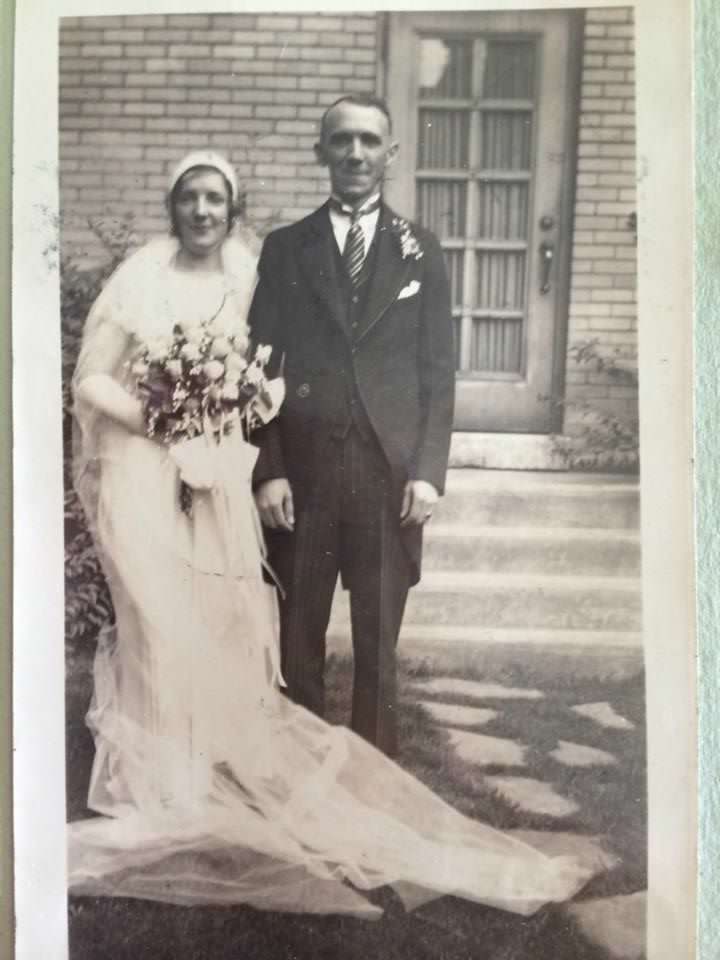
😇Remembering Daddy-Ott

Otto Wenke was born on the shortest day of the year, December 21, 1897 in Olean, New York. He was one of eleven siblings and his mother died when he was a small child. He was the first in his family to graduate from high school and went on to study business in Buffalo, NY. He served in the Navy. He met my grandmother, Mary Hammond, and eventually had a son, David, and daughter, Mary Ann (my mother). My grandfather, often referred to as Daddy-Ott, was an accountant for DuPont. DuPont was one of the first companies to occupy part of the Empire State Building after it opened in 1931. At one point in his career, he worked directly in New York, but eventually, my grandfather and his family landed in Wilmington, Delaware where DuPont was based. And that is where me, my brothers and my cousins all grew up together in close proximity to my grandparents.

My grandmother Daddy-Mar (crazy name for a grandmother, my oldest cousin Claire is responsible) died in 1962, one year after I was born. I have no memory of her but I have a multitude of memories of my Daddy-Ott.

Here are some memories of him:

Wenkeville

Every Labor Day weekend, the Wenke reunion is held in Olean, New York. With 11 siblings, some of those siblings ended up having upward of nine kids, meaning a multitude of Wenkes who grew up in Olean. There is even an area of Olean called Wenkeville! The family reunions garner upwards of 300 folks every year who get together and sing German drinking songs, remember their ancestors, play games and eat. We went several times and I can remember them all calling my grandfather “Gros Uncle” as he was the only remaining sibling of the original eleven. He was revered. Everyone came to see him and would give their kind regards. I felt like he was a celebrity. He was always in his element at the Wenke Reunion. What I appreciate most is that he wrote a history of his family to chronicle the escapades of his sister, Clara (the rebel), his father’s truck garden that helped keep the family afloat, and mapped out the various Wenke cousins on the family tree. I was always proud of being Ott’s granddaughter especially in Wenkeville.

Traveler

My grandfather was a traveler. He took a trip to the West Coast with my grandmother in the late 1950’s and accounted for every penny of the trip. The whole trip came to $724 with notable entries for 533 gallons of gas for a total of $202, 20 motel room nights at $181 and meals and snacks at $182. I think of how incredibly brave this was to head out on an 8,800 mile trip across country without a cell phone or GPS. That is wanderlust. After he retired and my grandmother passed away, he would travel to Florida, Canada and the west coast on his own. He always memorialized the trip with photos and meticulously wrote in his block pencil handwriting each location and person in the photo. Between my dad and my grandfather, I can understand why I love to wander.

Gardner

I lived in the same home in Wilmington, Delaware from the age of two. We lived next to park land and we had an enormous rock garden behind the house. The entire garden was the hard work of my grandfather. I’m sure he was inspired by the local DuPont estate, Longwood Gardens and the Butchart Gardens from his travels to Victoria, B.C. I can remember as a child that my grandfather came over every Saturday, without fail, to work on that garden. Dogwood, azaleas, impatiens, pansies, lilies, hens and chicks, and a maple tree. He had them all blooming throughout the spring and summer with nary a weed to disrupt his work of art. I can remember his voice coming in the front door of the house, “Hello, anybody home?” and sitting down to a hot cup of coffee, taking a sip and saying “hot ta ta.” He was a man of habits and we were able to enjoy the fruits of his labor.

Babysitter

Fortunately for me, I am the youngest of his grandchildren. As I was growing up and my mother returned to work, my grandfather cared for me on many occasions. What I remember most is escaping from the house in his Maroon Skylark Buick and riding “down the valley”, which included Beaver Valley Road, its hills and the Brandywine River. I loved to go gliding down in this big air-conditioned car with my grandfather behind the wheel and the farmland streaming by, honeysuckles perfuming the air. Even into high school, my grandfather would pick me up after swim practice or take me to a doctor’s visit. I could depend on him no matter what.

Piano

My grandfather had a grand piano in his apartment. He played it beautifully. In fact, he played piano when he was a teenager at silent movie houses. I had little appreciation for his talent when I was a child. I can remember visiting his apartment and him setting out block puzzles for my brother, Rick and me to play with and him playing his piano. It’s not until I tried to play the piano in elementary school that I understood what tenacity and practice it took to play the piano the way my grandfather did.

Regimented

My Daddy-Ott was regimented. Perhaps it was his motherless German upbringing, or becoming a parent amidst the Depression, but my grandfather was uniquely suited to being an accountant. He wrote in his diary every day of his adult life. Each day was memorialized with the external temperature and his daily activities in a brief 7 to 10 sentence paragraph. I believe you could set your watch to my grandfather’s activities. He was a devout Phillies fan and listened to the radio to follow their progress. I can remember crying when they won the World Series in 1980 because I was happy that my Daddy-Ott was alive to witness it. My grandfather and I had two struggles that I recall. Once when I was about 5 and he was babysitting me around lunchtime. He insisted that I could only have plain milk and I threw a tantrum over wanting chocolate milk. I can’t remember who won but boy, I remember us both being stubborn over who should prevail. For a brief year, my grandfather lived with my family, while I was in high school. Every Saturday night he insisted on watching The Lawrence Welk Show. This was excruciating for me. I loved Pink Floyd and Yes, and there I was suffering, listening to Polkas and watching bubbles float above the Lennon Sisters. What I would give to spend an afternoon watching Lawrence Welk with my Daddy-Ott now — although I’d still insist on chocolate milk!

My Daddy-Ott was a fixture in my childhood growing up in Wilmington, Delaware. He was there for Sunday dinners, Mother’s Day at the DuPont Country Club and escaping down the valley in his Buick. How fortunate I was to have a grandparent close by and involved in my upbringing. We always ended our Sunday dinners by my grandfather asking if we were “sufficiently suffonsified”? I have no idea where this expression came from but it’s basically asking if you are sufficiently full. He lives in my heart now and in my memories. I love you, Daddy-Ott.

🫣5 Fixes for Imposter Syndrome

There have been countless times in my life where I felt like an imposter. When I was in Junior High, I was first flute in the All-State Orchestra (granted Delaware is a very small state). I was initially proud of making first chair only to be overwhelmed by feeling like I would be caught. Found out. Attending the Hotel School at Cornell University where I was a work study student feeling completely inadequate with my fellow upper crust students whose pedigree far outranked my own. My first job out of college as a manager for a catering company in Manhattan. I was a 21-year-old woman working in a basement with 25 men, some twice my age, trying to manage a fast-paced catering business where the only rule was to “yes” to any customer request (i.e., lunch for 100 people in 45 minutes). Every day in that basement was complete anarchy with four phone lines of incoming orders and trying to supervise a largely immigrant crew. I felt like I would be unmasked every day.

As written by Chris Palmer for the American Psychological Association, “Up to 82% of people face feelings of impostor phenomenon, struggling with the sense they haven’t earned what they’ve achieved and are a fraud (Bravata, D. M., et al., Journal of General Internal Medicine, Vol. 35, No. 4, 2020). These feelings can contribute to increased anxiety and depression, less risk-taking in careers, and career burnout.” 82% of people are feeling the same way as me?  This doesn’t surprise me because I coach people every day who struggle with these same feelings. This manifests in my clients as countless work hours, fear of delegation and perfectionism

Here are 5 fixes for imposter syndrome:

  1. Shine a light.  It starts with acknowledging you are feeling inadequate, or you are harboring doubts. As Jack Kelly wrote for Forbes, “The first thing you should do is acknowledge these feelings when they arise. There’s no need to hide it from others or feel badly about harboring these thoughts. By confronting your self-defeating thoughts, it’s the start of taking proactive steps to change your mindset.” Turn on that light switch and make what is in the back of your brain into the light.  Acknowledging is the first step in addressing it.
  2. Acknowledge your accomplishments. It’s really easy to have amnesia about your accomplishments.  Did you grow up in a single parent home and manage to graduate from high school? Are you able to speak two languages? Have you been able to raise a child to adulthood? Did you thwart a deadly illness? Have you finished a 5k? Did you finally earn that certification you always wanted? I remember finally crossing the mile high bridge on Grandfather Mountain.  I was terrified, but I did it. Write down your accomplishments and take stock.
  3. Watch your self-talk. I find the easiest way to reframe self-talk is to use the third person.  So instead of saying “I’m an idiot”, I think “Cathy you’re an idiot”.  Seems harsh.  I would NEVER call anyone an idiot so why the heck would I call myself an idiot.  It’s similar to reframe it to what you would say to a friend.  As Palmer wrote, “Try to observe when your impostor feelings surface and how you respond to them.” Be compassionate in your self-talk.
  4. Let go of perfectionism. I’ve coached countless folks who struggle with perfectionism.  In my mind it’s the manifestation of imposter feelings.  So, they constantly work harder and longer to make their output as perfect as possible so that no one will find out that they are imperfect and, therefore, an imposter. Palmer wrote, “It may help to release yourself from rigid roles. For example, Orbé-Austin said people with impostor phenomenon often see themselves as helpers––people who come to the rescue. “Breaking free from those roles so you can be someone who doesn’t know it all or someone who can’t always help can allow us to be more robust people and professionals,” she said.” Perfection is failing, it’s suffocating and keeping folks stuck.
  5. Share your thoughts. Perhaps through therapy, a coach, or a trusted friend, share your imposter feelings with someone you can confide in. I find when I coach that when my client actually says something out loud (instead of rumination), it will bring insight.  Saying it out loud makes it real and prompts examination. As Kelly wrote, “By sharing with others, it will release the pent-up burden. You’ll quickly find out that you’re not alone and this is shared by many other professionals. You will feel a big sense of relief once you find out that it’s commonplace, you’re in good company and it’s not just you.” Share your thoughts so others can weigh in and help examine their validity.

I believe that comparison is at the root of most imposter feelings. I envy my neighbors new Tesla, my friend’s vacation to the Alps, or my sister’s promotion to Vice President. Comparison is the thief of joy and will keep me in the imposter zone. As a friend said to me recently, “Stay in your lane.” Focus on what’s in front of you and your experience and let others focus on their lanes. How do you address imposter feelings?

🥰4 Ways to Embrace Amor Fati

Definition of amor fati : love of fate : the welcoming of all life’s experiences as good

German philosopher Friedrich Nietzsche describes Amor Fati: “That one wants nothing to be different, not forward, not backwards, not in all eternity. Not merely bear what is necessary, still less conceal it…. but love it.” Appalachian Trail thru-hikers (an epic, several-month-long trek over 2,000 miles) would express this as “Embrace the Suck.” Bryon Katie wrote a whole book on the topic called Loving What Is. I’ve spent decades trying to recreate history and control the path of my future, my kid’s future and my family’s future. I imagine I have a giant eraser to take back a failed marriage and wallow in regret, or project forward that my father would miraculously cheat death as he slowly succumbed to congestive heart failure. I have learned over the last few years that I am powerless to rewrite history and to meaningfully alter the future. Amor Fati.

Here are the 4 ways to embrace Amor Fati:

Quit Complaining

As Will Bowen says, “Complaining is like bad breath – you notice it when it comes out of someone else’s mouth, but not when it comes out of your own.” Bowen is the creator of A Complaint Free World  and challenges folks to go complaint free for 21 days. I remember taking this challenge some 7 years ago and I have to say, it’s pretty tough. I mean there is the weather, the traffic, my son still hasn’t responded to my text, the soup is cold, the package is late, my assistant hasn’t responded…but I digress into complaining. It’s so easy to deny what is. It’s like the negativity bias that saved your ancestors from saber-toothed tigers. It is constantly scanning the environment to track everything that is wrong. Try it for today. Just today. Be focused on what’s right with the world. With your world. I have a roof, my son is safely home from the Republic of Georgia, a warm house and potable water. Welcome the rain, the red light, the screaming infant. Amor Fati.

Jump Forward

When I was going through my Brain Based Coaching training some twelve years ago, I remember a tool we used called 10:10:10. This is a concept developed by Suzy Welch for decision making. “Here’s how it works. Every time I find myself in a situation where there appears to be no solution that will make everyone happy, I ask myself three questions: What are the consequences of my decision in 10 minutes? In 10 months? And in 10 years?” So, if staying late to complete a project for your boss means missing your child’s play at school using the 10:10:10 process there may be a happy boss and perhaps a more resilient child. As Ryan Holiday wrote, “The loss of a loved one, a breakup, some public embarrassment… In five years, are you still going to be mortified, or are you still going to be wracked with grief? Probably not. That’s not saying that you won’t feel bad, but you’re not going to feel as terrible as you do now. So, why are you punishing yourself?” I remember selling my beautiful house by a lake in North Carolina and some 22 years ago in California a house by a creek. I thought, each time, I will never live like this again. It was true, not because my current situation is worse, it’s just different and I never would have imagined how terrific things are right now. Maybe the future is so much better than you think. Amor Fati.

Embrace the Challenge

When my ex-husband left me hanging after my home was flooded by Hurricane Matthew, I was devastated. And then? I decided that this was a challenge. I was going to get the home repaired, fix my devastated finances and create a space of tranquility and comfort. I had an endless punch list and day-by-day, week-by-week, month-by-month, I took it on and conquered it all. I would not succumb regardless of my lack of knowledge of plumbing, HVAC or foreclosure. In retrospect, the challenge of overcoming all the obstacles was the best part. I didn’t want to go through it, but now that I have, I am so glad I did. As Holiday wrote, “It’s like in a game, right? Let’s say I throw you into a football game. If you stop and spend all your time arguing over the rules, you’re never going play. Maybe it doesn’t make sense that the overtime rules are this way or that quarterbacks get special protection, or this or that, right? There are all these different rules that make no sense that are arbitrarily how the game has developed since its inception. The Stoics are asking you in some ways to accept the arbitrary rules. Then they’re saying you play the game with everything you’ve got.” Play the game and embrace the challenge. Amor Fati.

Grateful

Amor means love. It’s not just about accepting the suffering or fate; it’s about loving it. I think about this a lot as I sort through the aftermath of my divorce. I am grateful for the process, for each and every decision, good or bad, for the pain and the release, for the deception and the triumph. I would not be where I am now without the journey, without the emotional bruises, without the struggle. I am so grateful to be the woman I have become. Sober, independent, present and courageous. I do a loving kindness meditation every morning. I wish happiness, peace, health and living with ease to everyone in my family, my friends, my clients, my enemies and, lastly, my ex-husband. I imagine embracing each one. I love them all for what they have brought to my life and love the hand I have been dealt. I am most grateful for my ex-husband leaving me to live my life to the fullest. Amor Fati.

It’s all about reframing the journey. Instead of dreading the court date or the root canal, looking forward to and loving what fate has in store for me. I think a lot about, “Hmm, I wonder what exciting twist will occur?” or “What does the universe have planned for me now?” I’m not sure where I will be in 5 or 10 years but I know the journey will be exciting. Amor Fati.

😃 5 Tips to Setting Boundaries

I’ve been a professional coach for the last 15 years and have spent the last 3 years doing it full time.  I have seen themes amongst my clients with the most prevalent being the inability to set boundaries. This was especially true when many of us became remote workers at the beginning of the pandemic. Half-naked spouses walked in the background of zoom calls, we were literally transported into colleagues’ bedrooms inclusive of unmade beds, screaming children and lounging pets. There never seemed to be an off switch to my laptop and the demands never seemed to stop.  We’ve slowly inched back to what is nostalgically sort of normal (but not really).  It’s time to start rebuilding the boundaries that we either had before the pandemic or start all over and initiate some boundaries from scratch.

I love this quote from Brene Brown’s Atlas of the Heart,Resentment is the feeling of frustration, judgment, anger, “better than,” and/ or hidden envy related to perceived unfairness or injustice. It’s an emotion that we often experience when we fail to set boundaries or ask for what we need, or when expectations let us down because they were based on things we can’t control, like what other people think, what they feel, or how they’re going to react.” Instead of walking around with resentment, think about one new boundary you could set up now so that you can take back control of your life.

Here are 5 tips to setting boundaries:

Minimize Notifications. I had a client complain about their spouse because they were unwilling to make dinner when she was delayed at work.  I shared the Brene quote about resentment and said, “It sounds like he’s setting a boundary and perhaps you resent him for it.” She told me that the next evening she received a text a 3 AM.  It ruined her sleep.  She had an epiphany that she needed to set a boundary.  She set up her phone to not receive text notifications from 9 PM until 5 AM. I can remember when I first got my laptop, I was getting bells and beeps for all kinds of reasons and I spent the next week figuring out how to turn them off. Most notifications are nothing but distractions and they invade at the most inopportune times like sleep or when you want to be fully present. Turning off notifications that aren’t useful is one boundary you can set.

Communicate with Clarity.  I love the Power of the Positive No by William Ury because it’s all about communicating your values proactively instead of falling into resentment. The template is Yes, No, Yes.  The first yes is what you value like “I value being present for my family when I’m not working”, the no is “I won’t be receiving notifications after work hours” and finally the last yes which is “If it’s truly an emergency I propose you can call my cell phone.” Setting expectations is a key part of setting boundaries.  If you aren’t going to answer email or will be responding to slack messages at the end of the day, let your employee, coworkers and boss know.  It can be quite jarring when someone who would answer you immediately suddenly starts answering texts the next day.  Communicate your boundary upfront.

Get Uncomfortable. Setting boundaries is about leaning into discomfort. I typically don’t have clients of Fridays and I don’t have clients after 3 PM so that I can go swimming at a local pool. It can be uncomfortable when someone wants me to set up a recurring appointment during these times.  I don’t necessarily have a conflict but this is my time.  I have to make myself and what Stephen Covey referred to as Q2 time or quadrant 2 time, that which is important but not urgent.  Lots of things fall into this quadrant like writing this blog, going swimming and working on ancestry projects. It’s uncomfortable to make this a priority. It doesn’t help that women aren’t typically good at advocating for themselves.  To advocate for yourself by setting boundaries is to get uncomfortable. 

Others May Not Get It. When I start advocating for myself with boundaries there is a good chance that other folks won’t get it.  They may push back. It’s fine to empathize with “I can see you are frustrated I won’t change my schedule on Fridays” or “I can see you are upset that I didn’t respond to your email until this morning.” Just because someone else isn’t comfortable with your boundary is not an indication that the boundary is not useful or needed. As Wayne Dyer said, “What other people think of me is none of my business.”  Let go of the expectation that others will understand your boundary.

Stay Flexible. I go to bed at an outrageously early time for a grown adult.  I usually head to bed at 8:30 PM. This has contributed greatly to better sleep for me.  I have learned that if my kids are home or I am visiting others, I will need to be flexible. I recently saw my kid’s uncle in New York.  I hadn’t seen him in over 10 years and it meant driving a night (something I try to avoid) and not getting home until 10 PM.  Yes, I have boundaries but I need to be flexible and adaptable to the situation at hand.  I also have to pick up my son in the middle of the night as he travels back from several weeks overseas in the Republic of Georgia.  I may flex or update my boundary but I’m able to resume it, if it’s still a priority to me. 

As I frequently tell my clients it’s important to start small. I think of Tim Ferris’ book, “The 4-hour workweek,” in which he only responds to emails once a week and he had clearly outlined boundaries throughout his week so that he is able to only work 4 hours a week.  That is great for Tim.  It’s not necessary to start there for you or me.  Start small and get a win on creating one tiny boundary.  What boundary will you try first?

🪦5 Discoveries in Cornwall CT

I drove to Cornwall, Connecticut in mid-October of this year.  My purpose was to find gravestones of my relatives on my paternal grandmother’s family tree.  If you have joined ancestry.com or use findagrave.com, then perhaps you too have fallen down the rabbit hole that is researching your family roots.  As I was poking  around ancestry.com which is tied to the findagrave.com website, I started to realize that many of my ancestors were buried in the same cemetery or at least in the same region of Cornwall, Connecticut. What makes this so remarkable is how many generations and family lines are buried in Cornwall. 

Myself in the Cornwall Hallow Cemetery in front of Major General John Sedgwick and my 3rd Great Grandparents and
4th Great Grandparents graves.

Here are my 5 discoveries in Cornwall:

Cornwall is tiny. I expected the town to be at least 20,000 folks.  Imagine my surprise when driving through the Village of Cornwall, there wasn’t even a market or gas station.  Outside of a church, a historical society and library,there isn’t much else. In fact, the most recent census has the population at 1,567.  I can’t imagine how my forefathers all migrated to marry and prosper in this small town that was established in 1740 (well before the revolution).  To go to a restaurant or grocery store I had to drive at least 25 minutes into the Berkshires.  

Cornwall has 5 communities.  There is Cornwall, Cornwall Bridge, Cornwall Hollow, East Cornwall and West Cornwall.  There are some potters and artisans and a restaurant or two in some of these communities but I ended up driving to Sharon, Falls Village or Canaan to find “civilization”.  There is a famous covered bridge in Cornwall which you would assume to find in Cornwall Bridge.  There is a bridge in Cornwall Bridge over the Housatonic River but it’s not the covered bridge (crazy right?).  The covered bridge which dates from 1864 and is a single lane bridge also goes over the Housatonic but is actually in West Cornwall.  The confusion over Cornwall Bridge and the West Cornwall Covered Bridge had me quite confused for the first few days in Cornwall. 

Cornwall has parts of the Appalachian Trail. I was surprised by how hilly the terrain was in Cornwall and was surprised to see signs for the Appalachian Trail along the Housatonic River. Since Cornwall was initially and continues to be a farming community, it was surprising how hilly the region was as I’m used to the lowlands of North Carolina for farming. My friend, Susannah and I hiked part of the AT to Caleb Peak which was wonderful in the Fall and had a lovely view.  I also hiked part of the AT along the Housatonic out of Falls Village. There is also ski resort called Mohawk Mountain.  Perhaps it’s my impression that Connecticut is flat, has several large cities like Hartford and mostly beaches but there is mountain climbing in Cornwall. 

Cornwall Hallow = Sedgwick. The very first cemetery I went to was the Cornwall Hallow Cemetery. I found 11 headstones of ancestors on my Sedgwick side of the family in this one cemetery.  Here in this one cemetery were 4 generations of my grandparents from my 2nd Great Grandfather John Benjamin Sedgwick, 3rd Great Grandparents Philo and Eliza, 4th Great Grandparents Benjamin and Olive, 5th Great Grandparents John and Abigail and finally 6th Great Grandmother Anne Thompson Sedgwick. As I was searching for the oldest headstone which was Anne Sedgwick (1719-1793), a man pulled up in a truck and asked who I was looking for.  It turns out this must have been a long-lost cousin because his mother was a Sedgwick and he knew exactly where the Sedgwick homestead was which was about a half mile from the cemetery. In addition, there was a memorial to my 3rd Great Uncle John Sedgwick who was killed in action at Spotsylvania during the Civil War and was the highest-ranking Union General to fall in action. The homestead he built, a short half mile away, he only spent 3 months while recuperating from wounds during the war.  I find it amazing that 4 generations of a family prospered in the very small village which has no center but a road call Cornwall Hallow and not much else but the cemetery.

Cornwall is a connection point. My cousin Christie has photos of several houses from Cornwall in which my dad, his siblings and my grandmother lived or vacationed in over time. My 2nd Great Aunt Sadie lived here, my Great Uncle John Sedgwick Cooke and his wife Mary lived here. There are stories of the Rogers family which I am descended from 5 generations of Noah Rogers and Noah Rogers III through Noah Rogers V are all buried here in the Cornwall Cemetery and North Cornwall Cemetery.  They referred to the family home as Noah’s Ark (which I think is adorable) and then there is the Clark and Northrop sides of the family who are also found buried here including my namesake Catharine Rebekah Clark Rogers and there is one road called Clark Hill Road.  When they call something a “road” here there’s a good chance it’s single lane and gravel for up to ten miles.  But my sturdy forebears all connect here in the far western side of Connecticut. 

Here in this beautiful forested hilly country next to the mighty Housatonic River nestled in the Berkshires, 5 generations of my family found each other, established farms, grew families and whether they wandered off to other parts or stayed and kept the fires burning, they all returned here in the end to be close to family. In a letter from General John Sedgwick to his parents, Benjamin and Olive Sedgwick upon the death of his sister Olive Sedgwick Fuller, “I hope she is carried to our burying-ground.  It is a great consolation to believe that wherever I may die, I shall be buried with my family.” I discovered that Cornwall will always be a revered place in my heart for its beauty, history and my ancestral roots. 

😎It is Not My Only Line in the Play

I heard this quote at a conference in October. It really put things into perspective. We have a lot more shots at a goal than we imagine. I think back to grade school theatrical productions and not wanting to flub the one line I was given. But in reality, we have a ton of lines. For that matter, a ton of plays in life. I can get wrapped up in perfection in the job interview, or the presentation to the board, or the first date. It’s freeing to realize there are a lot of opportunities in life and it’s grand to not get wrapped up in the perfection of your next line in the play.

A recent facilitation for Daniels and Daniels Construction

I can relive conflicts in my life where I have an epiphany about what I should have said. The perfect comeback. The perfect redress. The perfect reparation. Finally putting someone in their place, and yet, the opportunity is long past. I can live in a loop in my head about how I should have played the situation differently. It takes energy. It zaps me. It’s completely unproductive. It was only one line.

So here are some ideas on how to move on to the next line in the play:

Piece it out

I facilitate a bunch of different trainings. They can range from Ethics, Sexual Harassment, or Human Resource Certification. Sometimes I present about CRR Global’ s “Lands Work”, Gallup’s Strengthsfinder, DiSC or Leadership Retreats. The thing is, when I first started facilitating, I would get completely caught up in the three upcoming events I had scheduled. I’d be worried about the one in three weeks when I was prepping for the one tomorrow. I would be overwhelmed and not sleep well. The secret is to focus on the next project. The next training. The next coaching client. By piecing it out to one project or event or client at a time, I can focus, be calm and better prepared. Focus on the next line in the play.

It’s about them

Delivering a line or a song or a presentation is all about the audience. Moving off of my own ego and onto the group in front of me is lifting an enormous burden off my shoulders. It’s not worrying about if I look fat in this outfit or if I can get a laugh out of the room. It’s delivering one piece that helps someone in their day. When you focus on them, it becomes a service. It makes it easier. I know that can seem like a lot of pressure but if I go into a room of two hundred people wanting to impress them all, it’s overwhelming and sure to fail. If I go into that same room with the intention to impact just one person’s life, it’s much easier. If it helps more than one person, terrific. If everyone gets it and loves the presentation? Even better. But the goal remains all about them.

$hitty first draft

Practically everything I facilitate, coach, or write is a first draft. I try not to overthink things. Granted, I have an editor for my blog, but the rest of what I deliver is on the fly. It’s in the moment. I’ve said some dumb things; I’ve said some witty things; I’ve said things I want to completely forget about (and usually don’t). Aren’t most conversations in life just $hitty first drafts anyway? Let go of perfection and be in the moment. If you mess up this line, there is another line coming up.

Be present in the moment

I’ve spent a lot of time rushing ahead. Planning. Mapping things out. I can be exhausting to be around. I can also spend a lot of time dwelling on the past. The Monday morning quarterbacking type stuff that is just as debilitating. The important thing is this moment right now. I facilitated a new group a few weeks back. I had never worked for this organization before. There were a bunch of unknowns: the audio visual; wall space for flip-charts; seating arrangements for the table. That’s all just flotsam. The real object is being present for the people in that room. It’s being present to tease out the wisdom in the room. It’s letting other folks shine their light for everyone else to benefit. If I’m more worried about the perfect room set up and refreshments, I’m not present for those in the room. So maybe you have to adjust the line in the play to fit the group in the room. Be present so you know it.

Be silent

It’s OK to be quiet. Not everything has to be filled with words. Time for folks to reflect is super important. Time for you to reflect is important as well. I think back to my first date with my ex. There was plenty of silence. I was OK with not filling every moment with language. I remember becoming certified to deliver a Myer’s Briggs facilitation. The instructor told us to wait 20 seconds after asking the group a question. Count out twenty seconds in your head.  Go ahead.                It’s an eternity, right? It’s an adjustment to be OK with silence. You don’t need to have language filling the air at all times. Give everyone time and space to reflect and digest. Some of the most profound moments in a play are when it is silent. Think back to all the pregnant pauses in a Hitchcock film. Rear Window would not be as griping without the silence. Silence can be powerful.

At the heart of all of this is just being authentic and present for as much as you can. Give up the need to know how it’s all going to end up. Every play is going to be different. Every line you deliver will have a different impact. What’s your next line in the play?

🙌 5 Tricks to Connection and Creativity

I recently read an interesting book by Gabriella Kellerman and Martin Seligman called Tomorrowmind. It’s a thought provoking book that looks at thriving at work with resilience, creativity and connection. Since I spent a good deal of my time coaching others, many of the tips resonated for me. They posit that we are naturally better at hunting and gathering and that every other kind of work is fundamentally a mismatch for our brain. 

As Kellerman and Seligman wrote, “Today our work is fast, uncertain, and full of complexity. We’ve come to expect that the challenges of next week will eat those of this week for lunch. Hunters and gatherers didn’t have to deal with that. The critical changes they saw were sudden and urgent, so our brains register change as threat. A huge part of the challenge of thriving at work today is overcoming the mental patterns that made sense for hunter-gatherers but no longer serve us today.” I can feel like I’m on high alert all week and yet, I’m never going to be eaten by a lion or the marketing department. The book looks for ways to cope with this mismatch.

Here are 5 tricks to connection and creativity:

Time Famine.  It frequently feels as if we don’t have enough time. Feeling like you have little time is detrimental to connecting with others. I can remember our weekly staff meetings at a company I worked for and the first half hour was spent talking about sports and events from the weekend. It was time to connect.  I remember thinking it was a waste of time but now I see that it was bringing about connection.  In a study called “Giving Times Gives You Time”, they found that, “Doing kind acts for others, even just for 15 minutes, converted people from time famine to time abundance.” When you feel behind think about ways to do something kind for others.

Connection Time.  Human beings are really bad at estimating the time something will take. Whether it’s goal setting or how long it will take to make a bed, we are woefully inaccurate.  As the authors wrote, A host of studies have been done looking at how long it takes for doctors to make patients feel seen and heard and cared for. It turns out to take less than one minute of kind words for a doctor to connect with their patient deeply enough to influence health outcomes and lower patient anxiety. Even increments as short as 10 seconds can make a difference.” Don’t we all have 10 seconds to connect? Some examples are, “It was so nice to catch up with you today. Let’s please do it again soon.”—three seconds. “I really admire how you navigated that question.”—two seconds. “I can tell you worked hard on this. Thank you for all of your effort. I’m so glad that we’re in this together.”—five seconds.” Spend time connecting.

Novelty. In order to build on your creativity, work in some novelty into your day.  Shake up your morning routine, drive a different route to the grocery store or work, or reach out to someone you haven’t talked to in a while.  A friend of mine that I haven’t spoken to in a while sent me a text about meditation a few weeks ago.  Out of the blue.  It made me think about my meditation routine and also introduced a new book for my reading list (Who knows? I might end up writing about it here).  Novelty introduces new pathways for your brain. I think this is why I like to travel so much, finding new experiences enhances my creativity.

Embrace Ambiguity. This is definitely a barrier for me.  I put off writing this piece for a while because I can feel uneasy about getting started if I can’t picture the whole thing in my mind.  This is a cornerstone of procrastination.  I want to see the whole thing and get it done in one sitting.  That, unfortunately, is rare and difficult in the current state of technology and the world.  As they wrote, “The murky uncertainty of the early phases of the creative process can feel uneasy to some of us, and we want to end them as quickly as possible. But when we shortchange the divergent parts of creativity, we put a ceiling on just how imaginative our solutions can be. Know that it’s normal to feel a little uneasy in ambiguity, but you can get used to it and even start to enjoy it. Try stretching this ambiguous phase just a little bit longer each time you hit it.”  I know it sounds painful to me.  Sitting in discomfort can be the mother of invention. 

Creative Confidence.  Henry Ford famously said “If you think you can, if you think you can’t, either way you are right.”  In the book Limitless by Jim Kwik, he writes about creating a limitless brain and practically every step starts with the belief that you can.  If I went around saying I have a bad memory….well…I’ll have a bad memory.  My body, my brain are feeding off each other.  If I walk around saying I can learn to improve my memory, I will. Think about the language you use in your head.  Catch yourself and others when they spark innovation even in the smallest of ways.  Create creative confidence in yourself and others.

I love that throughout the book they refer to the whitewater world of work.  It can really feel like we are running rapids all day and these are terrific ideas to expand your time and enhance your creative juices.  Which one will you try first?

🤔Ways to Quit Asking Why

I was the member of a Mastermind Group about ten years ago.  It was a terrific experience working with Human Resource professionals from different industries around the Raleigh/Durham area.  I always remember one of the ground rules for Mastermind, which is a group of like-minded professionals who discuss confidentially current issues in their job or business and meet on a regular basis. The ground rule was to not ask Why. I remember thinking that that seemed odd.  After all, haven’t I been asking why since I was about 3 years old?  Seems like an obvious, simple question to get to the bottom of an issue or problem.  But think about it for a moment when I ask you the following questions:

Why?

Why are you late?

Why are you early?

Why are you on time?

Why are we going?

Why is it hot?

Why haven’t you?

Why won’t you?

Why don’t you?

Why is that there?

Why don’t you just…?

How does that feel?  I know it makes me feel defensive and diminished. Like I belong on a stool facing the corner in my kindergarten class.  Is this really how I want to treat people? It can be interrogating, demanding, confrontational and judgmental all at the same time. It focuses on the problem instead of insight and solutions. What about some alternatives?

How to quit asking why:

Describe the situation.  Let’s say your employee is late with an important project.  Instead of asking “Why is this late?”, you could ask:

Tell me about the timeline for this project.

How did this get off track?

What were some obstacles you had to deal with?

What were the circumstances that led to this situation?

You are more likely to get better insight into what is causing delays for the employee that you may not realize; and be more proactive towards solutions going forward. This tests your assumptions and can open your eyes to the whole situation.

Getting unstuck. Let’s say your employee rarely seems to make progress on one aspect of their job like sending in status reports or proofing their work.  Instead of asking, “Why haven’t you completed the reports?” Or “Why don’t you check your work?”, you could ask:

What have you tried so far? 

How did it go? 

What is getting in the way? 

Who could help you? 

What other resources do you need? 

It’s important that this doesn’t open the door to you, as the boss, to take over.  It’s more about discovery for your employee to find ways to get unstuck. Instead of you prescribing the answer. 

Look for understanding.  What can be loaded into “why” is implying that the employee isn’t good enough.  Like, “Suzy finished on time so why didn’t you? “Or “Joe’s slideshow had 50 slides, why did you only have 10 slides?” This is loaded with blame and makes the employee feel less than.  You could ask instead:

What was your thought process…?

What other options have you explored?

How did you arrive at this decision?

Tell me more.

Tell me about that.

It’s important at this point to sit back and listen with an open mind and curiosity.  Frequently, if we are a new leader or new to the organization, we feel like we need to have an answer and solution for everything instead of looking for the wisdom in those that work for us.  

As a coach, I really try to steer clear of Why, and a little bit of shorthand for me is to ask either, “How” or “What” or “Help me understand”.  How about you?  What do you use in place of Why?

😌5 Steps to Hitting the Pause Button

I find that the holidays are a time of Absolute Overwhelm.  Making sure I have purchased gifts for the family equitably (like we all sit there with a calculator on Christmas morning), prepared joyful cards and letters for delivery before year end, made sure the holiday menu includes all the family traditions (Caramel Bubble is a Christmas morning must have), arranged travel home and back for my kids, find the tree and getting it decorated after Thanksgiving… is overwhelming.  The time between Thanksgiving and Christmas makes me feel like I’ll still have turkey leftovers on New Year’s Eve.  Whew.  Time to hit the pause button.

In Tara Brach‘s book Radical Acceptance, she recommends the “Sacred Pause”.  This is a break from constant striving.  Isn’t that the American way?  To constantly strive.  Who has time for a pause?  You do;  especially this time of year.  Have you ever woken up on New Year’s Day and wondered where the holidays went?  That means you never paused.  Take in the moment.  Drink it up.  Take a break and be present.

Here some ways to hit the pause button:

1. Stop. Stop what you are doing. Put down the dishes.  Stop liking on Facebook.  Get out of your inbox.  Put your phone on the charger and walk away.  Close out all the windows on your desk top.  Turn off the TV.  Don’t try this while driving, unless of course, you are not the driver.  Just stop.

2. Space.  Find a space to be.  Sit in your favorite chair.  Stand at the window.  Lay down on the couch.  Go for a walk outside.  Sometimes a complete change in environment or temperature can help break the spell.  If you are outside raking leaves, you might want to go inside.  If you are inside and have been sitting at your desk for two hours straight, you might want to go outside (this may require a jacket and gloves…use your best judgment).  Be in your space.

3. Eyes. Close your eyes.  When our eyes are shut, it’s so much easier to reconnect with ourselves.  It turns on our other senses.  You smell the coffee.  You hear the wind outside or the hum of the light bulb.  You feel the temperature of the room or the gravity of your feet against the floor. You taste the sourness of the orange juice.  Shutting your eyes turns off the constant barrage of information.

4. Breathe.  Take some deep breaths.  Feel your chest rise and fall.  Feel the air come in and out of your nostrils.  Feel your body soften as the air leaves your body.  When I find my breath, I become centered.  Present.  There is no grocery-list-making when you are focused on your breath.  Just breathe.

5. Inhabit. Tara recommends inhabiting the pause.  I love that image.  Inhabiting the pause.  Living in yourself.  Being yourself.  I invariably feel tension in my shoulders.  I concentrate on letting go.  Release the tension.  Let go and inhabit the pause.

Find a time to hit the pause button.  Before you take a shower, head into that meeting, decorate the tree or bake your sugar cookies, find a time to just pause.  Don’t wait till New Year’s Day and find the holidays are gone and you never just connected with the moment.  Do it now.

😇Angel: My Inflection Point

In 1989, I had been married for five years, toured South America with my Colombian husband, Orlando, we had recently purchased our first home and I was working in Sonoma County, California as a restaurant manager. If someone was looking from outside our marriage, you would think it was a good time to have a child. I was pretty intent on my career and wanted to rise to the position of General Manager at the time.  Out of the blue (and completely unplanned), I found out I was pregnant.  We had been using the rhythm method for birth control but regardless, Orlando assumed that I had been unfaithful (in hindsight this is a harbinger of his own infidelity) but I was astonished that he would accuse me. So, there I was 28 years old, pregnant with an unexpected child and a husband who had immediately suggested I get an abortion. This was incomprehensible to me.

I was very fortunate that my parents lived a few miles away from our 3-bedroom home in Windsor. I decided that husband or no husband, I was having this baby.  I had always wanted to be a mother.  Orlando must have come around to the idea because he ended staying and we soldiered forward into this new uncharted territory.  There were all the prenatal visits, the ultrasounds, and the sound of the heartbeat of my growing child. At about sixteen weeks, I started wearing maternity clothing and announced to my co-workers that I was expecting. In the state of California, it was mandatory to have an AFP test along with other prenatal tests.  I was surprised at about 18 weeks of pregnancy to receive a phone call that my test was abnormal and that I would need a special ultrasound at the Kaiser hospital in San Francisco (about an hour away).

My mother and I vividly remember that car trip to San Francisco.  Orlando was studying for his citizenship exam and we quizzed him on the thirteen original colonies and the constitution.  I was pretty confident that it must just be a false positive and that the ultrasound was just a formality. As with any prenatal ultrasound, I had to drink plenty of water beforehand, so by the time we arrived for the ultrasound, I was bursting to go to the bathroom and I recall having the first symptoms of high blood pressure. I remember having to walk up a hill (no surprise in San Francisco) but I had to stop several times and I started to see stars (just like the cartoons of my youth). 

I remember being in a dark room during the ultrasound as slowly more and more doctors came in to view the ultrasound.  Did I mention that this was my first pregnancy?  I had no idea what was on the ultrasound.  I couldn’t make out a thing. No one was speaking. Fortunately, they let me go to the bathroom before they brought my mother, Orlando and me into a small consulting room. They said that the placenta didn’t have enough amniotic fluid and that the fetus was not normal.  It’s all a blur in retrospect but they said they could try and add fluid to help the fetus develop although in all likelihood that if I kept the baby to term it would need a lot of care. And there was the issue of my blood pressure which was 200 over 120.  There was no way to know if I would survive carrying the baby to term. Mike drop.

I remember sitting there calmly asking questions trying to get my mind wrapped around the situation.  Tears were rolling down my face as I tried to weigh out the options based on the information they had at that moment. They needed to take blood for an HCG test which, if it was astronomically high, would point to a partial molar pregnancy and would indicate that I would have to end the pregnancy. My mother was a retired medical technologist and she warned the doctor to be sure to dilute the sample.  This in retrospect was very important as it quickened accurate results. From there, they sent me home.  Home to uncertainty as what was coming next.

The test results made it clear that it was indeed a partial molar pregnancy. This was before Google and WebMD. I do know that they told me that it was one in a million pregnancies.  As I researched this today it’s .0005% of pregnancies.  This arises at fertilization when two sperms implant one egg.  Instead of 46 chromosomes, the fetus has 69.  I remember having to wait a week until we traveled back to San Francisco for the surgery to end the pregnancy.  Kaiser had to find a specialist to do the procedure and they brought a doctor from Stanford who had performed this delicate surgery for this extremely rare condition.

When I was admitted it was in September of 1989.  At the time the Supreme Court had narrowed the rules of Roe v Wade in July of 1989.  I remember asking the resident who was inserting laminar tents (dried seaweed used to expand the cervix), if this procedure was still legal as I was then 20 weeks pregnant. He said it was but that he would do it regardless to save my life.  I don’t think I realized how serious my condition was up until that point. 

Right before the surgery, they told me that there was a chance I would lose my uterus and my ability to have children in the future. A horrendous turn of events from an unexpected pregnancy, to a wanted pregnancy to having no choice but to give it up and potentially, my ability to have children in the future. There was also the outside chance, I would lose my life.  The most poignant moment was my husband crawling into my hospital bed the hour leading up to the surgery. 

I remember waking from the surgery and only being concerned with still being able to have kids.  Fortunately, my uterus was intact but it would take a year of birth control and testing to assure the doctors that I was ready and able to safely get pregnant. There I lay in a step-down unit for a week. 

Post surgery, my husband and I escaped to the east coast to visit family and friends.  There in Jamaica, Queens was my newborn nephew, my husband’s brother, Oscar’s child, Jackie.  My mother-in-law could not understand why I didn’t want to hold the baby. It was so painful.  The last thing I wanted to be around was a newborn baby.  I held that guilt for many years although I am happy to say that Jackie is a terrific adult and cousin to my children and doesn’t bear any scars from my rejection. 

Perhaps because partial molar pregnancies are so rare, or my own ignorance, I never marked the date of the loss or gave the baby a name at the time.  A grief counselor called me about a month after the loss and I was just trying to shut the whole experience out of my life.

It was about thirty years ago when I finally named that child who never had a chance.  Their name is Angel because the sex was not able to be determined.  I have a Christmas porcelain ornament with a cherub looking up to the sky.  That’s my Angel. I light candles in churches all over the world for that Angel.  I learned that grieving Angel’s loss was an important step in my recovery from alcohol.  To sit with the pain of such a heart wrenching decision and to let grief take over and then, slowly, evaporate over time. I grieve the potential of what would have been a 34-year-old sibling to my two children.  The greatest gift that Angel gave me was the clear desire to be a mother and the knowledge that I can love something so deeply.  I will carry Angel in my heart for a lifetime.