🤠Southwestern Oddities on My Travels


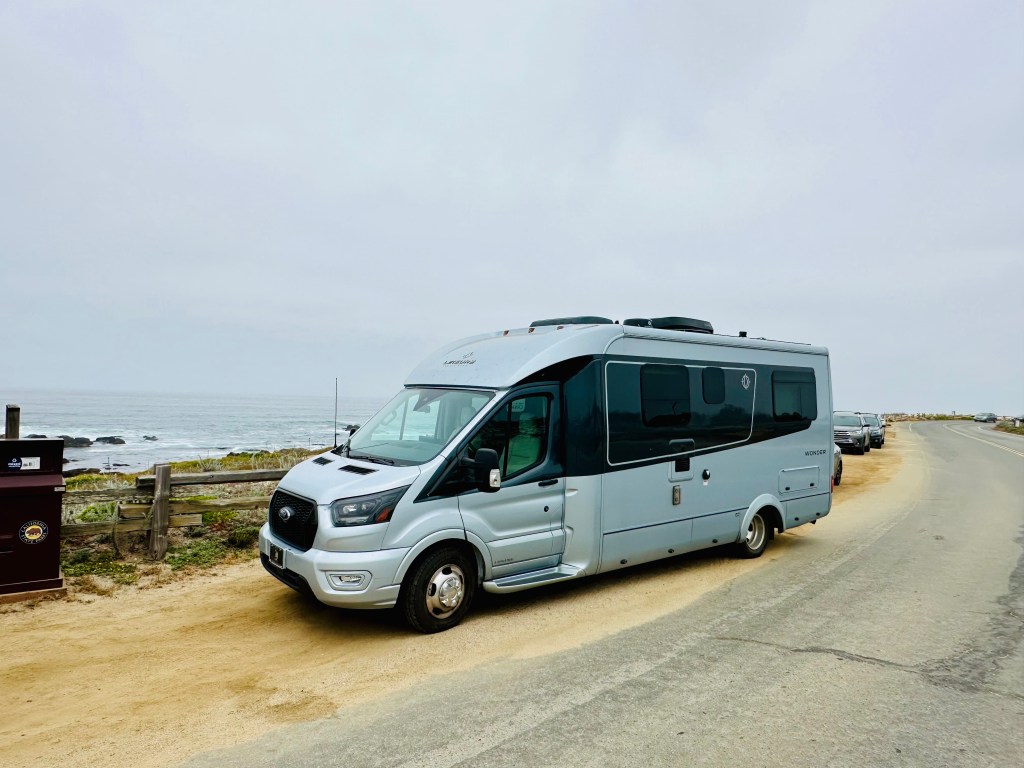
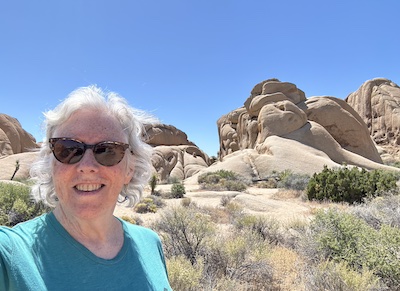
I’ve been traveling for almost 4 weeks in my RV, Abeona, through West Texas, Southern New Mexico and Arizona during the Spring of 2024.  There are some oddities that you just don’t see in Durham, NC, where my home is. I am familiar with some of these things as I lived in Albuquerque in the early 90’s but I have been genuinely surprised by some of these phenomena and roadside attractions.

West Texas

Here are some of the oddities I found on the byways of the Southwest:

Hitchhiker warnings.  I can remember my brother Rick and me driving through Arizona back in the 90’s and there were several signs about not picking up hitchhikers because we were near a prison facility.  First of all, are there really that many prison breaks that meant they needed signs for this? Secondly, wouldn’t it be pretty obvious that they were escaped prisoners?  I can remember at the time of my road trip with my brother that we were low on gas.  We were worried that we would run out and, due to the signs, we wouldn’t get help.  This was pre-cell phone. These signs are still there in New Mexico and Arizona and they are miles from the nearest prison. 

Tumbleweeds.  I always thought tumbleweeds were a creation for Looney Tunes when I grew up in the suburbs of Northern Delaware.  But tumbleweeds are for real and are quite jolting when driving down an Interstate at 70 miles an hour. They move fast and steam roll across the road out of nowhere.  

Prada Store.  There is an art installation along Route 90 near Marfa TX that looks like a small Prada Store complete with handbags and some shoes. I had been driving for about 2 hours as I was leaving Big Bend National Park and suddenly see this small store on the side of the road in the middle of nowhere.  I mean nowhere.  I’m thinking, who in the world would travel 3 hours to shop for Prada shoes? I didn’t know until later that it’s an art installation.  Crazy.

Giant Movie Roadside Tribute. Not far from the Prada Store in Marfa on Route 90 is a plywood tribute to the 1956 movie starring James Dean and Elizabeth Taylor.  There is a reproduction of the house James Dean, Elizabeth Taylor and Rock Hudson behind the wheel of a big yellow car. I can’t tell you how badly I wanted to stop and take pictures but, in an RV, it would have been too hard to turn around. 

Paisano Pete.  This is on a corner in Fort Stockton, TX.  It’s the second largest roadrunner in the world and stands 11 feet tall and has been there since the 1980’s.  At the time it was the largest roadrunner in the world until Las Cruces put in a larger roadrunner statute in 1993.  

Dust Storms.  If you have driven on Interstate 10 in southern New Mexico and Arizona, you are familiar with large yellow signs warning of “Dust Storms for the next 40 miles”.  They even have instructions on what to do (like don’t stay on the main roadway).  There was at least 200 miles of warnings of possible dust storms and I was there on a very windy day but luckily there were no storms as I was passing through.  The main upshot is that it’s windy and dusty and when they combine, it’s dangerous.

Ruidoso Bed Races.  There is an annual bed race in Ruidoso, NM.  This is a very small town in the hills of New Mexico between Alamogordo and Roswell.  I remember bed races when I was in college so seeing this annual event advertised in this tiny town in New Mexico brought back memories.

Deming Duck Races.  I immediately thought that this would be little yellow ducks which I have seen at charity events.  But no, in Deming, New Mexico, these are live ducks who race through the water to the finish line. In addition, there is a Tournament of Ducks Parade and a Duck Royalty pageant.  Random but looks like fun.

Some of these oddities are upward of hundreds of miles apart on the long, dusty roads of the southwest. It’s lonesome, dry and miles of long vacant high desert and hills.  It felt like an Easter Egg Hunt when I ran across some of these interesting oddities hundreds of miles outside of a large metropolitan city.

🥾Discovering Big Bend

I have been to many National Parks in my lifetime between a cross country trip with my family at the age of 8, a cross country move in the mid 80’s and a few more trips out west when my kids were small. Big Bend at the very edge of Texas was never on my radar until about 8 years ago.  I had never even heard of this park until then when it was featured on CBS Sunday Morning, but once I knew that there was a National Park on the edge of the Rio Grande between the United States and Mexico, it went on the bucket list. 

Hiking Santa Elena Canyon

I traveled to Big Bend in my motorhome, Abeona (Goddess of the Outward Journey) in May of 2024. It’s a little under 2,000 miles from my home in Durham, NC. I found many wonderful discoveries in Big Bend and here are some of them:

It’s enormous. I had stayed in Fredericksburg the night before I arrived and took route 385 on the northern border of the park.  It turns out that this is the least traveled entrance, although during the summer, the park is not heavily visited due to the extreme heat. Driving down through the center of the park on 385, it took almost 45 minutes to get to the visitor center at Panther Junction.  I didn’t pass a single car on the way to the visitor center. I actually was a little nervous that maybe a road was out because there was so little traffic until I got to the visitor center.  Big Bend is the size of the state of Rhode Island.  Now it doesn’t compare in size to the various parks in Alaska, Yellowstone or the Grand Canyon but anything that’s the size of a state is big.  It’s not going to be easy to see in a day. I was glad that I had three days to explore.

It’s a desert. While there are many mountains and the Rio Grande within the park, the vast majority of the park is desert.  It’s a parched landscape with cactus, agave, and prickly pear. It’s located at the northern end of the Chihuahuan Desert, which is mostly located in Mexico. It only gets about 5 inches of rain a year.  So much like Death Valley, it’s very arid and water is a must on even the smallest adventures in the park.

It’s mountainous.  Big Bend is the only National Park that contains an entire mountain range within its borders.  The Chisos Mountains were formed by volcanoes 32-38 million years ago which is really evident when you see formations like the Mule Ears which jute out above a mountain top.  The largest peak is Emory Peak at 7,832 feet and there are three more peaks above 7,000 feet. Only 2% of the park is woodland and all of that woodland is in the mountains. With highs coming in at 106 degrees, I didn’t manage to take any mountain hikes but when I took the Ross Maxwell Scenic drive, it felt like there were five or more different mountain ranges. Around each bend of the drive there was another vista with imposing mountains.

It’s a river. I was able to get out early to hike the Santa Elena Canyon trail which is right along the Rio Grande in an imposing canyon.  Although the imposing part of the canyon is on the Mexican side of the river, its cliffs are upwards of 1,500 feet tall which is higher than the Empire State Building. I was disappointed that most of the river was nothing but mud flats at that section of the Rio Grande but even still, the views along the hike were terrific. 

There are animals.  I ended up spotting several Road Runners in my hikes and travels around the park.  They almost felt domesticated, but when you see one zip off on foot, it’s apparent that it’s a Road Runner. My dear friend, Janine, gave me this insight on Road Runners:


Roadrunners symbolize good luck, magic, courage, strength, speed, and
endurance. They are also considered medicine birds by the Hopi and other
Pueblo tribes, who believe they can ward off evil spirits. The X-shaped footprints of
roadrunners are sacred symbols to Pueblo tribes because they are thought to confuse
evil spirits by hiding the bird’s direction of travel.

I felt really blessed to have seen several on my visit to Big Bend.I also ran into a Coyote walking down a road in the early morning.  I spotted several Jack Rabbits bolting across the road. Perhaps it’s because the park is so empty in the summer months but I was surprised to see such elusive animals.

There is Mexico.  I knew that it was possible to go to Mexico and the tiny village of Boquillas Del Carmen.  There is a port of entry and immigration about a half mile from the Rio Grande on the edge of the park. There are two things you need to know; you must have a current passport and plenty of small bills in US currency.  The boat ride…er….row boat ride that is guided by a guy in the water and takes about 2 minutes is the beginning.  From there you can pay a guide to walk you to the village, drive you to the village, take a donkey or a horse to the village.  I elected a burro named Maria and my guide was Raul.  He led Maria and me into the tiny village, to the Mexican immigration trailer for a wrist band and then I had a breakfast of cheese enchiladas. It was amazing as I sat outside on a plastic chair in 95-degree temperatures taking in this sleepy town of 250 residents who completely depend on the tourist trade from the National Park. Raul relayed that everything came to a stop for 12 years after 9/11 and for 18 months during COVID. Once I was back across the Rio Grande it was just about 10 minutes to repatriate to the United States. 

There is so much to experience in this park and although I was glad it wasn’t crowded because of the extreme heat, I can image that I could have explored a lot more if it was cooler.  It’s just so dangerously hot, even in May, that I would love to go back in the winter. And I just might.

🫰🏻How to Conquer Email

Since leaving my full-time job over three years ago, my use of email has dropped significantly.  As a professional coach, I think it is the biggest pain most of my clients are grappling with along with Slack or Team messaging. I recently read, A World without Email by Cal Newport and it’s a sobering eye-opening read.  As Newport wrote, “The modern knowledge worker is almost never more than a few minutes away from sending or receiving some sort of electronic communication. To say we check email too often is an understatement; the reality is that we’re using these tools constantly.” I find this was especially true in support roles like finance, human resources and IT.  To be responsive, we feel like we always have to be “on” and “on” is checking and responding to emails.

The amount of time spent on emails is staggering considering we didn’t even have this technology forty years ago.  As Abigail Hess wrote for Make It, “During the workday, respondents reported spending an average of 209 minutes checking their work email and 143 minutes checking their personal email, for a total of 352 minutes (about five hours and 52 minutes) each day.”  This was written in 2019, before the pandemic, when theoretically we might run into someone at the water cooler and be able to accomplish communication in a more satisfying, higher quality manner.  Way too much of our attention is captured by our inboxes.  

My 6 tips for conquering email:

Notifications.  Turn off any and all notifications.  When we hear a ping or see a visual notification that we have an email, our brain wants to go check.  After all, you may have hit the lottery or received some other windfall.  The likelihood of this is like .0001% but our brains want that hit of dopamine to see if maybe, just maybe there is an extra million or so dollars on the way.  I think of it as running out to your physical mailbox every 2 minutes.  I had to look on YouTube to figure out how to turn off notifications but it makes for an easier time to do deep high quality work.  Turn off notifications.

Phone or video chat.  Many of us are in a situation where we are not collocated with coworkers any more.  Email is devoid of all voice inflection and body language. In fact, people automatically view an email or text in a negative light due to our negativity bias. It is a poor and inefficient substitute for a conversation. If in-person communication isn’t possible, use the phone or video chat.  As Newport wrote, “Prioritization of abstract written communication over in-person communication disregarded the immensely complex and finely tuned social circuits that our species evolved to optimize our ability to work cooperatively. By embracing email, we inadvertently crippled the systems that make us so good at working together.” We are wired to talk and connect with others both visually and vocally.  Prioritize voice and visual connection.

Keep emails short.  I read recently that we should keep them to five sentences or less. I cannot tell you how many times my eyes would roll when I saw a multi-paragraph email and I would put off reading it for hours and sometimes days.  If it’s reference information, make it an attachment.  As Newport espoused, “Always keeping emails short is a simple rule, but the effects can be profound. Once you no longer think of email as a general-purpose tool for talking about anything at any time, its stranglehold on your attention will diminish.” Keep emails brief and to the point.

Subject lines.  Utilize subject lines so that at a glance, the receiver knows what it’s about and what, if any action, they need to take.  As Peter Diamandis wrote, “The subject needs to be unique and compelling—just like a headline on a news article, the subject should capture my attention, pique my interest, and make me want to open your email. The subject line should be meaningful: I should know what you want, based on the subject.” It might be:  Launch date for Widget Project – please confirm by this afternoon.  I remember sending emails to a coworker for proofing and putting the topic for the email and “please proof” at the end of the subject line.  Be discerning with your subject line.

Block time and set expectations. There are two ways to eliminate five plus hours on emailing.  One is to set times that you read and respond to emails like at 8 AM, 11 AM and 4 PM or setting up blocks for deep work like 10 to 11:30 and 2 to 3:30.  Either way, I’d suggest when you start this, please let those you work closely with know that you plan on spending chunks of the day not responding to email.  Have them pick up the phone if it’s urgent.  For time blocks to work, set expectations with those around you.

Don’t be a part of the problem.  Send less emails.  It’s wired into us that we must be cordial and respond quickly.  This goes back to being a part of a group of hunter gatherers.  Those that got along with the group were not shunned from the group.  We want to belong so we answer quickly.  We are wired to be responsive so that we can be connected to the group.  But email is not a conversation.  Try to connect in person, virtually or by phone.  Limit the emails you send out.

Newport refers to the state of our brains as the hyperactive hive mind.  We end up in a constant state of task and context switching which is stressful and not very gratifying.  Time to think and do deep quality work is what most of us are missing. Email is one of the causes of our distracted minds.  How do you conquer emails?

😇 Got Patience?

Patience is the ability to reframe one’s reality into something that is more acceptable.  So, if there is suddenly a delay on the highway on the way to the airport, you can reframe it in a way that doesn’t cause you anger and frustration.  Perhaps there is another flight if you miss this one or maybe I get to spend one more day in paradise or in my cozy home. Jane Bolton wrote in article for Psychology Today that “impatience was a happiness killer.” That got my attention.  My habitual slide into impatience was killing my happiness.  Perhaps it was time to address my foot tapping anxiety, my constant clock watching or interrupting others to “get to the point” and embrace the space for just this moment.  

Here are 6 tips on developing patience:

  1. Determine what type of impatience you are suffering from.  Sarah Schnitker breaks it down into three types: Interpersonal patience (our ability to be patient with others like children and co-workers), patience in life hardships (when we deal with a significant setback like a hurricane or loss of a spouse or job), and patience for daily hassles (the irritation of daily hassles like wifi outages and traffic issues).  I tend to have an easier time with being patient interpersonally but can completely lose my cool when my Wi-Fi slows down or other daily hassles.  I can struggle with wanting to push a rope like when my returning to my house after Hurricane Matthew was dependent on one lowly cabinet that was back ordered.  Without the cabinet, can’t have a counter top, therefore, can’t have a sink, therefore can’t put in the flooring.  Ugh. It’s good to know that I’m strong in some areas so maybe I can build in other areas.
  2. Be an active listener. It’s pretty hard to fake being a good listener.  I knew an executive that was pretty good at faking listening but regardless of what story I was telling, they would respond with a completely unrelated statement.  Although they were great at maintaining eye contact and leaning in, their lack of understanding with a reframe of what I said, asking a relevant question or giving additional information made it clear they weren’t listening. Failing to be an active listener creates disconnection. I try not to check out but look for ways to create understanding by reframing and asking clarifying questions.
  3. Pay attention when the irritation starts.  I recently completed a long drive from Jekyll Island Georgia to Durham NC.  Every time I would see brake lights a quarter mile ahead headed north bound on 95, I could feel the stress take over.  I personally have been stuck in a 4 hour delay on 95 before and just the whisper that it could happen again can cause me angst. There was an oversize load that several semis needed to pass.  I remember thinking, “Well, let this just pass.”  I actually got in the slow lane to let all my impatient road buddies pass.  We were going 50 miles an hour after all, it’s not like I was walking home.  But knowing that I was starting to get frustrated help center me.
  4. Get comfortable with being uncomfortable. As written on the Goodwill Blog, “Waiting around for something you really want or need doesn’t’t feel good. For many of us, waiting can be downright uncomfortable. And this discomfort often results in feeling impatient. How do you fix this? You can increase your tolerance for uncomfortable waiting periods by making yourself wait more often. That might sound counterintuitive, but, if you think about it, you can really become a more patient person.”  I remember reading this many years ago and the example was to get in the longest checkout line at the grocery store or (God forbid) DMV. 
  5. Stop Multitasking. As much as I like to think that I am robustly juggling several things flawlessly, I am, in fact, just skimming from one task to another to another and spreading myself too thin.  As written by Goodwill, “Multitasking can also force us to move too quickly from one task to another. We might then expect others to move quickly with us. Forcing others around us to rush is a form of interpersonal impatience, and it can put a bad taste in others’ mouths about you.” The opposite of this is uni-tasking.  Focus on what is in front of you right now and put away everything else as a distraction. 
  6. Be here now.  When I was in that “almost stuck on 95 north” moment. I remember pulling into the right lane and thinking, these other folks like these truckers have some place they have to be.  I only have to be here alive, safe and with plenty of gas.  I’ll let everyone else be on their way and, eventually, I’ll be able to pass when it’s the right time for me. I always love Rick Hanson’s question, “Are you alright right now?’ Yes, yes I am. And now. And now.  And now. When I am Ok with the current moment, I don’t need to get impatient for the next moment.

I always admired my late father for what I saw as his infinite patience. A 35-year veteran of teaching 8th grade history and a doting grandfather to 4 grandchildren.  He was, as I reflect back, always just in the moment.  I imagine channeling him when I have felt impatience rear its ugly head.  “What would Daddy do? “How do you find patience? 

😃Reset Your Happiness Set Point

I wrote a post a few years ago about perfectionism. In the post, I brought up Hedonic Adaptation which involves a happiness “set point”, whereby humans generally maintain a constant level of happiness throughout their lives, despite events that occur in their environment. So whether it’s buying a new Mercedes or crashing your new Mercedes, your level of happiness resets to the same pre-event level. A reader asked that I expound on how I have tried to reset my happiness set point.

So I’ve tried to reset my “set point” and it turns out there is some science behind it. I think I first became aware of this by reading “The Happiness Project” by Gretchen Rubin. In the book, she chronicles twelve months of changing her approach and raising her happiness set point. By the end of the year she felt like she had a sustained increase in her happiness. In another article called “Making Happiness Last” by Katherine Jacobs Bao and Sonja Lyubomirsky, they posit it is possible to reverse the effects of the hedonic adaptation. So here is some advice:

  •      Gratitude. Start a gratitude journal. All the authors recommended this and studies have shown that this has a positive effect. I have had a gratitude journal for over 15 years. I have varied it from writing actual paragraphs, to four bullets to my current style which is just to list events and names that had a positive impact on me or I had a positive impact on them. I don’t have a limited number but generally it’s somewhere between 4 and 12. I’m not a big fan of rules, so I just go with what works for me. Count your blessings.
  •      Kindness. Perform random acts of kindness. Apparently it matters if the acts of kindness are varied. It makes sense. If I always buy my team a dozen donuts every Friday, after a while, it has diminishing returns. So you need to shake it up. Buy a stranger a cup of coffee, offer to help the mother with the toddler and infant at the airport, compliment the cashier on her earrings, volunteer at the local triathlon, or bring the mail to your elderly neighbor. I have done all of these. If it becomes rote, it’s not the same impact. Spread kindness.
  •      Intrinsic. The things you do for intrinsic reasons have a much greater impact than those for extrinsic reasons. So I write this blog to inspire others. It brings me joy. If I was writing this blog just to make money, it would not bring me joy. It would be drudgery. Find things that line up with your soul. Paint, sing, play the banjo, run a half marathon, write, cook, bake, raise chickens. Find something that feeds your soul and do it.
  •      Friend. If you can find some way to make your activities social, it will add to your happiness. I have to say that when I walk with my friends instead of walking alone, I feel much better. Cooking with my son is more fun than cooking solo. Finding or making a friend while volunteering at a triathlon will multiply the results and the impact is tremendous. All these measures stave off the hedonic adaptation and keep your set point higher.
  •      Perspective. It’s important to remember where you started. Gretchen Rubin had a checklist where she kept track of what she did and didn’t do every day. I tried this but I just couldn’t work it into my routine. But I do remember where I started. Thirteen years ago when I started this blog, I felt self-conscious, overwhelmed and resentful. Working on resetting my set point has made me happier and, I think, helped me live in the present. If you just look back a week, there may not be a big difference but when you look back to where you started, you will be able to see that your set point has changed and is much higher. So start now. Record or journal where you are today. A year from now, look back and see how far you have come.
  •      Self. It’s important that you are doing this for yourself. So don’t go pick up some paint and an easel because I or anyone else told you to. It won’t have the same effect. What is missing in your life? What’s not there right now that you want to have there? Only you can answer that. Maybe you want to raise goldfish or have always wanted to make homemade gnocchi or want to write a book or play the oboe. Whatever it is. Go do it. For you and you alone.
  •     Aware. You need to be aware of the strides you have made. I have the evidence of 628 blog posts (wow that’s a lot!). Studies have shown that if you can appreciate the changes you’ve made, you are keeping Hedonic adaptation at bay or keeping your set point higher. I know that in general, I have a more optimistic view of life. I know that stress and conflict roll off me more easily. I appreciate that my happiness set point is higher. Acknowledge the changes you have made.
  •     Help. Sometimes this is a great opportunity to get help. I think the biggest advantage a coach or therapist brings is the space to reflect and create insight. To see where you have come from and all that is possible. We get so caught up in striving that having someone give you the space to just stop and think is such a relief. You may be able to find this in a friend or partner but having an outside, unattached, viewpoint can be life changing.

Happiness can seem elusive if you have had a recent catastrophic event. But even these downward resets in happiness can be overcome with time. Hedonic adaptation eventually will buoy you up. The secret is to keep moving it up or at least maintaining at a new set point.

🙋🏼Student versus Employee

I recently read Tara Mohr’s Playing Big.  Perhaps one of the biggest takeaways from the book, for me, was that most women excel at school but can get derailed easily when bringing “the good student” mentality when it comes to work. I look for clear parameters for what an A+ is and always work towards that goal. I rarely bother to let my boss know what I’ve accomplished, because, well, it will be obvious in the “grades”.  Unfortunately, there are no mileposts like grades in the work world and success can seem nebulous. There is no clear line between the A+ (i.e. perfect) and an A, as an employee. In fact, at school we know the expectations every day versus work where it’s a wide-open landscape and an annual assessment of meets or exceeds. 

Here is the difference between student and employee:

Adapting versus Challenging Authority.  As a student, I have to adapt to the authority figure, my teacher.  The locus of control is the teacher.  They let you know how to turn in papers, what an A+ looks like in terms of grades and weighting.  In college it was dictated but Strunk and White and the MLA Style Handbook.  God forbid your font be too large, not Times New Roman or your line spacing be wrong. As a student I adapt to the parameters of each authority figure. As an employee, I need to be able to challenge and influence the authority figures.  Is the status quo going to be enough to move this project forward?  There are many authority figures throughout the organization and they all have different views and perspectives.  There is also the end user and their perspective.  How do we influence and challenge them? In a business, everyone is an authority whether it be customer, boss, co-worker or direct report. If I focus on my student mentality in the workplace, I end up trying to adapt to the boss and wonder why I don’t rise any farther in the organization.

Preparation versus Improvisation. In school, I had a syllabus, a text book, a road map to follow to be prepared for each exam, paper and project.  Preparation was key for success. The map was clearly marked and rarely, if ever, was there a need for improvisation. In the work world, it is nothing but improvisation.  Customer service is improvisation, problem solving, a dance of influence, appeasement and adjustment. Sure, there are procedures, guidelines and rules at work but the majority of the day is gliding through distraction, focus and competing demands. I remember when I initially learned how to facilitate a training.  I went into a training with a script and note cards fully prepared to give the content.  It was stiff and unforgiving.  I learned overtime that improvisation and adapting to the audience is much more important than preparation. I try to embrace improvisation instead of over preparing.

Outside In versus Inside Out. As written by Mohr, “The dominant activity in school is absorbing information from the outside – whether from a book, a teacher’s lecture, or the Internet – and then internalizing it.  The message is that the value we have to contribute on a topic comes from the information absorbed from an external source.”  This is Outside In thinking; depending on getting the information from outside our own mind.  But what we need is the opposite, which is “accessing what we already know, trusting its value and bringing it forth.” It’s not what information we know as much as our strengths like our charisma, emotional intelligence, problem solving and leadership that can be more critical to achieving success. This is the inside out thinking or relying on our strengths to be able to think on our feet or synthesize information from disparate sources and relying on our strengths to propel ourselves forward. 

Heads Down Work versus Being Visible. This is similar to habit 1 and habit 2 from the book by Sally Helgesen and Marshall Goldsmith called How Women Rise.  Habit 1 is Reluctance to claim your achievements and Habit 2 is Expecting others to spontaneously notice and reward your contributions. I believe that women like myself learned this in school.  I’ll get a grade at the end of the marking period that will show my work… my worth.  I don’t need to tell the teacher because it’s there in the grade book.  I don’t need to say I’m an A+, or B- student, or be self-promoting, because it’s there for me and the teacher to see.  I can keep my head down and work with no need to claim my accomplishments.  Once I got into the work world, there was no grade book, no marking period, no end of the semester. As Mohr posits, “Women often slowly realize their good work isn’t leading to promotions or raises because it isn’t sufficiently visible, on an ongoing basis, to those scouting talent within the organization or making decisions about career advancement.” I need to always look for ways to be visible which is uncomfortable but necessary in order to rise in my career.

It’s uncomfortable to leave the good student habits behind. There is control in having clear expectations and parameters to success.  The work world takes being agile, influential, self-reliant and the ability to shine a light on your good work. What student habits do you struggle with?

🫰🏻6 Effortless Tips

I can make things a lot harder than they need to be.  In fact, as Greg McKeown writes in his book, Effortless, “Challenge the assumption that the “right” way is, inevitably, the harder one.” I remember seeing Diana Kander last year at a coaching conference and her saying that we have an additive bias.  So instead of what do I need to add to my list, what should I stop doing?  This came up for me recently in my morning routine. I have been doing a brain teaser app for almost ten years.  The majority of the games are no fun for me anymore, I’ve long ago plateaued at a certain level and it’s become an annoyance.  So, I stopped doing it. McKeown sheds light on the things I rarely question because it’s a habit or it’s expected or I’m in an out-of-date paradigm. 

Here are 6 tips towards effortlessness:

Find easy. McKeown recommends asking yourself, “What if this could be easy?” McKeown calls this Effortless Inversion. He shares an experience when he over prepared for a presentation on leadership, and because he over prepared, he bombed. I facilitate trainings frequently and I know if I have cue cards or too strict an agenda, it’s never as good as when I am in the moment and adapt and adjust to the audience.  Something is taking too long but the group is in a zone?  Cut the content piece that will take 15 minutes.  I’ve learned in over 30 years of facilitation; the easiest course is the best instead of trying to cram everything I ever knew on the subject into the heads of the participants. Look for the easy path.

Presence. It’s so easy to get caught up in a work messaging channel, your social media feed or your news feed. I think of how a crawler on the bottom of a screen just creates a sense of doom.  I feel like I have to read so I don’t miss out but 99% of the time it’s not critical. When my mind is distracted, everything seems harder.  I can’t seem to catch a break and be in the present moment. McKeown suggests clearing the clutter (in this case visual clutter).  Get rid of the irrelevant so you can make space for what matters. When I get caught up in overwhelm, I head outside for a 10-minute walk to flush out the clutter. Being present makes things more effortless.

Add joy. “It’s no secret that many essential activities that are not particularly joyful in the moment produce moments of joy later on,” writes McKeown. “But essential activities don’t have to be enjoyed only in retrospect. We can also experience joy in the activity itself.” I have learned to enjoy doing the dishes.  I also try to add joy by either playing dance music while I put the laundry away or listen to books or podcasts while commuting or on long drives. I look forward to long drives because I know I’ll probably finish a book I’m reading and get to start a new one. I light a candle when I meditate although while I find it essential, I don’t find it to be arduous. It helps me look forward to it though. Figure out ways to add joy.

Just start. When I finished reading 4000 Weeks by Oliver Burkeman, my biggest takeaway was doing what he calls “serializing” which is putting aside 30, 60 or 90 minutes a day across the work week to do focus work.  You don’t have to label it with a specific task, you just need to get started on whatever has risen to the top of your to do list that requires focus.  The main thing is to just start. Because most focus work takes more than 30 minutes to do, you start but don’t finish.  We procrastinate because, if we don’t have time to finish, we don’t start.  If you let go of the idea that you have to finish, it’s much easier to get started. McKeown writes, “Instead of procrastinating, wasting enormous amounts of time and effort planning for a million possible scenarios, we can opt for taking the minimum viable first action: the action that will allow us to gain the maximum learning from the least amount of effort.” Take the minimum viable first step.

Fail cheaply. Practically everything I write is what Anne Lamont calls a $hitty first draft. I don’t bother perfecting outside of obvious typos if I glance back at the last sentence. My long-suffering editor Susan can attest to this.  The main thing to me is to get started and get the words and ideas on paper. I don’t get wrapped up in perfection. I’ve seen many of my clients get stuck in perfection. In James Clear’s Atomic Habits, there was a classroom of photographers who were divided into two groups, the quantity group (take as many photos as you can) and the quality group (focus on each photo being perfect).  At the end of the semester the quantity group had the best photos. Fail cheaply and often.

Set limits. This is all about setting a pace.  A pace that can be maintained.  I think of my calendar, I don’t want to work past 4 PM.  It’s a rare week when I do.  I also don’t work Friday afternoons.  I never write more than one blog post a week.  As McKeown wrote, an effortless pace: slow is smooth, smooth is fast. Reject the false economy of “powering through.” Create the right range: I will never do less than X, never more than Y. Recognize that not all progress is created equal. Keep a range and pace that works on a consistent basis.

Simple and effortless is easier than hard and complex.  It’s about keeping boundaries, letting others know what they are and keeping yourself accountable. Which will you try first?

🏖️The Mysterious Driftwood Beach

I visited Jekyll Island, Georgia this past February and found it to be a mysterious and inspiring place along the Golden Isles of the Georgia barrier islands.  It has quite the history and an incredible Driftwood Beach which should be on everyone’s bucket list.  I was on my maiden voyage with my RV, Abeona, and we were on our way home from Florida. We camped for a week at the campground on the northern end of the island. 

Sunrise at Driftwood Beach, Jekyll Island, Georgia

I didn’t have a tow vehicle or a bike with me on the trip, so being within walking distance of the beach was a high priority (I didn’t want to pack up everything to go see the sunrise). The Jekyll Island Campground is the only campground on the island and I had no idea that it was just a mile from Driftwood Beach when I booked the campsite.  Imagine my surprise when I found that the beach was an easy walk each morning to photograph the sunrise. Serendipity. 

After arriving at my campsite, I decided to venture out to the beach during the daylight so that there wouldn’t be any surprises when I walked to the beach in the morning for sunrise. Arriving at around 4 PM on a Saturday afternoon after the mile walk to Driftwood Beach, I was astonished by how many cars were there and therefore, people on the beach.  This is not an umbrella and beach towel type of beach.  This is a photographer’s (re Instagram) Mecca. It also happened to be high tide. 

Driftwood Beach is a maritime forest that has been slowly overtaken by the sea.  There are hundreds of trees standing, fallen, eroded and sometime petrified, covered in barnacles on the beach. They are all driftwood, just most are full size trees as driftwood. Some stand as sentinels at attention with no branches, others are on their sides with their root structure solidified in an intricate web. Some look like they are trees on stilts with roots that grew long and straight in order to stay above the salt water.  It is mesmerizing to walk along the several hundred yards of what looks like a waste land of gray figures strewn haphazardly along the beach. 

The trees of Driftwood Beach stay on the beach because it’s very shallow for hundreds of yards off shore.  The waves are never high enough to pull them out.  In fact, when I first arrived, I thought I was in a bay because the water was so tranquil. Due to the shallowness, the trees over the last century have stayed where they have fallen. 

Jekyll island is a state owned and maintained island.  This means there aren’t any big resorts or towers along the beach. There were plenty of photographers each sunrise.  This was quite the contrast from when I recently stayed at a North Carolina barrier island of Ocracoke, where I was the sole person on the beach at sunrise.  Each morning at Driftwood Beach there was a minimum of twenty photographers each time I went out. Most with chairs and tripods, patiently waiting for that perfect shot as the sun slipped above the horizon. 

The real key to sunrise on Driftwood Beach is to know where the tide is and whether or not there will be clouds.  Some clouds are magical; when it’s fogged in, not so much.  If the water was high enough there were pools around some of the fallen trees making for a terrific reflection or you could capture the sun “caught” amongst the branches of the trees.  I had a ton of fun wandering up and down the beach looking for the magical combination of sun, tree, waves and cloud.  

It all seems so mysterious.  Like you are walking amongst fallen statues after some catastrophe. Like some civilization left these corpses behind.  The shape, the beauty and the serendipity of light, water and wood was amazing. 

🤨How to Stop Undermining Your Speech

When I recently read Playing Big by Tara Mohr, the biggest takeaway for me was her tip on empowering your speech, or rather, how to stop minimizing your voice. When I read all the ways that women in particular minimize their speech, it was a gut check for me.  There were several, in other words, words and phrases that I was using on a consistent basis. It’s a subtle habit that developed over time that I wasn’t even aware of. Mohr shone a spotlight on it.

How to stop undermining your speech:

Hedging.  I have to say that some of these hedges became apparent to me in my last few years as a Human Resource professional.  When you lead an organization from a people perspective, you send out a lot of emails.  It started to bother me when I would write, “Just a reminder to get your annual reviews in” or “This is actually overdue” or “This is kind of late.” I didn’t realize at the time but according to Mohr, this is hedging. I think of it as holding something at arm’s length so that no one gets mad at me.  It’s an effort to distance myself from a request so that I can walk into the cafeteria later without feeling like everyone is running to hide or staring daggers at me. It feels like softening so I don’t ruffle feathers. Mohr posits that just, actually, kind of and almost are all hedges. I have to say that it is far easier to review my word choice in an email than in a conversation.  Stay away from hedging.

Apologizing. This is when I try and excuse myself from existence. It’s like “don’t mind me, I’ll just sit here in the corner and not bother anybody.”  Mohr writes that “sorry, but”, “a little bit” andjust a minute” are all ways of apologizing. These are all ways of devaluing your voice. I am a recovering over apologizer and the antidote to “Sorry I’m late” is “Thanks for your patience.” The antidote to “I’d like to tell you a little bit about myself” is “I’d like to tell you about myself.” The antidote to “I need just a minute to review the reports” is “I need to review the reports.” When I take these apologizing words out of my lexicon, I’m able to take up more space and own my voice. Stop apologizing.

Qualifying phrases. When I was the only woman on an executive team, I used qualifying phrases constantly.  Things like “I could be wrong, but…” or “Maybe it’s just me, but…” or “This might sound crazy, but…” Prefacing my well thought-out, well-founded idea with these phrases was teeing me up to be shut down. I realize I did it for my own self-esteem.  I didn’t want it to be “found out” that I was in over my head so why not minimize my opinion? If it got shot down then it was just one of Cathy’s silly ideas…shots in the dark. No harm, no foul. Using qualifying phrases made me feel safe because if anyone criticized me, I had already minimized the idea anyway.  Of course, half the time a man at the table would say my idea without the qualifying and suddenly it was brilliant. The most habitual phrase I say as a coach is, “Does that make sense?” This makes me sound like I’m incoherent or that the idea is too outlandish or that the coachee isn’t smart enough to follow my thinking.  I’ve started asking “What are your thoughts” instead. Watch your qualifying phrases.

Undermining Structures.  These structures fall into three categories, Uptalking, Clause after clause (without periods in speech) or Substituting a question for a statement.  Uptalking is when you raise your voice at the end of sentence almost making it a question instead of a statement.  As Mohr wrote, “Research on uptalk shows that listeners think the uptalker is not sure what she is saying is relevant or valuable to the discussion at hand.” So, I’m devaluing my voice by raising it up at the end of the sentence.  Clause after clause is when there is a long run-on sentence which is nothing but clauses like “We are working on this, it’s been difficult, which makes it hard to project, although we have the funding, but there are some uncertainties.” The answer to the word salad is to create sentences and take a breath between each one.  Mohr says,” Some theorists postulate that women also rush because they tend to be interrupted more often than men and develop the coping strategy of rushing so that way are less likely to be interrupted during pauses.” The last undermining structure is making a statement into a question. I’ve done the double whammy of saying a statement with uptalk so that it sounds like a question. “We should start on this in July (?)” So it sounds like a statement but because of the uptalk, now it’s a question. If I constantly asks questions instead of making statements, it sounds like I don’t have a clear point of view. I’m constantly seeking validation for my ideas. Take a look at the structure of your speech.

I remember when I read this section of the book. I was overwhelmed. I saw myself in each of the examples. It’s also tied to wanting to come across as humble, agreeable and pleasant.  Mohr suggests putting warmth into conversation and emails by engaging in pleasantries and connecting personally.  So, it’s fine to connect with “I hope you’re having a great day or have a great weekend,” just don’t stand back from your thoughts and opinions. I took on one item at a time. Currently, I’m working on not saying “Does that make sense.”  Which will you work on first?

😃5 Tips on a Limitless Mind

I recently read Jim Kwik’s book, Limitless: Upgrade Your Brain, Learn Anything Faster, and Unlock Your Exceptional Life. As the title suggests, it makes a bold promise and I was pretty surprised by my results. For one, I ended up reading twice as fast with just one of his tips and I’ve made strides in the weeks since finishing the book with my ability to remember things. 

Here are my 5 tips on a limitless mind:

My language.  This was an eye opener for me. If I walk around saying I have a bad memory, well, I’ll have a bad memory.  If I walk around saying, I’m a slow reader, well, I’ll be a slow reader. As Henry Ford once said, “If you think you can or you think you can’t, you’re right.” As Kwik writes, “Being aware of how you’re holding yourself back with your self-talk and spending some time to get to the source of these beliefs is extremely liberating, because once you’re aware, you can begin to realize that these aren’t facts about you, but rather opinions. And there’s a very good chance that those opinions are wrong.”  I don’t need to be telling myself that I have limits.  So instead, I say, “I’m working on improving my memory” or “I’m getting better at reading faster.” The secret is editing the language and self-talk that I use.

Use music.  I’ve always used classical music when I write.  I like to have background music that doesn’t have lyrics (so I don’t start singing along or get distracted).  It also sets the stage for me to write.  If I have classical music going, I know it’s time to get down to business. Andy Anderson wrote for Listen for Life, “Research has shown the benefits of classical music – in particular Mozart and Vivaldi – to help open specific neuron-pathways of the brain to enhance learning.  Orchestras are made up of different types of instruments that produce music rich in overtones, so attending live orchestral concerts could someday be prescribed just like medicine!” Kwik recommends baroque music and it’s 50-80 beats per minute. Music can help one to be limitless.

Pomodoro technique.  This technique was developed by a university student, Francesco Cirillo who had a hard time studying and completing tasks.  He found himself setting a kitchen time (in the shape of a tomato) for initially 10 minutes but eventually 25 minutes.  Pomodoro is Italian for tomato hence the name. He found that working for 25 minutes and then taking a 5-minute break was the secret to ending procrastination and getting things done.  The recommendation is to take at least a 15-minute break after four pomodoros.  The key also is to take an actual break away from your work station.  This helps clear your mind and creates better work.  

Visualize to a better memory.  This is not new to the Limitless book and is a method I am familiar with as my father used this method in the classroom.  You create a mental map of something you do daily like getting out of bed.  So, you envision the alarm, the bedside table, the lamp, the slippers, the robe, the bathroom door, the toothbrush, the toothpaste, etc.  The order of your early morning routine.  Since this is unlikely to change much, you then use that “map” to put a picture of an object or animal or word on each of the stops on your mental map.  I have to say my father always impressed his 5 classrooms of 30 students by having each student’s name memorized by the second day of school. I’m not to that level yet but having a mental map is the ticket to a limitless mind.

Reading speed.  I typically listen to books and I learned to speed up the pace of the book which is an option on my Audible app.  I can get books completed much faster this way.  Kwik also gives guidance on how to measure speed: Reading speed (WPM) = (60/participant time in seconds) × (number of correctly read words in the passage). I read a passage as normal for 2 minutes.  The second time I used Kwik’s suggestion of using my finger on the page quickly gliding past the words.  I was amazed to double my reading speed by this one action. He also says to stop saying the words in my mind. This is a very difficult habit to break but I’m trying.  Everything starts with awareness.  

As with many things, it’s best to start small.  I’ve been working on my language, especially my self-talk and trying to keep the volume on my Inner Critic turned down to a low hum (instead of a cheerleader with a bull horn).  Awareness is the first step.  What would you work on first?