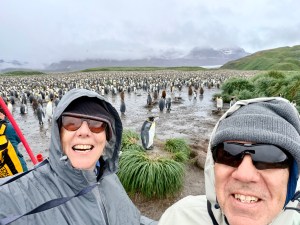
Reflections on the Journey South🧭


My brother Rick and I spent 6 weeks in early 2026 traveling south starting in Santiago Chile, through Chilean and Argentina Patagonia and then on to Antarctica. It was the trip of a lifetime and I’m glad I had my fearless brother, Rick, along on the adventure. It wouldn’t have been the same with anyone else. Rick is always game to try anything. In fact, I’m pretty sure I would have chickened out of the rafting trip we took in Chile if we hadn’t been together. He pushes me but doesn’t insist. I remember him saying as we stood in the pouring rain, “If they say the trip is on, I’m going”. And so, we went. We were drenched and exhausted after an hour on that river but it was absolutely exhilarating. I would have missed it if he hadn’t been stalwart. As siblings, we have a lifetime of experience together. We don’t need to impress each other and there’s no judgement if one of us doesn’t want to hike for 12 hours in the rain and the other does (guess who). 
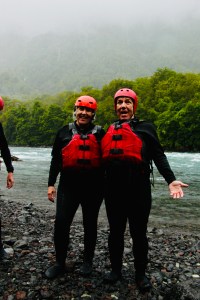
My fearless brother Rick and I on an exhilarating rafting trip

We both come to travel with an American lens. Rick has traveled more extensively but we both found some noteworthy oddities. Here are a few:

  • Plane landing. I remember this from traveling through South America some 35 years ago but when the plane lands the passengers clap. It’s cool to celebrate the minute you are safely back on land.  The other thing is that passengers unbuckle and start immediately going for the overhead luggage once the plane has landed. They don’t wait until they are at the gate.
  • Hiking.  We hiked a lot. I have to say it was a relief to not have to worry about snakes or bears. Patagonia certainly had rain and wind but there was no need to worry about a snake going across the trail.  It just felt like there were less critters in general like mosquitoes and spiders. Yes, there are snakes in Patagonia but they are extremely rare. The wind could definitely be a detriment. I remember on a hike to El Chalten that it was probably 30 mile an hour winds at the top of a mountain. One of our guides in Torres Del Paine had a wind speed detector which was helpful when determining to summit a trail. I’ve never thought twice about wind speed on a hike before Patagonia.
  • Shipboard. This was my first cruise outside of a few ferry rides (like Alaska, Ireland and Newfoundland). I’m so glad I had a prescription patch which Rick recommended and he didn’t need since he is ex-navy. So, I didn’t feel sick but taking a shower in 10-foot swells can be interesting while trying to hold onto the ship with one hand. I had to plan based on the forecast when it would be best to take a shower. Rick was so seaworthy he made me laugh when he would effortlessly dance down the hall. Each lunch and dinner, the servers would bring soup to your table. There was one lunch during 15-foot seas where they didn’t bring soup and the Creme Brûlée dessert was scrapped. It was our running joke that the seas were “no soup or creme brûlée” high. 
  • Zodiacs. Before the trip, outside of being terrified of crossing Drake’s Passage which is notorious for high seas, I was apprehensive about getting in and out of the zodiacs. Each zodiac held 10 passengers and one driver. First, we had to suit up with waterproof pants, jacket and muck boots.  These items had to be immaculately clean so that we would not transfer anything from say South Georgia island to Antarctica. Each landing had to be cleared to make sure there was no bird flu.  On top of being suited up, we had to wear a life preserver which had straps between the legs. It was quite the job to just get ready before embarking on the zodiac. Once suited up, you got in line to get down the stairs and out the open door to where the zodiac was. There was a small step up, then over the ship door, onto the pontoon and then down a step into the zodiac. If the seas were calm there would be one person leading you through the door from the ship side and the driver of the zodiac on the other. If the seas were high, there would be two on the ship and two on the zodiac.  Once on the zodiac, you sit on the side of the pontoon with only the rope behind you if you feel unsteady. From there you either head ashore to walk among half a million penguins or cruise amongst whales and icebergs for 3 hours in 30-degree temperatures. I was super fortunate that there was only one zodiac trip that was in larger swells.
  • Language.  We had several drivers while we made transfers across Patagonia. I don’t think any of them spoke English. I was really glad I could speak Spanish. If we had a guide, they were always bilingual but there were a few times where we only had a driver. Once on board the ship, all the Spanish came to a complete halt. I believe there might have been one other couple from the United States on the ship but everyone else including the crew was from Northern Europe, China, Philippines and Israel. We met several couples from the Netherlands and Germany who barely spoke English. Every lecture and briefing was done in English. I felt so fortunate to be able to understand it all. The ship itself is from the Netherlands so all the products like canned soda were Dutch. This was completely unexpected for me.

What has become apparent to me on this trip is that weather, outside of health, is the most important factor. We had three days at Antarctica where it was 35 degrees, sunny and little wind. Our excursion director, Marcel, kept saying that the bill was coming due (because we had such great weather). This meant that the last crossing through Drake’s Passage would likely be bad. Thankfully it wasn’t.  Seeing gigantic icebergs and tracking humpback whales on calm seas and sunny skies is priceless. It’s the luck of the draw and we drew the right cards on this trip.
😎End Your Workday Cleanly

You arrive home from work and completely forgot to stop at the bank, the store, the pharmacy, the _____.  How did I space that out?  You wake up at 2 AM and relive the outcome of the meeting with your boss, coworker, direct report, ______.  You not only relive it one or two times–you relive it twenty times by the time it’s 2:15 AM.  Not a good night’s sleep.  You open your front door after a full day’s work and all you want to do is zone out with a box of Oreos and Grey’s Anatomy reruns.  The last thing you want to do is hear about your partner’s lousy day.  Not a very healthy or positive end to your day.

There is an answer for this end-of-day malaise and ensuing erosion to your health and happiness.  I subscribe to an app called Whil.  One of the series on the app is called “Live Fully Every Day” by Peter Bonanno.  I have been using his “End Your Workday Cleanly” for about a week and the transition from work to home has vastly improved.  Instead of waking up at all hours of the night with a huge to-do list for work, replaying the not-so productive production meeting, or trying to escape into Never Neverland when arriving at home–I’ve found I am finally able to bring closure to the day.

Here are ideas for clearing out your day:

  • Journal at workday’s end. This has been a real life saver for me.  I sleep better and am able to transition into my life at home much more energized.  Bonanno recommends writing this with pen and paper.  Melanie Pinola equally recognizes the importance of handwriting your thoughts in her Life Hacker article: “The Wall Street Journal discusses several studies that show students who took handwritten notes outperformed those who typed their notes on their computers.  Compared with those who type their notes, people who write them out in longhand appear to learn better, retain information longer, and more readily grasp new ideas, according to experiments by other researchers who also compared note-taking techniques.”  So take out a piece of paper at the end of the workday and answer these prompts:

Journal Prompt:

What I am feeling right now is…

What’s left for me to do another time is…

What I’m grateful for today is…

This is a great brain dump that clears you head.  And it ends on a high note by highlighting what you are grateful for, which is a positive punch to the end of the workday.

  • Transition when arriving home to a quick walk with a friend or significant other.  As Bonanno pointed out, he and his wife walked at days end, but since they were not journaling, the walks took forever and started to turn into a pity party at times.  After starting to journal at the end of the work day, the walk with his spouse took maybe 10 minutes of recounting the day.  It became a much more positive experience.  Positivity is good and helps your evening get off to a great start.  So you’ve done your brain dump, you’ve connected with a loved one and now you are going to have a much better evening.
  • 10 minutes of daily planning. At your day’s end, do what Stephen Covey has espoused for decades.  Take ten minutes to plan your next day.  This along with the journaling helps you schedule the various things you never got to and places them in plain sight for the next day of work.  I’ve been doing this for at least a decade and I am rarely caught off guard by missing something.  It’s also part of Choice 3 of the Franklin Covey’s Five Choices to Extraordinary Productivity.  Couple this with 30 minutes of weekly planning, and both will keep you on target with your personal vision and mission.

Self-reflection on a daily basis is a way of acknowledging what you have accomplished.  It’s so easy to get caught up in what you didn’t do instead of what you actually did.  Instead of thinking about “what went wrong”, think of “what didn’t go wrong”.  The glass is half full.

Expedition to Antarctica 🇦🇶


My brother Rick and I traveled to Patagonia and Antarctica in late January and February of 2026. When we planned this trip, Antarctica was the goal and we added Patagonia as a “might as well”. Rick found a travel agency that specializes in Antarctica and Patagonia called Swoop. I’m so grateful that he found a specialist because we have truly been able to experience and explore both Patagonia and Antarctica in ways I never imagined I didn’t realize when we first started planning that most cruise ships don’t let you actually set foot on land. Antarctica has a multitude of rules about making landfall including no more than 100 people at a time on shore. This regulation is to maintain the pristine environment that is Antarctica. This rule makes all the larger cruise ships off limits for making landfall. I’m grateful that Swoop booked us on an expedition ship with only 162 passengers from 40 different countries. This meant that not only could we landfall at the Falkland Islands and South Georgia Island, we could make landfall on the continent of Antarctica and truly experience the environment and wildlife. 

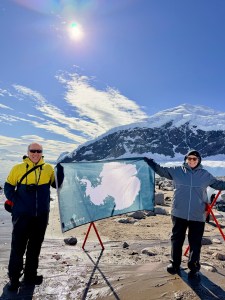
My brother Rick and I on the continent of Antarctica

Outside of days at sea, each day off the coast of Antarctica was organized into two zodiac rides per day to either make landfall or cruise. We were divided into the red group and the blue group so that we would never have more than 100 people on shore. Our first zodiac ride in Antarctica was in Mikkelson Harbor. We landed on an island that had a colony of Gentoo penguins. Gentoos are super animated and run or slide across the snow rather quickly making them adorable. They are utterly fearless and will walk right by you towards whatever their destination might be. We had to try and keep 15 feet away but they are so quiet and active, it can make it difficult to stay the minimum distance away. The bay we landed in was full of bergy bits and growlers (small icebergs) so the shore was strewn with large ice chunks.  There were also several whale skeletons on the beach as well and hundreds of Gentoos milling around in and out of the water. 

The next morning, we had tremendous weather with blue skies and no wind (unusual for Antarctica). The expedition guide, Marcel, had told us to be up at 5:30 AM to watch our ship, the Hondius, navigate the narrow Lemier Channel. Rick and I went up to the observation deck to see this magnificent channel with mountains and glaciers on both sides and hundreds of pieces of sea ice and icebergs floating on top of the clear, reflective water. It was absolutely surreal and picture perfect as we floated through the narrow channel, sometimes breaking through ice. The glow of the sunrise, the mist in the peaks of the mountains and the reflection on the ice strewn water was absolutely magical. It definitely will be one of my fondest memories of the trip.

We went for a zodiac cruise through the Iceberg Graveyard. There were hundreds of house size or bigger icebergs run aground. The icebergs calve off one of the many glaciers or sea ice and can’t move very far because it’s so shallow. If only 10% is above the water line, you can imagine how deep the icebergs go. There was one formation which had a hole in it making it look like it belonged in Arches National Park. When it’s perfect weather like we had, you can see all the shades of blue and green in the ice. The whole landscape looks like cool whip and ice cream and all of that bright white reflecting off the icebergs and glaciers can be blinding but wonderous. 

Each of the drivers on the zodiacs are also experts in one particular area of interest such as geology, penguins, ice, whales, history and seals. It’s a random assignment when you get on a zodiac but on this one day in Antarctica we had Pierre as our guide who is an expert on whales. It was fortuitous. We saw several humpback whales taking a nap which is a bizarre sight. They hover on the surface and make growls when they let out their air. These immense beings lying on the surface as we hover around in the zodiac. The most surprising thing was a group of Orcas (killer whales) swimming together in a pod. We could see the long dorsal fin of the male with several smaller whales with him. According to Pierre (who was super excited), they only see Orcas in Antarctica once a season.  Apparently, they swim so quickly they are hard to get a glimpse of. It felt very special that we were able to see this pod together and, at times, swimming under our zodiac which I found unnerving. I had hoped they didn’t want me for lunch.

On another zodiac cruise, we saw several varieties of seals lying on ice flows. It was like looking at a dog snuggled up next to a blanket except it was a seal snuggled up to the ice. We saw Weddel seals, crab eater seals and leopard seals during our various zodiac rides. These varieties of seals seem to be more solitary and we almost always spotted them on their own.  This is opposed to the fur seals which are in huge gangs playing together in the water as if in a swimming pool with their buddies. 

When we were on South Georgia Island there were half a million King penguins together on one shore line, in Antarctica, the penguin’s colonies are much smaller.  The shy little Adelie penguin is very small and timid. The entire group of Adelies was no more than twenty and they are completely black except for a white ring around their eye and a white abdomen. At our last landing, we saw a bunch of Gentoos swimming together and congregating on shore together. I’ve seen so many penguins on this trip that now I can identify each of the seven species that I’ve seen.

Our last stop was actually on the Antarctic continent. In previous landfalls we had been on islands and not on the mainland.  In this zodiac ride we went to Nekko harbor and set foot on what for many was their 7th continent. It was for Rick but not for me (I still need Asia and Australia). It’s momentous to stand on this white continent with all its beauty, wildlife and stunning landscape. It’s not easily achieved but it sure was worth the effort to experience this pristine, breathtaking landscape. 

Intriguing South Georgia Island🐧

I have been intrigued by South Georgia Island since reading about Sir Ernest Shackleton and the voyage of his ship the Endurance. It is such a remote place I assumed I would never actually see the island; nevertheless, set foot on it. I am happy to report that the island is far beyond my wildest imaginings. It is the convergence of history, topography and an unfathomable array of animals. I traveled there with my brother, Rick, in February of 2026 on the ship Hondius.  We first traveled to the Falkland Islands and our second destination was to South Georgia Island. South Georgia, like the Falklands, is in a permanent state of dispute between Argentina and the United Kingdom. The Argentines say it’s theirs and the UK actually has a very small group of people who operate a research station there. There are a handful of people who winter through on the island and there are about twenty folks who live there in the summer operating a museum, post office and store.

Exploring the stunning landscapes of South Georgia Island by zodiac, where adventure awaits.

Getting on the island is no small task. There is no airport or dock. The only way to arrive is by zodiac (a twenty foot inflatable boat with a motor and hard deck with seating on the pontoons that surround it) after all the passengers have been checked for any potential contamination. Boots and all outer wear must be inspected before anyone can arrive on land. This is to maintain the delicate environment for the various wildlife that come through South Georgia to mate, give birth and molt.

The first thing that is so utterly striking about the island is not only its size (it’s much larger than I imagined in my head) but its beautiful topography. While the Falklands were flat rolling hills, South Georgia is one long line of mountain peaks, many covered with glaciers. It’s quite the contrast to the Falklands. Outside of seven defunct whaling stations around the south side of the island, there is no infrastructure outside of the research station and museum complex in Grytviken. Most of the whaling stations contain asbestos and you are not allowed to enter the buildings. There are two mountain ranges here, the Allardyce Range and the Salvesen Range with 183 named peaks. The highest of which is Mount Paget at 9,629 feet. Even more remarkable is that there are 160 glaciers here that cover 50% of the land. Everywhere you turn you see another craggy peak covered in a glacier. It’s simply breathtaking although inhospitable. Shackleton found that out when he had to traverse the uncharted mountains to get to the Stromness whaling station in May of 1916 after his ship was crushed by ice flows and the majority of his crew were stranded on Elephant island. It’s a beautiful but dangerous land.

We took zodiacs several times to make landfall and enjoy the multitude of penguins who come here annually. The largest and second largest colony of King penguins come here for their rookery in the summer. Here they give birth to their young, raise them for several months and then experience a catastrophic molt which involves losing all their feathers and takes a month for their new feathers to come it. So, when we visited the two different colonies most of the penguins are just standing in place as they wait for their feathers to come in. Such patience.

The second largest King penguin colony in the world is on Salisbury Plain on South Georgia where there are over 150,000 mated pairs. We arrived by zodiac and the penguins and fur seals were EVERYWHERE. As we arrived on land, we took off our flotation devices and many curious seal pups and juvenile penguins started coming right up to us.  We had been instructed to stay 15 feet away from any animal, I’m here to tell you that is virtually impossible. Rick and I soon learned how to run the gauntlet along the path that was set out by our guides. The seals are much more curious and the older seals are much more brazen at coming up. There were several times where we each put up our hands and backed away from an intruding adolescent seal. We traipsed through lots of mud, forged creeks but finally arrived at the heart of the colony. It’s amazing to see penguins as far as the eye can see all the way up the side of a valley. They all looked like a well-dressed standing room only crowd waiting for a show. 95% are standing up packed in next to each other. It was quite the experience. On our way back to the zodiacs, Rick almost went over backwards trying to back away from a more aggressive seal. Luckily, he didn’t fall because it would have been a mess to get cleaned up.

The next day was a zodiac observation ride along the largest King penguin colony at St. Andrew’s Bay. Here over a half million penguins congregate annually. The zodiacs ran parallel with the coast so that we could observe thousands of penguins milling along the water’s edge, diving into the water or standing like sentinels up the various valleys and up to the side of a hill as I previously mentioned It’s overwhelming to see so many live beings in one area of the world congregating peacefully. The fur seals and elephant seals are there as well. Rick got some great footage of two male elephant seals having what is essentially a shouting match with one eventually sulking away.

We went ashore at Grytviken and enjoyed the museum and a tour there. Rick and I ran the gauntlet of fur seals to get to the grave of Ernest Shackleton. I’ve learned that walking with purpose is the way to keep the curious seals at bay.  They seem to back off if you don’t look tentative. There is also the replica of the James Cairn which is the lifeboat that Shackleton took from Elephant Island to South Georgia. When you see the size of the boat and have already experienced some of the big swells on the South Atlantic and Antarctic seas, it’s an amazing feat that 6 men survived the trip. There is also the defunct whaling station there and the knowledge that when it was first started in 1904, they didn’t have to leave the bay to be able to kill over 100 whales. The fact that so many whales were hunted until practical extinction is mind blowing.

Our final day was a stop at Cooper Bay and a colony of Macaroni penguins. These are adorable penguins that have crests on top of their heads with bright yellow plumes and dark red beaks. After five days in South Georgia, we set sail for the Orkney Islands and the home of Chin Strap penguins.  I had no idea that there so many different kinds of penguins but each is unique and they are incredible fun to watch either swim or waddle on land. The fur seals are fun as well when they are together in a swimming hole as they frolic together in the water. For me, South Georgia has been such a fulfilling stop between the history of whaling, the storied end to Shackleton’s ill- fated journey across Antarctica, a stunning landscape of dark craggy mountains with endless glaciers to a potpourris of penguins, sea birds and seals. There is some spell binding experience at every turn and I hope to venture back some day.