
The trip from Torres del Paine National Park in Chile to El Chalten in Argentina was a long hot dusty day overall on January of 2026. We were picked up by our first driver in Patagonia Camp and then driven to the Argentinian border which was 2 hours on a long, gravel road with tons of rabbits darting across the road. I can only compare it to the amount of squirrels that live in North Carolina. There were also many Guanacos which are a cross between camels and llamas and are completely wild in both Chile and Argentina.
We had to get checked out by the Chilean authorities and then about 5 miles later the Argentinian authorities which was housed in a small one building outpost surrounded by armed men in army fatigues. It’s a bit intimidating to go through this. Once across the Argentinian border we drove about 20 miles to be moved to a new driver who would take us to El Calafate. This drive took about 3 and a half hours and I suddenly realized we lost an hour because although we were east of Chile, Torres del Paine operates on daylight savings and Argentina does not. Upon arriving in El Calafate, it took a few texts to find our next driver to take us to El Chalten which took another 2 and a half hours. We stopped off at the half way point of La Leona where they claim Butch Cassidy and the Sundance Kid hid out for about a month.
Upon arriving in El Chalten we could see the mountain range; it sits at the base of the massive granite monolith of Mont Fritz Roy with stands at 11,171 feet. It was shrouded in clouds although most of the rock was visible when we arrived. The driver kept telling us that Cerro Torre (10,262-foot spire) was to the left but it wasn’t visible to us until the last day.
On our first day in El Chalten my brother Rick and I hiked to Los Condores and Aguilera viewpoints. This was a great hike from our hotel and we had a great view of the Viedma Lake which is bright, brilliant blue. Minerals from glacier rock contribute to the brilliance. In addition, we saw Andean condors soaring above us. That evening we had a food tour of El Chalten which was very interesting. We started by learning the art of drinking Yerba Mate. Rick and I had seen many of our guides and drivers share Mate while driving. The cup (frequently a gourd) has a straw with a filter on the bottom and the cup is filled about ¾’s full with mate. Mate is a caffeine-rich infused herbal drink. You keep refilling the cup with hot water throughout the day. I thought it was herbal tasting but I’m not likely to have it again.
We also learned that El Chalten was established in 1985 and is the national capital of trekking. It reminded me of the many Appalachian hiker towns I went to along the Appalachian Trail where there were tons of hostels, pizza joints and microbreweries. It also has one church but the pastor lives in Calafate so there isn’t any services on Sunday or otherwise. Odd.
Our guide took us to Lago del Desierto which was a two-hour drive from El Chalten on a rutted gravel road with over ten single lane wooden bridges; I said a small prayer every time we went over a bridge. It was an absolutely clear day so we could see the entire range of spires around Mont Fritz Roy along the way. Rick went on a hike up to the Huemul Glacier and the turquoise lagoon which sits at the base. From there we had a picnic on the banks of the Lago del Desierto and a short hike along the shoreline through the forest where I was able to pick out several new colorful birds with my Merlin app including Small-billed Elaina, Rufous-tailed Plantcutter and Thorn tailed Rayadito. After our hike we took a boat out on the Lago del Desierto which had terrific views of the three glaciers that surround the lake and had a hidden waterfall that we were able to see from the boat.
The next day we took a transfer back to El Calafate and saw all the rock formations which were all clearly visible as we left town including the elusive Cerro Torre. That evening we took a four-by-four adventure bus to Punta Walichu which is a nature and archeological reserve on the shores of Lago Argentino. It was early evening and the sun was slowing setting at 9:45 in the evening. We were guided through paintings from the Tehuelche people who have inhabited the area for centuries. We went to a cave where it was carbon dated to 4000 BC and guanaco fat was found in the carbon so the Tehuelche people were cooking guanaco meat in the cave. We enjoyed a meal in a cave with about twenty other tourists from Brazil, Germany and Israel.
Our last full day in El Calafate was spent on another long gravel ride into the dry, arid countryside of Lesser Rheas (which are large flightless birds similar to ostriches), horses and cattle. Estancias are ranches and we saw many gauchos on horseback. We enjoyed a meal at the Estancia Nibepo Aike which was developed by a Croatian owner. From there we traveled to a boat which took us up the southern branch of the Lago Argentino to the rich branch of the lake and dropped us off to hike to a viewpoint of the southern Patagonia ice field which is the second largest ice field in the southern hemisphere after Antarctica. As we descended the hill we had hiked up through Calafate bushes and we saw the vast expanse of floating growlers and icebergs from the Perito Moreno Glacier. There had to be over fifty chunks of glacier floating in the turquoise waters. It was stunning. The glacier itself is spiked and uneven with blue and white formations.
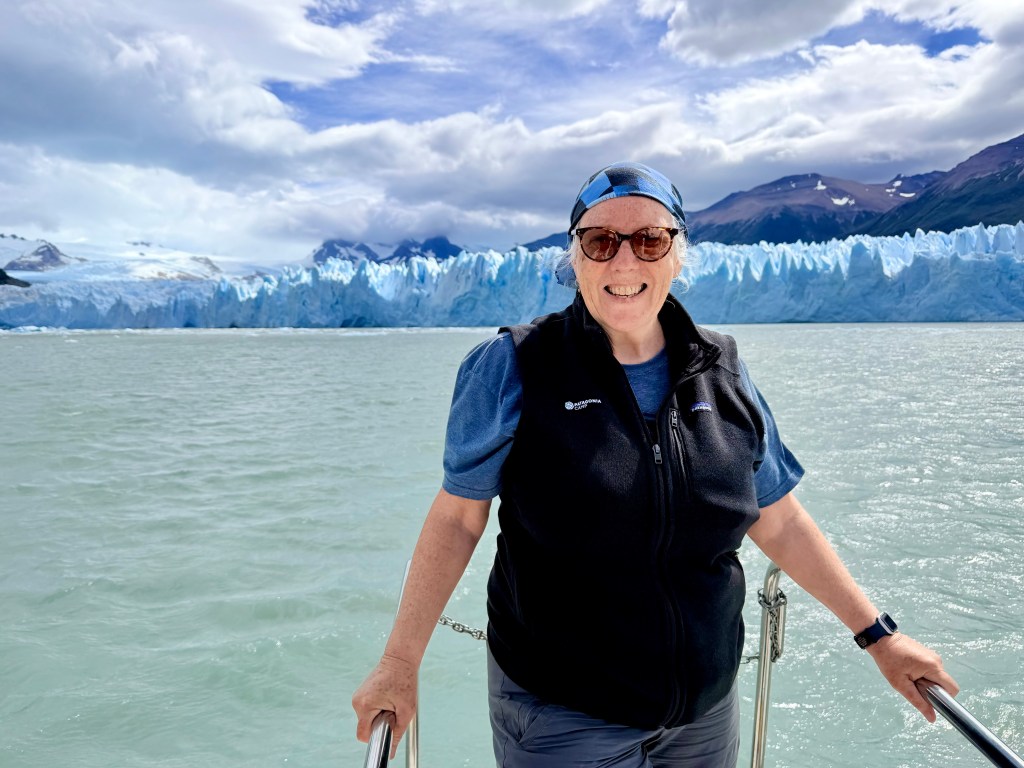
We got back in the boat and sailed about 1,000 feet from the glaciers edge. You could hear ruptures of the glacier as more icebergs were being calved .The glacier was in constant flux and outside of being windy it was relatively warm at 65 degrees. We had drinks on the boat with chunks of ice harvested from the lake. I think I was most struck that while I had seen two story icebergs in Newfoundland just 6 months before, this was all on a fresh water lake. We were dropped off on the opposite side of the lake and were taken to the main overlook for the glacier. There were countless walkways to view the glacier and to hear more ruptures from the glacier. We failed to witness a rupture as the guide pointed out that by the time you hear it, it’s already fallen.
We left the lakes region of Argentina with memories of stunning blue lakes, pristine granite rock formations and immense glaciers with vast fields of floating icebergs. It’s been amazing.
 Workplace Navigator