The Falklands: More Than I imagined 🇫🇰

My brother Rick and I traveled to the Falkland Islands (Islas Malvinas) in January of 2026 aboard an expedition cruise on the Dutch ship “Hondius”. We boarded in Ushuaia, Argentina and spent a day and a half sailing to the Falkland Islands. This was my first expedition trip and I must say, it has a lot of advantages to being on a much larger ship.  There are only 162 passengers and 70 crew on board. The reason for the smaller ship is that there are restrictions in the Falklands, South Georgia and Antarctica.  No more than 100 people can make landfall at the same time. Thus, immediately upon boarding we were assigned to the Red Group or the Blue Group. When the Red Group went on shore, the Blue Group would cruise the coast line in zodiacs. Large cruise ships don’t go to the Falklands or South Georgia It’s much more intimate. In fact, the only other cruise ships we saw were in Stanley (the capital of the Falkland Islands), where there is a dock available.
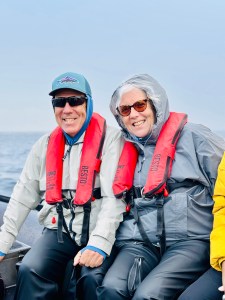
My brother Rick and I on a zodiac headed for shore in the Falkland Islands.

Preparing to go on shore via the zodiac is no small ordeal. We had to clean all of our outer gear like rain jacket, rain pants, muck boots and gloves to make sure it was free of any foreign objects such as crumbs, seeds, and dirt. We used brushes and paper clips to clean out the tread on the bottom of the boots. All of these preparations are to keep from contaminating the environment. Once we were all suited up in the mandatory rain jacket, waterproof pants and muck boots, we had to put our life preserver on top of it all. A hat was next, sunglasses, trekking poles and waterproof back pack. I felt like I was suiting up for Mars. Once suited up and our group had been called, we headed to where they load the zodiacs. They took our room key to make sure they had everyone accounted for before leaving the ship. There was an attendant on the inside of the ship and then the zodiac arrived next to the door outside the ship. The driver and attendant helped each rider over the pontoon to sit on the edge of the zodiac. The first few times we got onto the zodiac was quite intimidating because the ocean swell was relatively high (maybe 2 feet) and it’s a timing thing to get on the zodiac. We all had to wear water-proof gear because of riding in an open zodiac. You have to assume that you will get wet and we did.

Our first day in the Falklands, we took a zodiac and landed on the beach at Carcass Island (gruesome name). Upon landing we were greeted by hundreds of Magellanic penguins. They have eyes that are encircled with white. Gentoo penguins were also present and  are about the same size but have a less distinctive white spot behind their eyes. It is incredible to see hundreds of penguins milling around the beach or running into the water with their hapless saunter. We were told to always keep our distance of 15 feet from any animal we encountered. Rick and I also spied black-brow albatross which are elegant birds when they are soaring in the sky but are quite clumsy on land. Apparently 70% of the world population of these albatrosses are located in the Falklands. We hiked across the island to a pick-up point for the zodiacs which was about 4 miles away. I was really struck by the fact that there are no trees on the island, just rolling grass covered hills and white sandy beaches. It reminded me of Northern California.

The afternoon of the first day was spent at Saunders Beach. Here there are Rockhopper penguins that look like they have a bad toupee with black and white hair making a crown. They are rather squat in height and hop everywhere so it’s absolutely adorable. There was also a slew of King penguins which are the tallest penguins and they have neon orange on their beaks, back of the head and on their chest. Some of the King penguins were still caring for eggs on top of their feet. There was also a giant rookery for black-browed albatross who mate for life and return each year to the same nest. The higher the nest, the longer the mated couple have been together. There were hundreds of chicks sitting on top of the nests waiting for their parents to come back with food. It’s amazing to walk amongst the circle of life with these beautiful creatures.

The last day was spent in Stanley, Falkland Islands. This is the largest village on the 700 plus islands that make up the Falklands. The Falklands have a population of 3,600 and 3,000 of the residents live in Stanley. If you live here, you hold several jobs at once since the population is so small. The Falklands are a British overseas territory so only English or Falkland pounds are taken as currency. Everyone speaks with a British accent; they drive on the left-hand side of the road and it’s the largest Land Rover market per capita in the world. It’s strange to feel like you are in a small village outside of London but you are in reality 8,000 miles away near the end of the world. The relationship between the Falklands and the Argentines is difficult. Argentina will only let resupply ships in once a month and the only flights you can take to Stanley are through the military or Montevideo, Uruguay or Santiago, Chile. When we were in Ushuaia, the Argentinians still claim that the Malvinas are part of their territory extending to the Antarctic although there are no Argentines living there.

The Falklands (Malvinas) is a desolate oasis at the bottom of the Atlantic Ocean with a rich history, varied wildlife and resilient residents who love their heritage. I would guess that about the only way you can visit is by water or airplane and a lot of planning.  
Patagonia Surprised Me: The Little Cultural Differences I Didn’t Expect👀

My brother, Rick and I traveled through the Chilean and Argentinian portions of Patagonia for three weeks. I love travel because I get to learn about different cultures and it never fails to surprise me. I have traveled to Colombia, Peru, Brazil and Venezuela before and I have to admit that I had assumed that Chile and Argentina were going to be pretty similar to those countries since they are all part of the same continent. I was incorrect.

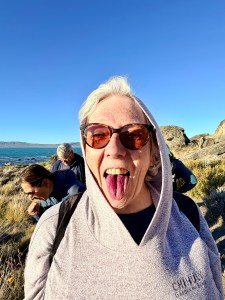
My blue tongue from eating Calafate berries

Here are some of the surprises and differences:

·      Pronunciation. There are several words and terms that are unique in their pronunciation. WIFI is pronounced as wee-fee (it sounds adorable). An IPA beer is pronounced as EE-pah (short and sweet). It took me a few minutes to figure out that locals in Chile and Argentina refer to a boat tour as “navigation”. This confused me for a bit until I clarified what “navigation” meant. I briefly thought it meant we would be on a sailboat (we weren’t). All of the various guides we had on this trip referred to wilderness as wild-erness. The folks from Argentina pronounce the double L in Spanish as “sh” instead of “y”. This one pronunciation threw off my Spanish while traveling in Argentina. There are a ton of Spanish words like silla (chair), llama (called), llave (key), calle (road), lluvia (rain), pollo (chicken) and ella (she) with the double L. I am relatively fluent in Spanish but this change in pronunciation absolutely threw me off.

·      Traffic. We took a tour in downtown Santiago and there are crosswalk signals on a lot of streets. What is crazy is that when the signal turns to “Walk” there is a small green stick figure walking slowly at the beginning of the signal but then they slowly start walking faster until it’s sprinting. It’s pretty funny to see it go from standing, to walking, to jogging to sprinting. Road signs in Argentina are covered with stickers. It’s almost like graffiti everywhere and it’s a wonder that you can even read the signs like how many kilometers to El Calafate.

·      Bathrooms. In every national park I went to in Chile, there is either no toilet paper or there is a communal toilet paper outside the stalls. I did not realize this the first time I used the bathroom and another woman on my tour instinctively knew to hand me some over the stall wall. I got into the practice of always carrying a few spare squares before heading into the stall. There is also the practice of not throwing any toilet paper into the toilet due to their sewer systems. It took me a few days to break the habit of throwing paper into the toilet but into a small garbage can. Every hotel room we had in Argentina had a bidet in the bathroom (even a hostel we stayed at).  I also never saw a pit toilet in any of the National Parks. Regardless of how remote something was (say a 90-minute ride on gravel road) there was a full bathroom with a flush toilet available.

·      Drinks. When we traveled to hiking excursions in Patagonia, there frequently was a guide and driver for the vehicle. They have this communal habit of sharing a Yerba Mate. The driver drives and the guide (seated next to them) is constantly refilling hot water into the Mate vessel and they pass the drink with a single metal straw back and forth. Rick tried a few times to order ice tea. We had one waiter in Puerto Varas that was providing the best service and when Rick asked if they had ice tea he said “yes”. Luckily, I enquired further in Spanish. The waiter had suggested a hot tea with ice cream (not ice) on top. Luckily, we figured that out and Rick ordered Coke Zero which had been available all across Patagonia. I always order “aqua con gas” or sparkling water as it assures me that it’s not tap water which they say can be hard for foreigners to digest.

·      Food. I believe that every guide we had in Chile or Argentina introduced (or reintroduced) Calafate berries to us. There are bushes all over Patagonia with Calafate berries. The guide would point it out and invariably asked us to have a few. It’s pretty funny because it turns your tongue blue and the berries are tasty and a little sour. Rick loves lamb and he came to the right place. There were countless restaurants and events where lamb was served in addition to beef and Guanaco. Guanaco are a mix between llamas and camels and are ubiquitous across Patagonia. Both the Guanaco and Calafate berries can’t be domesticated which I found amazing since so many places sell guanaco empanadas or Calafate jam. Porotos en escabeche is frequently served with bread (not butter). It’s beans in vinegar and herbs and used to put on your bread.

·      Music. I remember traveling to Lisbon last year and there being English Christmas songs being piped into all the streets in town. In isolated Patagonia in both Chile and Argentina, we heard old American songs like the Beatles, Billy Joel, Michael Jackson and even Pink Floyd in restaurants and tour vehicles. It’s disconcerting to hear songs from fifty years ago playing all the time. I rarely heard any music in Spanish.

I really enjoy discovering new cultural experiences. I noticed a sign on the wall that said “Zorro” with a picture of a fox. I did not realize that the name for Zorro came from Spanish and not by the television/movie from years ago. The native people and Spanish conquistadors came long before an American tourist like me.

The End of the World – Ushuaia Argentina 🌎

My brother Rick and I finished our trip through Patagonia in Ushuaia, Argentina in January of 2026. Ushuaia was not what I expected. It is the southernmost city in the world and I had assumed it would be more of a backwater village. Ushuaia is a city of 80,000. Tourism is themain source of income. Tourists from all over the world come there to hike, eat, shop and recreate before boarding an expedition or cruise to Antarctica. As withPuerto Varas, Puerto Natales, El Chalten and El Calafate, Ushuaia has its share of gravel roads to endure but it also has plenty to offer travelers looking for adventure.

We arrived by plane from El Calafate to the Ushuaia. It’s the largest airport we’ve been in since Santiago. Tons of planes come into Ushuaia from all over the world to be the jumping off point to sail around Tierra del Fuego or to the great arctic continent. We were taken to our hotel which had splendid view of the Beagle Channel (named for the ship that Captain Fitz Roy and Charles Darwin arrived on in the early 1800’s). All of Tierra del Fuego is steeped in explorer history as early European explorers looked for ways to get past South America and onto the Spice Islands. Magellan was here, Cook was here and Fitz Roy was here.

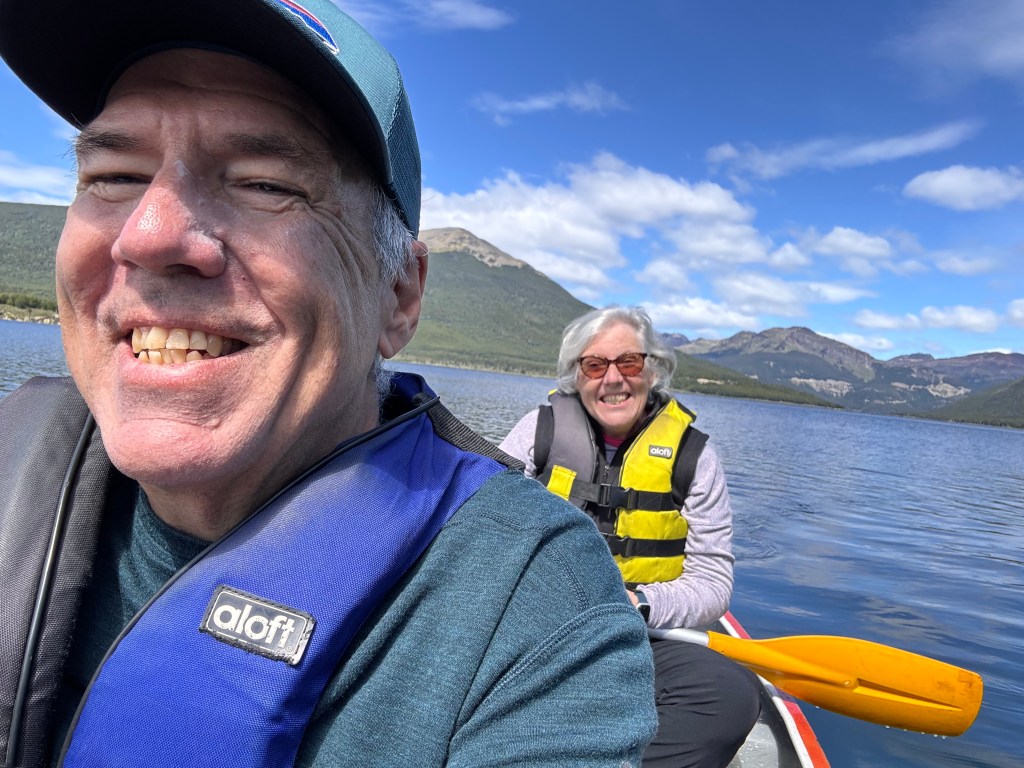
My brother Rick and I canoeing on Lago Escondido near Ushuaia, Argentina

On our first full day in Ushuaia, Rick and I went to Tierra del Fuego National Park and spotted Upland Geese and wild horses along the Lapatia river. The very end of the Andes mountains come through Chile and then take a left turn to head through Argentina and to the Atlantic at Staten Island (not the New York one). The Pan American Highway (from Alaska to Argentina) ends here after many thousands of miles and there were tons of motorcyclists and vans who take on the trip by starting at Fin del Mundo (end of the world) via the gravel road Route 3.

We ended our first full day in Ushuaia by taking a boat ride to the lighthouse and various islands that are home to wildlife. I have been really impressed by all the unusual birds we have seen including black necked swans, Andean condors and Upland geese.We saw two different islands that were covered in Imperial Cormorants which (when they swim) look just like penguins. In addition, we went by an island with a male sea lion and his harem of upwards of ten females sunning themselves on the rocks. We had a terrific guide named Juan Pablo who would explain everything we were seeing and escorted the group onto an island to have a better view of the Andean mountains that encircle the bay of Ushuaia. It was a lovely clear day and we could see the glaciers on top of the mountains. We ended our day by buying a sandwich from a food truck named Los Pollos Hermanos (from the show Breaking Bad). There aren’t any Starbucks or McDonalds but they have a food truck named after a show. Interesting.

We traveled to the Garibaldi Pass which is the first time I’ve traveled over the Andes by vehicle. I did not realize before this trip that the Andes mountains run the entire length of South America making the border between Chile and Argentina. At the very bottom, at Ushuaia, the mountain range then heads east towards the Atlantic Ocean and ends at an island named Staten Island. We drove to the 3rd largest lake in Argentina called Lago Fagnano. It was quite the crazy 4×4 ride as our guide, Martin, drove through several creeks until we drove along the lake’s shore, at times, completely surrounded by the lake. I had the impulse to pick up my feet as we traversed the water. It was a lovely lake. From there we went to a trailhead into the beech tree forest. The travel company has a private cabin in the woods and we hiked about a mile to get to the cabin. The forest here is full of beech trees, some of which are deciduous and others are evergreen. Martin pointed out that sometimes the ground we were walking on was spongy. This area has a lot of peat bogs which are a spongy layer on top of an aquifer. It’s a very unique environment and we were able to spot two Magellan Woodpeckers which are the largest woodpeckers in the world. I would guess they are at least a foot and a half tall. Once at the cabin, we went for a canoe trip on Lago Escondido. It was a brilliant day with clear blue skies (a rarity by all accounts). It was so peaceful and desolate on the lake as it is surrounded by wilderness. Martin cooked us an enormous lunch which was delicious.

On our last full day in Ushuaia, we drove eastward towards the Atlantic Ocean. We saw a few shacks along the way but it’s a gravel road to Puerto Almanza. There we saw mussel farms along the shore and fishing boats specializing in King Crab and Black Hake. There were several restaurants in the stretch of the shoreline that specialize in seafood and it’s a good hour and a half ride from Ushuaia. Their entire business is based on attracting the folks from the city and/or tourists to the eastern edge of Tierra del Fuego. Our lunch was at Alma Yagan which is the private home for a fisherwoman named Diana. She cooks whatever they caught that day and prepared an outstanding four course meal as we stared out at the Beagle Channel. It was windy (as usual) and clear outside; the food was fresh and delicious. She served Salmon Ceviche, King Crab poached in milk, and Black Hake on a carrot purée. It was outstanding.

On our last day before boarding our boat to Antarctica, we had a half day to spend in the town of Ushuaia. We went to the “End of the World” museum which is about the history of Ushuaia. We also went to their Maritime, Antarctica and Prison museum. The last three are all housed in the now defunct prison which was here until the 1940’s. There was lots of information on the first explorers to Tierra del Fuego, the natives that had been here since 8,500 years ago and all of the various explorations to Antarctica.

Ushuaia is a beautiful place surrounded by wilderness, lakes and unique flora and fauna like wild multicolored lupins, thousands of cormorants, and wild horses milling around the island. This end of Argentina is much more lush with the number of forests it has compared to some of the northern sections of Argentina which are much flatter and more arid. I hope I can come back again as there is so much more to see.

Exploring the Argentinian Lakes Region in Patagonia 🇦🇷

The trip from Torres del Paine National Park in Chile to El Chalten in Argentina was a long hot dusty day overall on January of 2026. We were picked up by our first driver in Patagonia Camp and then driven to the Argentinian border which was 2 hours on a long, gravel road with tons of rabbits darting across the road. I can only compare it to the amount of squirrels that live in North Carolina. There were also many Guanacos which are a cross between camels and llamas and are completely wild in both Chile and Argentina.

We had to get checked out by the Chilean authorities and then about 5 miles later the Argentinian authorities which was housed in a small one building outpost surrounded by armed men in army fatigues. It’s a bit intimidating to go through this. Once across the Argentinian border we drove about 20 miles to be moved to a new driver who would take us to El Calafate. This drive took about 3 and a half hours and I suddenly realized we lost an hour because although we were east of Chile, Torres del Paine operates on daylight savings and Argentina does not. Upon arriving in El Calafate, it took a few texts to find our next driver to take us to El Chalten which took another 2 and a half hours. We stopped off at the half way point of La Leona where they claim Butch Cassidy and the Sundance Kid hid out for about a month.

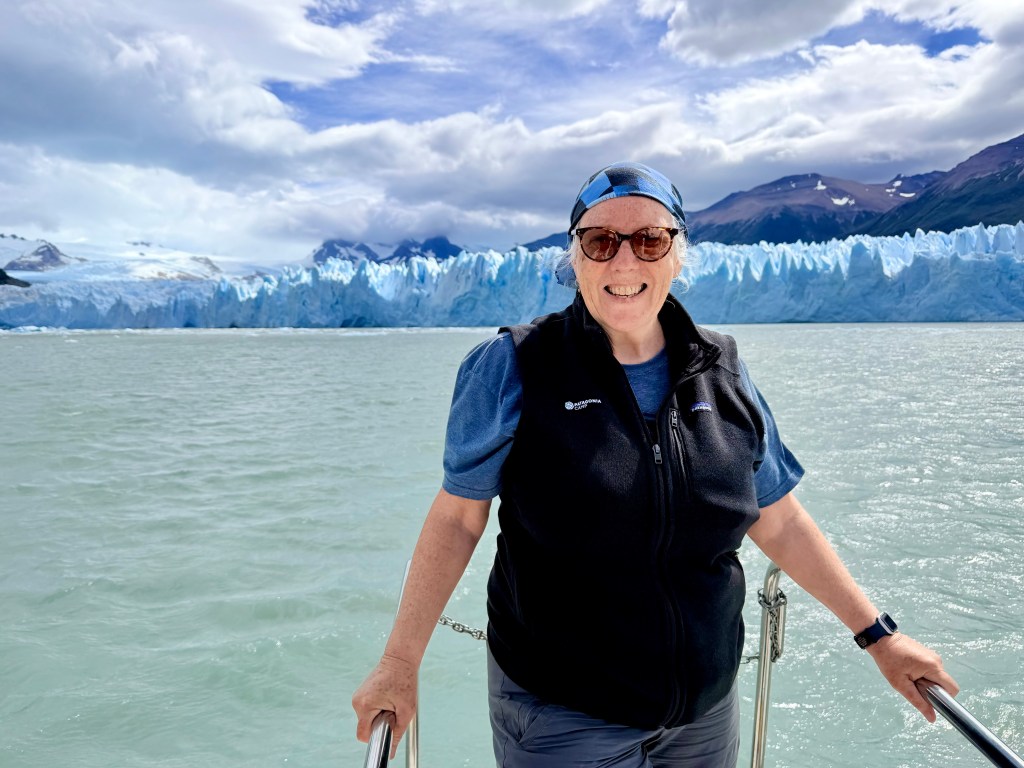
Standing on the bow of a boat in front of the Perito Moreno Glacier in Parque Nacional Los Glaciers in Argentina Patagonia

Upon arriving in El Chalten we could see the mountain range; it sits at the base of the massive granite monolith of Mont Fritz Roy with stands at 11,171 feet. It was shrouded in clouds although most of the rock was visible when we arrived.  The driver kept telling us that Cerro Torre (10,262-foot spire) was to the left but it wasn’t visible to us until the last day.

On our first day in El Chalten my brother Rick and I hiked to Los Condores and Aguilera viewpoints. This was a great hike from our hotel and we had a great view of the Viedma Lake which is bright, brilliant blue. Minerals from glacier rock contribute to the brilliance. In addition, we saw Andean condors soaring above us. That evening we had a food tour of El Chalten which was very interesting. We started by learning the art of drinking Yerba Mate. Rick and I had seen many of our guides and drivers share Mate while driving. The cup (frequently a gourd) has a straw with a filter on the bottom and the cup is filled about ¾’s full with mate. Mate is a caffeine-rich infused herbal drink. You keep refilling the cup with hot water throughout the day. I thought it was herbal tasting but I’m not likely to have it again.

We also learned that El Chalten was established in 1985 and is the national capital of trekking. It reminded me of the many Appalachian hiker towns I went to along the Appalachian Trail where there were tons of hostels, pizza joints and microbreweries. It also has one church but the pastor lives in Calafate so there isn’t any services on Sunday or otherwise. Odd.

Our guide took us to Lago del Desierto which was a two-hour drive from El Chalten on a rutted gravel road with over ten single lane wooden bridges; I said a small prayer every time we went over a bridge. It was an absolutely clear day so we could see the entire range of spires around Mont Fritz Roy along the way. Rick went on a hike up to the Huemul Glacier and the turquoise lagoon which sits at the base. From there we had a picnic on the banks of the Lago del Desierto and a short hike along the shoreline through the forest where I was able to pick out several new colorful birds with my Merlin app including Small-billed Elaina, Rufous-tailed Plantcutter and Thorn tailed Rayadito. After our hike we took a boat out on the Lago del Desierto which had terrific views of the three glaciers that surround the lake and had a hidden waterfall that we were able to see from the boat.

The next day we took a transfer back to El Calafate and saw all the rock formations which were all clearly visible as we left town including the elusive Cerro Torre. That evening we took a four-by-four adventure bus to Punta Walichu which is a nature and archeological reserve on the shores of Lago Argentino. It was early evening and the sun was slowing setting at 9:45 in the evening. We were guided through paintings from the Tehuelche people who have inhabited the area for centuries. We went to a cave where it was carbon dated to 4000 BC and guanaco fat was found in the carbon so the Tehuelche people were cooking guanaco meat in the cave. We enjoyed a meal in a cave with about twenty other tourists from Brazil, Germany and Israel.

Our last full day in El Calafate was spent on another long gravel ride into the dry, arid countryside of Lesser Rheas (which are large flightless birds similar to ostriches), horses and cattle. Estancias are ranches and we saw many gauchos on horseback. We enjoyed a meal at the Estancia Nibepo Aike which was developed by a Croatian owner. From there we traveled to a boat which took us up the southern branch of the Lago Argentino to the rich branch of the lake and dropped us off to hike to a viewpoint of the southern Patagonia ice field which is the second largest ice field in the southern hemisphere after Antarctica. As we descended the hill we had hiked up through Calafate bushes and we saw the vast expanse of floating growlers and icebergs from the Perito Moreno Glacier. There had to be over fifty chunks of glacier floating in the turquoise waters. It was stunning. The glacier itself is spiked and uneven with blue and white formations.

We got back in the boat and sailed about 1,000 feet from the glaciers edge. You could hear ruptures of the glacier as more icebergs were being calved .The glacier was in constant flux and outside of being windy it was relatively warm at 65 degrees. We had drinks on the boat with chunks of ice harvested from the lake. I think I was most struck that while I had seen two story icebergs in Newfoundland just 6 months before, this was all on a fresh water lake. We were dropped off on the opposite side of the lake and were taken to the main overlook for the glacier.  There were countless walkways to view the glacier and to hear more ruptures from the glacier. We failed to witness a rupture as the guide pointed out that by the time you hear it, it’s already fallen.

We left the lakes region of Argentina with memories of stunning blue lakes, pristine granite rock formations and immense glaciers with vast fields of floating icebergs. It’s been amazing.