
My brother, Rick, and I traveled to the Chilean portion of Patagonia in January of 2026. Patagonia is the lower third of South America straddling Chile and Argentina. We arrived there by traveling through Santiago. We traveled by plane to Puerto Montt and then took ground transportation to Puerto Varas on the beautiful Llanquihue Lake. We stayed at a lakeside hotel and could watch the sunrise with the extinct Osorno Volcano (Rick referred to it as Mount Fuji’s cousin) in the background. It’s 8,700 feet tall and has a glacier on top which gives it the conical snow-capped shape which is similar to Mount Fuji. Having arrived in Patagonia we learned that it can take days to have a clear view of a mountain or rock formation. When we arrived in Puerto Varas, it took us three days to see the entire profile of the volcano.
Puerto Varas is in the Lakes Region and Llanquihue Lake is the second largest lake in Chile. If you look at a map of the very southern tip of Chile, you can see that it is riddled with fjords and islands and small bays. It’s almost more water than land and the land is riddled with volcanoes both active and extinct jutting above sea level to thousands of feet and rocky formations from volcanic and glacial activity. It was very unique.
We enjoyed an incredible meal at a small farm about 25 miles north of Puerto Varas on the shores of Llanquihue Lake. It’s a family run farm and we got to harvest all the produce used for the meal including rhubarb, plums, several varieties of tomatoes, various greens, edible flowers, potatoes (a Chilean staple) and zucchini. We dug up the potatoes, cut the greens and foraged for plums. We also had a fresh caught salmon which was smoked along with the zucchini in a makeshift smoker. We ate in the lovely farmhouse and I have to tell you that salad of the mixed fresh cut greens was the best salad I’ve ever had. Verdant, bright and tender.
We drove out to the coast the next day. Chile’s width is 100 miles on average, so it’s pretty easy to ski the Andes and take a dip in the Pacific in the same day. The original inhabitants of southern South America are the indigenous group called the Mapuche Nation. They are the largest group of indigenous people that survive today and are divided into several groups and regions. We visited a group called the Huilliche who are in the southern subgroup associated with the Chiloe Archipelago. These Mapuche can be traced back to 500 BC and are largely fisherman and farmers.
We met the lonco or chief and he took us through a welcoming ceremony where we hugged and greeted each member of the tribe. We learned how they prepare wheat by toasting it on a fire inside their hut and then ground it with a mortar and pestle. The women of the tribe prepared chochoca which is raw grated potato and cooked potato blended by hand into a masa or dough. They then pat the masa along with what looks like a 7-foot giant rolling pin covered on all sides (except the handles). They then carry the enormous rolling pin to a large pit lined with coals. They turn the rolling pin for about thirty minutes as the masa cooks and the exterior starts to toast and turn brown. They then cut off the entire piece of potato masa into a large husk. From there they add cooked pork and then roll it and cut it into sandwich size pieces. It was fascinating to watch the wife of the lonco work so diligently to create this masterpiece. We enjoyed a meal with the entire group, briefly played field hockey with sticks and a ball shaped from reeds. I think the highlight was both the visitors and residents all introducing themselves to each other and reflecting on what we were grateful for. It was a bonding experience to learn of their trials and tribulations and for them to have a greater understanding of us. We are 6,000 miles a part but we are all parents, children and siblings. We all embraced and said goodbye.
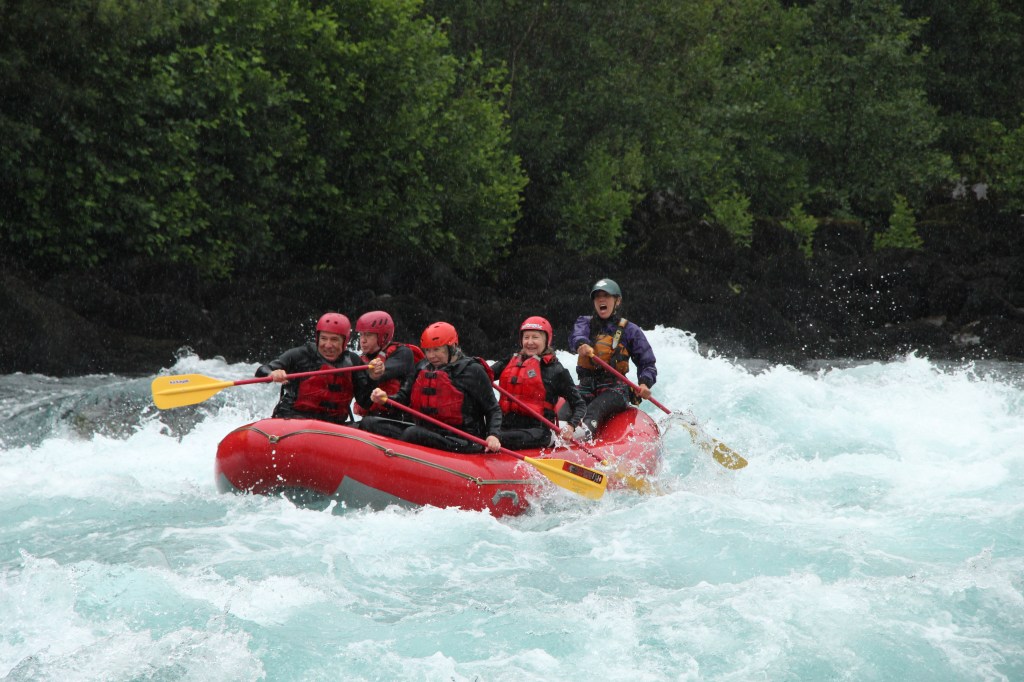
We were scheduled to go kayaking on the final day in Puerto Varas but we had to replace it with a rafting trip because it was too windy. It was supposed to rain the entire day. I assumed that they would cancel the rafting trip. I had also assumed that the rafting meant something akin to a lazy river, something relaxing and mellow. I was wrong. Very wrong. We traveled to the rafting vendor with a fellow retired traveler named Paul who was from Ireland and Debra from London. We piled aboard the transport van to get a briefing from the rafting vendor. Rick, Paul, Debra and I were at least twice if not three times the age of all the other twelve or so rafting participants. The woman giving the briefing on all the potential safety issues and what to do when we fall out of the raft (!?!##) and not to ever let go of your paddle. I was pretty shaken up by the end of the briefing which felt like she was trying to scare me straight. I was on the edge of bailing and Paul, who apparently couldn’t swim, was on the same wavelength. Rick was stalwart that if they were able to take us rafting, he was going. We all acquiesced and, ironically, we were all put in the same raft with our fearless leader Camilla who was a tough young vibrant leader and an outstanding guide. We were all suited up in wet suits, booties and jackets. We left all our belongings behind on a bus as we entered the tumultuous waters of the Petrohue River adorned with helmets. I was glad to protect my head but what about the rest?
We were instructed to jam our foot closest to the wall of the raft into the crevice to stay stable on the boat. There is a rope that goes around the entirety of the raft but outside of that, there is nothing (and I mean nothing) to hold onto. Camila would instruct us to go forward HARD, and it was typically about three paddles and then tell us to “Stop”. As we entered the various rapids (it seemed countless but theoretically it was 8 sets of class 3 rapids), Camila would let us know if we would have to “Go Down” or bend over and grab the rope on the outside of the raft while holding onto our paddle and, hopefully, not going overboard. Then, after whatever massive wave had hit our boat, we would go back to “Position” which was upright with the paddle at the ready. You can imagine that four paddlers over 60 have various paddling, hearing and dexterity skills. Camila had an accent and there were several times Debra, Paul, Rick and I would have to check in on what the current “order” was. Debra and Paul were in the front row for the first 4 to 5 sets of rapids. I was relieved as the amount of water coming off the bow of the boat was a torrent and staring into the upcoming waves and rocks was intimidating.
About halfway through, Camila instructed Rick and me to move to the front of the boat. GULP! Just changing seats mid river was all about balance and space and fear. So now Rick and I were in front and, let me tell you, this was the center of the storm. I have to say that I said a little prayer for the first time we had to “Go Down” and grab the rope on the raft. It was like diving into a tidal wave. I had water completely wash over me and there was water down the back of my wetsuit. Each time we survived a rapid without getting thrown out of the boat was exhilarating. I was always thinking, “Wow, how did that happen?” The final rapid felt like I was swimming underwater. The entire boat was filled with water which miraculously emptied almost immediately. All four of us elders survived the trip without a broken bone or falling out of the boat. I was completely soaked from head to foot but I had a smile on my face for surviving one of the most exciting experiences of my entire life. It was right up there with zip lining and kayaking Lake Titicaca. As Rick said later, I was pretty sure that 99.9% of participants typically survive.
The Patagonia Lakes region is full of adventure, culture and breathtaking views and even though it was intimidating and scary at times, it was an experience of a lifetime. I’m so glad we went.
 Workplace Navigator