Torres del Paine in Chilean Patagonia🏔️

My brother Rick and I are on a multiple week journey through Patagonia, starting off in Santiago, then onto the lakes region and ending our time in Chile in Torres del Paine (Blue Towers) National Park. This is the area of Patagonia that I imagined in my head before coming here. Sharp edged rocks soaring towards the heavens with pristine glaciers. It absolutely did not disappoint although it took three days for the weather to permit a stunning view of what are called “The Horns”.

We flew into the tiny airport of Puerto Natales. The airport is so small that there are no jet bridges and you exit from the front and back of the airplane directly onto the tarmac. It isn’t possible for more than one plane to be on the tarmac so they must turn around the same plane before the next plane can arrive. One gate, one baggage claim and no services other than a small booth selling sodas; just check-in and bathrooms. We knew that our transfer to Patagonia Camp (our next destination) would be delayed but luckily Max from Patagonia Camp met us and put us in a taxi to the small town of Puerto Natales where we grabbed some lunch. From there our transport picked us up along with some American folks coming from Argentina and headed to the same location. It’s a 90-minute drive on a very dusty, potholed road to get from Puerto Natales to Patagonia Camp. After about 30 minutes there was no more pavement; most of the roads while we were in Torres del Paine National Park were gravel and barely two lanes. It’s intimidating watching buses and large vans coming from the opposite direction but our driver was fortunately unflappable.
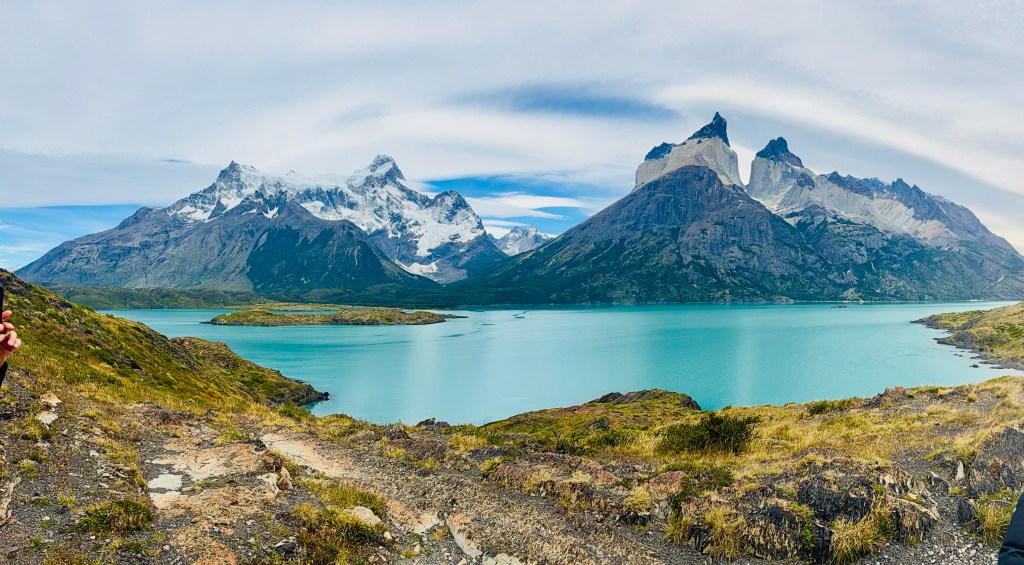
Torres del Paine National Park along the Miradores Trail with “The Horns” on the left

We arrived at Patagonia Camp at about 6 PM and were immediately ushered into an orientation about the property. They took our luggage to our yurt as we sat in the reception area where we were greeted with a welcome drink and appetizers. From there we went onto a different meeting room to select our excursions for the next three days. This is the first time I have stayed at an all-inclusive resort and both Rick and I felt like it had a White Lotus vibe (an HBO show) where everyone on the staff is so friendly and eager to make you comfortable. We had a lake front yurt with a hot tub. When I think “yurt”, I think of a tent in the middle of the dessert and a shared bathroom. That was not even close to the luxury of Patagonia Camp. The yurts are framed with wood and covered with tarp but also have a plastic top at the peak which gives a clear view of the starlit skies. There is a private bath off the side of the yurt which is a wooden structure. It’s really quite remarkable with natural formed wooden tables, comfortable beds and a fridge stocked with food and drinks. All we had to do was call the front desk to have the hot tub uncovered. The best aspect of the camp was the terrific food. The desserts and appetizers were works of art and there were new choices at each meal. The restaurant and bar had a beautiful view of Lago Toro and the spires of Torres del Paine in the distance.

Our first hike was the next day and we went for a hike within the National Park then to a rock outcropping that had cave paintings on the Aonikenk Trail. The trail is in puma (mountain lion) country and children under the age of fifteen are not allowed to hike since they are the main target of pumas. That’s a scary piece of information! You also have to hike with a guide in case you run into a puma. We did not have any puma encounters. We were able to see the handprints and figures on the rock from 11,000 BC. It rained, it was windy (gusts to 40 miles an hour) and the spires of the Torres del Paine were obscured for most of the day.

The next day my brother was able to check off a bucket list item for him; doing the 12-hour trip of hiking to the base of the horns in Torres del Paine. He hiked with the folks that we picked up on our transport from Puerto Natales on our arrival date which were two guys in their 60’s and their twenty something daughters from Michigan. It was a tough hike through windy canyons, intermittent frozen rain and a boulder field with many bottle necks. It is the most popular hike in the national park and that Saturday during high season there were several hundred hikers on the trail. He never saw the horns due to the low hanging fog but he was happy to complete the hike. I didn’t accompany him on this adventure.

Our final excursion was on our last full day at Patagonia Camp and it was amazing. We took the Miradores (viewpoint trail) which had an overview of the Salto Grande (Big Jump Falls) and a spectacular view of the Los Cuernos (The Horns), Paine Grande (the highest peak) Cerro Almirante Nieto, Valle del Frances and the turquoise Lake Nordenskjold in the foreground. The view is spectacular; after days of waiting to see the craggy tops, the shades of blue between the lakes, rivers, skies and rock along with shades of gray from the glaciers and granite is spectacular Perhaps it was the anticipation of hoping to see the elusive mountain tops but it was worth every minute of effort to see this spellbinding sight. One of our companions on the hike kept saying,” It’s not AI, it’s real”. It was appropriate because the colors were so vivid it felt like it must have been airbrushed or a simulation.

I can’t say enough about Patagonia Camp and its impeccable staff. The drivers, the servers, the housekeepers and guides were all terrific. On our last excursion, there were 8 of us, all in our 50’s and 60’s and the music on the van sound system was all obscure songs from the eighties from the Police to Talking Heads to Billie Joel. It’s hard not to believe that it was selected especially for us. If you ever venture to Patagonia, be sure to stay at this incredible oasis.
🌋Discovering the Lakes Region of Chilean Patagonia

My brother, Rick, and I traveled to the Chilean portion of Patagonia in January of 2026. Patagonia is the lower third of South America straddling Chile and Argentina.  We arrived there by traveling through Santiago. We traveled by plane to Puerto Montt and then took ground transportation to Puerto Varas on the beautiful Llanquihue Lake. We stayed at a lakeside hotel and could watch the sunrise with the extinct Osorno Volcano (Rick referred to it as Mount Fuji’s cousin) in the background. It’s 8,700 feet tall and has a glacier on top which gives it the conical snow-capped shape which is similar to Mount Fuji. Having arrived in Patagonia we learned that it can take days to have a clear view of a mountain or rock formation. When we arrived in Puerto Varas, it took us three days to see the entire profile of the volcano.

Puerto Varas is in the Lakes Region and Llanquihue Lake is the second largest lake in Chile. If you look at a map of the very southern tip of Chile, you can see that it is riddled with fjords and islands and small bays. It’s almost more water than land and the land is riddled with volcanoes both active and extinct jutting above sea level to thousands of feet and rocky formations from volcanic and glacial activity. It was very unique.

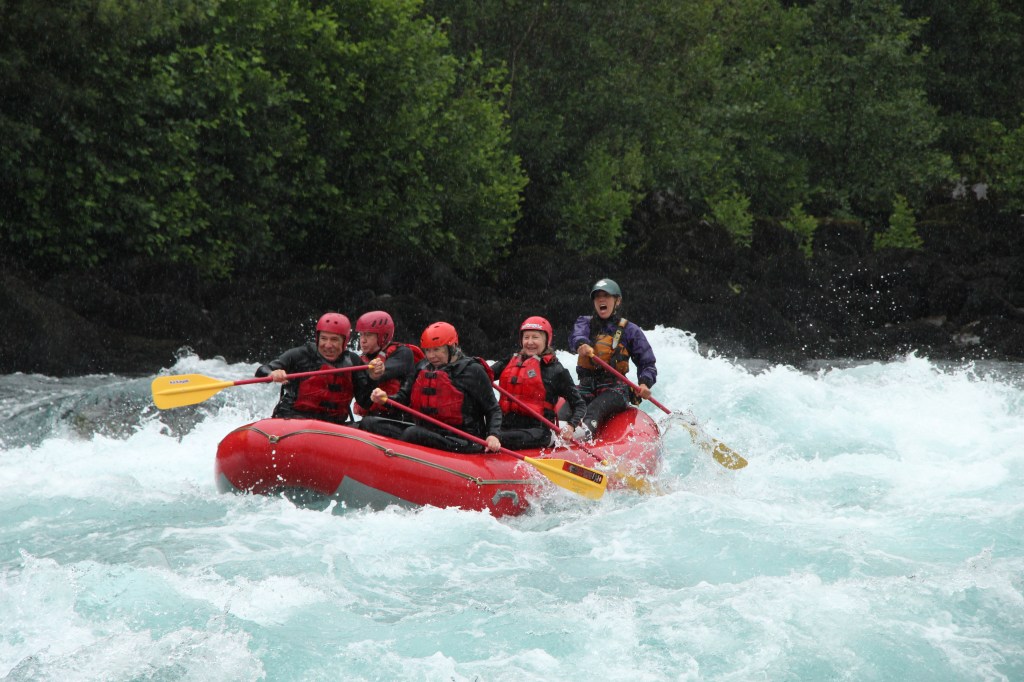
My brother Rick, Paul, myself, Debra and Camilla (left to right) rafting near Puerto Varas Chile

We enjoyed an incredible meal at a small farm about 25 miles north of Puerto Varas on the shores of Llanquihue Lake.  It’s a family run farm and we got to harvest all the produce used for the meal including rhubarb, plums, several varieties of tomatoes, various greens, edible flowers, potatoes (a Chilean staple) and zucchini. We dug up the potatoes, cut the greens and foraged for plums. We also had a fresh caught salmon which was smoked along with the zucchini in a makeshift smoker. We ate in the lovely farmhouse and I have to tell you that salad of the mixed fresh cut greens was the best salad I’ve ever had. Verdant, bright and tender.

We drove out to the coast the next day. Chile’s width is 100 miles on average, so it’s pretty easy to ski the Andes and take a dip in the Pacific in the same day. The original inhabitants of southern South America are the indigenous group called the Mapuche Nation. They are the largest group of indigenous people that survive today and are divided into several groups and regions. We visited a group called the Huilliche who are in the southern subgroup associated with the Chiloe Archipelago. These Mapuche can be traced back to 500 BC and are largely fisherman and farmers.

We met the lonco or chief and he took us through a welcoming ceremony where we hugged and greeted each member of the tribe. We learned how they prepare wheat by toasting it on a fire inside their hut and then ground it with a mortar and pestle. The women of the tribe prepared chochoca which is raw grated potato and cooked potato blended by hand into a masa or dough. They then pat the masa along with what looks like a 7-foot giant rolling pin covered on all sides (except the handles). They then carry the enormous rolling pin to a large pit lined with coals. They turn the rolling pin for about thirty minutes as the masa cooks and the exterior starts to toast and turn brown. They then cut off the entire piece of potato masa into a large husk. From there they add cooked pork and then roll it and cut it into sandwich size pieces. It was fascinating to watch the wife of the lonco work so diligently to create this masterpiece. We enjoyed a meal with the entire group, briefly played field hockey with sticks and a ball shaped from reeds. I think the highlight was both the visitors and residents all introducing themselves to each other and reflecting on what we were grateful for. It was a bonding experience to learn of their trials and tribulations and for them to have a greater understanding of us. We are 6,000 miles a part but we are all parents, children and siblings. We all embraced and said goodbye.

We were scheduled to go kayaking on the final day in Puerto Varas but we had to replace it with a rafting trip because it was too windy. It was supposed to rain the entire day. I assumed that they would cancel the rafting trip. I had also assumed that the rafting meant something akin to a lazy river, something relaxing and mellow.  I was wrong. Very wrong. We traveled to the rafting vendor with a fellow retired traveler named Paul who was from Ireland and Debra from London. We piled aboard the transport van to get a briefing from the rafting vendor.  Rick, Paul, Debra and I were at least twice if not three times the age of all the other twelve or so rafting participants. The woman giving the briefing on all the potential safety issues and what to do when we fall out of the raft (!?!##) and not to ever let go of your paddle. I was pretty shaken up by the end of the briefing which felt like she was trying to scare me straight. I was on the edge of bailing and Paul, who apparently couldn’t swim, was on the same wavelength. Rick was stalwart that if they were able to take us rafting, he was going. We all acquiesced and, ironically, we were all put in the same raft with our fearless leader Camilla who was a tough young vibrant leader and an outstanding guide. We were all suited up in wet suits, booties and jackets. We left all our belongings behind on a bus as we entered the tumultuous waters of the Petrohue River adorned with helmets. I was glad to protect my head but what about the rest?

We were instructed to jam our foot closest to the wall of the raft into the crevice to stay stable on the boat. There is a rope that goes around the entirety of the raft but outside of that, there is nothing (and I mean nothing) to hold onto. Camila would instruct us to go forward HARD, and it was typically about three paddles and then tell us to “Stop”. As we entered the various rapids (it seemed countless but theoretically it was 8 sets of class 3 rapids), Camila would let us know if we would have to “Go Down” or bend over and grab the rope on the outside of the raft while holding onto our paddle and, hopefully, not going overboard. Then, after whatever massive wave had hit our boat, we would go back to “Position” which was upright with the paddle at the ready. You can imagine that four paddlers over 60 have various paddling, hearing and dexterity skills. Camila had an accent and there were several times Debra, Paul, Rick and I would have to check in on what the current “order” was. Debra and Paul were in the front row for the first 4 to 5 sets of rapids. I was relieved as the amount of water coming off the bow of the boat was a torrent and staring into the upcoming waves and rocks was intimidating.

About halfway through, Camila instructed Rick and me to move to the front of the boat. GULP! Just changing seats mid river was all about balance and space and fear. So now Rick and I were in front and, let me tell you, this was the center of the storm. I have to say that I said a little prayer for the first time we had to “Go Down” and grab the rope on the raft. It was like diving into a tidal wave. I had water completely wash over me and there was water down the back of my wetsuit. Each time we survived a rapid without getting thrown out of the boat was exhilarating. I was always thinking, “Wow, how did that happen?” The final rapid felt like I was swimming underwater. The entire boat was filled with water which miraculously emptied almost immediately. All four of us elders survived the trip without a broken bone or falling out of the boat. I was completely soaked from head to foot but I had a smile on my face for surviving one of the most exciting experiences of my entire life. It was right up there with zip lining and kayaking Lake Titicaca. As Rick said later, I was pretty sure that 99.9% of participants typically survive.

The Patagonia Lakes region is full of adventure, culture and breathtaking views and even though it was intimidating and scary at times, it was an experience of a lifetime. I’m so glad we went.

Exploring Santiago Chile 🇨🇱

I traveled to Chile in January of 2026. This is my first time in this country although I have been in other parts of South America including Colombia, Venezuela, Peru, and Brazil. My brother, Rick and I arrived after a red eye from Miami. I was struck by how many foreigners were coming into Chile when we went through immigration and the area for Chilean Nationals stood empty. I assume it’s that everyone is arriving to escape the cold wet short days of the Northern Hemisphere. It was quite the shock to the system to go from 40-degree rain of the Pacific Northwest where the sunsets at 4 PM to 90 degrees, arid dry and sunset at 8:30 PM. I had to keep looking at my watch to reassure myself that yes, we should probably eat dinner before going to bed.

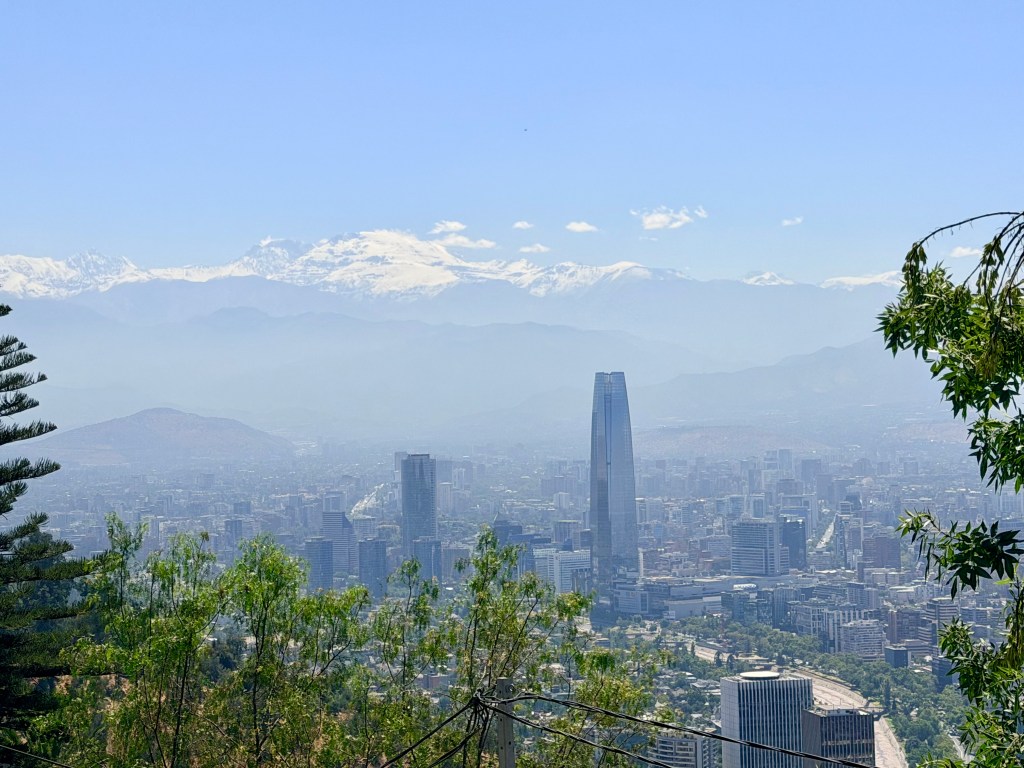
The Gran Torre (tallest building in South America) with the snow capped Andean range in the distance in Santiago Chile.

 Santiago is somewhat like Los Angeles. It’s a sprawling city that sits in a bowl between the glacier covered Andes to the east and the coastal mountains to the west. This causes, similar to LA, the smog to sit in the bottom of the bowl so it was pretty hazy most of the time. We dropped our bags off at the hotel we were staying at and headed to an obscure park in an Uber.

I find that using Uber is a godsend because I don’t need to know how to pronounce the address and I am reassured by the map on the app that we are headed to the correct location. I have been hunting trolls by Thomas Dambo for a little over a year. Dambo is an artist who uses only sustainable or used products to create is somewhat enormous wooden and sometimes metal structures called Trolls. There are over 100 trolls worldwide but only one troll in South America. The only troll in South America called Ulle is located in a Parque de la Familia in Santiago. So, my brother and I headed to this park in an Uber to locate this structure which is locally called “The Wooden Man.” Once we were dropped off at the park, we walked about a half mile to see Ulle sitting by the water’s edge. It was fun to discover an elusive troll. It’s like looking for Easter eggs. We ordered another Uber, and the driver asked us how long we had been in Santiago and we said a few hours. He was perplexed why were wandering this obscure park on the outskirts of Santiago just hours after landing. We explained that we were looking for the troll. He, like everyone else we met, did not know about the troll.

We next went to the Gran Torre Santiago which is the tallest building in South America which stands 984 feet tall or 62 stories. We happened to be there two days after some unseasonable rain had passed through so the peaks of the Andean Mountains were snow covered. It was a spectacular view of the mountains, and you could see a 360 view of the expanse of the enormous city which has 40% of the country’s population. We ate lunch at the top at Sky Costanera which had excellent food. By the time we exited Gran Torre it was 3 PM and the traffic was bumper to bumper. We almost got hit by a bus trying to get to our Uber. I doubt the driver spoke English, but she said, “Mucho Taco.” I thought that talking about food seemed odd, so I immediately looked up the expression and apparently, it’s one of the many slang words specific to Chile which means “a lot of traffic.” I enjoyed using this expression going forward with each subsequent ride we got in Chile.

Our last day in Santiago we spent traveling around the center of the city at the old central market which had hundreds of fish and produce purveyors. We walked through the narrow aisles as folks came along to shop. A lot of the buildings in Santiago has a French influence. This stems from the fact that the French helped Santiago achieve independence from Spain in the 1810.

The last place we toured was San Cristobal Hill. It’s a hill in the center of Santiago which is 2,831 feet tall. We took a funicular up the hill and then toured around the top. The Sanctuary of the Immaculate Conception on San Cristobal Hill is a principal place of worship for Catholics in Santiago. There is an enormous amphitheater and alter outside where mass is also held. At the very top of the hill is the Statue of Virgin Mary which is 45 feet tall. The top of the hill has been a shrine for indigenous people well before the Spanish ever arrived. On the way back down San Cristobal we took a cable car with a terrific aerial view of the city.

Most amenities have been quite modern. Outside of some tipping, we have been able to use touchless credit card transactions for our trip. We haven’t been handed a menu but instead scan a QR code which is helpful for getting it in the correct language. It’s been quite the adventure so far between looking for obscure trolls to rising to new heights. It’s a terrific gateway to the southern end of South America.

Change in 4 Parts 🫣

Behavioral change is one of the most difficult things to accomplish.  In Marshall Goldsmith’s book, Triggers, he uses a device called the Wheel of Change to address behavioral changes both on a personal and collaborative level.  The main point is to actually reflect on how we want to improve as individuals, as well as a team. How often do we talk about that as a department, a family or as an individual?  Unless you are being coached, it’s not likely it’s being discussed.

This is a great tool to use to coach yourself on a regular basis.  It’s divided into four areas: Creating, Eliminating, Preserving, and Accepting.  It’s relatively easy to look at what you want to do going forward when it’s broken up in this way.  I like the fact that it’s a form of forward-thinking, instead of the traditional approach of dredging up blame and scapegoats.  This is a much more positive experience.  It’s similar to when I’m working with a client and they haven’t done the exercise they’d set out to do.  Questions to consider:  “No sweat. Is it still important to you?  Should it be phrased a different way so that you’ll feel forward motion?”  I have a client who walks at work but not on his treadmill at home.  So he won’t count that as exercise.  I’ve asked him, “Is your heart rate elevated?  Would those steps count on a Fitbit?”  “Yes. Hmmm.  Maybe it is exercise and you’re not giving yourself credit.”  It’s amazing how we won’t give ourselves credit for what we actually accomplish.  Being forward-focused instead of berating the client for not achieving what they said they wanted to achieve can make a huge difference in accomplishing goals.

Here are the four parts of the wheel of change:

  • Creating.  This is the innovation or creation portion of the wheel.  What do you add or invent?  When I work with teams, I ask what do we want to do differently?  Sometimes it might mean adding a team member who can bring a different perspective.  Sometimes you decide that you want to use a different software to track progress going forward.  I recently decided that I wanted to perfect my team facilitation skills and committed to reading more about the topic for 30 minutes a day.  So I added it to my schedule.  I created a new habit to help me increase my knowledge and skills in a certain area.  What about you?  What do you want to add to your life that will make you a better contributor, husband, partner or accountant?  What can your team add to make it work more effectively, serve the customer better or improve quality?
  • Eliminating.  This is eradicating or reducing things that are outdated and ineffective. What do we need to eliminate?  When I work with teams, I ask, “What should we do less of?”  It may be eliminating a step in the process that doesn’t make sense now that we are paperless.  It may be reducing the meeting time from one hour to 15 minutes to keep everyone more efficient and on-task.  It might be reducing your commute by moving closer to the office. Organizations frequently get wrapped up in the status quo and never think that maybe if they eliminated a particular technology that has been around since the company was founded, they would have forward motion instead of being dragged down by old technology.  What do you need to eliminate?
  • Preserving.  What do we need to improve or maintain?  When I work with teams, I ask, “What do we need to keep?”  The answer might be “a sense of humor” or “meeting times”.  It’s likely the heart of the organization likes family values.  I also love when I work with teams and one of their values is fun.  Isn’t that something you want to preserve and enhance?  Don’t you want to be on a team that values fun? Sometimes we want to throw out the baby with the bathwater.  Taking time to reflect on what you want to keep in your life is important.  What do you need to preserve?
  • Accepting.  What do we need to delay or make peace with?  This is an important piece of the wheel.  We can spend a lot of energy getting angry or resenting something when what we really need to do is just make peace with it.  I was in a job where there were one or two sacred cows in the organization.   I spent a lot of time getting angry about the sacred cow.  “They never show up.  They never do the job.  What are we doing with these folks?”  Problem was that the powers that be had no issue with the performance and had no intention of eliminating them.  When my energy around it turned into one of acceptance, I became much happier.  I didn’t have to spend my time focusing on their failures.  Let it be.   It might be that you don’t have the capital right now to spend on improvements.  Maybe it needs to be delayed until 2017.  What do you need to accept?

The important thing about the Wheel of Change is that all four areas need to be addressed.  This makes sense.  An example that Goldsmith uses in his book is of his client who wants to preserve his family, eliminate his commute, create a new commute and accept that he wasn’t good at golf.  He decided that he would move from the suburbs of New Jersey to Manhattan, reducing his 3-hour daily commute to a 10-minute walk.  So he gave up golf and is spending more time with his family.  They are all interconnected.  What do you want to work on?

😏 Being Mindful at Work

You have been scattered all day.  You haven’t finished a thing.  Your to-do list keeps growing and you are starting to forget even the most minor of things, like feeding your dog. You are caught in the surge of overwhelm.  This is especially true during the holidays.  All the annual items start popping up at the most inappropriate times at like say…2 AM and then again at say…3 AM.  Holiday cards for your co-workers.  Poinsettias for the company party.  That conference in San Antonio that you don’t want to forget to budget in for 2026.  Welcome to year-end overwhelm.

There are ways to mitigate the annual barrage of holiday, year-end, one off to-do’s without succumbing to it.  Restful nights without waking up to, “Did you remember to budget for the company picnic?”  The secret to getting your head back from the overwhelm is mindfulness.  You probably are skeptical.  You might be thinking, “But Cath, I haven’t got time to be mindful.”  How can 10 minutes of peace actually help me, when all I want to do is dive in and start checking things off my list?  I can’t shut off my head.  There is science behind this.

Here are small steps to bring mindfulness to work:

  • Take a breath. In Thich Nhat Hanh’s book, Peace in Every Step, he recommends taking a mindful breath every time you sit down.  So while at your desk as you sit in your chair, take a breath.  As you sit in your car, driving to work, take a breath.  As you sit at the table to eat, take a breath.  You need to take a breath anyway, right?  So why not pay attention when you take a breath.  Give it a try today.  It’s amazing how one breath can change the trajectory of your day.  Try it now.  Breath in.  Breath out.
  • Greet the day with a smile. Nhat Hanh says, “Waking up this morning, I smile.  Twenty-four brand new hours are before me.  I vow to live fully in each moment and to look at all beings with eyes of compassion.”  I have tried to do this for the last week.  The very first thought when I wake in the morning is to smile.  Smiling relaxes the muscles in your face.  It brightens the day.  How can anything go wrong when you start it off with a smile?  Try it.  Feel your face relax.  The day just got better, didn’t it?
  • The promise of hope. Instead of getting caught up in what will go wrong today, get caught up in what will go right.  Nhat Hanh writes, “Hope is important because it can make the present moment less difficult to bear.  If we believe that tomorrow will be better, we can bear a hardship today.”  Optimism is contagious.  So is negativity.  Be the one that spreads optimism.  So when you are in the meeting, ask what is going right or what does success look like.  It brings it back to hope instead of languishing in negativity.
  • Tie it to your roles. I have been teaching the 5 Choices of Extraordinary Productivity for the last 18 months.  I think one of the greatest values of the training is identifying your role and making that extraordinary.  So instead of being a “Coach”, I have recreated that role to be “Inspiration Engineer”.  Instead of being a “Mother”, I have recreated that role to be “Natalie’s Best Friend”.  Recreate your roles to be extraordinary.  It makes everything you do at home and at work into something inspirational.  For me, personally, it makes everything I do have value, whether it’s washing the dishes so my son and I can get out of the house faster, or taking an extra ten minutes with a client to help them work through an insight.  Create your extraordinary roles.
  • Be happy now. I’ve spent a good deal of my career waiting to be happy.  I’ll be happy when I get that promotion.  I’ll be happy when I pay off the car.  I’ll be happy when I have the corner office.  This is futile.  I was putting my life on hold until the next hurdle.  As Naht Hahn says, “The seed of suffering in you may be strong, but don’t wait until you have no more suffering before allowing yourself to be happy.” It’s the small things that I need to take stock in.  My favorite song playing.  The sunshine outside.  The smell of fresh brewed coffee.  Don’t put off happiness until – Be happy now.

By being more mindful throughout the day, the little distractions seem to fall away.  I’m able to buoy against the struggles and float over the disagreeable nuisances.  The sea may be roiling but I am floating on top.