🐳 Puffins, Whales and Lighthouses: Newfoundland

My original purpose in traveling to Newfoundland was to see icebergs and the Norse settlement, L’Anse aux Meadow. But in addition, I was secretly hoping for puffins and whales as well. I scheduled my trip at the height of iceberg season (May and June) so if I was able to see puffins and whales, all the better. I knew, of course, there had to be lighthouses because with 6,000 miles of coast line, there will be lighthouses. 

While I camped outside of St. John’s on the Avalon peninsula, I took a tour of the area surrounding St. John. I could have driven it but with a 24-foot motor home to park and St. John being full of narrow streets and hills, I figured I’d leave the parking and maneuvering to someone more knowledgeable. We headed to Cape Spear and the most easterly point of North America. We arrived there on a windy day and saw the two lighthouses that sit atop the craggy cliffs. The current lighthouse was built in 1955 and is completely white and stands 45 ft. tall. It’s quite picturesque above the rocky coastline. Behind it about 50 yards away is the original lighthouse which was built in 1836 and is a squat single story white building with a red and white light on top. This older lighthouse is the oldest surviving lighthouse in Newfoundland. They apparently used to use whale oil to light the original lighthouse. It doesn’t feel like it but Cape Spear is within the city limits of St. John, the heart of which is 7 miles away. Cape Spear is a windswept place on its isolated crag. The Portuguese named this place Cabo da Esperance meaning “cape of hope”, which became Cap d’Espoir in French and finally Cape Spear.  It feels like every European nation had hands in the naming of the towns and headlands of Newfoundland. If they were fishing for cod, they were here at some point.

The Bonavista Lighthouse in Newfoundland

My next conquest was puffins. Before coming to Newfoundland, I made sure I joined a few Facebook groups.  There are several iceberg, whale and puffin Facebook groups and you can find out in real time if there is any activity.  This proved invaluable. I was camped in Chance Cove and almost a three-hour drive to the best puffin viewing area.  When I come back to Newfoundland, and I know I will, I will definitely plan to camp closer to Elliston which is out on the Bonavista peninsula. Puffins are most active in June and July while they are nesting. The best time of day to see puffins is in the early morning and late evening.  Even though I headed out at 7:30 AM, I wasn’t able to park and see the puffins until around 10 AM so most of the activity had subsided by the time I trekked out around a very narrow isthmus to get to the Puffin Viewing Area. There were about twenty people out there. There were several hundred puffins out on the cliff walking and flying about in addition to seagulls. It was really interesting but I should have brought binoculars or a high zoom camera lens. They are such unusual looking birds that I wanted to see them up close. There was another puffin viewing area off the coast of the Bonavista lighthouse but by the time I got there around noon, I didn’t see any puffins. The Bonavista lighthouse built in 1843 is another squat lighthouse although it is painted with bold red and white stripes. So, no puffins but another lighthouse bagged.

Next up, the Whales Playground in St. Vincent, Newfoundland. I traveled there on the Sunday of the major holiday weekend of Canada Day (July 1st). It was sunny and I wanted to beat the crowds. I figured it would be busy since by all accounts on Facebook, the humpbacks were definitely there. I headed out at 7 AM and arrived just before 9 AM. There was plenty of parking and the crowds were already gathered to see this awe-inspiring site. Apparently, the small fish called Capelin migrate in June and July off the shores of Newfoundland and the humpbacks migrate as well to feast on the abundance of fish. The beach off of St. Vincent has a sharp drop-off so that the whales are just 25 feet away.  I parked and headed out to the beach where there were 30 or so spectators, many with enormous zoom lenses. I absolutely gasped and tears came to my eyes as I saw the shiny black back of a humpback whale right off the beach. There was one single whale at one end of the beach and a mother and her calf about 30 feet away. When they are feeding, they are super active with tails, blow holes and pectoral fins flying. They are such majestic animals and they seem like they are just barely out of reach from the stone covered beach. Many people set up and camp in a chair for the day. As I headed out around noon, I passed hundreds of cars on their way to see the whales. I was glad I got there early before the crowds descended. The Whales Playground on a sunny day in June is not to be missed.

Newfoundland has been a treasure trove of UNESCO world heritage sites, lighthouses, spectacular rocky cliffs, icebergs and encounters with beautiful wildlife. I had a short Wishlist before I arrived and it’s been completely fulfilled in my month here on the island referred to as The Rock.  It truly has been an adventure and I’m so glad I made the effort. 

🇫🇷 Enchanting St. Pierre and Miquelon

St. Pierre and Miquelon (SPM) are two tiny islands off the south west coast of Newfoundland that are part of France. It recently came into the public eye when the current U.S. administration levied the highest tariff on SPM tied with the African county of Lesotho. SPM makes up .01 of the GDP of France.  SPM was visited by indigenous people for over 5,000 years but in 1536 it was claimed by Jacques Cartier for France. Over the ensuing years there were battles between Great Britain and France, changing hands multiple times before being definitively restored to French control in 1816. Its allure was the vast abundance of Cod fishing in the North Atlantic and the ability to dry the cod and send it back to Europe. I became aware of this French archipelago almost 7 years ago when Anthony Bourdain came here in 2018 on his show Parts Unknown. It was also featured in Peaky Blinders final season in 2022. I knew I had to investigate this French gem off the coast of Newfoundland. 

There is a lot involved in planning a trip here as there is not a daily ferry from Newfoundland and I couldn’t find a flight from St. John’s that was available.  First, I secured an RV spot that was walking distance to the ferry at Fortune, NL. Next, I found a hotel room that matched the ferry availability. This involved making several international calls (calling Canada is free on my Verizon plan, not so SPM) and making sure my lodging was walking distance to the center of the town of St. Pierre. I could not understand the ferry booking site since it’s mostly in French although parts are translated so here again, I made an international call. So once all the parts of the journey were set up, I was set to travel by ferry to St. Pierre and back for a weekend stay. 

The lovely austere countryside of L’Ile aux Marins (Island of the Sailors) off the coast of St. Pierre et Miquelon

When we set sail from Fortune it was foggy.  The ferry was very nice with only a small deck towards the back of the deck to be outside.  It was 50 degrees and foggy so why be outside, right? When we arrived in SPM at the main wharf in St. Pierre (both the town and name of the island), we disembarked and went through customs where I happily received a stamp on my passport from France. St. Pierre is not exactly pedestrian friendly since the sidewalks (if there are any) are narrow and cut up and the streets are narrow as well. I stood in a marked crosswalk and the traffic continued (this I can assure you would never happen in Spain or Italy). There is a lawless feel to those behind the wheel.  I was glad I didn’t have far to walk to get to my bed and breakfast, Nuit Saint Pierre. Michel, my host, was there at the bottom of the stairs to greet me and shake my hand.  I would guess the B and B had about 7 guest rooms and a kitchen to share where Michel or his son would put out delicious French pastries, juice and coffee each morning. It was nice to have a private bath and a place to flop. Reservations are compulsory in SPM and Michel immediately reviewed everyone’s dinner reservations.  I did not have one because I don’t normally eat dinner. Michel took it upon himself to take me to a local market in his car.  That was a trip. I’m not sure if it was a one-way street but he squeezed through two cars facing opposite directions with maybe an inch on each side of the car. Michel knew everyone in the market and immediately took me to a refrigerator case that had cooked lobster in a container. I have to say that the lobster was one of the best I’ve ever had and I couldn’t believe I bought it at a market. 

One of the big highlights of my trip to SPM was going to the tiny island of lle aux Marins (Island of the Sailors). I went to the tourist information center to get ferry times. I planned it for the one morning when it wasn’t too windy and there would be sun.  SPM reminds me of San Francisco in the summer, cool and foggy most of the time. I traveled by boat on the ten-minute ride that I paid for in 7 Euros cash only. The island was settled in 1604 and once had a population of 700 which was almost all fishermen and their families.  There is a church and school.  It was largely abandoned in the 1960’s with only 20 inhabitants in the summer.  There is no electricity or running water or cars.  There are communal wheel barrels and wagons available for visitors and inhabitants to use. I immediately made a beeline to see the Transpacific wreckage which is a German Cargo ship that wrecked in 1972.  It’s a ghostly sight with its bow face-up on the beach. The island itself is stark with nary a tree or bush.  There are plots full of rocks which is where children were used to put out the cod to dry. There was an Andrew Wyeth vibe to the place with windswept austerity.  After exploring the island for an hour and a half,  I was picked up by the ferry and headed back to St. Pierre. 

Michel let me know that there was the blessing of the boats at the main church that morning which was a block from the B and B. Another guest and I walked over when the service headed outside.  It was an emotional experience as the priest and parishioners marched out to the wharf with models of boats that had been lost at sea. They sang beautiful hymns in French as they walked through the streets in their blue and white striped shirts. It was particularly poignant as a boat that was lost in 1962 call the Ravenel had just been found the month before. 15 St. Pierre fishermen had lost their lives and many of the family member were in the procession to leave flowers by the statue commemorating “our lost sailors”. We watched as the priest went to the wharf to bless the boats as dories with rowers, small crafts and fishing vessels honked their horns. It was a brilliant blue sky for all the pageantry. 

I headed back to Newfoundland on Sunday afternoon after spending three enchanting days on SPM. Anyone passing me on the street said “Bon jour” even the children getting out of school. I’m not sure any place could be more welcoming and I found myself here at the optimum time to truly experience a piece of France in North America. 

🧐Iceberg Hunting

When I took the ferry to Newfoundland in June of 2025 one of my main goals was to see an iceberg. The eastern waters off the coast of Newfoundland are referred to as Iceberg Alley and the best time of the year to view them is in May and June. When I started planning my trip, I found the most places to camp didn’t open until June 1st.  So, I planned for the ferry ride as early as possible in June to take advantage of prime iceberg season. I had watched a few YouTube videos on the topic and apparently 2024 was a “bad” year for icebergs. I planned my trip to head to the most northern tip of Newfoundland first and then, heading to the more populated areas of St. John towards the end of my trip to leverage my iceberg viewing potential.   

I traveled up the Viking Trail or route 430 to the Great Northern Peninsula.  As I drove up the highway the Gulf of the St. Lawrence was on the left-hand side almost the entire way. With gusting winds of up to 30 miles an hour, there were a lot of white caps on the ocean. I tried in vain to spot an iceberg but white caps on the ocean and the white of an iceberg are identical. I never saw an iceberg in the Gulf of the St. Lawrence but I knew that the eastern side of “The Rock”, Newfoundland, is where icebergs are most prevalent.

In front of the largest iceberg I saw with a piece of glacier in my hand of the coast of St. Lunaire-Griquet

I arrived in St. Lunaire-Griquet on June 14th and, after some hunting, I found a place to park Abeona, I went to the dock where my zodiac tour was to launch and there in front of me was my first iceberg (which I later learned was a growler due to its small size). I was so excited. When we met our captain, Molly, she explained that she had two icebergs to take us to as we suited up in what was essentially an all-body life preserver. There were nine of us and Molly as we headed out into the Labrador Sea. It was raining but it was relatively calm waters (hardly any white caps). I think in retrospect I was glad for rain instead of choppy waters. After about 30 minutes we came upon an enormous iceberg that was 80 feet by 150 feet. It was absolutely amazing because there was a cove of sorts on the end of the iceberg that waves were crashing into. You could see the striations of dark blue ribbons which are the purest portions of the iceberg. We kept a fair distance from the iceberg and Molly could tell from her depth detection that it was 120 feet below the surface and it was “stuck” at the moment on the sea floor.  The greatest danger in an iceberg is a piece breaking off and possibly toppling the boat. 

Molly reached into the ocean and grabbed a piece of floating ice and broke it up for us to each have a piece. There I licked my tiny piece of a 10,000-year-old glacier from the purest water on Earth.  It was surreal. After circumnavigating the biggest iceberg, we traveled another 20 minutes to see a mid-size iceberg that almost seemed to be turning over in the water. The waves were rocking the iceberg topsy turvy. It was the size of a ranch house and was see-sawing in the water. When I realized that the icebergs have no ballast, it makes sense that this one was rocking so much. 

The last iceberg we saw was pretty small and was more of the classic cone shape. It’s interesting to see how the water forms ripples in the surface as the iceberg slowly dissolves into the sea. On our way back to the dock we went by my first “iceberg” which was really a growler because it’s more the size of a car.  From the time we left and came back, it had dissolved almost a third of its size. 

The icebergs of “Iceberg Alley” are the pieces of glaciers mostly from western Greenland but also from Canada’s Arctic. Each year there are upwards of 40,000 medium to large size icebergs that break off, or calve, off glaciers in Greenland. They float their way down Iceberg Alley with about 800 making it as far south at St. John’s. I drove down to Twillingate a few days later and was able to see two, off in the far distance from Long Point Lighthouse.  There were two that were the size of a two-story house floating in Bayview which is near Twillingate. I really wanted to get a closer look but with a 24-foot RV, I was loathe to head down unfamiliar roads and possibly get stuck with no way out. I found that there are several iceberg alley resources on Facebook where you can see real time photos of icebergs up and down iceberg alley. It’s truly amazing to see one floating in a bay taller than the houses that sit by the water’s edge.

So far, I’ve seen eight icebergs and growlers on my visit to Newfoundland. Each one is unique and beautiful. They are silent sentinels marching south to slowly melt into the sea. It’s a once in a lifetime experience that took over a year of planning but it was worth it. They believe that icebergs have been off the coast of Newfoundland for over 10,000 years and I was able to bear witness to them.

🚐 The Viking Trail – Newfoundland

Route 430 is the 257-mile road that goes from Corner Brook to L’Anse aux Meadow on the Great Northern Peninsula of Newfoundland. I traveled the entire route in my RV, Abeona, while exploring Newfoundland for a month in the summer of 2025. The route is called the Viking Trail for the Norse folks who came here in approximately 1000 AD (well before any other Europeans). There is an immense amount of beauty along this road which takes you from Deer Lake all the way to the tip of the peninsula at L’Anse aux Meadow and along the way there are two UNESCO world heritage sites. UNESCO sites are known for their universal value and protected for future generations. 

Gros Morne National Park is stunning and enormous. It’s the second largest National Park in Atlantic Canada with 697 square miles. It’s part of the Long Range Mountain range which is an extension of the Appalachian Mountains. It became a UNESCO world heritage site in 1987 because “The park provides a rare example of the process of continental drift, where deep ocean crust and the rocks of the earth’s mantle lie exposed.” Geologists discovered the ancient North American trilobite fossils matched those in Spain and North Africa. I took a hike at Green Point and sure enough you can see the Earth’s mantle there on the side of a cliff. There is also a long shelf which causes the north Labrador Sea to crash sideways. It’s quite remarkable to stand in a place that was formed over 1.2 billion years ago.

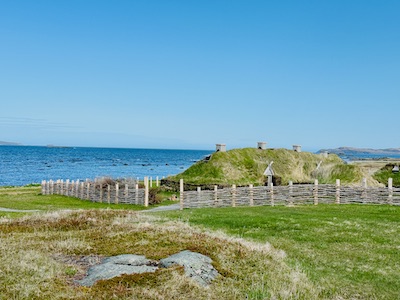
The rebuilt Norse encampment in L’Anse aux Meadows, Newfoundland

I scored a boat ride on Western Brook Pond (quite an understatement) on a clear day.  This was a two-hour tour which was simply awe inspiring. I felt transported as we traveled on a fresh water lake that once was attached to the sea.  Here a 2,000-foot glacier carved fjords that loomed over us as we traveled the length of the lake. Impossibly high water falls and jagged cliffs with formations like the “tin man” and “the old man on the mountain” are here. Some of the waterfalls are so high that they evaporate into mist before reaching the lake below. At one point I felt like I was in Yosemite and looking at El Capitan as the rock face was so gigantic; even though El Capitan is a thousand feet higher. Perhaps it’s the stunning lake at the base but the fjords rise majestically above. It’s a 2 miles hike to get to the boat ride and back but it’s worth the effort to see this incredible site. 

I camped overnight in Port aux Choix.  It was pretty cool because the campsites were next to the Gulf of the Saint Lawrence.  I ventured over to the Port aux Choix lighthouse and saw the lobster boats that go out at sunrise pulling in traps. This area has deep historical significance because there is evidence of over 5000 years of Archaic, Groswater and Dorset-Palaeo Eskimos in the area.  Burial sites in the area discovered in the 1960’s are unusually well preserved due to the raised shoreline and alkaline soil. It makes sense that this area has been inhabited for so long because Port aux Choix has a large protected port which now has fishing vessels. 

From Port aux Choix, I continued on to Flower’s Cove which is famous for thrombolites. Thrombolites are very rare fossils from 650 million years ago with remnants of bacteria and algae. The only other place in the world to find them are in Australia. They look dome shaped and dot the coast line. 

I had two purposes in coming to Newfoundland, one was to see an iceberg; I am happy to report I saw many. And the other was to see the first place that Europeans landed in North America. I am the daughter of a history teacher and when I was eight years old, we traveled to Minnesota to investigate the Kensington Stone and look for evidence of Viking explorers. This was all to help my father teach investigative history to his students. The Kensington stone has since been debunked as a hoax, so coming to L’Anse aux Meadows, I was excited to find evidence of the discovery of the Americas by Europeans. 

L’Anse aux Meadow was just a fishing village on the tip of Newfoundland when Helge and Anne Stine Ingstad were shown what was thought to be an Indigenous campsite by a local fisherman. It was an indigenous campsite and, as they discovered, also an 11th century Viking settlement. There were a few significant artifacts found including a forge and metal objects which were likely used in ship repair.  It also corresponds with the stories told in the Vinland Sagas which document the voyages of Leif Erikson and other Norse explorers who came from Greenland and Iceland. They have rebuilt several of the dwellings based on Norse traditions.  It’s quite remarkable to tour the area.  This is seen as the end of the circle of exploration since crossing the Atlantic was the last piece of migration across the globe. 

I was so excited to visit this remote area of the world and explore something that I know my father would have loved. I left some of my father’s ashes there so that he too could be a part of history, the subject he loved so much.