
I traveled to Lisbon in December of 2024. There has been a lot of buzz about Portugal of late with many Americans seeking to move there. With Portugal’s generous visa options there is a lot of interest.. I wasn’t thinking to relocate to Lisbon but I have to say that it was more intriguing than I expected. If I had to describe Lisbon, I would say it’s as if San Francisco and Bordeaux had a baby. San Francisco because of the endless hills (Lisbon is called The City of Seven Hills) and the romantic 1930’s era trolley cars that are ubiquitous throughout the city. Bordeaux because Lisbon has all the charm of a mid-size European city, it sits on the Tagus River. Bordeaux’s Place de la Bourse Square and Lisbon’s Praca do Comercio feel almost identical with their riverside grandeur. Both Bordeaux and Lisbon have endless plazas, historic buildings and are very walkable (although in Lisbon, you will be walking up or down a hill).
When I arrived at the Lisbon airport, I was delighted by how fast the customs process was. I scanned my passport quickly and easily and walked over to a customs agent who opened my passport and stamped it without even asking any questions. I easily got a rideshare to my apartment for the week. The airport is about 4 miles from downtown Lisbon so it’s inexpensive and quick. It’s amazing how the proximity of an airport to the downtown of a city can make visiting so much more enjoyable and easier. I was amazed at how many signs and advertising are in English. Public bathrooms throughout the city. They are marked as WC (or Water Closet) and are nowhere close to the Portuguese “Banheiro” or “Sanitario”. Stops signs say “Stop” as opposed to “Parar” in Portuguese. One of the bigger surprises for me was, was that the Christmas Music was entirely American classics like Jingle Bells and White Christmas. I guess I thought there would be classic Portuguese carols. It’s interesting how much our culture has impacted other parts of the world.
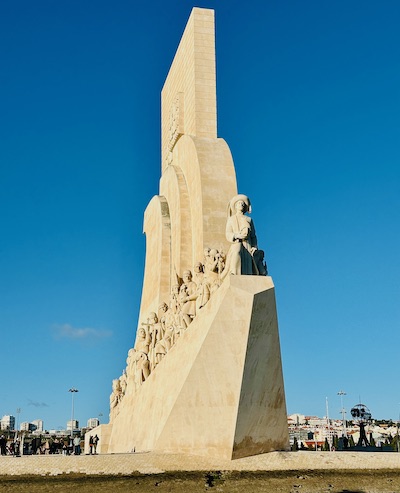
Lisbon is the second oldest city in Europe (after Athens). The Greeks and Phoenician’s set up trading posts here in 800 BC. Its proximity to the Mediterranean, Atlantic,Red and Indian oceans make it perfect for trade routes. In fact, it’s many maritime discoveries during the 15th and 16th centuries included a trade route to India and eventually Macau which made the kingdom of Portugal vastly rich. This resulted in many magnificent structures like the Jeronimo’s Monastery and the Tower of Belem (both are UNESCO world heritage sites). The district of Belem is a must visit for anyone traveling to Lisbon. Besides the Monastery and Tower, the entire waterfront along the Tagus River is not to be missed. I thought the Monument of the Discoveries which was dedicated in 1960, a beautiful homage to the many navigators, writers, cartographers, kings and missionaries who set out on the Tagus into the great beyond. It stands 184 feet high and has 33 statues of these various explorers looking toward to the horizon. It has three large geometric sails and is uncomplicated in its beauty.
As I walked around Lisbon, I became obsessed with the Portuguese Pavement. White limestone and black basalt are used to create sidewalks and plazas with various designs. My first introduction to these types of designs was Rio de Janeiro some 35 years ago. Long endless designs of waves or checkerboards or stars are throughout the city. Some of these masterpieces date back to the 1880’s. It’s like looking for easter eggs and trying to find a new and unique pattern. There is very little actual “pavement” as you would find in the United States. Practically every street and narrow sidewalk is made of cobblestone. I wore sneakers the entire time I was here and I defy you to find anyone who is not wearing comfortable rubber soled shoes in the city, tourist or no. Cobblestones mixed with steep hills was something to get used to and I am only glad that it didn’t rain as I can imagine it’s not a good mix. In fact, the cobblestone narrow streets and sidewalks are one of the main reasons I couldn’t see living here as I age.
Each little or big plaza in Lisbon usually has a “Bica” or a little round coffee kiosk for drinks and outdoor tables. I was surprised that even in 40-degree temperatures there were plenty of folks sitting outside in their jackets enjoying a coffee or beer. Each evening there is invariably someone playing melancholy Fado music on a guitar. My apartment was overlooking a plaza and each night I would be serenaded to sleep by a nameless singer singing Fado.Fado is a characteristically mournful tunes and lyrics. They often reflect on the sea or the life in general.
No trip to Lisbon is complete without venturing on to Sintra, Cascais and Cabo de Roca. I highly recommend getting out on a tour or taking the train to Sintra at the very least and its many castles, quaint streets and natural beauty. On my tour the best stop was at Cabo de Roca which is the western most point in continental Europe. It sits high on a cliff overlooking the Atlantic with its lighthouse. The wind gusts were powerful and erratic. I love the quote that sits out there at this remarkable point, “Where the land ends the sea begins” – poet Luis Vas de Cameos. Here on this land once occupied by Romans, Phoenicians, Celtics and Arabs, many bravely headed out into that windswept landscape to conquer the sea. They left the comfortable harbor of Lisbon and ventured out to see what else there was.
 Workplace Navigator